If you’re adding olive oil for your heart, there’s one surprisingly common mistake that could mean you’re missing the benefit seen in clinical research.
The advice is deceptively simple: add olive oil. What it leaves out is the word “which,” the word “how much,” and the phrase “instead of what.” Those three details, it turns out, are the entire story.
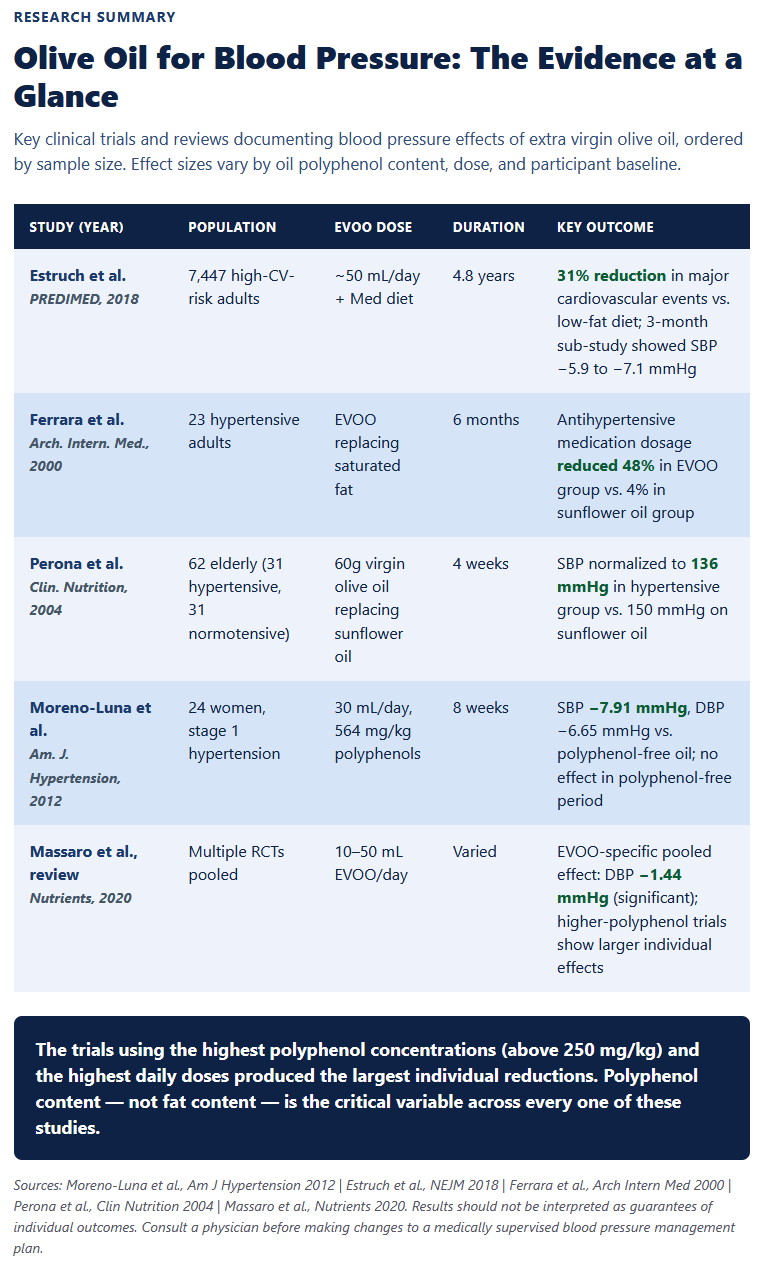
A clinical trial tracked 24 women with elevated blood pressure through two separate eight-week dietary periods. One was built around polyphenol-rich extra virgin olive oil. The other used a nutritionally similar oil with the polyphenols chemically removed.
The results from the polyphenol-rich period, published in the American Journal of Hypertension in 2012 by Rafael Moreno-Luna and colleagues, showed a 7.91 mmHg drop in systolic blood pressure and a 6.65 mmHg drop in diastolic. The polyphenol-free period: no measurable effect at all.
Same fat profile. Same calorie load. The only variable was the polyphenol content, and that single difference was the whole result.
The Dose That Changed the Result
The Moreno-Luna crossover trial used a precise protocol. Over each eight-week period, participants consumed approximately 30 mL of oil daily (roughly two tablespoons), and the polyphenol-rich oil contained 564 mg of total polyphenols per kilogram.
When researchers switched participants to the polyphenol-free oil for the second period (with a four-week washout in between), blood pressure returned toward baseline. The change did not persist. The polyphenols were the active variable, not the fat.
That’s the detail most articles miss. The dose in this trial was not a drizzle. It was a consistent, intentional 30 mL per day from an oil with genuinely high polyphenol content, taken over two months before results were measured.
In practice, 30 mL looks like one tablespoon with a morning meal and one tablespoon with dinner, used as a finishing oil over vegetables, pasta, or fish. The goal is to make it a deliberate daily habit, not an incidental addition. Blending it into a smoothie, drizzling it over avocado on toast, or using it as a base for salad dressing all count equally.
One honest limitation: this study involved 24 young women with high-normal blood pressure or early stage 1 hypertension, none of whom were on antihypertensive medication at the time. These results do not generalize cleanly to all populations or all degrees of hypertension. The picture becomes considerably stronger, though, once you look beyond this single trial.
What the Fat Alone Can’t Do
The fat content of olive oil is not what makes it work. A spoonful of corn oil carries nearly the same caloric profile. So when researchers kept seeing blood pressure drop in olive oil groups and not in controls using refined fats, the question was straightforward: what is actually doing this?
The answer is a class of plant compounds called polyphenols. In high-quality extra virgin olive oil, the most clinically studied ones are oleuropein and oleocanthal. These compounds reduce oxidative stress and inflammation in the walls of arteries. When inflammation and oxidative burden decrease, the cells lining blood vessels (the endothelium) produce more nitric oxide (a signaling molecule that tells vessel walls to relax and widen). Wider vessels mean lower pressure, without any increase in cardiac output.
The mechanism also accounts for what the Moreno-Luna control group revealed: no benefit at all, despite consuming the same fat content. Refined olive oil retains oleic acid, the monounsaturated fat, but the refining process strips out the polyphenols. Without them, the pathway that widens blood vessels doesn’t get activated.
A 2020 review by Massaro and colleagues, published in Nutrients and indexed by the National Institutes of Health, surveyed the epidemiological, clinical, and mechanistic evidence for olive oil’s effects on blood pressure and found consistent support for a diastolic pressure benefit from liquid extra virgin olive oil.
Average effect sizes across pooled trials run in the range of 1 to 2 mmHg, which looks modest in isolation, but pooled results compress toward the mean because they mix together studies using different oil qualities, doses, and participant profiles. In trials where polyphenol content is high, and participants begin with elevated readings, the effects are consistently larger, as the Moreno-Luna numbers illustrate.
The “Cough Test”: How to Buy the Right Oil
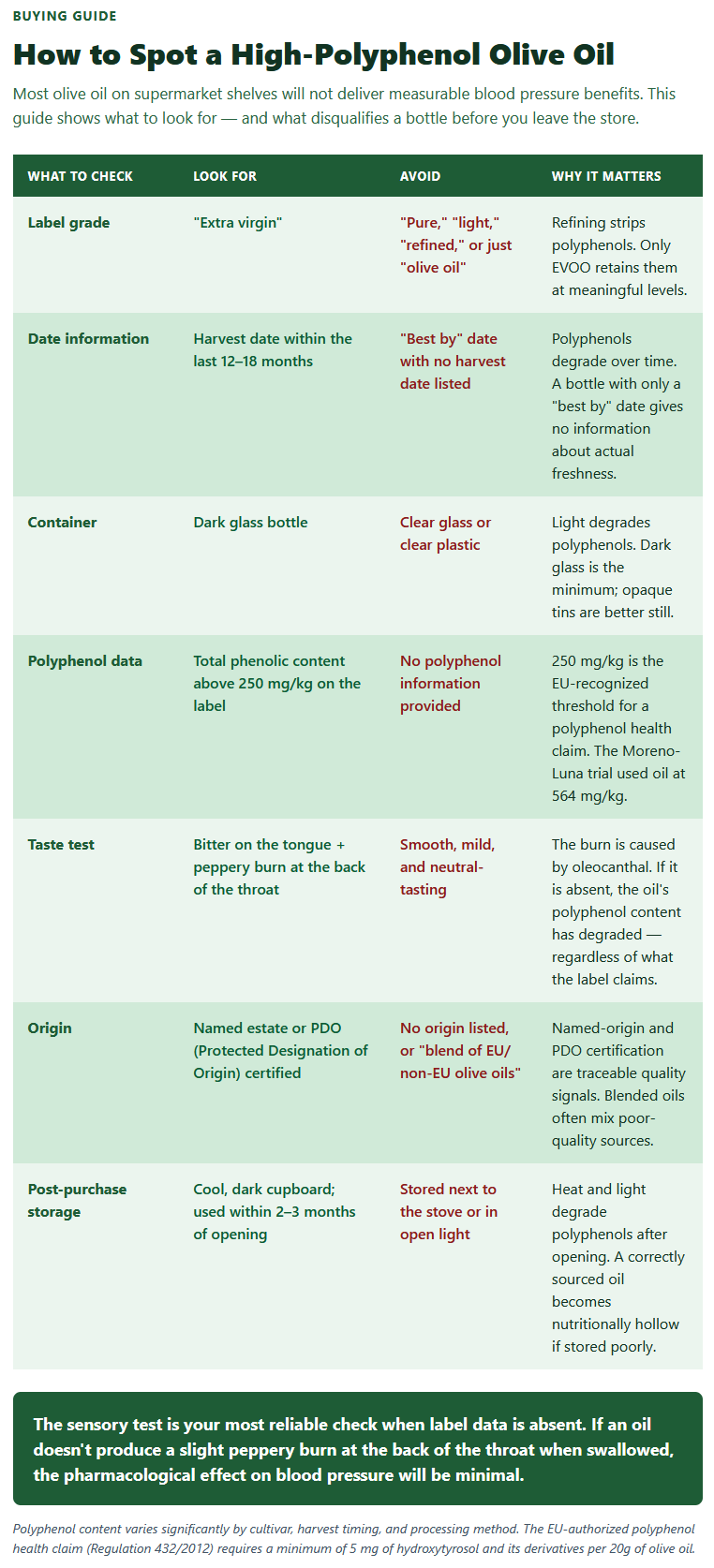
Most olive oil sold in supermarkets will not produce these effects. Bottles labeled “olive oil,” “light olive oil,” or “pure olive oil” are refined products. Many bottles labeled “extra virgin” contain oil that is too old, processed too aggressively, or blended from low-polyphenol sources. Polyphenols degrade quickly with age, heat, and light exposure. A bottle with a “best by” date three years out is almost certainly too old to matter.
High-polyphenol EVOO announces itself in three ways. The first is a grassy, green aroma when you open the bottle. The second is a genuine bitterness on the tongue. The third, and the most reliable of the three, is a scratchy, peppery burn at the back of the throat when you swallow.
That burn is sometimes called the “cough test,” and it is caused by oleocanthal, one of the most studied anti-inflammatory polyphenols in the oil. A smooth, mild oil that tastes inoffensive and neutral has almost certainly lost its polyphenol content.
When shopping, look for dark glass bottles (light accelerates oxidative breakdown), a harvest date rather than a “best by” date, and oil pressed within the last 12 to 18 months. PDO (Protected Designation of Origin) certification is a reasonable quality signal.
Some producers, including Cobram Estate, now publish total phenolic content directly on the label, a development that takes most of the guesswork out of buying. If that information is available, look for oils above 250 mg/kg total polyphenols.
Once the bottle is open, store it away from the stove. Heat accelerates degradation. Use it within two to three months of opening for maximum polyphenol content.
Does Cooking Destroy the Benefit?
A persistent belief holds that cooking with extra virgin olive oil destroys its benefits, making it suitable only for cold applications like salads and bread dipping. This concern is overstated, and it has led many people to reach for refined seed oils for anything that goes near heat.
EVOO does have a lower smoke point than refined oils, and that part is accurate. But the relevant health question is not about smoke point. It’s about how much beneficial content survives cooking. EVOO’s own polyphenol antioxidants help protect the oil from oxidative breakdown during heating, which makes it more stable under moderate temperatures than the smoke point figure suggests.
The large-scale PREDIMED trial documented significant cardiovascular benefits in participants who used EVOO generously throughout their cooking, not only as a raw condiment. The evidence supports using EVOO throughout cooking, not only as a cold condiment.
A practical approach: use your best, freshest high-polyphenol oil for finishing dishes and salads, where the polyphenols arrive intact and unheated. Use a good-quality standard EVOO for sautéing, roasting, or cooking eggs. Cooking with EVOO remains substantially better than the alternative of refined corn, soybean, or sunflower oil, even accounting for heat exposure.
The Mediterranean Multiplier
Olive oil does not produce the same effects in isolation as it does inside a diet built around vegetables. That gap appears in the data consistently, and the mechanism behind it is more specific than “eat more plants.”
Certain vegetables are dense in dietary nitrates: spinach, arugula, beets, and celery are the most studied. Research suggests that when polyphenols from EVOO interact with those nitrates in the digestive system, they may form compounds called nitro-fatty acids. In laboratory and animal models, nitro-fatty acids are potent activators of nitric oxide pathways. They signal blood vessel walls to relax.
Researchers are still working out how reliably this conversion happens in humans at the amounts found in a typical diet. The individual variables are substantial: gut microbiome composition, meal timing, the specific combination of foods, and baseline nitric oxide status all appear to influence the outcome.
Three competing mechanisms have been proposed for how polyphenols and dietary nitrates interact in vivo. None of them fully accounts for all the observed effects, and researchers studying the question have not converged on a single explanation. That ambiguity is worth acknowledging rather than papering over with a confident summary sentence.
What is clear is that olive oil and nitrate-rich vegetables have been repeatedly found to work better in combination than individual studies of either alone would predict. The large-scale PREDIMED trial, originally published in the New England Journal of Medicine in 2013 and republished in 2018 after an independent re-analysis corrected protocol irregularities at several sites (the core findings remained materially unchanged), followed 7,447 adults at high cardiovascular risk for a median of 4.8 years.
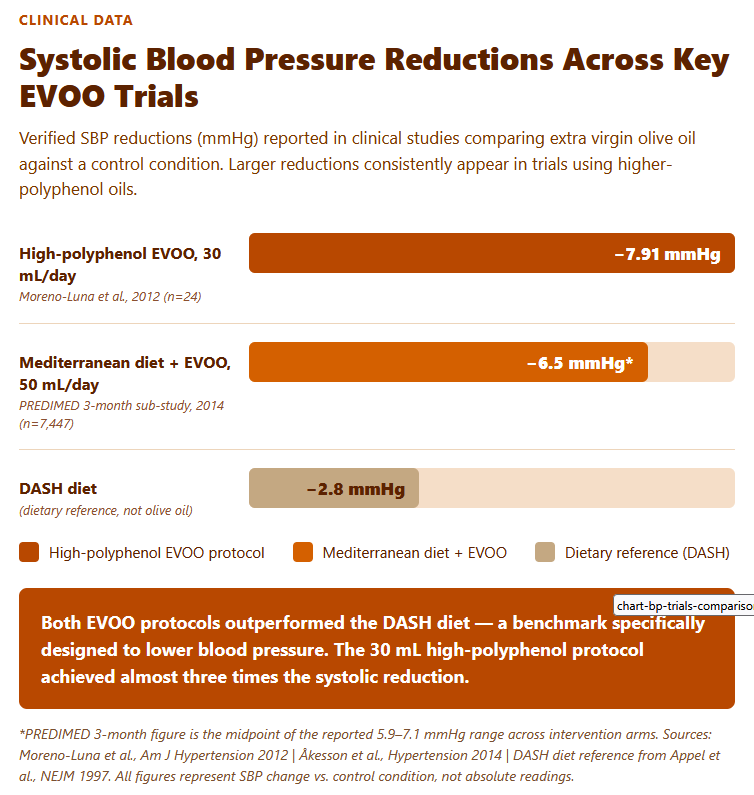
Participants assigned to a Mediterranean diet with approximately 50 mL of EVOO per day showed a 31% reduction in major cardiovascular events compared to those on a low-fat diet, and a three-month blood pressure sub-study found systolic readings fell 5.9 to 7.1 mmHg in the EVOO group.
Fifty milliliters is more than the 30 mL in the Moreno-Luna trial, and PREDIMED participants ate a vegetable-heavy diet throughout the intervention. Whether it is the oil doing the work, the vegetables, or the combination remains genuinely difficult to separate out from a trial designed around a dietary pattern rather than a single ingredient.
Who Actually Sees the Numbers Move
The 7.91 mmHg systolic drop from the Moreno-Luna trial is a meaningful reduction. To put it in context: the DASH diet, the dietary intervention designed specifically to address hypertension, achieved a 2.8 mmHg systolic reduction through dietary nitrate-rich foods alone.
But the Moreno-Luna numbers came from a specific population: young women with high-normal or early stage 1 hypertension, using oil with 564 mg/kg of polyphenols, over a controlled two-month dietary period. Someone starting with a systolic reading of 118 mmHg is going to see a very different response than someone starting at 142 mmHg.
People with elevated blood pressure are more likely to see meaningful reductions from this kind of protocol. A 2015 substudy of the PREDIMED trial by Medina-Remón and colleagues, published in Nutrition, Metabolism and Cardiovascular Diseases, found that higher polyphenol intake from a Mediterranean diet improved nitric oxide availability and was associated with lower blood pressure even in participants without clinical hypertension, pointing toward a long-term protective effect that runs ahead of the cuff reading.
For people not yet in the hypertensive range, that finding has real weight. The oil may be doing meaningful vascular work that a standard blood pressure monitor cannot yet detect.
The substitution question is the one most people don’t ask.
The math applies directly here. Adding 30 mL of olive oil on top of your current diet adds roughly 360 calories per day. Sustained caloric surplus raises blood pressure over time, which works against the goal. The benefit from EVOO requires replacing butter, margarine, or refined seed oils, not supplementing them.
Two trials that used sunflower oil as the control document this substitution effect clearly. In a 2004 study in Clinical Nutrition, Perona and colleagues at the Instituto de la Grasa in Seville compared four weeks of virgin olive oil against sunflower oil in 62 elderly participants (31 with medically treated hypertension, 31 normotensive). Virgin olive oil normalized systolic blood pressure in the hypertensive group (average 136 mmHg, compared to 150 mmHg on sunflower oil).
A longer study by Ferrara and colleagues, published in 2000 in Archives of Internal Medicine, found that hypertensive patients following an olive oil-based diet reduced their daily antihypertensive medication dosage by 48% over six months, compared to a 4% reduction in the sunflower oil group. Sunflower oil is a reasonable cooking fat in other respects, but it carries no polyphenols, and that difference shows up in the blood pressure data consistently.
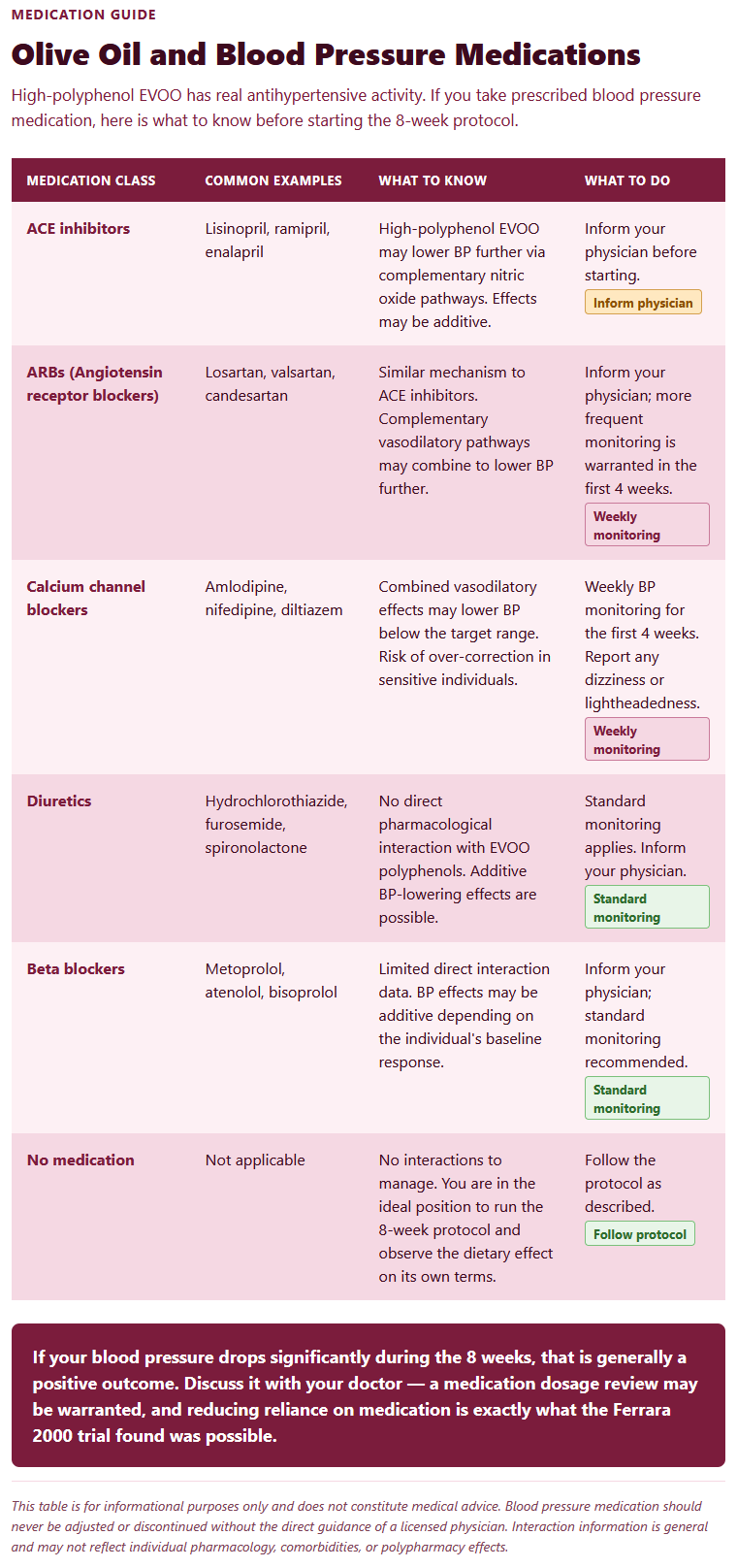
If you are currently on blood pressure medication, a conversation with your physician before starting this protocol is worth having. High-polyphenol EVOO has real antihypertensive activity, and when taken alongside medication, the combined effect may be stronger than either alone.
That is a positive outcome, but one worth monitoring. If readings drop significantly, a dosage review with your physician may be warranted.
Your 8-Week Protocol
Multiple independent trials, a 7,447-person Mediterranean study, and a systematic review of the mechanistic evidence all point in the same direction. That is about as convergent as dietary evidence gets. It does not make olive oil a cure, and it does not change anything if your physician has prescribed medication.
As a daily dietary habit with a defensible evidence base, low risk, and a delivery format most people find genuinely enjoyable, though, “try it for eight weeks and measure the result” is actually defensible advice, which is unusual in nutrition.
Here is what eight weeks can look like in practice.
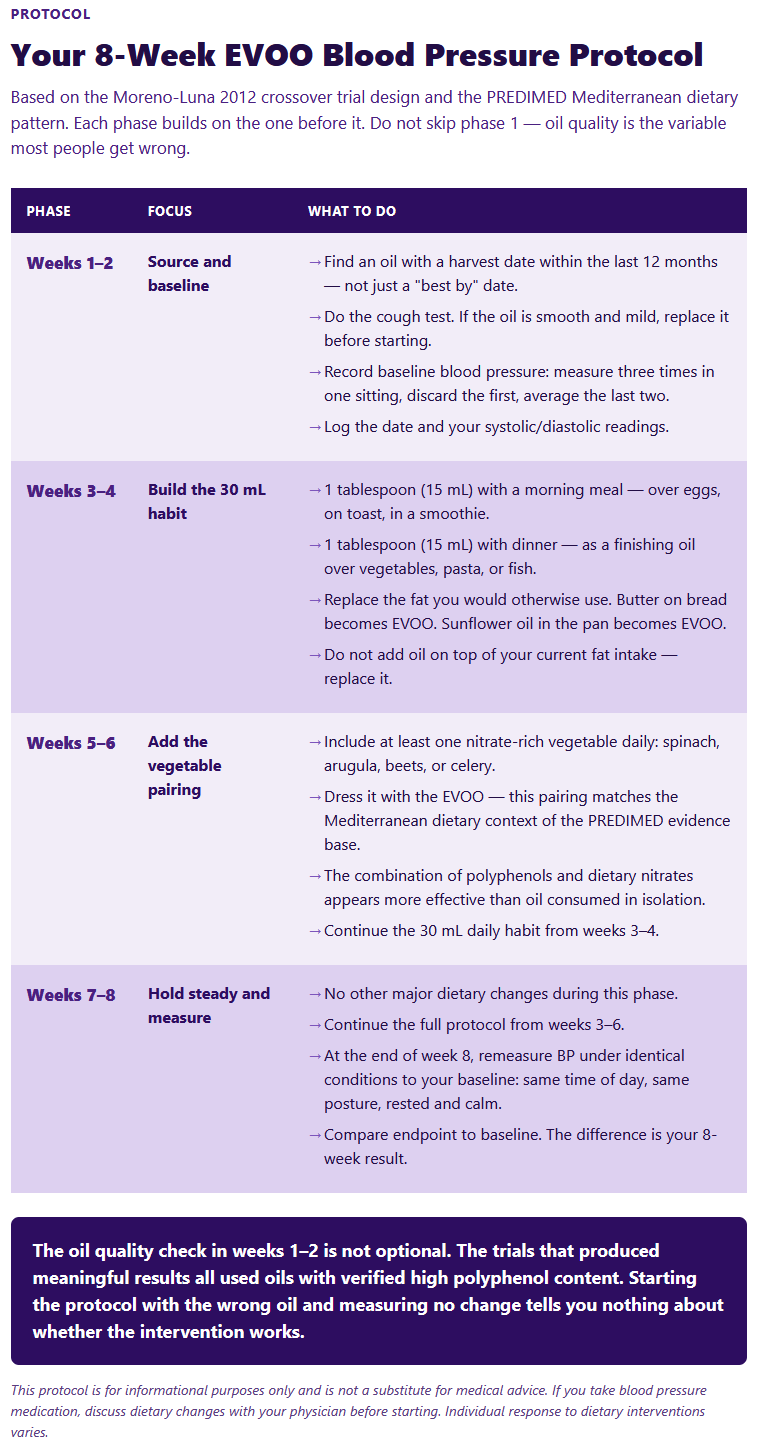 Start with two weeks of sourcing and verification before you change anything else. Find a bottle with a harvest date within the last 12 months. Do the cough test. If the oil is smooth and mild, it will not carry the polyphenol content the research required, so replace it before starting. Take a baseline blood pressure reading: measure three times in one sitting, discard the first, and average the last two. Record it.
In weeks three and four, build the 30 mL daily habit. One tablespoon with a morning meal, one with dinner, used as a finishing oil over whatever you’re already eating. The critical rule is the one stated above: replace the fat you would otherwise have used. Butter on bread, sunflower oil in the pan, margarine on vegetables. Not in addition to those fats. Instead of them.
Add the vegetable pairing in weeks five and six. At least one nitrate-rich vegetable daily (spinach, arugula, beets, or celery), dressed with the EVOO. This matches the dietary pattern that the larger trials actually tested, and it may do more than the oil alone could.
Hold the routine steady through weeks seven and eight with no other major dietary changes. At the end of week 8, remeasure under the same conditions as your baseline: same time of day, same posture, rested and calm. That comparison is your result.
For some people, the numbers will shift meaningfully. For others, they won’t. Individual response to dietary interventions varies, and that variation is real, not a sign the evidence is wrong. What the evidence can tell you is what a population of people with elevated blood pressure saw over eight weeks of consistent use. What it cannot tell you in advance is exactly where you sit within that distribution.
EVOO Blood Pressure Protocol Tracker
Track your 8-week high-polyphenol olive oil protocol from oil check to final result
Frequently Asked Questions
How long does it take olive oil to lower blood pressure?
The Moreno-Luna trial produced its 7.91 mmHg systolic reduction over an eight-week daily-use period. Shorter interventions generally show smaller effects. Eight weeks at the correct dose, using a genuinely high-polyphenol oil, is a reasonable minimum before assessing individual response. Blood pressure also varies day to day, so measure under consistent conditions: same time of day, same posture, rested. Replicate those same conditions at your endpoint.
Which olive oil is best for high blood pressure?
Extra virgin olive oil with verified high polyphenol content is the target. Practically, that means an oil with a harvest date within the last 12 to 18 months, storage in dark glass, and a total phenolic content above 250 mg/kg if that figure is on the label. The sensory check remains a useful proxy: bitterness on the tongue and a peppery burn at the back of the throat when you swallow. Refined olive oil, “pure” olive oil, and any product labeled “light” will not produce the same effect.
Can olive oil interact with blood pressure medication?
Yes, and the interaction is worth being aware of. High-polyphenol EVOO has documented antihypertensive activity, and combining it with medication can lower readings further than either alone. This is generally a favorable outcome, not a dangerous one, but people on antihypertensive medication should inform their doctor when starting this protocol so that blood pressure can be monitored and dosage adjusted if readings drop significantly.
I’ve been eating olive oil for years and my blood pressure hasn’t changed. What’s different here?
Almost certainly the oil type and the dose. Most olive oil consumed habitually is refined, blended, or old enough that its polyphenol content has degraded. The trials above used oils at 564 mg/kg polyphenol concentration or above, at a consistent 30 mL daily, replacing other fats rather than adding to them.
A drizzle of mid-shelf extra virgin on a salad twice a week is a genuinely different intervention than 30 mL of fresh, high-polyphenol EVOO substituted daily for butter and seed oils. If you have not tried the protocol above with verified high-polyphenol oil, you haven’t yet run the experiment the research describes.