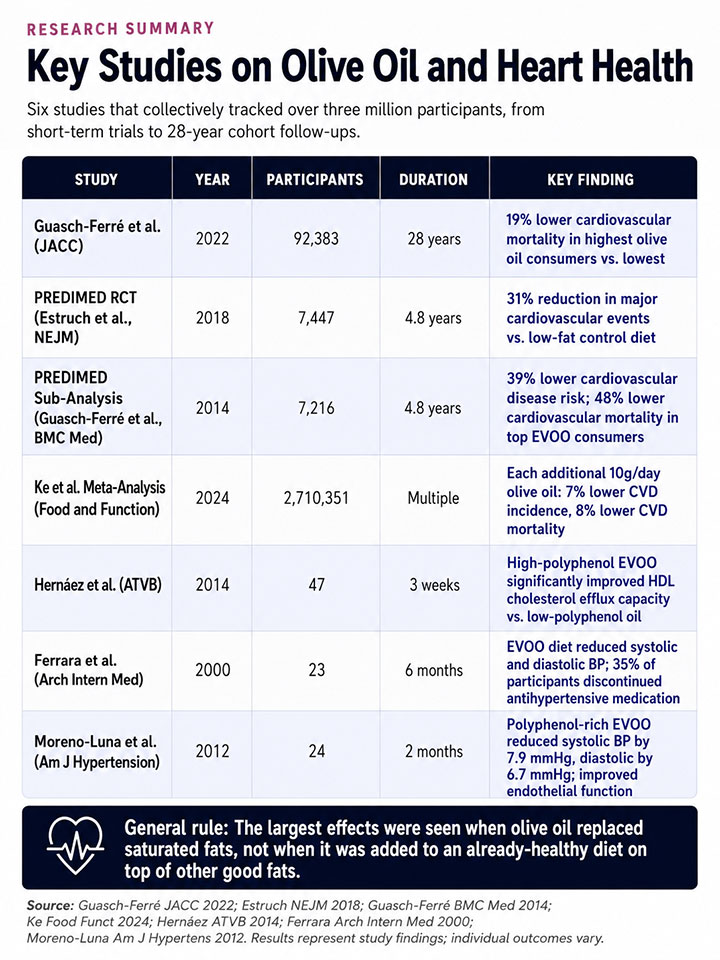
A 28-year study involving more than 92,000 people found a meaningful connection between olive oil and heart health, but there’s more to the story than simply adding oil.
In a carefully controlled crossover trial, researchers gave participants either a high dose of extra virgin olive oil or a very low dose, both within an already-healthy plant-based diet. Both groups improved. The group eating less olive oil did marginally better on LDL cholesterol.
That finding doesn’t undo decades of evidence. What it does is clarify something researchers have suspected for a while: a lot of olive oil’s cardiovascular benefit comes from what it replaces, not just what it adds. That distinction changes how to think about using it.
What the Strongest Evidence Actually Shows
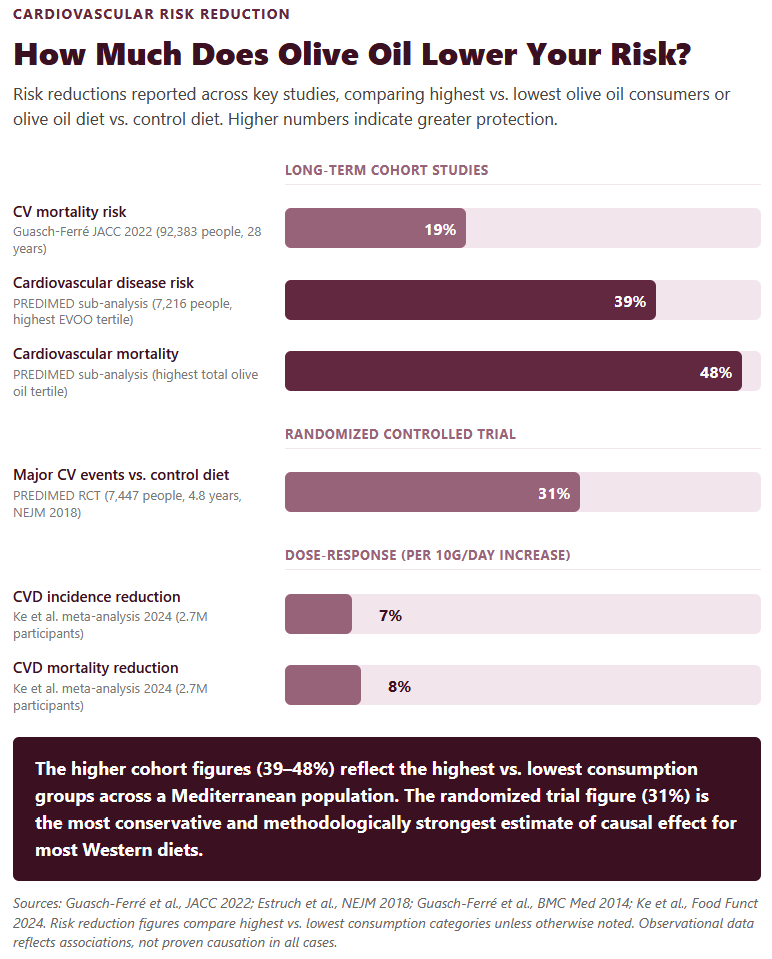
The headline numbers on olive oil and cardiovascular disease are large enough to take seriously. A 28-year follow-up study by Dr. Marta Guasch-Ferré and colleagues at Harvard’s T.H. Chan School of Public Health tracked over 92,000 men and women and found that those consuming more than half a tablespoon of olive oil per day had a 19% lower risk of dying from cardiovascular disease, compared with those who rarely or never used it.
Replacing 10 grams per day of butter, margarine, or dairy fat with olive oil was associated with an 8 to 34% lower mortality risk across multiple causes. This is the study currently cited by the American College of Cardiology, Yale School of Medicine, Harvard Health, and the Mayo Clinic in their own public guidance on olive oil.
The PREDIMED trial adds a different layer. That landmark randomized controlled trial assigned 7,447 adults at high cardiovascular risk to one of three diets, one of which was a Mediterranean diet supplemented with extra virgin olive oil.
After a median of 4.8 years, the olive oil group showed a 31% relative reduction in major cardiovascular events compared with the control low-fat diet. A separate observational analysis within the same cohort found that the participants consuming the most extra virgin olive oil specifically had a 39% lower risk of cardiovascular disease overall, and a 48% lower risk of dying from it.
Those two numbers refer to different outcomes from different analyses. Articles that quote 30%, 39%, and 48% from “the PREDIMED study” as if they are the same figure are describing the same cohort from different vantage points.
The 2024 meta-analysis by Ke and colleagues in Food and Function, which covered 30 studies and over 2.7 million participants, found that each additional 10 grams per day of olive oil was associated with a 7% reduction in cardiovascular disease incidence and an 8% drop in cardiovascular mortality.
What Changes in Your Body
Cholesterol Function, Not Just Cholesterol Levels
The standard cholesterol story (raise HDL, lower LDL) is familiar. The more interesting finding from EVOO research is what the oil does to how cholesterol functions, not just how much of it is circulating.
HDL cholesterol’s job is to carry excess cholesterol from artery walls back to the liver for disposal. Not all HDL particles do this equally well. Some are efficient. Others are sluggish. Researchers at the Cardiovascular Risk and Nutrition Research Group in Barcelona wanted to know whether olive oil polyphenols could change that functional capacity rather than just the HDL count.
In a randomized controlled trial published in Arteriosclerosis, Thrombosis, and Vascular Biology in 2014, Hernáez and colleagues gave 47 participants high-polyphenol olive oil for three weeks and measured HDL’s ability to pull cholesterol from peripheral cells. The high-polyphenol oil significantly increased that capacity. The low-polyphenol oil did not.
At the same time, EVOO polyphenols appear to reduce LDL oxidation. Oxidized LDL is the form that lodges in artery walls and triggers plaque formation. Slowing that oxidation process is, in the view of most cardiovascular researchers, where a meaningful portion of olive oil’s protective effect originates.

Blood Pressure
High blood pressure affects close to half of adults in the United States, and most people with it have no symptoms until problems arise. Olive oil’s effect on blood pressure is real but modest, and the mechanism is worth understanding.
EVOO polyphenols increase the production of nitric oxide, a signaling molecule that relaxes the smooth muscle lining blood vessel walls. When those walls relax, vessels widen, and blood flows through with less force. The result is a reduction in both systolic and diastolic pressure.
The blood pressure evidence has been accumulating since 2000, when researchers led by Dr. L.A. Ferrara at Federico II University in Naples found that 35% of hypertensive patients on an olive oil-enriched diet were able to discontinue their antihypertensive medications entirely over six months, without the sunflower oil comparison group showing any equivalent effect.
That last detail is the one that excites researchers. It is not a small detail. A decade later, Moreno-Luna and colleagues isolated the mechanism more precisely: 24 young women with high-normal or mildly elevated blood pressure consumed polyphenol-rich olive oil for two months, while a matched group consumed the same oil with the polyphenols chemically removed. Only the polyphenol group improved. The fat was not the active ingredient.
The Artery Lining
Most cardiovascular events start with the endothelium, a single-cell-thick layer most people have never heard of, lining the inside of every blood vessel in the body. When it is damaged or stiffened, it stops regulating clotting, blood flow, and inflammatory responses at the same time. The failure is simultaneous. That is why it matters so much, and why the olive oil research on endothelial function is arguably more interesting than the cholesterol data.
Healthy endothelial function shows up on clinical measurement as good flow-mediated dilation: the ability of vessels to expand responsively when blood flow increases. The Moreno-Luna trial measured this directly and found that two months of polyphenol-rich olive oil significantly improved it. The same participants also showed reduced biomarkers of oxidative stress and vascular inflammation.
Researchers still disagree on exactly how much of olive oil’s vascular benefit is driven by its monounsaturated fat content versus its polyphenol load, though the balance of evidence points toward the polyphenols. The Ferrara and Moreno-Luna studies both support this: the comparator oils in each trial had similar or higher fat content but produced no equivalent effect.
Inflammation
Chronic low-grade inflammation in artery walls is a precondition for plaque development, and it is not detectable by how a person feels. Oleocanthal, a compound found in fresh extra virgin olive oil, was identified in a 2005 paper in Nature by Dr. Gary Beauchamp and colleagues at the Monell Chemical Senses Center as a natural inhibitor of the same cyclooxygenase enzymes that ibuprofen blocks. The characteristic burning sensation at the back of the throat when tasting high-quality EVOO turned out to be that compound producing its anti-inflammatory signal.
This does not mean olive oil is a pharmaceutical-grade anti-inflammatory. The dose required to approximate the effect of an ibuprofen tablet is several tablespoons, and the comparisons are directional rather than clinically equivalent.
What the research does establish is that oleocanthal provides a real mechanism, not merely a correlation. That matters because nutritional epidemiology is full of correlations that fall apart when you look for the mechanism. This one does not.
Oxidative Stress
Free radicals are unstable molecules produced during normal metabolic processes, and at high concentrations they damage cell membranes, proteins, and DNA. The cardiovascular relevance is specific: when LDL particles are oxidized by free radicals, they become pro-inflammatory and begin adhering to artery walls.
High-quality extra virgin olive oil contains over 30 distinct phenolic compounds that function as antioxidants, each contributing to neutralizing oxidative damage through slightly different mechanisms.
The distinction between EVOO and refined olive oil is most pronounced here. The refining process that converts fresh-pressed olive oil into standard commercial olive oil removes the polyphenols that carry this antioxidant activity. A bottle labeled “pure olive oil” or “light olive oil” retains the monounsaturated fat but loses most of the compounds behind the cardiovascular evidence.
Where the Research Gets More Complicated
The 2024 trial by Krenek and colleagues, published in the Journal of the American Heart Association, deserves more attention than it has received. Forty adults at elevated cardiovascular risk followed two versions of the same whole-food plant-based diet for four weeks each: one with four tablespoons of EVOO daily, one with less than a teaspoon.
Both diets produced comparable improvements in LDL cholesterol, total cholesterol, and inflammatory markers compared with their baseline omnivorous diets. But the group on less olive oil showed a trend toward greater LDL reduction, and participants lost more weight when olive oil was lower.
The researchers noted the obvious limitation: their comparison group was not eating a high-fat Western diet. They were already eating an exceptionally clean diet with no animal products and no refined foods.
In that context, adding a concentrated source of caloric fat may have partially offset the benefits that the rest of the diet was producing. The authors were careful not to extrapolate this to a general anti-olive-oil conclusion. They described it as evidence that the optimal amount of EVOO may depend heavily on what the rest of the diet looks like.
That framing is probably right. The populations where EVOO shows the strongest cardiovascular benefits are those in which it is replacing saturated fats from butter, margarine, processed meats, and dairy. In a diet already free of those inputs, its marginal benefit narrows. In a typical Western diet, the case for it remains strong.
The honest answer is that nobody has fully resolved this yet.
How Much Olive Oil for Heart Health
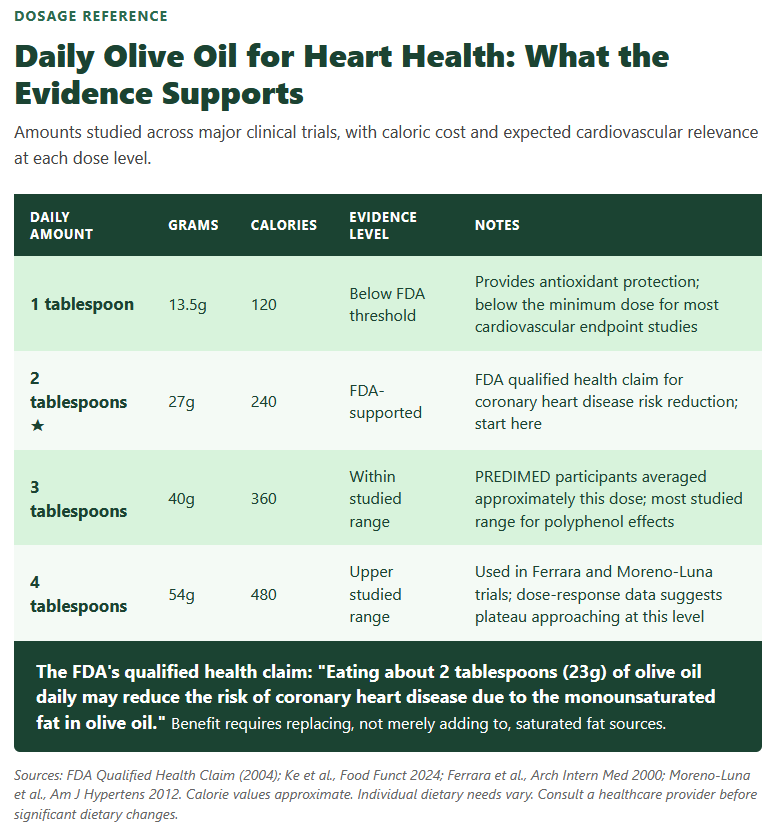
The FDA’s qualified health claim, established for olive oil and coronary heart disease, specifies approximately 2 tablespoons (23 grams) per day as the amount supported by evidence for reducing coronary heart disease risk through the monounsaturated fat content.
The dose-response meta-analysis by Ke and colleagues found the cardiovascular benefit continued increasing up to 18 to 22 grams per day before flattening, which aligns closely with the FDA’s guidance.
The studies showing the largest effects generally used between 25 and 50 grams per day (roughly 2 to 4 tablespoons), with polyphenol-rich extra virgin oil specifically. Beyond 4 tablespoons, the research shows diminishing returns on cardiovascular markers, while caloric load continues to increase at 120 calories per tablespoon.
EVOO Heart Health Calculator
Answer 5 questions to get personalized guidance based on current research on olive oil and cardiovascular health.
How much olive oil do you currently use per day?
Include all uses: cooking, salad dressings, finishing drizzles.
What type of olive oil do you typically use?
The type matters significantly for cardiovascular effects.
What does olive oil primarily replace in your diet?
Research shows the largest benefits when olive oil replaces saturated fats.
Which of these applies to your cardiovascular health?
This helps tailor which research is most relevant to your situation.
When you buy olive oil, which do you typically check?
Select all that apply, or none if you don't currently check these.
This calculator provides general guidance based on current nutritional research. It is not a substitute for medical advice. If you take medications or have cardiovascular conditions, discuss dietary changes with your healthcare provider before making significant adjustments.
One practical consideration worth raising: the quality of the oil matters more than the quantity. Two tablespoons of fresh, high-polyphenol extra virgin olive oil deliver meaningfully more active compounds than four tablespoons of a refined or low-quality product. Harvest date, dark packaging, and polyphenol content on the label are better guides than brand origin alone.
What Cardiologists and Major Health Bodies Recommend
The American Heart Association, the American College of Cardiology, the FDA, and the Mayo Clinic all recommend substituting olive oil for saturated fats, not adding it. That word, substituting, is doing more work than it appears.
It is the reason the 2024 Krenek trial produced a complicated result: the participants were not substituting anything. They were adding EVOO to a diet already free of the fats it is meant to replace. The official guidance and the trial’s finding are not in conflict. They are describing the same thing from different angles.
How to Choose and Store EVOO
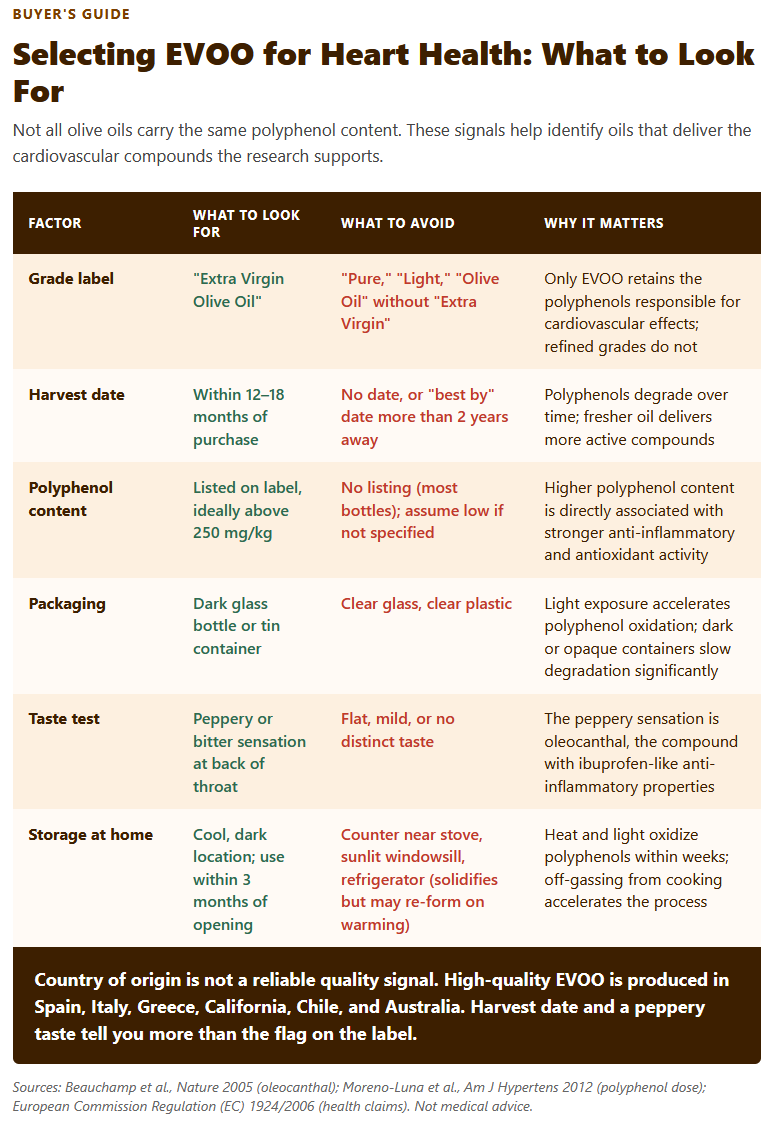
The most important quality signals for cardiovascular-relevant EVOO are polyphenol content and freshness. Polyphenol content above 250 mg/kg indicates a high-phenolic oil likely to have the anti-inflammatory and antioxidant activity the research supports.
Some bottles list this. Most do not. As a proxy, a harvest date within the past 12 to 18 months and a pronounced peppery or bitter taste at the back of the throat are the strongest sensory indicators of polyphenol presence.
Storage degrades polyphenols faster than most people realize. Light and heat accelerate oxidation: a clear bottle sitting on a counter near a stove can lose a significant portion of its active compounds within weeks.
Dark glass or tin, stored away from heat and used within three months of opening, preserves the most. A musty or flat smell replacing olive oil’s characteristic sharp fruitiness is the clearest sign that polyphenols have already degraded.
Drug Interactions and Safety Considerations
Olive oil is a food, not a supplement, and the risks of consuming it at the doses recommended by the evidence are low for most adults. Three clinical situations warrant specific awareness.
People taking anticoagulant medications such as warfarin should be aware that higher olive oil intake can have modest antiplatelet effects. The interaction is unlikely to be clinically significant at 1 to 2 tablespoons per day, but monitoring INR levels after a significant change in olive oil consumption is reasonable, and discussing the change with a prescribing clinician is advisable.
Because olive oil can lower blood pressure, combining a meaningful increase in daily intake with antihypertensive medications requires monitoring. The Ferrara trial showed participants reducing medication needs, which is a positive outcome, but one that requires physician awareness to manage dose adjustments safely.
People with gallbladder disease or a history of gallstones should start with small amounts. Fats stimulate bile release from the gallbladder, and in susceptible individuals, larger amounts of any dietary fat can trigger discomfort or complications. Starting with a teaspoon and increasing the amount gradually over several weeks allows the digestive system to adjust.
What to Expect, and When
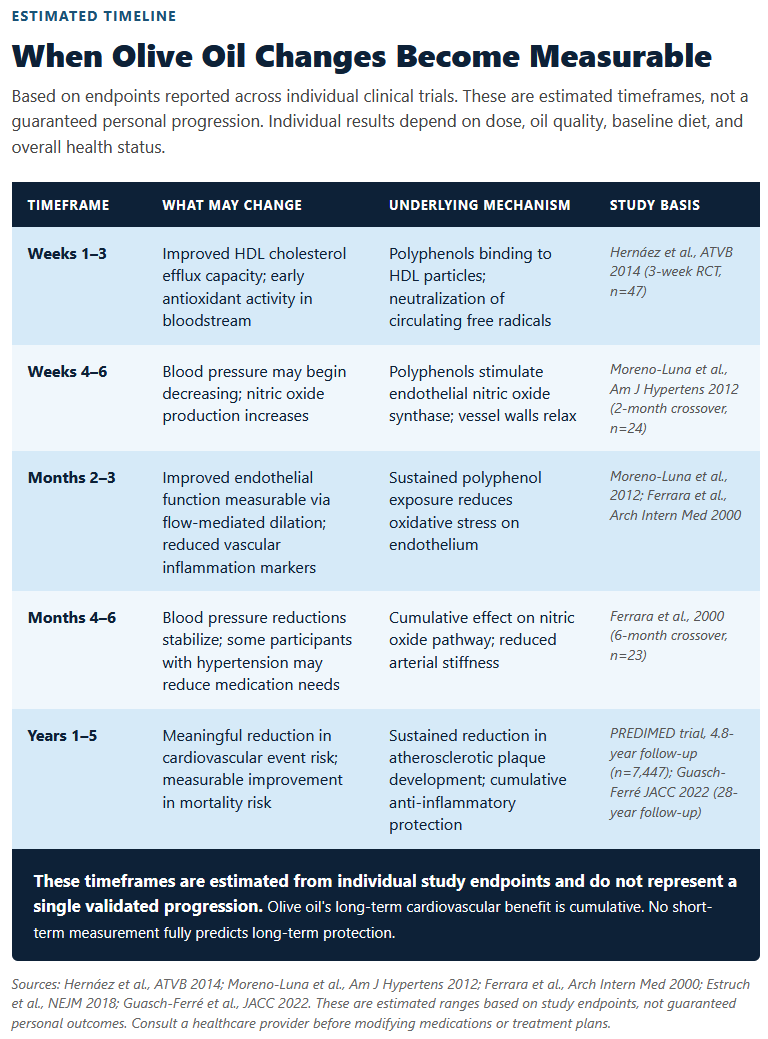
The timeline below is based on the endpoints reported across individual studies, not a single tracked cohort. Individual results will vary depending on baseline diet, oil quality, dose, and other cardiovascular risk factors.
One thing the research consistently shows: the cardiovascular effects of olive oil are cumulative, not acute. A single tablespoon does not measurably change anything. The protection builds through sustained daily use over months and years, which is why the cohort studies with decade-long follow-up periods show the largest associations.
Conclusion
The 2024 trial that showed less olive oil outperforming more olive oil in an already-excellent diet does not change the core finding from 28 years of follow-up data across 92,000 people. It clarifies something that was always implied in that data: olive oil’s cardiovascular benefit is largest when it is replacing something worse.
In most Western diets, there is no shortage of saturated fat to replace. Two tablespoons of fresh, high-polyphenol extra virgin olive oil most days, in place of butter, margarine, or processed fat, is about as well-supported an intervention as nutritional epidemiology currently offers.
The peppery burn at the back of your throat when you taste good EVOO is not an acquired taste to tolerate. It is oleocanthal doing exactly what the research says it does.
FAQs
Can I get the same benefits from regular olive oil?
No. The refining process that produces regular, “pure,” or “light” olive oil removes most of the polyphenols responsible for the anti-inflammatory and antioxidant effects documented in the research.
Regular olive oil retains the monounsaturated fat content, which has modest benefits for cholesterol, but it is a different product for cardiovascular purposes than extra virgin. If you cannot find or afford high-quality EVOO regularly, using regular olive oil to replace saturated fats is still preferable to butter or margarine, but it does not replicate the full benefit profile.
How quickly will I see results?
Endothelial function improvements appear within two to three months in the clinical trials. Blood pressure changes have been documented in as little as six weeks. Changes to cholesterol function, as measured in the Hernáez trial, showed up within three weeks.
Meaningful reductions in cardiovascular risk as measured in long-term cohort studies are cumulative over years. The short-term changes are real. The long-term benefit is the point.
Does higher intake always produce more benefit?
Not necessarily, and the 2024 Krenek trial is the clearest illustration of why. The dose-response relationship appears to plateau at roughly 2 to 4 tablespoons per day in most studies, and in populations already following very clean diets, adding more olive oil may not produce additional cardiovascular benefit. The FDA’s 2-tablespoon recommendation reflects the lower end of the studied range, which is where the benefit-to-caloric-load ratio is strongest.
Can I substitute olive oil supplements for food-grade EVOO?
Not on current evidence. Isolated polyphenol supplements have not replicated the cardiovascular effects observed with whole EVOO in intervention trials, which suggests the compounds in whole oil interact in ways that supplements cannot yet replicate. The evidence base was built on food, not capsules.
Does the country of origin matter?
Not as a primary indicator. Polyphenol content varies more by variety, harvest timing, processing method, and storage than by country of production. High-quality EVOO is produced in Spain, Italy, Greece, California, Chile, Australia, and elsewhere. Harvest date, dark packaging, and a detectable peppery taste are more reliable guides than origin labeling.