The Mediterranean diet gets the credit, but scientists have now isolated the exact dose and type of olive oil doing the real cardiac work.
There’s a number that should change how you think about your cooking oil: 7 grams.
That’s roughly half a tablespoon of extra virgin olive oil. It doesn’t sound like much. But a landmark study tracking over 92,000 Americans for nearly three decades found that this small daily amount was tied to a 19% lower risk of dying from heart disease.
Not a Mediterranean diet overhaul. Not a strict lifestyle program. Half a tablespoon, swapped in for the butter or margarine you’re already using.
The 28-Year Study That Changed the Conversation
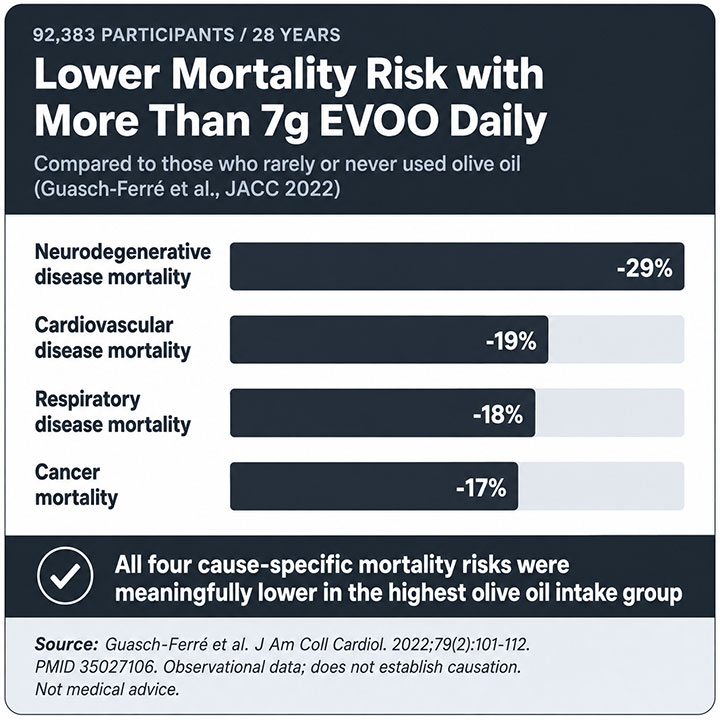
In 2022, researchers published findings from one of the longest-running dietary studies ever conducted in the United States. The Guasch-Ferré et al. study in the Journal of the American College of Cardiology followed 92,383 adults (60,582 women and 31,801 men) from 1990 through 2018. Every four years, participants reported what they ate. Researchers then tracked who developed heart disease, cancer, and other life-threatening conditions.
The results were striking. People who consumed more than half a tablespoon of olive oil per day had a 19% lower risk of dying from cardiovascular disease compared to those who rarely or never used it. The same group also showed 17% lower cancer mortality and a 29% lower risk of dying from neurodegenerative diseases like Alzheimer’s.
This research gave scientists something they rarely get: a massive, long-term, dose-specific look at one food’s effect on mortality in a real-world U.S. population. The participants were primarily health professionals (nurses and doctors), which may mean the findings apply somewhat more optimistically than they would in the general population, but the direction of the effect is consistent with what other large cohorts have found.
Why Swapping Matters More Than Adding
Think of your daily fat intake like a budget. You have a fixed number of calories to spend. If you pour olive oil on top of a diet already full of butter and processed fats, you’re going over budget without changing where the money goes. The evidence is clear that this approach doesn’t help much.
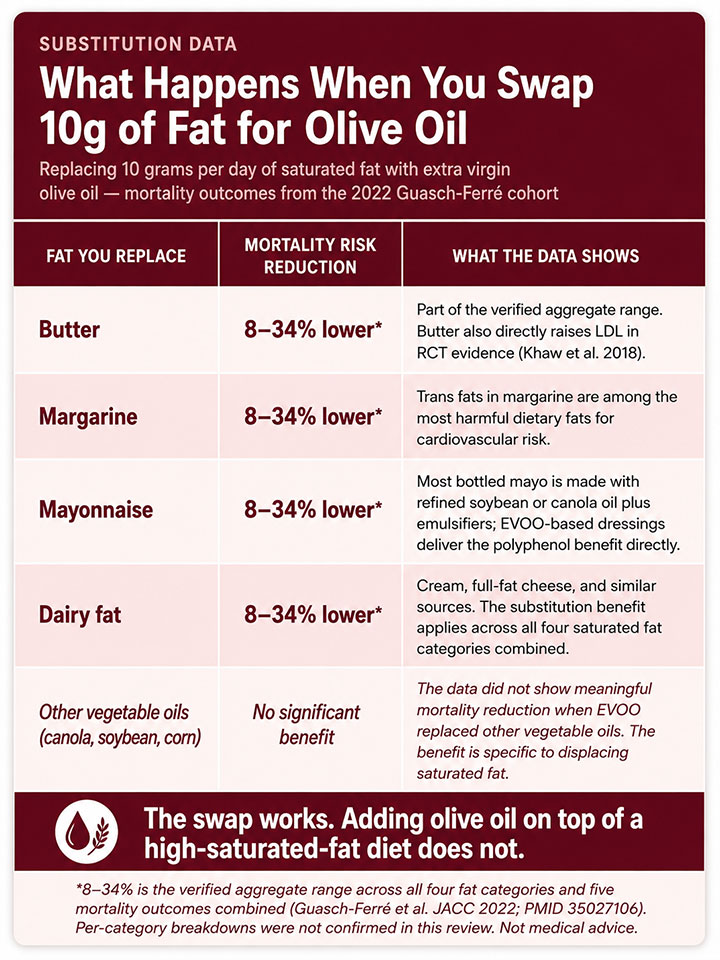
But when olive oil replaces those saturated fats? The numbers shift considerably. The same 2022 study found that substituting 10 grams of butter, margarine, mayonnaise, or dairy fat per day with the equivalent amount of olive oil was associated with an 8% to 34% lower risk of total and cause-specific mortality across those fat categories combined. The effect held across cardiovascular, cancer, neurodegenerative, and respiratory outcomes.
One important note from the data: replacing other healthy vegetable oils with olive oil showed no significant mortality benefit. The gains come from displacing the fats most harmful to cardiovascular health, not from replacing oils that already carry relatively low risk.
Saturated fat raises LDL cholesterol, the kind that can build up in arterial walls and contribute to blockages. Extra virgin olive oil does not. A randomized trial from Cambridge published in BMJ Open confirmed this directly.
Ninety-one adults were randomized to consume 50 grams per day of either coconut oil, butter, or extra virgin olive oil for four weeks; Khaw and colleagues found that butter significantly raised LDL compared to olive oil and that olive oil produced no meaningful LDL increase at all.
Also worth keeping in mind: the 19% cardiovascular mortality reduction was tied specifically to people consuming more than half a tablespoon daily on a consistent basis. A teaspoon every few days is unlikely to produce the same result. The 7-gram daily threshold is where the evidence is strongest.
Your Heart vs. Your Stroke Risk: An Important Difference
Most coverage of olive oil groups “heart health” and “brain health” together under a broad “cardiovascular” umbrella. The science is more precise than that, and the difference matters depending on your personal health history.
A companion analysis by the same Harvard research team, also published in JACC, tracked nearly 93,000 U.S. adults over 24 years and recorded 9,797 cardiovascular events. Higher olive oil intake was tied to an 18% lower risk of coronary heart disease, the kind that leads to heart attacks. There was no significant association with stroke risk in those findings.
This doesn’t mean olive oil is useless for overall brain health. The 2022 mortality data showed strong reductions in neurodegenerative deaths. But if stroke prevention is your primary concern, olive oil alone may not be the lever you’re looking for.
For people with a family history of heart attacks, blocked arteries, or coronary artery disease, the evidence is consistent and meaningful. For those focused specifically on stroke risk reduction, the picture stays less settled.

It’s Not Just Oil. It’s the Polyphenols Inside It.
Not all olive oil is the same. This is where most buying guides fall short, and where the science gets genuinely interesting.
Extra virgin olive oil contains hundreds of polyphenols, plant compounds with antioxidant properties. These aren’t nice-to-haves. They appear to be a significant part of what makes high-quality olive oil work differently from cheaper, refined versions.
Here’s the key mechanism: LDL cholesterol doesn’t become dangerous just by being present in the bloodstream. It becomes dangerous when it oxidizes, reacting with oxygen and beginning to stick to arterial walls, forming the plaque that leads to blockages and heart attacks. High-polyphenol olive oil helps inhibit that oxidation process.
The EUROLIVE study, led by Dr. Maria-Isabel Covas and published in Annals of Internal Medicine, tested this directly. Two hundred healthy men across five European countries consumed 25 ml of olive oil daily at one of three polyphenol concentrations: low (2.7 mg/kg), medium (164 mg/kg), or high (366 mg/kg).
The high-polyphenol oil produced meaningfully lower levels of oxidized LDL compared to the low-polyphenol version. Total LDL levels didn’t change, but the artery-clogging potential of that LDL did.
Think of it this way: polyphenols don’t reduce the number of vehicles on the road, but they make those vehicles far less likely to cause accidents.
More recent work adds to this picture. A 2025 randomized trial in patients with hyperlipidemia found that a high-phenolic extra virgin olive oil (containing over 1,000 mg/kg of phenols) reduced total cholesterol more than a lower-phenolic version when both groups received equivalent daily phenol doses, with the high-phenolic oil delivered in a smaller volume.
Researchers led by Christos Kourek at the National and Kapodistrian University of Athens reported statistically significant lipid improvements in the high-phenol group that weren’t seen in healthy controls consuming the same oils, which suggests polyphenols are most clinically meaningful for people already managing elevated cholesterol rather than those starting from a healthy baseline.
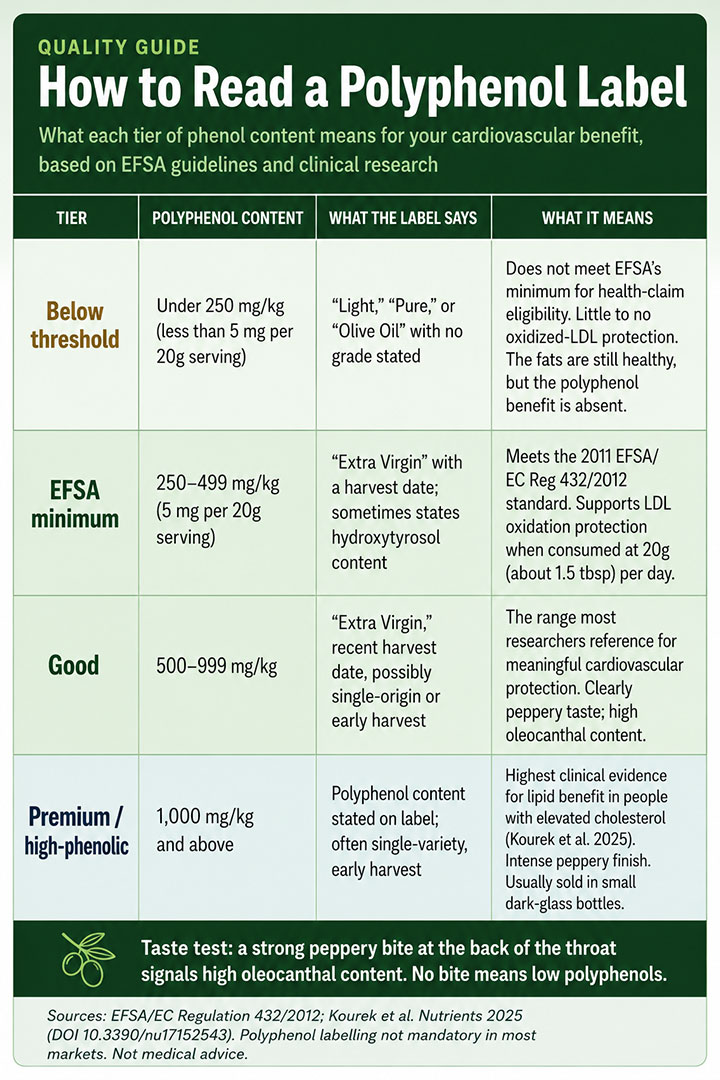
The European Food Safety Authority established its health claim for olive oil polyphenols in 2011, codified in EC Regulation 432/2012. The claim applies specifically to hydroxytyrosol and its derivatives (including oleuropein complexes and tyrosol), and requires at least 5 mg of those compounds per 20 g of olive oil, roughly equivalent to 250 mg/kg. Many grocery store oils, especially refined or “light” olive oil, fall well below that level.
What to Look for When Buying Extra Virgin Olive Oil for Heart Health
The research is specific about what kind of oil produces the heart benefit. “Extra virgin” is not a marketing tier: it’s the threshold at which the polyphenol content that drives the cardiovascular effect is actually present. Refined olive oil, sold as “light” or “pure,” has been processed in ways that strip those compounds out. Here’s what else to look for on a label.
Check for a harvest or pressing date. Polyphenols degrade over time, and the “best by” date on most bottles tells you nothing about freshness. An oil pressing date does. As a practical rule, use your bottle within 18 months of the harvest date and within six weeks of opening it.
Polyphenol content on the label is not required by law in most markets, but high-quality producers increasingly list it. EFSA’s 2011 threshold for health-related claims sits at approximately 250 mg/kg (5 mg per 20 g serving) of hydroxytyrosol and related compounds.
For meaningful cardiovascular protection, researchers tend to point to oils exceeding 500 mg/kg, and some premium EVOOs exceed 1,000 mg/kg. High-polyphenol brands like Cobram Estate list polyphenol content on the label, which takes the guesswork out of the purchase.
Buy in dark glass or tin because light accelerates polyphenol breakdown, and a clear bottle sitting near a sunny window is quietly reducing the value of what you paid for it.
Finally: taste the oil. High-polyphenol extra virgin olive oil has a distinct peppery bite at the back of the throat. That sensation comes from oleocanthal, a compound with anti-inflammatory properties. If your olive oil tastes like nothing in particular, it probably contains very little of what makes the heart-healthy version work. See our full guide to recommended olive oil brands for options across different price points.
How to Actually Hit Your Half-Tablespoon Daily Goal
Half a tablespoon is not a large amount. Most people can hit this target without restructuring their diet. The challenge is consistency.
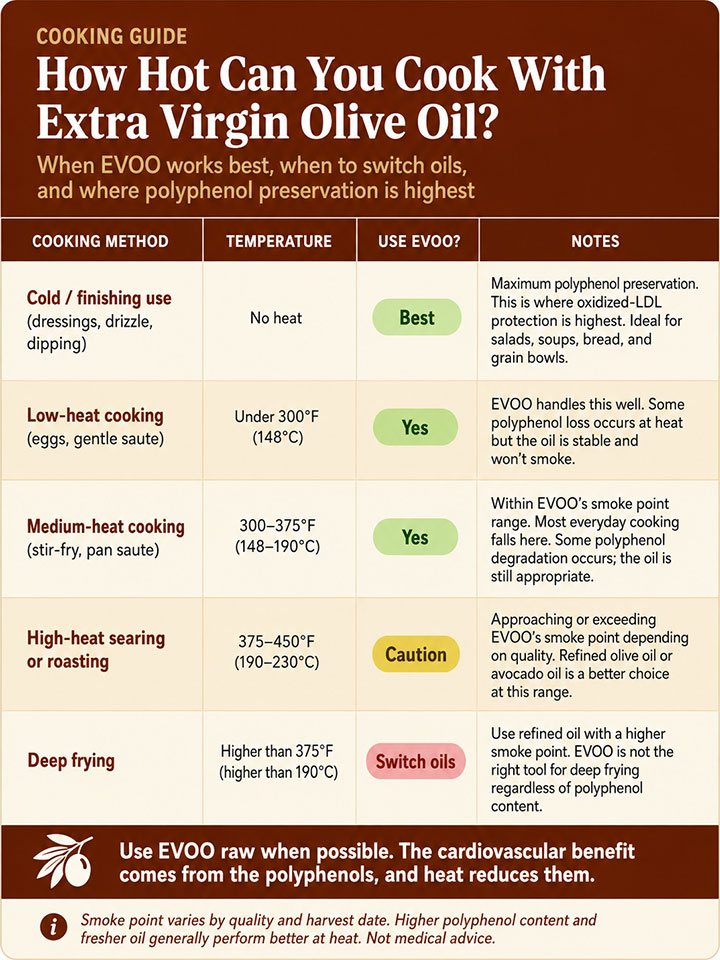
Cold use preserves the most polyphenols. Extra virgin olive oil handles everyday medium-heat cooking well (sautéing vegetables, cooking eggs, light pan work up to roughly 350 to 375°F), but using it as a finishing oil over vegetables, soups, or grain bowls is where the most delicate compounds survive intact. For high-heat work like deep frying or searing, a refined oil with a higher smoke point is the better choice.
The breakfast substitution is the highest-leverage change most people aren’t making. If you typically reach for butter or margarine in the morning, replacing it with olive oil is the exact swap the mortality data supports most strongly. In Mediterranean countries, dipping bread directly into a small dish of extra virgin olive oil is ordinary.
A tablespoon alongside a soft-boiled egg and whole grain toast takes no additional time, produces no sacrifice in flavor, and is doing real work for your lipid profile while you’re at it. This is the part most people skip because it feels too small. It isn’t.
Bottled salad dressings are one of the most common places saturated fat hides in an otherwise careful diet. Making your own takes under a minute: olive oil, lemon juice or vinegar, a pinch of salt. That’s the substitution the data most consistently backs, because it replaces mayonnaise and creamy dressings directly rather than adding fat alongside them.
Is Your Olive Oil Actually High-Polyphenol?
4 label questions to find out whether your bottle delivers the heart-health benefit
Conclusion
The science on extra virgin olive oil and cardiovascular health has moved past a general endorsement. We have 28 years of data on 92,000 people, controlled trials confirming the mechanism at the cellular level, and 2025 research showing that polyphenol concentration drives a meaningful part of the lipid benefit specifically for people managing elevated cholesterol.
The dose is modest, and the habit is transferable. Half a tablespoon a day in place of butter, margarine, or mayo is enough to register in mortality data spanning nearly three decades. The type matters: extra virgin, high polyphenol content, fresh harvest date, dark bottle. And the mechanism is precise.
This oil doesn’t dramatically lower your LDL number. What it does, when rich in polyphenols, is protect LDL from oxidizing into the form that actually damages arterial walls. It shifts the character of the fat in your bloodstream, not just the quantity.
That’s a different proposition from most dietary advice. Most of it asks you to eat less of something. This one asks you to swap one fat for another, at a dose small enough to fit inside a single breakfast.
Frequently Asked Questions
Which oil do cardiologists recommend?
Most cardiologists align with the American Heart Association’s position on dietary fats: replace saturated and trans fats with unsaturated plant oils. Among those oils, extra virgin olive oil has the strongest evidence base for cardiovascular outcomes specifically, largely because of its polyphenol content alongside its monounsaturated fat profile.
Other unsaturated oils (canola, avocado, soybean) support healthy lipid profiles, but they lack the polyphenol-driven LDL oxidation benefit that distinguishes EVOO in the research.
Is extra virgin olive oil good for people who already have heart disease?
The evidence for existing heart disease is more limited than for primary prevention, since most large studies (including the Guasch-Ferré cohorts) excluded participants with established cardiovascular disease at baseline.
The PREDIMED trial, which included participants at high cardiovascular risk, found meaningful reductions in major events in the Mediterranean diet arms supplemented with extra virgin olive oil. For patients managing established coronary artery disease, olive oil fits within the dietary patterns most cardiologists recommend, but it’s not a substitute for medical management.
Is too much olive oil bad for your heart?
Olive oil is calorically dense at roughly 120 calories per tablespoon, so large amounts can contribute to caloric excess and weight gain over time, which carries its own cardiovascular implications. The data supporting cardiovascular benefit centers on the replacement of saturated fats with olive oil, not on adding large amounts of olive oil to an already high-fat diet.
Two to four tablespoons daily is a reasonable range for most people looking to capture the benefits without displacing other nutritious foods from their diet.
Is olive oil good for heart failure patients?
Evidence specific to heart failure is limited. Most olive oil and heart disease research focuses on primary prevention or coronary artery disease, not the distinct clinical picture of heart failure. Patients with heart failure should follow the dietary guidance of their clinical team rather than generalizing from the primary prevention literature.