The viral blueberry trick sounds almost too simple to be true. But when researchers put it to the test, they discovered the real story was both more specific and more surprising than most people realize.
The research on blueberries and memory is better than most people expect. It is also more specific than most headlines let on. Dozens of studies have examined whether eating blueberries regularly changes how the brain processes and recalls information.
Several well-designed clinical trials say yes. What those trials actually measured, though, is narrower than “better memory” sounds, and understanding the distinction is what turns a vague food tip into something you can actually use.
If you’ve searched “blueberry trick for memory” and found a wall of conflicting claims (some from serious researchers, some from supplement ads promising to reverse cognitive decline with a spoonful of berries), you’re in the right place. The trick, such as it is, has a straightforward answer.
What the Clinical Trials Found
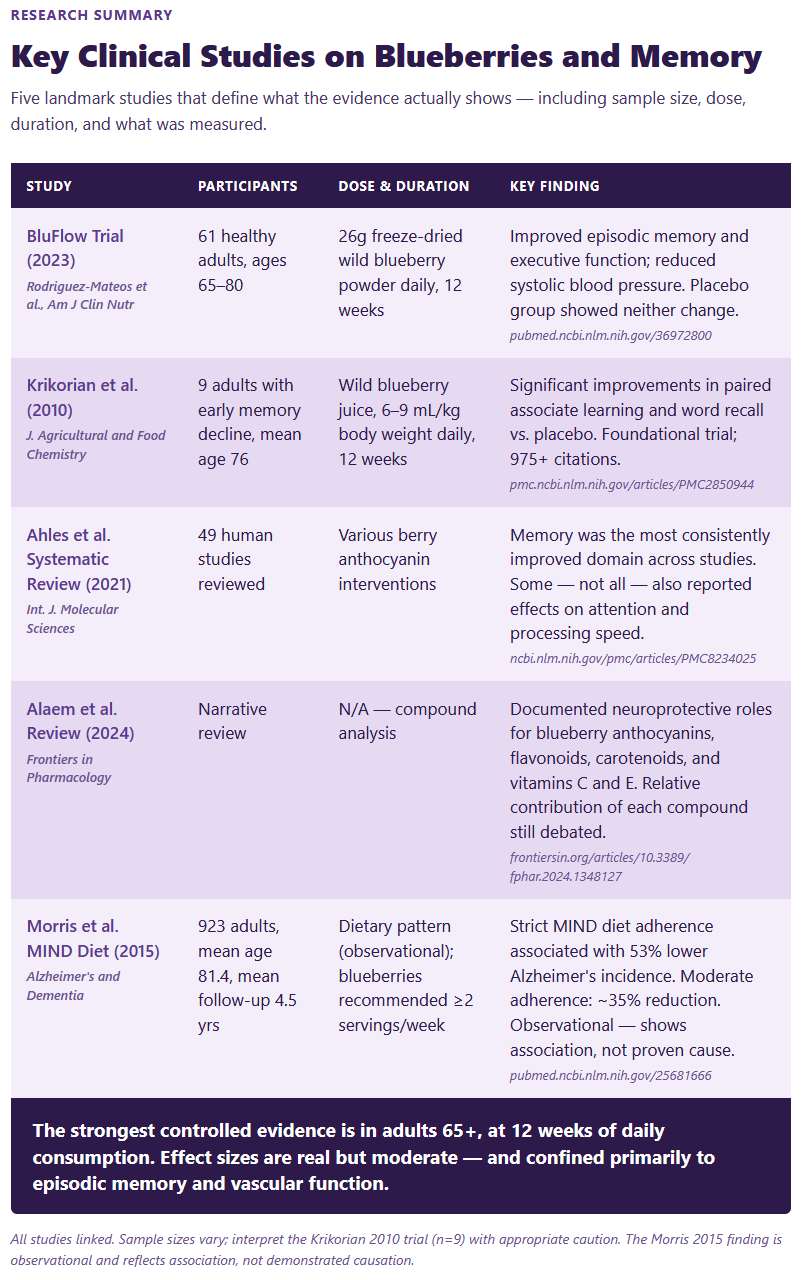
The most rigorous recent evidence comes from the BluFlow trial, a double-blind, placebo-controlled study led by Dr. Ana Rodriguez-Mateos at King’s College London and Professor Claire Williams at the University of Reading.
Sixty-one healthy adults between 65 and 80 drank a beverage containing 26 grams of freeze-dried wild blueberry powder daily for 12 weeks. At the end of that period, participants in the blueberry group showed measurable improvements in episodic memory (specifically, the ability to learn and recall word lists) along with faster performance on executive function tasks and a reduction in systolic blood pressure. The placebo group showed neither.
That finding took a while to sink in for the research team, too. Improving both cognitive function and vascular health simultaneously from a single dietary intervention in healthy older adults was not something the standard model had predicted cleanly.
An earlier study, the one behind the Krikorian 2010 paper in the Journal of Agricultural and Food Chemistry, now cited more than 975 times, pointed in the same direction. Older adults with early memory decline who drank wild blueberry juice daily for 12 weeks showed significant improvements in paired associate learning and word recall compared to those drinking a placebo.
The sample was small (nine participants in the blueberry group), which matters for interpreting certainty, but the signal was clear enough that it set off more than a decade of follow-up research.
A 2021 systematic review published in the International Journal of Molecular Sciences pulled together findings from 49 studies examining berry anthocyanins in humans. Memory was the domain where improvements showed up most consistently across studies, while some, though not all, also reported effects on attention and processing speed.
The evidence base isn’t without complications. A 2019 analysis raised concerns about publication bias in the blueberry cognition literature. When positive results are more likely to be published than null results, the overall effect size in a body of research tends to look larger than it probably is.
More recent meta-analyses with stricter inclusion criteria still support cognitive benefits, but the honest read is that the field is promising rather than settled, and the effect sizes in individual studies are real but moderate.

Why Blueberries Affect Memory at All
Most of what you eat stays outside the brain. The blood-brain barrier is highly selective. Compounds that look useful from the bloodstream get turned away, which is one reason dietary interventions for cognitive function so often fail to pan out in clinical trials.
Anthocyanins are among the exceptions. These polyphenolic pigments, the same ones that give blueberries their color, are capable of crossing that barrier and appear to accumulate in the hippocampus and prefrontal cortex, exactly the regions the trials later showed responding.
Inside the brain, anthocyanins appear to work along several pathways at once. They reduce inflammatory markers, including IL-6 and TNF-alpha, which are associated with the kind of chronic, low-grade neuroinflammation linked to age-related cognitive decline.
They also improve blood vessel function. The BluFlow trial measured this directly through flow-mediated dilation and found vascular improvements alongside the cognitive ones, suggesting the two effects may be related. Better circulation to memory-relevant brain regions means more oxygen and glucose delivery where it matters.
A 2024 review in Frontiers in Pharmacology identified additional neuroprotective compounds in blueberries beyond anthocyanins (flavonoids, carotenoids, vitamins C and E) and documented their potential roles in brain protection.
Whether these compounds contribute meaningfully to the cognitive effects seen in clinical trials, or whether anthocyanins are doing most of the work, researchers still don’t fully agree on.
What Kind of Memory Improves
This is the part most coverage glosses over, and it matters. The improvements seen in blueberry trials are not improvements across every type of memory. They cluster around episodic memory, specifically the ability to recall specific events, sequences, and associations, alongside spatial working memory: the capacity to hold and mentally manipulate location-based information.
In practical terms: remembering where you put your keys, recalling the sequence of a conversation, learning a new name and connecting it to a face. These are also the first cognitive functions to show meaningful decline.
Not because memory degrades uniformly with age (it doesn’t), but because episodic and spatial working memory are handled by structures that age particularly fast. That’s another way of saying that if blueberries are going to produce any cognitive benefit, they appear to be working on exactly the right target.
What blueberries do not appear to do, based on current evidence, is reverse established cognitive impairment or meaningfully affect the progression of dementia in people who already have it. The research has consistently been conducted in healthy adults or those with very early, mild memory changes. Clinical Alzheimer’s populations have not been studied.
How Much to Eat, and in What Form
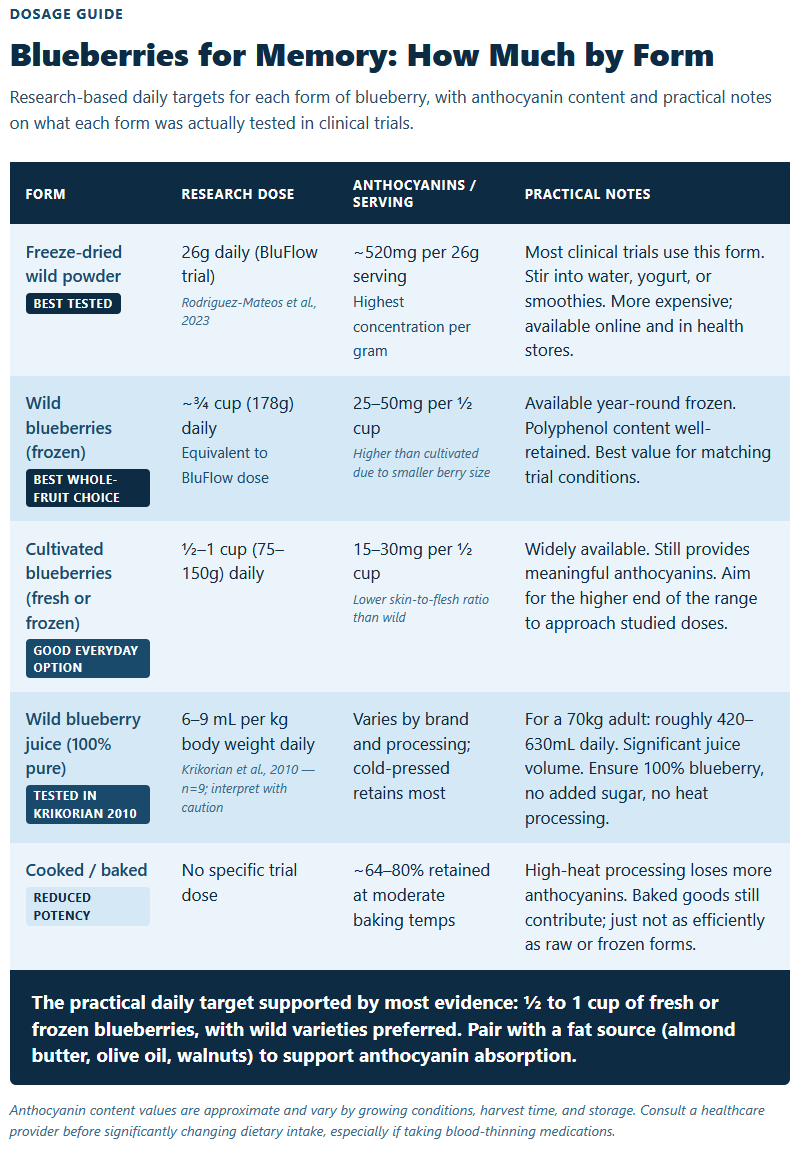
The BluFlow trial used 26 grams of freeze-dried wild blueberry powder daily, equivalent to roughly 178 grams (about three-quarters of a cup) of whole fresh berries. The Krikorian 2010 study dosed by body weight: 6 to 9 milliliters of blueberry juice per kilogram per day, which works out to roughly 1.5 to 2.5 cups of juice daily for a 70-kilogram adult.
Most consumer guidance converges on half a cup to one cup of whole blueberries as the practical daily target, which sits within the range studied.
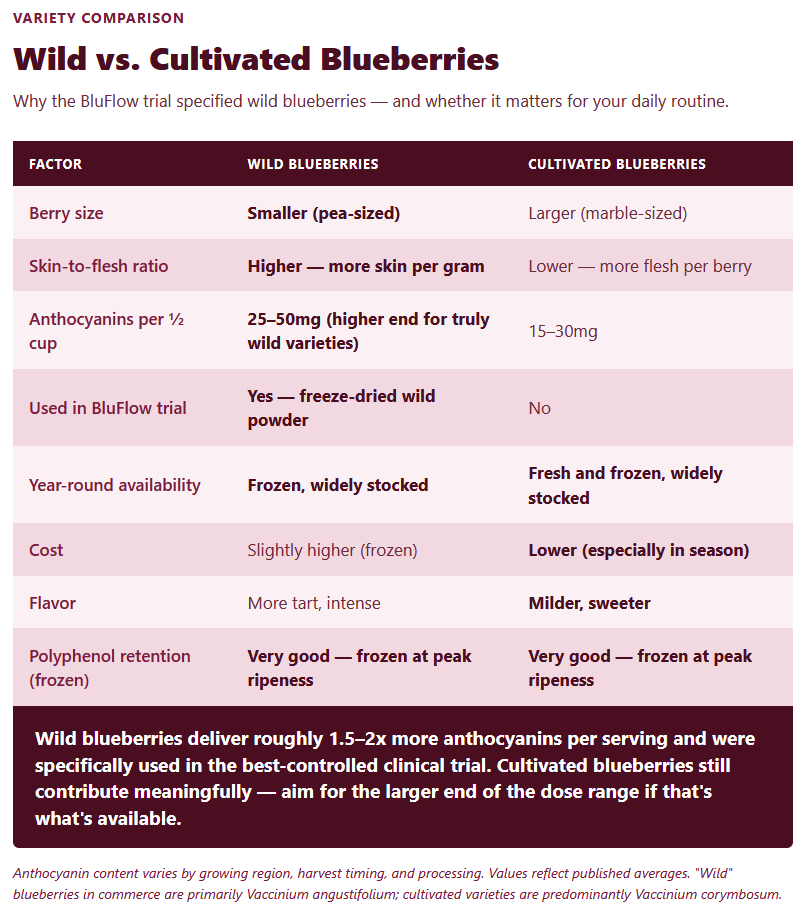
Wild blueberries consistently contain higher anthocyanin concentrations than cultivated varieties: roughly 25 to 50 milligrams per half cup versus 15 to 30 milligrams for cultivated. The difference traces to size.
Wild blueberries are smaller, which means a higher skin-to-flesh ratio, and most of the anthocyanins sit in the skin. Frozen wild blueberries are the most practical way to access them year-round and retain their polyphenol content well.
The blueberry juice and green tea pairing that appears in some guidance (including Google’s AI Overview for this topic) reflects the complementary flavonoid profiles of both: blueberry anthocyanins and the catechins in green tea appear to work through overlapping but distinct pathways for vascular and cognitive health.
The evidence for the combination specifically is less robust than for blueberries alone, but pairing them is reasonable and supported by what’s known about each independently.
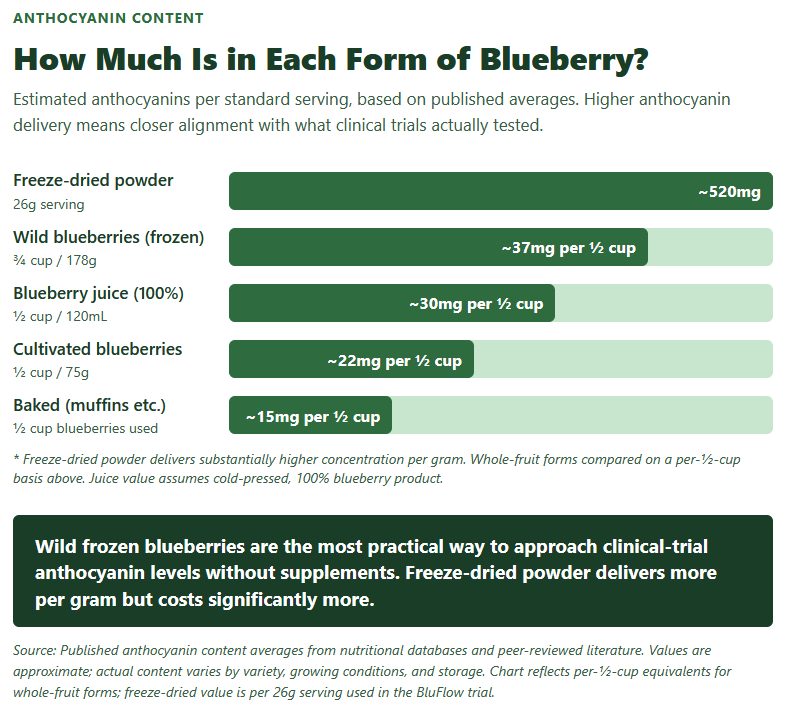
Fresh, frozen, and freeze-dried forms all retain meaningful anthocyanin content. High-heat cooking reduces potency. Baking at moderate temperatures preserves roughly 80 percent of the compounds, while high-heat processing loses more.
Juice, unless it’s cold-pressed and 100 percent blueberry, often has anthocyanin concentrations lower than whole berries. Freeze-dried powder offers the highest concentration per gram and is what most clinical trials have used, though cost and availability make it less practical for daily use than whole frozen berries.
Blueberry Form and Dose Finder
Find your research-based daily target based on how you plan to eat blueberries
Blueberries and the MIND Diet
Of all the foods in the MIND diet, blueberries and leafy greens are the two the researchers singled out as having the strongest evidence: not just the strongest association, but the clearest link to reduced cognitive decline.
The MIND diet was developed by Martha Clare Morris, a nutritional epidemiologist at Rush University Medical Center who spent years trying to isolate which specific dietary components were doing the cognitive work in the Mediterranean and DASH diets.
Her 2015 study in Alzheimer’s and Dementia found that people who adhered strictly to the MIND diet had a 53 percent lower incidence of Alzheimer’s disease compared to those with the lowest adherence. Even moderate followers saw about a 35 percent reduction.
That’s an observational finding, not a controlled trial, so it reflects association rather than proven cause. But the effect held even after adjusting for cardiovascular risk factors, education level, and other lifestyle variables, which suggests the diet itself is doing something beyond proxying for generally healthy behavior.
The MIND diet recommends at least two servings of berries per week, with blueberries as the preferred choice. Other components (leafy greens, walnuts, olive oil, fish, beans) create a dietary pattern where each element appears to reinforce the others. Pairing blueberries with walnuts or olive oil also improves anthocyanin absorption, since some of the beneficial compounds are fat-soluble.
Who Benefits Most
The research is most consistent in two groups: healthy older adults (roughly 65 and over) and younger adults under cognitive stress, such as sustained mental load, inadequate sleep, or periods of high demand.
The BluFlow trial recruited specifically in the 65-80 range. The Krikorian trial recruited adults with early memory decline. A separate line of research has examined cognitive performance in younger, healthy adults under acute conditions, with the University of Reading contributing several studies.
For younger adults with no particular memory concerns, the evidence is less robust. The effect may still be present, but the baseline is harder to move meaningfully when cognitive function is already operating well.
The clearest practical argument for starting early is prevention rather than treatment: the compounds associated with cognitive benefit appear to work in part by reducing the inflammatory burden on brain tissue over time, which makes long-term consistency more valuable than high-dose short-term intervention.
Recipes Built Around the Research Dose
Reaching the research-consistent dose of roughly three-quarters of a cup per day is easier when built into food than when approached as supplementation. The following recipes keep the blueberry portion at or above the effective range while including compounds that support absorption.
Brain-Boosting Blueberry Overnight Oats
Serves 1. Prep time: 5 minutes. Chill overnight.
- 1 cup rolled oats
- 3/4 cup fresh or frozen blueberries
- 1 tablespoon chia seeds
- 3/4 cup unsweetened almond milk
- 1 tablespoon almond butter
- 1 teaspoon honey
Combine all ingredients in a jar, stir well, and refrigerate overnight. The almond butter provides the fat that improves anthocyanin absorption from the berries.
Blueberry Memory Smoothie
Serves 1. Prep time: 3 minutes.
- 1 cup frozen wild blueberries
- 1/2 banana
- 1/2 cup Greek yogurt
- 1 tablespoon walnut pieces
- 3/4 cup unsweetened almond milk
Blend until smooth. The walnuts provide omega-3 ALA. The yogurt protein helps steady the glucose response. Frozen wild blueberries rather than fresh cultivated ones give you a higher anthocyanin concentration per cup.
Blueberry and Spinach Brain Bowl
Serves 1. Prep time: 10 minutes.
- 2 cups baby spinach
- 3/4 cup fresh blueberries
- 2 tablespoons walnut halves
- 1 tablespoon extra-virgin olive oil
- 1 teaspoon balsamic vinegar
Toss the spinach with oil and vinegar, top with blueberries and walnuts. The olive oil serves both as a MIND diet staple and as a fat vehicle for the fat-soluble polyphenols in the berries. Spinach provides the leafy-green component the MIND diet recommends alongside berries.
Safety and Practical Considerations
Blueberries carry FDA GRAS (Generally Recognized as Safe) status. At typical dietary portions, there are no meaningful toxicity concerns. Digestive sensitivity (mild bloating or loose stools) can occur when fiber intake increases quickly. Starting at a quarter cup and building up over a week or two avoids this for most people.
Allergy to blueberries is rare but documented, and cross-reactivity with birch pollen allergy is possible. If you notice oral itching or tingling after eating them for the first time, that’s worth flagging with a physician before continuing.
People taking blood-thinning medications such as warfarin should be aware that large amounts of blueberries (two or more cups daily) may increase anticoagulant effects due to their vitamin K and polyphenol content.
At typical one-cup portions, this interaction is unlikely to be clinically significant, but it warrants a conversation with a prescribing physician before substantially increasing intake. Blueberries have a glycemic index of around 53, making them well tolerated by most people managing blood sugar, though pairing them with protein or fat further moderates the glucose response.
One note on the more dramatic claims circulating online: the research supports regular blueberry consumption as a cognitive support strategy with real but moderate effects, primarily in episodic memory and vascular function.
It does not support the idea that blueberries or blueberry-based preparations can reverse existing memory loss or meaningfully alter the course of neurodegenerative disease. Those claims, when you encounter them alongside supplement offers, are well ahead of the science.
Key Clinical Studies
Conclusion
A reasonable case for eating blueberries daily doesn’t require overstating what the research shows. The trials are real, the mechanism is established well enough to take seriously, and the specific type of memory that improves (episodic recall, spatial working memory, the ability to hold and retrieve recent information) is exactly what tends to decline first. That’s not a cure or a trick. It’s a dietary habit with a decent body of evidence behind it, most of it pointing in the same direction. Blueberries are pleasant to eat and not expensive when frozen, which means the cost-benefit calculation doesn’t require much convincing.
Frequently Asked Questions
Are blueberries good for memory?
Yes, with specificity. Clinical trials show that regular blueberry consumption at doses of roughly half a cup to one cup daily produces measurable improvements in episodic memory and spatial working memory, particularly in adults 65 and older. The effects are real and replicated across multiple studies, though they are moderate in scale and most consistent in the 65-and-older age group.
What is the blueberry trick for memory?
The “blueberry trick” is the daily habit of eating half a cup to one cup of fresh or frozen blueberries, or drinking blueberry juice (sometimes paired with green tea), to support memory and brain health over time. The word “trick” comes from social media shorthand. The underlying method is just consistent daily intake over several weeks, which is what clinical trials have studied. There is no secret method or special preparation involved.
How many blueberries a day for dementia prevention?
Current research doesn’t establish a specific dose for dementia prevention, since the clinical trials have been conducted in healthy adults or those with mild memory changes, not in people with diagnosed dementia. The MIND diet, which recommends two or more servings of berries weekly and is associated with a significantly lower Alzheimer’s risk in observational research, provides a practical framework. For cognitive support more generally, most trial evidence used half a cup to one cup daily.
What is the blueberry recipe for dementia?
No single blueberry recipe has been tested in clinical trials for dementia specifically. The most researched preparation is freeze-dried wild blueberry powder in a beverage (the BluFlow trial used 26 grams per day), but the practical equivalent is three-quarters of a cup of whole wild blueberries daily. A simple smoothie combining frozen wild blueberries, spinach, banana, and almond milk provides both the blueberry dose and several other MIND diet components.
Does blueberry juice work as well as whole blueberries?
Blueberry juice can deliver meaningful anthocyanin content, and the Krikorian 2010 study used juice as its intervention. However, juice preparation varies widely. Cold-pressed, 100 percent blueberry juice retains the most polyphenols, while processed or diluted juices may contain significantly less. Whole berries also provide fiber, which slows glucose absorption and supports gut health. If using juice, look for 100 percent blueberry content with no added sugar and no heat processing listed on the label.
How long before blueberries improve memory?
The honest answer is that nobody has measured this carefully over short timeframes. The trials that showed consistent cognitive improvements all measured at 12 weeks. Vascular effects may begin earlier, but in this context “earlier” likely means weeks, not days. The 8-to-12-week mark is where the evidence consistently places the meaningful signal. There is no good data on what happens before that.
Are wild blueberries better than cultivated for memory?
Yes, meaningfully so. Wild blueberries contain roughly 1.5 to 2 times more anthocyanins per serving than cultivated varieties, because they are smaller and the anthocyanins concentrate in the skin. The BluFlow trial used wild blueberry powder specifically. Frozen wild blueberries are widely available year-round and are the practical choice for anyone who wants to match what the research actually tested.
Can I take a blueberry supplement instead of eating blueberries?
Anthocyanin supplements and blueberry extracts exist, but the clinical evidence base is substantially smaller than for whole berries or freeze-dried powder. Whole blueberries provide fiber, vitamins C and E, and additional flavonoids that may contribute to the overall effect. If cost or access makes daily whole-berry consumption difficult, freeze-dried blueberry powder is the closest tested equivalent to whole fruit, and it is what most of the controlled trials have used.
What should you not mix with blueberries?
At normal dietary portions, there are few meaningful interactions. The main exception is for people taking anticoagulant medications such as warfarin: large quantities of blueberries (two or more cups daily) may increase blood-thinning effects due to their vitamin K and polyphenol content. Calcium supplements taken at the same time may also reduce anthocyanin absorption, a minor consideration if you take both. At typical portions with a varied diet, neither concern is significant for most people.
This article is for educational purposes only and does not constitute medical advice. Consult your healthcare provider before making significant dietary changes, particularly if you take medications or have existing health conditions.