Researchers discovered that green tea doesn’t improve memory all at once. The benefits arrive in stages, with the most surprising changes appearing much later.
Coffee wakes you up. Green tea rewires you. That distinction took researchers by surprise. Most expected green tea to function as a mild stimulant (something like a gentler coffee, familiar but quieter). What they found instead was a beverage that, taken consistently over eight to twelve weeks, produces measurable changes in the brain structures that control memory. Not in how alert you feel. In how your brain is actually organized.
The caffeine arrives quickly. So does a second compound most coffee drinkers never think about: L-theanine, an amino acid that alters the electrical activity of the brain within thirty minutes. A third compound, EGCG, operates on a much longer timeline: one that most people never reach because they stop drinking green tea before anything significant happens.
This is what the research consistently shows.
Green tea supports memory through three compounds working in sequence. L-theanine raises alpha brain wave activity within 30 to 60 minutes. This improves focus and working memory. Caffeine sharpens attention without the crash. And EGCG, the main antioxidant in green tea, strengthens the neural connections between memory-related brain regions: an effect that builds over 8 to 12 weeks of daily use.
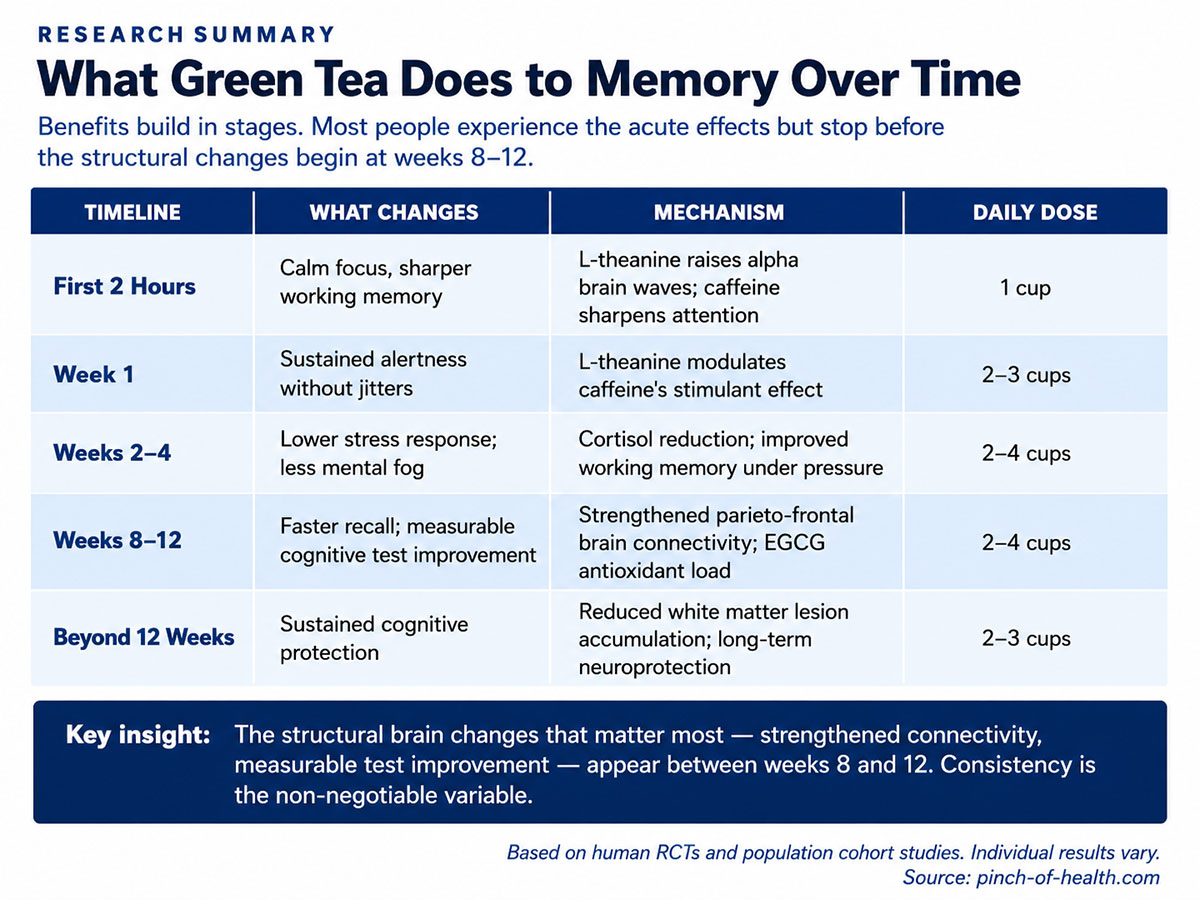
The First 2 Hours: Calm Focus Takes Over
Pour a cup of green tea. Within thirty to sixty minutes, the brain shifts into a different state. Not the sharp, slightly aggressive alertness that follows a strong coffee. Something cleaner than that, and harder to name until you’ve felt it a few times.
L-theanine is responsible. Once it crosses the blood-brain barrier, it increases alpha brain wave activity: the electrical signature associated with relaxed focus, the mental state a person is in when they’re working well without feeling rushed.
At the same time, the caffeine in green tea sharpens attention. In 2012, researchers at the University Hospital Basel gave healthy volunteers a green tea extract drink and scanned their brains during a working memory task. Brain activity in the dorsolateral prefrontal cortex (a region central to holding and manipulating information) increased measurably compared to a control condition.
The L-theanine and caffeine combination has been studied repeatedly. A clinical trial from Northumbria University found that the combination improved performance on working memory tests and reduced reaction time on task-switching exercises compared to a placebo. Neither compound alone produced the same effect. The pairing is what makes green tea cognitively distinct from coffee.
Working memory is what lets you hold several pieces of information in your head at once: tracking a conversation, following a recipe step without rereading it, and holding a number in mind before you write it down. The first cup doesn’t rebuild that capacity. But it does sharpen it for a few hours, reliably, in a way that becomes more useful once you understand the timing.
Drink one cup thirty to sixty minutes before any work that requires sustained concentration. The L-theanine needs time to cross into the brain, and the caffeine reaches peak levels most rapidly in the first hour. Find that window, and the shift from scattered to settled is hard to miss.
Weeks 2–4: Stress Stops Blocking Your Memory
By the second week, something subtler starts to show. The tasks that used to create a low-grade internal alarm (a deadline, a difficult conversation, an overloaded afternoon) don’t seem as hard. This isn’t the calm of caffeine wearing off. It’s L-theanine working on a slower mechanism than alpha waves.
Daily intake begins to reduce cortisol, the body’s primary stress hormone. High cortisol is one of the most reliable ways to impair memory formation. When a person is under acute stress, the brain prioritizes threat-detection over encoding new information, and retrieval of stored memories becomes less reliable. Green tea reduces that interference. Think of stress as static on a radio. The signal (your memory) is still there. The noise is what drowns it out.
Researchers at the Central Research Institute of ITO EN, Japan’s largest tea producer, tested whether matcha affected attentional performance under psychological stress. In a 2021 placebo-controlled trial of 42 young adults, two weeks of daily matcha consumption led to significantly faster reaction times on attentional tasks performed immediately after an induced stress event.
The matcha group’s attentional function held up under pressure, where the placebo group’s did not. Working memory was not the outcome that changed. Attention was. But attention is the gateway: you cannot encode what you do not properly attend to.
The stress-buffering effect makes the afternoon timing recommendation more than a habit. Swapping the second coffee for a cup of matcha protects sleep quality (the period when memories formed during the day are consolidated) while keeping cortisol from spending the afternoon fighting against the work you’re trying to get done.
For someone in their sixties who has noticed that words come a half-second later than they used to, or that a name heard in conversation disappears before it can be written down, the cortisol reduction in weeks two to four is the beginning of something, not the point of it. What actually changes in the brain, and what that looks like on a scan, is what weeks eight to twelve are for.
Weeks 8–12: Where the Structural Changes Begin
This is where green tea stops being a daily habit and starts becoming something more interesting. The changes that accumulate between week eight and week twelve are not subjective. They show up on cognitive tests, and they show up on brain scans.
Consider what researchers at Nihon University found when they followed a group of Japanese adults aged 50 to 69 who reported self-assessed cognitive decline. In a 2020 double-blind, placebo-controlled trial, participants who received decaffeinated green tea catechins daily for twelve weeks showed a significant reduction in response time on the two-back test: a working memory task that requires tracking a sequence of letters and matching each to the one two positions back.
The placebo group showed no change. The catechin group became measurably faster at a task that, in practice, mirrors the kind of rapid information-juggling that slows as people age.
The question researchers kept asking was why. What is the mechanism? In 2014, a team at the University of Basel used functional MRI to look directly at the brain during working memory tasks after green tea extract administration.
Their study found that green tea extract increased the strength of connectivity between the right superior parietal lobule and the right middle frontal gyrus: the parieto-frontal pathway that handles incoming information and passes it to the region responsible for planning and decision-making.
Think of it as upgrading the connection between the part of the brain that receives and the part that acts. The study involved twelve participants, and the performance improvement approached but did not reach conventional statistical significance. The finding is genuinely interesting, but not conclusive. Larger replication studies are needed.
A word the research doesn’t often state directly: most of the key human trials in this area are short-term, running eight to sixteen weeks. The BDNF mechanism (EGCG’s proposed ability to support the growth of new neurons in the hippocampus) rests primarily on animal studies.
Whether that mechanism operates the same way in the human brain, at tea-drinking doses, over longer periods, is still an open question. The evidence that green tea improves cognitive performance in humans is solid. The explanation for exactly how is still being worked out.
There is also a newer line of research worth noting. A large population-based study published in npj Science of Food in early 2025 tracked more than 8,700 Japanese adults and found that regular green tea consumption was associated with fewer cerebral white matter lesions: the small areas of brain tissue damage linked to vascular disease and, over time, to cognitive decline.
Coffee showed no such association. The study is observational, and association is not causation. But the pattern was consistent, the sample was large, and white matter health is not a trivial outcome.
Green Tea vs. Coffee: The Memory Difference
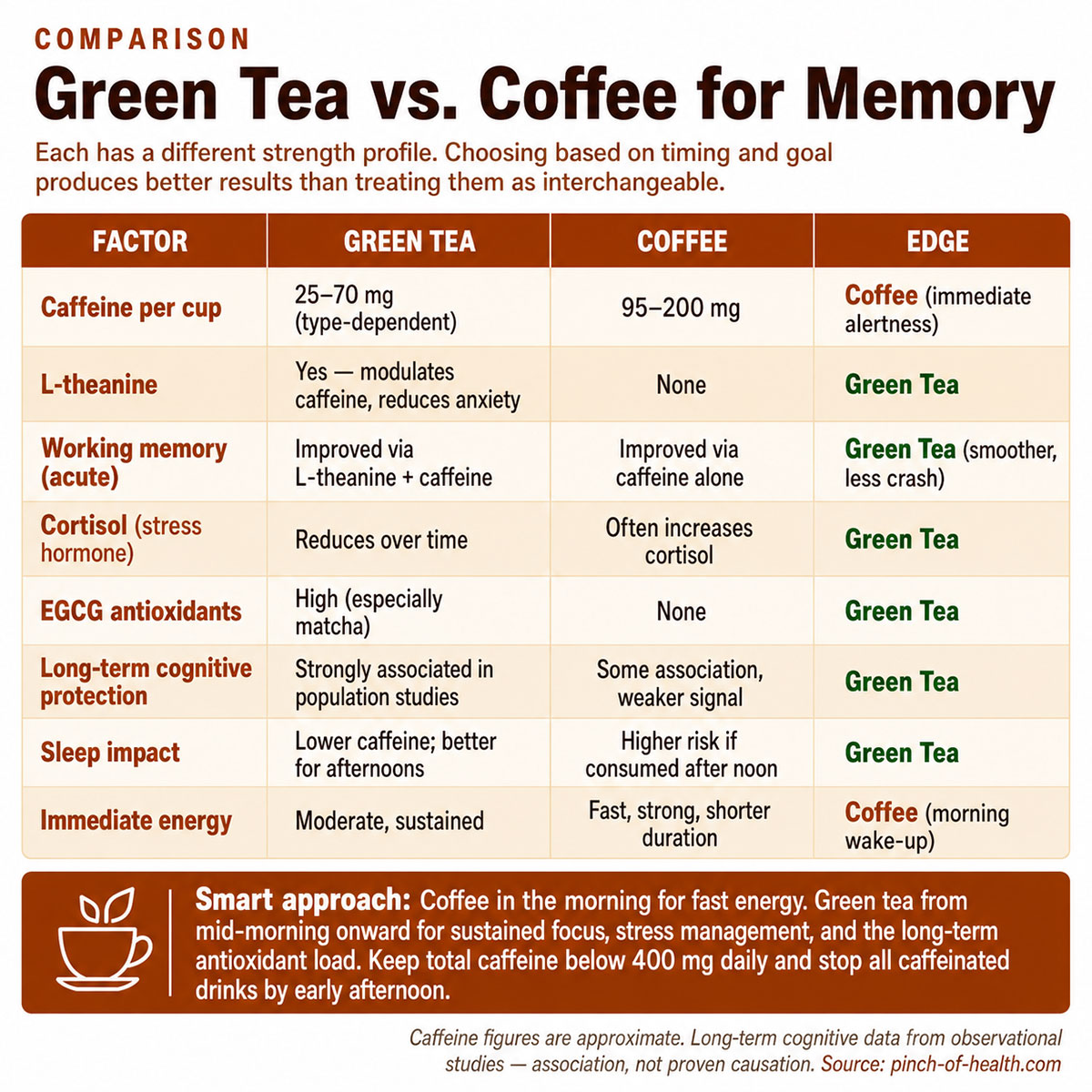
Coffee is faster and stronger. Green tea is different in kind, not just degree. Understanding which one is better for memory depends on what kind of memory benefit you’re asking about and over what timeframe.
For immediate alertness, coffee wins. A standard cup delivers 95 to 200 mg of caffeine (three to seven times the amount in most green teas). The spike is real. So is the subsequent cortisol increase, the anxiety risk, and the disruption to deep sleep that follows afternoon consumption.
For long-term cognitive protection, the clearest population-level data favors green tea. The Nakajima Project, a prospective cohort study published in 2014, followed 723 Japanese adults over 60 years of age for approximately five years.
Of the 490 who completed follow-up, those who drank green tea daily showed a relative risk of 0.32 for overall cognitive decline (dementia or mild cognitive impairment) compared to those who consumed no green tea.
Coffee and black tea showed no similar association. It is an observational study and cannot rule out that daily green tea drinkers differ from non-drinkers in other lifestyle factors. But the gap was large enough and consistent enough to hold up under adjustment for multiple variables.
The practical answer is to use both, but not interchangeably. Coffee is a faster tool. Green tea is a longer-term one. For memory specifically, that distinction matters more than most people’s caffeine routines reflect.
Afternoon coffee doesn’t just disrupt sleep: it undercuts the consolidation window where the day’s working memory gains get stored. Keep total daily caffeine below 400 mg. Cut everything caffeinated by early afternoon.
How to Get the Most from Green Tea for Memory
The Right Amount
Aim for two to four cups daily. That range delivers approximately 300 to 600 mg of catechins: the range used in most of the human trials showing cognitive benefit. If you are using supplements, look for products standardized to this catechin range and stay below 800 mg of EGCG per day. The European Food Safety Authority’s 2018 safety review identified no liver-related adverse events below that threshold in studies lasting up to twelve months.
Choose Your Type
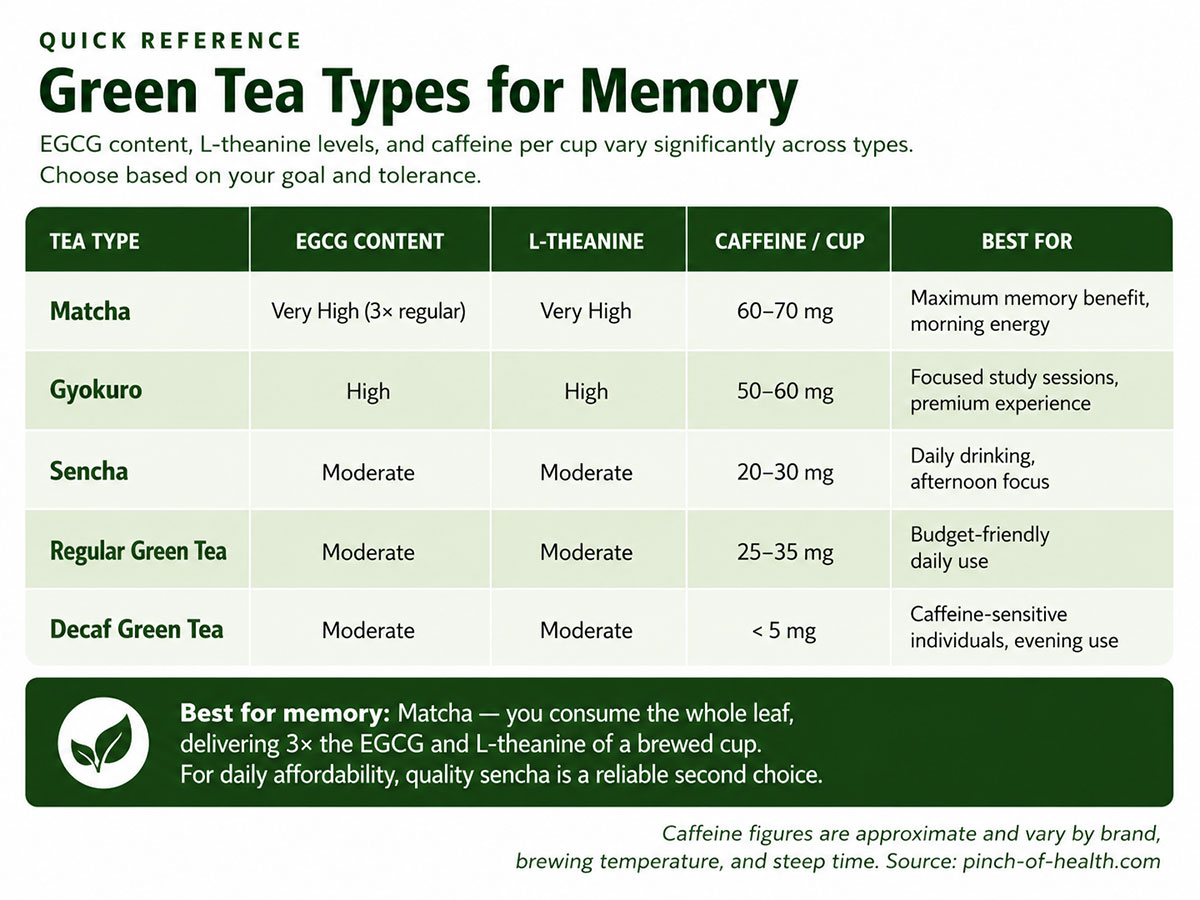
Matcha delivers the most concentrated dose because you consume the whole leaf in powdered form rather than an infusion. Regular green tea and sencha are solid everyday options. Gyokuro sits between the two in EGCG concentration and costs more without proportionally greater benefit for most purposes. For memory specifically, the catechin content matters more than the brand.
Timing and Absorption
This is where most people leave benefits on the table. A 2015 study tested how much EGCG reached the bloodstream when taken as a supplement on an empty stomach versus with food. Absorption was 2.7 to 3.9 times higher in the fasted state compared to consuming it alongside a light breakfast.
The study used EGCG capsules with only four participants. The principle likely transfers to brewed tea, but the magnitude of the effect in everyday tea drinking hasn’t been measured in the same controlled way. The practical implication is worth acting on regardless: drinking green tea between meals rather than immediately with food appears to meaningfully improve how much EGCG your body absorbs.
Best timing windows: first thing in the morning, at least thirty minutes before eating, mid-morning, about two hours after breakfast, or early afternoon. Avoid drinking after 2 to 3 PM if you are caffeine-sensitive. Avoid drinking right after iron-rich meals: green tea reduces the absorption of non-heme iron from plant foods.
Temperature
Water temperature affects both flavor and nutrient delivery. Use water at approximately 75 to 80°C (165 to 175°F). Boiling water degrades some of the delicate catechins and intensifies bitterness. For matcha, a slightly lower range (70 to 75°C) preserves more L-theanine and produces a smoother cup.
Perfect Brewing Timer
Never over-steep your tea again • Preserve L-theanine & catechins
Three Green Tea Recipes for Memory and Focus
Brain-Boosting Matcha Latte
Ingredients: 1 tsp matcha powder (about 2g), 60 ml hot water at 75°C, 240 ml warm milk of your choice, 1 tsp honey (optional, added after brewing).
- Sift the matcha into a bowl to break up any clumps.
- Add the hot water and whisk vigorously for 15 to 20 seconds until frothy.
- Warm the milk separately without bringing it to a boil.
- Pour the whisked matcha into a cup, add the warm milk, and stir gently.
Memory benefit: Approximately 68 mg caffeine, 45 mg EGCG, high L-theanine. Best for morning focus sessions or 60 to 90 minutes before demanding cognitive work.
Afternoon Focus Green Tea
Ingredients: 2 tsp loose sencha leaves, 240 ml water at 80°C, lemon slice (optional, added after brewing to preserve catechins).
- Bring water to a boil, then allow it to cool for 90 seconds.
- Add the sencha to a teapot or infuser.
- Pour the cooled water over the leaves.
- Steep for 90 seconds. Strain and serve.
Memory benefit: Approximately 25 mg caffeine, 15 mg EGCG, sustained focus without disrupting afternoon sleep. Best for the post-lunch cognitive dip.
Pre-Exam Memory Tea
Ingredients: 1/2 tsp matcha powder, 1 tsp sencha leaves, 300 ml hot water at 75°C, a splash of coconut water added after brewing.
- Brew the sencha in 240 ml of water for 60 seconds, then strain.
- Separately whisk the matcha in 60 ml of hot water.
- Combine both teas in a cup.
- Add a small pour of coconut water for electrolytes.
Memory benefit: Combined catechin and L-theanine load from both teas, approximately 40 mg caffeine, and minerals that support neuronal function. Drink 60 to 90 minutes before the event.
Common Mistakes That Reduce the Benefits
Boiling water is the first mistake to avoid. Water above 85°C denatures some catechins and creates excessive bitterness. The beneficial compounds are present. They’re just degraded. Cool your water for 60 to 90 seconds after boiling before pouring.
Drinking tea with meals is the most consequential mistake on this list, and the most common. The 2015 absorption study covered in the brewing section found EGCG reached the bloodstream at 2.7 to 3.9 times higher levels when taken on an empty stomach.
What that number means in practice: someone drinking green tea with breakfast every morning receives somewhere between a quarter and a third of the catechin dose of someone drinking the same tea between meals.
Over twelve weeks of daily habit, that gap compounds into a meaningfully different cognitive outcome. The mechanism is straightforward: food delays gastric emptying, and proteins in the meal bind to catechin molecules before they can be absorbed. Tannins add a further absorption drag. The fix requires a schedule shift, not a sacrifice: first cup thirty minutes before eating, or a full two hours after a meal.
Steeping too long is a common way to lose flavor and increase bitterness. Sencha: 60 to 90 seconds. Gyokuro: 90 to 120 seconds. Matcha: whisk immediately after adding water. There is no steeping time. Extended steeping extracts more tannins, which cause bitterness and stomach upset in some people, and doesn’t increase EGCG content meaningfully.
Expecting changes too quickly leads to quitting early. The Weeks 8–12 structural benefits require consistency. The first two weeks feel like little is happening. Track the smaller signals (energy, stress response, ease of focus), and the twelve-week window will feel less abstract.
Drinking green tea too late is the mistake with the biggest downstream consequences. Green tea’s caffeine, even at 25 mg, can delay sleep onset and reduce slow-wave sleep, which is when the information processed during the day actually consolidates into long-term memory.
After 2 PM is the general cutoff for caffeine-sensitive people. After 3 PM is a reasonable limit for most. This is also where decaf green tea becomes useful rather than just acceptable: the catechins and L-theanine remain intact.
Taking concentrated supplements without food carries a different risk profile than brewed tea. High-dose EGCG supplements taken on an empty stomach have been associated with nausea and, at doses above 800 mg per day in concentrated form, with liver enzyme elevations. Brewed tea does not carry the same risk: the dose is spread across multiple cups, and the form is different. Supplements require more caution than the cup.
Who Should Be Careful
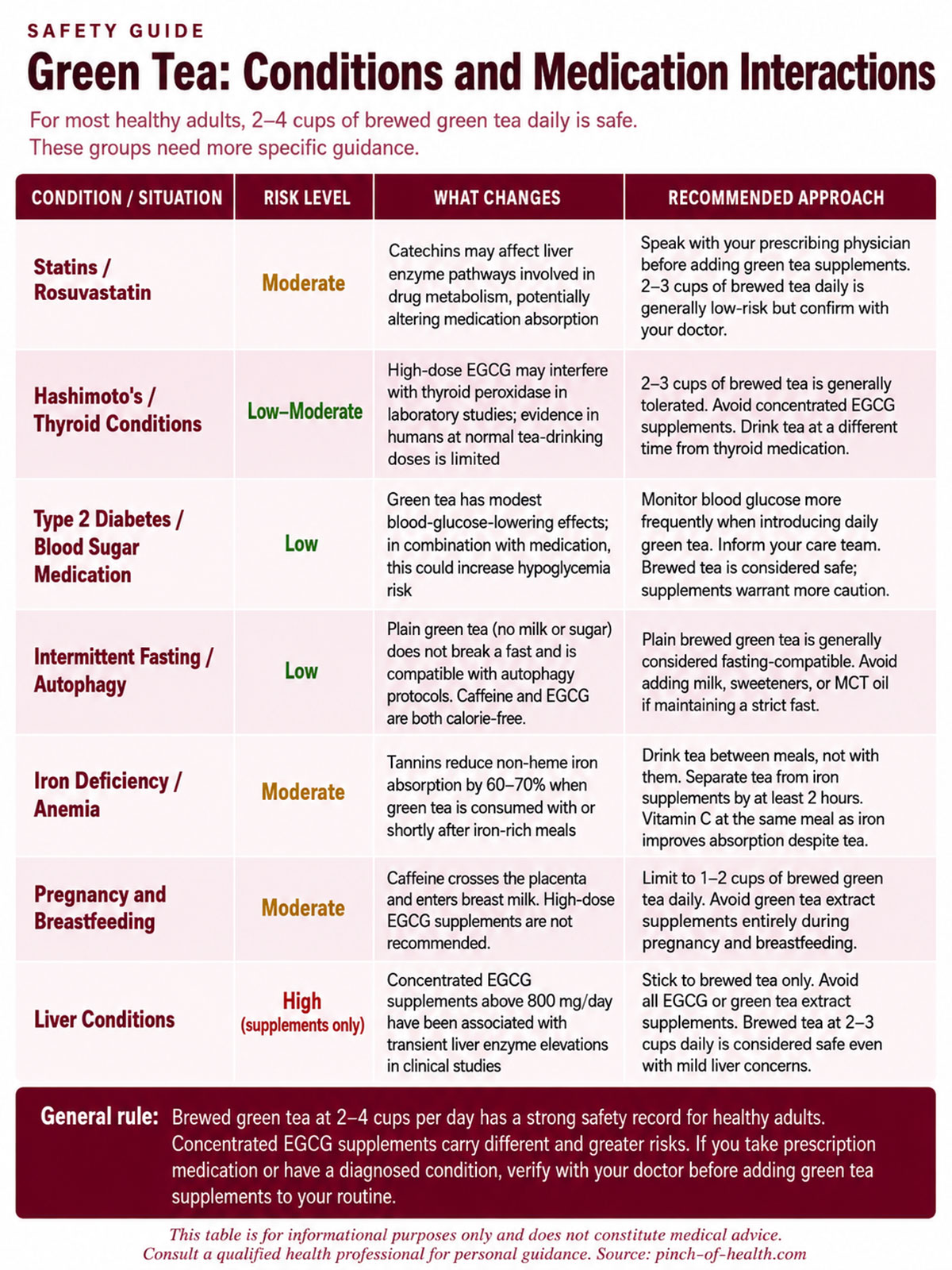
Green tea is safe for most healthy adults at two to four cups per day. Several populations benefit from more specific guidance.
People taking statins, including rosuvastatin. Green tea can interact with some medications that are processed by the same liver enzymes involved in drug metabolism. The interaction with rosuvastatin in particular has been documented in pharmacological studies. Green tea catechins may influence how the drug is absorbed.
If you take any statin or lipid-lowering medication, speak with your prescribing physician before adding concentrated green tea or supplements to a daily routine. Two to three cups of brewed tea per day is generally considered low-risk, but verification with your doctor is the correct step.
People with Hashimoto’s thyroiditis or thyroid conditions. EGCG in high doses has been shown in laboratory studies to interfere with thyroid peroxidase, an enzyme involved in thyroid hormone production. Evidence in humans at normal tea-drinking doses is limited and inconsistent.
Most people with hypothyroidism tolerate two to three cups daily without issue, but those on thyroid medication should be aware that the timing of tea relative to medication may affect absorption, and that concentrated EGCG supplements warrant extra caution.
People with type 2 diabetes. Green tea generally has a favorable effect on blood glucose regulation, and several studies show modest improvements in insulin sensitivity with regular consumption. The caution is for people on blood-glucose-lowering medication.
Combining green tea’s blood sugar effects with medication could increase the risk of hypoglycemia. Monitor blood glucose more frequently when introducing green tea regularly, and inform your care team.
Iron-deficient individuals. Green tea reduces the absorption of non-heme (plant-based) iron by 60 to 70% when consumed with or immediately after iron-rich food. For people with iron deficiency or anemia, the workaround is straightforward: drink tea between meals rather than with them, and separate tea from iron supplements by at least two hours.
During pregnancy and breastfeeding. Limit intake to one to two cups per day. Caffeine crosses the placenta and enters breast milk. High-dose EGCG supplements are not recommended during either period.
Other Ways to Support Your Memory
Green tea works well as part of a larger pattern. Its benefits compound when the rest of the conditions are right, and they plateau when they aren’t.
Sleep is the only intervention in this list that green tea cannot substitute for, replace, or compensate for in any partial way. Memory consolidation happens during deep sleep, and specifically during the slow-wave and REM stages that are the first casualties of either short sleep or late caffeine.
Many people reading this article are probably not sleeping enough. Seven to nine hours with consistent timing is the baseline that makes every other cognitive tool in this list actually work.
Omega-3 fatty acids complement green tea’s mechanisms in a distinct way. DHA (the omega-3 found in fatty fish and fish oil) supports cell membrane integrity in neurons. The anti-inflammatory and antioxidant pathways that EGCG uses and the structural support that DHA provides are distinct, which is what makes this one of the more credible two-supplement pairings in cognitive health: they are not doubling up on the same pathway. Aim for two to three servings of fatty fish per week, or 1 to 2 grams of EPA and DHA from a quality supplement daily.
Active recall is what converts green tea’s effect on working memory into retained knowledge. Green tea may increase the brain’s capacity to form and retrieve connections. What you do with that capacity matters.
Passive re-reading reinforces recognition, not recall, and most people spend their study time on passive re-reading. Twenty-five minutes of studying with green tea, then putting the material away and trying to retrieve it without looking, uses the neurological conditions green tea helps create in the way they were built to be used.
Exercise raises BDNF more reliably than any supplement in this category, including green tea. Physical activity independently raises BDNF: the same protein that EGCG is proposed to support. A thirty-minute aerobic session three to five times per week produces cognitive effects that are among the most consistent in the literature. Drinking green tea before exercise captures both mechanisms at once. Substituting one for the other does not.
The Case for Eight Weeks
Most people who try green tea for cognitive benefits quit within three weeks. The calm alertness appears immediately, then becomes the new normal, and the benefit becomes invisible. The structural changes, the ones that actually rewire how efficiently your brain processes and retrieves information, are still weeks away.
The research doesn’t suggest green tea is a treatment for cognitive decline. What it suggests (across fMRI studies, randomized trials, and long-running population cohorts) is that consistent daily consumption provides a meaningful and measurable advantage to the brain’s memory infrastructure. That advantage is not available in the first week. It starts to appear around week eight.
Eight weeks is a modest commitment. Start today. Note what changes in the first two hours. Note what changes at week four. Test yourself at week twelve.
Frequently Asked Questions
How long until I see results?
Calm focus and improved attention typically appear within one to two hours of the first cup. Reduced stress response and less mental fog are common by weeks two to four. Measurable improvements on working memory tests appear in research between weeks eight and twelve. The progression is real. Each stage builds on the one before it.
Can I drink too much green tea?
Yes. Stay below eight to ten cups of brewed tea per day. Above 800 mg of EGCG daily (a level generally reached only through concentrated supplements, not brewed tea), studies have found transient increases in liver enzymes. Symptoms of excess caffeine: insomnia, headaches, stomach upset, and elevated heart rate. Two to four cups daily is the evidence-supported range for cognitive benefit.
What if I am caffeine-sensitive?
Start with one cup of sencha (lower caffeine than matcha) daily and see how you respond. Decaf green tea retains most of its EGCG and some L-theanine, so the long-term antioxidant benefit is largely preserved. The acute attentional effect of caffeine is reduced, but the twelve-week structural benefits from catechins should still apply.
Will it help me study for exams?
The research supports it specifically for working memory: the kind of cognitive function involved in holding multiple concepts simultaneously and retrieving them under pressure. Start at least eight weeks before an exam period for the full structural benefit. The acute attentional boost from a cup sixty minutes before studying is available from day one.
Does brand matter?
Quality matters more than brand. Look for organic origin, Japanese or Chinese production using traditional growing methods, bright green color indicating freshness, and a recent harvest date. Mass-market tea bags often contain lower-grade leaves with reduced catechin content. Loose-leaf or ceremonial-grade matcha from a reputable source will consistently outperform budget bags on EGCG concentration.
Can I add milk or sugar?
You can, but with a trade-off. Milk proteins bind to catechins and may reduce bioavailability. Sugar has no cognitive benefit and can work against the stable blood glucose that supports memory formation. Drinking tea plain for the first few weeks usually leads to taste adaptation, after which the subtle astringency reads as pleasant rather than harsh.
What about iced green tea?
Cold brewing extracts fewer catechins than hot brewing. For these memory benefits (particularly the catechin load that accumulates over twelve weeks), hot-brewed tea is more effective. Cold-brew or iced green tea is a reasonable option for hydration and general antioxidant intake, but it should not be treated as equivalent for cognitive purposes.
Should I take breaks?
No evidence supports periodic breaks as necessary or beneficial for maintaining green tea’s cognitive effects. Unlike some stimulants, tolerance to L-theanine’s mechanisms does not appear to develop meaningfully with daily use. Consistent daily drinking over months and years is what the long-term observational evidence measures.
Will it prevent Alzheimer’s disease?
No specific claim about disease prevention is supported by current evidence. What the research does show is a consistent population-level association: people who drink green tea regularly show lower rates of cognitive decline in observational studies, and a 2025 study in npj Science of Food found that regular green tea drinkers had significantly fewer cerebral white matter lesions: a marker of vascular brain damage that contributes to dementia risk over time.
These are associations across large populations, not proof of individual disease prevention. Green tea appears to be one useful tool among many for supporting long-term brain health. It is not a substitute for addressing cardiovascular risk, sleep quality, physical activity, or other established factors.
Can children drink green tea?
Small amounts are generally considered safe. One cup daily is a reasonable upper limit for children, and decaf green tea removes the caffeine concern entirely. Children are more sensitive to caffeine than adults on a per-kilogram basis. For children under twelve, decaf is the safer default if green tea is being introduced.