Millions of people deal with tight hips every day from long hours spent sitting.The good news is that this problem can be fixed with a simple yoga routine that takes just 10 to 30 minutes. The results are real and backed by science.
Why Your Hips Feel Like Concrete
Let’s talk about what happens when you sit for 8 hours or more each day.
Your hip flexors—the muscles at the front of your hips—stay in a shortened position. Over time, they adapt to this position. They actually get shorter. Doctors call this “adaptive shortening.”
At the same time, your glutes (your butt muscles) barely work. They weaken from lack of use.
This creates a problem. Your body loses its natural range of motion. Your hips can’t extend properly when you walk or stand. Your lower back tries to make up for it. That’s why you feel pain.
Think of it like leaving a rubber band wrapped around your finger for hours. When you finally remove it, your finger doesn’t spring back right away. Your hip flexors work the same way.
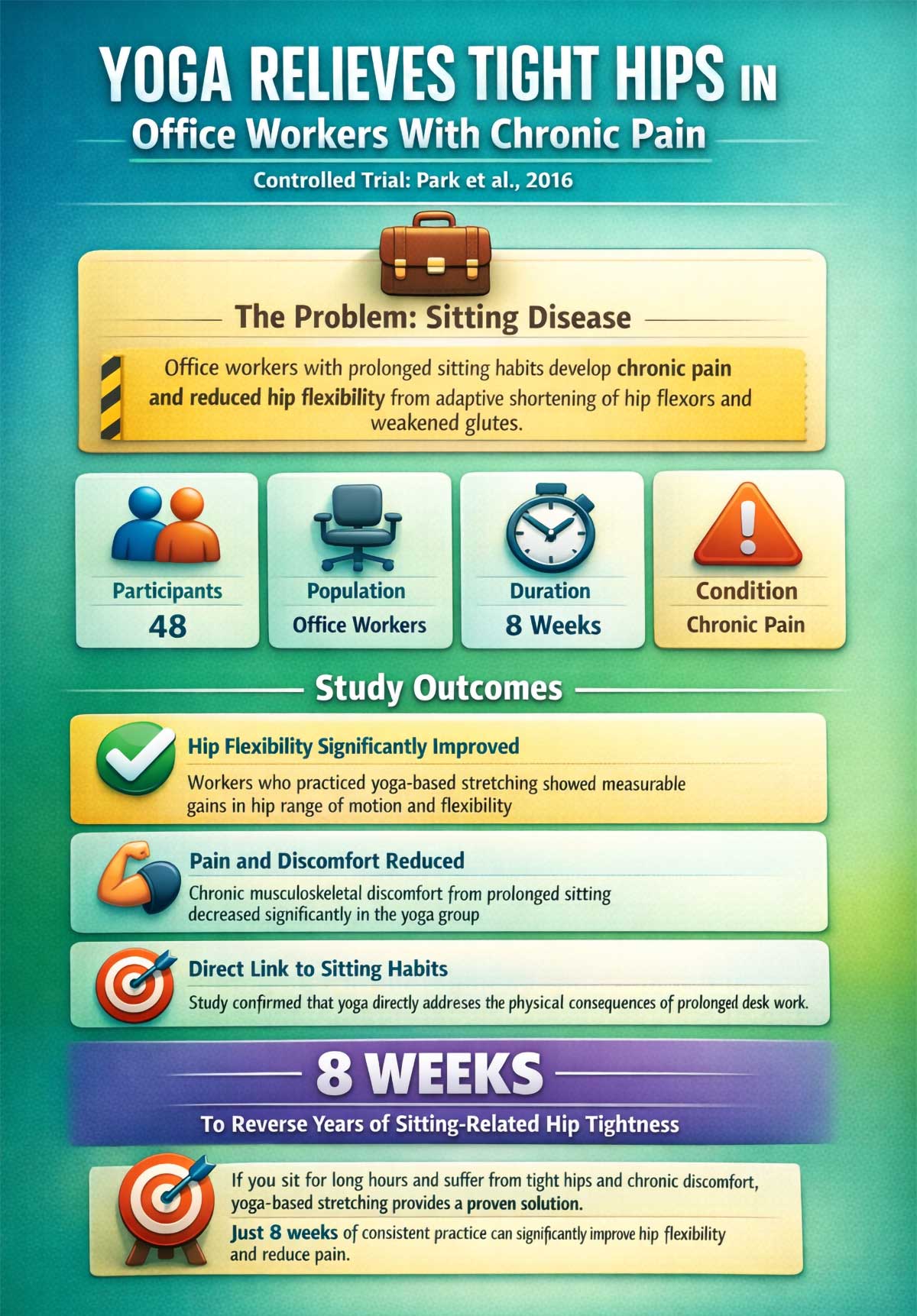
A 2016 study of 48 office workers with chronic pain found that prolonged sitting habits directly contributed to reduced hip flexibility and ongoing discomfort. After 8 weeks of yoga-based stretching, these workers showed significant improvements in hip mobility and reduced pain levels.
Understanding Your Hip Joint: A Quick Anatomy Lesson
Your hip is a ball-and-socket joint. It moves in six directions:
- Flexion: Bringing your knee toward your chest
- Extension: Pushing your leg behind you
- Abduction: Moving your leg out to the side
- Adduction: Bringing your leg back to center
- Internal rotation: Turning your thigh inward
- External rotation: Turning your thigh outward
Sitting all day locks you into flexion. You lose extension, rotation, and abduction. These five poses restore all six movements.
How Yoga Actually Fixes Tight Hips
Yoga isn’t just about stretching. That’s what most people get wrong.
Your nervous system controls how much your muscles can lengthen. When you sit all day, your nervous system treats that shortened position as “normal.” It resists any attempt to change.
Yoga works because it combines two things:
Passive stretching tells your muscles to relax and lengthen. You hold positions that gently pull on tight tissues.
Active strengthening tells your nervous system it’s safe to release tension. When you activate weak muscles (like your glutes), your tight muscles (like your hip flexors) naturally relax. Scientists call this “reciprocal inhibition.”
Most articles tell you to just stretch more. That’s only half the solution.
A 2016 study involving 118 sedentary older adults (average age 62) demonstrated that Hatha yoga practiced three times weekly for 8 weeks significantly improved lower body flexibility, including hip range of motion and sit-and-reach scores. The sessions lasted 60 minutes each, proving that consistent moderate practice produces measurable results.

The best part? You don’t need hour-long sessions. Short, daily practice beats one long weekly class.
The Big 5: Your Complete Hip Mobility Routine
These five poses target every angle of hip tightness. You can do them all in 30 minutes or pick two for a quick 10-minute session.
1. Supine Figure-Four (Reclined Pigeon Pose)
What it targets: Your deep hip rotators (piriformis, obturator internus, gemelli) and gluteus medius
Why it works: Most yoga teachers recommend Pigeon Pose for tight hips. But if you’re a beginner, Pigeon Pose can strain your knees. This lying-down version gives you the same benefits without the risk. The supine position removes spinal load while addressing the most commonly tight hip rotators from prolonged sitting.
How to do it:
Lie on your back. Bend both knees. Place your feet flat on the floor.
Cross your right ankle over your left thigh. Your right knee points out to the side.
Lift your left foot off the floor. Thread your right hand through the space between your legs. Clasp both hands behind your left thigh.
Gently pull your left thigh toward your chest. Keep your head and shoulders relaxed on the floor.
Flex your right foot (pull your toes toward your shin). This protects your knee joint.
Hold for 1-3 minutes. Breathe deeply. Switch sides.
You should feel a stretch in your right hip and glute. If you feel pain in your knee, back off a bit.

Common mistakes to avoid:
Don’t pull your knee toward your shoulder—this strains the hip joint. Always pull the thigh toward your chest instead.
Don’t point your crossed foot. A flexed foot protects your knee from torque.
Don’t hold your breath. Breathing signals your nervous system to relax.
2. Low Lunge: The Desk Worker’s Antidote
What it targets: Your hip flexors (iliopsoas, rectus femoris, tensor fasciae latae) and anterior hip capsule
Why it works: This pose literally reverses the sitting position. Instead of keeping your hips at 90 degrees, you extend them fully. This tells your shortened hip flexors to lengthen again. The anterior hip capsule—the connective tissue at the front of your hip joint—gets stretched, restoring mobility essential for normal gait and upright posture.
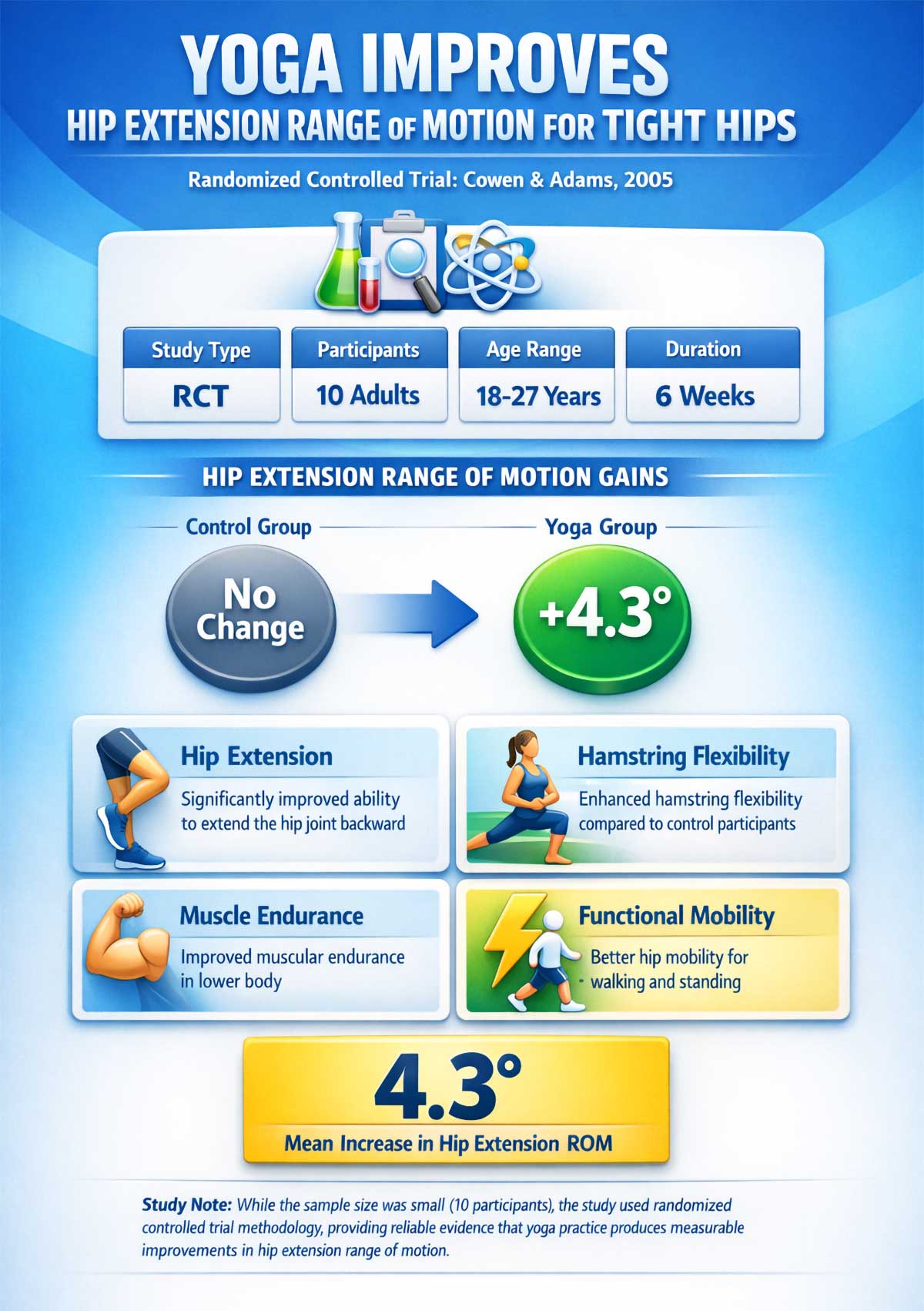
A 2005 randomized controlled trial of 10 healthy adults found that 6 weeks of yoga practice significantly improved hip extension range of motion, with a mean increase of 4.3 degrees compared to controls. While the sample size was small, the results demonstrate measurable improvements in hip extension—exactly what Low Lunge provides.
How to do it:
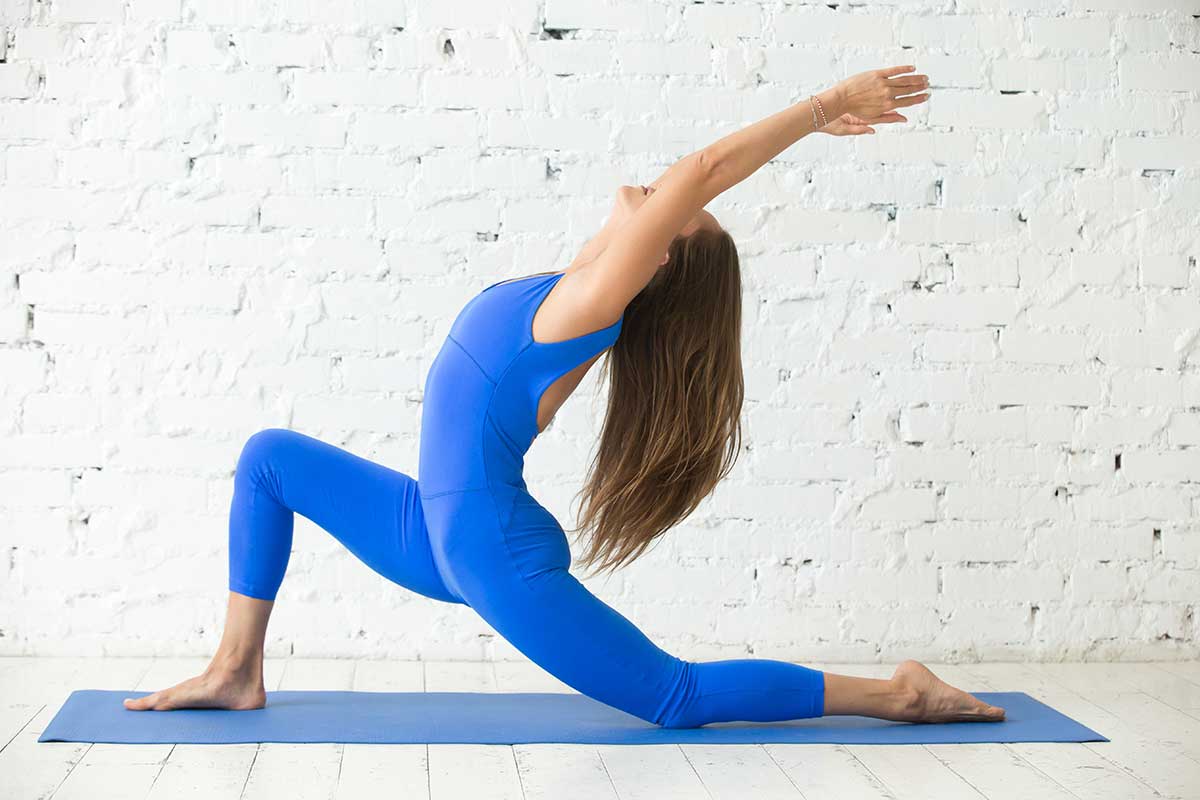
Start on your hands and knees. Step your right foot forward between your hands. Your right knee should stack over your right ankle.
Slide your left knee back. The top of your left foot rests on the floor.
Place your hands on yoga blocks if you have them. This helps you stay upright.
Lift your chest. Don’t let your lower back arch too much.
Press your hips forward gently. You should feel a stretch at the front of your left hip.
Hold for 1-2 minutes. Keep breathing. Switch sides.
Pro tip: If your back knee hurts on the floor, fold a blanket under it.
Common mistakes to avoid:
Don’t let your front knee drift past your toes. This puts stress on your knee joint.
Don’t let your front knee collapse inward. Keep it aligned over your ankle.
Don’t dump into your lower back. Keep your core engaged to protect your spine.
3. Butterfly Pose: The Adductor Opener
What it targets: Your adductors (gracilis, adductor longus, adductor brevis, adductor magnus) and groin
Why it works: Tight inner thighs pull on your pelvis. They limit how wide you can open your legs. This affects everything from walking to climbing stairs. Butterfly Pose uses gravity to gently release these muscles while loading the hip joint capsule in multiple planes. This improves comfort in wide-stance movements and addresses inner thigh tightness. No forcing required.
How to do it:
Sit on the floor. Bend your knees and bring the soles of your feet together.
Let your knees fall out to the sides. Hold your feet with your hands.
Sit up tall. Keep your spine long.
You can stay upright or fold forward slightly. Go only as far as feels comfortable.
Hold for 2-5 minutes. Breathe into any tight spots.
What you’ll feel: A pulling sensation in your inner thighs and groin. This is normal. Pain is not. If you feel pain, sit on a folded blanket to raise your hips.
Common mistakes to avoid:
Don’t round your back to get your head closer to your feet. Fold from your hips, not your spine.
Don’t push your knees down with your hands. Let gravity do the work.
Don’t sit in pain. Elevate your hips on a block or blanket if needed.
4. Reclined Spinal Twist: The Rotation Restorer
What it targets: Internal hip rotation and lateral hip structures (tensor fasciae latae, external rotators)
Why it works: Internal rotation is the most ignored hip movement. But you need it for normal walking. When you can’t rotate your hip inward, your lower back twists instead. This causes pain. This gentle twist restores internal rotation without loading your joints. The safe supine position allows passive stretching of external rotators and lateral hip structures.
How to do it:
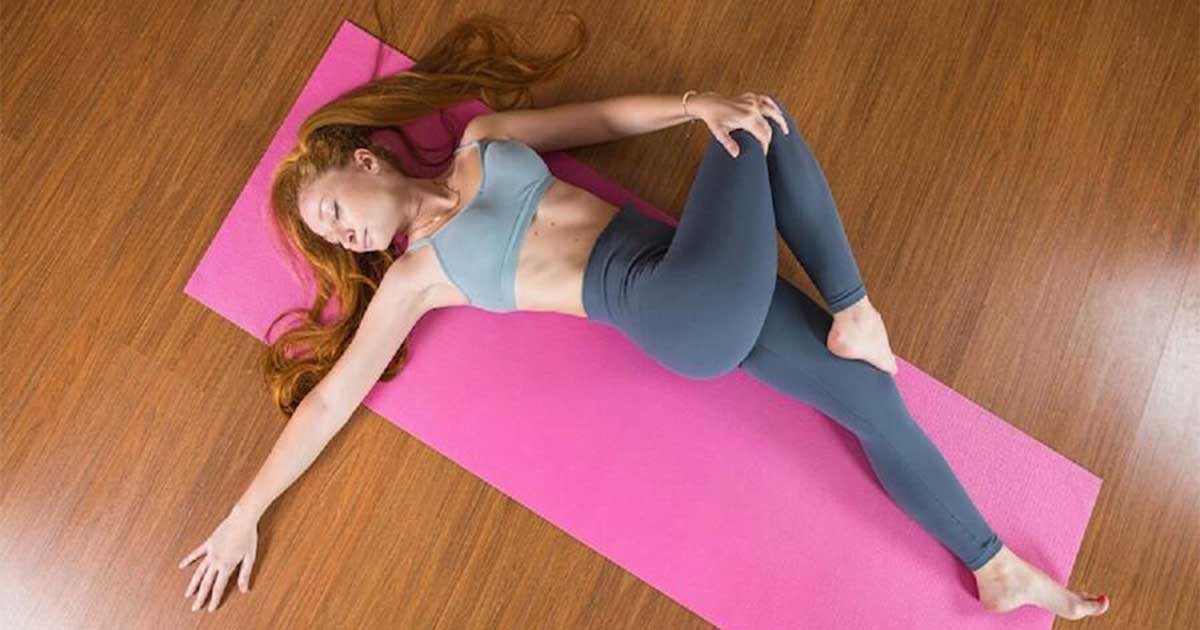
Lie on your back. Bend both knees. Place your feet flat on the floor.
Extend your arms out to the sides in a “T” shape.
Drop both knees to the right side. Let them rest on the floor (or close to it).
Keep your left shoulder on the floor. Turn your head to the left.
Hold for 1-3 minutes. Breathe deeply. Switch sides.
You should feel a stretch along your outer left hip and lower back. Let gravity do the work.
Common mistakes to avoid:
Don’t force your knees all the way to the floor. Meet your body where it is today.
Don’t let your opposite shoulder lift off the ground. Keep both shoulders anchored.
Don’t hold tension in your legs. Let them be heavy and relaxed.
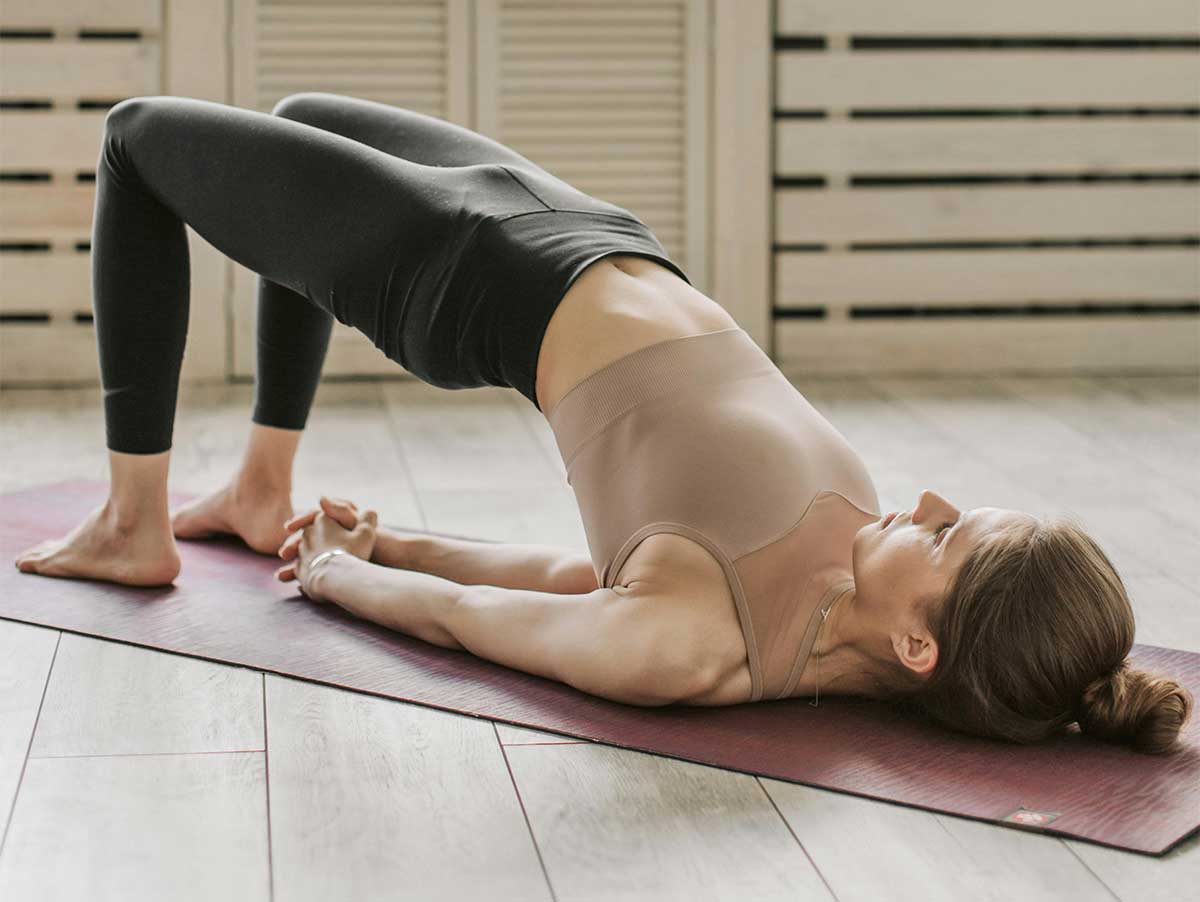
5. Bridge Pose: The Strength-Stability Component
What it targets: Posterior chain (glutes, hamstrings) and hip flexor opening
Why it works: Here’s the secret most people miss. Stretching alone won’t fix tight hips permanently. You need to strengthen the opposite muscles too.
When you activate your glutes and hamstrings, your hip flexors automatically relax. This is that reciprocal inhibition we talked about earlier. You’re building usable mobility, not just flexibility. The combination of strengthening and stretching helps the nervous system release protective tension and allows more functional hip range of motion.
How to do it:
Lie on your back. Bend your knees. Place your feet flat on the floor, hip-width apart.
Your feet should be close to your butt. Heels directly under your knees.
Press into your feet. Lift your hips toward the ceiling.
Squeeze your glutes hard. Keep your knees pointing forward (don’t let them fall in or out).
Hold for 30 seconds to 1 minute. Lower down slowly. Rest. Repeat 3-5 times.
Key point: Your knees should stay over your ankles. If they push forward past your toes, your feet are too far from your butt.
Common mistakes to avoid:
Don’t squeeze your glutes so hard that your lower back arches too much. Keep your ribs down.
Don’t let your knees splay out or collapse in. Maintain parallel alignment.
Don’t lift your heels. Keep your entire foot planted firmly.
What You Need to Get Started: Your Props Shopping List
You don’t need much to practice these poses safely and effectively.
Essential:
- Yoga mat or soft carpet (any basic mat works; skip the $100 options)
Highly recommended:
- 2 yoga blocks ($15-25 for a set; cork or foam both work)
- These make Low Lunge accessible and safe
Optional but helpful:
- 1-2 blankets for knee padding and hip elevation
- Foam roller for pre-yoga muscle prep
- Yoga strap for assisted stretches (an old belt works too)
Not necessary:
- Expensive yoga clothes (comfortable clothes you own work fine)
- Meditation cushions
- Incense or candles
- Special yoga towels
Build Your Custom Routine
You don’t need to do all five poses every day. Match your routine to your schedule and your needs.
Quick Relief: The 10-Minute Office Break
When you’re tight and tired, focus on the poses that reverse sitting:
- Low Lunge (1 minute each side)
- Bridge Pose (30 seconds, repeat 3 times)
- Supine Figure-Four (1 minute each side)
This quick sequence wakes up your glutes and opens your hip flexors. Do it mid-afternoon when you feel stiff.
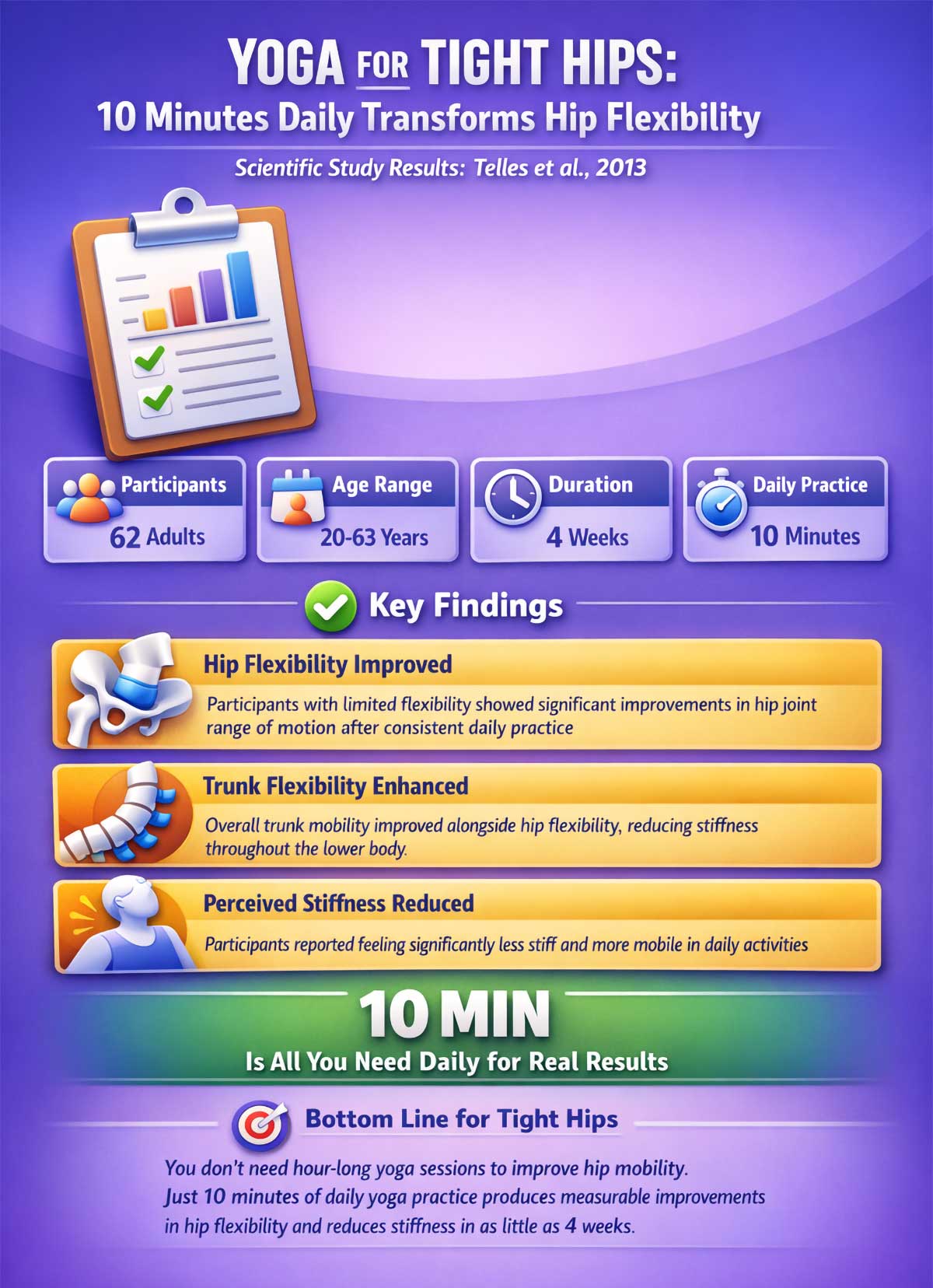
A 2013 study of 62 adults with limited flexibility found that just 10 minutes of daily yoga sessions significantly improved hip and trunk flexibility while reducing perceived stiffness after only 4 weeks. This express routine isn’t a compromise—it’s scientifically sound.
Deep Work: The 30-Minute Evening Recovery
When you have more time, go deep:
- Supine Figure-Four (3 minutes each side)
- Low Lunge (2 minutes each side)
- Butterfly Pose (5 minutes)
- Reclined Spinal Twist (3 minutes each side)
- Bridge Pose (1 minute total, broken into 3 sets)
Hold each stretch longer. Let your body melt into the poses. This is your deep fascial release session.
Weekend Reset: The 20-Minute Moderate Flow
For a balanced middle ground:
- Supine Figure-Four (2 minutes each side)
- Butterfly Pose (3 minutes)
- Low Lunge (1.5 minutes each side)
- Bridge Pose (45 seconds, repeat 3 times)
- Reclined Spinal Twist (2 minutes each side)
This routine hits all six hip movements without requiring too much time.
Your Weekly Practice Schedule
Consistency beats intensity. Here’s a sample week that balances deep work with quick maintenance.
| Day | Routine | Duration | Focus |
|---|---|---|---|
| Monday | Full 5-pose sequence | 30 min | Deep release |
| Tuesday | Office break routine | 10 min | Hip flexors & glutes |
| Wednesday | Full 5-pose sequence | 30 min | Deep release |
| Thursday | Rest or gentle walking | – | Recovery |
| Friday | Office break routine | 10 min | Hip flexors & glutes |
| Saturday | Full 5-pose sequence | 30 min | Deep release |
| Sunday | Butterfly + Twist only | 15 min | Gentle maintenance |
Adjust based on your schedule. Three full sessions weekly plus two short sessions will produce results.
Get More From Every Pose
These tips will speed up your progress.
Breathe with your belly. Deep breathing switches your nervous system from “tense” to “relaxed.” When you breathe in, your belly should expand. When you breathe out, let your body sink deeper into the stretch. This signals safety to your nervous system.
Use props without shame. Yoga blocks, folded blankets, and pillows aren’t for beginners only. They help you meet your body where it is today. Can’t reach the floor in Low Lunge? Use blocks. Knees hurt? Add padding. That’s smart, not weak.
Choose frequency over intensity. Your hip tissues remodel best with consistent, gentle pressure. Doing these poses 6 days a week for 10 minutes beats a single 90-minute class once a week. Your connective tissues need regular input to change their structure.
Track your progress. Notice small changes. Can you fold deeper in Butterfly Pose this week? Does Low Lunge feel less intense? These small wins add up. Take a photo from the same angle every two weeks to see visual progress.
Warm up first. Five minutes of walking or gentle movement before stretching helps. Cold tissues resist lengthening. Warm tissues respond better.
What to Expect: Your Progression Timeline
Set realistic expectations. Hip mobility doesn’t appear overnight, but changes come faster than you think.
| Timeline | What to Expect | How to Progress |
|---|---|---|
| Week 1-2 | Poses feel very tight; you may not go deep | Focus on breathing, hold shorter times (30-60 seconds) |
| Week 3-4 | Notice slight improvements in depth; less next-day soreness | Increase hold times by 30 seconds per pose |
| Week 5-8 | Clearer range of motion gains; easier to get into poses | Add intensity (deeper lunges, higher bridge lifts) |
| Week 9-12 | Significant flexibility; reduced back pain during daily activities | Maintain routine, consider adding advanced variations |
A 2013 systematic review analyzing 17 randomized controlled trials confirmed that yoga consistently improved flexibility across multiple joints, with strong evidence supporting its effectiveness. Hip-specific outcomes showed positive trends across studies, with improvements typically becoming noticeable within 4-8 weeks of consistent practice.
Warning Signs: When to Stop
Stretching should feel like gentle pulling, not stabbing or burning. Stop immediately if you feel:
- Sharp pain in your joints (especially knees or lower back)
- Pinching sensations in the front of your hip
- Numbness or tingling down your leg
- Pain that gets worse as you hold the pose
- Clicking or popping accompanied by pain
Mild muscle soreness the next day is normal. Sharp joint pain is not. If you experience any of these warning signs, back off the intensity. If pain persists, consult a healthcare provider.
Common Myths About Hip Flexibility
Let’s clear up some confusion.
Myth 1: “You need to be flexible to start yoga.”
Truth: These poses work specifically BECAUSE you’re tight. That’s the point. Yoga meets you where you are. Saying you’re too tight for yoga is like saying you’re too dirty for a shower.
Myth 2: “Stretching more intensely gives faster results.”
Truth: Gentle, frequent stretching beats aggressive stretching. Your nervous system resists force. It interprets intense pain as danger and tightens up more. Moderate discomfort signals safe lengthening.
Myth 3: “If it doesn’t hurt, it’s not working.”
Truth: Pain is a warning signal, not a progress indicator. Effective stretching feels like gentle pulling or mild discomfort (about 5-6 out of 10). Anything higher is counterproductive.
Myth 4: “Hip tightness is just part of getting older.”
Truth: It’s part of sitting more, not aging itself. Active older adults maintain hip mobility well into their 70s and 80s. Sedentary 30-year-olds develop tight hips. Movement patterns matter more than age.
Myth 5: “You should bounce while stretching to go deeper.”
Truth: Bouncing triggers your stretch reflex, causing muscles to contract protectively. This increases injury risk and reduces effectiveness. Hold stretches still and breathe.
Beyond the Basics: Next-Level Progressions
Once these five poses feel comfortable (usually after 8-12 weeks), try these progressions:
Supine Figure-Four progression: Pull your shin parallel to the floor instead of pulling your thigh. This creates a more intense stretch in your deep hip rotators.
Low Lunge progression: Lift your back knee and straighten your back leg. This is High Lunge. It adds quad strengthening while maintaining the hip flexor stretch.
Butterfly Pose progression: Fold forward from your hips (not your back) to access deeper tissue layers. Keep your spine long as you hinge forward.
Reclined Spinal Twist progression: Extend your top leg straight while keeping the bottom knee bent. This intensifies the stretch along your IT band and lateral hip.
Bridge Pose progression: Lift one leg straight toward the ceiling while holding the bridge position. This is Single-Leg Bridge. It challenges stability and strengthens each glute independently.
Don’t rush these progressions. Master the basics first.
Pair Yoga With These Activities
Hip mobility improves faster when you support it with complementary movement.
Walking: 20-30 minutes daily reinforces hip mobility gains. Walking takes your hips through their natural range of motion and strengthens what yoga lengthens.
Foam rolling: Roll your IT band, hip flexors, and glutes for 5-10 minutes before yoga. This prep work helps tissues respond better to stretching.
Strength training: Squats, deadlifts, and lunges build the strength yoga starts. Strong muscles support mobile joints. Aim for 2-3 strength sessions weekly.
Swimming: Provides hip mobility work without impact stress. The water supports your body weight while you move through full ranges of motion.
Cycling: Moderate cycling maintains hip flexor length. Avoid excessive cycling (more than 10 hours weekly), which can tighten hip flexors.
A 2010 literature review examining physical and mental health benefits of yoga found that yoga improves flexibility, balance, and overall function through sustained, low-intensity stretching. The review noted that hip mobility specifically appeared as a common benefit across multiple studies, particularly when yoga was combined with other moderate physical activities.
When to Talk to Your Doctor First
These poses are generally safe, but some conditions require professional guidance.
Seek medical advice before starting if you have:
- Hip arthritis (osteoarthritis or rheumatoid)
- Recent hip surgery (within 6 months)
- Hip labral tears or FAI (femoroacetabular impingement)
- Chronic pain conditions affecting your hips or pelvis
- History of hip dislocation
- Active herniated disc or sciatica
- Pregnancy complications
Your healthcare provider can help you modify poses safely or may refer you to a physical therapist for individualized guidance.
If you experience new sharp pain, swelling, or reduced function while practicing, stop and consult a professional. Don’t push through concerning symptoms.
Conclusion
Tight hips aren’t just annoying. They affect how you walk, stand, and sit. They cause lower back pain. They make you feel older than you are.
But here’s the truth: You can fix this. A 2015 randomized controlled trial of 95 adults with chronic non-specific low back pain found that 12 weeks of Iyengar yoga improved functional ability and reduced pain. While the study focused on back pain, hip mobility improvements were noted as secondary benefits—showing that addressing hip tightness can reduce back discomfort.
You don’t need fancy equipment. You don’t need to be flexible already. You just need 10 to 30 minutes and a commitment to show up.
Start with one pose. Do it today. Do it again tomorrow. Your hips will thank you.
The stiffness you feel right now isn’t permanent. It’s just your body adapting to how you’ve been moving (or not moving). Give it new information. Give it these five poses. Watch what happens.
FAQs
My knees hurt in Butterfly Pose. What should I do?
Sit on a folded blanket or yoga block. This tilts your pelvis forward and takes pressure off your knees. You can also place blocks under each knee for support. Don’t force your knees toward the floor.
I can’t get my back knee down in Low Lunge. Is that okay?
Yes. Keep your back toes tucked under and your knee lifted. This is actually harder and works your legs more. It’s called High Lunge. Lower the knee when you’re ready. There’s no rush.
Should I feel sore after doing these poses?
Mild muscle soreness the next day is normal, especially in your glutes and inner thighs. This means you’re working muscles that have been asleep. Sharp pain is not normal. If you’re very sore, cut your hold times in half and build up gradually.
Can I do this routine every day?
Yes. Unlike weight training, these gentle stretches are safe for daily practice. Your connective tissues need frequent, consistent input to remodel. Daily practice is actually more effective than less frequent longer sessions.
How long until I see results?
Most people notice less stiffness within 1-2 weeks. Measurable flexibility gains typically appear within 4-8 weeks of consistent practice. Your timeline depends on your starting flexibility and how often you practice.
I feel a pinching sensation in the front of my hip during Low Lunge. Is that normal?
No. This suggests hip impingement or capsular restriction. Reduce your range of motion. Don’t push as deep into the lunge. If pinching continues, see a physical therapist. Some hip structures need professional assessment.
Can I do these poses if I’m pregnant?
Generally yes, but modifications help. Skip deep twists in later pregnancy. Use blocks to keep your belly comfortable. Consult your doctor or a prenatal yoga instructor for specific guidance.