If you feel exhausted before lunch despite getting plenty done, don’t blame motivation. Your brain may be paying a hidden price every time your focus shifts.
You sit down to work at 9 a.m. with a clear list and good intentions. By 11 a.m., you’ve answered fourteen messages, half-finished a report, joined a meeting you weren’t prepared for, and opened your inbox twice between each of those. You feel like you’ve been working hard. You haven’t been working well.
This isn’t a motivation problem. It isn’t a time management problem in the way most people mean that phrase. The research points somewhere more specific: every time you shift your attention from one task to another, your brain pays a cost. That cost compounds. And for most people doing knowledge work in a world of constant notifications, the bill is due all day.
The irony is that the people who think they’re best at this are often the worst off.
The Sticky Brain Effect
Think of your focus less like a cursor you drag across a screen and more like a strip of tape you’re peeling off a surface. When you pull it away, some of it sticks. That residue doesn’t disappear the moment you move on to the next task. It lingers.
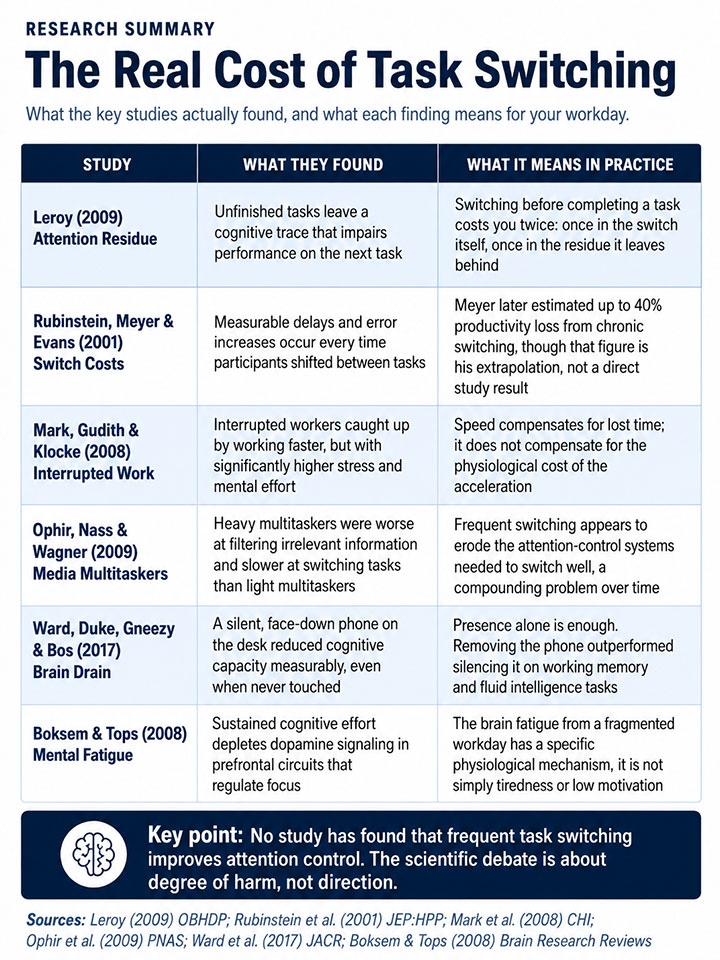
Sophie Leroy, a professor of management at the University of Washington Bothell, gave this phenomenon its name in a 2009 paper in Organizational Behavior and Human Decision Processes: attention residue. Her research showed that when people move from Task A to Task B without fully completing Task A, part of their cognitive attention stays anchored to the unfinished work. The result is that performance on the new task drops, often without the person realizing why they feel scattered.
You can be physically present at your desk, eyes on a document, and still be cognitively elsewhere. The question the research has been trying to answer is how much that costs you, and whether you can do anything about it.
What the Science Says About the Real Cost
The figure most often cited in productivity writing is that task switching can reduce efficiency by as much as 40%. That number traces back to research by Joshua Rubinstein, David Meyer, and Jeffrey Evans, published in a 2001 issue of the Journal of Experimental Psychology: Human Perception and Performance.
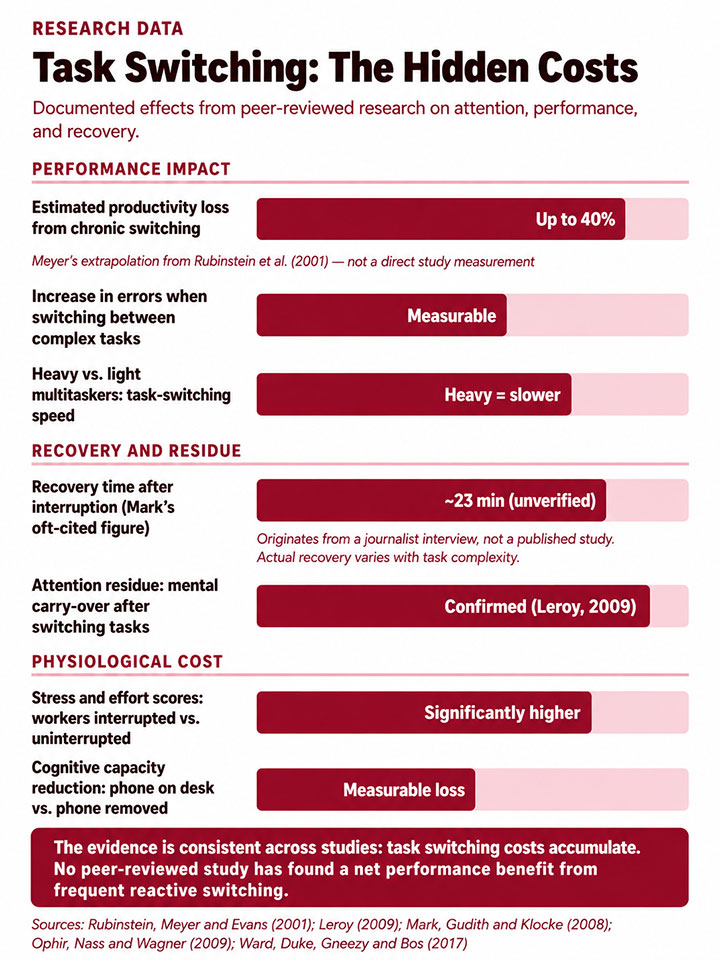
Their experiments found measurable “switch costs” (delays and increased error rates) whenever participants had to shift between tasks. Meyer has since estimated that chronic task switching could account for a 40% productivity loss, though that figure is his extrapolation from the lab data rather than a single measured outcome.
The 40% estimate gets a lot of circulation. What gets less attention is what the research actually measured: the time it takes for the brain to disengage a prior set of rules and configure for a new task.
Even in controlled conditions, with simple lab tasks and willing participants, the cost was real and consistent. That raises an obvious question: what happens when the switching doesn’t stop at the end of a lab session, but runs all day, every day?
Why Working Faster Doesn’t Fix It
Gloria Mark, a professor of informatics at UC Irvine who has spent years studying how people use computers at work, set up an experiment worth sitting with for a moment. In a 2008 study published in the ACM Conference on Human Factors in Computing Systems, Mark and her colleagues found that workers who were interrupted did eventually catch up, but they did so by accelerating their pace.
The researchers also measured what that acceleration cost: stress, frustration, and mental effort scores climbed significantly as the day progressed. They were making up time and spending something they didn’t know they had.
A figure you’ll often see attached to Mark’s name is that it takes “23 minutes and 15 seconds” to fully regain focus after an interruption. That specific number deserves honest treatment: it appears to have originated from an interview Mark gave to a journalist, not from a published study.
What her research does consistently show is that recovery time from disruptions is substantial and varies by task complexity. The picture the data draws is one of compounding recovery gaps, not a clean, measurable window.

The Long-Term Cost: Filter Failure
Heavy multitaskers were assumed, intuitively, to be better at managing multiple streams of information. Eyal Ophir, Clifford Nass, and Anthony Wagner at Stanford decided to test that assumption.
What they found in their 2009 Proceedings of the National Academy of Sciences study overturned it: people who regularly juggled multiple media streams were worse at filtering out irrelevant information, worse at holding information in working memory, and slower at switching between tasks than people who multitasked less.
The group that considered itself better at handling multiple things at once was, by the lab’s measures, the most cognitively disrupted. Three subsequent studies (Alzahabi and Becker, Minear, Baumgartner) failed to replicate aspects of this, so the picture is still being worked out. What no study has found is a benefit. The argument in the literature is about degree of harm, not direction.
Why the Drain Is Real, Not Just in Your Head
The fatigue that follows a fragmented workday has a physiological account. Maarten Boksem and Marc Tops, in a 2008 review published in Brain Research Reviews, described how sustained cognitive effort depletes the dopamine signaling in prefrontal circuits that regulate focus and error-monitoring.
The anterior cingulate cortex, which tracks the gap between intended and actual performance, increases its signaling when that gap widens, and task switching widens it repeatedly, all day.
There is a competing explanation that has received significant attention: Roy Baumeister and Kathleen Vohs’s ego depletion model, which proposes that self-regulatory capacity functions like a limited fuel supply and gets used up.
Their 2007 paper in Social and Personality Psychology Compass was influential and widely cited. It has also run into serious trouble. The collapse of ego depletion is one of the more dramatic correction stories in recent psychology.
A 2016 registered replication across 23 independent labs, involving more than 2,000 participants, found no meaningful effect. The model is not settled science, and covering this topic honestly means saying so.
What remains better supported is the neurological account: task switching imposes a real cost on the prefrontal systems that manage executive control, and those systems do not recover instantaneously between shifts.
What This Looks Like in ADHD
For people with ADHD, task switching doesn’t just cost more. It sits at the intersection of what the condition already makes harder at baseline.
Research by Nicholas Cepeda, Manuel Cepeda, and Arthur Kramer, published in the Journal of Abnormal Child Psychology in 2000, found that switch costs (the measurable delays when moving from one task to another) were significantly higher in children with ADHD than in their non-ADHD peers, whether or not they were on medication.
The difference wasn’t in their ability to do either task. It was in the cost of the transition between them. That study focused on children, and adult ADHD research has developed considerably since. The transition difficulty itself, however, is widely reported across ages.
The mechanism likely involves the same executive control circuits described above, operating under greater baseline strain. Task inertia (the difficulty disengaging from one activity and initiating another) is one of the more common day-to-day challenges people with ADHD describe, and the lab data on switch costs gives that description a reasonable physiological basis. People on the autism spectrum often report something similar, particularly when transitions are unplanned.
Task-switching ability is not fixed. For people with ADHD, that single fact may be the most useful thing in this section. Jutta Kray and colleagues spent several years developing a structured switching-training protocol for children with ADHD, and their 2012 findings in Frontiers in Human Neuroscience showed measurable improvements in executive control.
The training worked. What it required was sustained, repeated practice of the transition itself: not better time management, not stronger willpower, but deliberate practice of the specific cognitive act of disengaging from one task and reorienting to another.

When Task Switching Is Actually Useful
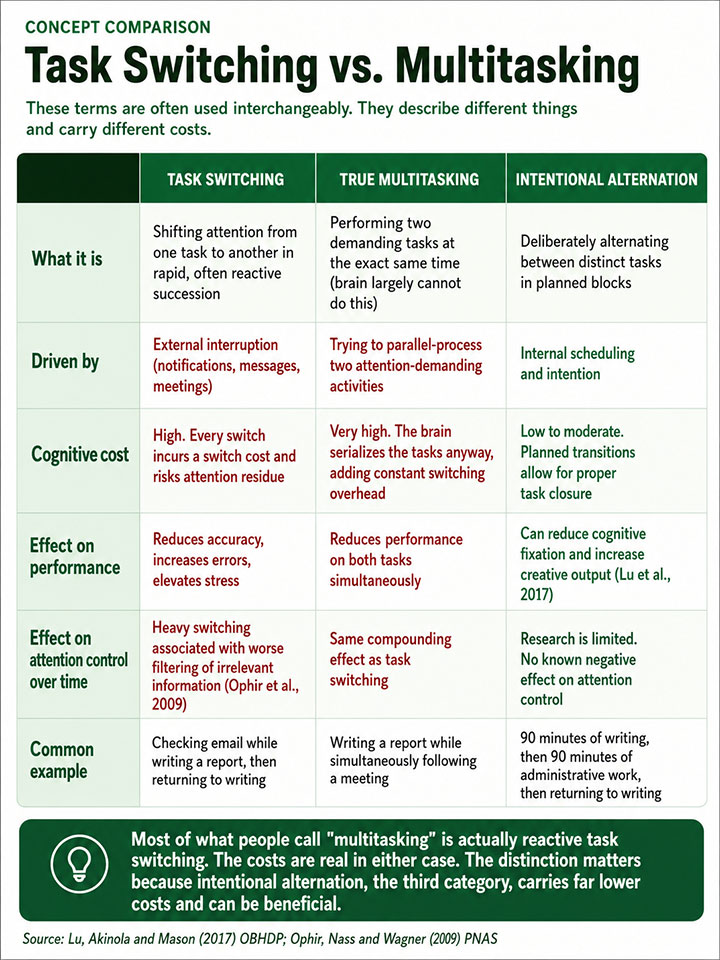
There is a category of task switching that research has found demonstrably beneficial, and conflating it with the problem behavior described above produces exactly the wrong conclusion.
Jackson Lu, Modupe Akinola, and Malia Mason at Columbia Business School studied what happens when people switch between distinct, meaningfully different tasks: not reactive checking and interruption, but intentional alternation.
Their 2017 paper in Organizational Behavior and Human Decision Processes found that this kind of switching reduced cognitive fixation and increased creative output. Moving between substantively different work gave participants a fresh angle on problems where they’d been stuck.
The distinction matters. Checking email every eight minutes while writing is reactive switching driven by external interruption. Spending ninety minutes on a writing task, then ninety minutes on a different kind of work before returning, is intentional alternation. The first creates the costs this article is about. The second can be genuinely useful.
5 Practices That Actually Help
The research points toward a small set of behavioral changes that address the actual mechanism, not productivity philosophy: specific, implementable habits.
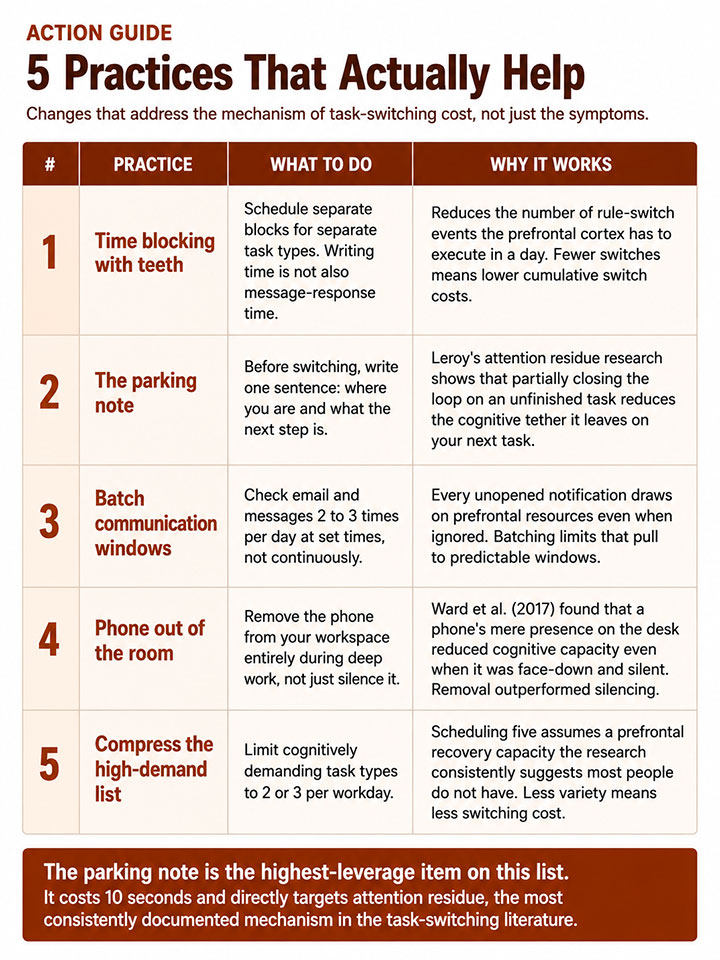
1. Time blocking with teeth. Schedule distinct blocks for distinct types of work. A block for writing is not also a block for responding to messages. The division by task type matters more than the specific duration.
2. The parking note. Before switching away from a task (whether by choice or interruption), write one sentence: where you are, and what the next step is. Leroy’s attention residue research suggests that closing the loop on an incomplete task, even partially, reduces the cognitive tether. The note is the loop.
3. Batch your communication windows. Two or three designated windows for email and messages per day, rather than continuous open access. Every unopened notification places a low-grade pull on prefrontal resources even when you don’t respond to it.
4. Notifications off, by default. Ward, Duke, Gneezy, and Bos published a study in the Journal of the Association for Consumer Research in 2017 showing that the mere presence of a smartphone on a desk reduced available cognitive capacity, even when the phone was face-down and silent.
The researchers measured the effect through working memory tasks and fluid intelligence scores. Removing the phone entirely performed better than silencing it. The phone on your desk is costing you something even when you’re not looking at it.
5. Compress your high-complexity task list. Limit the number of cognitively demanding tasks you attempt to shift between in a single workday. Two or three is realistic for most people doing genuine depth work. Scheduling five assumes a recovery capacity the research suggests most brains don’t have.
Daily Focus Cost Estimator
Find out how much focused thinking time your switching habits may be costing you each day.
Where it comes from
The Thing Most Productivity Advice Gets Wrong
Most advice about focus treats attention like a resource you’re not using efficiently enough. The research says something different: attention is a resource you’re spending whether you intend to or not, and the hidden spending happens at every transition.
You finish one recovery window and immediately trigger another. You exist in a permanent state of shallow focus, always catching up, never quite arriving. That is not a discipline failure.
The brain is doing what a system built for survival in a physically demanding, socially complex world was designed to do, which turns out to be poorly suited to an eight-hour day of context switching between email, deep work, and real-time communication.
The architecture of modern work demands something the prefrontal cortex was not built to sustain. That’s not a character flaw. It’s a design mismatch. And design mismatches can be worked around, even when they can’t be willed away.