You slept last night. You had your coffee this morning. So why do you feel like you’re running on empty? You’re not alone. A 2020 CDC report found that more than one in three American adults feels tired or exhausted most days.
Fatigue has quietly become one of the most common health complaints seen in primary care offices. Yet most people brush it off as stress or a sign of “just getting older.”
Here’s the uncomfortable truth: feeling “fine” is not the same as having real energy. There’s a wide gap between functioning and thriving. Millions of people live somewhere in that gap — managing their days but never really feeling alive in them.
Standard blood tests often miss the deeper picture. Your CBC may come back “normal” while your cells quietly starve for oxygen, your cortisol rhythm falls apart, or your hydration hovers just below the line where your brain starts to slow down. That said, if your fatigue is new, severe, or hasn’t improved after two weeks of addressing basic sleep and nutrition, medical evaluation should come first — not last.
This article goes beyond “drink more water and get more sleep.” Below are 11 science-backed causes of persistent fatigue — each one tied to real research — along with practical fixes you can start using today.
1. Poor Sleep Quality: The Sleep Debt Problem
The most obvious place to start is also the most misunderstood.
Most people know that not sleeping enough makes you tired. What fewer people realize is that poor-quality sleep does the same damage — even when total hours look fine on paper.
Sleep isn’t just rest. It’s an active biological process. During deep and REM sleep, your brain clears metabolic waste, consolidates memory, and resets inflammatory pathways. When those stages get cut short or fragmented, everything suffers.
Research by Charles Czeisler and Joseph Gooley, reviewed in a 2023 CDC analysis, confirmed what sleep scientists have long argued: chronic sleep restriction builds a “debt” that you can’t pay back over a single weekend. People who sleep 6 hours per night for two weeks show the same cognitive impairment as those who go completely without sleep for 48 hours — and they don’t even feel impaired.
That’s the dangerous part. You adapt to feeling foggy. You stop noticing how tired you actually are.
The fix: Protect a 7–9 hour sleep window every night. Set a consistent wake time — yes, even on weekends. Give yourself 60 minutes of wind-down before bed with low light and no screens. This lowers core body temperature and supports natural melatonin production, setting the stage for deeper, more restorative sleep.
2. Dehydration: The 2% Problem
This one surprises people. You don’t need to feel parched to be dehydrated enough to feel tired.
A landmark study by Lawrence Armstrong and colleagues, published in the Journal of the American College of Nutrition (2012), tested the effects of mild dehydration — just a 2% drop in body water — on healthy adults. The results were stark. Even at that low level, fatigue perception increased significantly. Alertness dropped. Cognitive performance took a measurable hit.
Here’s why. Blood is largely water. When you’re even slightly dehydrated, blood volume drops and becomes thicker. Your heart has to pump harder to move the same amount of oxygen to your muscles and brain. The result feels exactly like fatigue — sluggishness, brain fog, low motivation.
The sneaky part? Most of us wake up mildly dehydrated every morning. You lose water just by breathing overnight. And if the first thing you do is reach for coffee — a mild diuretic — you’re digging a deeper hole before the day has started.
The fix: Front-load your hydration. Drink 16–20 oz of water within 30 minutes of waking, before coffee. This simple habit counteracts overnight water loss and primes your circulation for the day ahead. Carry a bottle and sip consistently throughout the day rather than gulping large amounts at once.
3. Iron Deficiency: You Don’t Have to Be Anemic to Be Exhausted
Most fatigue articles talk about anemia. This one’s going to take it a step further.
Your doctor checks your hemoglobin. It comes back normal. They tell you your iron is fine. But there’s another number — ferritin — that often tells a different story. Ferritin measures iron stores, and you can have perfectly normal hemoglobin while your ferritin is critically low.
A meta-analysis published in BMJ Open (Houston et al., 2018), covering 1,170 iron-deficient but non-anemic adults, found that iron supplementation meaningfully reduced fatigue scores even in people who wouldn’t technically be diagnosed with iron-deficiency anemia. The effect was clinically significant — a standardized mean difference of -0.38 on fatigue scales.
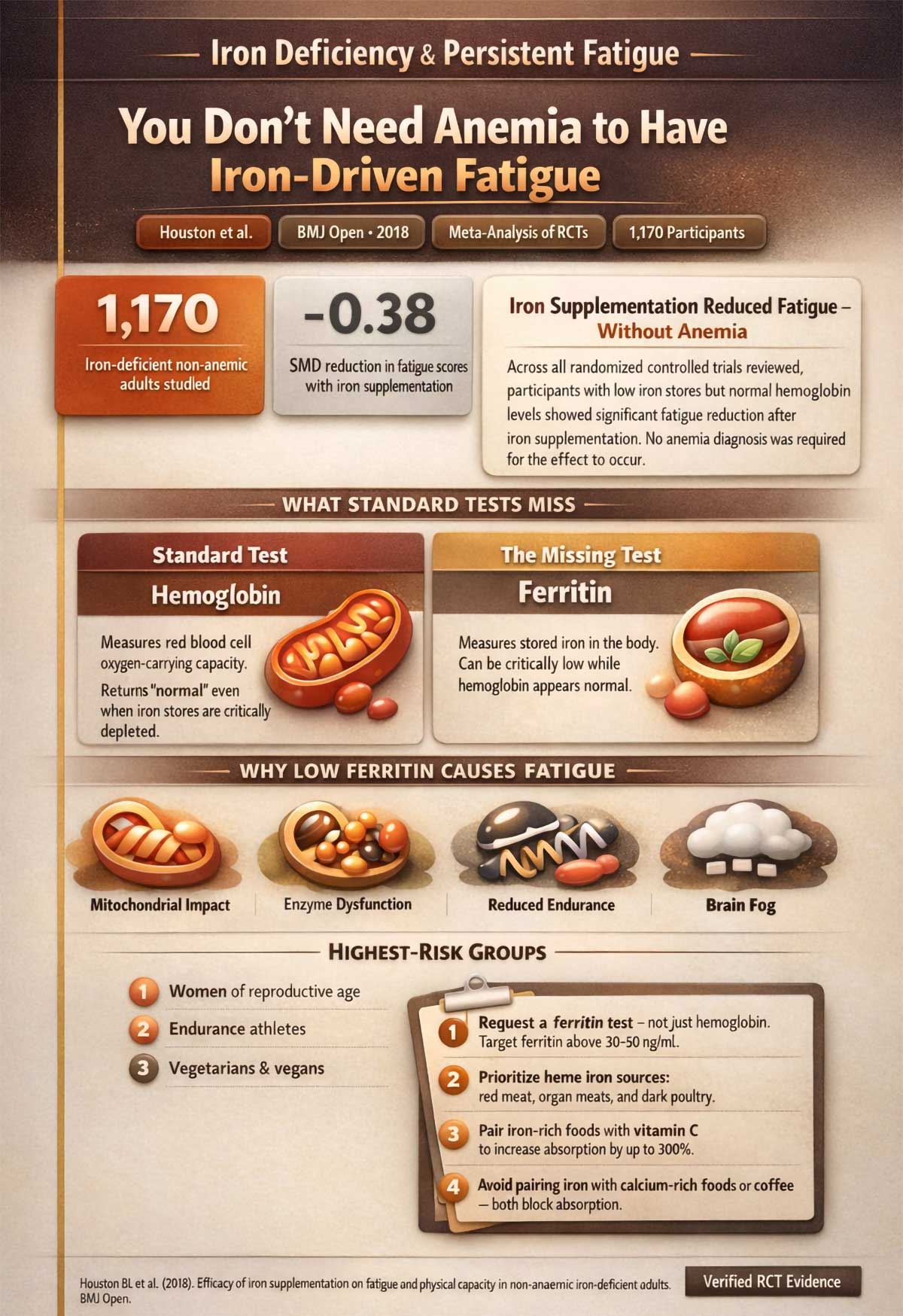
The mechanism makes sense. Iron isn’t just for red blood cells. It’s a core component of the enzymes inside your mitochondria — the parts of your cells that actually produce energy. Low iron means your cellular “power plants” run less efficiently. This hits especially hard in women of reproductive age and endurance athletes who deplete iron stores faster.
The fix: Ask your doctor for a ferritin test, not just hemoglobin. If your ferritin is below 30–50 ng/mL, that may explain your fatigue. Eat more heme iron sources — red meat, dark turkey meat, organ meats — paired with vitamin C, which can boost iron absorption by up to 300%. Avoid pairing iron-rich meals with calcium-rich foods or coffee, as these block absorption.
4. Blood Sugar Swings: The Glucose Rollercoaster
You know the 3 PM crash. You finish lunch and within an hour you’re fighting your eyelids, reaching for sugar or caffeine just to make it through the afternoon.
That pattern isn’t weak willpower. It’s biology.
When you eat high-carbohydrate meals — especially refined ones without much protein or fiber — your blood glucose spikes sharply. Your pancreas floods your bloodstream with insulin to bring it back down. Often, it overshoots. Blood sugar dips below baseline, and your brain — which runs almost entirely on glucose — starts sending out distress signals. Fatigue, irritability, inability to concentrate: these are your brain asking for fuel.
Research published by David Benton and colleagues (2011), in a review of diet and cognitive performance, confirmed the link between high glycemic load meals and post-meal energy crashes — particularly the kind that impair afternoon focus and sustained alertness.
This pattern is called reactive hypoglycemia. It’s not a disease requiring a formal diagnosis — it’s a normal metabolic response to certain meal types that millions of people experience without realizing it. You don’t need to be diabetic for your blood sugar to swing enough to wreck your afternoon.
The fix: Apply the “protein-first” principle. At every meal, prioritize protein, fiber, and healthy fats before carbohydrates. These slow glucose absorption and flatten the spike-crash cycle. Swap refined carbs for whole food sources — legumes, whole grains, root vegetables — and pay attention to how your energy holds up two hours after eating.
5. Physical Inactivity: The More You Rest, the Worse It Gets
This one seems backward. You’re exhausted, so the last thing you want to do is exercise. But here’s what the research shows: inactivity is itself a cause of fatigue, not just a consequence of it.
A major meta-analysis by Timothy Puetz, Patrick O’Connor, and Rod Dishman (2006), covering sedentary adults, found that regular moderate exercise reduced fatigue by approximately 20%. The benefits appeared with as few as 2–3 sessions per week. Notably, moderate-intensity activity — like brisk walking — outperformed high-intensity exercise for reducing fatigue in people who were previously sedentary.
The biological reason comes down to mitochondrial density. When you move regularly, your body adapts by creating more mitochondria in your muscle cells. More mitochondria means more energy production capacity. A sedentary body does the opposite — it scales back energy production because the demand isn’t there.
In other words, your body produces exactly as much energy as it thinks you need. Sit most of the day, and it assumes low demand. You feel drained doing basic tasks.
The fix: Start with 20-minute walks, 3–5 times per week. This is enough to begin triggering mitochondrial adaptation without overwhelming a fatigued body. The goal isn’t to push hard — it’s to give your system a regular signal that more energy is needed. Over weeks, that signal reshapes your baseline energy levels.
6. Chronic Stress and Cortisol Dysregulation
Stress doesn’t just make you feel mentally drained. It rewires your hormonal system in ways that leave you physically exhausted.
Here’s the mechanism. Your adrenal glands produce cortisol — a hormone that follows a daily rhythm. Cortisol should peak sharply about 30–45 minutes after waking (called the Cortisol Awakening Response, or CAR). This morning spike is what gives you that natural sense of alertness and readiness. By evening, cortisol drops, allowing your body to prepare for sleep.
Chronic psychological stress disrupts this rhythm. Research on workplace stress and fatigue, along with a 2009 longitudinal study by Chida and Steptoe, showed that long-term stress flattens the cortisol awakening response. You wake up without that natural surge. You feel neither properly alert nor properly rested — functional, but never actually refreshed. Sleep doesn’t restore you the way it should.
More recent work published in 2023 confirmed this connection: dysregulated cortisol patterns are consistently associated with persistent fatigue and burnout.
The fix: You can’t eliminate stress, but you can reset your nervous system’s response to it. Physiological sighing — a double inhale through the nose followed by a long exhale through the mouth — is one of the fastest ways to activate the parasympathetic nervous system. Practice it for two minutes when stress peaks. Pair this with time-blocking your schedule to reduce the mental load of constant decision-making, which depletes cortisol reserves faster than most people realize.
7. Magnesium Deficiency: The ATP Connection
ATP — adenosine triphosphate — is the actual unit of energy your cells use. Every movement, every thought, every heartbeat runs on it. What most people don’t know is that magnesium is required to activate ATP. Without it, your cells cannot produce or use energy efficiently.
A review by Tardy and colleagues published in Nutrients (2020), along with clinical work by Gromova and colleagues (2014), confirmed that magnesium deficiency is directly linked to muscle weakness, fatigue, and reduced energy. The problem is widespread — estimates suggest that 50–75% of adults in Western countries don’t meet the recommended daily intake for magnesium.
Modern food processing strips magnesium from grains. Chronic stress depletes it faster. And unlike iron or B12, most standard blood tests measure serum magnesium, which stays normal even when your cells are running low. That makes this deficiency easy to miss.
The fix: Focus on magnesium-dense foods: pumpkin seeds, chia seeds, dark leafy greens, almonds, and black beans. If you’re considering a supplement, magnesium glycinate is a strong choice. The glycine compound helps carry magnesium across the intestinal wall, making it well-absorbed and gentle on digestion. It also has a calming effect on the nervous system that can support sleep quality. Avoid magnesium oxide — it uses a less efficient absorption pathway and much of it passes through your system unused.
8. Vitamin B12 Deficiency: The Quiet Drain
B12 is essential for two things closely tied to energy: red blood cell formation and the upkeep of the myelin sheath — the insulating layer around your nerve fibers. When B12 is low, both systems degrade. The result is fatigue that feels neurological — heavy limbs, slowed thinking, a constant sense of mental and physical heaviness.
A cross-sectional analysis by O’Leary and Samman (2010), published in the European Journal of Clinical Nutrition, found that B12 deficiency is especially common in vegans and vegetarians — one study cited showed deficiency in 52% of vegans who weren’t supplementing. Older adults absorb B12 less efficiently due to reduced stomach acid. People on long-term metformin (for blood sugar) or proton pump inhibitors (for acid reflux) are also at elevated risk.
The tricky part is that B12 deficiency develops slowly. Your liver stores about 3–5 years’ worth. By the time symptoms appear, the depletion has often been building for a long time.
The fix: Get B12 levels checked, including methylmalonic acid (MMA) — a more sensitive marker of functional B12 status than serum B12 alone. Dietary sources include meat, fish, eggs, and dairy. For vegans and vegetarians, fortified nutritional yeast or sublingual B12 supplements are the most reliable options. Sublingual B12 dissolves under the tongue and enters the bloodstream directly through the mouth’s thin tissue — bypassing the gut absorption issues that are common in older adults and those on certain medications.
9. Circadian Rhythm Disruption: When Your Internal Clock Falls Out of Sync
Your body runs on a roughly 24-hour internal clock, controlled by a small region of the brain called the suprachiasmatic nucleus. This clock governs when you feel alert, when you feel sleepy, when your digestion is active, and when cortisol should peak. When it’s properly set, everything runs in sync. When it’s off — even slightly — fatigue becomes chronic and hard to explain.
Research by Wright and colleagues, published in PNAS (2013), and earlier work by Czeisler and Gooley (2007), showed that misaligned circadian rhythms consistently increase daytime sleepiness and fatigue. This affects shift workers in obvious ways, but it also quietly affects anyone who stays up late on screens and wakes at different times on weekends.
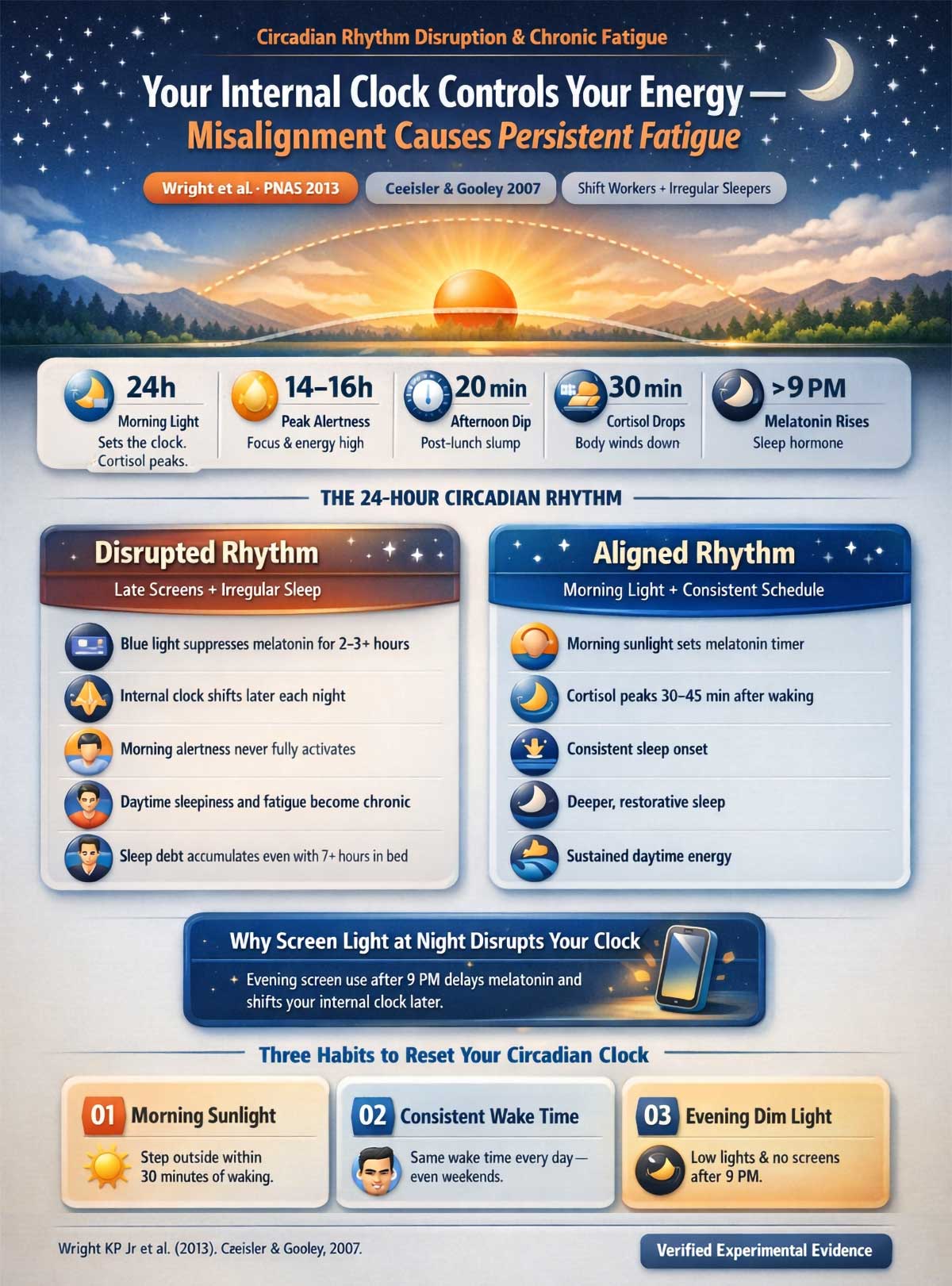
Blue light from phones and screens signals your brain that it’s still daytime. This suppresses melatonin production for hours after you put the screen down. Your internal clock shifts later. You can’t fall asleep easily, you can’t wake up feeling rested, and the whole cycle repeats.
There’s a powerful reset tool most people overlook: morning sunlight. Wright and colleagues confirmed that natural light exposure in the morning is the strongest external cue for resetting the circadian clock. Getting bright outdoor light within 30–60 minutes of waking sets your internal timer for melatonin release 14–16 hours later — making it dramatically easier to feel sleepy at a consistent, healthy time at night.
The fix: Step outside within 30 minutes of waking — even on cloudy days, outdoor light is far brighter than indoor lighting. Keep sleep and wake times consistent 7 days a week. In the evenings, dim your lights and switch screens to their warmest color setting after 9 PM. These three habits, done consistently, can meaningfully shift your daily energy within 1–2 weeks.
10. Hypothyroidism: When Your Thyroid Slows Everything Down
The thyroid gland sits at the base of your neck and controls your body’s metabolic rate — how fast your cells convert fuel into energy. When it under-produces thyroid hormone, everything slows. Heart rate, digestion, muscle function, and brain activity all drop below their normal operating level. The result is a heavy, persistent fatigue that sleep doesn’t fix.
Research by Wiersinga (2021) and Chaker and colleagues (2018) found that hypothyroidism causes profound fatigue in the vast majority of those affected. About 70% of hypothyroid patients report persistent fatigue even after TSH levels normalize with treatment. This is especially true in autoimmune Hashimoto’s thyroiditis, where immune activity continues to affect thyroid tissue even when hormone levels look acceptable on paper. A 2025 prevalence study confirmed fatigue remains a major unaddressed symptom in this population.
Hypothyroidism is more common than most people assume — affecting between 1.5% and 5% of the general population, with higher rates in women over 40. Many people go undiagnosed for years, attributing their fatigue to aging, stress, or depression.
Other symptoms often accompany this fatigue: unexplained weight gain, feeling cold when others don’t, hair thinning, dry skin, and a mental sluggishness often described as “brain fog.”
The fix: Ask your doctor to check your TSH, free T4, and thyroid antibodies (TPO and TgAb). Standard TSH alone can miss early or autoimmune thyroid dysfunction. If hypothyroidism is confirmed, thyroid hormone replacement is typically effective — though some patients benefit from more targeted management beyond TSH normalization alone.
11. Sleep Apnea: The Fatigue You Sleep Through
You may be spending 8 hours in bed and waking up more tired than when you went to sleep. If that sounds familiar, sleep apnea could be the cause — and it’s far more common than most people realize.
Obstructive sleep apnea (OSA) occurs when the muscles at the back of the throat relax during sleep, partially or fully blocking the airway. Breathing stops — sometimes dozens or hundreds of times per night — and the brain triggers a brief arousal to restart it. Most people have no memory of these episodes. They just wake up feeling crushed.
Clinical research by Vgontzas and colleagues (2008) and Lal and colleagues (2021) established OSA as a major driver of excessive daytime sleepiness and persistent fatigue. CPAP therapy — which uses mild air pressure to keep the airway open during sleep — significantly reduced fatigue scores in clinical trials. OSA affects an estimated 26–32% of adults, making it one of the most common and most under-diagnosed causes of chronic fatigue.
It’s not just about snoring. Many people with sleep apnea don’t snore loudly at all. Symptoms include waking with headaches, waking with a dry mouth, needing to urinate frequently at night, difficulty concentrating, and mood changes that feel hard to explain.
The fix: If you regularly wake unrefreshed despite adequate time in bed, ask your doctor about a sleep study. At-home sleep tests are now widely available and far less disruptive than in-lab studies. CPAP therapy, when used consistently, is highly effective. Some people also benefit from positional therapy or dental devices, depending on severity and anatomy.
Conclusion
Fatigue is almost never caused by one thing. It’s a slow accumulation — a night of broken sleep here, a low-ferritin level there, a skipped breakfast, two weeks of high stress, and months of sitting at a desk. The causes layer on top of each other until the drain becomes the new normal.
The good news is that the fixes layer, too. Each one you address chips away at the load your body is carrying.
Start with one. Pick the cause that sounds most like your life and commit to its fix for 7 days. Track how you feel. Then add the next one.
When to see a doctor: Some fatigue has nothing to do with lifestyle. If you have any of the following alongside persistent tiredness, book an appointment promptly:
- Unexplained weight loss or gain
- Night sweats
- Breathlessness at rest or with light activity
- Heart palpitations
- Extreme cold sensitivity or hair loss (possible thyroid involvement)
- Waking unrefreshed despite 8+ hours in bed (possible sleep apnea)
- Fatigue that doesn’t improve after 2–3 weeks of lifestyle changes
Ask for a full metabolic panel — not just a standard CBC. Request ferritin, B12, vitamin D, TSH, free T4, thyroid antibodies, and fasting glucose. These markers tell a more complete story than a routine check-up typically covers.
Feeling tired all the time isn’t something to push through. It’s information. Your body is telling you something is off. The goal isn’t to manage that signal with more caffeine — it’s to find the source and fix it.