Yoga may do more than calm the mind. Researchers explored whether 8–12 weeks of practice could activate neuroplasticity and reshape the brain.
Feeling calmer is not the same as having a structurally different brain. This article is not about mood journals or how you feel walking out of a yoga class. It’s about gray matter density, white matter integrity, cortical thickness, and the imaging data that documents real changes in living brain tissue after eight to twelve weeks of consistent yoga practice.
The early findings pointed in one direction. Researchers kept imaging yoga practitioners’ brains and kept finding the same things: regions responsible for memory, emotional regulation, and self-awareness were denser, better-connected, and more resistant to age-related shrinkage than those of matched controls. What nobody fully anticipated was how fast it starts, or what the chemistry looks like underneath the structure.
What Neuroplasticity Actually Means
Neuroplasticity is the brain’s capacity to physically change its structure based on repeated experience. New neural pathways form, certain regions grow denser, and others atrophy. The brain is not a fixed organ. It responds to what you repeatedly do and think, and those responses show up on scans.
Before the evidence, two terms are worth separating. Gray matter volume refers to the overall size of a brain region. Gray matter density refers to how many neurons are packed into that space. Both can increase, and both signal a more active, better-resourced region. Think of volume as the size of a library and density as how many books are actually on the shelves.
For most of the twentieth century, scientists believed the adult brain was largely fixed. That view changed when modern imaging tools (functional MRI and diffusion tensor imaging) made it possible to watch the brain reorganize itself in response to experience. The question researchers turned to next was whether yoga could trigger those changes, and if so, how quickly.
The 8-to-12-Week Window
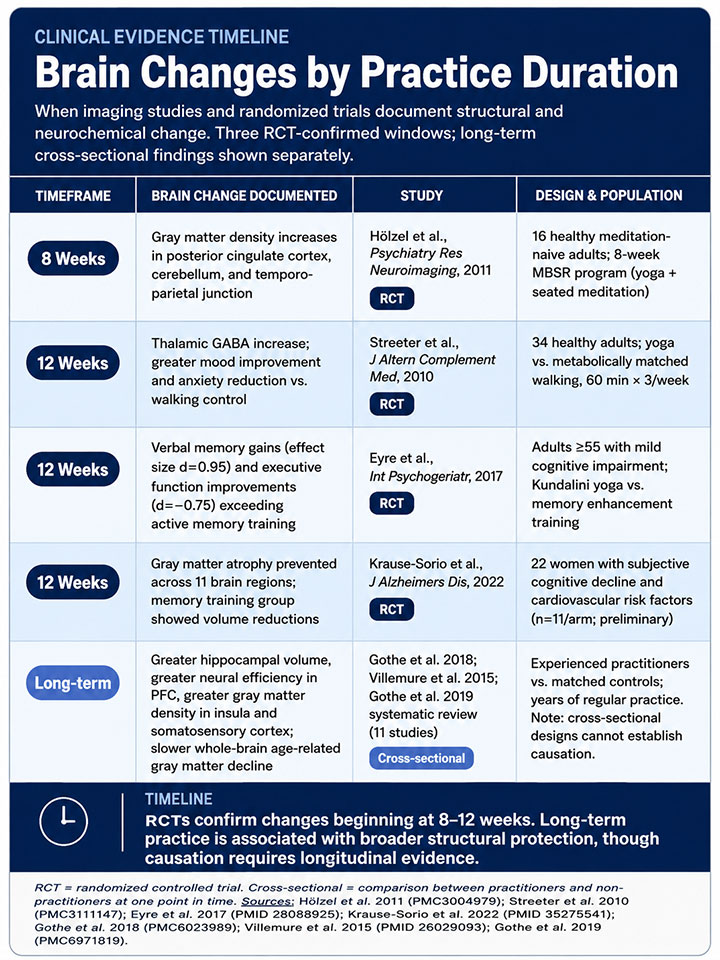
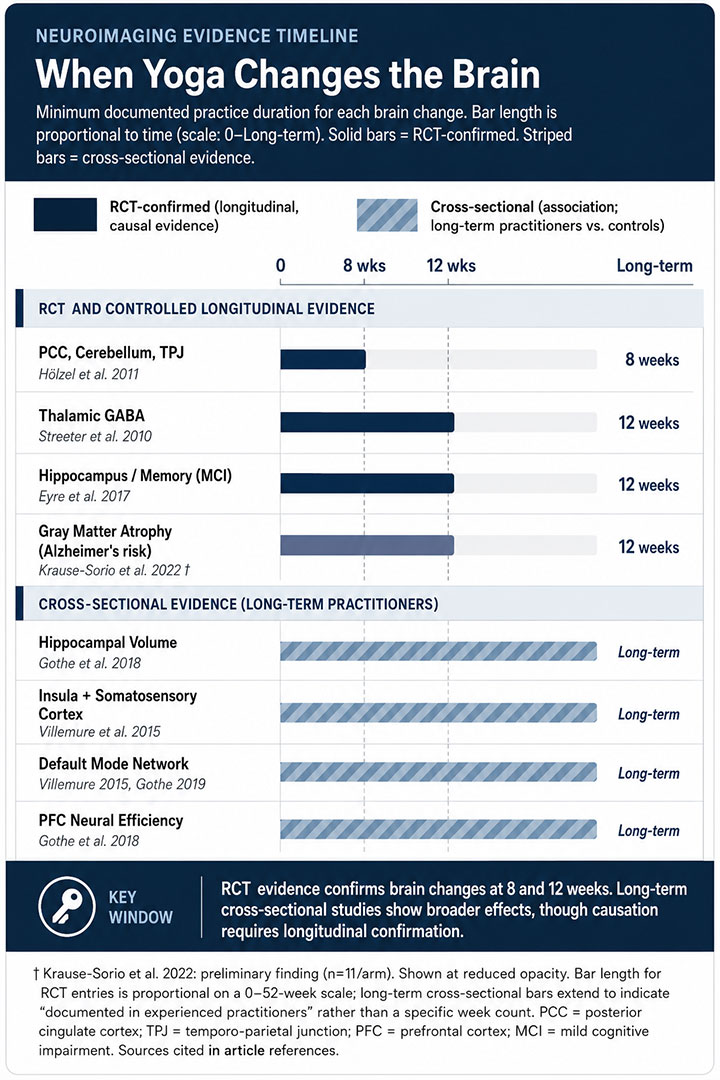
Clinical trials consistently point to a two-to-three-month window as the threshold for measurable brain remodeling. Multiple independent research teams, using different populations and imaging methods, have landed on the same timeline. This is not one lab’s finding.
Eight weeks appears to be the floor. Twelve weeks tends to produce more pronounced effects. This is the range where gray matter volume, cortical thickness, and white matter integrity all begin to shift in ways that register clearly on a scan.
What the research does not require is years of advanced practice. The participants in the studies below include sedentary adults, stressed professionals, and older individuals with early cognitive concerns. None of them were yogis by training.
Quieting the Overthinking Brain
The default mode network (DMN) is the brain’s background noise, the system that fires during rumination, self-criticism, and mental replay of conversations that ended hours ago. Chronic overactivity there is strongly associated with anxiety and depression.
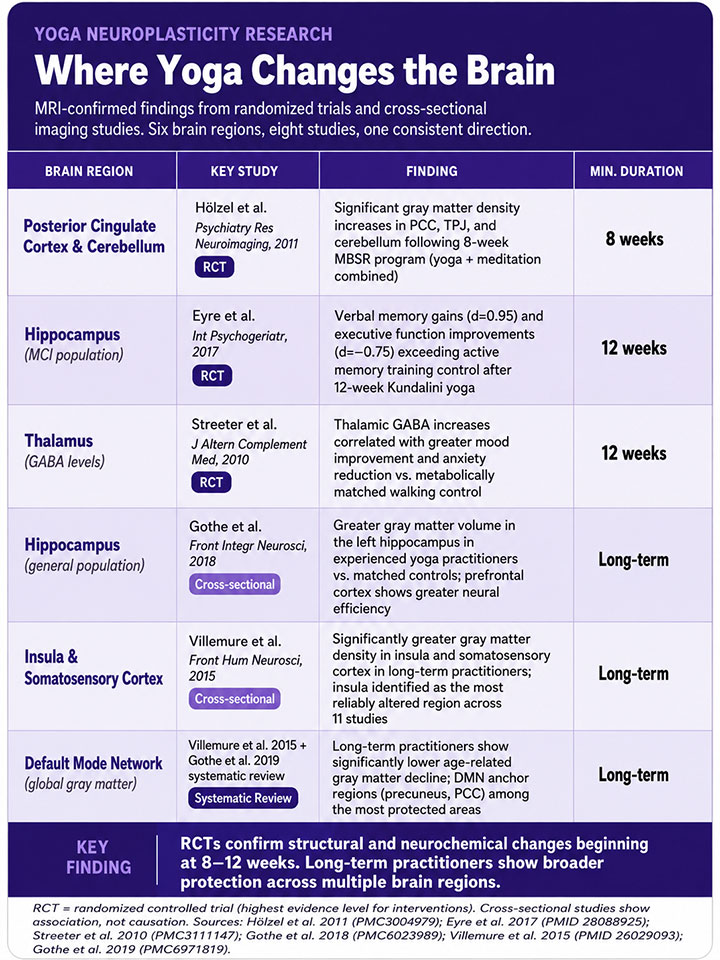
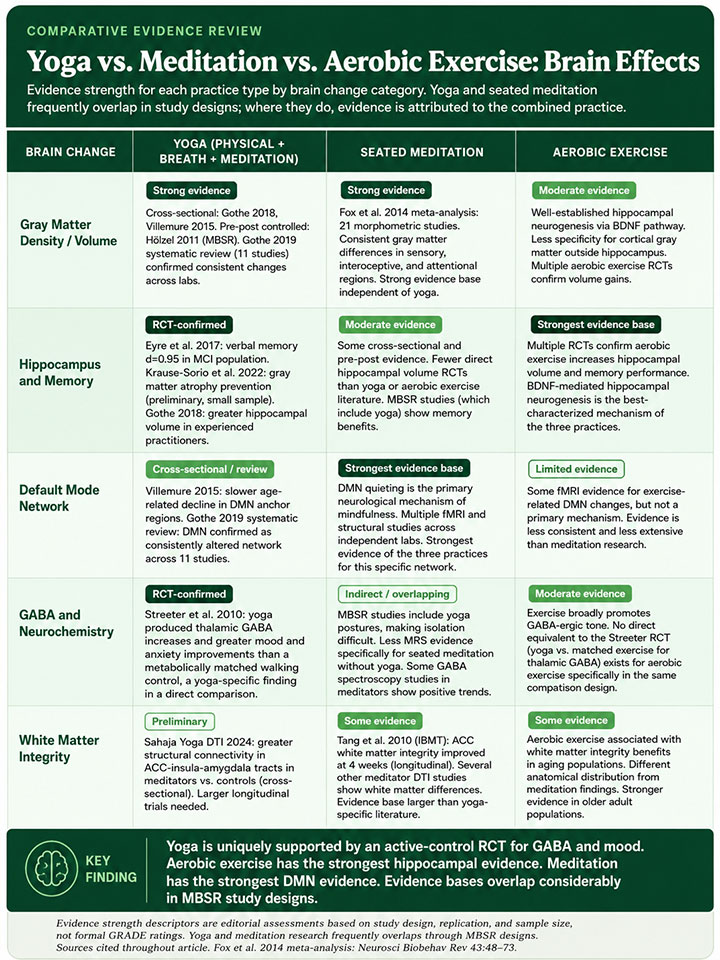
Cross-sectional MRI data from Chantal Villemure and colleagues (2015), published in Frontiers in Human Neuroscience, found that long-term yoga practitioners showed significantly lower age-related decline in whole-brain gray matter volume compared to non-practitioners. Controls displayed the expected pattern of age-related gray matter loss. Practitioners did not. The DMN’s anchor regions (the precuneus and posterior cingulate cortex) were among the areas most protected.
A 2019 systematic review by Neha Gothe and colleagues, published in Brain Plasticity, examined eleven imaging studies spanning MRI, functional MRI, and SPECT. Yoga practice showed a consistent association with positive structural and functional changes in the hippocampus, amygdala, prefrontal cortex, cingulate cortex, and the default mode network itself. The review confirmed DMN findings across multiple independent research groups, not a single lab’s result.
Protecting Memory as You Age
The hippocampus is involved in memory formation and is also one of the first structures to shrink with age or chronic stress. Volume loss there is a recognized early marker of cognitive decline. The prefrontal cortex, which governs planning and impulse control, faces similar attrition from sedentary behavior over time.
Researchers at Wayne State University set out to determine whether yoga practice left a structural mark on either region. Neha Gothe and colleagues’ 2018 cross-sectional study, published in Frontiers in Integrative Neuroscience, compared thirteen experienced practitioners to thirteen matched controls using both structural and functional MRI.
Experienced practitioners showed significantly greater gray matter volume in the left hippocampus. In the prefrontal cortex, the finding was neural efficiency rather than superior performance: practitioners showed less activation during a working memory task while producing the same reaction times and accuracy scores as controls. The brain was doing more with less.
For adults already showing early memory concerns, two randomized trials from the Lavretsky group at UCLA sharpened the picture. A 2016 pilot study by Harris Eyre and colleagues, published in the Journal of Alzheimer’s Disease, found that verbal memory improvements in the yoga group correlated with increased connectivity within the default mode network after twelve weeks of Kundalini yoga.
The honest caveat is that the memory training control group showed comparable connectivity changes, suggesting the DMN changes may reflect engaged cognitive practice generally. Where yoga distinguished itself was in visuospatial memory and depression scores.
The 2017 randomized controlled trial by the same group, published in International Psychogeriatrics, enrolled older adults with mild cognitive impairment and assigned them at random to either twelve weeks of Kundalini yoga or memory enhancement training.
At the trial’s end, the yoga group showed large improvements in verbal memory (effect size d=0.95) and executive function (d=−0.75), both exceeding the active control. That’s a performance difference, not just a brain-scan finding.
A third RCT brought in a different population entirely. Beatrix Krause-Sorio and colleagues (2022), published in the Journal of Alzheimer’s Disease, randomized women with subjective cognitive decline and cardiovascular risk factors to either twelve weeks of Kundalini yoga or memory enhancement training.
On structural MRI, the memory training group showed gray matter volume reductions across eleven brain regions. The yoga group did not. Sample sizes were small (eleven per arm), so the finding is preliminary, not definitive. The direction, though, is consistent with the larger literature: yoga appears to slow the structural changes that precede clinical decline, not only improve test scores.

The Cerebellum Finding Nobody Expected
The cerebellum coordinates balance and fine motor control. It is not usually mentioned in discussions of stress, emotional regulation, or cognitive health. That changed when it kept appearing in the neuroimaging data on yoga and mindfulness practices.
Britta Hölzel and colleagues at Massachusetts General Hospital tracked healthy, meditation-naive adults through an eight-week Mindfulness-Based Stress Reduction program, a structured intervention that combines seated meditation with yoga postures. MRI scans taken before and after the program showed significant increases in gray matter density in the posterior cingulate cortex, the temporo-parietal junction, and the lateral cerebellum.
That last finding is the one worth consideration. More recent neuroimaging work has placed the cerebellum at the center of emotional learning and adaptive behavior, alongside its established role in motor coordination.
Gray matter density increases there point toward improved capacity to process new emotional experiences and regulate behavioral responses. It is one of the more surprising findings in this research space, and it suggests that what looks like a physical practice is doing something architecturally different in the brain from what the anatomy implies.
One methodological note: the Hölzel study used an MBSR program that combined yoga with seated meditation, so the precise contribution of each element is not separable from the data. That limitation applies to most research in this category. Pure yoga-only interventions are less common in the imaging literature than combined mind-body programs.
The Insula, White Matter, and Why Interoception Leaves a Structural Mark
Most neuroimaging research on stress and aging centers on the expected targets: hippocampus, prefrontal cortex, the regions everyone agrees matter. The insula tends to appear in papers almost as an afterthought. Then researchers started mapping what consistent body-awareness training actually does to it.
The insula is the region most closely tied to interoceptive awareness. It maps internal states and links physical sensation to emotional experience. Chantal Villemure and colleagues’ 2015 study found significantly greater gray matter density in both the insula and the somatosensory cortex among experienced practitioners compared to yoga-naive controls.
What made that finding hold up was the Gothe 2019 systematic review across eleven studies: the insula showed up as one of the most reliably altered regions regardless of yoga style. Not one lab’s result.
White matter carries the signals between regions, and its integrity matters as much as the density of the regions themselves. The evidence for yoga’s effects on white matter is thinner than the gray matter literature and relies more heavily on cross-sectional imaging than on longitudinal trials.
A 2024 diffusion tensor imaging study comparing Sahaja Yoga meditators to matched controls found greater structural connectivity in white matter tracts linking the anterior cingulate cortex, insula, and amygdala, the network responsible for emotional processing and regulatory control.
When those tracts become more organized, communication between the brain’s alarm systems and its regulatory circuits runs faster and more reliably. Larger longitudinal trials in this area are still needed.
The honest accounting on structural evidence: a large portion of it comes from cross-sectional comparisons between long-term practitioners and matched controls. Cross-sectional designs cannot establish causation.
People with certain brain profiles may be more likely to sustain a yoga practice over years, rather than the practice producing those profiles. The longitudinal data from the Hölzel study and the Lavretsky RCTs point in the same direction, which strengthens the case. But what exists is converging evidence, not a closed argument.
Does Yoga Change Brain Chemistry?
The structural findings get the headlines. But there is a neurochemical dimension to this research that MRI does not capture, and it may help explain why the behavioral effects of yoga appear to outlast a single session.
Chris Streeter and colleagues at Boston University School of Medicine ran a twelve-week randomized controlled trial comparing yoga to a metabolically matched walking program, not against a sedentary control but against an active comparator with the same cardiovascular demand.
Participants attended sixty-minute sessions three times per week. Using magnetic resonance spectroscopy, the researchers measured gamma-aminobutyric acid (GABA), the brain’s primary inhibitory neurotransmitter, in the thalamus.
The yoga group reported greater mood improvements and greater reductions in anxiety than the walking group by the end of twelve weeks. Thalamic GABA levels rose in the yoga group and correlated with those changes.
The walking group showed no comparable shift. It was the first study to demonstrate that a behavioral intervention, not a drug but a structured movement practice, could produce this correlation between thalamic GABA increases and measured improvements in anxiety and mood.
What this adds to the structural literature is a mechanism. The brain regions yoga appears to change (the hippocampus, the insula, the anterior cingulate cortex, the posterior cingulate cortex) all connect to the thalamus through circuits that GABA helps regulate. The neurochemical shift and the structural changes may be two dimensions of the same process. They unfold on different timescales.
Conclusion
Yoga’s mental health benefits have been attributed, at various times, to relaxation, social connection, deliberate breathing, and the placebo effect of having a practice. Those explanations are not wrong, but they are incomplete.
What the imaging literature adds is that something structural is also happening. Regions that typically shrink with age and chronic stress appear more preserved in practitioners. Gray matter density increases in areas responsible for memory, interoception, and emotional regulation.
GABA levels rise in a twelve-week yoga trial in ways that correlate with actual reductions in anxiety. This is the same neurotransmitter anti-anxiety medications target.
The sample sizes are often small, and the cross-sectional designs that dominate this research cannot prove causation. None of that is reason enough to dismiss the literature.
The consistent direction across independent labs, varied populations, and different imaging modalities is not something that usually appears in research that isn’t pointing at something real.