The more carefully you choose your words, the less confident you can sound. Here’s the psychological reason that backfires, and how to fix it.
There’s a specific kind of professional humiliation that is never apparent at first. Nobody tells you that your colleagues stopped listening somewhere around the second paragraph, or that the person you were trying to impress walked away adjusting their opinion of you downward.
You just notice, later, that the meeting didn’t go the way you expected. Or that your idea was credited to someone else who said roughly the same thing, more bluntly, three minutes after you did.
The habits that cost people authority aren’t the obvious ones. They’re not checking your phone or interrupting. Everyone already knows about those. The more corrosive habits are the ones that feel like good communication: sounding careful, being thorough, wanting to seem approachable. The research shows, uncomfortably, that these instincts can work against you.
The Words That Signal Weakness
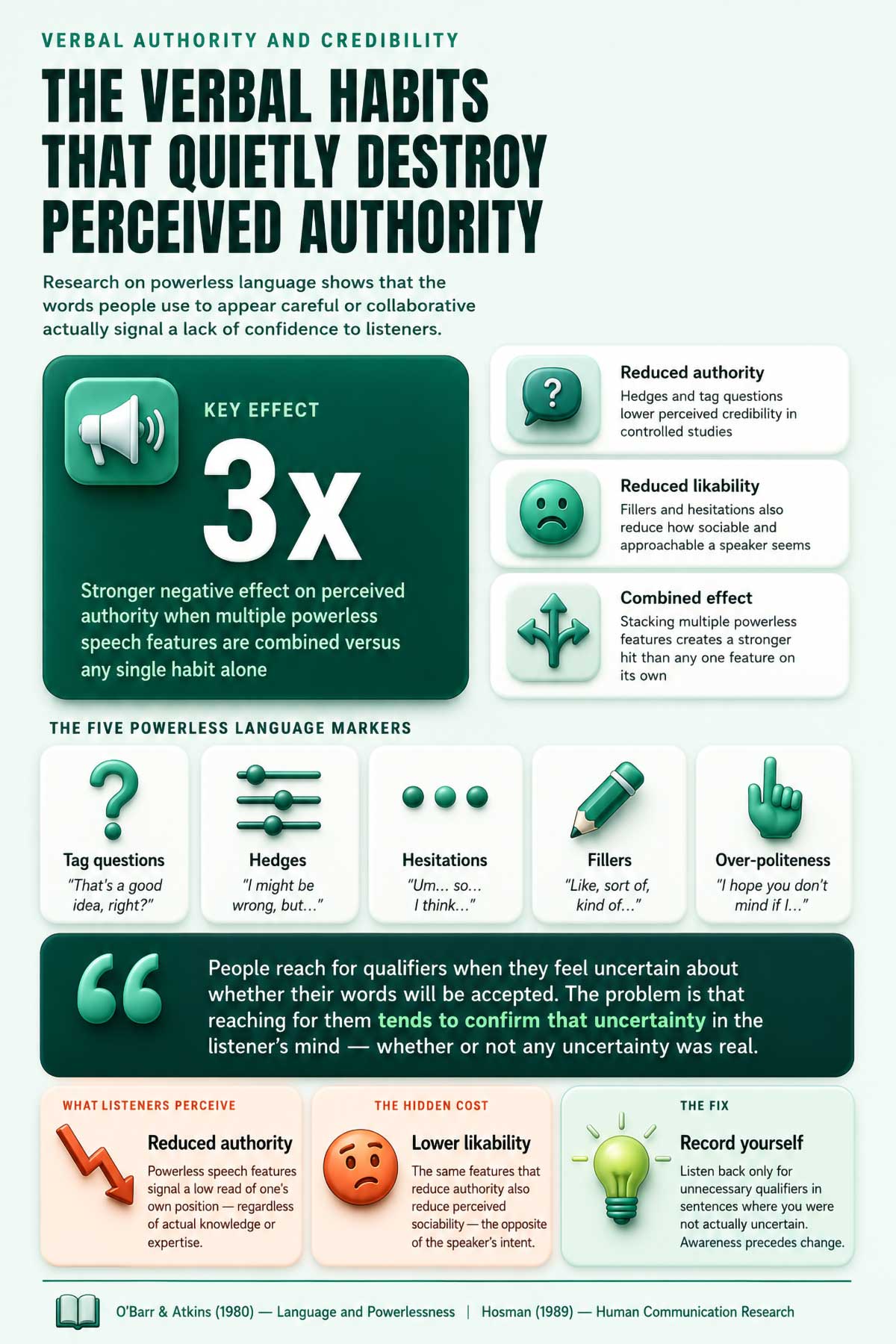
The most common authority-eroding habit is also the one most people use every day without thinking. Tag questions tacked onto statements. Hedging language that surrounds every claim like bubble wrap. Filler words that break up sentences before any challenge has even been raised. These features of speech have a name in linguistics: powerless language.
Researchers William O’Barr and Bowman Atkins coined the term in their 1980 study of courtroom speech, which found verbal patterns that correlated with lower perceived authority in legal settings. Their argument, later extended to everyday speech, was that these features don’t reflect personality.
They reflect how a speaker reads their own position in the room. People reach for qualifiers when they’re not sure their words will land. The problem is that reaching for them tends to confirm that doubt in the listener’s mind. Communication researcher Lawrence Hosman followed this work with controlled studies in Human Communication Research, showing that hedges, hesitations, and fillers each reduced how credible and likable a speaker seemed. When combined, the effect was stronger than any single habit on its own.
What makes this hard to fix is that powerless language usually comes from a place of care. People hedge because they’re trying to be accurate. They add tag questions because they want agreement, not submission. These aren’t flaws. They’re misplaced social instincts, and they carry a real cost.
Why Your Nervous System Is Working Against You
Speech hesitations and vocal tension aren’t just verbal habits. They’re also physical. When people feel anxious about how they’re coming across, that anxiety shows up in the voice before they’ve even noticed it themselves. It appears in slightly elevated pitch, in micro-pauses, in the audible catch that happens when someone braces before saying something they’re not sure will land.
The problem is how listeners process those signals. Psychologist Bella DePaulo and colleagues at the University of Virginia published a large meta-analysis in Psychological Bulletin drawing on over 1,300 estimates across 158 behavioral cues.
Their findings showed that the signs people link to anxiety, including vocal tension, speech hesitations, and excessive qualifiers, are the same ones observers tend to read as signs of dishonesty. The brain doesn’t cleanly separate nervous-because-anxious from nervous-because-lying. Both patterns trigger similar skepticism.
This is worth consideration. The person who speaks carefully to be accurate can be misread the same way as someone who isn’t being straight. It doesn’t matter what’s happening internally. Listeners respond to what they can detect, and that gets routed through a threat-reading system that isn’t interested in nuance.
The Part That Happens in Seconds
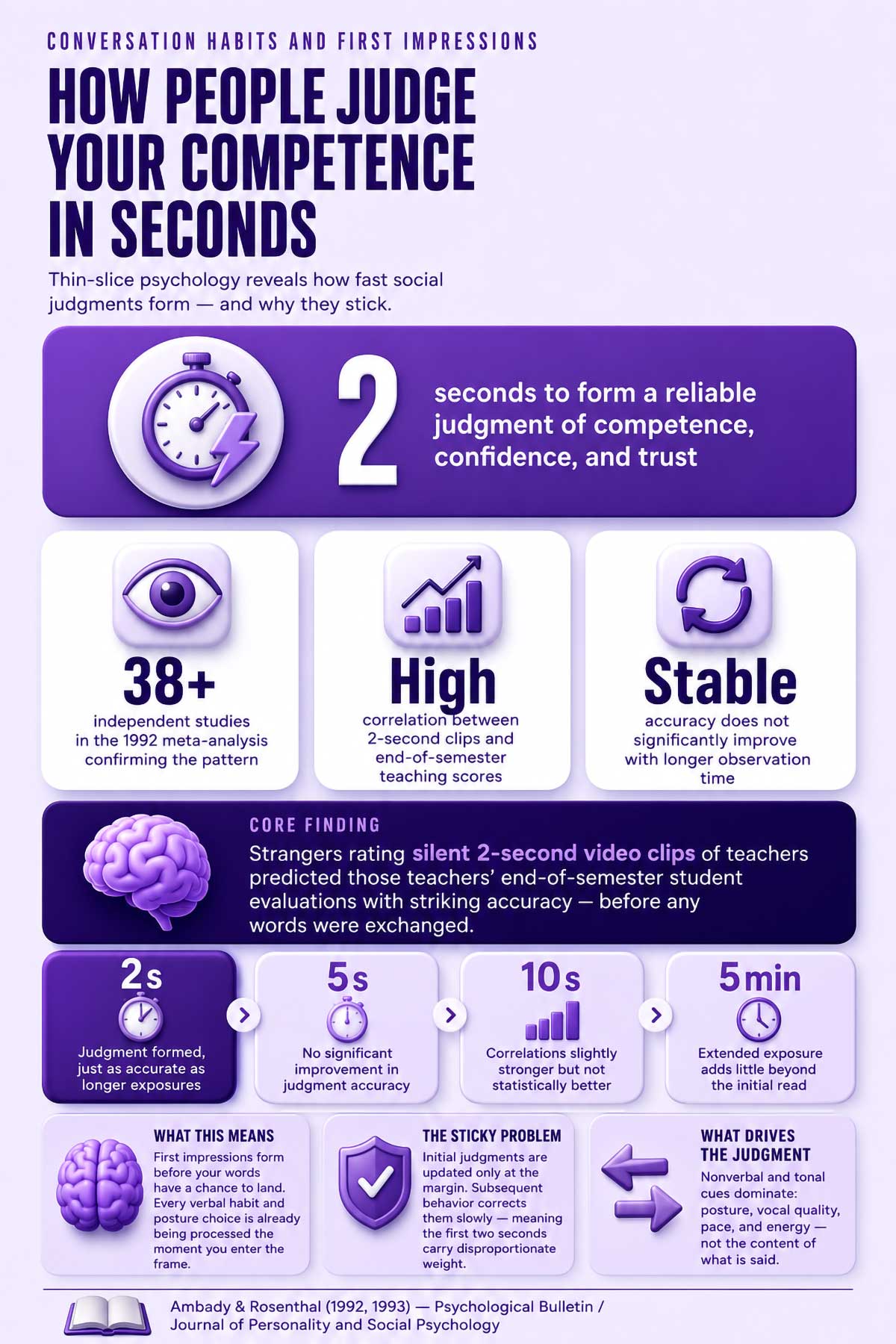
People generally believe they form opinions of others over time. They don’t, or at least not primarily. Psychologists Nalini Ambady and Robert Rosenthal showed in their foundational thin-slice research that observers can form reliable judgments of competence, confidence, and trust from exposures lasting just two to ten seconds.
The 1993 study showed that strangers’ ratings of silent two-second clips of teachers predicted end-of-semester scores with striking accuracy. A 1992 meta-analysis across dozens of studies confirmed the pattern held broadly.
What this research shows is that first impressions aren’t as fixed as most people assume. They’re updated at the margin, but the initial read is sticky. Every powerless speech feature, every moment of vocal hesitation, every collapsed posture lands inside a judgment that was already forming before the substance of what you were saying had a chance to register.
How Your Body Completes the Picture
Verbal habits don’t operate alone. The body adds information at the same time, and the overall picture is hard to fake one element at a time. A study showed that open posture, steady vocal delivery, reduced self-touching, and controlled pacing all raised observers’ sense of competence and confidence. The inverse holds: closed posture, fidgeting, and unsteady delivery read as insecurity even when the words themselves are confident.
Albert Mehrabian’s research on nonverbal behavior showed early on that tone, expression, and body language carry real weight in how authority is read by others. His work is sometimes misapplied, but the core finding has been confirmed many times: if the body says one thing while the words say another, the body generally wins.
Violations That Help and Violations That Hurt
There’s a wrinkle in all of this that standard etiquette advice never addresses. Not all departures from social norms reduce perceived authority. Some raise it. Judee Burgoon and Jerald Hale’s expectancy violation theory, published in Communication Monographs, showed that when someone breaks the unspoken rules of engagement, such as unexpected changes in posture, proximity, or eye contact, the effect on perceived credibility depends on how the listener reads the move. A positive read pushes credibility up. A negative one pushes it down.
This matters for anyone told to always maintain perfect social decorum. Confident stillness when someone expects nervous movement, holding eye contact a beat longer than the script calls for, staying physically settled when others in the room are shifting, these are all norm violations, and they tend to be read positively.
The person who breaks the rules in ways that signal ease rather than discomfort often ends up seen as more credible than the one who follows every rule.
The Sound of Authority
One of the harder findings here concerns something most people can’t easily change: the natural pitch of their voice. Casey Klofstad, Rindy Anderson, and Susan Peters published a study in Proceedings of the Royal Society B showing that listeners, both men and women, consistently picked lower-pitched voices as more suited to leadership, competence, and strength. The researchers used digitally adjusted recordings of the same speakers to isolate the effect. The preference was held across all listener groups tested.
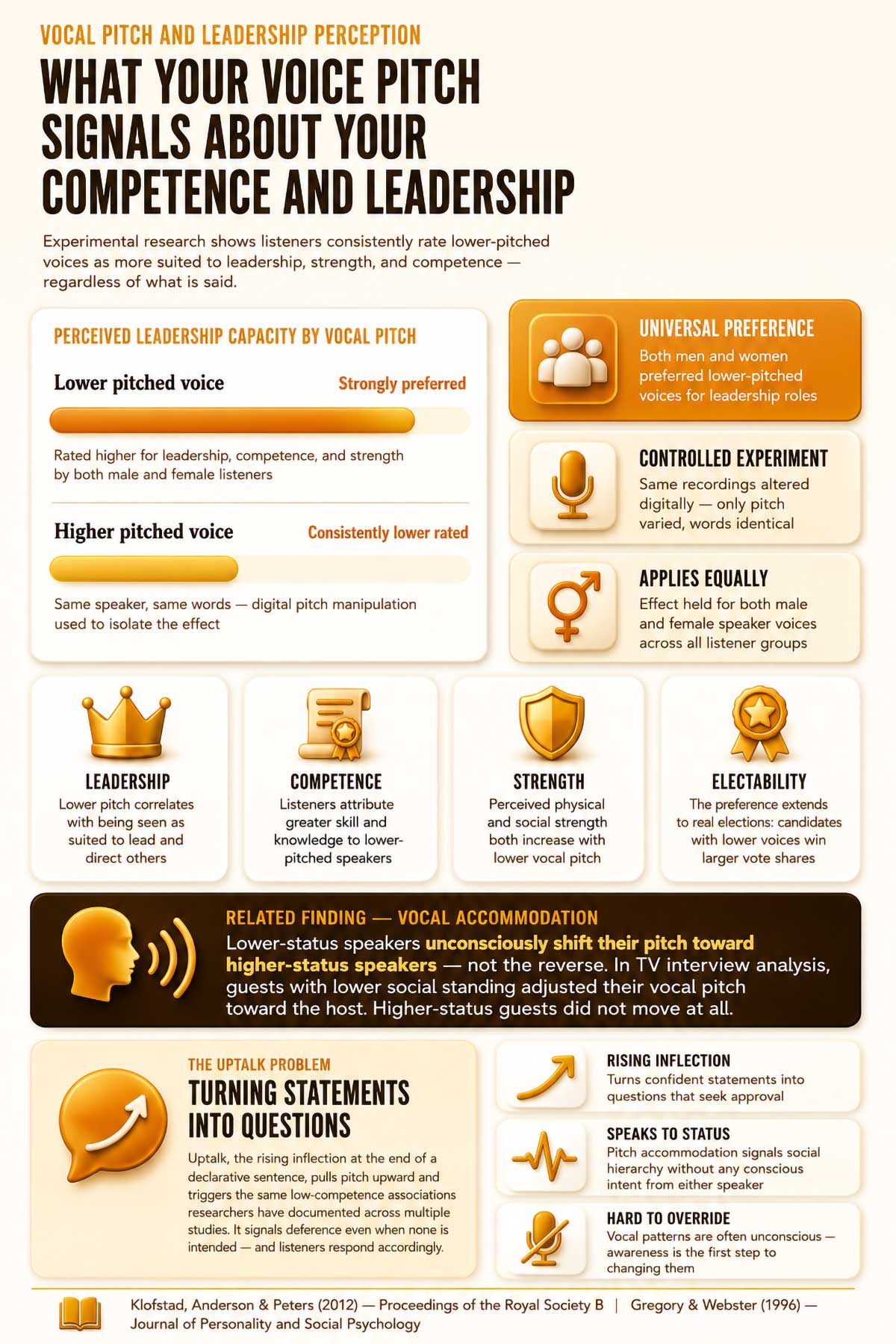
A related study examined vocal pitch between interview partners. They found that lower-status speakers tend to shift their pitch toward higher-status speakers, not the reverse. In their analysis of TV interview data, guests with lower social standing adjusted their vocal pitch toward the host. Higher-status guests did not.
That shift was an audible signal of relative standing, produced without awareness. Uptalk, the rising inflection that turns statements into questions, works the same way. It pulls pitch upward and sets off the same competence-reducing reactions researchers have documented across multiple studies.
What You Can Actually Do With This
The practical takeaways are narrower than they might appear. You can’t will yourself into a lower register, and you can’t remove anxiety through good intentions. What you can do is catch your verbal habits before they become automatic. Next time you explain something simple to a friend or colleague, record yourself on your phone and listen only for filler words and qualifiers you didn’t need. The goal isn’t to fake certainty, but to stop advertising doubt where it doesn’t belong.
Physical stillness is learnable. Reducing self-touching, the absent hair-touching, the hand to the face, the fidgeting that reads as contained anxiety, is a matter of awareness, not character change. Posture that takes up space without performance signals exactly what the research says it does: that the person in that space expects to be there.
Speaking slightly more slowly than your anxious brain wants to, leaving real pauses instead of filling them with “um” and “so,” lets you hold the floor without fighting for it. Listeners read deliberate pacing as confidence. Rushed pacing reads as someone who isn’t sure they’ll be allowed to finish.
Conclusion
The habits that quietly drain authority from capable people almost always come from the desire to be liked, to seem reasonable, or to avoid coming across as arrogant. Those instincts are processed by the listening brain in a way that doesn’t reward them.
Ironically, people trying hardest to sound reasonable often come across as the least confident, while those who seem slightly less eager to please often gain the respect they never set out to perform.