A Harvard neurology professor has spent 46 years studying Alzheimer’s. His six-part brain-health framework puts one overlooked habit ahead of what most people expect.
Rudolph Tanzi is a Harvard neurology professor and co-director of the McCance Center for Brain Health at Massachusetts General Hospital. He has spent 46 years studying the molecular biology of Alzheimer’s disease and identified three genes linked to the condition.
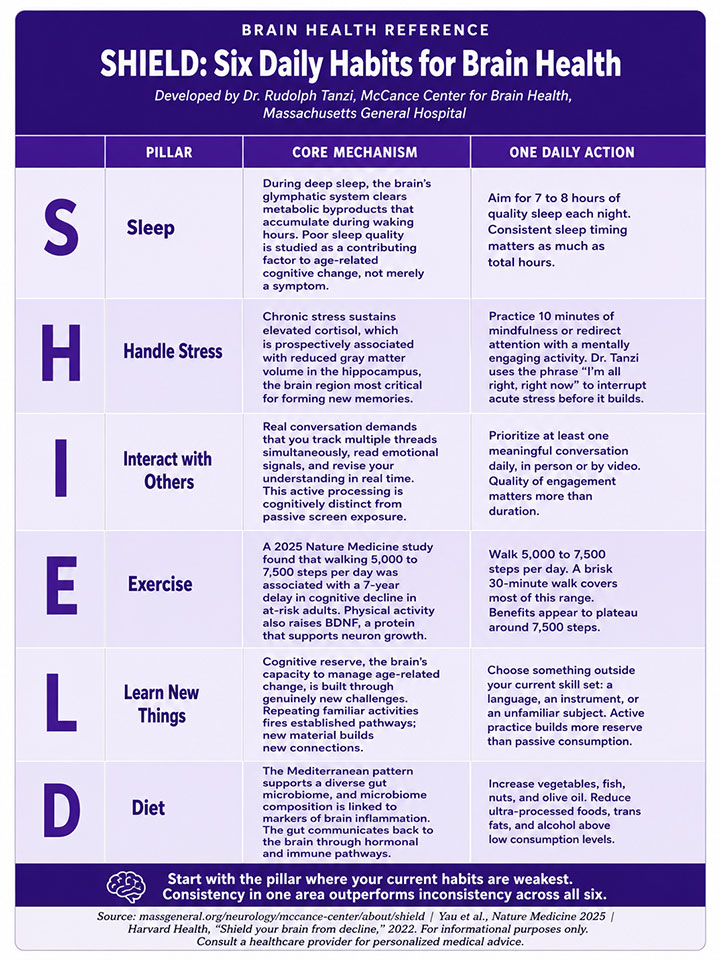
The framework he calls SHIELD was designed as a clinical tool for everyday brain care, and it reads differently when you go to the original source than when you read the social media coverage.
Why the Source Matters Here
There is a tendency in brain health content to flatten a credentialed researcher into the same six-item checklist every other publication produces. Tanzi’s background complicates that easy version.
His lab was among the first to use human stem cells to build three-dimensional brain organoids, miniature tissue models that let scientists observe how neurons respond to disease-related proteins in real time.
The SHIELD framework did not emerge from lifestyle medicine. It came from someone who has spent four decades studying what goes wrong inside a brain and working backward toward what might slow it down.
The McCance Center publishes SHIELD as an active clinical program. Harvard Health covered it in a 2022 article titled “Shield your brain from decline.” This is an institutional framework with two independent Harvard-affiliated sources behind it, not a social media trend.
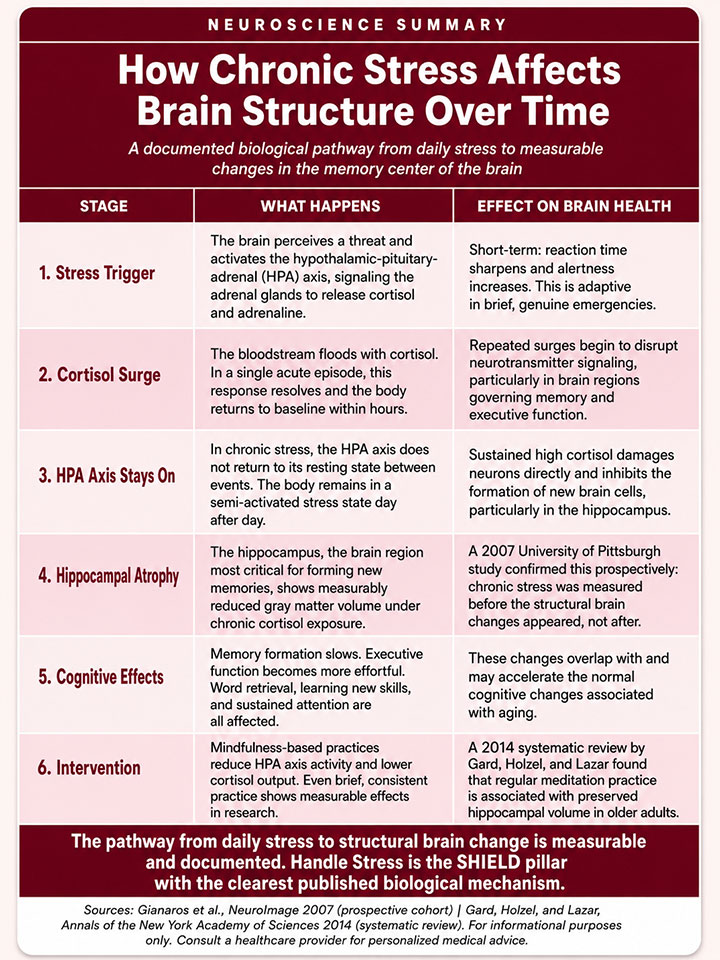
Before the familiar territory of sleep, exercise, and diet, SHIELD places a pillar that rarely gets adequate treatment: handling stress. Tanzi describes cortisol, the hormone the body releases under stress, as a direct threat to brain cells.
Chronic stress does not merely affect mood. According to Tanzi, it can damage neurons and trigger brain inflammation.
The mechanism has been studied directly. Researchers at the University of Pittsburgh tracked middle-aged adults over several years and found that people who reported higher levels of chronic stress showed measurably reduced gray matter volume in the hippocampus, the brain region most critical for forming new memories, compared with those who reported lower stress.
That finding, published in NeuroImage in 2007, was prospective. Stress was measured before the structural brain changes were observed, not after. The same brain region most associated with age-related cognitive change is also the region most vulnerable to the physiological effects of accumulated daily stress.
A 2014 systematic review led by researchers Tim Gard, Britta Hölzel, and Sara Lazar, published in the Annals of the New York Academy of Sciences, examined whether mindfulness-based practices could attenuate age-related cognitive decline.
The review found that regular meditation practice appeared to reduce activity in the hypothalamic-pituitary-adrenal axis, the hormonal pathway responsible for cortisol release, and was associated with preserved hippocampal volume in older adults. Effect sizes varied across studies, most of which were small, but the directional finding held across the body of reviewed research.
Tanzi’s personal prescription for this pillar is practical. He recommends redirecting attention rather than fighting the stress response: meditation, a walk in nature, gardening, or any activity that genuinely engages the mind with something other than the source of the anxiety.
For acute stress, he describes using the phrase “I’m all right, right now” as a way of breaking a spiral of anxious thought before it compounds.
Tanzi’s prescription here is direct: seven to eight hours of quality sleep each night. The biological rationale is well-established. During deep sleep, the brain’s glymphatic system runs a waste-clearance process that removes metabolic byproducts that accumulate during waking hours.
This process does not operate as efficiently in the waking brain, which is one reason poor sleep quality is increasingly studied as a contributing factor to age-related cognitive change rather than merely a symptom of other problems.
What Tanzi adds is a time horizon. Brain care starts early, not in late adulthood. What accumulates over decades of disrupted sleep may be difficult to recover from through better habits later.
Exercise and the Number the Coverage Got Wrong
The Exercise pillar generated the most attention when Tanzi’s framework went viral in January 2026, largely because the framework referenced a Mass General Brigham study with a striking finding about daily walking. The figure that circulated was that each additional 1,000 steps per day roughly delays cognitive decline by one year. The study does not say that.
What the researchers found was a dose-response relationship with two distinct bands. In the study, published in Nature Medicine in November 2025, first author Dr. Wai-Ying Wendy Yau and colleagues at Mass General Brigham followed 296 adults between the ages of 50 and 90 for an average of 9.3 years, using PET brain scans to track biological markers and pedometers to record daily step counts.
Adults who walked 3,000 to 5,000 steps per day showed cognitive decline delayed by an average of three years compared with less active participants. Those in the 5,000 to 7,500 step range showed a delay of seven years.
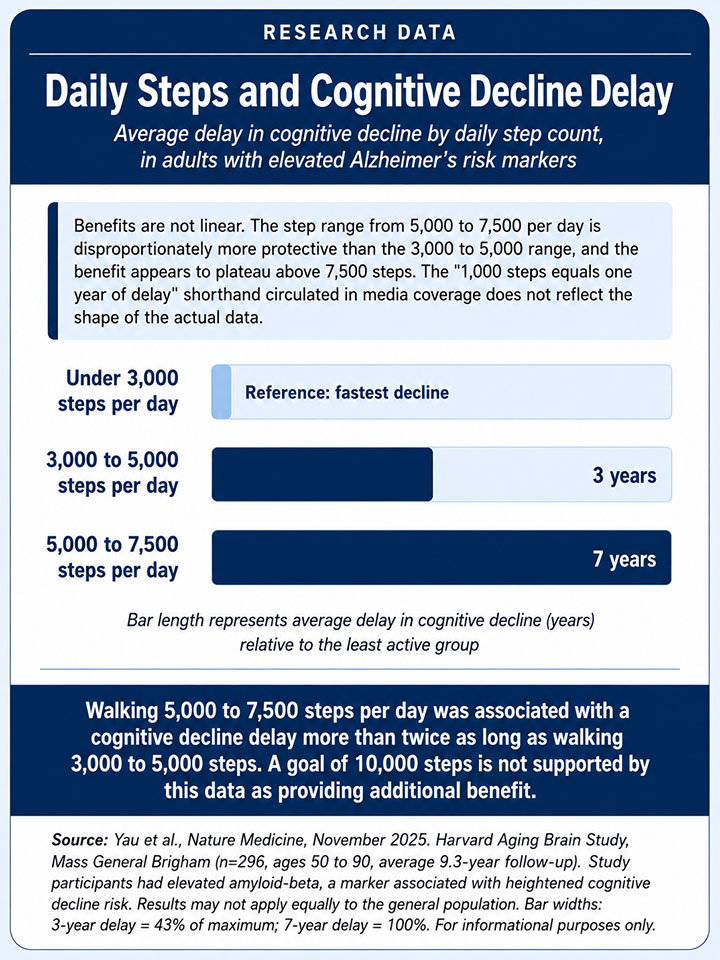
The second band, adding roughly 2,500 more steps above the lower threshold, produced four additional years of protective effect. Benefits appeared to plateau around 7,500 steps, which means the commonly cited 10,000-step daily target is not supported by this data as a meaningful additional goal.
It also means the “1,000 steps per year” shorthand misrepresents the shape of the benefit entirely.
Two things worth stating clearly: the study participants had elevated amyloid-beta levels in the brain, a biological marker associated with heightened risk of cognitive decline. The findings may not translate equally to the general population without that risk factor.
And even the lower activity band produced a three-year difference over the study’s timeline, which is a meaningful outcome for a change in daily routine that requires no equipment, membership, or structured training.
Tanzi also references irisin, a hormone released by muscle tissue during exercise, as part of the mechanism by which physical activity may influence brain chemistry. Animal research suggests irisin may affect how certain proteins function in the brain.
Human evidence on irisin specifically is still early, and the more established benefit pathways remain aerobic activity’s effect on blood flow to the brain and BDNF production, a protein that supports neuron growth and maintenance.
Social Interaction Is Cognitive Work
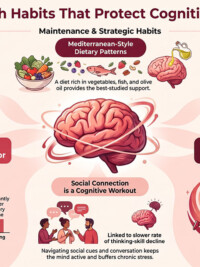
The Interact pillar is not about proximity to other people. Real conversation demands that you track multiple threads simultaneously, read emotional signals in real time, and revise your understanding of what someone means as they speak. That active processing is cognitively distinct from passive exposure to other people through screens.
Tanzi describes social interaction as one of the ways the brain is kept in active use. The research on this is largely observational, and isolating the effect of social contact from other lifestyle variables in cohort data is methodologically difficult.
The directional finding, that regular meaningful social contact is associated with slower rates of cognitive decline, holds across a range of studies without a single definitive controlled trial to anchor it.
Learning, Diet, and What the Brain Actually Needs You to Stop Eating
On the Learn pillar, Tanzi draws on the concept of cognitive reserve: the brain’s accumulated capacity to manage age-related change, built through a lifetime of genuinely challenging mental activity. He composes ambient jazz and watches documentaries as part of his own routine.
The distinction that research supports is between passive exposure and active challenge. Repeating a familiar activity fires established pathways. Picking up an instrument, working through a new language, or studying something genuinely unfamiliar builds new connections.
The Diet pillar maps onto the Mediterranean pattern: vegetables, fruit, fish, nuts, and olive oil, with minimal red meat and processed food. Tanzi adds a point that most diet coverage skips entirely.
A Mediterranean-pattern diet supports a diverse gut microbiome, and research has linked microbiome composition to markers of brain inflammation. The communication runs in both directions: the brain signals the gut through the nervous system, and the gut communicates back through hormonal and immune pathways. How you eat shapes your gut, and your gut shapes your brain.
Three categories of food that neurologists and brain health researchers consistently identify as harmful are ultra-processed foods high in added sugar, trans fats (still present in some packaged and fried foods despite regulatory restrictions), and alcohol above low consumption levels.
Alcohol shrinks brain tissue over time, particularly in regions tied to memory and executive function, and the damage scales with quantity rather than declining at a clean moderate threshold. If you don’t drink, there is no case from the brain-health evidence for starting.
Which SHIELD Pillar Should You Focus On First?
Six questions to find where a small change could make the biggest difference for your brain health
Where the Evidence Actually Stands Across All Six Pillars
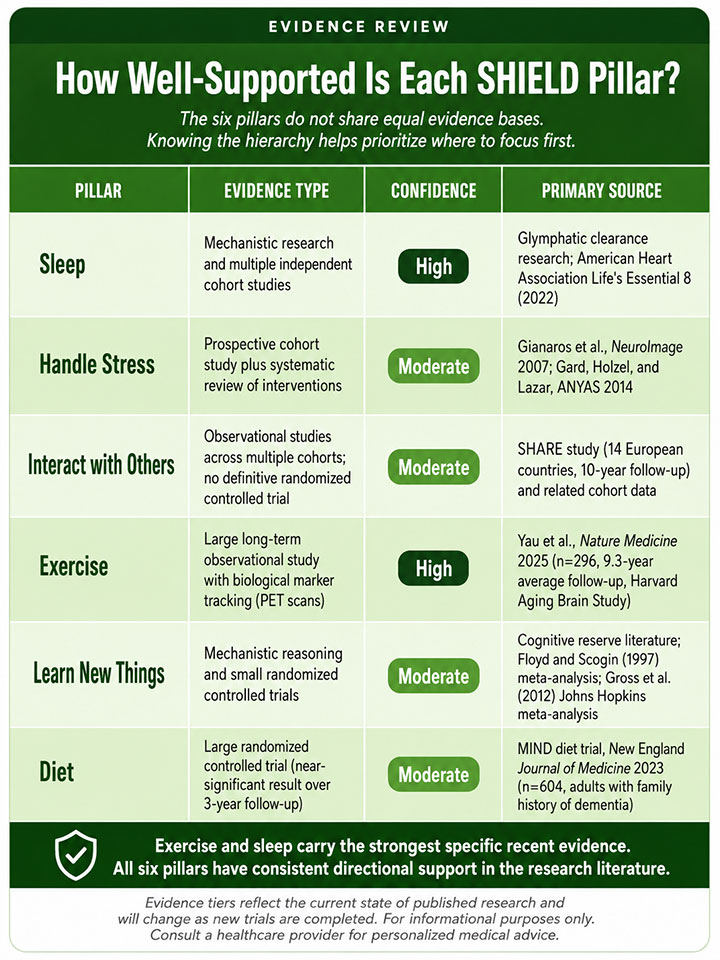
SHIELD presents six pillars as a coordinated framework. The evidence supporting each pillar is not equally developed, and the framework is more useful if you understand that going in.
Exercise has the strongest specific evidence, from the Yau Nature Medicine study. Sleep’s mechanism is well-documented. Those two are the clearest.
The middle ground belongs to stress management: solid observational evidence, a plausible pathway involving cortisol and measured reductions in hippocampal volume, but intervention trials that are mostly small and heterogeneous. Social interaction sits in a similar position, with consistent observational signal and limited controlled trial support.
Diet and the Learn pillar have the thinnest controlled trial base of the six. The largest randomized trial of the MIND diet in 2023 produced encouraging findings but fell just short of statistical significance over its three-year period. The Learn pillar relies more heavily on mechanistic reasoning than on direct intervention outcomes.
Knowing the hierarchy doesn’t disqualify the framework: it tells you where to start if you’re choosing where to put your effort first.
The most underweighted pillar in SHIELD is Handle Stress. It requires the least equipment and the least structured time of any of the six, and most brain-health content covers it in a single sentence before returning to diet and exercise.
Tanzi placed it second in an acronym shaped by 46 years of Alzheimer’s research. That ordering reflects something real about the biology, and it is worth more than the treatment it usually gets.