Researchers followed thousands of adults for a decade, expecting several habits to matter equally. One consistently separated slower cognitive decline from faster decline.
A study that tracked 32,000 people’s brains for a decade found something that contradicts a lot of brain-health advice. Researchers compared people who smoked with people who didn’t, people who drank heavily with people who drank little or not at all, and people who stayed active and social with people who mostly didn’t.
One factor explained most of the difference in who declined faster. It wasn’t diet. It wasn’t puzzles. It was whether a person smoked.
That finding surprised the team that ran the numbers. It doesn’t mean diet, exercise, or mental stimulation are irrelevant. It means the tidy story of “six equal habits” that shows up in a lot of brain-health content is more complicated, and more interesting, than most articles let on.
This piece pulls from several different studies, not one, because that’s what the honest picture actually requires. Some habits here have strong direct evidence, and others have real evidence that comes with real caveats. Both kinds are worth knowing before you decide where to put your energy.
The Study That Tracked 32,000 Brains for a Decade
For years, research on lifestyle and memory leaned on small samples and short follow-up periods. A 2024 study in Nature Communications, led by researchers at University College London and Ohio University, took a different approach. The team pulled data from SHARE, a long-running survey of adults aged 50 to 104 across 14 European countries, and tracked memory and word-finding ability for up to a decade.
Nobody in this study was told what to eat or how often to exercise. People lived their lives, and researchers measured what happened to their thinking skills as they aged. That kind of observational design shows what tends to happen in the real world, though it can’t prove that any one habit caused the outcome.
The researchers built lifestyle profiles from four behaviors: smoking, alcohol use, physical activity, and social contact. Comparing 16 different combinations of those four factors against a reference group with none of the risk behaviors, they found that memory and word-fluency decline looked nearly identical across every non-smoking lifestyle, regardless of how active or social a person was.
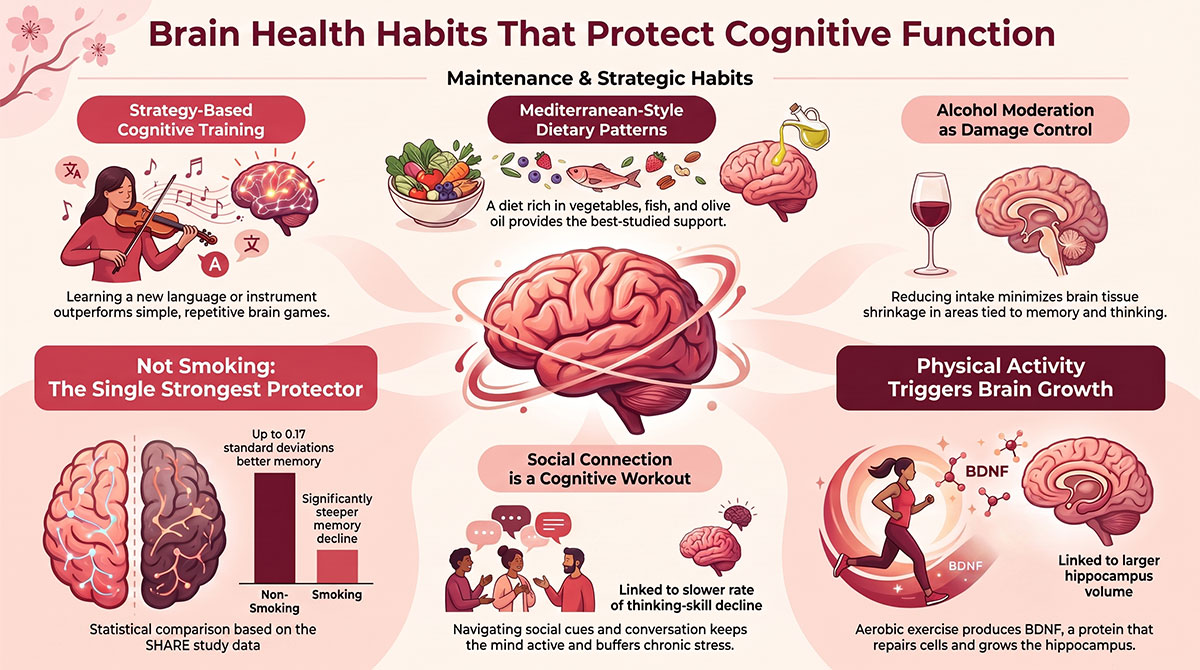
People with smoking-related lifestyles showed a measurably steeper decline, with memory scores dropping by as much as 0.17 standard deviations more over ten years than the reference group. The other three factors mattered less than expected, at least in this particular dataset.
None of that means diet, structured mental training, or the rest of the habits in this article are pointless. It means this one large study tested four behaviors, not six, and two of the habits covered below come from entirely separate research.
Why the Six-Habit Picture Still Holds Up
A different kind of study picked up where the SHARE analysis left off. The US POINTER trial enrolled 2,111 adults at elevated risk of cognitive decline and randomly assigned them to either a structured, intensive lifestyle program or a lighter, self-guided version. Both groups received guidance on exercise, the MIND diet, structured cognitive training, and social engagement.
After two years, the structured group showed a significantly greater improvement in global cognition and executive function than the self-guided group. Processing speed moved in the same direction but didn’t reach statistical significance, and memory scores didn’t differ between groups at all. Real trials rarely deliver a clean sweep across every measure, and this one didn’t either.
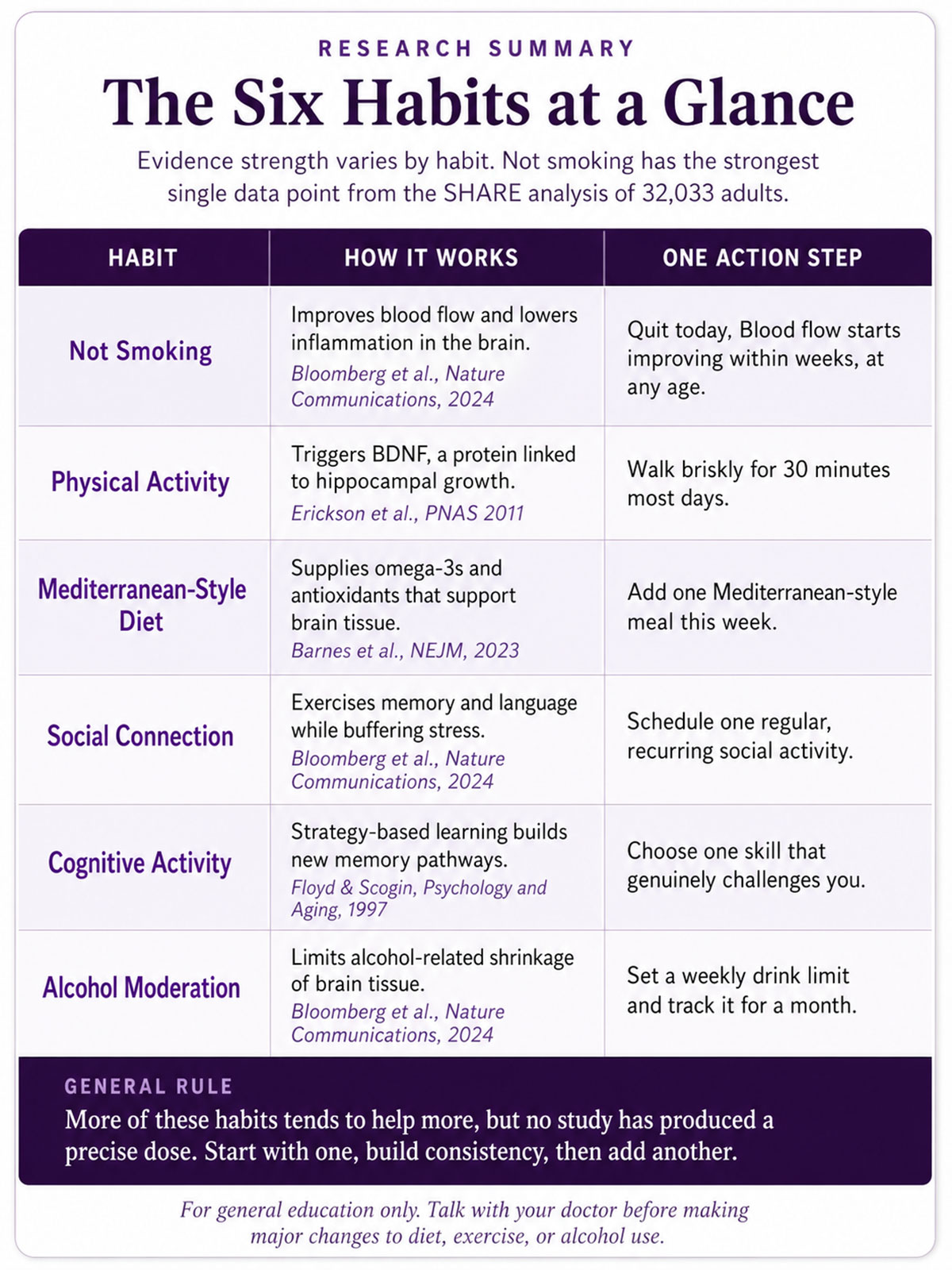
Between SHARE and POINTER, six behaviors keep showing up as protective across the wider research: physical activity, a Mediterranean-style diet, social connection, structured cognitive activity, alcohol moderation, and not smoking. They don’t carry equal weight. The sections below say so plainly, instead of pretending six habits are interchangeable.
The Six Habits That Support a Sharp Brain
1. Not Smoking Has the Single Strongest Data Point
Of the four behaviors SHARE researchers tracked directly, this is the one with a hard number attached. Smoking-related lifestyles showed measurably steeper memory and fluency decline than every non-smoking lifestyle in the study, even smokers who also exercised and stayed social.
Smoking reduces blood flow to the brain, damages blood vessels, and raises inflammation, and all three speed up cognitive decline.
Quitting doesn’t erase existing damage. It does slow what comes next. Blood flow improves and inflammation begins to decrease within weeks of quitting, at any age.
2. Physical Activity Signals Your Brain to Grow
Aerobic exercise triggers the production of a protein called brain-derived neurotrophic factor, or BDNF, which supports growth and repair in brain cells. Researchers have linked higher BDNF activity to a larger hippocampus, the brain region most responsible for forming new memories.
You don’t need marathon training to get this benefit. A brisk 30-minute walk most days raises your heart rate enough to matter, and swimming or cycling works equally well. The POINTER trial’s structured arm combined aerobic exercise with resistance training, and both types appear to contribute something slightly different to brain function.
Beyond memory, aerobic activity is linked to sharper executive function, the planning and decision-making skills that let you organize a task and follow through on it.
3. Mediterranean-Style Eating, With an Honest Complication
Diet is the habit most wellness content treats as settled science. The trial data is messier than that.
The largest randomized trial of the MIND diet to date, a hybrid of the Mediterranean and DASH patterns, followed 604 older adults with a family history of dementia for three years. Published in the New England Journal of Medicine in 2023, the trial compared the MIND diet against a control diet that also included mild calorie restriction.
Both groups improved on cognitive testing by similar amounts, and the MIND diet’s added benefit fell just short of statistical significance over the full three years, though it reached significance in the portion of the trial conducted before pandemic disruptions.
That’s not the tidy result diet marketing prefers. It’s still a meaningfully different outcome from a diet that does nothing, and it’s a fair example of how nutrition science on the brain remains a work in progress. The pattern itself, rich in vegetables, fish, nuts, and olive oil, and light on red meat and processed foods, still has the strongest overall support of any dietary approach studied for brain health.

4. Social Connection Does More Than Keep You Company
Talking with friends or family puts your brain to real work. You read facial cues, track shifting details, and adjust your words based on how someone reacts, and all of it keeps your mind active in ways solitary tasks rarely do.
Social contact was one of the four factors the SHARE researchers tracked directly. Its association with slower decline was smaller than smoking’s, but the pattern held. People with regular contact tended to retain their thinking skills better than those without it.
Chronic stress shrinks parts of the brain, the hippocampus especially, and strong relationships appear to buffer some of that damage. A video call counts here as much as an in-person visit, though nobody’s tested whether that holds up as well for people who were never especially social to begin with.
5. Cognitive Activity Only Works a Certain Way
Brain games promise a lot. Simple repetition doesn’t deliver much of it. Doing the same puzzle over and over rarely makes a measurable difference, but strategy-based training, learning new techniques for remembering or solving problems, is a different story.
A meta-analysis of 27 controlled studies, published by researchers Marguerite Floyd and Forrest Scogin in 1997, found that strategy-based memory training improved how older adults rated their own memory, with smaller but measurable gains on objective memory tests too. That analysis is nearly three decades old, but a 2012 meta-analysis led by Alden Gross at the Johns Hopkins Bloomberg School of Public Health, covering 35 additional trials, found that a similar pattern holds up in more recent research.
What tends to work: learning a new language, taking a class, playing an instrument, or working through complex puzzles. The key is challenge, since a task that’s too easy won’t help, and one that’s too hard will frustrate you. Where that line sits seems to shift as a skill gets easier, and nobody’s pinned down on how often to move it.
6. Alcohol Moderation Is Damage Control, Not a Health Boost
Heavy drinking damages the brain. That much isn’t new. What’s less clear to most people is where the line for “moderate” actually sits.
Alcohol use, one of the four factors tracked directly in the SHARE data, was linked to better cognitive outcomes at lower levels of consumption. That doesn’t mean moderate drinking helps your brain. It means drinking less does less harm, and alcohol shrinks brain tissue over time in areas tied to memory and thinking, with damage scaling roughly alongside consumption.
Current guidelines suggest no more than one drink a day for women and two for men, though newer research keeps finding measurable effects below that line. If you don’t drink, there’s no reason to start for your brain’s sake. If you do, that line looks more like a moving target than a floor where risk actually stops.
When Forgetfulness Is Normal, and When It Isn’t
Everyone loses their train of thought occasionally, or walks into a room and forgets why. That kind of lapse is a normal part of an aging, busy brain and not a warning sign on its own.
According to the National Institute on Aging, patterns worth mentioning to a doctor look different from ordinary forgetfulness. Repeating the same question within a short span, getting lost on a familiar route, or struggling to follow a conversation you’d normally track easily are the kinds of changes that warrant a discussion with a doctor, not a diagnosis you make yourself.
A single missed appointment isn’t one of them. A pattern of confusion about time, place, or recent events is worth a second look.
Poor cognitive function isn’t always about aging or dementia risk either. Uncontrolled blood pressure, thyroid problems, vitamin B12 or vitamin D deficiency, sleep apnea, depression, and certain medications can all produce symptoms that look like cognitive decline, and the underlying causes often respond well to treatment once identified. That’s part of why a doctor’s evaluation matters more than a quiz you take on your own.

Your Genetics Set the Odds, Not the Outcome
About 25% of people carry one copy of the APOE ε4 gene variant, and 2 to 3% carry two copies. This variant raises the risk of Alzheimer’s disease meaningfully, and for years, people treated it as close to a life sentence.
A 2019 study in JAMA, led by researchers at the University of Exeter Medical School, analyzed 196,383 UK Biobank participants and combined a genetic risk score with a four-factor lifestyle score covering smoking, diet, physical activity, and alcohol use.
People with high genetic risk and a favorable lifestyle had a 32% lower risk of dementia than those with high genetic risk and an unfavorable lifestyle. There was no significant interaction between genetics and lifestyle, meaning a healthy lifestyle helped regardless of how much genetic risk someone carried.
The POINTER trial found something similar from a different angle. Its structured intervention produced consistent benefits for APOE ε4 carriers and non-carriers alike, with no meaningful difference between the two groups.
Genes load the dice. Your daily habits are still how you play the hand you were dealt.
How Many of the Six Do You Actually Need?
You don’t need a perfect record on all six to get something out of this. POINTER’s own comparison makes that point directly: the self-guided group, which received lighter support and less structure, still improved. The structured group simply improved more.
That’s a more honest way to think about “dose” than a precise formula, because no single study has produced one.
Start with whichever habit is easiest for you to build first. Get comfortable with it, then add another. Small, sustained changes tend to outperform an ambitious plan abandoned in week three.
A Week-by-Week Plan for Building These Habits
Ready to start? Here’s a structure that mirrors how the intervention trials actually built these habits over time, adapted for someone doing it without a research team.
Weeks 1 to 4: Start With One Habit
Rate yourself honestly on each of the six habits, zero to ten, and write the numbers down as a baseline, not a judgment. Then pick whichever habit is closest to already being a habit, since early wins build momentum better than an ambitious restart. If you walk sometimes, make it regular, and if your diet is decent, add more vegetables before overhauling everything.
Stay with that first habit through week four before adding a second one. Track how many days you actually followed through. Seeing the number climb is its own motivation.
Months 2 to 6: Layer In the Rest
Once the first habit feels close to automatic, add another. Habits that combine well save time: walking with a friend covers exercise and social connection in one session, and a language class with a group does the same for cognitive activity and social connection.
Add a new habit every few weeks until most or all six are in place. Some weeks will be harder than others, and that’s expected rather than a sign you’re failing. Notice the small stuff along the way, sharper focus, more energy, less mental fog, since those subjective shifts tend to show up before anything measurable does.
Year One and Beyond: Raise the Bar
After a year, these habits should feel close to normal. Keep pushing anyway, with a harder class, a more demanding walk, or a new social setting. A brain that’s stopped being challenged stops gaining much from the habit that once challenged it.
What Changes First, and What Takes Years
Results don’t arrive overnight, but the timeline isn’t as slow as most people assume.
POINTER’s two-year data showed measurable improvement in global cognition and executive function for people following a structured program, some of them already in their 70s at enrollment. Subjective improvements like sharper focus and less mental fog often show up before formal testing picks up any change.
The SHARE analysis, built for a longer horizon, tracked people for a full decade. The gap that opened over that time wasn’t subtle. It was concentrated almost entirely in the group with smoking-related lifestyles, a detail worth sitting with rather than glossing over.
What We Still Don’t Know
The research here is real, but it isn’t complete, and pretending otherwise wouldn’t do you any favors.
Nobody has established a precise dose for any of these habits. How many minutes of exercise is enough, or how much social contact? The available data points toward “more, generally,” without offering an exact prescription.
Individual variation is real as well. Genetics, existing health conditions, and age all shape how much benefit any one person gets from a given habit. The SHARE cohort was overwhelmingly European, and POINTER enrolled Americans already showing elevated dementia risk factors, so how well these findings generalize to other populations remains an open question.
Even the MIND diet trial, one of the more rigorous nutrition studies in this space, delivered a result that was directionally positive but not conclusively significant over its full three years. Diet and cognition is an area where the science is still catching up to the confidence with which it’s often marketed.
Conclusion
The most useful finding here isn’t the six-habit checklist. It’s the reminder that smoking status explained more of the ten-year gap in the SHARE data than diet, puzzles, and socializing combined, a detail most brain-health content skips because it’s harder to sell than a tidy list.
That doesn’t make the other five habits pointless. It means the honest hierarchy of what protects a mind matters more than the length of the list you’re handed.
Your brain a decade from now will reflect the choices that are hardest to turn into content: the cigarette you didn’t have, the walk you took anyway, the dinner you didn’t eat, distracted and alone. A headline can’t hold any of that. The data still says it plainly.
FAQs
What if I’m already experiencing memory problems?
Start with these habits regardless. The research suggests they can slow further decline even after problems have started. Talk to your doctor as well, since some memory issues trace back to treatable causes like vitamin deficiencies, thyroid dysfunction, or sleep apnea rather than irreversible decline.
Do supplements help?
Most brain supplements lack strong evidence, and food generally outperforms pills here. A Mediterranean-style diet supplies the nutrients your brain actually needs.
Deficiencies are the exception. Low vitamin B12 or vitamin D can impair cognition, and correcting a confirmed deficiency helps. Taking supplements when you aren’t deficient hasn’t been shown to add extra benefit, so it’s worth confirming with bloodwork before spending money on a bottle.
Is it really never too late to start?
The SHARE cohort included adults from their 50s to past 100, and POINTER enrolled adults aged 60 to 79, many already showing risk factors for decline. Both groups still showed benefit from healthy habits at those ages. The brain’s ability to adapt, known as neuroplasticity, decreases with age but never fully disappears.
What about stress and sleep?
The SHARE analysis didn’t test sleep or stress management directly. It only examined four factors, and neither made the list.
Separate research makes clear that both matter substantially. Poor sleep impairs memory consolidation, the process that moves information from short-term to long-term storage, and chronic stress damages the hippocampus while impairing the creation of new brain cells.
Consider sleep and stress management unofficial habits seven and eight. They’re not part of the core evidence covered here, but they support everything else on this list.
How precise does my diet need to be?
Not very. The evidence points to an overall pattern rather than a strict checklist: more vegetables, fruit, fish, nuts, and olive oil, and less red meat, processed food, and added sugar.
In the largest MIND diet trial to date, higher adherence to the pattern was linked to a larger, though not statistically decisive, cognitive benefit compared with looser adherence. Partial adherence still counts for something. Start with one Mediterranean-style meal a week and build from there rather than trying to overhaul everything at once.