You don’t need years of poor sleep to affect this process. One night of sleep deprivation was enough to increase a protein linked to Alzheimer’s disease.
Eight hours of sleep means nothing if you’re skipping the one stage where your brain actually clears out the proteins linked to Alzheimer’s disease.
The relationship between sleep and brain health goes further than most people realize. It isn’t about rest in any passive sense. While you sleep, the brain runs a maintenance operation that the waking brain physically cannot perform: a fluid-based purge that removes the metabolic waste that accumulates across the day. Miss the right stage, and that cleaning doesn’t happen. Not fully, anyway.
This isn’t a metaphor. It’s a physical process with a name, a mechanism, and a body of human evidence that has grown considerably in the past few years. That evidence links disruption of this system directly to neurodegenerative disease.
The Hidden Plumbing System Inside Your Brain
The brain has a problem most other organs don’t share. It is one of the most metabolically active tissues in the body, generating waste constantly. Yet unlike muscles, the liver, or the gut, it has no conventional lymphatic drainage. For most of modern medicine, how the brain cleared its own debris remained largely unexplained.
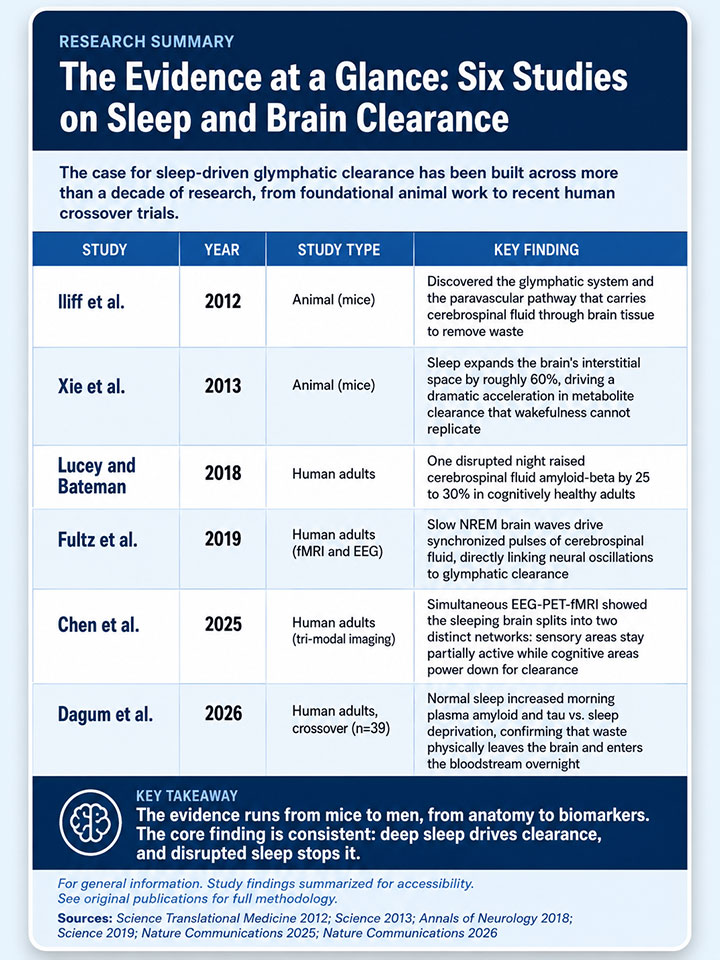
In 2012, neuroscientists at the University of Rochester gave that explanation a name. Working with live mice, Jeffrey Iliff and colleagues at Maiken Nedergaard’s lab published research in Science Translational Medicine describing a previously unknown brain-wide waste-clearance network operating through channels that run alongside blood vessels.
Cerebrospinal fluid (CSF) enters brain tissue, mixes with the fluid surrounding cells, and carries waste products out. The system was named the glymphatic system: the name combines “glial” (referring to the support cells that drive it) and “lymphatic” (the body’s standard waste-removal infrastructure).
What made a follow-up finding, published the next year, genuinely striking was the scale of the change during sleep. Xie and colleagues showed in a 2013 Science paper that sleep is associated with roughly a 60% increase in the interstitial space (the gap between brain cells), allowing cerebrospinal fluid to move in and dramatically accelerate the rate at which metabolites are cleared. The brain physically opens up to let the wash cycle run. During wakefulness, that space contracts and the system operates at a fraction of its sleep-state capacity.
The system’s most clinically significant target is amyloid-beta, the protein that builds into the plaques that define Alzheimer’s disease. The cells doing the work are astrocytes, specialized glial cells that govern how cerebrospinal fluid enters brain tissue through Aquaporin-4 channels expressed in the end-feet that wrap tightly around cerebral blood vessels. Think of them as biological valves that open during sleep and close when you wake.
Why Deep NREM Sleep Is the Only Stage That Counts
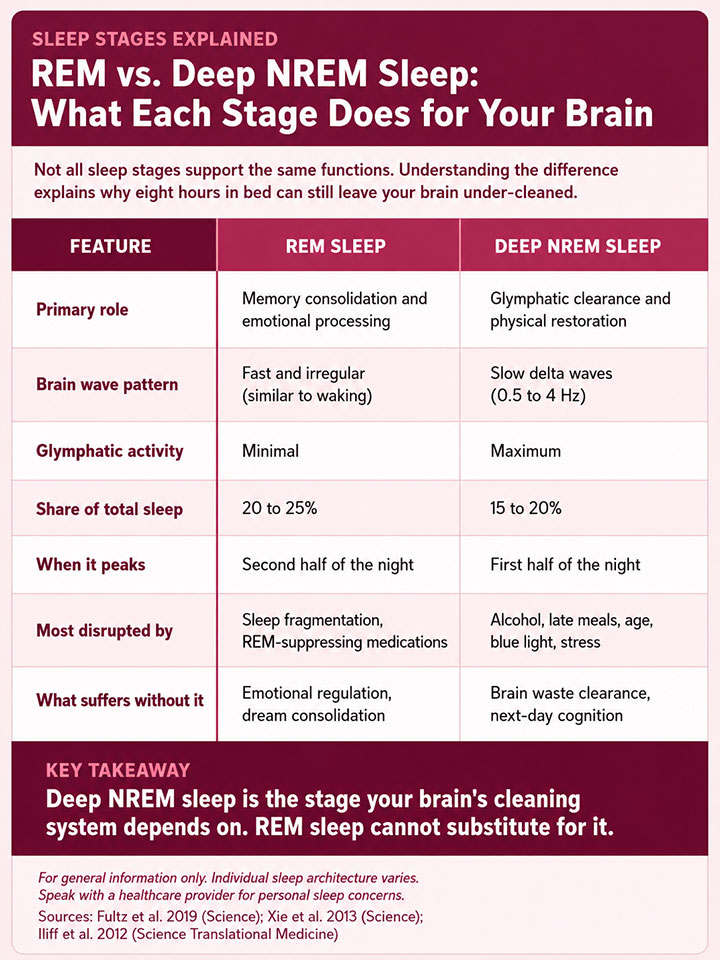
People commonly associate sleep quality with REM sleep, the stage linked to dreams and memory consolidation. REM gets most of the popular attention. For glymphatic clearance, the stage that matters is deep non-REM (NREM) sleep, sometimes called slow-wave sleep, and the reason comes down to electrical activity in the brain itself.
During deep NREM, the brain produces large, slow electrical waves known as delta oscillations. A 2019 research team led by Laura Lewis at Boston University wanted to know whether these waves were simply a sign of deep rest or whether they were actively driving the fluid dynamics that make glymphatic clearance possible. What they found changed the picture considerably.
Fultz et al., writing in Science, showed that during NREM sleep, large slow electrical oscillations in the brain are tightly coupled to oscillations in blood volume, which in turn drive waves of cerebrospinal fluid. The neural wave comes first, blood follows, then a pulse of CSF sweeps through. The slow waves that define non-REM sleep appear to be a key driver of the waste clearance that occurs during sleep.
Without those waves, the fluid pulses don’t happen at the same intensity, and clearance decreases. REM sleep, light sleep, and fragmented sleep don’t generate the same effect.
The mouse-to-human translation gap hasn’t fully closed. Not every lab has replicated the precise scale of these fluid dynamics in people, and some measurement methods used in the foundational animal work remain contested. The human imaging data has added weight that most researchers find difficult to dismiss, but the underlying questions aren’t settled.
That distinction matters considerably when you look at how modern sleep disruption tends to work. Alcohol, chronic stress, blue light exposure, and age all disproportionately suppress deep NREM sleep while often leaving total sleep time relatively intact. Someone sleeping seven hours but generating very little slow-wave activity may be achieving significantly less glymphatic clearance than the clock suggests.
What the Brain Is Actually Doing While You Sleep
The picture of what happens inside a sleeping brain, region by region, was largely invisible until 2025. The spatial detail simply wasn’t there. Then a team at Massachusetts General Hospital and MIT ran an experiment that hadn’t been done before.
Using a simultaneous tri-modal imaging approach combining EEG, fMRI, and functional PET scanning, Chen et al.’s 2025 study in Nature Communications tracked how brain activity, blood flow, and glucose metabolism shift together as people fall into NREM sleep.
The imaging revealed two distinct network patterns operating at the same time. Sensory networks (sight, sound, and touch processing) displayed high-amplitude, low-frequency blood flow waves with relatively preserved metabolic activity. The default-mode network, which governs higher cognition and internal mental activity, showed smaller blood flow changes and the most pronounced drop in energy use.
Your brain splits into two operational modes during deep sleep. The sensory networks stay partially alert. They maintain a biological alarm system capable of waking you if the outside world demands it. The cognitive and memory areas power down as completely as possible. This explains how the brain stays responsive to genuine threats even as conscious awareness disappears.
The architecture is not a coincidence. The areas that shut down most completely during NREM are precisely the areas that appear to benefit most from glymphatic clearance. Deep suppression of the default-mode network seems to be part of what allows the fluid exchange to run effectively, with reduced metabolic demand and maximum opportunity for waste removal.
Your Glymphatic Sleep Check
During deep NREM sleep, your brain runs a fluid-based cleaning cycle that clears Alzheimer's-linked proteins. Six behavioral factors determine how much of that window actually runs each night.
Answer 6 quick questions to find out where your habits stand.
The Cost of Skipping the Wash Cycle
When deep sleep is cut short, the cleaning cycle runs incompletely. Waste builds up. In the case of amyloid-beta, that buildup can be rapid.
Brendan Lucey and Randall Bateman led a study that used lumbar catheters to sample cerebrospinal fluid overnight. It compared participants who slept normally against those who were kept awake.
The study, published in Annals of Neurology in 2018, showed that sleep deprivation increased overnight amyloid-beta levels by 25 to 30% through increased production relative to sleeping controls. The participants were cognitively healthy adults. One disrupted night, and brain amyloid levels increase by more than a quarter.
That’s not a chronic effect of years of poor sleep. That’s the cost of a single bad night.
The effect is reversible. Amyloid levels return toward baseline with recovery sleep, which suggests the system works as designed when sleep is adequate. But for people with persistently disrupted sleep, or those who chronically sacrifice deep NREM for early alarms or late nights, the connection between brain health and sleep deprivation compounds over time rather than resetting.
Proof the Waste Actually Leaves the Brain
For years, a gap remained in the evidence. Researchers could show that amyloid levels in the brain rose with sleep loss, and that the glymphatic system was anatomically capable of clearing these proteins. What was missing was direct proof that sleep-driven glymphatic activity successfully moved amyloid and tau out of the human brain and into the bloodstream, where the body could eliminate them.
Paul Dagum and his team at Applied Cognition spent years designing a trial that could actually test this, not infer it from animal data or anatomical theory.
Their randomized crossover trial, published in Nature Communications in January 2026, enrolled 39 participants and showed that glymphatic clearance during normal sleep increased morning plasma levels of Alzheimer’s disease biomarkers compared to sleep deprivation.
Higher levels of amyloid and tau in the blood after a normal night of sleep don’t indicate a worsening problem. They indicate successful overnight clearance: the proteins were moved out of brain tissue and into circulation for elimination.
Participants wore monitoring devices that tracked brain parenchymal resistance throughout the night: essentially a measure of how open or closed brain tissue is to fluid movement. The pattern matched what the glymphatic model predicts. When sleep was normal, resistance fell, fluid moved freely, and morning blood samples showed elevated clearance markers.
Certain measurement methods from earlier animal work remain the subject of active scientific debate. But the Fultz imaging study and the Dagum 2026 trial provide direct evidence for the core mechanism in people, not just in mice. That is the kind of evidence the field needed.
Five Ways to Get More Deep NREM Sleep
Most sleep advice stops at “get eight hours.” Total time in bed and time spent in slow-wave sleep are genuinely different quantities, and most people have no idea how far apart theirs are.
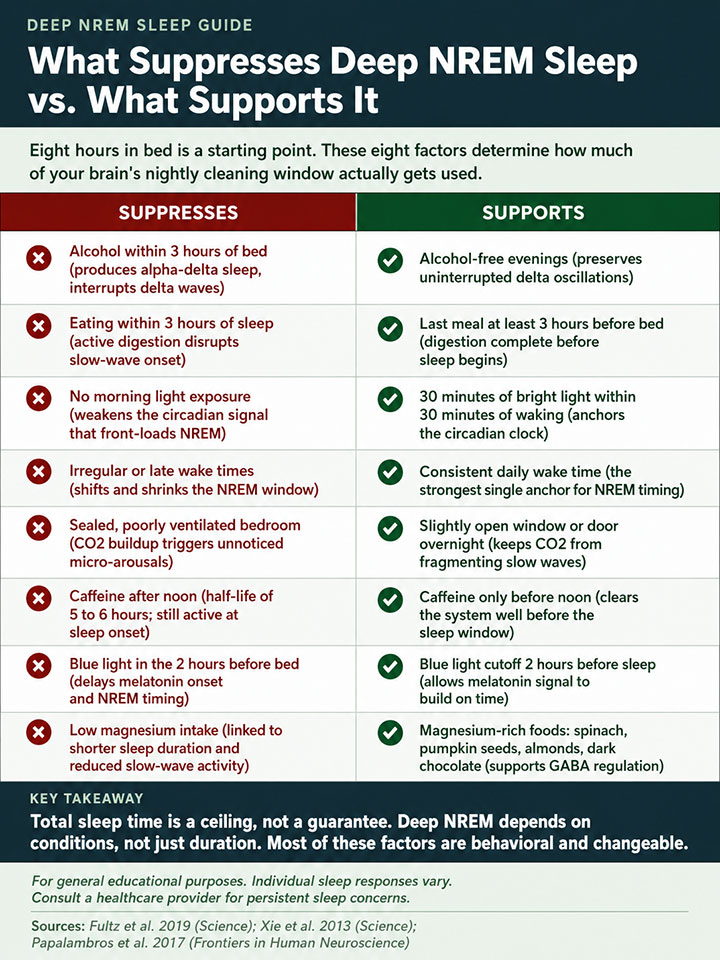
Drop your core body temperature before bed. Deep NREM sleep requires a fall in core temperature. Taking a hot shower or bath 60 to 90 minutes before bed draws blood to the skin surface, and the rapid cooling that follows when you step out helps trigger the temperature drop your body needs to enter slow-wave sleep efficiently. The effect is well-established and takes nothing more than changed timing.
Stop eating at least three hours before sleep. Active digestion interferes with sleep quality. The body cannot fully commit to restoration while processing a large meal. Cutting off heavy caloric intake well before bed removes one of the most common but underappreciated suppressors of slow-wave sleep.
Try pink noise, and not just for blocking out disturbances. Pink noise is slightly warmer and deeper than white noise, and it appears to serve a more active function: synchronizing and amplifying the delta oscillations the brain produces during deep NREM.
Those rhythms run at 0.5 to 4 Hz, the slowest electrical activity the brain generates. Research published in Frontiers in Human Neuroscience found that pink noise pulses timed to the upstate of slow waves increased slow-wave activity and improved memory performance in older adults. You’re not just masking a neighbor’s car. You’re potentially feeding the cleaning cycle.
You sleep eight hours and wake up tired, and you can’t figure out why. One underexamined candidate is the air in your room. Carbon dioxide builds up in poorly ventilated bedrooms overnight, and even mild accumulation triggers micro-arousals, brief partial wakenings the sleeper never consciously registers.
Those interruptions break the sustained slow-wave activity the glymphatic system requires. Open a window slightly, or crack the door. The fix is simple enough that most people don’t think it counts.
Get bright light within 30 minutes of waking. This is the tip that does the most work, though it looks nothing like a sleep intervention. Morning sunlight anchors the circadian rhythm and determines the timing and strength of the melatonin signal at night. A well-timed melatonin signal produces a faster and deeper onset of NREM sleep when the time comes.
Deep NREM sleep is not evenly distributed across the night. It is front-loaded. The longest and most efficient slow-wave cycles happen in the first half of the night, typically the two to three hours after sleep onset.
A well-anchored circadian clock ensures that stage three NREM arrives on schedule and runs fully. When the circadian signal is weak or delayed (from no morning light exposure, from late evening screen use, from irregular wake times), that NREM window compresses or shifts later, and the most productive cleaning hours are the ones lost.
This is why a consistent wake time arguably matters more than a consistent bedtime. The alarm sets the clock. The clock determines when NREM peaks. The peak determines how much cleaning gets done.
One note on sleep medications. Research from Nedergaard’s group at the University of Rochester found that zolpidem (the widely prescribed sedative sold as Ambien) suppressed glymphatic activity in mice even when the animals appeared to sleep normally.
Sedative-induced unconsciousness and restorative slow-wave sleep are not the same state. If you rely on a sleep aid regularly, it’s worth discussing this with a doctor, particularly given the glymphatic connection to long-term brain health.
A word on alcohol, which deserves its own category entirely. Alcohol is a sedative, so it feels like it helps you sleep. It pushes you into unconsciousness faster. But it produces what researchers call alpha-delta sleep: a state where slow delta waves are constantly interrupted by faster alpha activity, the kind the brain generates during quiet wakefulness.
The glymphatic pump requires sustained, uninterrupted delta oscillations. Alcohol effectively paralyzes it while creating the subjective feeling of rest. You wake up having “slept” eight hours with very little of the cleaning done.
What Foods Help You Sleep More Deeply?
No single food switches on deep NREM sleep, but certain nutrients are consistently associated with improved sleep quality and slow-wave activity.
Magnesium is the most studied. It plays a role in regulating GABA, the inhibitory neurotransmitter that reduces neural excitability and allows the slow-wave state to develop. Low magnesium intake has been linked in observational data to shorter sleep duration and poorer sleep quality.
Foods rich in magnesium include dark leafy greens (spinach, kale), pumpkin seeds, almonds, dark chocolate, and legumes.
Getting adequate magnesium through food rather than supplementation is preferable when possible, but magnesium glycinate and magnesium threonate are the forms most consistently associated with sleep benefit in the supplement literature, largely because of their absorption profile.
Tryptophan-rich foods (turkey, eggs, dairy, oats) provide the precursor to serotonin and melatonin, and consuming them with complex carbohydrates (which aid tryptophan transport across the blood-brain barrier) may support the evening melatonin signal.
Timing matters here: eating a light, tryptophan-containing meal two to three hours before bed aligns with the recommendation to stop heavy eating earlier and keeps digestion from interfering with deep-sleep onset.
The practical answer turns out to be disappointingly unglamorous. Adequate magnesium, a reasonable cutoff time for eating, no alcohol, and no caffeine after noon. That’s it.
The industry built around sleep optimization, with its supplements and gadgets and protocols, largely sits on top of those four things. Getting the basics right doesn’t leave much room for the products to add meaningful benefit.
A Note on Where This Science Stands
The glymphatic field has moved fast and, in some areas, outrun rigorous human replication. Most foundational work was done in mice. The jump to human physiology is not always direct, and some researchers have raised methodological challenges to specific experimental approaches used in earlier animal studies.
That said, the human evidence has strengthened considerably. The Fultz imaging study directly captured fluid-neural coupling in sleeping people.
The Dagum trial demonstrated successful overnight clearance of Alzheimer’s biomarkers in a controlled human crossover design.
The Lucey and Bateman study showed measurable amyloid accumulation in cognitively healthy adults after a single disrupted night.
The Chen imaging data mapped the regional brain dynamics of NREM with a level of detail not previously achievable in humans.
What remains less certain is the precise relationship between the nightly clearance measured in these studies and the decades-long trajectory toward dementia. Sleep deprivation research shows acute amyloid spikes.
Epidemiological data links chronic poor sleep to elevated Alzheimer’s risk. Whether the two are directly causal, and what threshold of sleep disruption becomes dangerous over a lifetime, is still being worked out. The animal-to-human translation gap is real, and the methodological debates around measuring glymphatic function in living humans are ongoing rather than resolved.
What is established is this: the brain has a cleaning system, it runs at night, it depends on a type of sleep that most people don’t think about, and it can be disrupted in a single night by things that most people consume without a second thought.
Whether that is enough to change what you do tonight is a question only you can answer. But it is not a question you can answer well without knowing the mechanism exists.