A study found yoga produced greater hamstring flexibility gains than standard static stretching after just six weekly sessions. Here’s why.
Most people who stretch their hamstrings regularly still have tight hamstrings. They reach for their toes every morning, foam roll after runs, hold static stretches for the recommended thirty seconds, and the tightness comes back by mid-afternoon. The frustrating truth is that the problem often isn’t how much you stretch. It’s what stretching alone cannot do.
Yoga for hamstrings works differently than static stretching because it pairs controlled breathing with sustained, load-bearing positions. That combination doesn’t just lengthen the muscle. The nervous system’s response to the stretch changes too.
When researchers at Doncaster College compared yoga practice to standard static stretching in 2014, the yoga group showed significantly greater gains in hamstring and lower-back flexibility after just six weekly sessions. The mechanism behind the advantage had nothing to do with the poses being more intense. It had to do with breathing.
This guide gives you six targeted poses, a 10-minute daily routine you can run right now, and the specific daily habits that keep hamstring flexibility from eroding between sessions. If you’ve been stretching without seeing results, the reason is probably in this article.
Understanding Your Hamstrings: The Three Muscles That Matter
Your hamstrings aren’t one muscle. They’re a group of three distinct muscles: the biceps femoris along the outer back of the thigh, the semimembranosus along the inner back, and the semitendinosus running through the middle. Together they share two jobs: bending the knee and extending the hip. They also do something people rarely think about.
During walking and running, the hamstrings work eccentrically, meaning they lengthen while under load. They act as a brake on knee extension. That repeated eccentric demand is what creates micro-stress in the fibers over time. Without regular stretching to offset it, the muscles adapt toward a shorter resting length.
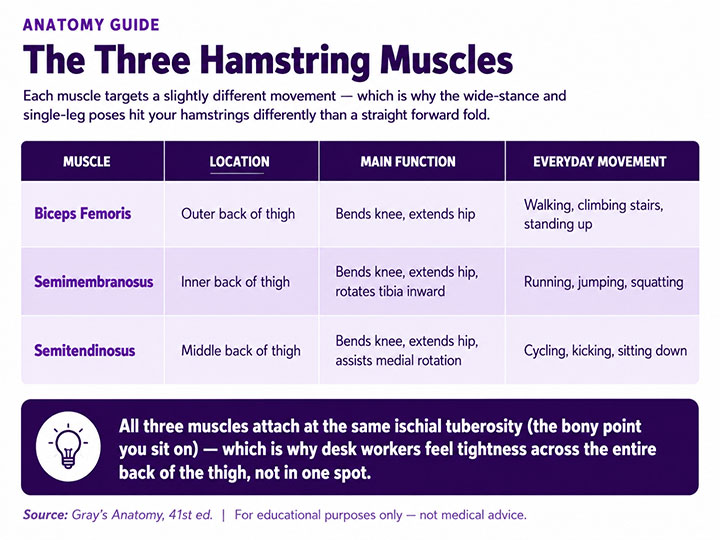
All three heads attach at the same point on the ischial tuberosity (the bony point you sit on), which is why seated desk workers feel tightness across the entire back of the thigh rather than in one specific spot. When you sit for hours, all three muscles stay shortened simultaneously.
Who Gets Tight Hamstrings? Risk Factors You Should Know
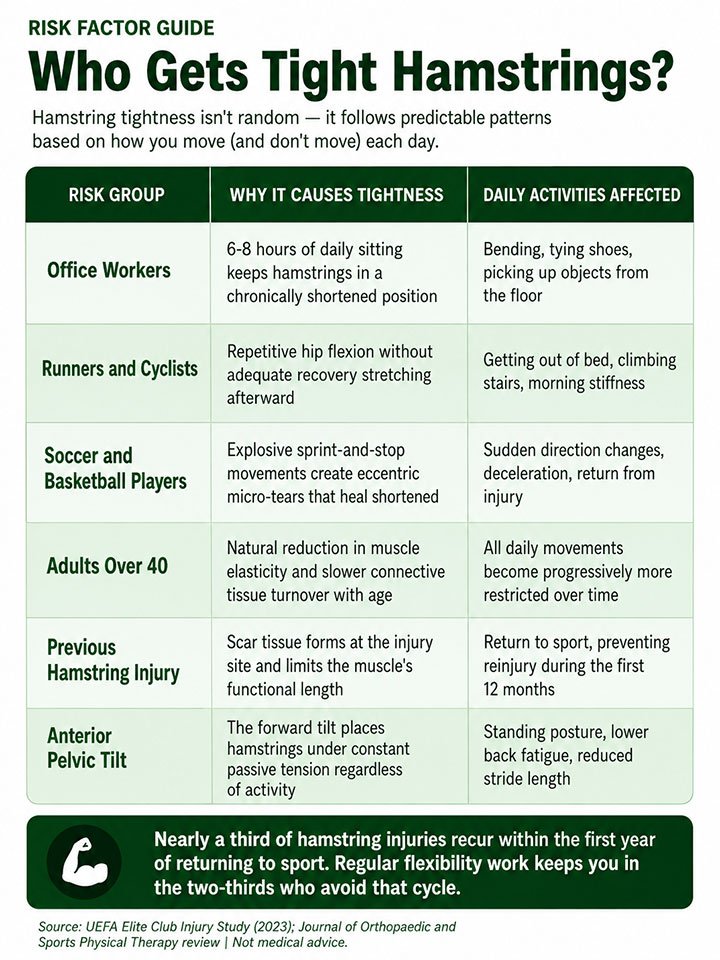
Office workers and runners are the two populations most researchers focus on, each for different reasons. People who sit for six to eight hours a day keep the hamstrings in a chronically shortened position, while runners and cyclists subject them to repetitive flexion without adequate recovery stretching afterward.
The injury statistics make a strong case for prevention. Across 21 seasons of UEFA Elite Club data, hamstring injuries represented 19% of all injuries in professional football players, and that figure has been rising steadily.
What makes the numbers more sobering: according to a review published in the Journal of Orthopaedic and Sports Physical Therapy, nearly a third of those injuries recur within the first year of returning to sport. Scar tissue forms, tissue extensibility decreases, and the muscle is weaker in the very range of motion where injuries happen.
Regular flexibility work keeps you in the two-thirds who don’t go through that cycle.
If flexibility isn’t improving, this may be why. In many cases, what feels like hamstring tightness is actually a mobility restriction elsewhere. Find out what could actually be limiting your mobility.
Before You Start: The Golden Rules of Safe Stretching
Listen to Your Body
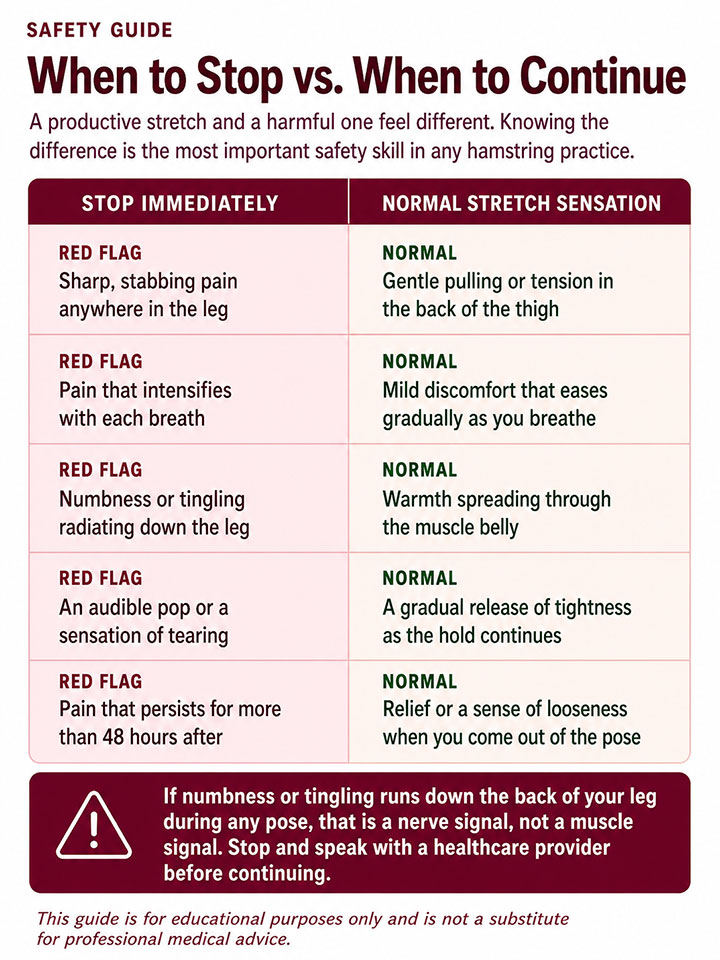
Stretching should produce a mild pulling sensation in the target muscle. Gentle tension that gradually eases as you breathe into it: that’s a productive stretch. Sharp, stabbing pain, numbness, or tingling down the leg is a different signal entirely and means you’ve exceeded a safe range.
Warm Up First
Cold muscles stretch poorly and tear more easily. Spend two to three minutes in light movement before starting: march in place, swing your legs gently, or take a short walk. Think of muscle fiber the way material scientists think about polymer chains: at low temperature the chains are stiff and brittle, and as temperature increases they become more pliable and resistant to tearing. Your hamstrings operate on the same principle.
Breathing and Hold Duration
A systematic review by David Behm and colleagues, published in Applied Physiology, Nutrition, and Metabolism in 2016, confirmed that static stretching produces meaningful acute increases in range of motion, but the review also showed that stretches held longer than 60 seconds start to impair muscle force production.
The sweet spot for consistent, daily hamstring work is holds of 30 to 60 seconds. Deep nasal breathing throughout each hold shifts the autonomic nervous system toward its parasympathetic state, reducing baseline muscle tension and allowing the stretch to work in the tissue rather than against a protective reflex.
Common Mistakes to Avoid
Bouncing while stretching triggers a protective reflex called the myotatic stretch reflex, causing the muscle to contract rather than lengthen. It also increases the risk of micro-tears in the muscle fibers. All movements in this routine are slow and controlled.
Holding your breath during a stretch keeps the sympathetic nervous system active, maintaining baseline muscle tension and working against the flexibility gains you’re trying to create. Make your exhale the signal for each deepening of the pose.
Pushing through sharp pain is the mistake with the longest recovery time. Mild discomfort is productive. A stabbing sensation means the muscle is being loaded beyond its tolerance. Back off and approach the stretch more gently from a modified starting position.
Comparing your flexibility to someone else’s is also worth naming directly. Bone structure, muscle fiber type distribution, past injuries, and training history all determine your range of motion. Another person’s Downward Dog tells you nothing about what yours should look like.
Your 10-Minute Daily Hamstring Reset: The 6 Poses
These six poses are sequenced to move from weight-bearing to supine to single-leg to wide-stance, which lets you build heat gradually and ensures you hit each of the three hamstring muscles from different angles. Follow the sequence in order.
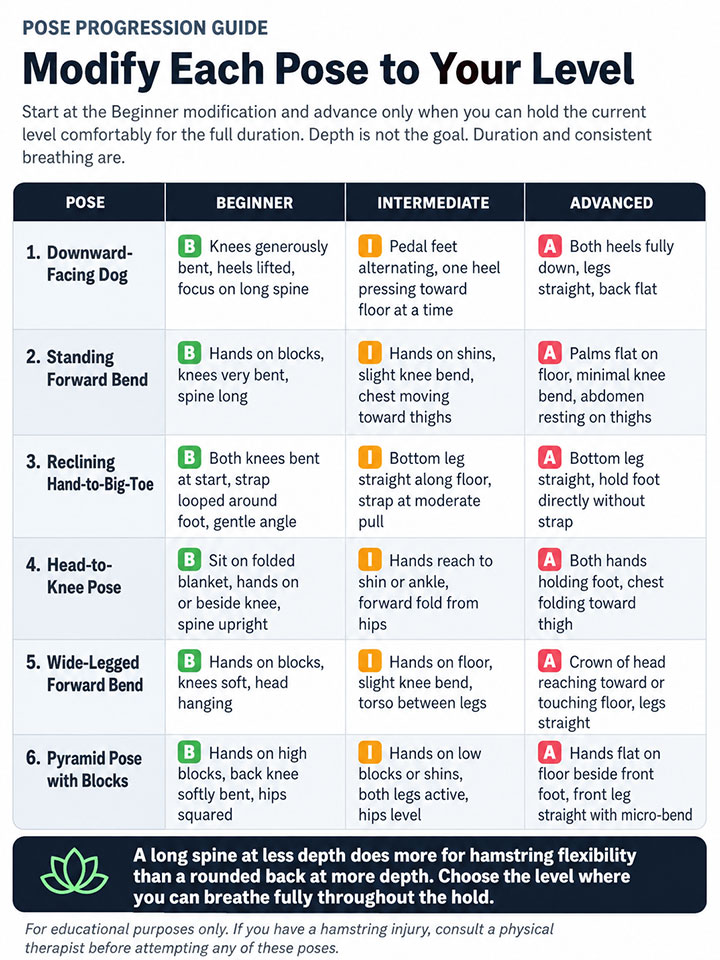
Pose 1: Downward-Facing Dog (Adho Mukha Svanasana)
Target: Entire posterior chain (hamstrings, calves, lower back)
Difficulty: Beginner to Intermediate
Hold: 60 seconds
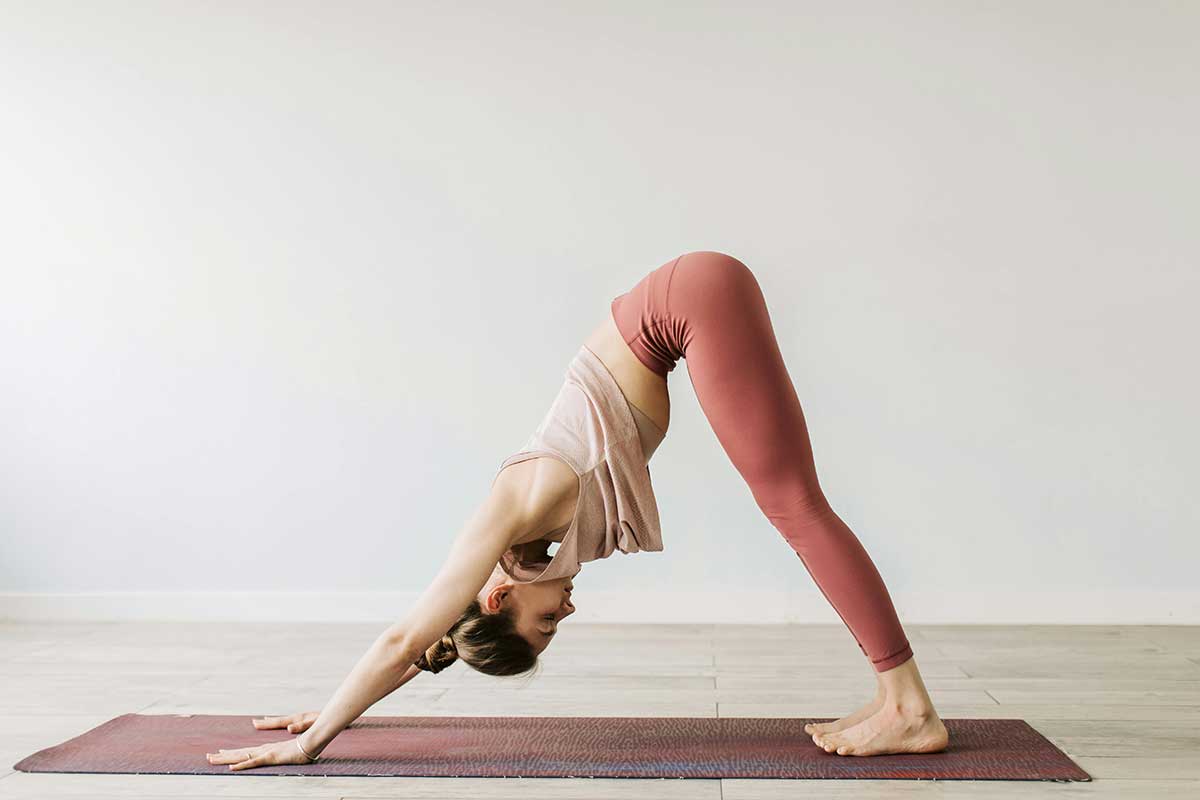
This is the best opening pose for hamstring work because it loads the entire back line of the body at once, warming the calves and lower back simultaneously. Most people underuse the heel-pedaling variation, which is where the real hamstring benefit lives for beginners.
- Start on hands and knees with hands shoulder-width apart and fingers spread wide.
- Tuck your toes, then press into your palms and lift your hips up and back, forming an inverted V shape.
- Bend your knees generously at first, then slowly begin to “pedal”: pressing one heel toward the floor while bending the opposite knee.
- After several pedal cycles, settle with both feet even, maintaining a long spine even if your heels remain lifted.
The single most common error here is rounding the back to force the heels down. A long spine with lifted heels does more for your hamstrings than a rounded spine with flat heels. Keep the focus where the stretch is, not where the aesthetic is.
Pose 2: Standing Forward Bend (Uttanasana)
Target: Hamstrings, lower back, calves
Difficulty: Beginner
Hold: 60 seconds
Gravity becomes your tool here. In the Iyengar yoga study published in the Journal of Bodywork and Movement Therapies, forward folds were among the core poses driving the flexibility improvements the researchers measured, specifically because hip-hinging postures allow the posterior chain to decompress under passive load rather than active effort.
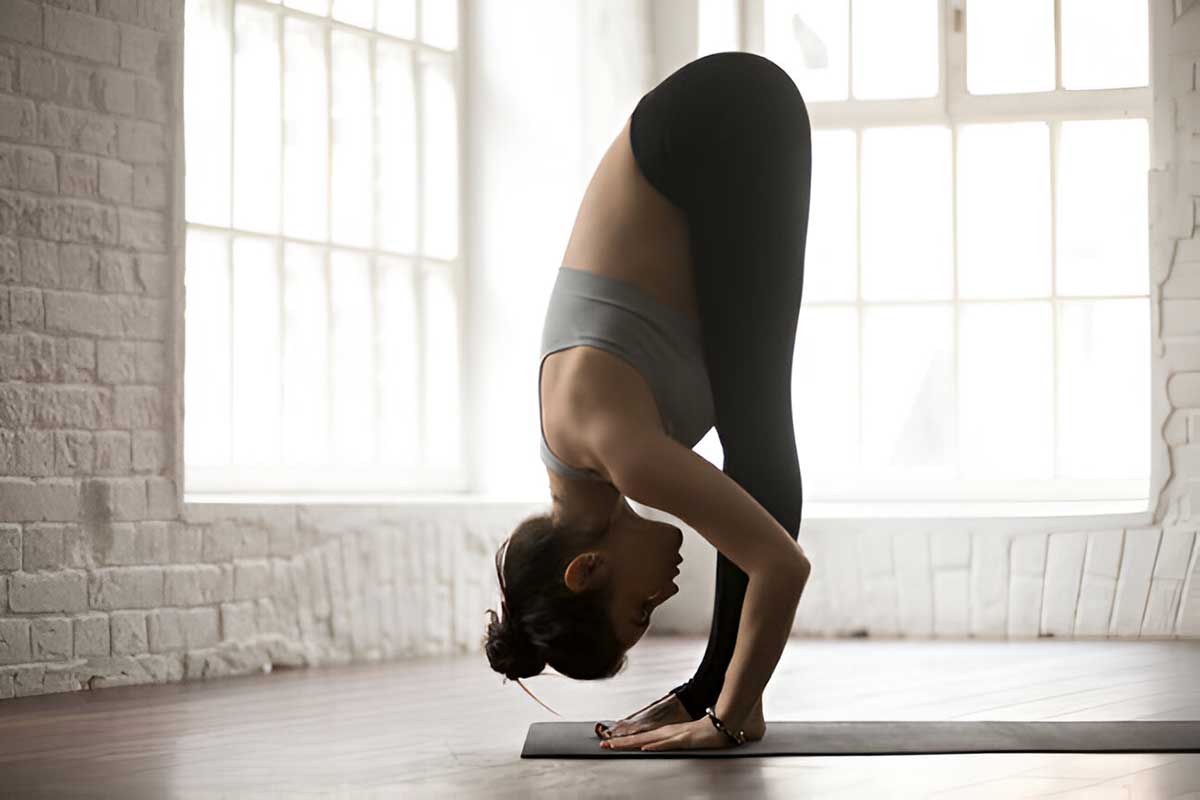
- Stand with feet hip-width apart, toes pointing forward.
- Inhale to lengthen the spine, then exhale and hinge forward from the hips, not the waist.
- Let your head and neck hang heavy. Rest your hands on yoga blocks, your shins, or the floor, whichever allows you to maintain a long spine rather than a rounded one.
- With each exhale, allow gravity to deepen the fold slightly. Do not bounce or force.
Bending generously from the knees is not cheating. It shifts the stretch from the lower back (where it doesn’t belong) to the hamstrings (where it does).
Pose 3: Reclining Hand-to-Big-Toe Pose (Supta Padangusthasana)
Target: One hamstring at a time, hip flexors
Difficulty: Beginner to Intermediate
Hold: 60 seconds per side
Lie down for this one. Your lower back stays against the floor, one leg works at a time, and there’s no way to compensate by shifting weight or swiveling your hips. Most people find their two legs feel completely different here, and that gap, once you notice it, explains a lot about why one hip feels tighter than the other in everything from running to sitting.
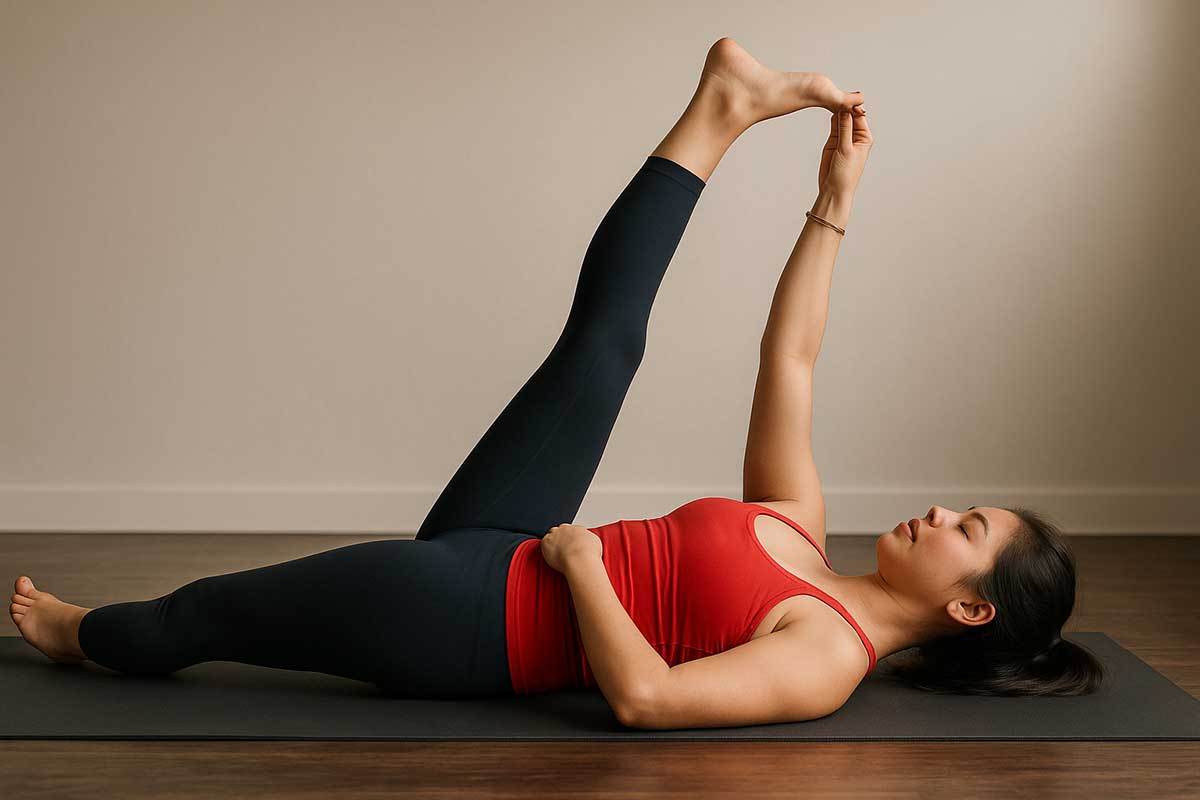
- Lie on your back with both knees bent, feet flat on the floor.
- Loop a yoga strap, belt, or towel around the ball of your right foot and hold both ends.
- Slowly extend your right leg toward the ceiling, keeping your head, shoulders, and opposite hip flat against the floor.
- Hold for the full 60 seconds, breathing steadily. Switch sides.
Lifting the opposite hip to get the raised leg higher is the most common form error. It removes the hamstring isolation you’re working for and transfers load to the hip flexors. If you notice the opposite hip rising, soften the leg angle until the hip stays grounded.
Pose 4: Head-to-Knee Pose (Janu Sirsasana)
Target: Single hamstring, hip, side body
Difficulty: Intermediate
Hold: 60 seconds per side
If you’ve been at a desk all day, this one will find you out. The bent knee of the non-working leg quietly shifts your pelvis, deepening the stretch in the extended leg without you doing anything extra. Runners tend to feel it most immediately. The hamstring-hip connection in this pose is direct enough that tight runners occasionally mistake the sensation for something wrong. It isn’t.
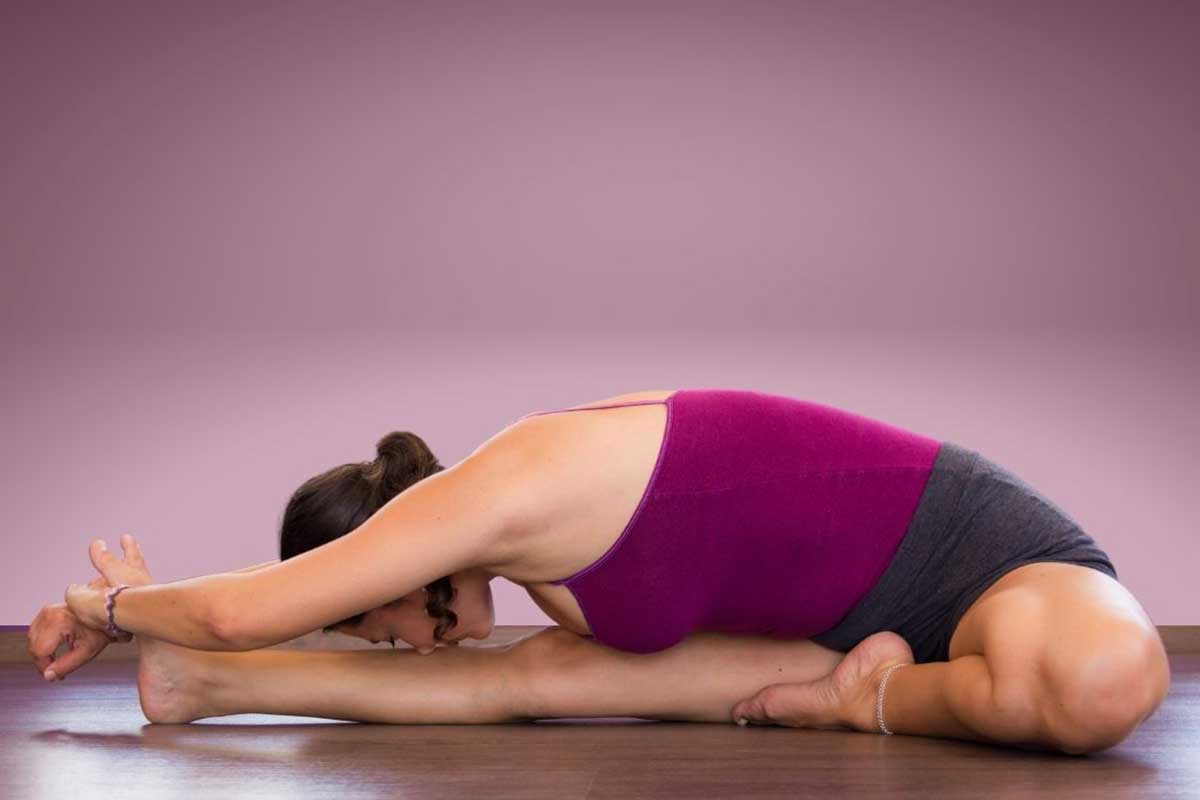
- Sit on the floor (or on the edge of a folded blanket) and extend your left leg straight in front of you.
- Bend your right knee and place your right foot against your inner left thigh, letting the knee fall out to the side.
- Inhale to lengthen your spine, then exhale and hinge forward from your hips over the extended leg.
- Hold your foot, ankle, or shin, whichever you can reach without rounding your back. Switch sides.
Sitting on a folded blanket tilts the pelvis forward and changes everything about how this pose feels. If your lower back is the first thing you notice rather than your hamstring, the blanket is the fix.
Pose 5: Wide-Legged Standing Forward Bend (Prasarita Padottanasana)
Target: Hamstrings from a different angle, inner thighs
Difficulty: Beginner to Intermediate
Hold: 60 seconds
The wide stance changes which muscle fibers within the hamstring group are most loaded, targeting the inner aspects (semimembranosus and semitendinosus more than biceps femoris) while also recruiting the adductors. This is where most hamstring routines leave gaps by treating the three muscles as one undifferentiated unit.
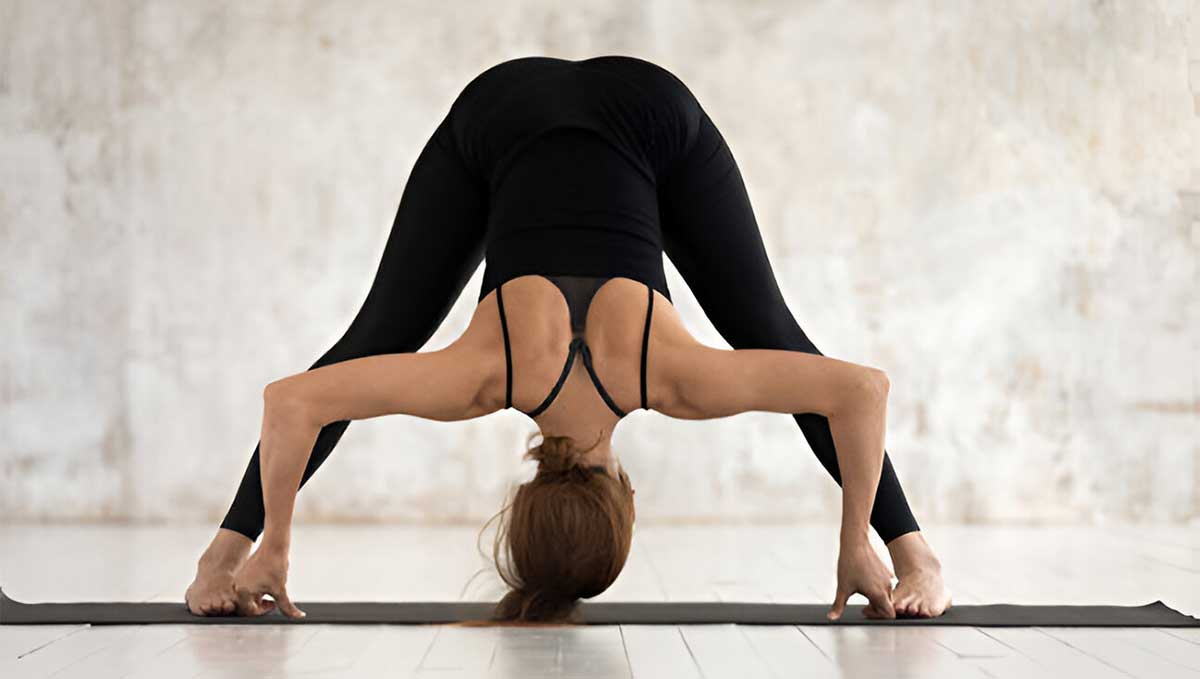
- Stand with feet three to four feet apart, feet parallel, toes pointing forward.
- Place your hands on your hips, inhale to lengthen your spine, then exhale and hinge forward, placing your hands on the floor or on blocks directly under your shoulders.
- Let your head hang naturally. Feel the stretch spread across the backs of both legs simultaneously.
- Try a slow sway from side to side. You’ll often find one side noticeably tighter than the other, which is useful diagnostic information.
Pose 6: Pyramid Pose (Parsvottanasana) with Blocks
Target: Front-leg hamstring (most intense focus in the routine)
Difficulty: Intermediate to Advanced
Hold: 60 seconds per side
This pose deserves more space than the others because it’s the most technically demanding in the sequence and the most commonly done wrong. Of the six poses here, Pyramid Pose is where most people discover their largest imbalance. Working one leg at a time with squared hips makes it nearly impossible to compensate, and the side that’s been compensating for years announces itself quickly.
The blocks are not optional. Without them, the hamstring resistance forces either a hyperextended front knee, a rounded spine, or a twisted pelvis, all of which remove the hamstring stretch you came for and add strain to structures that shouldn’t be taking load.
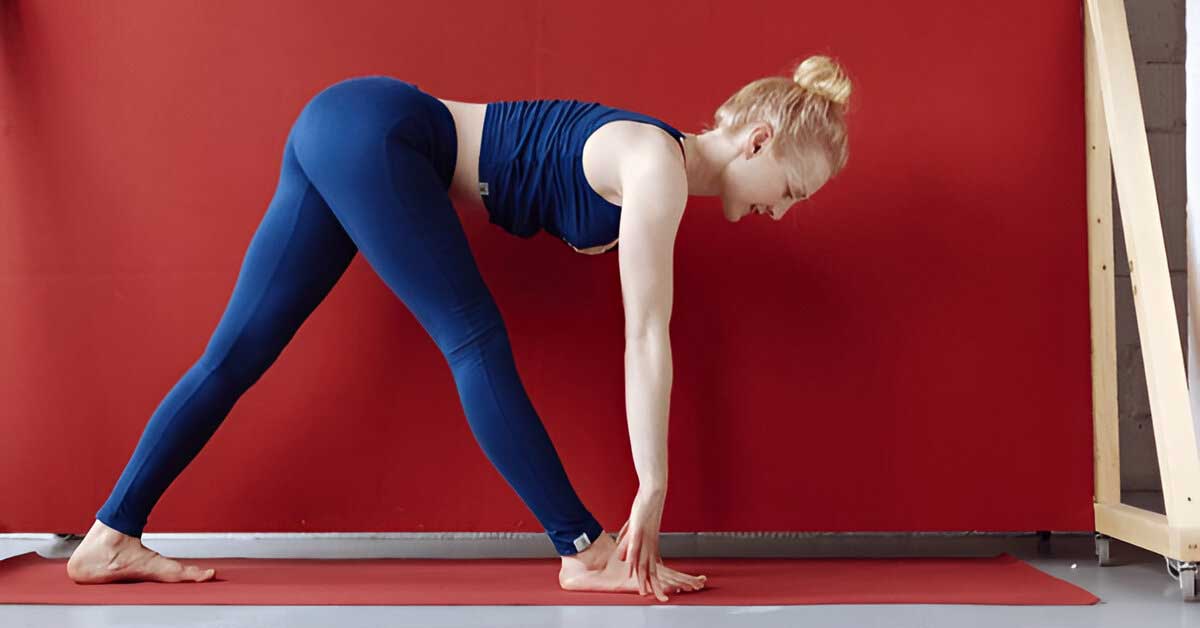
- From standing, step your left foot back about three feet, keeping both feet flat on the floor.
- Square your hips to face forward: both hip bones pointing in the same direction. This is the hard part.
- Place yoga blocks on either side of your front foot at the height you need to keep your spine long.
- Inhale to lengthen, then exhale and hinge forward from your hips, resting your hands on the blocks. Keep a micro-bend in the front knee to protect the joint.
- Hold without compromising hip alignment, then switch sides.
Does Yoga Strengthen Hamstrings, or Just Stretch Them?
Both stretch and strengthen the muscle, and the strengthening part is why the flexibility tends to stick. Static stretching produces passive lengthening of the muscle. Yoga produces active lengthening, meaning the hamstrings are working to control the movement into and out of the stretched position rather than simply being pulled there.
That distinction matters neurologically. When a muscle builds strength through its full range of motion, including at the lengthened end, the nervous system stops treating that range as a threat requiring a protective contraction. This is one reason consistent yoga practice tends to produce more durable flexibility gains than static stretching alone, where the lengthened range is visited but never trained.
If you want to add strengthening work specifically, Warrior III and Bridge Pose with leg lifts are the most direct options. Neither is in this six-pose routine, which is focused on flexibility. But they’re worth layering in once the basic routine is established.
What the Research Shows
The comparison between yoga and static stretching was made directly in a study at Doncaster College, where researchers had 16 moderately active women practice Iyengar yoga for six weekly 90-minute sessions.
The results, published in the Journal of Bodywork and Movement Therapies, showed a statistically significant increase in hamstring and lower-back flexibility, with an effect size of 0.89, large by any research standard. One session per week was enough to produce measurable change. What the study left open was the hold-duration question: is a 90-minute session doing the work, or does shorter daily practice produce the same results?
A 2016 systematic review by David Behm, Anthony Blazevich, Anthony Kay, and Malachy McHugh, published in Applied Physiology, Nutrition, and Metabolism, addressed that directly. Stretches under 60 seconds produced meaningful range-of-motion gains without impairing force production.
At holds longer than 60 seconds, performance began to decrease. The practical implication: 30 to 60 seconds, done daily, is more than enough, and very likely more effective than the occasional long session.
The chronic adaptation picture is still being filled in. Researchers broadly agree that neuromuscular signaling is doing much of the work, meaning flexibility gains are as much about reduced protective tension as actual tissue lengthening, but exactly how quickly that reset happens and how long those gains persist between sessions is an open question. What is settled is that skipping days slows it down considerably.
Consistency ran through all the findings. A single session, no matter how long, does less than a short daily practice maintained over weeks. That’s not a motivational claim. It reflects how the neuromuscular adaptation to stretching actually works. The nervous system updates slowly and reverts quickly.
Putting It All Together: Your Daily Sequence
Morning practice works well because muscles are slightly stiffer after sleep, which makes the nervous system adaptation more pronounced. Evening practice gives you the warmest possible starting point. Both produce results. Pick the one you’ll actually do every day, set a phone reminder, and use the timer below to stay on pace without watching the clock.
⏱️ 10-Minute Hamstring Routine
Follow along with timed guidance for each pose
Customize Your Session
Excellent Work!
You completed your hamstring routine
Beyond the Mat: Daily Habits for Hamstring Flexibility
What you do between sessions determines whether the flexibility from your mat work carries into daily life or evaporates by the time you sit at your desk for three hours.
The most important desk adjustment is simple: stand up and walk for two minutes every hour. Two minutes. Not a long walk. That brief interruption to sustained hip flexion is enough to prevent the muscular shortening that accumulates across a full workday. A standing desk helps but isn’t required.
For runners, the timing of the stretching routine matters. Before a run, warm up with movement (leg swings, easy walking, a slow jog) rather than static hamstring stretches. The Behm 2016 review found that stretching immediately before explosive activity can reduce power output temporarily. Save the yoga routine for after the run, when the muscles are warm, and the body responds best to extended holds.
Foam rolling for one to two minutes per leg two to three times a week is a useful addition but not a replacement for the yoga practice. Rolling reduces tissue stiffness acutely and doesn’t create the neuromuscular adaptation that yoga builds over time.
For Busy Days: The 3-Minute Emergency Routine
On days when ten minutes feels impossible, two poses cover the highest-value territory:
Standing Forward Bend: 90 seconds
Reclining Hand-to-Big-Toe Pose: 45 seconds per side
Those two poses hit the bilateral hamstring lengthening and the single-leg isolation that together produce the most benefit in the least time. The 3-minute version isn’t an equal substitute for the full routine, but it beats skipping entirely, and that’s the only standard it needs to meet.
For anyone recovering from a pull or strain and waiting to be cleared for stretching, this is also the lower-intensity starting point your clinician may have in mind. A shortened routine you can execute in a hotel room, during an office break, or five minutes before bed is the single most accessible entry point for starting a daily practice.
Tracking Your Progress: Measure Your Gains
The sit-and-reach test is the simplest reliable measure. Sit on the floor with both legs straight, place a ruler along your leg with zero at your hip, and reach forward with both hands. Record the distance and repeat the test at the same time of day each week. Morning stiffness means morning and evening measurements can differ by several centimeters.
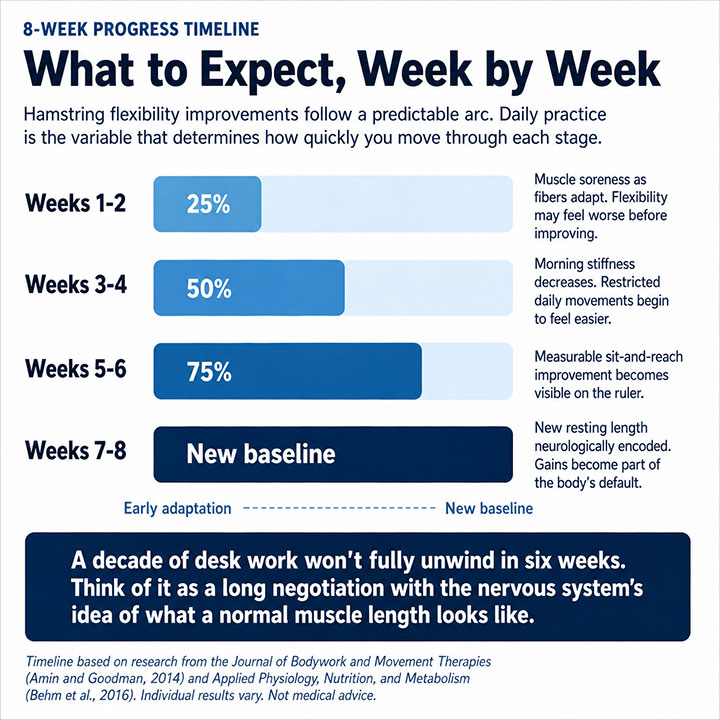
What to expect by week:
- Weeks 1 to 2: You may feel more soreness than usual as the muscle fibers adapt to consistent load in their lengthened range.
- Weeks 3 to 4: Morning stiffness decreases noticeably. Movements that previously felt restricted (bending to tie shoes, getting in and out of a low car seat) feel easier.
- Weeks 5 to 6: Measurable improvement in sit-and-reach distance becomes visible.
- Weeks 7 to 8: New baseline flexibility established. The gains from this period are neurologically encoded rather than transient.
That 4 to 8 week window for measurable change reflects what the research consistently shows. How long it took to develop the tightness matters too. A decade of desk work won’t fully unwind in six weeks. The more accurate framing is a long negotiation with the nervous system’s idea of what a “normal” muscle length looks like, and that negotiation moves slowly, reliably, and in one direction as long as the practice continues.
For a deeper look at how long yoga takes to produce lasting flexibility improvements, the research on specific timelines and consistency thresholds is worth reading in detail.
Troubleshooting: What If You’re Not Getting More Flexible?
If you’ve been consistent for four to six weeks and your sit-and-reach score hasn’t moved, these are the most likely explanations.
Tight hip flexors can mimic hamstring tightness. When the hip flexors are shortened, they tilt the pelvis anteriorly, placing the hamstrings in a state of chronic passive tension that no amount of hamstring stretching will resolve. Adding hip flexor work (Low Lunge and Supported Bridge specifically) often produces rapid apparent gains in “hamstring flexibility” that were actually hip flexor tightness all along.
Shallow breathing during holds is a common limiting factor. If you’re breathing into your chest rather than your belly during each pose, the stretch reflex stays active and the muscle resists the lengthening you’re trying to create. Slow the exhale down and aim to let the belly drop with each breath.
Minor alignment errors can eliminate most of the stretch benefit from any individual pose. One or two sessions with a qualified yoga teacher (not necessarily ongoing classes) can identify form problems that are difficult to self-diagnose.
Nerve involvement is a distinct possibility worth naming. If you feel tingling, numbness, or a shooting sensation down the back of the leg during any of these poses, that’s a nerve signal rather than a muscle signal.
That symptom warrants a conversation with a healthcare provider before continuing. Nerve tension and muscle tightness respond to different interventions, and treating one as the other delays resolution of both.
Equipment You’ll Need (and What Works Instead)
Yoga strap: $8 to $15. An old belt, bathrobe tie, or resistance band works equally well: anything six to eight feet long that holds its shape under gentle tension.
Yoga blocks: $10 to $20 for a pair. Thick hardcover books or stacked firm cushions substitute well. The height needed depends on your current flexibility range.
Yoga mat: $20 to $50. A thick towel on carpet works for all six of these poses. Non-slip surface is the main functional requirement.
A folded blanket for seated poses costs nothing extra and makes Head-to-Knee Pose substantially more accessible and effective.
Conclusion
Tight hamstrings don’t improve from a single long session or an occasional burst of effort. They respond to frequency: the consistent signal that this range of motion is being used and maintained. Ten minutes a day is less about the time commitment and more about the frequency of that signal reaching the nervous system. Miss two weeks, and the adaptation starts to revert. Stay consistent for two months, and the flexibility becomes part of how the muscles think about their resting length.
The six poses in this routine aren’t novel. What makes them effective together is the sequence, the breathing, and the commitment to daily repetition over dramatic effort. You have everything you need right now. A small space, ten minutes, and your own body.
FAQs
How long does it take to see results from yoga for hamstrings?
Most people notice tightness decreasing and daily movements feeling easier around weeks three to four. Measurable sit-and-reach improvement tends to appear between weeks five and eight with daily practice. The caveat that matters: if the tightness has been building for years, eight weeks won’t fully reverse it. The improvement is real and progressive, but the timeline for complete resolution is longer than most people expect going in.
Can I do yoga for hamstrings every day?
Yes. The hamstrings recover quickly from stretching work, and daily practice produces faster, more durable results than longer sessions done a few times a week. Think of it the way you think about dental hygiene: daily repetition beats occasional intensive sessions.
Should my hamstrings feel sore after stretching?
Mild soreness the day after starting a new stretching routine is normal, particularly in the first one to two weeks. It reflects delayed-onset muscle soreness from the eccentric load the poses place on the muscle fibers. Sharp pain during a hold, or pain that persists for more than 48 hours after, means you’ve pushed too far into the stretch and should back off the intensity.
What if one leg is significantly tighter than the other?
Asymmetry is common and often comes from habitual movement patterns, posture, old injuries, or the side you favor when sitting. Work both sides with the same hold durations rather than giving the tighter side extra time, as that approach tends to create further imbalance by fatiguing the tight side and shortchanging the other. Let the tighter side catch up at its own pace.
Can tight hamstrings cause lower back pain?
Yes, and this connection is well established. Shortened hamstrings pull the ischial tuberosity downward, which flattens the natural lumbar curve and distributes mechanical stress to the spinal facet joints and surrounding musculature.
Many people find that lower back pain they’ve carried for years improves significantly once consistent hamstring flexibility work is established. The overlap between yoga for lower back pain and hamstring tightness is real and runs in both directions.
Is yoga for hamstring injury appropriate during recovery?
Not immediately. An acute hamstring strain or pull requires rest, and in many cases physical therapy, before stretching work resumes. Once your clinician clears you to return to stretching, this routine is appropriate starting from the beginner modifications, but the sequence of clearance before stretching matters.
Attempting yoga for a pulled hamstring too early is a common cause of re-injury. The reinjury rate for hamstring strains is high enough (nearly a third within the first year, per the JOSPT review) that the timing of return to stretching matters.
Is yoga better than regular stretching for hamstrings?
The research suggests yes, and the mechanism is the nervous system component. Yoga pairs the physical lengthening with controlled breathing that reduces the defensive tension the muscle would otherwise maintain during a stretch.
Static stretching lengthens the tissue. Yoga also signals to the body’s threat-detection system that the lengthened range is safe. Over time, that distinction produces greater retention of flexibility gains.