Most apologies fail. Not because the person isn’t sorry. But because they misread what “sorry” actually needs to look like to the person on the receiving end.
That gap — between what someone meant to say and what the other person actually needed to hear — is where emotional intelligence (EQ) lives or dies. And nowhere is that gap more visible than in how a person apologizes.
An apology is a window into someone’s inner wiring. It shows how well they read others, how honestly they see themselves, and whether they care more about being forgiven or about making things right. Pay attention to it, and you’ll learn more about a person’s emotional maturity in two minutes than you would in two years of casual conversation.
Emotional intelligence is the ability to recognize emotions in yourself and others, and to use that awareness to manage your own behavior and relationships. It’s not about being nice. It’s about being aware.
1. Why “I’m Sorry” Is Never Enough
Think of an apology as a structure. Not a feeling. Not a social formality. A build.
The phrase “I’m sorry” is just the foundation. Without the right components on top of it, the whole thing collapses.
Research backs this up. A 2016 study by Lewicki, Polin, and Lount tested how 755 people responded to apologies and found that the most critical element was acknowledgment of responsibility. Not tone. Not eye contact. Not how emotional the person seemed. Responsibility. And the more structural components an apology included — acknowledgment, an offer to repair, an explanation of why the harm occurred — the more credible and effective it was rated.
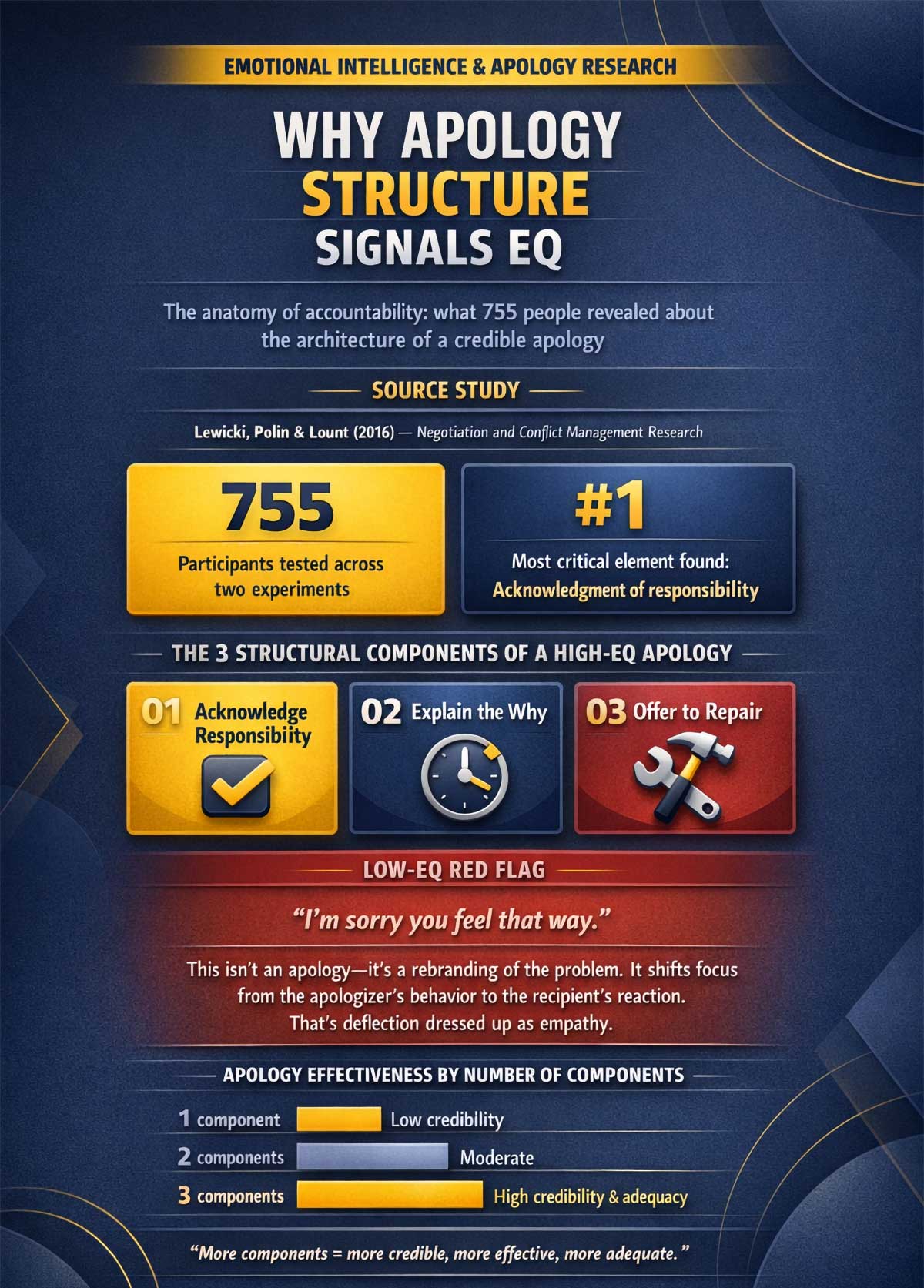
High-EQ people know this. They don’t say “I’m sorry” and wait for relief. They say “I was wrong to do that. Here’s why it happened. Here’s what I’m going to do about it.” That kind of apology signals real self-awareness.
Low-EQ apologies, by contrast, often rely on vague sentiment dressed as understanding. Phrases like “I’m sorry you feel that way” are exhibits A through Z of this. That phrasing isn’t an apology — it’s a rebranding of the problem. It shifts the focus from the apologizer’s behavior to the other person’s reaction. It implies that the problem is how you’re responding, not what they did. That’s not accountability. That’s deflection dressed up as empathy.
2. Naming the Emotion Right Changes Everything
Getting the words right is one thing. Getting the emotion right is something else entirely.
High-EQ apologizers don’t just acknowledge that the other person is upset. They identify the specific emotion the person is experiencing. There’s a big difference between “I can see you’re upset” and “I can see you feel betrayed.” The second one shows the apologizer was paying real attention. It says: I see you, not just the situation.
The stakes of getting this wrong are surprisingly high. A 2025 study published in the Journal of Hospital Medicine looked at how accurately naming someone’s emotion during an apology affected trust levels. When the apologizer correctly identified the other person’s emotion — saying “I see how angry you feel” — trust ratings jumped to 4.74 out of 7. When they named the wrong emotion — saying “I see how dishonored you feel” when the person was angry — trust dropped to 2.22. That’s a significant collapse.
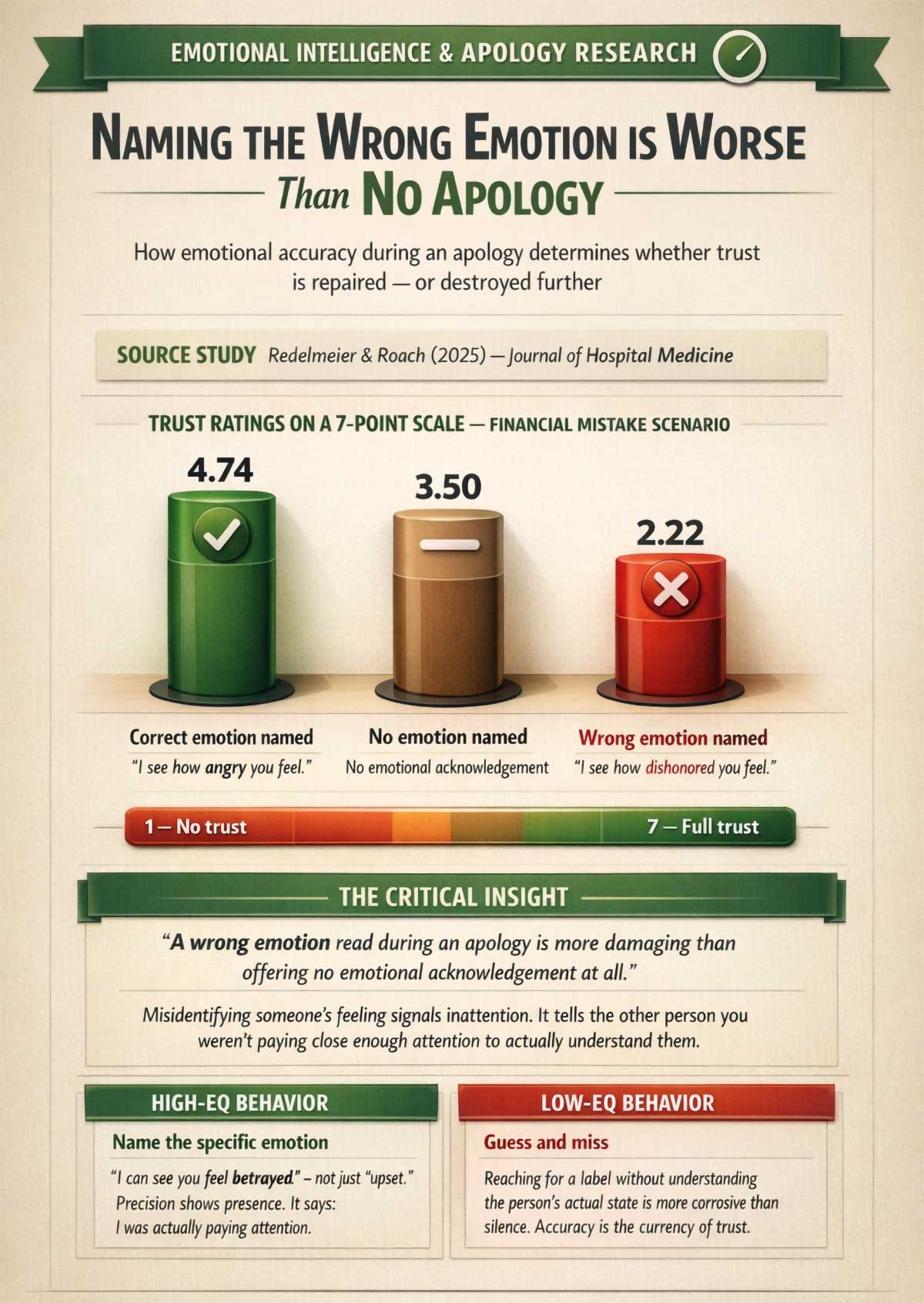
The finding that makes this truly striking: an inaccurate emotional read was worse than offering no emotional acknowledgment at all. Misidentifying someone’s feelings during an apology doesn’t just miss the mark — it actively makes things worse. It signals that you weren’t paying attention. That you’re more focused on performing remorse than actually understanding the other person’s experience.
Accuracy is the currency of trust. In apologies, precision matters more than effort.
3. How Much Are You Defending Yourself?
Picture two people apologizing for the same mistake.
Person A says: “I know that hurt you. I’m not going to make excuses. What I did was wrong, and your feelings about it are completely valid.”
Person B says: “I’m sorry, but you have to understand that I was under a lot of pressure, and I didn’t mean for it to come out that way. I think you’re reading too much into it.”
Both people said “I’m sorry.” But the first apology is high-EQ. The second one is an ego protection strategy wearing an apology’s clothing.
Research from Schumann and Dragotta (2021), published in the European Journal of Social Psychology, found a direct link between empathy and apology quality. Participants who reported higher levels of empathy toward their partner gave more thorough, less defensive apologies for real unresolved offenses. Empathy didn’t just shape how they felt — it changed what they actually said and did.
Defensiveness is the ego’s immune system. The moment someone feels accused or blamed, the instinct is to explain, justify, and protect. That’s human. But high-EQ people can override that instinct. They understand that prioritizing the other person’s pain over their own need to be understood is not weakness. It’s the whole point.
The empathy-to-defense ratio in someone’s apology tells you exactly where their priorities are. Watch it carefully.
4. The Body Doesn’t Lie
Words can be rehearsed. Tone can be managed. But the body is harder to fake.
A 2021 study by Yamagishi and colleagues, published in Frontiers in Psychology, broke down the nonverbal differences between sincere and “instrumental” apologies — the kind made simply to end a conflict rather than to genuinely repair it. Think of a boss who apologizes to an employee after being called out in a meeting, knowing they need to say something to hold their authority. Or a partner who apologizes because they’ve learned it’s the fastest way to end an argument. These aren’t repairs. They’re exits. The differences were measurable.
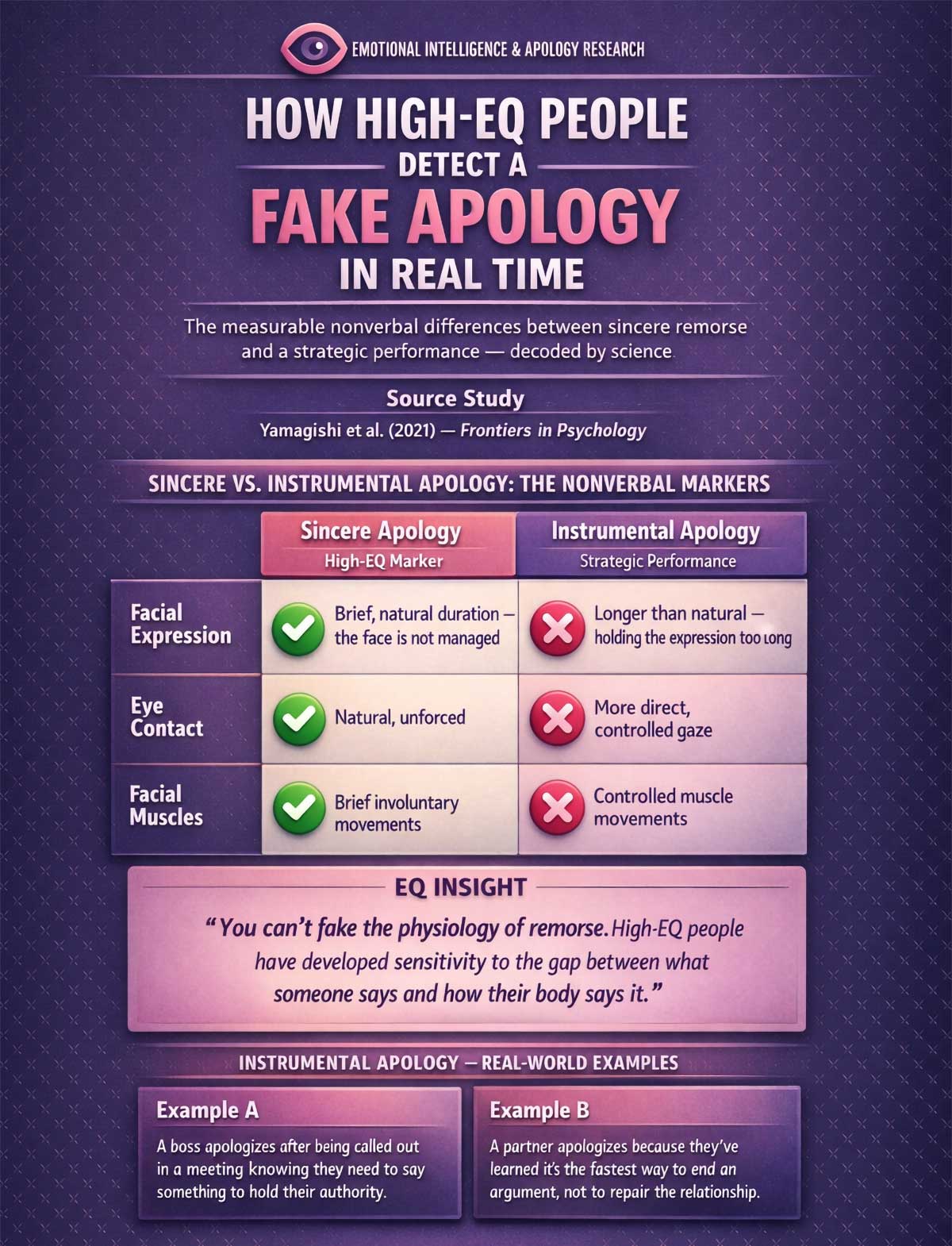
Instrumental apologizers tended to hold their facial expressions of sadness for longer than felt natural. They also showed more direct, controlled gaze — as if consciously trying to appear convincing. These are performance markers. Small signs that the display is being managed rather than felt.
Genuine remorse, by contrast, shows up in micro-expressions. Brief, involuntary muscle movements. A lack of control. The kind of face that happens to someone rather than the kind someone puts on.
High-EQ individuals can often read these signals, even without formal training. They’ve developed sensitivity to the gap between what someone says and how their body says it. They know the difference between a person sitting with their guilt and a person trying to close a file. When an apology feels “off,” there’s usually a physiological reason for that feeling.
5. One Apology Doesn’t Fix Everything — High-EQ People Know This
Here’s a common mistake. Someone works up the courage to apologize. They say the right things. They feel like a weight has been lifted. Then they get frustrated — or even offended — when the other person isn’t immediately warm and forgiving.
That frustration is itself a sign of limited emotional intelligence.
A 2011 study by De Cremer, Pillutla, and Reinders Folmer, published in Psychological Science, found a consistent gap between how people imagined receiving an apology and how they actually responded to it in real life. People pictured themselves feeling immediately restored. In practice, trust took longer to rebuild. The researchers found that apology-givers consistently overestimated how quickly the relationship would bounce back.
High-EQ people understand this tempo. They know an apology is the start of repair, not the end of it. They don’t treat the words “I’m sorry” as a transaction that instantly wipes the slate clean. They stay present after the apology. They follow through. They give the other person time and space to process — and recognize that their own relief must wait.
That patience is not passive. It’s one of the clearest signs of genuine accountability. Sitting with the discomfort of having hurt someone, without rushing their healing for your own sake, is emotional maturity in action.
6. Reading What the Other Person Actually Needs
Not every person needs the same thing from an apology. High-EQ people know this, and they adjust.
Some people are more independent in how they see themselves. When they’re wronged, what they need is clear acknowledgment that a rule was broken and some form of fair compensation. The specifics of the relationship matter less to them than the principle.
Others are more relational in how they see themselves. What they need is empathy — acknowledgment of how the relationship itself was affected. They’re less focused on the rule and more focused on the bond.
A 2010 study by Fehr and Gelfand, published in Organizational Behavior and Human Decision Processes, found that apologies were most likely to produce forgiveness when they matched what the recipient valued most. Independent types responded better to acknowledgment of the violation and offers of compensation. Relational types responded better to empathy and acknowledgment of the relationship’s harm.
Picture a couple working through infidelity. The independent partner might say, “What matters is that you broke our agreement.” The relational partner might say, “What matters is that you broke us.” Same harm. Completely different apology needed.
A one-size apology fits no one. High-EQ apologizers read the other person first — and then shape the apology around what that specific person actually needs, not around what feels most comfortable to give.
7. A Real Apology Changes the Other Person — Biologically
Here’s something most people don’t know. A well-built, genuinely empathetic apology doesn’t just make the other person feel better emotionally. It changes their body.
A 2020 study by Witvliet and Worthington, published in Frontiers in Psychology, measured the physiological effects of thorough apologies on 61 participants using within-subjects testing. When participants received a sincere, complete apology, their heart rate came down. Cardiac stress indicators dropped. The corrugator supercilii muscle — the brow muscle associated with negative emotion — visibly relaxed.
That’s not just “feeling heard.” That’s a physical shift in the nervous system.
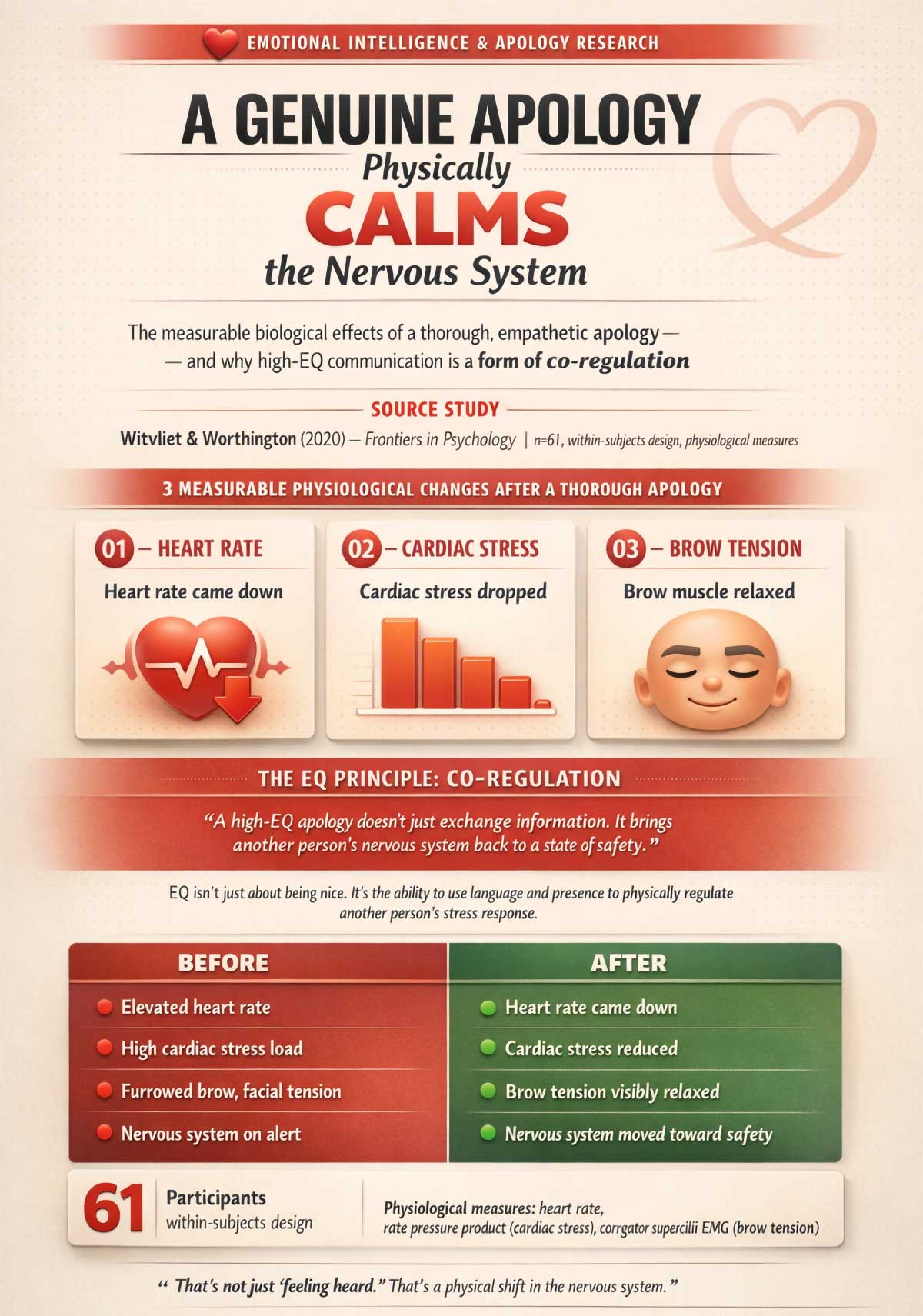
This is what high-EQ communication actually does at its best. It doesn’t just exchange information. It brings another person’s body out of a stress response and back toward safety. When someone is hurt or angry, their nervous system is activated. A well-delivered apology can begin to reverse that. Quite literally.
Think about that the next time you’re tempted to brush off an apology as “just words.” The right words, delivered with genuine awareness and structural care, can physically calm another person down. That’s not a small thing.
Conclusion
How someone apologizes is a diagnostic. It tells you whether they can hold discomfort without deflecting it onto you. Whether they were paying attention. Whether they care about your inner experience or just their own image.
Low-EQ apologies vague out the responsibility. They label the wrong emotion, or skip the emotion entirely. They fold in defensiveness. They rush toward forgiveness before the other person is ready. They perform remorse instead of feeling it.
High-EQ apologies do the opposite. They’re specific. They’re structured. They prioritize the other person’s experience over the apologizer’s need for relief. And they recognize that saying the words is just the beginning.
EQ isn’t a fixed trait you either have or don’t. It’s a practice. Auditing your own apologies — honestly, without excuses — is one of the sharpest tools available for building it.
Next time you say “I’m sorry,” pause. Ask yourself: Am I naming the right emotion? Am I taking clear responsibility? Am I making this about them, or about me? The answers will tell you exactly where you stand.