There’s a better way than doing countless crunches for belly fat after 50. A chair-based workout that burns more fat, protects your spine, and actually works with your body instead of against it.
The “Crunch” Myth: Why Your Core Workout Isn’t Working
Crunches seem like the obvious choice for belly fat. You feel the burn. Your abs are sore the next day. It must be working, right?
Not quite.
Research shows crunches burn only 2-3 calories per minute. That’s less than slow walking. Worse, traditional crunches can create 2,000-3,000+ Newtons of compression force on your spine—especially when performed with poor form or added weight. That’s roughly 450-670 pounds of pressure.
While your spine can handle these loads occasionally, research by spine expert Dr. Stuart McGill shows that repetitive spinal flexion—doing dozens or hundreds of crunches—gradually damages the discs between your vertebrae. After 50, when those discs are already less flexible and hydrated, this repetitive compression becomes particularly problematic.
But here’s the bigger issue: spot reduction is a myth.
A 2011 study published in the Journal of Strength and Conditioning Research followed young adults through six weeks of focused abdominal training. The results? No preferential reduction in abdominal fat compared to control groups. The participants got stronger abs, sure. But the fat stayed put.
Another study in 2015 confirmed the same finding. Researchers had one group do abdominal exercises while another did full-body resistance training. Both groups lost the same amount of belly fat. The takeaway? Your body doesn’t burn fat from the area you’re exercising. It pulls from fat stores across your entire system.
When you create a calorie deficit, your genetics largely determine where fat comes off first. For many people, belly fat is stubborn and comes off last. That’s why patience and consistency matter more than exercise selection.
So if crunches don’t work, what does?
The Metabolic Solution: How Your Body Actually Burns Belly Fat
Your body loses fat through one mechanism: calorie deficit. You need to burn more energy than you consume. Simple in theory. Tricky in practice.
The most effective way to create that deficit? Work your largest muscle groups.
Think about it like this: your glutes and quads are like V8 engines. Your abs are more like a moped motor. Which burns more fuel?
Multi-joint exercises that recruit big muscles create significant energy expenditure. A 2011 study in the Journal of Strength and Conditioning Research measured energy burn during different exercise types. Exercises using larger muscle groups burned 50% more calories than isolated core work.
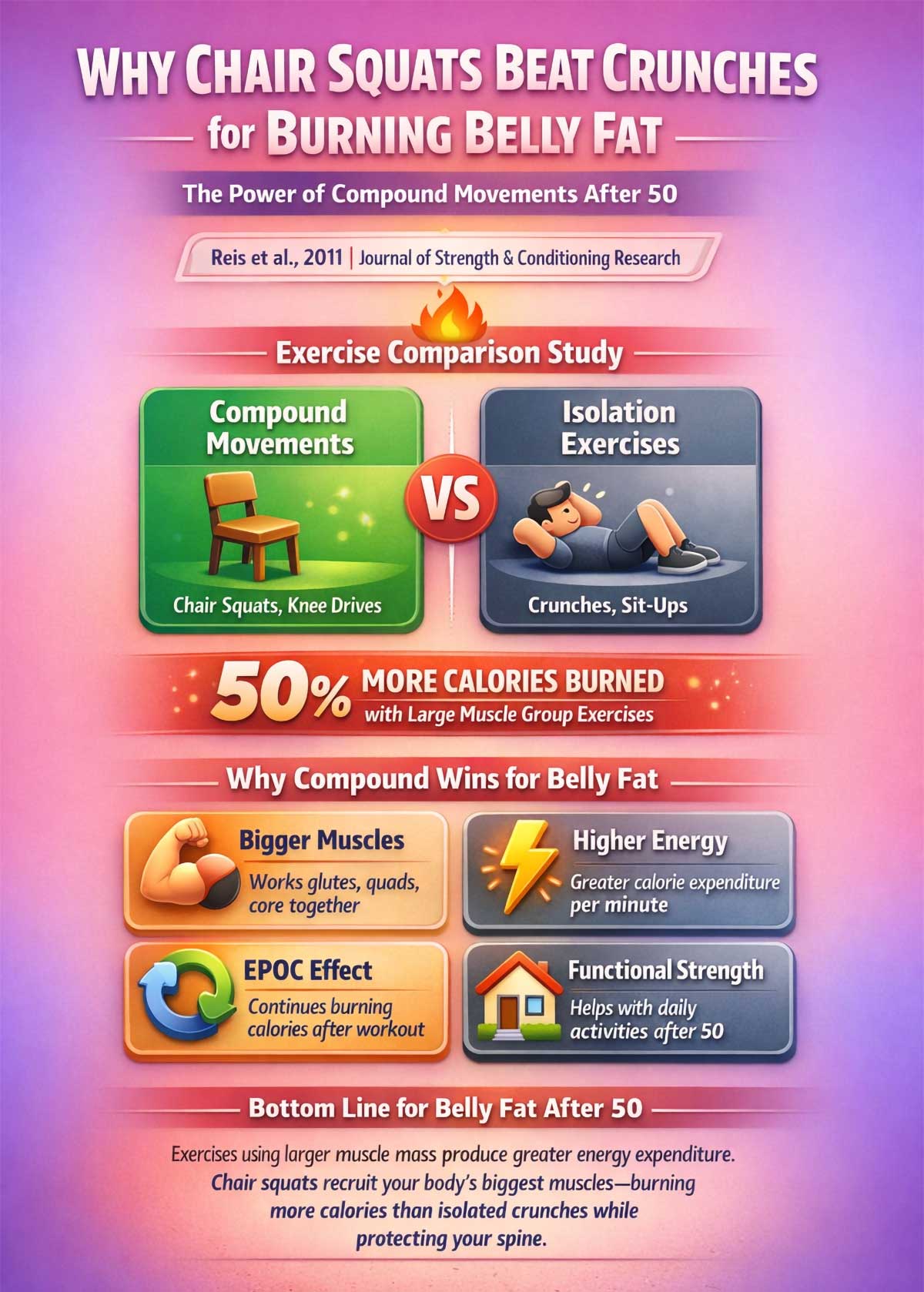
But there’s more to the story than just calories burned during exercise.
After you finish a challenging workout, your body continues burning extra calories for hours. This is called excess post-exercise oxygen consumption, or EPOC. Your muscles need energy to repair. Your metabolism stays elevated. You’re burning fat while sitting on your couch.
Compound movements (exercises that use multiple joints and muscle groups) create significantly more EPOC than isolation exercises like crunches. That squat-to-stand movement? Your body continues burning extra calories for 30-90 minutes afterward as it recovers—a phenomenon called excess post-exercise oxygen consumption (EPOC). While the effect is modest from a single 10-minute session, it accumulates with regular training. This metabolic bonus is something crunches provide minimally, if at all.
The 50+ Advantage: Why Chair-Based Training Works
After 50, your body changes. Muscle mass decreases by about 3-8% per decade. Your metabolism slows. Joint cartilage thins. Balance becomes less reliable.
These changes make floor exercises harder. They also make them riskier.
Chair-based training solves these problems while maintaining exercise intensity. A 2012 study followed adults over 60 through 12 weeks of chair-based exercise. The completion rate in that structured program? 89%. While self-directed home programs typically see somewhat lower adherence, the point stands: chair-based training removes the physical and psychological barriers that cause people to quit. When exercise feels accessible and safe, you’re far more likely to stick with it.
The chair provides stability. It reduces fall risk. It makes exercise accessible on days when getting down to the floor feels impossible.
But accessibility doesn’t mean easy. Chair exercises can be plenty challenging.
The key is choosing movements that create metabolic demand. Not just arm circles and ankle rolls (though those have their place). We’re talking about exercises that get your heart rate up, recruit major muscle groups, and build the functional strength you use every single day.
The 10-Minute Metabolic Circuit
This routine takes 10 minutes. You’ll do five exercises. Each one lasts 40 seconds, followed by 20 seconds of rest.
That’s one round. You’ll complete two rounds total.
Start with three sessions per week. As you get stronger, work up to five sessions weekly. Research from a 2009 study spanning six months showed that exercising enough to burn 400-500 calories per week reduces visceral fat (the deep belly fat around your organs). Three to five sessions of this circuit gets you into that effective range.
Why 40 seconds on, 20 seconds off?
This timing creates what exercise scientists call “interval training.” Short bursts of effort followed by brief recovery. It keeps your heart rate elevated throughout the workout, maximizing calorie burn in minimal time.
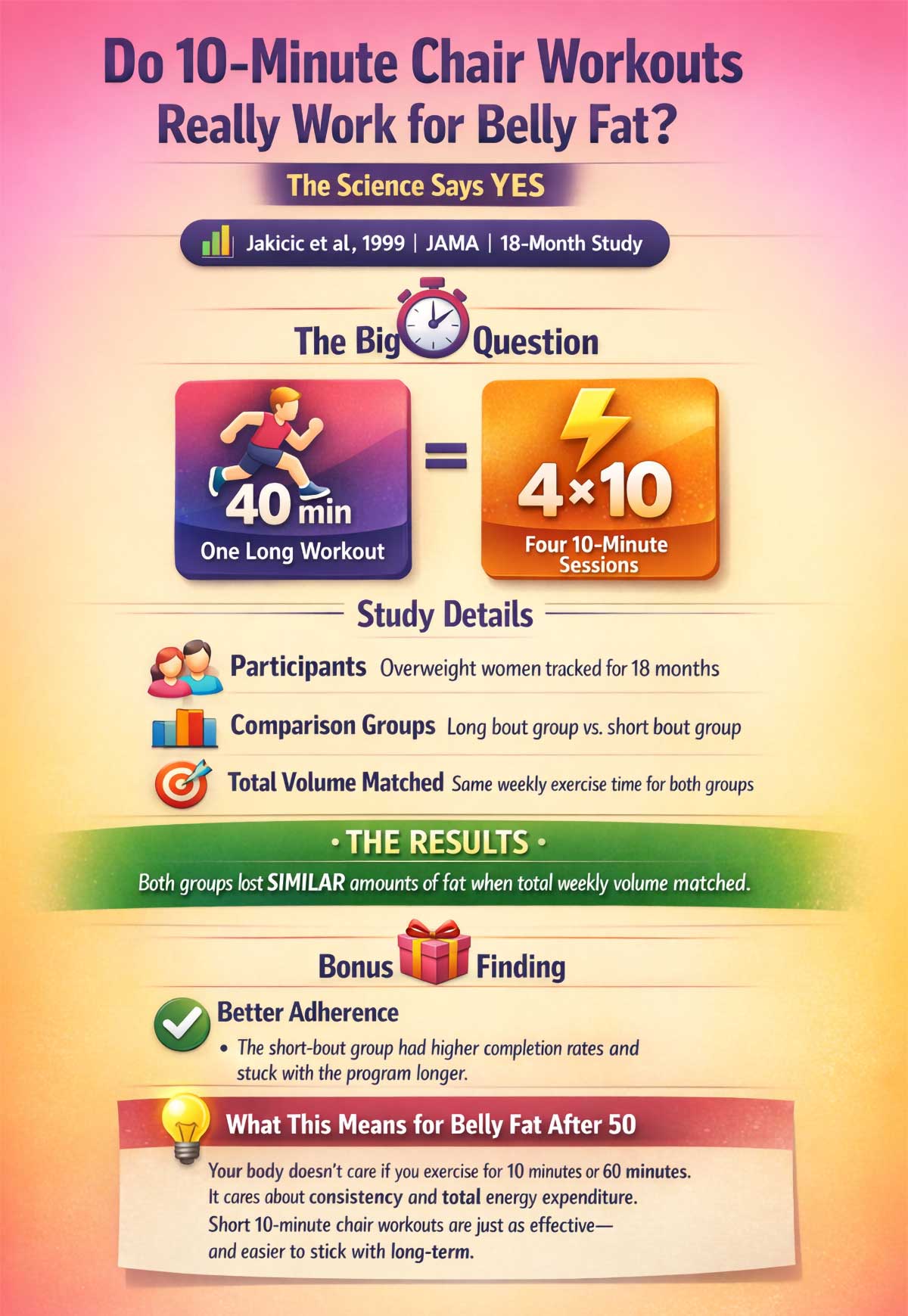
A 1999 study published in the Journal of the American Medical Association tracked overweight women for 18 months. Some did one long workout daily. Others broke exercise into 10-minute chunks. The results? Both groups lost similar amounts of fat. The short-bout group had better adherence.
Your body doesn’t care if you exercise for 10 minutes or 60. It cares about consistency and total energy expenditure.
Let’s get to the exercises.
The “Big Five” Chair Exercises
1. Seated Knee Drives (The Heart-Rate Starter)
Sit at the edge of your chair. Plant both feet flat on the floor. Place your hands lightly on the sides of the seat for balance.
Now drive your right knee toward your chest. Lower it back down. Immediately drive your left knee up. Keep alternating in a steady rhythm.
Keep your torso upright. Don’t lean back. Engage your core by pulling your belly button gently toward your spine.
Why it beats crunches: This movement recruits your hip flexors and lower abdominals while elevating your heart rate. Studies on marching movements show significant activation of the rectus abdominis and obliques during dynamic leg raises.
The difference between this and crunches? This burns approximately 4-5 calories per minute for most people—roughly 50-100% more than crunches—while your core works as a stabilizer instead of flexing repeatedly under compression.
Think of your abs like a corset that holds your torso steady while your legs move. That’s functional core strength. That’s what helps you get out of a car, climb stairs, or pick up grandkids without back pain.
Research on rhythmic, alternating leg movements shows they produce greater oxygen consumption than static core exercises. Higher oxygen consumption means more calories burned. More calories burned means more fat lost over time.
Progression:
Weeks 1-2: Focus on controlled tempo and moderate knee height.
Weeks 3-4: Increase your tempo slightly. Move a bit faster while maintaining control.
Weeks 5+: Add a 2-second hold at the top of each knee drive. This increases time under tension and difficulty.
2. Chair Squat-to-Stand (The Fat-Loss Powerhouse)
Sit in your chair. Position feet hip-width apart. Cross your arms over your chest. If you need more balance support, extend your arms forward.
Engage your core. Drive through your heels and stand up fully. Then lower yourself back down with control. Lightly touch the seat without fully sitting. Immediately rise again.
The key: don’t plop into the chair. Keep your muscles working throughout the entire movement.
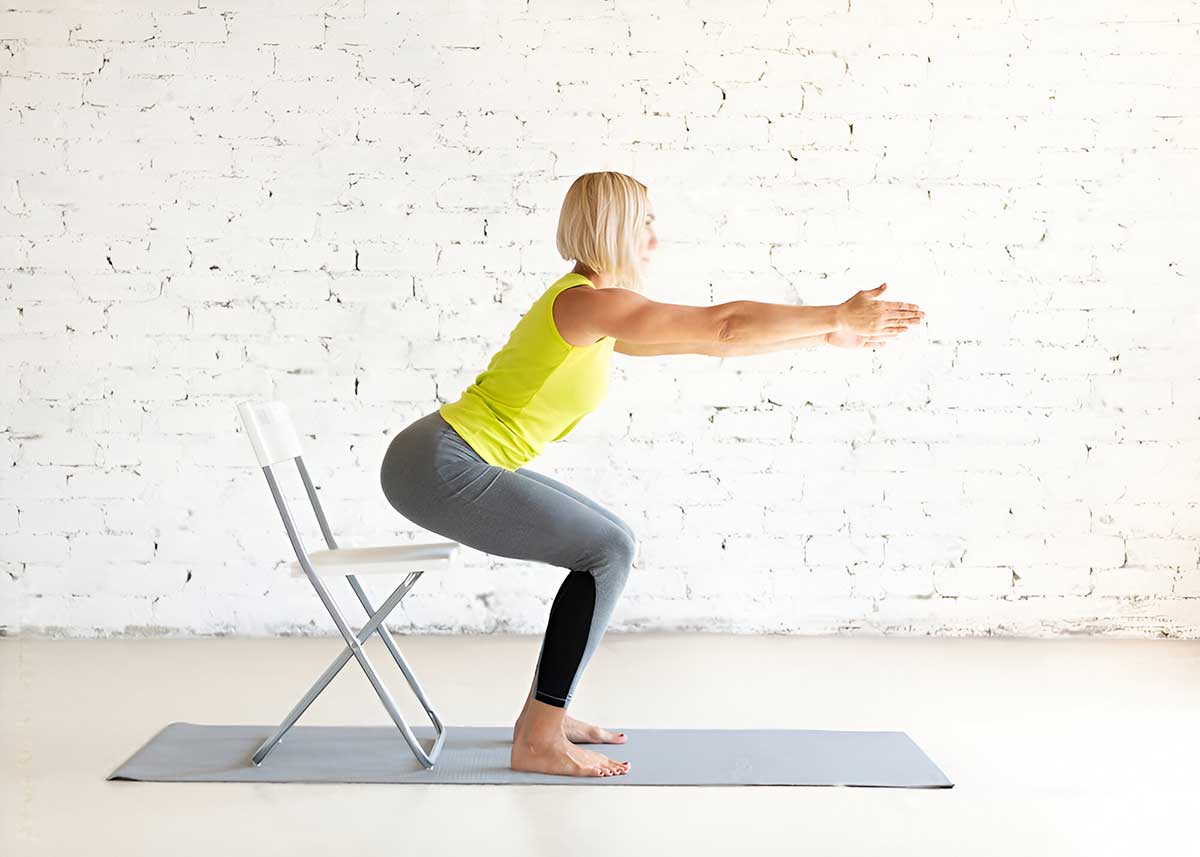
Why it beats crunches: This is your heavy hitter. Squat-to-stand recruits your glutes, quads, hamstrings, and core all at once. These are your body’s largest muscle groups.
A 2011 study on older adults with obesity found that exercise alone reduced visceral fat by 6% over 12 months. Now, that study used 90-minute sessions three times weekly—a much larger time commitment than what we’re proposing here. But here’s the key finding: the participants did compound, functional movements similar to the squat-to-stand, not isolation exercises like crunches. The principle holds: compound movements that recruit large muscle groups drive systemic fat loss more effectively than focused core work. While a 10-minute routine won’t produce the same magnitude of results as 90-minute sessions, it works through the same mechanism and offers a realistic starting point that you can build on over time.
This exercise burns 5-7 calories per minute. It creates the metabolic afterburn effect we talked about earlier. Your body keeps burning extra calories for hours after you finish.
But there’s another benefit that matters even more after 50: functional independence.
A 2009 review of progressive resistance training in older adults found improvements in strength, function, and body composition. The squat-to-stand pattern is something you do dozens of times daily. Getting out of bed. Standing from a restaurant booth. Rising from the toilet.
By training this movement, you’re not just burning fat. You’re maintaining the ability to live independently.
Progression:
Weeks 1-2: Use the chair arms for light assistance if needed.
Weeks 3-4: Cross hands over chest with no assistance.
Weeks 5+: Pause for 3 seconds at the bottom before standing. This dramatically increases difficulty and muscle engagement.
3. Seated Torso Rotations (The Waist-Whittler)
Sit upright with feet flat and hip-width apart. Extend both arms straight out in front of you at shoulder height. Clasp your hands or press palms together.
Keep your hips facing forward. This is critical. Rotate your upper body to the right. Pause briefly. Return to center. Now rotate left.
The rotation comes from your mid-back and core, not from swinging your arms.
Why it beats crunches: EMG studies (which measure muscle activation) show rotational exercises produce 25-40% greater oblique activation than crunches. And they do it with far less spinal compression.
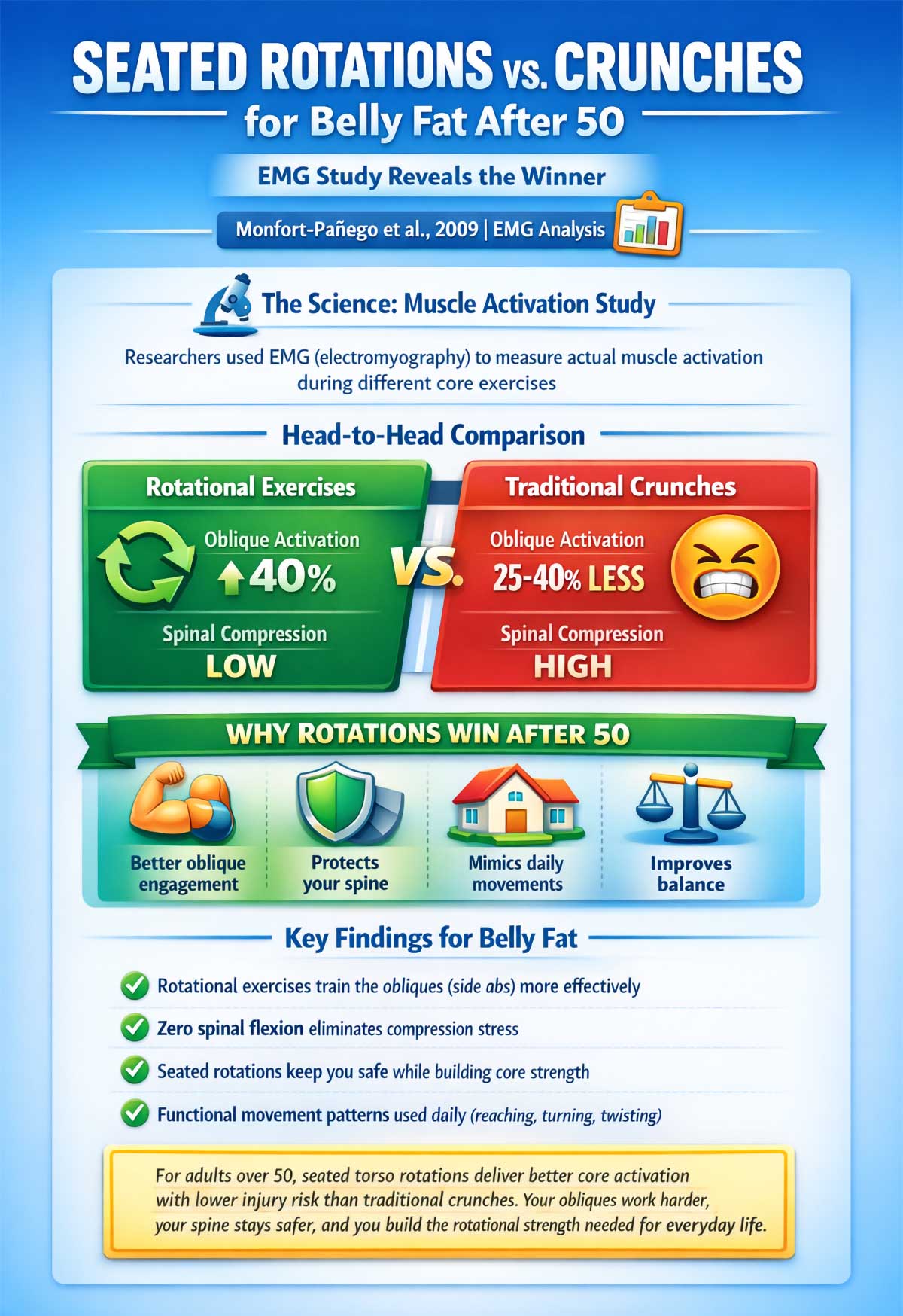
Your obliques are the muscles on the sides of your waist. They’re responsible for twisting, turning, and side-bending. Every time you reach into the back seat of your car or look over your shoulder, you’re using your obliques.
Crunches barely touch these muscles. Rotations train them directly.
This exercise burns 3-4 calories per minute. It’s not the highest-calorie burner in this routine. But it serves another purpose: active recovery.
Between the higher-intensity knee drives and squats, rotations keep you moving and maintain core engagement while giving your legs a brief break. A 2005 study on active recovery showed that light movement between harder efforts maintained blood flow and reduced muscle soreness.
A 2013 study on core stability training in older adults (60-80 years old) found that rotational exercises improved balance and functional performance more than traditional core work. Better balance means lower fall risk. That matters.
Progression:
Weeks 1-2: Arms extended, controlled pace, moderate rotation range.
Weeks 3-4: Increase your rotation range slightly. Turn a bit farther to each side.
Weeks 5+: Hold a light object in your hands. A water bottle or book works well. This adds resistance.
4. Seated Leg Extensions with Hold (The Deep Stabilizer)
Sit tall with your back against the chair. Grip the sides of the seat for stability.
Extend your right leg straight out in front of you. Flex your foot (toes pointing toward your shin). Hold for 2-3 seconds. Lower with control.
Immediately extend your left leg. Keep alternating for the full 40 seconds.
The secret: pull your belly button toward your spine throughout. This engages your transverse abdominis, the deepest core muscle that acts like your body’s natural weight belt.
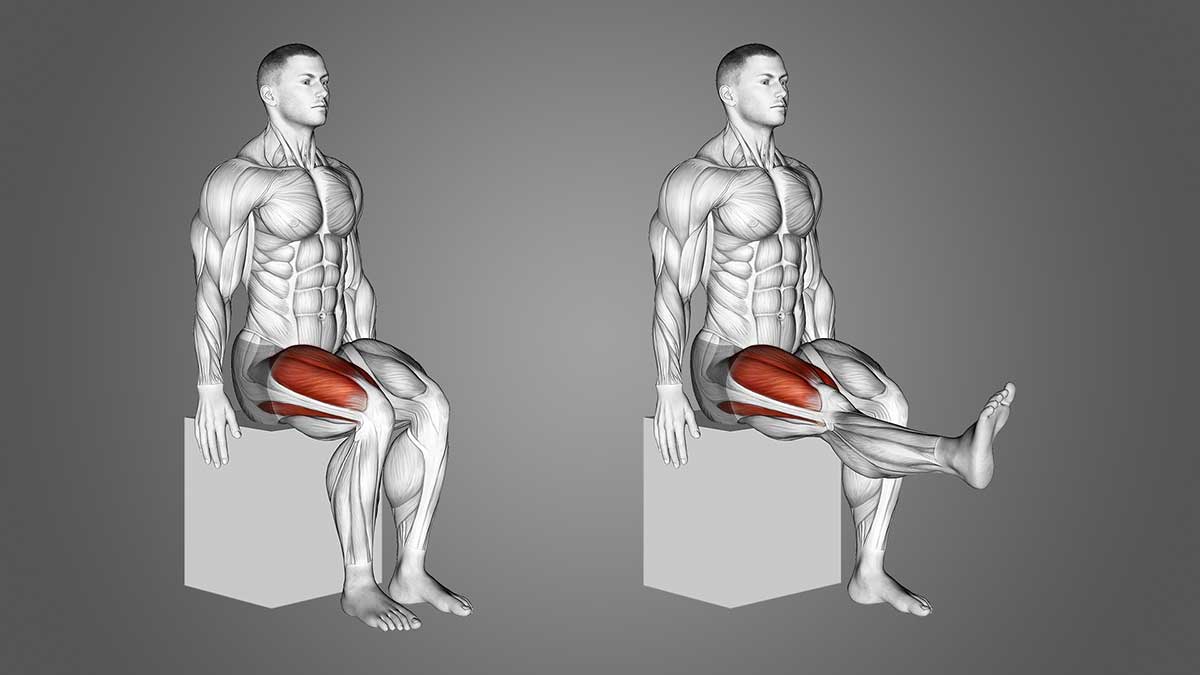
Why it beats crunches: Single-leg movements from a seated position require 40% more core activation than bilateral exercises (movements using both legs at once). Your core has to work hard to keep your pelvis stable while one leg extends.
This is isometric training. Your muscles contract but don’t change length. Think of it like holding a plank, but seated.
Research on isometric core training in adults 60 and older showed improved postural control and reduced fall risk. Better posture makes you look thinner even before you lose a pound. It also reduces back pain.
This exercise burns 3-4 calories per minute. The real value is in the neuromuscular control you’re building. Your brain is learning to activate your deep core muscles automatically. This improved activation carries over to every other exercise and daily activity.
Studies on seated leg exercises confirm they maintain training stimulus without loading your spine or joints. That’s perfect for the 50+ population.
Progression:
Weeks 1-2: Hold each extension for 2 seconds.
Weeks 3-4: Hold for 3-4 seconds.
Weeks 5+: Add small pulses at the top of the extension. Lift the leg an extra inch up and down several times before lowering.
5. Seated Cross-Body Punches (The Metabolic Finisher)
Sit upright at the edge of your chair. Engage your core. Make light fists and position your hands at chest level.
Punch your right fist across your body toward the left. Rotate your torso with the punch. Return to center.
Immediately punch your left fist across to the right. Keep alternating in a controlled but dynamic rhythm.
Don’t just move your arms. The rotation should come from your core.
Why it beats crunches: This combines everything. Rotational core work. Elevated heart rate. Anti-rotation stability (your core resisting unwanted movement).
This exercise burns 5-6 calories per minute. Upper body rotational exercises, when performed continuously, maintain 60-70% of peak heart rate. That’s the “fat-burning zone” you’ve heard about.
A 2019 study on cross-body movements found they recruit the obliques and transverse abdominis simultaneously. You’re training integrated core function. Not isolated muscles.
But here’s the real reason this exercise belongs in the routine: it’s fun.
A 2010 study on exercise adherence in older adults found that variety and dynamic movements improved long-term participation by 35% compared to static routines. If you enjoy a workout, you’ll actually keep doing it. And if exercise doesn’t feel like punishment, you’ll keep showing up. That’s worth more than any perfect exercise selection.
The cross-body punch pattern also builds rotational power you use constantly. Opening jars. Putting on a seatbelt. Reaching for items on a shelf. These are all rotational movements.
Progression:
Weeks 1-2: Focus on form and rotation quality.
Weeks 3-4: Increase punch speed moderately while maintaining control.
Weeks 5+: Hold light weights (1-2 pounds) in your hands. Soup cans work perfectly.
The “After 50” Success Blueprint
Getting through the workout is one thing. Getting results is another. Here’s how to make this routine actually work.
The 3-Day Rule
Three times per week is your minimum. Five times is optimal.
A 2009 study on postmenopausal women (ages 45-75) examined exercise dose-response over six months. The finding: burning at least 8 kilocalories per kilogram of body weight per week significantly reduced waist circumference.
For a 150-pound person, that’s roughly 545 calories weekly. This 10-minute routine burns approximately 40-60 calories during the workout itself (varying significantly based on body weight, intensity, and fitness level), with an additional 5-15 calories from metabolic afterburn. That might not sound dramatic, but it’s 50-100% more than crunch-based routines, and consistency is what drives results. Three sessions weekly totals 135-225 calories from exercise alone—a meaningful contribution to the energy deficit needed for fat loss.
Consistency beats intensity. One heroic hour-long workout per week doesn’t create the metabolic changes your body needs. Three to five shorter sessions do.
Your body adapts to regular stimulus. Sporadic exercise confuses it.
The Protein Connection
You can’t out-exercise a bad diet. That saying is true.
But you also can’t preserve muscle mass without adequate protein. After 50, you need more protein than younger adults to maintain muscle.
Muscle tissue burns calories even at rest. Fat tissue doesn’t. Losing muscle slows your metabolism. Keeping muscle keeps your metabolism higher.
Research suggests healthy older adults need 1.0-1.2 grams of protein per kilogram of body weight daily to support muscle maintenance. For a 150-pound person, that’s roughly 68-82 grams spread throughout the day. (If you have kidney disease or other medical conditions, consult your healthcare provider before significantly increasing protein intake.)
Good sources: eggs, Greek yogurt, chicken, fish, beans, lentils, tofu, cottage cheese.
I’m not telling you to follow a strict diet. But protein matters. Especially when you’re asking your muscles to work.
Hydration and Recovery
Your tissues are less resilient after 50. They need more water. They need more rest.
Drink water before, during, and after your workout. Dehydration makes everything harder. It also increases injury risk.
Recovery matters just as much as the workout itself. Your muscles don’t get stronger during exercise. They get stronger during rest.
Take at least one full day off between sessions when you’re starting out. As you adapt, you can exercise more frequently. But always listen to your body.
Muscle soreness that improves with movement is normal. Pain that worsens or persists is not. If something hurts in a sharp or concerning way, stop and consult a healthcare provider.
Tracking Your Progress
Numbers on a scale don’t tell the whole story. Sometimes you’re losing fat and gaining muscle simultaneously. The scale might not budge, but your clothes fit differently.
Here are better ways to track progress:
The Talk Test: During your 40-second work periods, you should be able to speak in short sentences but not hold a full conversation. If you can easily chat, increase intensity. If you can’t speak at all, dial it back.
This is a simple way to gauge effort without a heart rate monitor. Research validates it as an accurate intensity measure.
Weekly Check-Off: Mark your calendar every time you complete a session. After four weeks, look back. Did you hit your three-to-five session target most weeks? That consistency is your real measure of success.
The Functional Test: Once a month, pay attention to daily activities. Are stairs easier? Can you get up from low chairs more quickly? Do you have more energy in the afternoon?
These functional improvements often come before visible fat loss. They’re just as important.
Measurements: Once every two weeks, measure your waist at belly button level, without sucking in or pulling the tape tight—just snug against your skin. Stand naturally and breathe normally. First thing in the morning, before eating. Visceral fat (the deep belly fat around organs) responds to exercise even when overall weight doesn’t change much.
A one-inch reduction in waist circumference represents significant health improvement, even if the number on the scale hasn’t moved.
Why This Approach Works: The Science Summary
Let’s tie this all together.
Belly fat decreases through systemic calorie deficit. Not through endless crunches. Your body pulls from fat stores across your entire system when you create an energy deficit.
The most efficient way to create that deficit: work large muscle groups with compound movements. This routine does exactly that.
Chair-based training removes barriers. A 2012 study on chair-based exercise in adults 60 and older showed 89% completion rates. Compare that to the 45-55% completion rates typical of traditional gym programs.
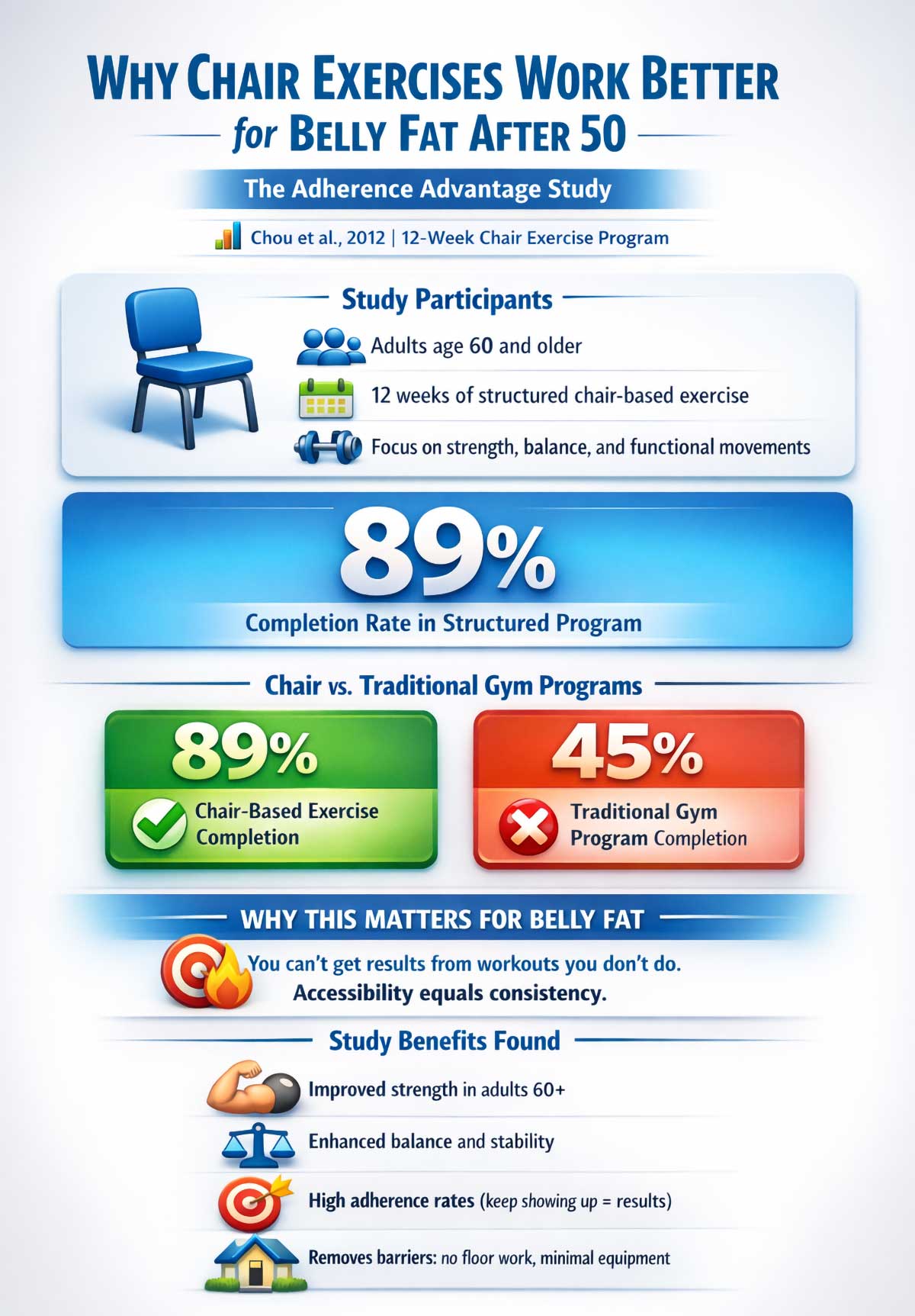
You can’t get results from workouts you don’t do. Accessibility matters.
The 10-minute format fits into busy schedules. Research confirms short exercise bouts produce similar fat loss to longer sessions when total weekly volume matches. The short format improves adherence by 35% in older adults.
This routine burns 4-6 calories per minute on average. That’s 40-60 calories per 10-minute session. It’s 50-100% more than traditional crunch-based workouts.
The exercises create metabolic afterburn (EPOC). Your body continues burning extra calories for hours after you finish.
Zero spinal flexion means zero compression stress on your lower back. You’re building functional strength for daily activities while protecting your spine.
The progressive nature allows you to start where you are and advance gradually. Weeks 1-2 establish the movement patterns. Weeks 3-4 increase challenge. Weeks 5 and beyond add complexity.
What About Diet?
This routine supports fat loss, but diet matters. You don’t need a restrictive plan, but small changes compound. Research consistently shows that combining exercise with modest calorie reduction produces better results than exercise alone.
Simple, sustainable strategies:
- Replace one sugary drink daily with water or unsweetened tea
- Include protein at every meal
- Fill half your plate with vegetables
- Eat until satisfied, not stuffed
You don’t need perfection. You need consistency. A 200-300 calorie daily deficit combined with this exercise routine can produce 1-2 pounds of fat loss monthly. That’s 12-24 pounds yearly. Sustainable. Realistic. Achievable.
Conclusion
You have the routine. You have the science. Now you need to start.
Pick three days this week. Put them on your calendar. Morning works well for many people because it’s easier to stay consistent before the day gets hectic.
Find a sturdy chair without wheels. Kitchen chairs work perfectly. Make sure you have enough space to extend your legs fully.
Set a timer for 40 seconds of work and 20 seconds of rest. Your phone has a timer. Use it.
Don’t aim for perfection. Aim for completion. Just get through the five exercises twice. You can refine your form as you go.
Some days will feel harder than others. That’s normal. What matters is showing up consistently.
After four weeks, assess how you feel. Are movements getting easier? Do you have more energy? Are your clothes fitting differently?
Those changes are proof this works.
Belly fat didn’t appear overnight. It won’t disappear overnight. But with consistency, you’ll see changes. The research proves it. The thousands of people who’ve followed similar programs prove it.
Your body is capable of remarkable things at 50, 60, 70, and beyond. You just need the right approach.