Both improved. But one changed in weeks. The other took months. Knowing the difference changes how you supplement.
Most people expect brain supplements to work overnight. They don’t. But after 12 weeks of consistent omega-3 intake, one cognitive function showed more consistent and reliable improvement than researchers anticipated: processing speed.
The data behind it is hard to ignore.
The 84-Day Threshold: Why 12 Weeks Is the Cognitive Turning Point
When most people think about daily omega-3 intake, they picture heart health, joint pain, or maybe a general sense of wellness. Brain performance rarely enters the picture. But a growing body of research points to something specific happening in the brain around the 84-day mark.
Omega-3 fatty acids, particularly DHA (docosahexaenoic acid), are structural building blocks of brain cell membranes. They influence how quickly signals travel between neurons, how efficiently the brain uses oxygen, and how well the prefrontal cortex handles high-pressure tasks. These are not fast changes. They require consistent, adequate intake over a sustained period.
There’s an important distinction worth making here. General health guidelines from organizations like the American Heart Association recommend around 250–500mg of combined EPA and DHA per day. But the doses used in cognitive performance studies are often considerably higher: typically 1–2g of DHA-rich oil daily. These aren’t the same targets, and confusing the two leads to frustration when standard-dose supplements don’t produce the mental sharpness people are hoping for.
The Metric That Surprised Researchers: Processing Speed
Memory gets most of the attention in brain health conversations. It’s personal. Everyone forgets a name or loses their train of thought. But researchers looking at omega-3 supplementation kept finding that a different metric moved first: processing speed.
Processing speed refers to how fast the brain takes in information and responds to it. Think of it as your mental reaction time. It governs how quickly you follow a fast conversation, respond while driving, or complete a task under time pressure.
A 2012 study by Jackson et al. placed 65 healthy young adults aged 18–29 on either 1g or 2g of DHA-rich fish oil daily for 12 weeks. Using functional near-infrared spectroscopy (fNIRS), a technique that maps real-time brain activation, researchers found that both doses led to significantly increased oxygenated hemoglobin and total hemoglobin in the prefrontal cortex during cognitive tasks. In plain terms: more blood and oxygen were reaching the decision-making center of the brain. These hemodynamic changes did not consistently translate to improved task scores in this particular study, but they reveal something important: the physiological groundwork for faster cognition was being laid. The prefrontal cortex was becoming more metabolically active, even before behavioral scores shifted.
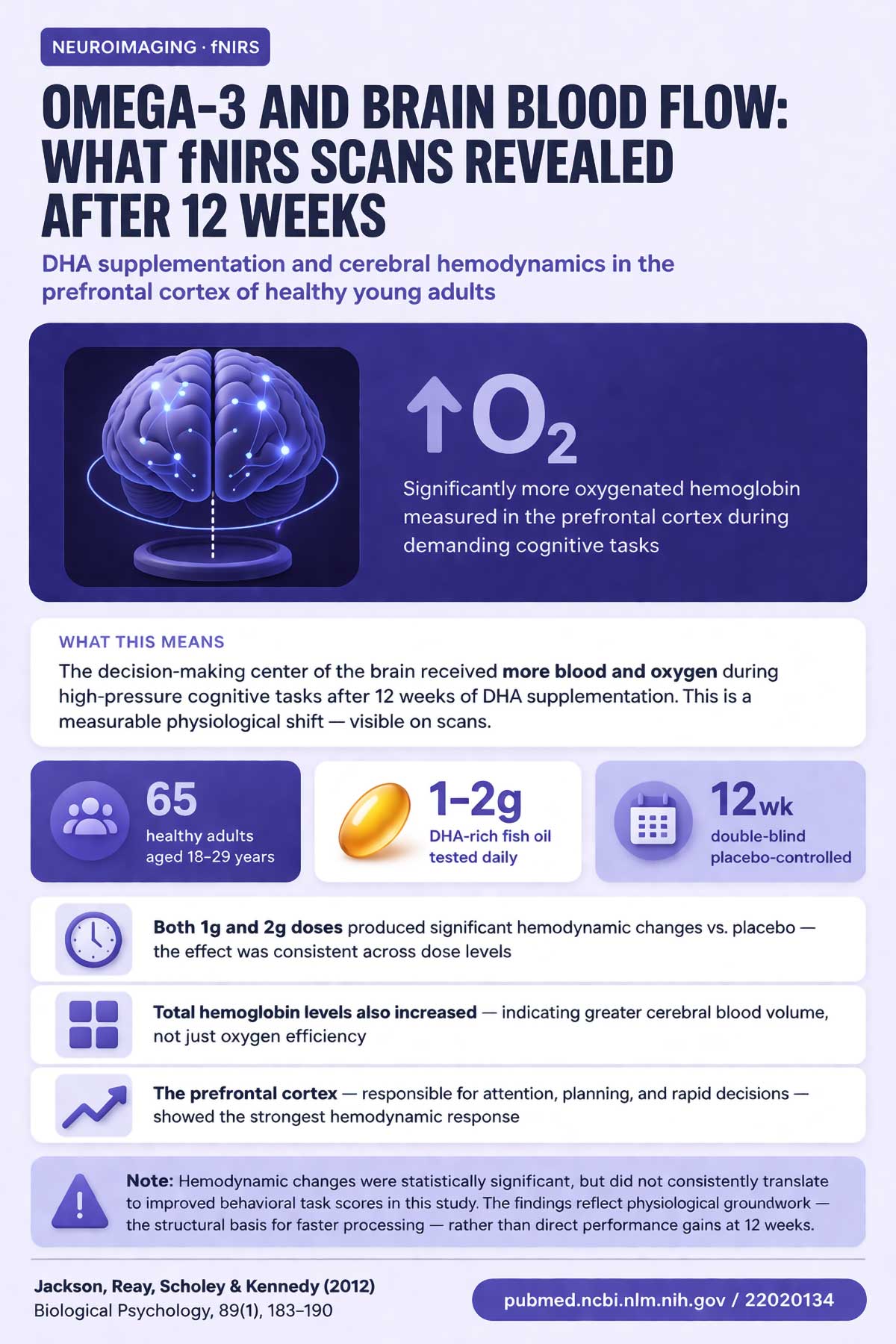
This distinction matters. Processing speed changes appear to be tied partly to oxygenation and blood flow, which can shift within weeks. Measurable behavioral improvements often require longer, or a study design sensitive enough to detect them. Memory consolidation depends on structural changes in cell membranes, which take even more time to develop.
What the Brain Looks Like After 12 Weeks
A 2014 study by Bauer et al. added an important piece of imaging evidence. Using functional MRI, researchers scanned 13 healthy young adults aged 20–34 in a crossover design, testing both EPA-rich and DHA-rich supplementation periods of 30 days each, with scans taken before and after each phase. What they found was that DHA-rich supplementation changed brain activation patterns in regions linked to memory and attention, and participants also performed better on cognitive tasks.
What made this noteworthy was the concept of neural efficiency. The brain was completing the same mental tasks using less overall effort after supplementation. Think of it like upgrading from an older processor to a newer one. The work gets done faster, with less heat and less drain on the system.
Why Memory Takes a Different Path
Here’s where things get nuanced, and most omega-3 articles miss this entirely.
There are different types of memory. Working memory is short-term: holding a phone number in your head just long enough to dial it. Episodic memory is longer-term: recalling where you were last Tuesday or the name of someone you met at an event.
Both types can improve with adequate omega-3 intake, but they do so on different timelines. Working memory and focus tend to show improvement earlier, often within the same 12-week window where processing speed changes are seen. Episodic memory and recall improvements tend to emerge later, requiring three to six months of consistent daily intake.
The reason lies in biology. DHA is incorporated into the phospholipid bilayer of brain cell membranes. This structural integration takes time. Neurons become more fluid, signals move more efficiently, and synaptic communication improves. But this is a slow process. You can’t rush the physical remodeling of cellular architecture.
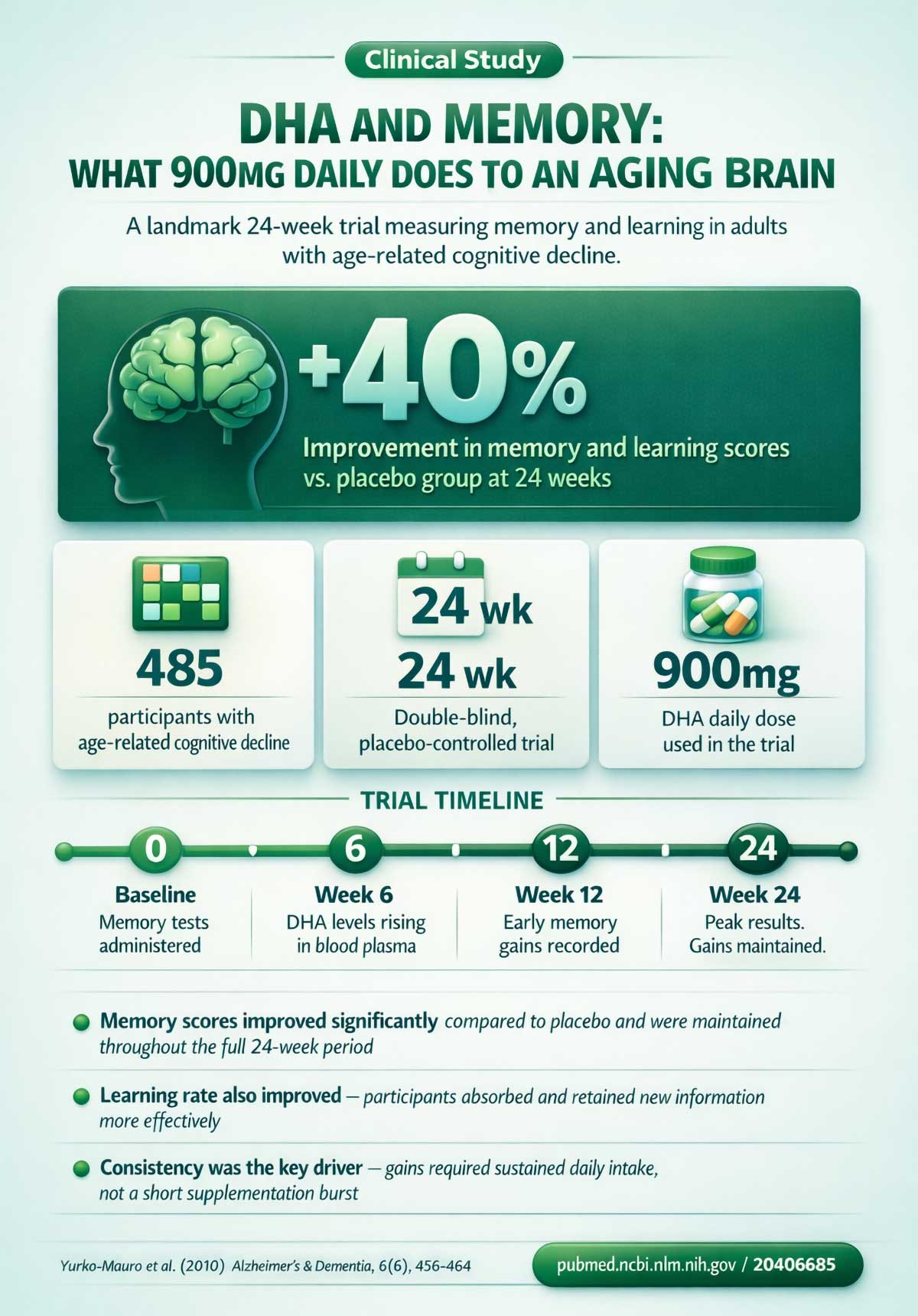
A landmark 2010 study by Yurko-Mauro et al. placed 485 older adults with age-related cognitive decline on 900mg of DHA daily for 24 weeks. By the end of the trial, participants showed significant improvements in memory and learning scores compared to placebo. Crucially, those gains were maintained throughout the 24-week period, suggesting that consistent daily intake is what drives results, not a short burst of supplementation.
The “Goldilocks” Dose for Brain Performance
Standard omega-3 dosing guidelines were not built with cognitive performance in mind. They were designed for cardiovascular and general health maintenance. Cognitive improvement studies consistently use higher doses, and the ratio of EPA to DHA in your supplement matters more than most labels suggest.
DHA is the dominant structural fat in the brain. It makes up a large portion of the gray matter in the cerebral cortex and is highly concentrated in the synaptic regions where neurons communicate. When it comes to brain structure and memory function, DHA is the primary driver.
EPA (eicosapentaenoic acid), the other major omega-3, plays a different role. It’s more anti-inflammatory and has stronger connections to mood regulation than to cognitive speed or memory. Some research suggests EPA may support emotional wellbeing alongside DHA’s structural benefits.
For cognitive performance specifically, most successful 12-week trials used 1–2g of DHA per day, often alongside EPA in varying ratios. Standard fish oil capsules typically contain far less DHA. Reading the label for DHA content specifically, rather than just “omega-3” or “fish oil,” is essential.
Dosage comparison at a glance:
| Goal | Typical Daily Dose Used in Trials |
|---|---|
| General cardiovascular health (AHA) | 250–500mg combined EPA+DHA |
| Cognitive performance (processing speed) | 1–2g DHA-rich oil |
| Memory improvement in older adults | 900mg DHA (Yurko-Mauro et al.) |
| Memory in MCI (mild cognitive impairment) | DHA-concentrated fish oil, 12+ months |
These are research doses. Always consult a healthcare provider before making changes to your supplement routine.
Who Benefits Most? The Population Variable
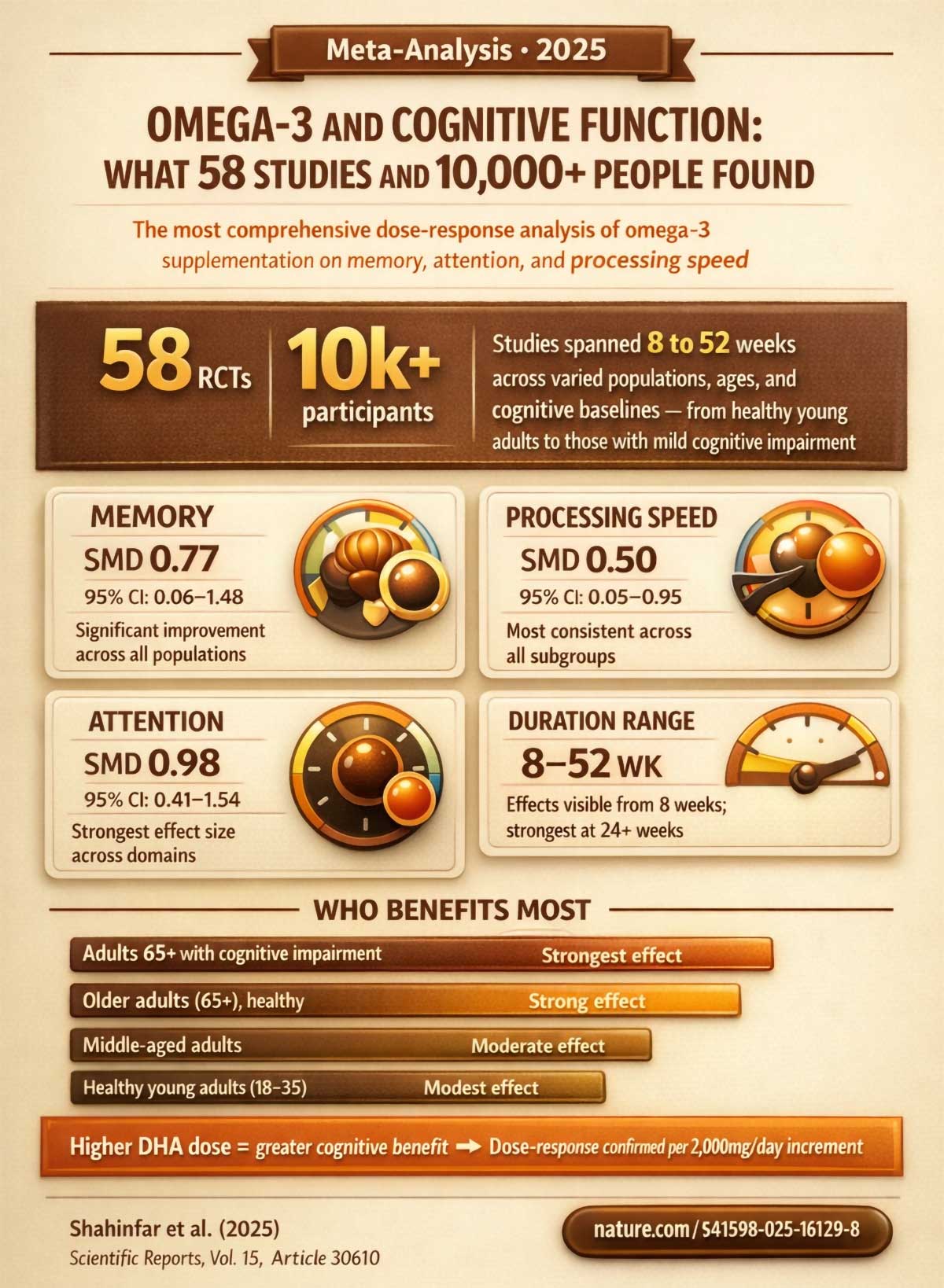
The 2025 meta-analysis by Shahinfar et al., published in Scientific Reports, analyzed 58 randomized controlled trials covering more than 10,000 participants. It found that omega-3 supplementation improved memory performance with a standardized mean difference of 0.77, and also improved processing speed across populations. But the effects weren’t evenly distributed.
Adults aged 65 and older showed the most dramatic gains, particularly in processing speed. People with mild cognitive impairment (MCI) also saw strong benefits. This makes biological sense: these groups often have lower baseline DHA levels and more to gain from replenishing stores.
A 12-month study by Lee et al. involving 36 older adults with MCI found that DHA-concentrated fish oil slowed cognitive decline and improved memory scores compared to placebo. The neuroprotective effect was especially meaningful in this group, given that MCI often precedes more serious cognitive conditions.
But younger adults aren’t left out. The first study to demonstrate reaction time improvements in healthy adults aged 18–45 was published by Stonehouse et al. in 2013. Over six months, participants taking 1.16g of DHA daily showed improvements in both episodic memory and reaction time. Women in the study showed particularly notable results across episodic memory subtypes, while men benefited more on working memory reaction times. For young adults, omega-3s won’t produce dramatic transformations, but they appear to sharpen the edges, particularly reaction time and neural efficiency.
The 2025 Meta-Analysis: What 58 Studies Tell Us
Individual studies are useful, but they’re snapshots. A meta-analysis pools data across dozens of trials to look for consistent signals, and the 2025 analysis is the most thorough yet.
Covering 58 randomized controlled trials and more than 10,000 participants, the Shahinfar et al. analysis confirmed improvements in memory performance (SMD: 0.77; 95% CI: 0.06, 1.48) and processing speed from omega-3 supplementation. Studies ranged from 8 to 52 weeks in duration, across varied age groups and cognitive baselines.
A few findings stood out. First, effects were strongest in participants over 65 and in those with existing cognitive impairment. Second, the dose-response analysis confirmed that higher DHA intake was associated with greater cognitive benefit. Third, processing speed was one of the most consistent outcomes across diverse populations, reinforcing what individual fMRI and fNIRS studies had already suggested.
This is not a niche finding from a single lab. It’s the convergence of decades of research across thousands of people.
How to Structure Your Daily Intake for Results
Getting the dose right is only part of the equation. How and when you take omega-3s affects how much of it your body actually absorbs.
DHA and EPA are fat-soluble. They absorb most efficiently when taken alongside a meal that contains fat. Taking omega-3 supplements on an empty stomach or with a low-fat meal like cereal or fruit can significantly reduce absorption. A meal containing avocado, eggs, full-fat yogurt, olive oil, or nuts creates the ideal environment for maximum uptake.
Triglyceride-form fish oil may absorb slightly better than ethyl ester form in some research, though practical differences between forms remain modest. Krill oil is another option with reasonable bioavailability, though DHA concentrations per capsule vary by brand. Individual absorption also differs based on genetics, baseline DHA status, and gut health, which is one more reason professional guidance is worth seeking when choosing a dose.
Consistency matters more than timing. The neural changes shown in 12-week trials were built through daily, uninterrupted supplementation. The brain doesn’t stockpile DHA from occasional doses. It incorporates it steadily into cell membranes over time. Missing days frequently slows or interrupts this process.
Setting a daily reminder and pairing the supplement with the same meal each day are simple strategies that improve adherence significantly over a 12-week period.
Tracking Your Progress: Simple Ways to Measure Change
Unlike blood pressure or cholesterol, cognitive changes aren’t measured with a home device. But there are practical ways to monitor improvement over a 12-week period.
Reaction time apps offer one of the most accessible measures. Applications that test tapping speed and response to visual cues can be run in minutes and tracked over time. A consistent downward trend in reaction time over 8–12 weeks is a real signal.
Focus duration is another useful proxy. How long can you work on a single task before your attention breaks? Tracking this informally, even in a notes app, provides useful data over weeks and months.
The 12-week mark is a realistic point to assess processing speed changes. For memory improvements, particularly episodic recall, the meaningful window is closer to 6 months. Patience and consistency matter here. The biology of membrane integration doesn’t respond to impatience.
Conclusion
Here’s the honest summary. Memory is a long game. Structural changes in brain cell membranes take months to fully develop, and measurable recall improvements often emerge between 3 and 6 months of consistent intake. Processing speed, on the other hand, moves faster. Neural oxygenation, prefrontal cortex activation, and reaction time can all show measurable shifts within 12 weeks.
Both outcomes are backed by solid evidence, from fMRI imaging studies — including Bauer et al.’s crossover neuroimaging work showing brain activation changes after DHA supplementation — to a 58-trial meta-analysis covering more than 10,000 people. The key is using a dose relevant to cognitive performance, typically 1–2g of DHA daily, taking it with fat, and not skipping days.
If you’re starting from zero or you’re unsure what dose makes sense for your age, health status, or existing supplement routine, a conversation with a healthcare provider is the right first step. They can help you find the dose that fits your specific situation, whether you’re 25 and chasing sharper reaction times or 68 and focused on keeping memory strong.