The microbes in fermented ginger are real. The probiotic claim is where things get complicated. One scientific distinction changes everything.
For years, calling a jar of fermented ginger “probiotic” felt a little like calling sourdough bread medicine. The word stuck because it sounded right, not because anyone checked it.
A 2014 consensus statement from the International Scientific Association for Probiotics and Prebiotics drew a much narrower line: a probiotic has to be a specific, identified strain, delivered at a known dose, with a demonstrated health benefit. Almost nothing fermented in a home kitchen clears that bar. That includes the ginger sitting in your fridge.
The jar is still doing something worth understanding. The real story is more specific and more interesting than the label suggests.
Why “Fermented” Doesn’t Automatically Mean “Probiotic”
Fresh ginger is neither a prebiotic nor a probiotic on its own. Once it ferments, the picture changes, but not in the simple way most articles describe it.
Lactic acid bacteria multiply in the brine, and ginger’s own fiber acts as a prebiotic, feeding the bacteria already living in your gut. Both things are real. Neither one, by itself, makes the jar a probiotic food in the strict sense.
The distinction matters because of what it does and doesn’t promise. A true probiotic claim requires knowing which strain is present, in what quantity, and what it does in the human body, the kind of detail a regulated supplement label carries, and a mason jar on a counter never will.
Home fermentation produces an undefined mix of wild bacteria and yeast in unknown amounts. That can still be a fermented food worth eating. It isn’t the same claim.
What’s Actually Happening Inside the Jar
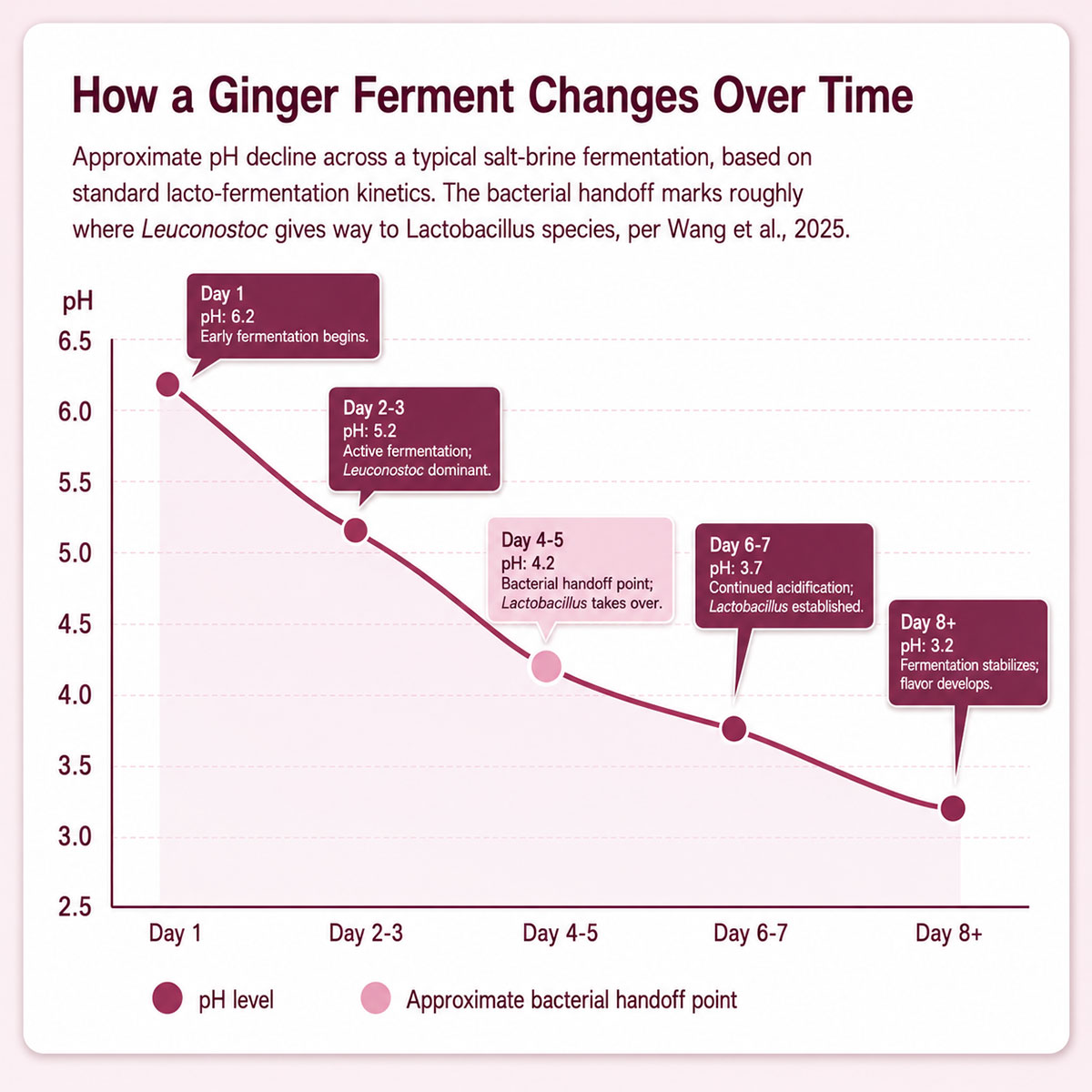
A 2025 study tracked naturally fermented ginger over six weeks and found a predictable handoff between two groups of bacteria. Early on, a genus called Leuconostoc dominates the brine.
As days pass, it gets overtaken by Lactobacillus species, particularly Lactiplantibacillus plantarum, the same organism behind much of sauerkraut and kimchi’s tang. Alongside that shift, the researchers measured rising levels of organic acids, flavonoids, and gingerol, the compound responsible for ginger’s bite.
That succession isn’t unique to one lab’s batch of ginger. A separate analysis of fermented vegetable and fruit juices found Lactobacillus and a related genus, Weissella, making up more than half the bacterial population in raw ginger juice ferments specifically.
It doesn’t quite make sense until you realize where these microbes come from in the first place. They’re not added. They’re already living on the ginger’s skin and in the surrounding air, waiting for the right conditions (salt, sugar, time) to multiply.
Fresh, Fermented, or Dried: Does the Form Matter?
Each form of ginger behaves differently in the body and in the kitchen. Fresh ginger delivers the most heat and the shortest shelf life.
Drying concentrates some compounds while converting others, shifting some of its gingerol into shogaols, a milder, slower-burning relative. Fermentation does something else again, tempering the heat, extending the shelf life to months rather than weeks, and introducing the live bacteria and organic acids described above.
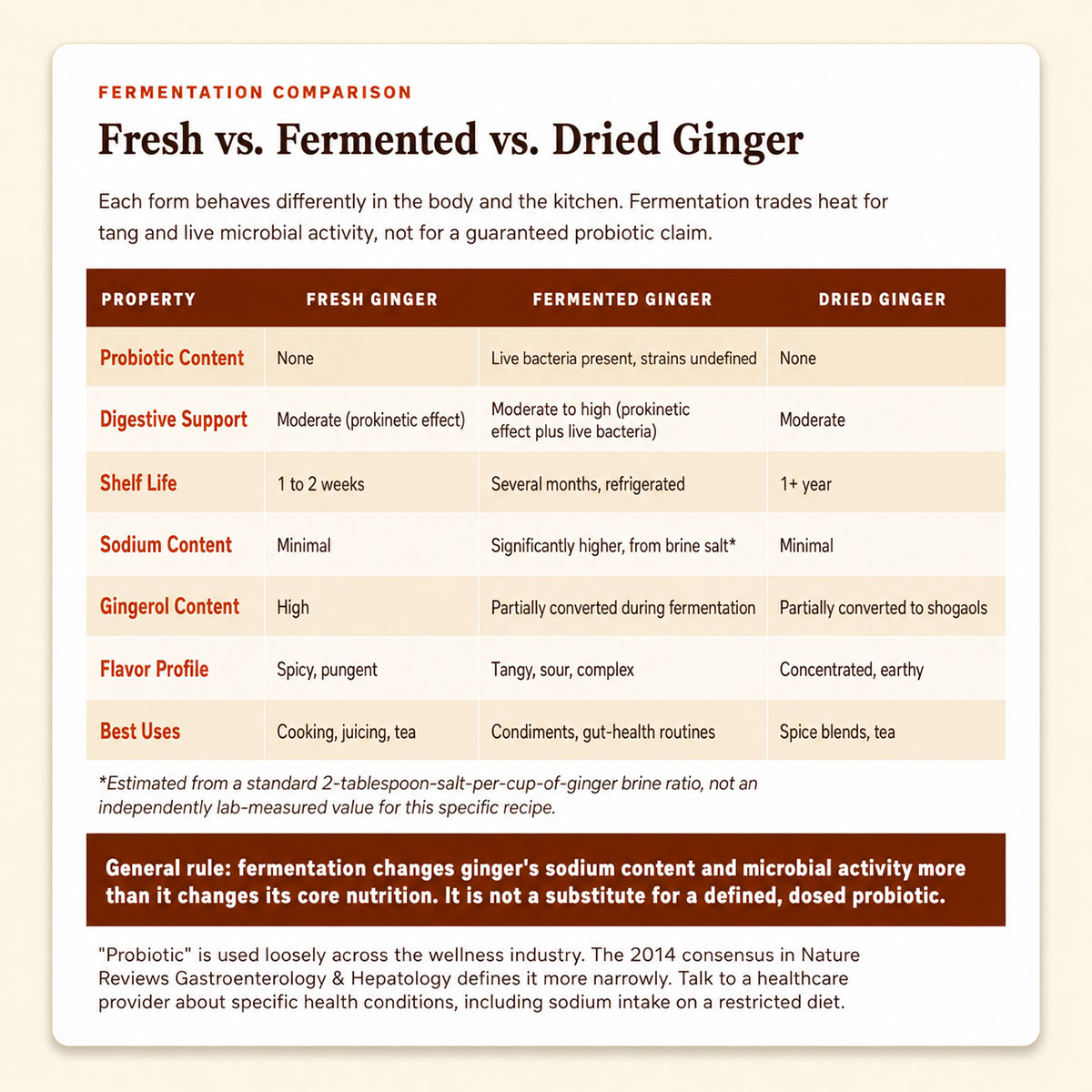
None of the three forms is strictly better. They’re suited to different jobs: fresh for cooking and juicing, dried for tea and spice blends, fermented for condiments and the slow, sour depth that only time and bacteria can produce.
Does Fermented Ginger Help Digestion?
Ginger’s reputation as a digestive aid is older than fermentation itself. Gastric emptying sped up measurably when healthy adults took ginger before a meal, according to a 2008 crossover trial in the European Journal of Gastroenterology and Hepatology, a real, human-level result rather than a lab curiosity. Fermentation adds a second layer on top of that mechanism: an undefined but active population of bacteria, plus the fiber that feeds your gut microbes regardless of method.
Put those two things together, and a fermented ginger condiment plausibly supports digestion twice over, once through motility and once through whatever the live bacteria are doing. Nobody has run the trial that would prove either route in a fermented-ginger-specific way, so this is an educated guess.
Inflammation and Oxidative Stress
The case for ginger and digestion is about as clear as it gets, with the evidence supporting it. Inflammation holds up almost as well: a 2020 meta-analysis in the journal Cytokine pooled randomized trials of ginger supplementation and found a measurable reduction in inflammatory markers across studies.
That’s a broad result across many markers at once. A narrower 2016 analysis in Food and Nutrition Research zoomed in on just one of them, C-reactive protein, and found ginger lowered it by a small but statistically real amount. Ginger also contains naturally occurring antioxidant compounds that help neutralize the oxidative stress linked to chronic disease, though the specific claim that fermentation itself boosts that antioxidant activity hasn’t been tested directly and shouldn’t be overstated.
The Cardiovascular Claim, Examined Honestly
The anti-inflammation evidence is reasonably solid. The cardiovascular claim is where most ginger articles get sloppy, claiming that ginger lowers LDL and raises HDL cholesterol in one tidy sentence.
The honest picture is more complicated. A 2000 study in the Journal of Nutrition found ginger extract reduced LDL, triglycerides, and total cholesterol, but it was conducted in mice bred to develop atherosclerosis, not in people.
Human evidence exists, and it’s genuinely mixed. Total cholesterol, triglycerides, and LDL all dropped significantly in a human trial published in Herbal Medicine Journal, though HDL didn’t follow. A different trial, in Phytotherapy Research in 2023, found that total cholesterol and triglycerides fell significantly, but the LDL and HDL changes weren’t statistically significant at all.
Researchers still don’t agree on exactly which lipid markers ginger reliably moves in humans. What’s consistent across the human trials is triglyceride and total cholesterol reduction. The LDL and HDL story is still being worked out.
Can Fermented Ginger Support Immunity?
Cardiovascular evidence is genuinely split. Immunity evidence has the opposite problem: what’s there is solid, but it covers far less ground than the marketing suggests. Fresh ginger showed measurable antiviral activity against respiratory syncytial virus, but only in human respiratory cell lines, according to a 2013 study in the Journal of Ethnopharmacology, a meaningful finding observed in a petri dish, not in a person who ate ginger and got sick less often.
Treat any claim that fermented ginger “fights infections” or “boosts immunity” in a person as aspirational rather than established. That same caution about more bacteria not automatically meaning more benefit carries straight into the next question, because sometimes more bacteria is the actual problem.
A Caution for SIBO and IBS
Ginger’s motility-boosting effect is the same mechanism that makes it useful for one specific gut condition and questionable for another. Small intestinal bacterial overgrowth, or SIBO, involves bacteria growing where they shouldn’t, and slow gut motility is part of what allows that overgrowth to take hold. Ginger’s prokinetic effect should, in theory, help.
At the same time, many SIBO management approaches advise caution with fermented and probiotic foods during active treatment, since introducing more live bacteria into an already overgrown small intestine can aggravate symptoms rather than ease them. No direct clinical trial has tested fermented ginger specifically in SIBO patients, so this is a real, unresolved tension rather than a definitive answer. If you have been diagnosed with SIBO, talk to the clinician managing your treatment before adding a fermented ginger condiment to your routine.
How to Make Salt-Brine Fermented Ginger
This is the classic method, the same logic behind sauerkraut and pickles, applied to ginger root.
You’ll need: 1 cup fresh ginger, organic if you can get it, 2 tablespoons sea salt, 2 cups filtered water, and a quart-sized glass jar.
- Wash, peel, and thinly slice or grate the ginger.
- Dissolve the salt in the water to make a brine.
- Pack the ginger into the jar and pour the brine over it, keeping the ginger fully submerged.
- Weigh it down if you have a fermentation weight, or use a cabbage leaf to hold it under the brine.
- Cover loosely, enough to let gas escape, and store in a cool, dark spot for 5 to 7 days.
- Check daily, releasing any built-up gas, until the flavor and tang reach where you want them.
- Move it to the refrigerator to slow things down once it tastes right.
Troubleshooting a Stalled Ferment
You did everything the recipe said, and the jar still isn’t bubbling. This is the moment most fermentation guides skip past, and it’s usually not a sign you’ve ruined anything.
- Mold on the surface: lift it off carefully, make sure the ginger stays fully submerged, and use a fermentation weight next time.
- No bubbling at all: the room is probably too cold. Move the jar somewhere warmer, or add a small pinch of extra sugar to feed the bacteria.
- Too salty: rinse briefly before eating this batch, and use less salt next time.
- Too sour: it fermented longer than you wanted. Refrigerate earlier next round, or balance the current batch with a little honey.
- A soft, mushy texture: normal for a longer ferment. Pull it earlier for crisper ginger.
- A genuinely putrid smell, not just sour: discard it and start over with cleaner equipment. Sour and tangy is normal. Rotten is not.
The Ginger Bug: A Different Kind of Starter
A ginger bug is a wild starter culture, built the same way a sourdough starter is built, except it runs on grated ginger and sugar instead of flour. The wild yeast and bacteria living on the ginger’s skin do the work.
- Combine 1 tablespoon warm water, 1 tablespoon sugar, and 1 tablespoon grated unpeeled ginger in a clean jar.
- Stir until the sugar dissolves, then cover loosely with a breathable cloth.
- Each day for the next 4 to 6 days, feed it another tablespoon each of sugar and grated ginger.
- It’s ready when the liquid turns cloudy and faintly yellow, smells yeasty rather than sour, and bubbles actively after a fresh feeding.
- Once active, strain it and use it to carbonate fruit juice, lemonade, or homemade ginger beer.
- Between batches, refrigerate the bug to slow it down, feeding it a teaspoon each of ginger and sugar every week or two to keep it alive.
Is It Safe? The Ginger Bug Botulism Question
Anyone who searches “ginger bug” long enough eventually finds someone asking about botulism, and it’s a fair question to ask rather than dismiss. Clostridium botulinum, the bacterium behind botulism, needs four things at once to produce its toxin: an oxygen-free environment, enough water, a pH above roughly 4.6, and a specific bacterial virus that codes for the toxin gene.
Lacto-fermentation works against nearly all of those conditions at once. Competing bacteria acidify the liquid quickly, a process food-safety researchers call competitive exclusion, and that acidification is what keeps a properly fermenting jar inhospitable to botulism.
The honest caveat most recipe sites skip: a ginger bug is what food-safety extension programs classify as a “wild” fermentation, meaning no salt, no starter culture, nothing controlling which microbes take hold beyond whatever happens to be on the ginger that day. Virginia Cooperative Extension specifically flags wild fermentation as the least consistent method, precisely because it depends on the right organisms showing up, and recommends following a tested recipe rather than improvising ratios. That’s a real reason to measure your sugar and ginger rather than eyeballing it, not a reason to fear the jar.
It’s also worth knowing where documented fermentation-linked botulism cases actually come from. A University of Missouri Extension food-safety bulletin traces recent U.S. cases to fermented fish, prison-brewed alcohol, and fermented soy, not vegetable or starter-culture ferments like a ginger bug. If your bug hasn’t shown any bubbling within four days, the food-safety community’s practical advice is simple: discard it and start fresh rather than waiting it out.
Honey-Fermented Ginger: Skipping Water and Salt Entirely
There’s a third method that uses neither water nor salt, only raw honey and ginger, and it works through a mechanism almost nothing online explains correctly. Submerge thin ginger slices in raw honey, leave the jar loosely covered, and burp it daily to release the carbon dioxide that builds up as it ferments.
Raw honey already contains dormant yeasts and lactic acid bacteria, but its low water activity, roughly 0.5 to 0.7 on the scale microbiologists use, normally keeps them inactive. Most microbes need water activity above about 0.6 to multiply.
Ginger is mostly water, and as it sits in the honey, it slowly raises the surrounding water activity until those dormant microbes wake up and start fermenting. That’s also the answer to why some jars never seem to work: too little ginger relative to honey, or ginger that’s dried out, simply never raises the water activity enough.
Use raw, unpasteurized honey only, since heat-treated honey lacks the live microbes the process depends on. Plan on two to four weeks at room temperature for the flavor to develop, though it keeps for months at room temperature and roughly a year refrigerated. One safety note has nothing to do with fermentation and everything to do with age: honey, fermented or not, should never be given to a child under twelve months, because of a real risk of infant botulism that the CDC has documented and continues to warn about.
Three Jars, Three Sources of Microbes
Put the three methods side by side, and a pattern emerges that explains a lot of the confusion around fermented ginger. The salt-brine method and the ginger bug both lean on bacteria and yeast already living on the ginger’s own skin, which is why both recipes call for leaving it unpeeled. The honey method works differently. Honey itself is the main reservoir of microbes, with the ginger mostly supplying the moisture needed to wake them up.
That single distinction explains why peeling matters for two of the three methods and barely matters for the third, and why a recipe that works perfectly for someone else’s salt-brine batch might say nothing useful about why your honey jar isn’t bubbling. Different methods, different microbes, different troubleshooting.
Ginger Ferment Batch Calculator
Scale any of the three methods to the amount of ginger you actually have.
The classic method. Submerge sliced or grated ginger in a salt-and-water brine for 5 to 7 days.
Your scaled brine
Ginger Beer, Real and Imitation
Most ginger beer sold in stores today never sees a starter culture. It’s a carbonated soft drink flavored to taste like the real thing, not something actually fermented. The traditional version starts with an active ginger bug, strained into a sweetened ginger liquid and bottled to carbonate naturally over two to three days, then refrigerated to stop the process before the bottles build too much pressure.
A homemade batch made this way genuinely contains live cultures the store-bought version doesn’t. That’s a real point in its favor, but it’s worth keeping in proportion. Per EatingWell’s nutrition coverage of ginger bug drinks, a homemade ginger soda is healthier than cola but not sugar-free, so it’s worth drinking for the flavor and the fermentation, not as a guilt-free health drink.
Pairing Fermented Ginger With Turmeric and Carrots
Two combinations are worth knowing if you’ve already got a batch of fermented ginger going. Blending it with fresh turmeric before fermenting adds curcumin to ginger’s gingerol.
Combined, the two compounds produced a stronger anti-inflammatory effect in lab models than either alone, per a 2022 study in the journal Molecules, though that’s cell and mouse research, not a human trial. Mix one cup chopped ginger with half a cup chopped turmeric, a tablespoon of salt, a pinch of black pepper to help the turmeric absorb, and two cups of water, then ferment five to seven days the same way as the basic recipe.
Carrots pair well too, contributing fiber and beta-carotene alongside ginger’s bite. Combine four cups of carrot sticks with a quarter cup of grated ginger, two tablespoons of salt, and four cups of water, and ferment for seven to ten days at room temperature.
Working Fermented Ginger Into Your Day
A spoonful goes a long way. Stir it into salad dressing with olive oil and lemon, blend it into a morning smoothie, fold it into a marinade, or add it to a finished soup right before serving so the heat doesn’t kill off the live bacteria. A simple morning shot, two tablespoons of fermented ginger with its brine, a tablespoon of lemon juice, and a quarter cup of water, blended and strained, is an easy way to use it consistently.
Who Needs to Be Careful
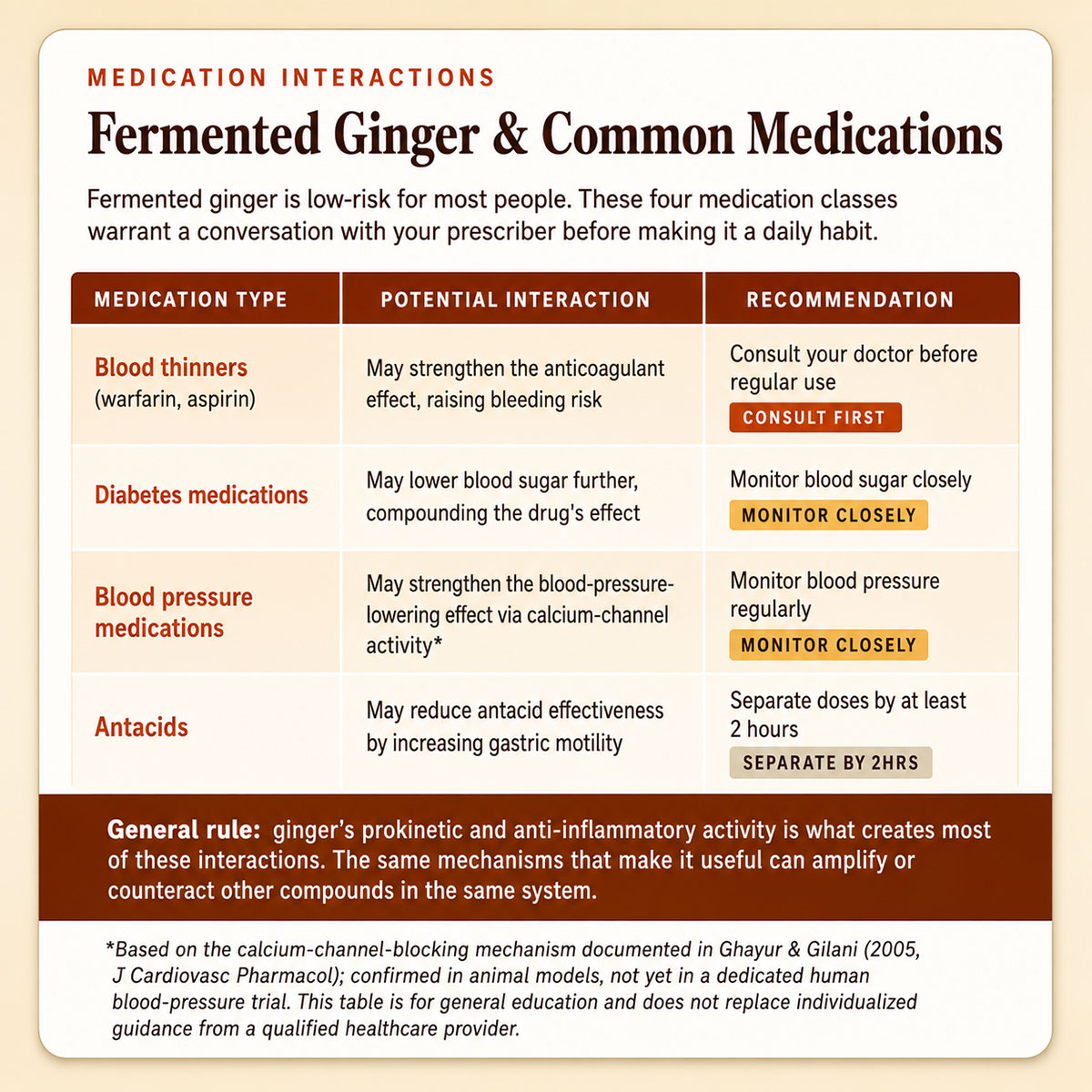
Fermented ginger is low-risk for most people, but a few groups have real reasons to slow down. If you take blood thinners, diabetes medication, or blood pressure medication, fermented ginger can strengthen their effect, so talk to your prescriber before making it a daily habit.
If you’re pregnant, plain ginger has solid evidence behind it for nausea. The fermented version introduces two things that haven’t been studied the same way: trace alcohol from fermentation and an undefined mix of live bacterial strains.
A blanket “ask your doctor” undersells what’s actually different here. Raise the fermentation specifically when you bring it up, not just ginger in general.
A history of ginger allergy is also a reason for caution, since fermentation can alter or introduce proteins that weren’t a problem in fresh ginger. Start with a small amount and watch for a reaction, or skip it entirely if you’ve had a severe response before.
What the Jar Actually Promises
Ginger has shown up in traditional Chinese medicine, Ayurveda, and Caribbean folk remedies for centuries, mostly for digestion and circulation, long before anyone had a microscope to check why it worked. Modern research has confirmed parts of that intuition while leaving other parts unsettled, which is roughly where fermented ginger sits today as well.
None of this makes the jar on your counter less worth keeping. It makes the claim worth getting right: not a probiotic in the strict sense, but a fermented food with a real, traceable microbial story that shifts day by day from one genus of bacteria to another, whether or not anyone’s watching.
The 2014 ISAPP definition didn’t take anything away from your ginger. It just gave the jar a more honest name.
Frequently Asked Questions
Is fermented ginger good for you?
It’s a fermented food with real, traceable benefits: prokinetic support for digestion, measurable anti-inflammatory effects, and a documented microbial succession, rather than a guaranteed probiotic. It’s worth eating for what the evidence actually shows, not for the unqualified “yes” you’ll see elsewhere.
What probiotics are in fermented ginger?
Home-fermented ginger isn’t a probiotic in the clinical sense, since the strains and doses aren’t defined or measured. What’s actually there, based on 2025 fermentation research, is a shifting population dominated early on by Leuconostoc and later by Lactobacillus species.
Is pickled ginger the same as fermented ginger?
No. The pale pink ginger served with sushi is pickled in vinegar and sugar, a quick preservation method with no live bacteria involved. True fermented ginger develops over days through lactic acid bacteria, not vinegar.
Does ginger affect gut bacteria?
Yes. A 2021 study in Frontiers in Microbiology found that short-term intake of ginger juice measurably shifted the composition of human gut microbiota, though that study used ginger juice rather than the fermented version specifically.
Do you have to peel ginger before fermenting?
For the salt-brine and ginger bug methods, no, and you generally shouldn’t. The skin carries the wild yeast and bacteria that the fermentation depends on. The honey method is less picky about this, since honey’s own microbes do most of the work there.
Does ginger ferment in honey?
Yes, through a water-activity mechanism rather than added cultures. Raw honey’s dormant microbes wake up once ginger’s moisture raises the water activity inside the jar past the threshold they need to multiply.
How long can ginger last in honey?
Flavor typically develops over two to four weeks at room temperature. The jar keeps for up to about three months at room temperature, or roughly a year once refrigerated.
Is it safe to drink a ginger bug?
Yes, when it’s made and fed properly. Lacto-fermentation acidifies quickly enough to keep the conditions Clostridium botulinum needs from coming together, and documented fermentation-linked botulism cases trace back to fish, alcohol, and soy ferments, not vegetable or starter cultures like a ginger bug.
What does a ginger bug taste like?
A ready bug is cloudy, faintly yellow, and smells more like bread dough than vinegar. Strained and used in soda, it carries a mild tang with ginger’s characteristic bite underneath.
Is a ginger bug unhealthy?
It’s healthier than a can of cola, but it isn’t sugar-free. The sugar feeds the fermentation, and some of it remains in the finished drink, so enjoy it as a better alternative rather than a guilt-free one.
How long will a ginger bug last?
Indefinitely, as long as you keep feeding it. Refrigerate it between uses to slow it down, and feed it a teaspoon each of ginger and sugar every one to two weeks to keep it alive.
How long does it take to ferment ginger?
Most salt-brine batches are ready in 5 to 7 days. Warmer rooms speed things up, and cooler ones slow them down.
Can fermented ginger interact with medications?
Yes, particularly blood thinners, diabetes medications, and blood pressure medications. Check with your prescriber before adding it to your routine if you take any of these.
Is fermented ginger alcoholic?
It can contain a small amount of alcohol as a byproduct of fermentation, typically under 0.5 percent, depending on fermentation time and sugar content.
Does ginger lower blood pressure?
It may, through a calcium-channel-blocking effect documented in animal research. That mechanism hasn’t been confirmed in a dedicated human blood-pressure trial, so treat it as a plausible contributor rather than a substitute for prescribed treatment.
Is it safe to consume fermented ginger if I have a ginger allergy?
Proceed carefully. Fermentation can alter or introduce proteins that a fresh ginger allergy wouldn’t have reacted to. Start with a very small amount, or avoid it entirely if you’ve had a severe reaction before.