Doctors call it hyperkyphosis. You call it slouching. Either way, “sit up straight” won’t fix it — but this 8-week protocol will.
You’ve heard it your whole life. “Shoulders back. Chin up. Sit up straight.” Maybe a parent drilled it into you. Maybe a doctor mentioned it at a checkup. Whatever the source, the message was always the same: good posture is about holding yourself upright, like a soldier at attention.
Here’s the problem. That advice is wrong. And for people over 50, it may actually be doing more harm than good.
Real posture improvement isn’t about holding a position. It’s about retraining your nervous system and building specific muscles that keep you upright without you having to think about it. That’s a very different thing — and the research backs it up.
Why Your Spine Changes After 50
To fix something, you need to understand why it’s breaking down in the first place.
The spine isn’t lazy. It’s responding to real physical changes. After 50, spinal discs gradually lose fluid and flatten. The muscles along the back — particularly the ones responsible for pulling the spine into extension — weaken and lose their ability to fire quickly. At the same time, the muscles at the front of the body, including the chest and hip flexors, tend to stay tight from years of sitting.
The result is a slow forward lean. Medically, this is called hyperkyphosis — an excessive rounding of the upper spine into a “C” shape. You’ve seen it. You may even feel it in yourself.
What most people don’t realize is that this isn’t just an aesthetic issue.
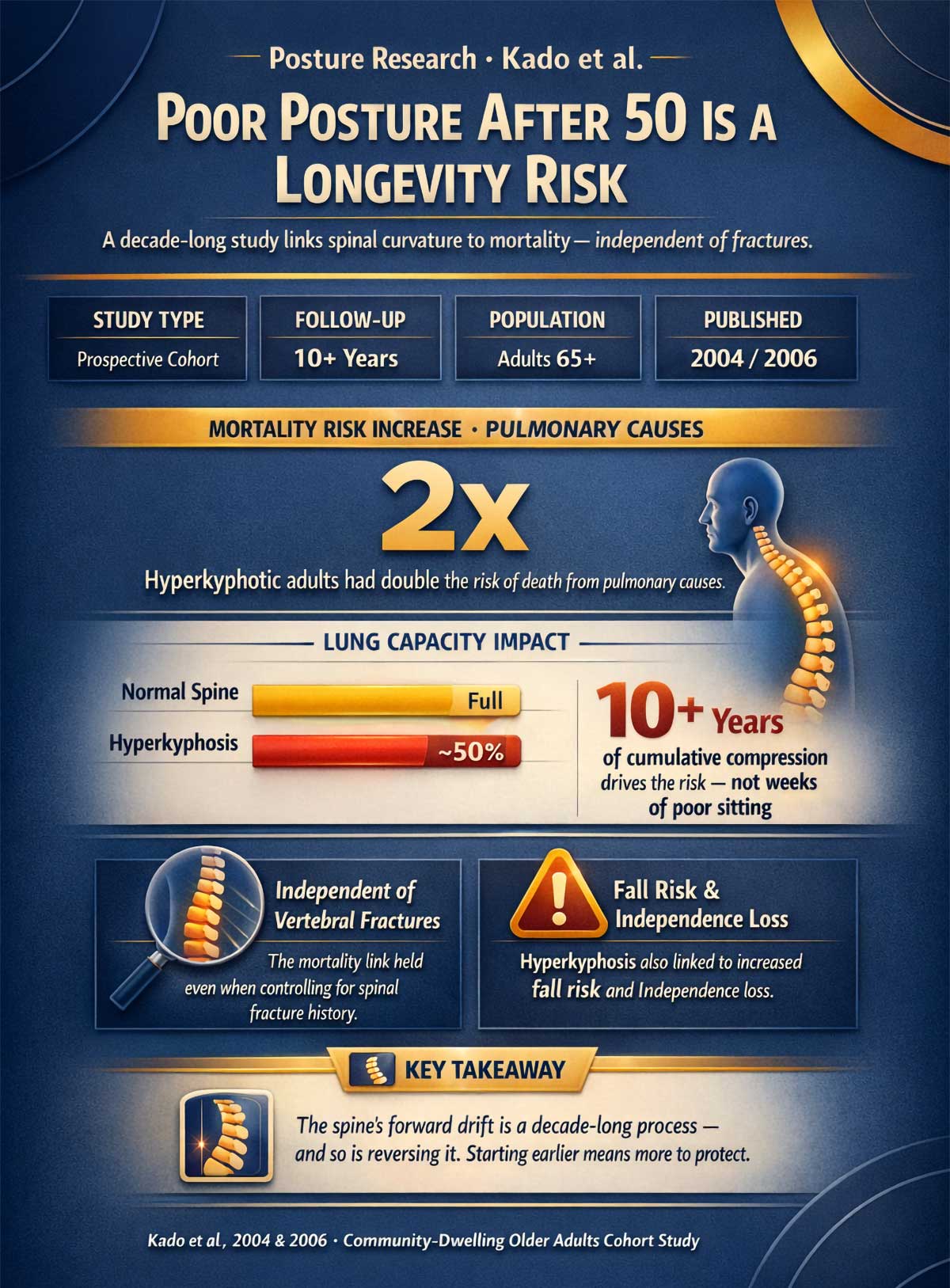
The rounding of the upper spine gradually compresses the lungs and restricts breathing capacity. Over years, this compound effect accumulates into real health consequences. A long-term study by Kado and colleagues followed a large group of community-dwelling adults over the age of 65 for more than a decade. Those with hyperkyphotic posture had roughly double the mortality risk from pulmonary causes compared to those with less curvature — and this held true independent of whether vertebral fractures were present. This isn’t about the risk from a few weeks of bad sitting. It’s about where a decade of unchecked forward lean can take you.
Posture, it turns out, is a longevity issue. Not just a back pain issue.
How to Measure Your Alignment Right Now
Before you start any kind of training, it helps to know where you stand — literally.
The “wall test” is a simple, no-equipment check. Stand with your heels, buttocks, and upper back touching a wall. Now try to touch the back of your head to the wall without forcing it. If you can’t get your head back without strain, or if there’s a large gap between your lower back and the wall, your alignment is worth addressing.
This isn’t a clinical measurement, but it gives you a useful starting point. You can use it again after several weeks of training to track real change. Even better — take a side-angle photo of yourself at the start. A comparison shot at week eight can be more motivating than any scale or timer.
Why “Sit Up Straight” Actually Makes Things Worse
Let’s talk about why the common advice doesn’t work — because understanding this changes everything.
The Muscle Load Problem
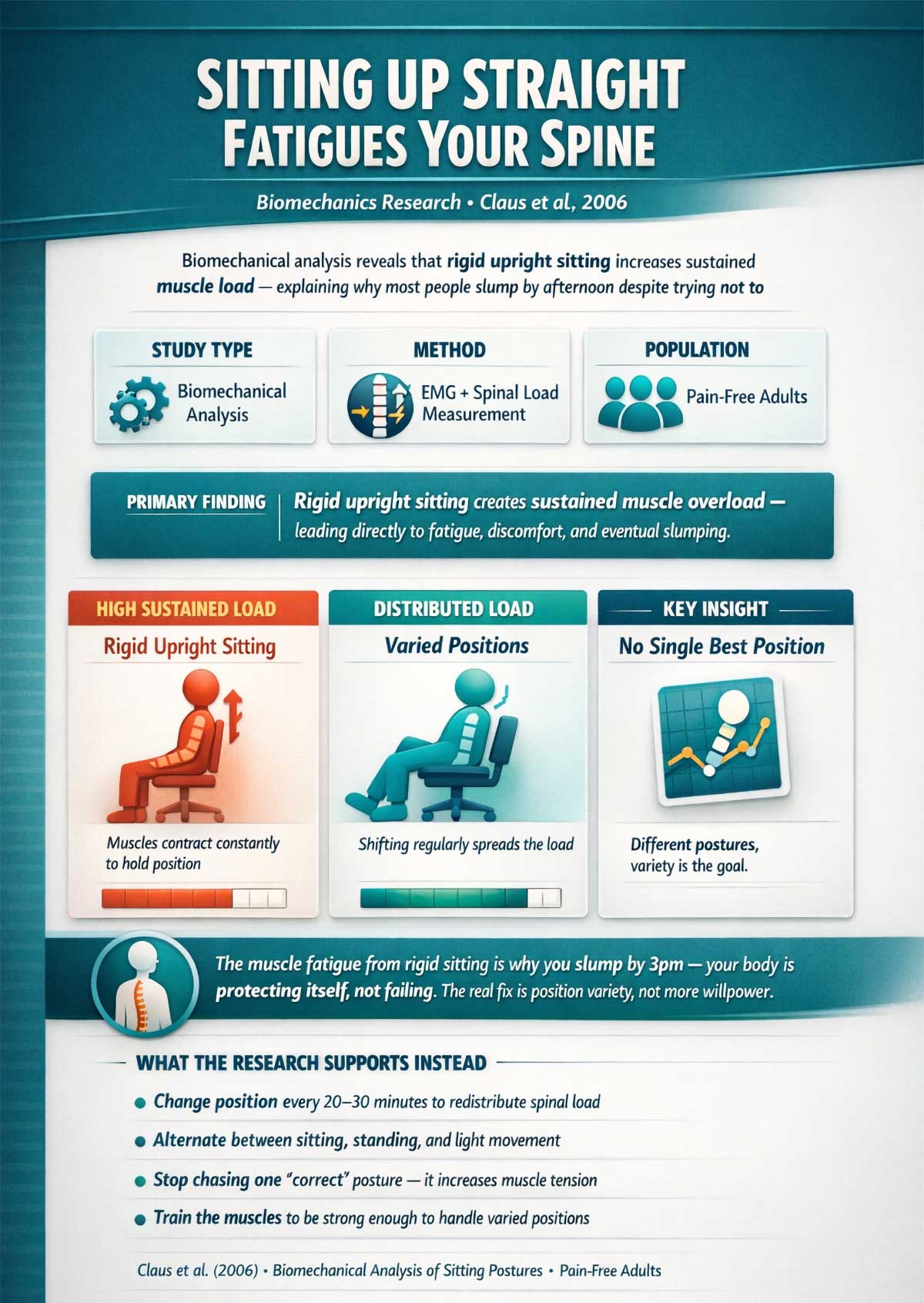
Biomechanics researcher Claus and colleagues analyzed what actually happens in the spine during upright sitting. Their findings challenged a lot of conventional thinking. Holding a rigid, upright seated posture actually increases sustained muscle load on the spine. Over time, this leads to fatigue and discomfort — which is why people end up slumping by the end of the day, even when they’re trying not to.
There is no single best sitting position. The key is varying positions throughout the day to distribute loading across different muscle groups rather than exhausting one set. Staying in any one position too long is the actual problem, not the specific angle of your back.
The “Just Remember” Trap
Here’s the other big issue. Most posture advice relies on awareness. “Just remind yourself to sit up.” “Set an alarm every hour.” “Put a sticky note on your monitor.”
Research by Czaprowski and colleagues tested this exact idea — whether posture education and awareness alone, without structured exercise, could lead to long-term improvement. The answer was clear. Education and awareness without active movement training had minimal impact. People would straighten up when reminded, then drift right back. Awareness doesn’t change the underlying muscle patterns. Only training does.
This is a critical insight. Posture is a neuromuscular habit. It lives in the nervous system, not in your willpower.
Movement Variability: A Better Goal Than “Perfect Posture”
Before getting into the specific exercises, there’s a mindset shift worth making.
Researcher O’Sullivan and colleagues have argued persuasively that the goal of posture improvement should not be a fixed, “correct” position. Instead, the goal is movement variability — the ability to move through many different positions comfortably and with control. Their work on chronic low back pain found that rigid static posture goals were far less effective than training the body to adapt and move fluidly.
The phrase that sums this up well is: your best posture is your next posture.
This doesn’t mean anything goes. It means the spine needs to be strong and mobile enough to handle different positions, not locked into one idealized shape. This is liberating for people who feel anxious about whether they’re “doing it right.”
The Three Pillars of Research-Backed Posture Improvement
The best evidence points to three areas that actually move the needle. These aren’t isolated tips. They work together as a system.
Pillar One: Targeted Back Extensor Loading
The muscles that run along the spine — the erector spinae, the lower trapezius, the rhomboids — are the body’s primary “anti-gravity” structures. When they weaken, the spine has nothing pulling it upright. Gravity wins.
Work by Lau and colleagues on older women with established kyphosis showed that targeted back extensor strengthening reduced spinal curvature and improved muscle torque. This wasn’t general fitness training. It was specific resistance work aimed at the muscles responsible for spinal extension.
General stretching alone doesn’t achieve this. Resistance training aimed at the posterior chain does. This is one of the most important distinctions in posture research for the 50+ population.
Pillar Two: Opening the Anterior Chain
While the back muscles need strengthening, the front needs release. The chest (pectorals) and hip flexors tend to shorten and tighten with age and prolonged sitting. When they’re tight, they pull the shoulders forward and tilt the pelvis, creating exactly the conditions for poor alignment.
Research by Kendall and colleagues confirmed this pattern across populations. Weak posterior muscles paired with tight anterior muscles creates a predictable postural breakdown. Fix one side without addressing the other and progress will be slow.
Hip flexor release work and chest opening movements are not optional additions to a posture program. They’re foundational.
Pillar Three: Neuromuscular Re-patterning
This is where posture work gets genuinely interesting — and where many programs fall short.
The brain maintains a “map” of where the body is in space. This is called proprioception. After years in a forward-leaning position, the nervous system starts to register that position as “normal.” Changing posture isn’t just about building muscle; it’s about updating that map.
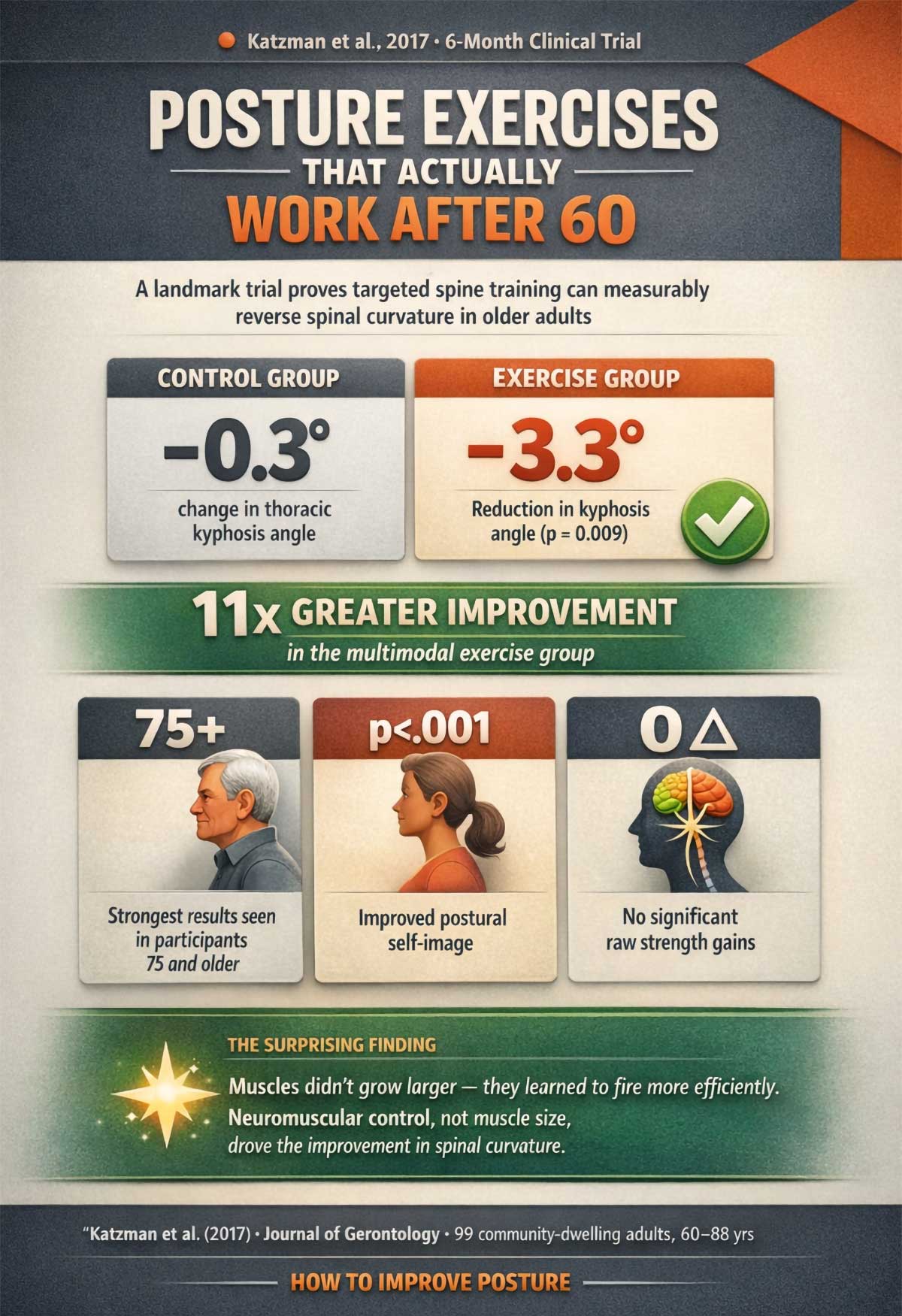
A landmark study by Katzman and colleagues followed 99 community-dwelling adults between 60 and 88 years old through a six-month multimodal program. This combined spine-strengthening exercises with postural training, meeting three times per week for one-hour sessions. The results were meaningful. The intervention group reduced their thoracic kyphosis angle by an average of 3.3 degrees, compared to just 0.3 degrees in the control group. This was statistically significant.
Here’s the compelling part: the researchers did not observe significant improvements in raw muscle strength. Yet kyphosis still improved. This points strongly to improved neuromuscular control — better brain-to-muscle communication — as the likely driver of change. In other words, the muscles didn’t grow larger, but they learned to fire more efficiently and in better coordination patterns. This doesn’t mean you can skip loading the muscles. You still need to. But the primary outcome appears to be better activation, not bigger tissue.
The Katzman study also found that effects were strongest in participants aged 75 and older. It’s never too late to benefit.
The 8-Week Protocol: Exercises That Actually Work
These movements are drawn from the research and are appropriate for most adults over 50. If you have a history of spinal fractures, significant osteoporosis, or severe joint issues, check with a physiotherapist before starting.
Aim for three to four sessions per week. Each session should take 20 to 30 minutes.
Use this progression across the eight weeks:
Weeks 1–2: Focus on learning the movements correctly. Use a mirror if possible. Quality over quantity. Keep reps at the lower end of each range.
Weeks 3–4: Increase repetitions or hold times by roughly 10 to 20%. Movements should start to feel more natural.
Weeks 5–8: Add light resistance where appropriate — a small dumbbell for the scapular drill, a resistance band for rows. Increase volume gradually. If an exercise feels easy, that’s the signal to add challenge.
The Thoracic Opener
Sit on the edge of a chair with your feet flat on the floor. Place your hands behind your head with fingers interlaced. Gently arch backward over the back of the chair, opening the chest toward the ceiling. Hold for 3 to 5 seconds. Return slowly. Repeat 8 to 10 times.
This directly addresses the stiffness in the thoracic spine that drives the “C-curve.” It’s low-impact and highly effective when done consistently.
The Scapular Retraining Drill
This goes beyond the familiar “shoulder squeeze.” Lie face down on a mat with your arms at your sides, palms facing down. Lift your hands slightly off the floor and pull your shoulder blades down and toward your spine — not just together, but down. Hold for 5 seconds. Release slowly. Do 10 repetitions.
This targets the lower trapezius, a muscle that is almost always under-activated in people with poor posture. Strengthening it changes the resting position of the shoulders.
The Wall-Based Functional Reach
Stand with your back against a wall, heels about 4 inches out from the base. Try to get as much of your back in contact with the wall as possible without forcing your neck back. Hold this position for 30 seconds. Then slowly walk your feet back to the wall and reassess.
This uses environmental feedback — the wall — to reset the nervous system’s sense of where “upright” is. Over time, it recalibrates what “normal” feels like.
The Hip Flexor Release
Standing tall, step one foot back into a gentle lunge. Keep the back knee down on a mat if needed. Shift your weight slightly forward until you feel a gentle pull at the front of the back hip. Hold for 30 to 45 seconds per side. Do two repetitions each.
Tight hip flexors tilt the pelvis forward, which cascades up the spine and worsens rounding in the upper back. Releasing them consistently changes the foundation that your posture sits on.
The Mind-Body Link You Probably Haven’t Heard About
The Katzman research found something worth spending more time on. Beyond the physical changes, participants showed significant improvements in postural self-image — their perception of how they carry themselves.
This isn’t a soft, secondary finding. Research suggests that how a person perceives and feels about their own body posture has a measurable connection to their actual physical alignment. When people feel more confident in how they’re moving, they tend to stand and sit differently — and the spinal angles reflect that.
This is worth taking seriously. A posture program that only addresses muscles and movement may be missing a piece. Working on how you think about your body — your sense of physical competence and confidence — can contribute to real, physical change.
Consistency Beats Intensity Every Time
The Katzman study raised a note of caution. When researchers followed up at 12 months, the benefits in spinal curvature had partially diminished in people who didn’t maintain their training. The spine is responsive, but it reverts without ongoing input.
This is actually good news framed differently. The spine responds to what you consistently ask it to do. Stop asking, and it drifts back. Keep asking, and it keeps improving.
You don’t need long sessions to maintain progress. Between formal sessions, keeping the nervous system aware of upright alignment has real value. Every 20 to 30 minutes of prolonged sitting, consider a posture reset: stand up, take three deep breaths, do a quick scapular squeeze, roll the shoulders back. These aren’t a substitute for the structured sessions — but they help maintain the signal to your nervous system in between.
As for timeline: most people notice reduced end-of-day fatigue and less upper back tension within three to four weeks of consistent practice. Visible changes in spinal alignment typically take 12 to 16 weeks of regular training — which lines up with the Katzman study timeline. Be patient with the process. The spine responds slowly, but it does respond.
Dynamic Sitting: Working With Variety
Since no single sitting posture is ideal for extended periods, use variety intentionally. Shift between sitting upright, slightly reclined, and perched forward throughout the day. If possible, use different types of seating at home — a firmer chair for desk work, a slightly reclined position for reading. The goal is to keep the spine moving through a range, not stuck in one angle.
A height-adjustable desk that lets you alternate between sitting and standing is one of the most practical investments for posture over 50. Even standing for portions of the day reduces the total time spent in compressive seated postures.
What “Progress” Actually Looks Like
Progress in posture isn’t about achieving a perfect silhouette. It’s functional. It shows up as less fatigue at the end of the day. It’s being able to stand at a social event for an hour without your upper back aching. It’s breathing more easily at the top of a flight of stairs. Clothes fitting differently across the shoulders. Walking into a room without feeling like you need to consciously “pull yourself together.”
Research by Bansal and colleagues found that programs combining both strengthening and stretching were significantly more effective than posture education and cues alone. The finding reinforces a core principle: real change requires loading the tissues, not just changing awareness. Active participation — challenging the muscles and nervous system together — is what separates lasting improvement from a momentary correction.
That’s the gap between what most people try and what actually works.
Conclusion
Here’s what the evidence actually says about how to improve posture after 50:
The spine changes with age, but it remains highly adaptable. Hyperkyphosis isn’t inevitable. It’s a pattern that can be interrupted and partially reversed with the right kind of consistent training. The key is targeting back extensors with resistance work, releasing the tight muscles at the front of the body, and giving the nervous system new movement patterns to learn from.
Awareness and reminders won’t get you there. Loading the right muscles, consistently, in a way that challenges the brain-to-muscle connection — that’s what works.
And the goal isn’t perfection. It’s function. A spine that moves well through many positions is far more valuable than one that can hold a single “correct” pose for thirty seconds before collapsing.
Start with the wall test. Take a side-angle photo. Pick one exercise from the protocol above. Do it today. Then do it again tomorrow. Within a few weeks, the body starts to respond — less fatigue, less aching at the end of a long day, easier breathing on stairs. Within a few months, the response becomes visible in that photo comparison, and more importantly, it becomes felt in everything you do.
That’s what posture improvement actually looks like — not a rigid pose held white-knuckled for thirty seconds, but a stronger, more responsive spine that carries you through the day with less effort and more ease.
This article is for general informational purposes only and is not a substitute for professional medical advice. If you have a history of spinal conditions, vertebral fractures, or osteoporosis, consult a physiotherapist or physician before starting any new exercise program.