If you’ve ever replayed a conversation for hours, second-guessed a decision, or struggled to switch your mind off at night, the research behind why may surprise you.
Overthinking, what psychologists call rumination, is your mind’s misguided attempt at problem-solving. It feels productive. It feels like you’re working toward a solution. But you’re not moving forward.
Here’s the problem: your brain didn’t evolve for modern anxiety. It evolved to outrun predators and immediate physical threats, with a clear solution. Run or fight, then recover. But the thing keeping you up at 2 AM isn’t a predator. It’s a performance review, or a conversation you can’t stop replaying, or a decision you can’t seem to make. There’s no running from it. There’s no fighting it. So your brain does the only thing it knows how to do: it keeps processing, hoping it missed something the first time around.
Specific techniques drawn from decades of clinical research in Cognitive Behavioral Therapy (CBT), Metacognitive Therapy (MCT), and Mindfulness-Based Stress Reduction (MBSR) do work. And here’s what most articles on this subject skip: researchers at the University of Utah used brain scans to confirm that these techniques don’t just make you feel better. They physically alter the connectivity between brain regions that drive the rumination loop. The change shows up on an fMRI. It lasts. That matters because it means the seven habits below aren’t coping tools or coping strategies. They’re rewiring agents.
What Kind of Overthinking Are You Dealing With?
Before jumping into solutions, it helps to know which type of overthinking is running the show. According to research by Susan Nolen-Hoeksema, who studied rumination in over 1,300 adults at the University of Michigan, 73% of adults aged 25 to 35 are chronic overthinkers, a rate that drops to 52% by middle age and just 20% after 65. Most people experience one of four patterns, or a combination:
Rumination (past-focused): Replaying conversations, mistakes, or embarrassing moments. Asking “why did I do that?” on a loop. Struggling to move on from things that have already happened.
Worry (future-focused): Imagining worst-case scenarios that haven’t happened yet. Feeling anxious about things outside your control. Planning for problems that may never exist.
Analysis paralysis (decision-focused): Inability to make choices without endless research. Second-guessing every decision after you make it. Fear of choosing wrong.
Perfectionist overthinking (performance-focused): Obsessing over tiny details. Never satisfied with good enough. Fear of being judged or criticized.
The seven habits ahead work across all four types. Some will resonate more depending on your pattern.
What Is Your Overthinking Type?
Answer 8 questions to find your primary pattern and get matched to the habits most likely to work for you
Your Top Habit Recommendations
When You Need Help Right Now: The 90-Second Reset
These three techniques don’t fix overthinking. They buy you time, a way to interrupt the spiral long enough to calm down before you tackle the deeper work.
The 5-4-3-2-1 grounding method. Name 5 things you can see. Name 4 things you can physically touch, feel the texture of your shirt, the chair beneath you, and the cool surface of your desk. Name 3 things you can hear, 2 things you can smell, and 1 thing you can taste. This pulls your attention from abstract fears toward concrete sensory experience, which is mechanically incompatible with the rumination loop.
Physical movement reset. Stand up. Shake your arms for 10 seconds. Roll your shoulders. Jump up and down three times. This breaks the mental loop by shifting your physical state, a change the brain registers as a context shift.
Cold water reset. Splash cold water on your face. Hold an ice cube in your hand. Run your wrists under cold water for 30 seconds. Cold activates the vagus nerve, which helps regulate the stress response.
None of these targets the connectivity patterns that drive chronic overthinking, that’s what the seven habits are for. What they do is reduce the physiological noise enough that you can actually use those habits instead of just white-knuckling through a spiral.
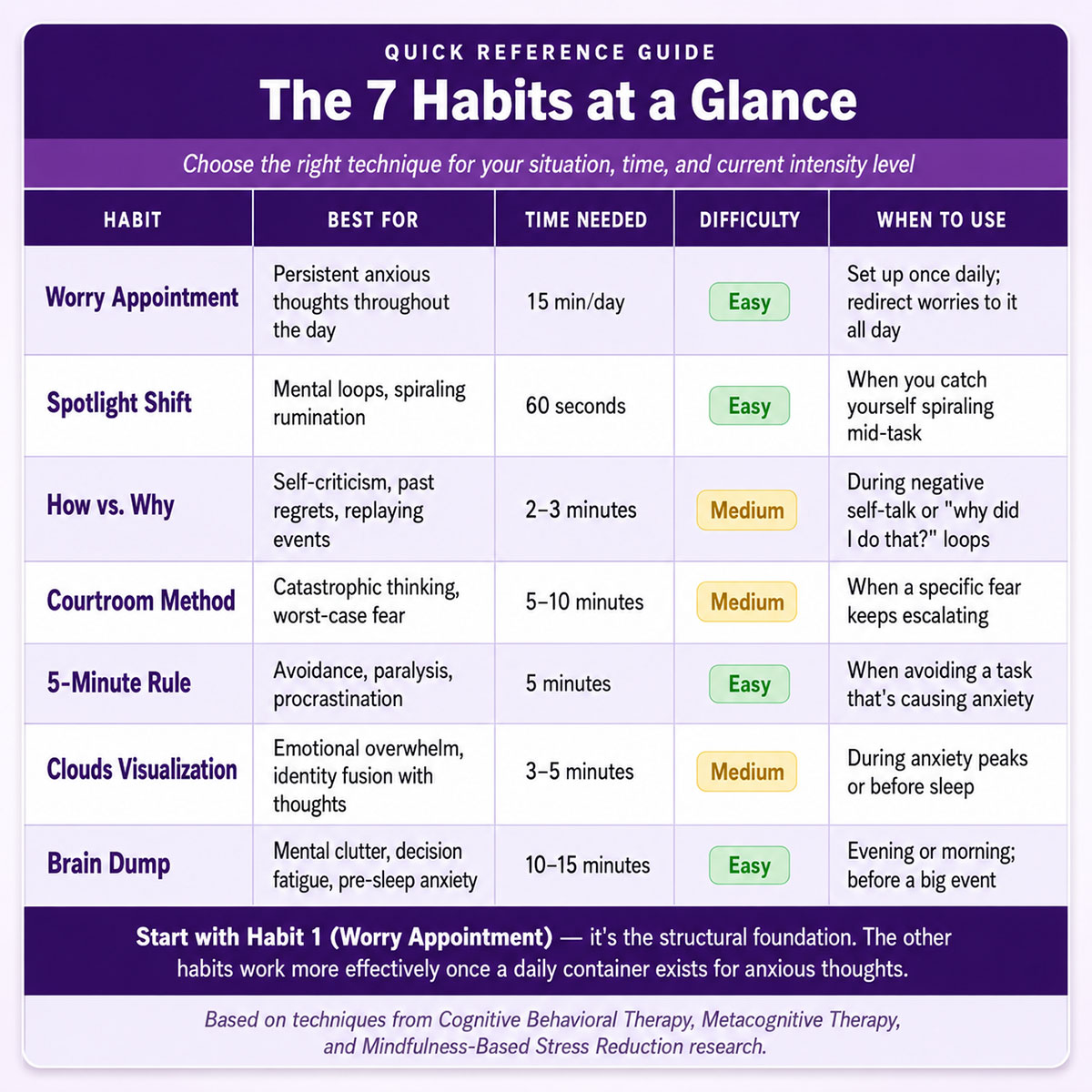
Habit 1: Schedule Your Worries
This sounds backward. Give anxious thoughts an appointment rather than trying to stop them. But the research behind it is clear.
Psychologists call this stimulus control, and it’s a component of the CBT protocol developed by Michel Dugas and colleagues at the University of Concordia for generalized anxiety disorder. In a series of controlled trials, people who learned to contain their worrying to specific daily windows felt significantly less anxious throughout the day. The reason has to do with how suppression backfires: when you try to push a thought away, your brain treats that suppression as evidence that the thought is threatening, which makes it bounce back harder. Acknowledging the thought and postponing it sends a different signal, “I see you, we’ll deal with this at 4 PM”, and that’s enough to quiet it.
- Pick a 15-minute window each day at the same time. This is your Worry Appointment.
- When an anxious thought arrives at 10 AM, write it down briefly, “worried about presentation” is enough.
- Say to yourself, out loud if possible: “I’ll think about this at 4 PM.” Then redirect your attention to what you were doing.
- When your appointment arrives, sit down and worry about everything on the list. Genuinely engage with it.
- When the 15 minutes end, stop. Set a timer if you need to.
Most items on your list won’t feel urgent by the time 4 PM arrives. The emotional charge fades. The act of scheduling trains your brain that not every anxious thought needs immediate attention, and that’s a skill, not a one-time fix.
Keep the window to a maximum of 15 minutes. If you skip your scheduled time, the technique loses its reliability: your brain stops trusting the postponement promise. Honor the appointment even when you don’t feel like it.
One caveat worth naming: this technique is not a good fit for OCD. For generalized anxious rumination, containing worry to a scheduled window works because it reduces engagement with the anxious thought. But OCD involves a different mechanism, one where any deliberate engagement with intrusive thoughts (including scheduling time to think about them) can reinforce the cycle rather than interrupt it. If your overthinking involves recurring intrusive thoughts that feel qualitatively different from ordinary worry, thoughts that feel contaminating, or that you can’t dismiss even when you know they’re irrational, the Worry Appointment is worth discussing with a therapist before trying on your own.
Habit 2: Redirect Your Attention Away from the Loop
Overthinking happens when your attention gets locked onto internal chatter. This habit teaches you to move it.
The technique comes from Metacognitive Therapy, developed by psychologist Adrian Wells at the University of Manchester. Think of your attention as a flashlight. When you’re ruminating, that beam is pointed inward, illuminating every worry and running it on repeat. MCT teaches patients to aim the beam elsewhere, not by suppressing the thoughts, but by choosing where attention lands.
In a 2010 pilot randomized trial, Wells and colleagues compared Metacognitive Therapy against Applied Relaxation in 20 adults with generalized anxiety disorder. MCT was significantly more effective at post-treatment, and those gains held at 6- and 12-month follow-up: recovery rates of 80% for MCT versus 10% for relaxation on worry measures.
- Stop what you’re doing. This works anywhere.
- Close your eyes if you can. If not, soften your gaze.
- Identify three distinct sounds around you: traffic, a refrigerator hum, air conditioning, or rain.
- Focus on each sound for 20 seconds. Notice its quality, volume, and rhythm. Is it steady or changing?
- When your mind wanders, and it will, bring your attention back to the sounds without self-criticism.
This 60-second exercise disengages the brain from the internal loop without fighting the thoughts directly. You’re not suppressing anything. You’re choosing to pay attention to something else, which is a different mechanism entirely. Practice it several times daily, especially when you catch yourself spiraling. The more you practice when calm, the more available it becomes when you’re not.
Habit 3: Ask “How” Instead of “Why”
Pay attention to the questions your brain asks when overthinking starts. Chances are, they begin with “why.”
Why did this happen to me? Why can’t I get it together? Why do I always mess things up?
These questions feel like insight. They feel like you’re seeking understanding. Research by psychologist Ed Watkins at the University of Exeter shows they’re actually traps. Abstract “why” questions fuel rumination by keeping you locked in an evaluative, self-focused mode without producing any path forward. In a 2011 clinical trial with adults experiencing depression, Watkins found that shifting from abstract to concrete thinking, asking “how” rather than “why”, significantly reduced both rumination and depressive symptoms.
What that finding revealed wasn’t just a cognitive trick. It points to a structural difference in how the brain processes problems. “Why” questions loop. “How” questions move.
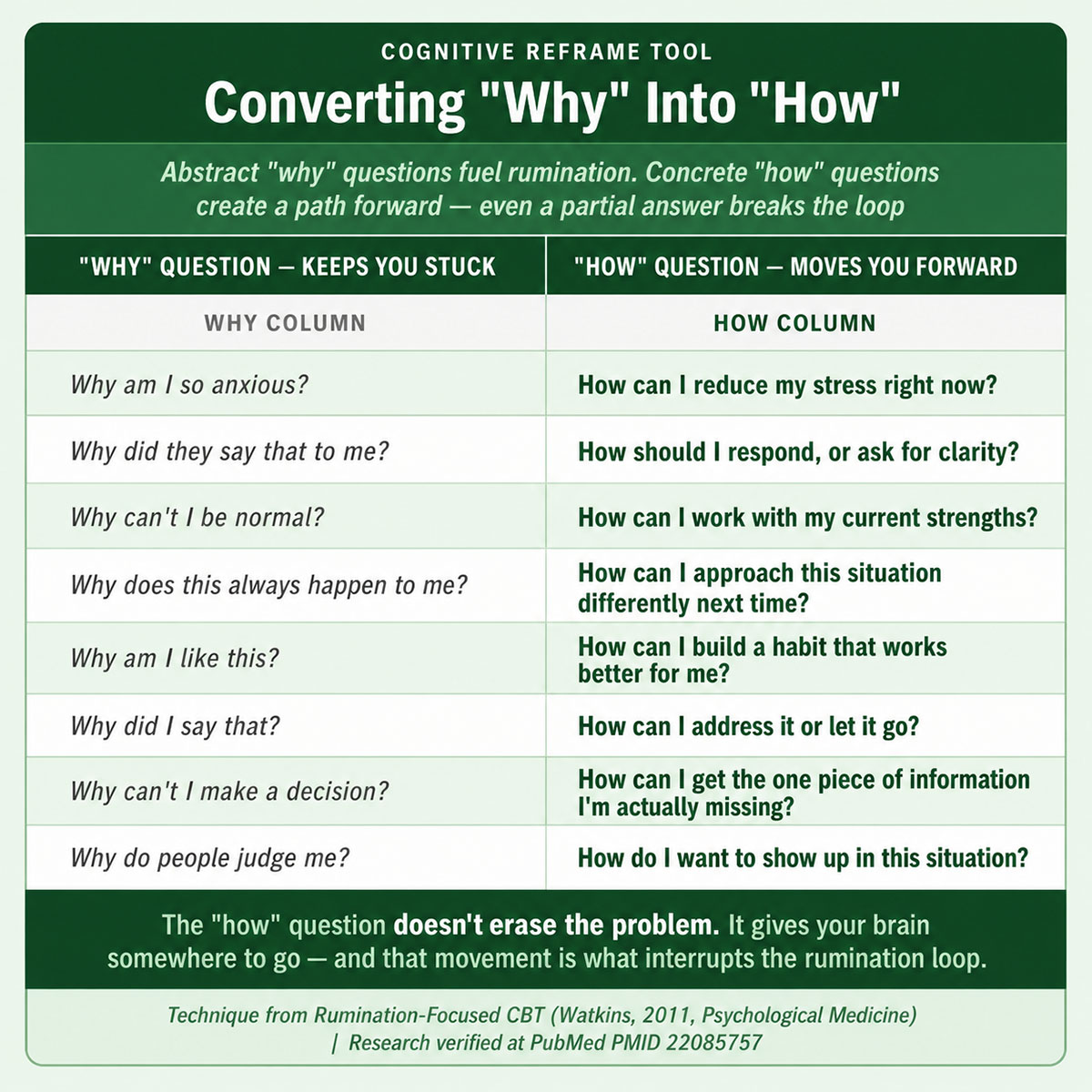
The shift doesn’t erase the problem. Sometimes there’s no good answer to “why.” But there’s almost always an answer to “how”, even a partial one moves you forward, which changes your brain’s assessment of the situation.
- Catch yourself asking “why.” That awareness is the first step.
- Pause. Take one slow breath.
- Rewrite the question starting with “how.”
- Answer the “how” question. Even a partial answer is enough to interrupt the loop.
Expect the first few “how” questions to feel forced. That’s normal. The shift becomes more automatic with practice.
Habit 4: Put Your Thoughts on Trial
Your brain treats thoughts as facts. It doesn’t reliably distinguish between “I might fail” and “I am failing.” This habit forces it to back up its claims with actual evidence.
Cognitive restructuring is a core CBT technique, and Dugas and colleagues confirmed in their GAD treatment trials that challenging catastrophic predictions significantly reduced pathological worry. The same Dugas research base that underlies Habit 1 applies here: the two techniques are complementary components of the same protocol.
When a catastrophic thought arrives, write it down and run it through three questions:
What evidence supports this thought? Be honest. List what’s actually there. For “I’m going to get fired”: you made a mistake on a project, or your boss seemed annoyed in a meeting.
What evidence contradicts it? You’ve received positive feedback recently. Other people make mistakes without being fired. Your boss is stressed about company-wide issues. You haven’t been warned about performance concerns. You got a good review three months ago.
What’s the most realistic outcome based on all the evidence? You might need to fix the mistake or have a conversation about it. Your job probably isn’t in danger. You’re catastrophizing from limited data.
Write down the verdict. Seeing it on paper makes it real in a way that internal reasoning doesn’t. Most anxious thoughts don’t survive this process: they’re built on feelings, and feelings are not evidence. That’s not toxic positivity. It’s testing your brain’s worst-case scenarios against what’s actually observable. They usually don’t hold up.
Habit 5: Move First, Then Feel Better
When you’re stuck in overthinking, the instinct is to wait until you feel better before doing anything. That’s backwards.
Action changes mood. Mood does not reliably create action. Behavioral activation is a treatment approach with a solid evidence base for anxiety, and a 2023 randomized controlled trial by Hannah Berg and colleagues at the Laureate Institute for Brain Research tested it directly against exposure therapy in 102 adults with generalized anxiety disorder. Behavioral activation worked as well as exposure therapy by the end of treatment, and produced faster reductions in anxiety and depression during the treatment period.
Your brain is a prediction machine, and right now it’s predicting that the task is as difficult as the worry about the task. It’s almost never right about that. When you sit still and avoid what worries you, the prediction holds. When you take action, even a small, almost laughably small action, the prediction has to update. The task wasn’t as hard as the dread made it. That’s usually the first thing people notice.
The 5-minute rule works like this:
- Pick one task related to your worry. Just one.
- Commit to doing it for five minutes only.
- Set a timer. When it goes off, you can stop.
If you’re overthinking a work project, open the document and write one sentence. If you’re anxious about a relationship, send one text. If you’re stressed about job hunting, update one line on your resume. The goal is not to finish. The goal is to prove to your brain that action is possible, because proving that is enough to break the paralysis cycle.
You probably won’t want to stop at five minutes. Momentum builds. But even if you do stop, you’ve interrupted the pattern that was keeping you stuck.
Habit 6: Watch Your Thoughts Like Clouds
You are not your thoughts. That sounds like a bumper sticker. The research behind it isn’t.
Mindfulness-Based Stress Reduction (MBSR) works partly through what researchers call metacognitive detachment: the ability to observe thoughts as temporary mental events rather than facts about you or the world. A 2009 study by Mary Deyo and colleagues at Pacific Graduate School of Psychology found that MBSR completers showed measurable reductions in rumination compared to non-completers, with decreases in depressive symptoms tracking alongside those reductions.
The clouds visualization is the fastest entry point to this skill:
- Find a comfortable position, sitting or lying down.
- Close your eyes and take three slow, deep breaths.
- Picture your mind as a blue sky, clear, open, wide.
- Your thoughts are clouds drifting across it. Some dark and heavy. Some light and wispy.
- Watch them pass. Don’t grab them. Don’t climb into them. Don’t push them away.
- When you notice you’ve gotten absorbed in a thought, you’re thinking it instead of watching it, gently return to the sky. This will happen repeatedly. That’s the practice.
Three to five minutes is enough. The distance this creates between you and a thought is significant. It’s not that the thought disappears. It’s that you stop treating it as the most important thing happening in that moment. Practice it when you’re calm. That’s when the skill is built. It becomes available under pressure only after it’s been rehearsed without pressure.
Habit 7: Get It Out of Your Head and Onto Paper
Worries held entirely in your head create cognitive overload. Your working memory was not designed to hold multiple emotional scenarios simultaneously and evaluate them in real time. Writing externalizes that burden.
The key distinction, confirmed in a large 2022 effectiveness study by Ville Ritola and colleagues at Helsinki University Hospital (involving 1,099 physician-referred patients with generalized anxiety disorder), is that structured writing reduces worry far more than random venting. The Ritola trial used a structured CBT program with written reflection exercises rather than the specific prompt described below, but the underlying principle is the same: organized processing of anxious thoughts reduces worry. An unstructured complaint doesn’t.
The worst-best-likely prompt gives the structure:
- When a worry hits, write down the absolute worst thing that could happen. Don’t hold back. Let the catastrophe run its full course on paper.
- Write down the absolute best thing that could happen.
- Write down what will most likely actually happen, based on past experience and available evidence.
For a presentation anxiety example: worst case is freezing completely, blanking, getting fired, losing your apartment. Best case is a standing ovation and a promotion. Most likely is getting through it nervously, settling in after the first few minutes, answering questions adequately, and moving on with your life intact.
Read all three. Notice the gap between the worst case and the likely case. Your anxiety was running the worst-case scenario as its prediction model. Seeing all three on paper recalibrates that. Most worst-case scenarios never happen, and keeping past entries proves that over time.
How the Habits Work Together
Overthinking rarely stays in one category, and the habits don’t operate in isolation. The pairings that follow aren’t prescriptions, they’re what tends to work given how each pattern of overthinking actually behaves.
Work presentation anxiety is mostly future-focused: the brain running catastrophic rehearsals for outcomes that haven’t happened and are unlikely to. The Worry Appointment (Habit 1) is the right container for that, it gives the rehearsals a legitimate time slot so they stop bleeding into the rest of the day. The Courtroom Method (Habit 4) does the heavier lifting once the appointment arrives: it asks the worst-case prediction to produce actual evidence, and most of the time it can’t. The night before, the Brain Dump (Habit 7) empties whatever is still cycling, so the brain has less material to process at 2 AM. The 5-Minute Rule (Habit 5) belongs in the days before, when avoidance is highest, because the dread of practicing almost always exceeds the difficulty of actually doing it.
Relationship overthinking is trickier because the loop is usually story-based: your mind isn’t just worrying, it’s generating narratives about what the silence means. The How vs. Why shift (Habit 3) interrupts the story at the source. “Why aren’t they texting?” has no productive answer, but “how do I stay settled until I hear from them?” does. The Clouds Visualization (Habit 6) is useful here specifically because it creates distance from the narrative rather than engaging with it. You’re watching the story drift past rather than casting yourself in it. The Spotlight Shift (Habit 2) is the immediate interrupt when you catch yourself checking your phone for the fourth time in ten minutes. It gives your attention somewhere else to land without requiring any analysis at all.
Life decision paralysis usually isn’t actually about missing information. By the time most people have been stuck for more than a few days, they have enough information to decide, what they don’t have is tolerance for the uncertainty of not knowing how it turns out. The Brain Dump’s worst-best-likely structure (Habit 7) is particularly useful here because writing all three scenarios for both options side by side makes the actual range of outcomes visible, rather than leaving the worst case as the dominant working model. The Courtroom Method (Habit 4) handles specific fears about each option. And if you’re still stuck after that, How vs. Why (Habit 3) often reveals that the remaining hesitation is emotional rather than informational: the question shifts from “why can’t I decide?” to “what one piece of information would actually move me?”, and most of the time, there isn’t one.
What’s Actually Happening in Your Brain
You might wonder whether these techniques create any real change, or whether they’re just temporary relief. The brain imaging research gives a direct answer.
Scott Langenecker, vice chair of research in the Department of Psychiatry at the University of Utah, led a preregistered randomized clinical trial published in 2024 that specifically set out to replicate earlier findings about what Rumination-Focused CBT does to the brain. Seventy-six teenagers aged 14-17 with a history of depression and elevated rumination were randomly assigned to 10-14 sessions of RF-CBT or to their standard treatment. Both groups received fMRI scans before and after.
The results were large. Teens in the RF-CBT group showed a significant reduction in rumination scores, with an effect size of z=0.84, classified as clinically meaningful in the rumination treatment literature. But the brain scans showed something more specific: a reduction in connectivity between the left posterior cingulate cortex (a region central to self-referential thinking and the default mode network) and the right inferior frontal and temporal gyri (regions involved in attention control and cognitive regulation). In plain terms, the brains of teens who received the treatment became structurally less likely to get caught in self-focused loops.
That finding took a while to sink in when the research team first saw it. This wasn’t a mood shift or a change in self-reported feelings: it was an observable, physical restructuring of how different brain regions communicate with each other. And it happened in 10-14 sessions.
Every time you practice one of the seven habits, you are acting on that connectivity. Repetition is how neural pathways are strengthened. The more you practice, the more automatic the shift becomes, not because you’re trying harder, but because the brain reorganizes around what it does regularly.
When Your Body Is Telling You Something
The rumination loop doesn’t stay in your head. Your brain and body communicate constantly through the nervous system, and when thoughts spiral, your body responds with stress signals, which send danger signals back to the brain, which creates more anxious thoughts. The physical symptoms are the loop expressing itself in tissue rather than thought.
Physical signals worth recognizing: a tight jaw or clenched teeth, shoulder and neck pain, tension headaches, trouble falling asleep or waking at 3 AM with thoughts already running, digestive upset or loss of appetite, rapid heartbeat, shallow breathing, and mental exhaustion that rest doesn’t fix.
Chronic rumination triggers the stress response repeatedly, flooding the system with cortisol and stress hormones over time. Research links chronic anxiety to elevated blood pressure, reduced immune function, digestive problems, and increased cardiovascular risk, though most of this evidence comes from clinical anxiety populations rather than general overthinkers. The 90-second reset techniques at the start of this article help break the cycle from the physical side: calming the body feeds back to calm the mind, which is why they’re listed as first steps rather than afterthoughts.
A 4-Week Practice Plan
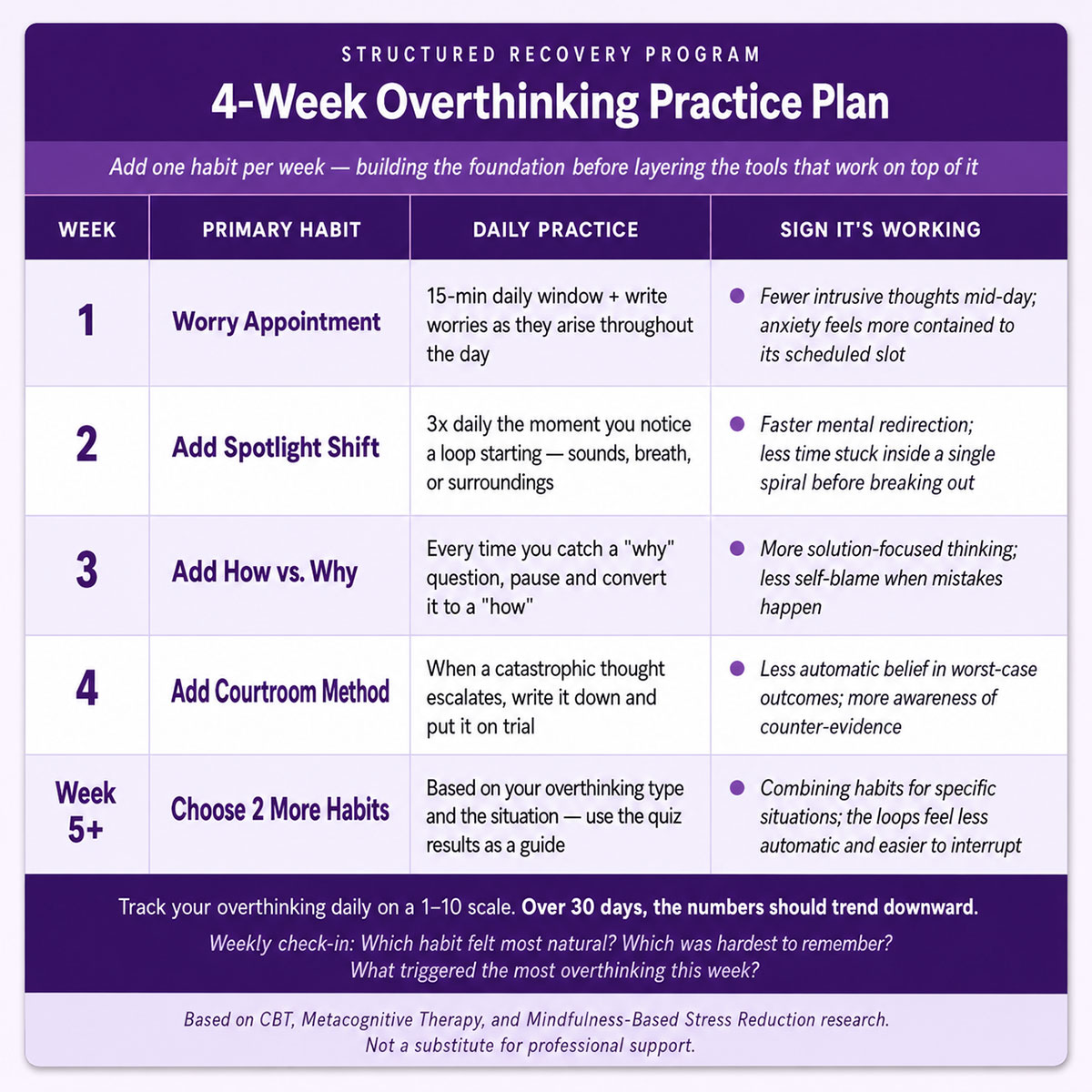
Track your overthinking daily on a 1-10 scale. One to three is minimal, thoughts are manageable. Four to six is moderate, noticeable but not debilitating. Seven to ten is severe, and significantly affects daily function. Over 30 days, the numbers should trend downward. Weekly check-in questions worth asking: which habit felt most natural? Which was hardest to remember? What situation triggered the most overthinking?
When These Habits Aren’t Enough
These seven habits are backed by research and can significantly reduce overthinking for many people. They are not a substitute for professional support when the situation calls for it.
Consider speaking with a mental health professional if: overthinking has persisted for more than two to three months despite consistent practice; the thoughts are so overwhelming you can’t function at work, maintain relationships, or take care of basic needs; you’re consistently sleeping fewer than five hours because of racing thoughts; you’re having any thoughts about hurting yourself or that life isn’t worth living. These are signs that something more structured is needed, and that’s not a failure of the habits. It’s a signal about severity.
Effective options include CBT with a licensed therapist trained in cognitive restructuring, Metacognitive Therapy from an MCT-certified practitioner, and MBSR programs available through hospitals, community centers, and online platforms. Finding a therapist through the Psychology Today directory or your primary care provider’s referral network are both reliable starting points.
The Point of All This
The Langenecker brain imaging study is worth returning to here, at the end, because it reframes what these seven habits actually are. They aren’t coping tools or coping strategies. They’re a targeted intervention on a specific pattern of brain connectivity, the same pattern that keeps 73% of adults in their 30s stuck in loops that feel like thinking but function like stalling.
Most people who try to stop overthinking fail because they’re targeting the wrong thing. They try to control the content of their thoughts. The research consistently points somewhere else: control where your attention goes, and what questions your brain is allowed to ask. The thoughts can keep coming. The loop is what you’re dismantling.
Start with one habit. Habit 1 is the most foundational: everything else builds more naturally once the daily container exists. The rest are available when you’re ready for them.
Frequently Asked Questions
How long does it take to stop overthinking?
Most people notice some reduction in frequency within two to four weeks of consistent practice. The brain imaging research suggests meaningful structural changes in the rumination networks can occur within 10-14 sessions of focused work. That said, these are habits, they require maintenance, not just acquisition.
Can you completely eliminate overthinking?
No, and that’s not the goal. Some degree of reflective thinking is adaptive, it helps with planning, problem-solving, and learning from experience. The target is reducing the uncontrolled, repetitive loops that serve no function and consume significant mental energy.
What’s the difference between overthinking and anxiety?
Overthinking is a cognitive pattern (repetitive, passive, ruminative thought). Anxiety is a broader emotional and physiological response that often includes overthinking as a feature. You can overthink without meeting diagnostic criteria for an anxiety disorder, and not all anxiety involves overthinking. They frequently co-occur.
Is overthinking a mental illness?
No. Chronic overthinking is not a standalone diagnosis, but it’s a significant risk factor for depression and anxiety disorders. Nolen-Hoeksema’s research identified it as one of the strongest predictors of depressive episodes in people not currently depressed.
What is the 3-3-3 rule for overthinking?
The 3-3-3 rule is a grounding technique: name 3 things you see, 3 things you hear, and move 3 parts of your body. It’s a simplified version of the 5-4-3-2-1 grounding method described in this article. Both work by pulling attention away from abstract internal content and anchoring it in immediate sensory experience.
What are the 7 types of overthinking?
Researchers don’t have a single agreed-upon taxonomy, but commonly identified types include rumination (past-focused), worry (future-focused), analysis paralysis (decision-focused), perfectionist overthinking (performance-focused), relationship overthinking, social anxiety overthinking, and existential or meaning-focused rumination. Most people show more than one type.
Can overthinking cause physical symptoms?
Yes. Chronic overthinking activates the stress response repeatedly, leading to elevated cortisol. Physical symptoms associated with this pattern include tension headaches, muscle pain, sleep disruption, digestive issues, and fatigue. These are real physiological effects, not psychosomatic exaggerations.
How do I know if I need professional help?
If overthinking is significantly affecting your daily functioning, your sleep, your relationships, or your ability to work, and consistent practice of these techniques for several weeks hasn’t produced improvement, that’s a clear signal. Any thoughts of self-harm should prompt you to reach out to a mental health professional or crisis service right away.