Most people over 50 fail this test without realizing it. The question isn’t whether you should try it. It’s whether you’re ready for the answer.
There’s a moment most people over 50 recognize. You reach down to pull on a sock, and suddenly you’re hopping sideways. You grab the wall. You laugh it off. But that small, everyday wobble may be telling you something worth paying attention to.
Standing on one leg sounds trivial. It’s not.
The “Sock Test” Is Your New Annual Exam
Think of getting dressed as a silent report card from your nervous system. Every morning, your brain, inner ear, and leg muscles are having a conversation. When you stand on one foot to pull on a sock or a shoe, that conversation has to go well — or you lose your balance.
For most people in their 30s and 40s, that conversation is easy. But somewhere around the mid-50s, things start to change. The signal gets a little noisier. The response gets a little slower. And before long, a task you never thought about becomes something you brace for.
That shift isn’t random. It reflects real changes in your neurological health, your cardiovascular fitness, and what scientists now call your “biological age.” And the good news? You can do something about it.
The Quick Sock Test Scorecard
Try this right now. Stand near a wall (for safety). Lift one foot off the ground. Don’t hold anything. Time yourself.
- 10 seconds or more: You’re in the clear for now — but keep training.
- 5–9 seconds: Worth paying attention to. Start the exercises in this article.
- Under 5 seconds: A strong reason to talk to your doctor and start a balance program today.
Use your non-dominant leg (the one you’d kick a ball with less naturally). That side tends to show the real picture, as you’ll see below.
The 10-Second Threshold: What the Research Actually Says
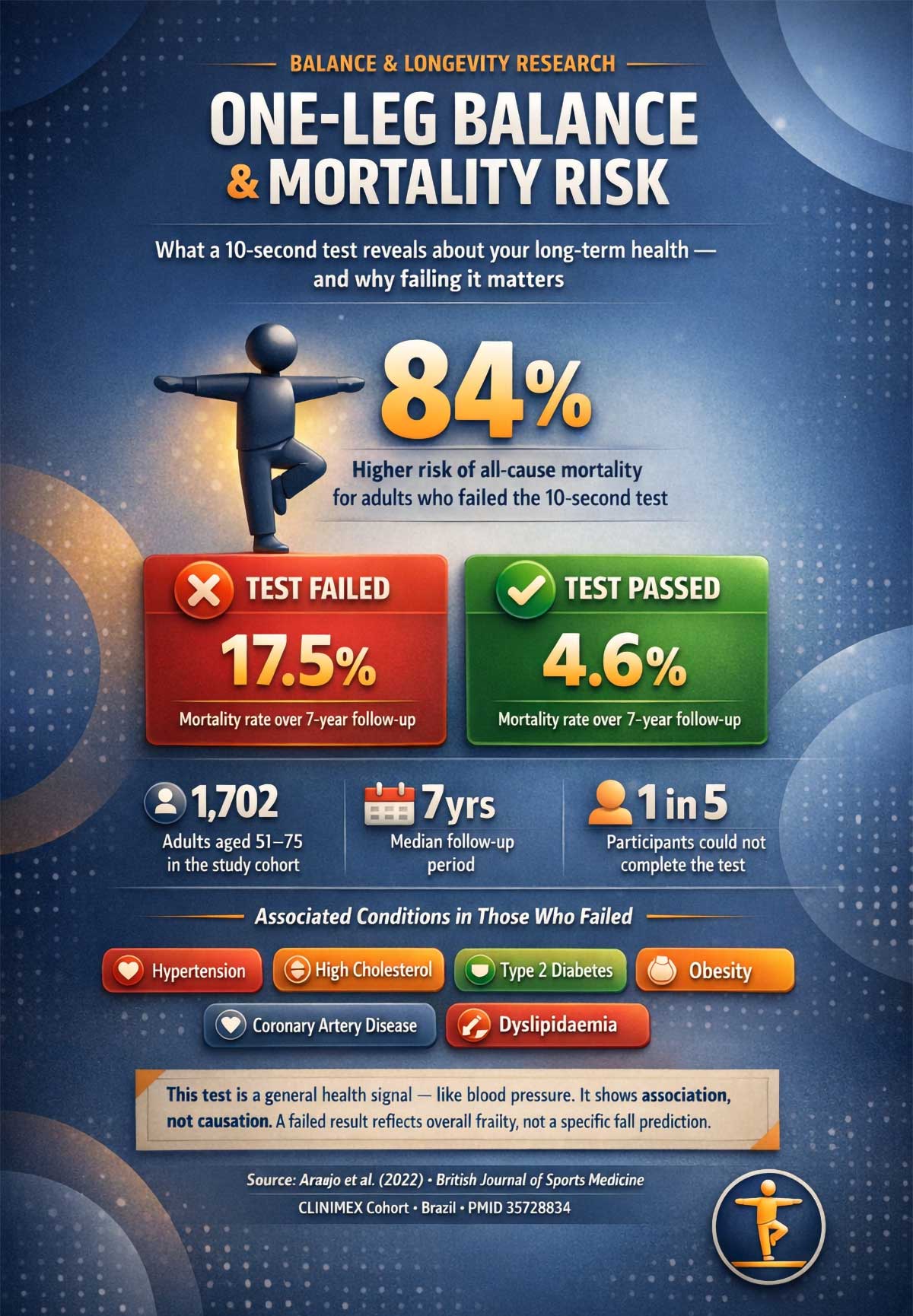
In 2022, a study published in the British Journal of Sports Medicine got a lot of attention — and for good reason. Researchers from the CLINIMEX cohort in Brazil followed 1,702 adults between the ages of 51 and 75 over a median of seven years. They tested each person’s ability to stand on one leg for 10 seconds without support.
The result? People who couldn’t complete the test had an 84% higher risk of death from any cause during the follow-up period, even after adjusting for age, sex, BMI, and existing health conditions. Among those who failed, the mortality rate was 17.5% over that seven-year follow-up, compared to 4.6% for those who passed.
That’s a striking gap.
About one in five people in the study couldn’t complete the test. That’s not a fringe number. And for those who failed, the data showed significantly higher rates of hypertension, high cholesterol, diabetes, obesity, and coronary artery disease. The test, in other words, wasn’t just measuring leg strength. It was reflecting the overall state of the body’s systems.
This is important: the study was observational. That means it found an association, not a cause. Standing on one leg doesn’t make you live longer. But being unable to do it may reflect an underlying picture of health that carries real risk.
Think of it like blood pressure. High blood pressure doesn’t cause a heart attack by itself. But it signals that something in the system is under strain — and that’s worth acting on.
Beyond the Scare: Balance as a Vital Sign
The smarter way to think about this test isn’t as a death sentence. It’s as a vital sign — like heart rate or body weight. It’s a number that, by itself, doesn’t tell the whole story. But in context, it adds important information.
When your balance declines, it often means your vestibular system (your inner ear), your proprioception (your body’s sense of where it is in space), and your neuromuscular coordination are all losing ground. These systems don’t operate in isolation. They’re tied to your brain health, your circulation, and your ability to recover from physical stress.
A weak score on this test doesn’t mean you’re doomed. It means there’s a signal worth listening to — and a window to act on it.
The Non-Dominant Leg: Your Biological Clock
Here’s something most articles skip entirely.
Not all legs are equal when it comes to balance testing. Research from the Mayo Clinic suggests that the non-dominant leg — the one you’d use less naturally for kicking or stepping — shows the steepest rate of decline with age. It’s more sensitive to the effects of aging than grip strength or walking speed.
This matters because many people test their stronger leg and feel reassured. Then they try the other side and find a very different story.
Your non-dominant leg is, in a sense, your biological clock. It shows the effects of aging earlier and more clearly. So if you’re testing yourself, use that side. It gives you the most honest read on where you actually stand — no pun intended.
The mid-50s appear to be a critical turning point. That’s when balance decline starts accelerating in most people. It’s also when most people aren’t doing anything specifically to address it.
The Fall Prediction Paradox: What Other Articles Get Wrong
Here’s where the popular coverage of this topic often misleads people — and it’s worth clearing up.
Many articles frame the one-leg balance test as a fall predictor. “If you can’t do this, you’ll fall.” That’s not quite what the evidence supports.
A 2022 study in Frontiers in Sports and Active Living analyzed data from a large British birth cohort — roughly 2,000 people followed from ages 53 to 68. When researchers specifically tested whether one-leg balance could predict individual falls, the accuracy was poor. The test alone had an AUC (a measure of predictive accuracy) of just 0.577–0.600, barely better than chance. For individual fall prediction, even a person’s own history of past falls was more telling.
So what does this mean?
It means the test is a population-level health marker, not a personal crystal ball. At the level of a large group, people with poor balance die sooner and have more health problems. That signal is real and meaningful. But the test can’t reliably tell you whether you specifically will fall next Tuesday.
The distinction matters because it changes how you should respond. Passing the test isn’t a reason to stop training. Failing it doesn’t mean a fall is imminent. In both cases, the right move is the same: work on your balance, consistently, with a proper program.
A “pass” is not a finish line. It’s a starting point.
The Science of Trainability: Your Balance Can Improve at Any Age
Here’s the part that deserves more attention than it usually gets.
Balance is trainable. Not just a little — significantly, measurably, and at any age.
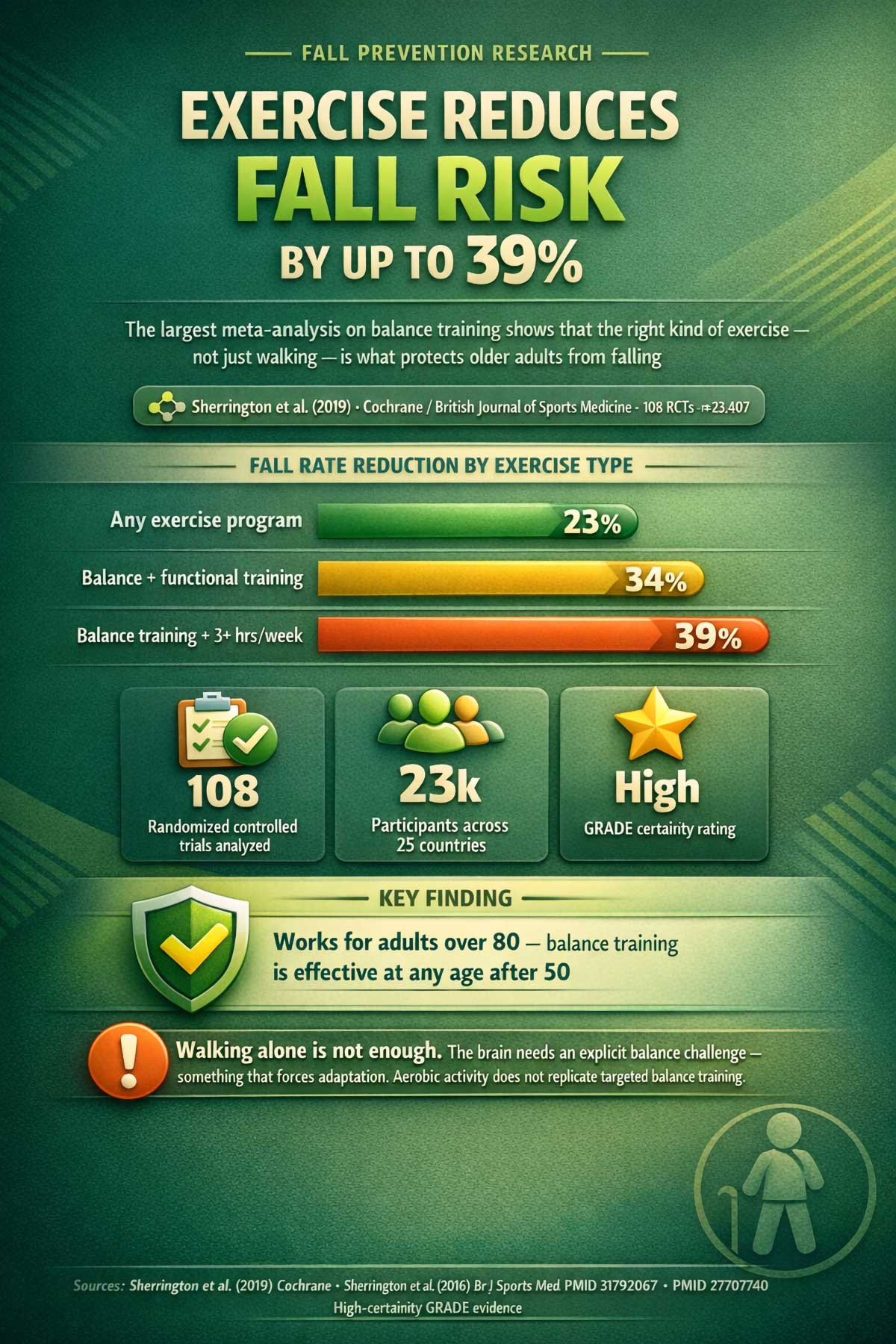
A landmark systematic review published in the British Journal of Sports Medicine (Sherrington et al., 2019) pooled data from 108 randomized controlled trials covering 23,407 participants across 25 countries. The evidence quality was rated “high certainty” — as strong as it gets in this field. The finding: exercise reduces fall rates by 23%. When balance and functional exercises were combined with resistance training, that figure rose to 34%.
That’s not a small effect. That’s a meaningful, real-world reduction in one of the most common causes of injury and disability in older adults.
An earlier analysis by the same research group, published in 2016, found that programs specifically designed to challenge balance — rather than just aerobic exercise like walking — cut fall rates by up to 39% in adults who exercised more than three hours per week. Together, these two bodies of work tell a consistent story.
Walking is great for your heart. But it’s not enough to protect your balance. The brain and body need an explicit challenge — something that forces them to adapt.
The “Golden Dose”: An 11-Week Blueprint to Reset Your Balance
If you’re going to train your balance, you should know how much is actually needed to make a difference.
A 2015 systematic review and meta-analysis in PLOS ONE (Lesinski et al.) analyzed 23 randomized controlled trials in community-dwelling adults aged 65 and older. The researchers identified an optimal training dose for improving static and dynamic balance. The sweet spot: 11–12 weeks, three sessions per week, 31–45 minutes per session.
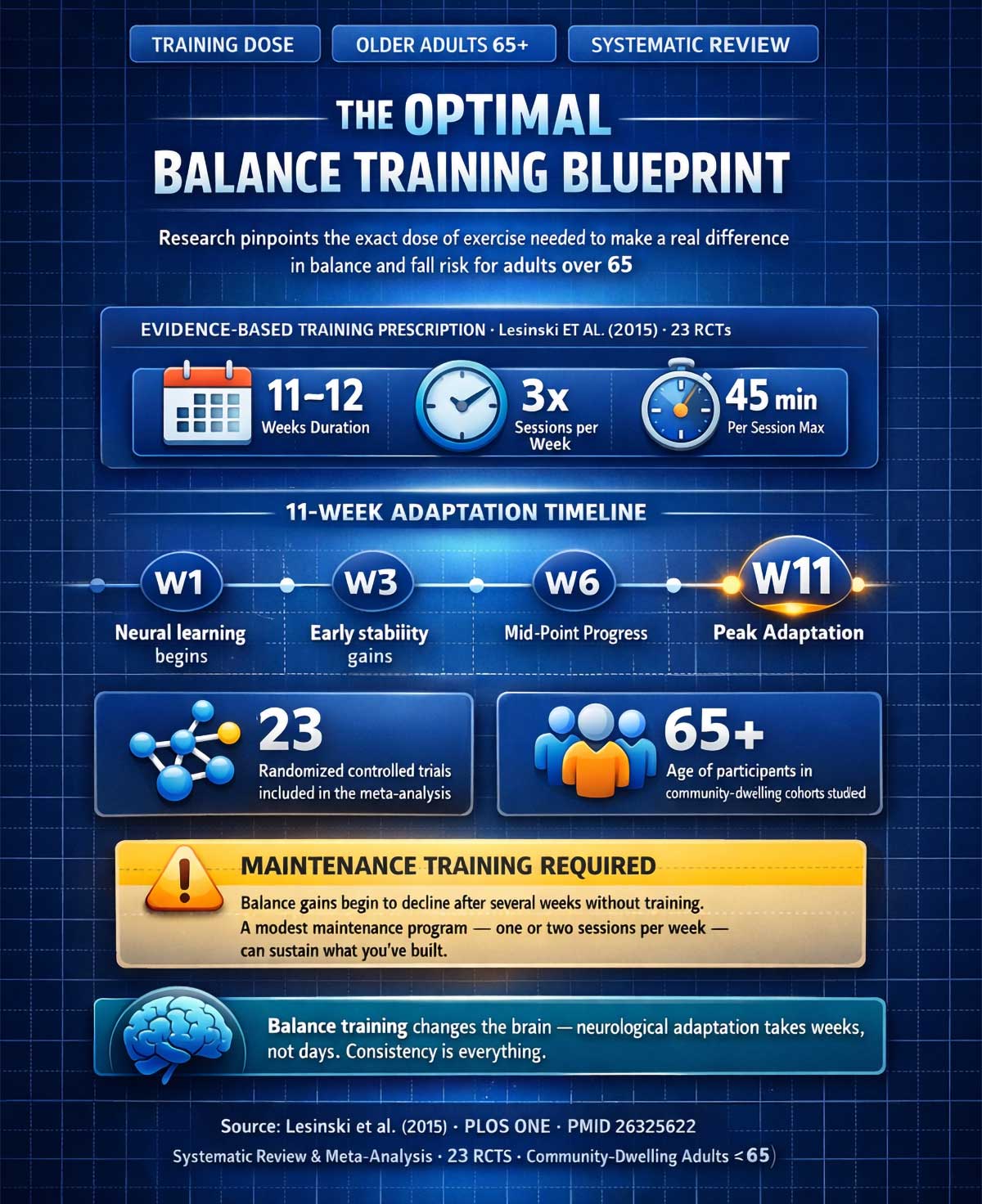
Well-dosed programs in that review produced large improvements in static balance — among the strongest effect sizes reported in balance training research. That’s not a marginal improvement. That’s a genuine shift in your body’s ability to stay upright.
There’s one thing worth knowing upfront: balance gains begin to decline after several weeks without training. A modest maintenance program can sustain what you’ve built. This isn’t a one-time fix. It’s a lifestyle shift. But maintenance training doesn’t need to be as intensive as the initial program. Once you’ve built the foundation, keeping it doesn’t take as much effort.
Eleven weeks is a short commitment for a potentially significant payoff.
The “Socks-On” Workout: 4 Progressive Moves
The four levels below build the foundation you need before you’re truly ready for the sock-putting movement safely. Levels 1 through 3 each strengthen a different part of your balance system. Level 4 brings it all together in the functional movement you care about most.
If you already pass the 10-second non-dominant leg test comfortably, you can reasonably begin at Level 2. For everyone else, start at Level 1. Skipping the foundation is how people plateau or get hurt.
Do three sessions per week. Each session should take 30–45 minutes when you include warm-up and rest periods.
Level 1: The Static Stance (The Foundation)
What to do: Stand on one leg near a wall or sturdy surface. Use just one or two fingertips on the surface for support — not a full grip. Hold for 10–30 seconds. Switch legs. Repeat 3–5 times per side.
Why it works: This teaches your nervous system the basics of single-leg stability. The fingertip contact gives just enough feedback to keep you safe without removing the balance challenge entirely. Over time, reduce your reliance on the surface until you’re holding free.
Progress marker: Can you hold 10 seconds on your non-dominant leg without touching the wall? That’s your first milestone.
Level 2: The Proprioceptive Shift
What to do: Stand on one leg. Turn your head slowly left and right while holding the position. Then try it with your eyes closed for 5–10 seconds.
Why it works: Your balance depends on three systems working together: your vision, your vestibular system (inner ear), and your proprioception (muscle and joint feedback). When you remove vision or add head movement, you force your body to rely more heavily on the other two systems. That’s where real neurological adaptation happens.
Progress marker: Can you hold 10 seconds eyes closed on your non-dominant leg? That’s a meaningful functional milestone.
Level 3: Dynamic Balance in Motion
What to do: Two moves here.
Tandem Walk: Walk heel-to-toe in a straight line for 20 steps. Arms out for balance. Aim for slow and controlled, not fast.
Step-Ups: Use a low step or curb. Step up with one leg, bring the other foot up to meet it, then step back down in a controlled way. 10 reps per side.
Why it works: Static balance is only part of the story. Most falls happen during movement — turning, reaching, stepping off a curb. Dynamic balance exercises train the same systems but in real-world movement patterns.
Level 4: The Sock-Put Simulation
What to do: Stand near a wall. Lift one foot slightly off the ground and hold it there. Then slowly shift your weight to mimic the act of pulling on a sock — bending forward slightly, reaching toward the lifted foot. Don’t touch the wall unless you need to.
Why it works: This is the functional goal. You’re training the exact movement pattern that reveals balance problems in daily life. Once this feels easy, you’ve earned it.
When to See a Professional
Balance issues aren’t always about fitness. Sometimes they’re a sign of something that needs medical attention.
See your doctor promptly if you notice:
- Dizziness or a spinning sensation when you stand up or turn your head
- Sudden changes in your balance that appeared over days, not years
- Balance problems paired with vision changes, hearing loss, or ringing in the ears
- A recent fall that resulted in injury
- Unsteadiness that isn’t improving despite several weeks of training
There’s an important difference between unsteadiness — feeling wobbly or uncertain on your feet — and dizziness — a sensation that the room is moving or that you might faint. Dizziness, especially new or sudden onset, warrants neurological or cardiovascular assessment.
Poor balance can sometimes be an early signal of conditions like peripheral neuropathy, inner ear disorders, or vascular changes in the brain. A physiotherapist with experience in vestibular rehabilitation can assess your specific situation and design a program tailored to your needs.
Don’t wait for a fall to take this seriously.
Conclusion
Standing on one leg isn’t really about standing on one leg.
It’s about staying independent. It’s about being the person who carries their own groceries, plays on the floor with their grandkids, and walks into a room without scanning for something to hold onto.
The research from Araujo and colleagues captured something important: the body’s ability to balance reflects the integrated health of your cardiovascular system, your brain, your muscles, and your nervous system — all at once. When that system is working well, you pass the test easily. When it’s under strain, the test starts to reveal it.
The studies on training are equally clear. Exercise cuts fall rates by 23% or more. Dedicated balance programs, done consistently over 11–12 weeks, produce large, measurable improvements. These aren’t trivial numbers. They represent real people staying on their feet, staying out of hospitals, and staying in their lives.
The sock test is a starting point, not a verdict. Whether you passed with ease or grabbed the wall on attempt one, you now have a target, a protocol, and the evidence to back it up.
Three sessions a week. Eleven weeks. Start at Level 1.
That’s the whole plan.
This article draws on peer-reviewed research but is not a substitute for medical assessment. If your balance changes are sudden or come with dizziness, speak with your healthcare provider.