Most advice for clearing brain fog requires major lifestyle changes. “Sleep better.” “Eat cleaner.” “Reduce stress.” These suggestions take weeks or months to show results. But what if you need clarity today?
This guide focuses on micro-habits. These are small, science-backed actions you can take right now. Some work within minutes. Others need a few hours or days to kick in. I’ve organized them by how fast they work, so you can pick the ones that match your timeline.
What’s Actually Happening When You Feel Foggy?
Brain fog isn’t one thing. It’s an umbrella term for several cognitive symptoms: poor concentration, slow processing speed, difficulty finding words, and mental fatigue. These symptoms can stem from multiple biological causes—reduced cerebral blood flow, inflammation at the blood-brain barrier, neurotransmitter imbalances, or circadian misalignment.
Think of your brain as a high-performance engine. It needs the right fuel (glucose, oxygen, amino acids), the right timing (circadian rhythms), the right operating conditions (hydration, temperature regulation), and the right maintenance schedule (sleep). When any of these inputs is off, performance suffers.
The good news? Most lifestyle-driven brain fog is reversible. You’re not broken. Your brain is just operating in suboptimal conditions. The habits in this guide address those conditions directly.
Let’s start with what you can do in the next five minutes.
The Instant Resets: Results Within 5–30 Minutes
Habit 1: The 5-Minute Vagus Nerve Reset
Your brain runs on two operating systems. The first is your sympathetic nervous system—your body’s “fight or flight” mode. The second is your parasympathetic system—your “rest and digest” mode.
When you’re stressed, your sympathetic system dominates. Your heart races. Your breathing gets shallow. Blood flow shifts away from your prefrontal cortex—the part of your brain that handles complex thinking—and moves toward your muscles.
This is why stress makes you foggy. Your brain literally has less fuel to work with.
The fix? Slow breathing.
A 2018 review by Zaccaro and colleagues examined the effects of slow breathing on brain function. The researchers found that breathing at 4-6 breaths per minute activates the vagus nerve. This nerve acts like a brake pedal for your stress response. When you activate it, your body shifts into parasympathetic mode.
The result? This reduces the stress-induced constriction of blood vessels and improves overall circulation, including blood flow to your prefrontal cortex. Higher heart rate variability. Lower cortisol levels. All within minutes.
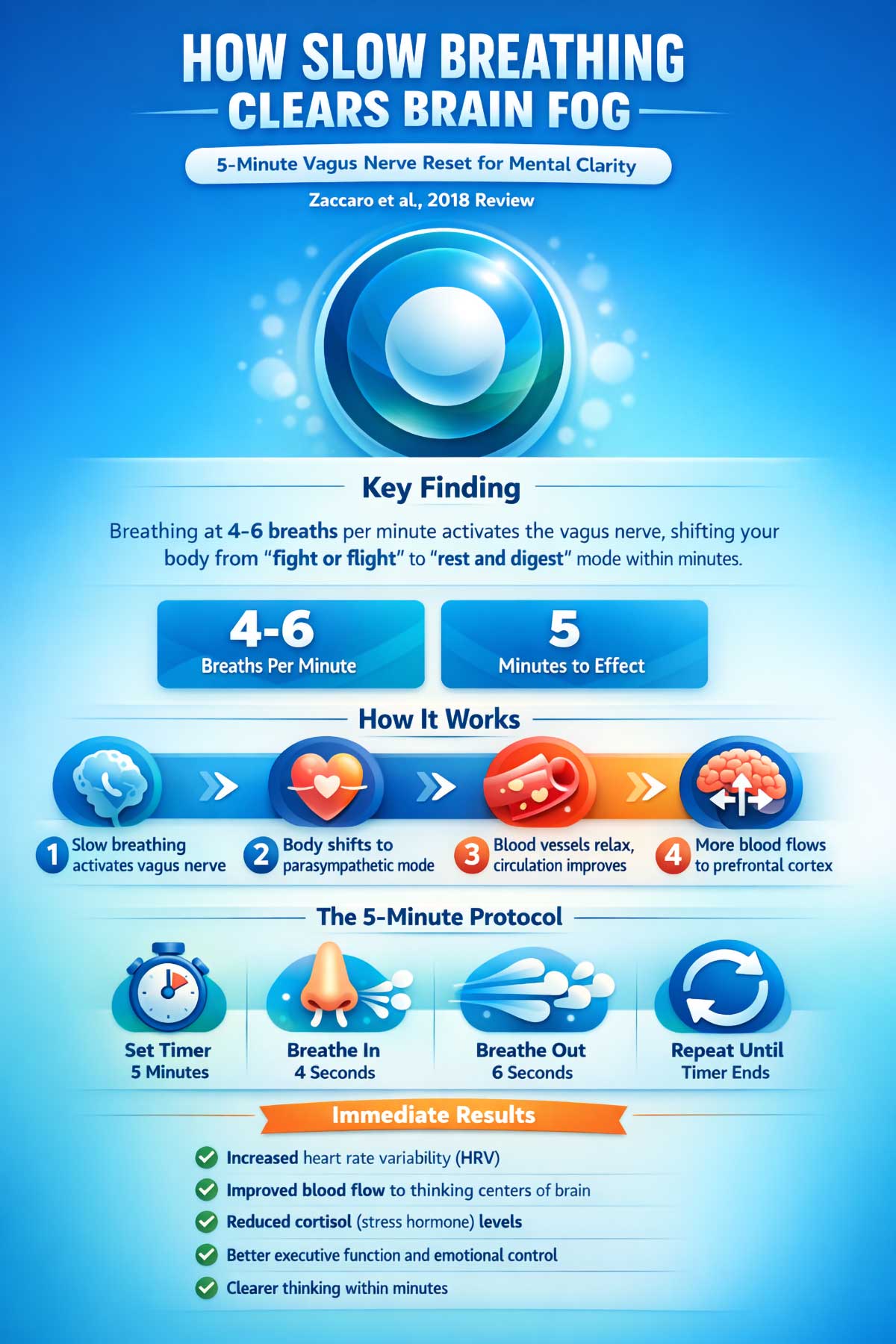
The Protocol: Set a timer for five minutes. Breathe in for four seconds. Breathe out for six seconds. That’s it. You can do this at your desk, in your car, or anywhere else. The effect is immediate.
Ma and colleagues tested this in 2017. They found that breathing meditation improved executive function and emotional control in participants. These are the exact cognitive abilities that disappear when brain fog hits.
Habit 2: The 10-Minute Post-Meal Walk
You eat lunch. Thirty minutes later, you can barely keep your eyes open. Your thoughts slow down. You need a nap.
This isn’t laziness. It’s biology.
When you eat, especially a meal high in carbs, your blood sugar spikes. Your body releases inflammatory signals called cytokines. These molecules interfere with your blood-brain barrier—the protective layer around your brain tissue. The result? Reduced blood flow to your brain and impaired thinking.
DiPietro and colleagues tested a simple fix in 2013. They had adults walk for 15 minutes after meals. The walks reduced blood sugar spikes by 30%. This wasn’t a long workout. Just a short walk around the block.
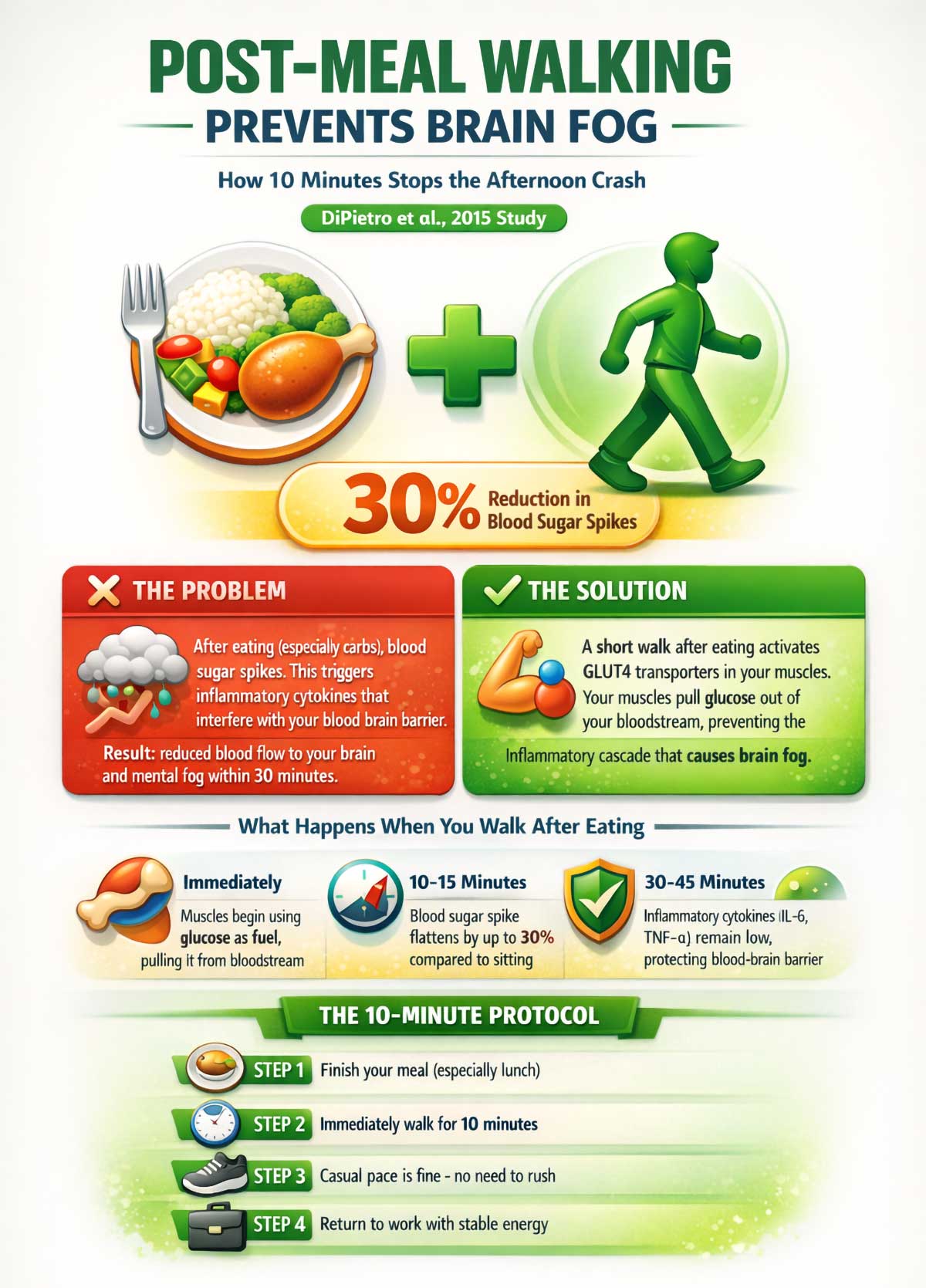
Why does this work? Your muscles act like sponges for glucose. When you walk, they pull sugar out of your bloodstream. This prevents the inflammatory cascade that causes post-meal brain fog.
Colberg’s 2016 analysis confirmed this effect across multiple studies. Post-meal walks consistently flattened glucose curves and improved metabolic markers.
The Protocol: After you eat, walk for 10 minutes. It doesn’t need to be fast. A casual stroll works. Do this after lunch, and you’ll skip the 2:00 PM crash.
Habit 3: The Context-Switching Audit
You’re writing an email. A Slack message pops up. You answer it. You switch to check data in a spreadsheet. You go back to the email. What were you saying again?
This is called task switching. And it’s draining your brain.
Monsell’s 2003 research on task switching showed something important. Every time you switch between tasks, you pay a cognitive cost. Your brain needs 200-500 milliseconds to reorient itself. That doesn’t sound like much, but it adds up.
Worse, task switching depletes glucose in your prefrontal cortex. This is the brain region that handles planning, focus, and decision-making. When it runs low on fuel, you feel foggy.
Brain scans by Brass and von Cramon in 2004 confirmed this. Task switching lights up the dorsolateral prefrontal cortex—one of the most metabolically expensive parts of your brain. The more you switch, the more fuel you burn.
The Protocol: Pick one type of work. Close all browser tabs except the ones you need for that task. Turn off notifications. Work on that one thing for 90 minutes. Then take a break.
This isn’t about productivity tips. It’s about conserving metabolic energy in your brain. Less switching means less fatigue. Less fatigue means clearer thinking.
The Morning Foundation: Results Within 1–3 Hours
Habit 4: The 60-Minute Light Rule
Your brain has an internal clock. It’s called your circadian rhythm. This clock controls when you feel alert and when you feel tired.
The problem? This clock can drift. When it does, your cognitive function suffers.
Light is the reset button for your circadian rhythm. Specifically, bright light hitting your eyes in the morning.
Khalsa and colleagues mapped this out in 2003. They found that morning light exposure synchronizes your suprachiasmatic nucleus—the master clock in your brain. This triggers your cortisol awakening response, which makes you feel alert.
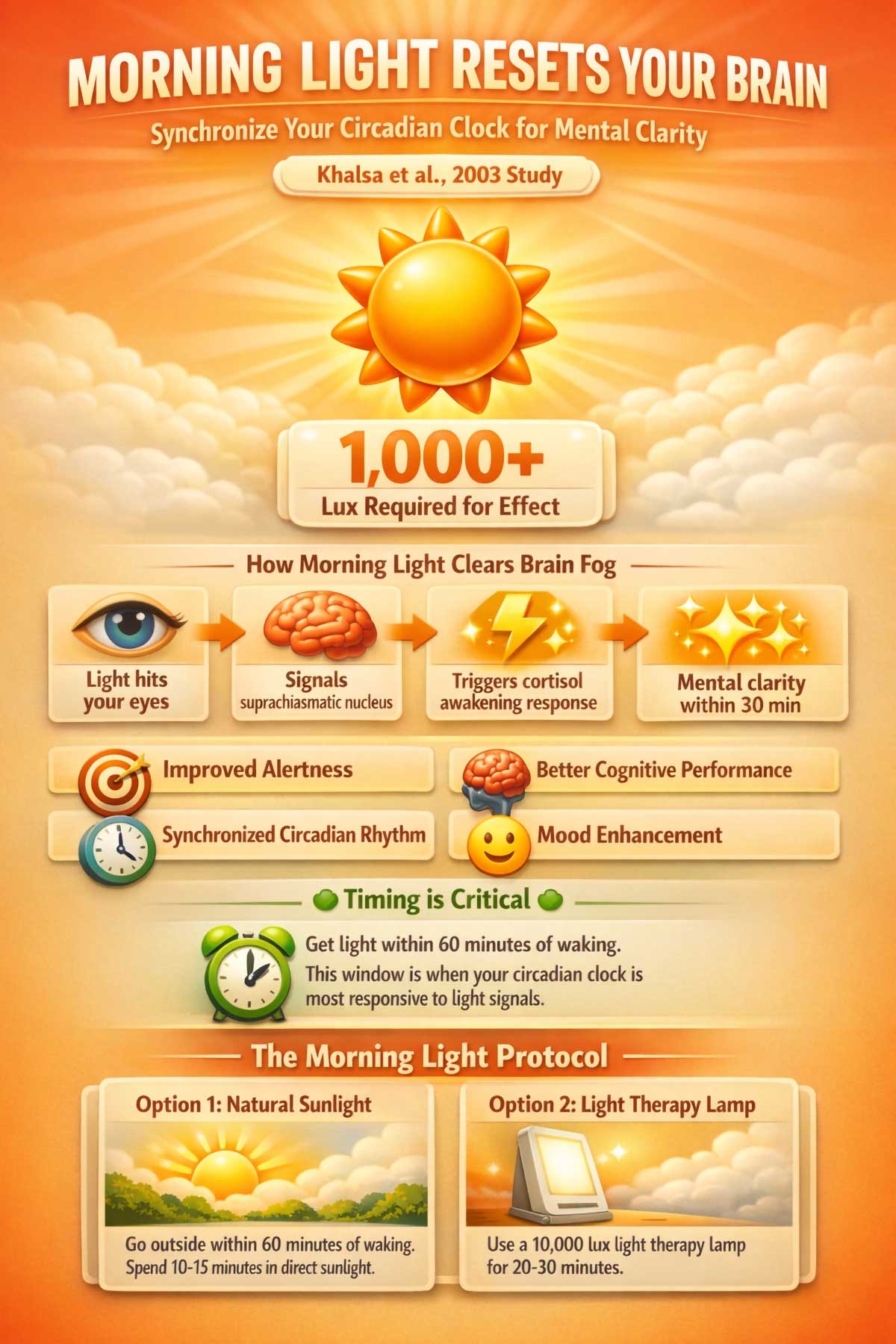
Cajochen’s 2005 study went further. Participants exposed to bright light (over 1,000 lux) in the morning showed improved alertness and cognitive performance within 30 minutes. The effect lasted for hours.
Why does this matter for brain fog? When your circadian rhythm is misaligned, your hippocampus and prefrontal cortex don’t function well. These are the exact brain regions you need for memory and clear thinking.
Lok and colleagues tested this with shift workers in 2018. Morning light exposure improved both alertness and mood. The effect was measurable on the same day.
The Protocol: Get outside within 60 minutes of waking up. Spend at least 10 minutes in direct sunlight. If you live somewhere cloudy, use a 10,000 lux light therapy lamp instead.
This isn’t about vitamin D. It’s about signaling to your brain that it’s time to be awake.
Habit 5: The 500mL Hydration Standard
You wake up dehydrated. Not severely. But enough to affect your brain.
While you sleep, you lose water through breathing and minimal sweating. Most people wake up about 1-2% dehydrated. That doesn’t sound like much. But your brain is 75% water. Even small water deficits matter.
Ganio’s 2011 study quantified this. Men who were 1.59% dehydrated showed impaired working memory and increased anxiety. Women showed similar effects at 1.36% dehydration, according to Armstrong’s 2012 research.
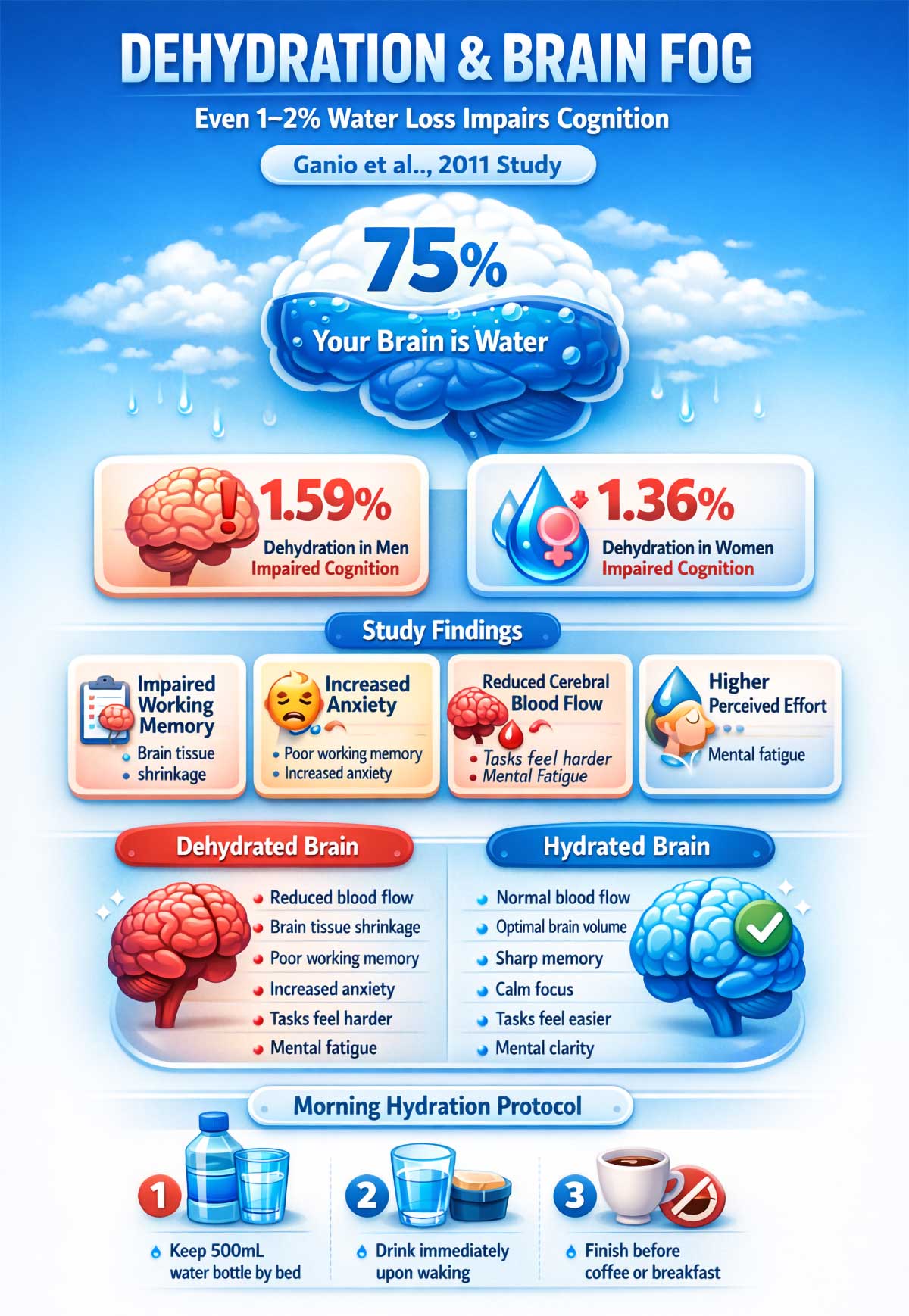
Why? Dehydration reduces cerebral blood flow. Your brain tissue literally shrinks slightly. This increases the “effort cost” of thinking. Tasks that should feel easy feel hard.
The fix is simple. Drink water first thing in the morning.
The Protocol: Keep a 500mL (16-ounce) bottle of water by your bed. Drink it when you wake up, before coffee. Add a pinch of salt or use an electrolyte packet if you want faster absorption.
You’ll notice the effect within an hour. Your thinking feels less effortful. Your focus sharpens.
Habit 6: The Protein-First Breakfast
Your brain needs fuel. Specifically, it needs amino acids to make neurotransmitters—the chemical messengers that control focus and mood.
Most breakfast foods don’t provide this. Toast, cereal, and pastries are mostly carbs. They spike your blood sugar, then let it crash. The crash brings brain fog with it.
Protein works differently. It stabilizes blood sugar. And it provides tyrosine and phenylalanine—amino acids your brain uses to make dopamine and norepinephrine. These neurotransmitters drive attention and motivation.
Leidy and colleagues tested this in 2013. Teens who ate high-protein breakfasts (with at least 20 grams of protein) showed better cognitive control and less hunger throughout the day. Their blood sugar stayed stable.
Gibson and Green’s 2002 review of nutritional influences on cognition found that dietary protein supports neurotransmitter synthesis, which underlies sustained attention and working memory—though most studies examined overall dietary patterns rather than single meals.
The Protocol: Eat at least 20 grams of protein within an hour of waking. Three eggs give you 18 grams. A protein shake with one scoop of whey gives you 20-25 grams. Greek yogurt with nuts works too.
Skip the cereal. Your brain will thank you by mid-morning.
The Strategic Delay: Results by Mid-Morning
Habit 7: The 90-Minute Caffeine Buffer
You wake up. You immediately make coffee. This feels necessary. But it might be working against you.
Here’s why. When you wake up, your body naturally produces a surge of cortisol. This hormone makes you feel alert. The surge peaks about 30-45 minutes after you open your eyes.
The theory goes like this: if you drink coffee during this natural cortisol peak, you’re adding stimulation when your body is already waking itself up. Some researchers suggest this could reduce the efficiency of both signals over time, though direct human studies testing this timing effect on brain fog specifically are limited.
What we do know is that adenosine—the molecule that makes you feel tired—builds up while you sleep. It takes 60-90 minutes after waking for adenosine levels to naturally clear. Caffeine works by blocking adenosine receptors. Waiting until adenosine has partially cleared may make caffeine more effective when you do consume it, potentially reducing the afternoon crash many people experience.
Roehrs and Roth reviewed caffeine’s effects in 2008. They found that caffeine timing matters as much as the dose. Strategic timing reduces tolerance and improves sustained alertness.
The evidence for this strategy is more theoretical than the other habits in this guide. If you’re already sleeping well, staying hydrated, and getting morning light, experiment with delaying caffeine to see if it helps your individual energy patterns. But if delaying it makes your morning harder, drink it when you need it. The stress of forcing yourself to wait may outweigh any theoretical benefit.
The Protocol: Wait 60-90 minutes after waking before you drink coffee or tea. Use that time for Habits 4, 5, and 6 instead. Your cortisol will wake you up naturally. Then the caffeine will keep you sharp through the morning. But this is one to test for yourself—it works for some people and not others.
The Foundation Builders: Results Within 3–7 Days
Habit 8: The Sleep-Wake Anchor
Sleep duration gets all the attention. Eight hours. Seven hours. Nine hours. Everyone debates the magic number.
But there’s something more important: consistency.
Your body runs on rhythms. When you go to bed at 11:00 PM one night and 2:00 AM the next, you’re not just losing sleep. You’re desynchronizing your internal clocks.
You actually have multiple clocks in your body. One in your brain. Others in your liver, pancreas, and muscles. These clocks control when different organs work best. When your sleep schedule varies, these clocks fall out of sync.
Bei’s 2016 research showed that irregular sleep patterns disrupt circadian alignment. This creates metabolic inefficiency and cognitive impairment. Your prefrontal cortex—already vulnerable to sleep loss—suffers the most.
Huang and colleagues confirmed this in 2020. They found that sleep irregularity harmed cognitive performance independent of total sleep time. Two people could sleep the same number of hours, but the one with irregular timing performed worse on cognitive tests.
The Protocol: Pick a wake-up time. Keep it within a 60-minute window every day, including weekends. If you wake up at 7:00 AM on weekdays, don’t sleep until 10:00 AM on Saturday.
This won’t fix brain fog overnight. But within 3-7 days, you’ll notice sharper thinking. Your brain starts to predict when it should be alert and when it should rest.
Habit 9: The Digital Sunset Wind-Down
Your brain needs a shutdown sequence. Without it, you lie in bed with racing thoughts. You fall asleep late. You wake up groggy.
The problem? Blue light from screens. This light suppresses melatonin—the hormone that makes you sleepy. But it’s not just the light. It’s also the mental stimulation. Scrolling social media, answering emails, watching intense shows—all of this keeps your brain in “on” mode.
Irish and colleagues reviewed sleep hygiene practices in 2015. They found that consistent pre-sleep routines improve sleep onset latency. This is the time it takes to fall asleep.
The mechanism? Classical conditioning. When you repeat the same calming actions every night, your brain learns to associate them with sleep. Over time, the routine itself triggers drowsiness.
Better sleep onset means better sleep quality. Better sleep quality means less brain fog the next day.
The Protocol: Choose a 20-minute routine. No screens during this time. Read a book. Stretch. Take a warm shower. Journal. Do the same thing every night at the same time.
This takes 7-14 days to fully condition your brain. But even in the first few nights, you’ll fall asleep faster. And faster sleep onset means more total sleep, even if your bedtime stays the same.
The Brain Fog Clearance Timeline: Quick Reference
Foggy right now?
- Do Habit 1: 5-minute slow breathing
- Do Habit 3: Close extra tabs and focus on one task
Foggy every afternoon?
- Do Habit 2: Walk for 10 minutes after lunch
- Do Habit 7: Delay your first coffee for 90 minutes
Foggy every morning?
- Do Habit 4: Get bright light within 60 minutes of waking
- Do Habit 5: Drink 500mL of water before coffee
- Do Habit 6: Eat 20+ grams of protein for breakfast
Foggy all the time?
- Do Habit 8: Keep your wake time consistent
- Do Habit 9: Build a 20-minute screen-free wind-down routine
How to Actually Implement These Habits
You don’t need all nine habits to see results. Start with your biggest bottleneck. Ask yourself:
Do you crash after lunch? → Start with Habit 2 (post-meal walking)
Do you wake up groggy every day? → Start with Habit 4 (morning light) and Habit 5 (hydration)
Is stress making you scattered? → Start with Habit 1 (slow breathing) and Habit 3 (task batching)
Do you feel foggy all day, every day? → You likely have a sleep issue. Start with Habits 8 and 9.
Add one habit per week. This gives your body time to adapt and lets you isolate what actually helps. Once a habit becomes automatic—when you do it without thinking—add the next one.
What This Guide Doesn’t Cover
These habits address lifestyle-driven brain fog—the kind caused by poor sleep, stress, dehydration, or circadian misalignment. They won’t fix brain fog caused by:
- Underlying medical conditions (hypothyroidism, diabetes, autoimmune disorders)
- Medication side effects
- Post-viral syndromes (long COVID, post-Epstein-Barr)
- Neurodegenerative conditions
- Nutritional deficiencies (B12, iron, vitamin D)
If you’ve implemented these habits consistently for 3-4 weeks and still have persistent brain fog, see a healthcare provider. Chronic brain fog can be a symptom of treatable medical conditions.
Conclusion
Brain fog isn’t a permanent condition. It’s feedback from your body. Your brain is telling you something is off—sleep, hydration, nutrition, stress, or routine.
Most people treat brain fog reactively. They drink more coffee. They push through. They wait for it to pass.
But these micro-habits let you be proactive. You’re not fixing brain fog. You’re removing the biological conditions that create it.
Start with one habit today. Pick the one that matches your biggest problem. If you’re foggy right now, do the 5-minute breathing exercise. If you crash every afternoon, walk after lunch.
These aren’t life overhauls. They’re small adjustments to how your brain operates. But small adjustments compound. One habit leads to clearer thinking. Clearer thinking makes it easier to add the next habit.
Your brain wants to work well. You just need to give it the right conditions. These nine micro-habits are those conditions. Pick one. Start today.