Standard bone scans miss what really matters. Penn State used 3D imaging to measure something far more important than density.
Most people don’t think about their bones until something breaks. By then, years of quiet bone loss have already done real damage. But a growing body of research points to an unlikely ally sitting in your pantry: the humble prune.
Not just for bone density, either. We’re talking about bone strength — the kind that determines whether a hip fracture happens or doesn’t. Here’s what the science actually shows, why the dose matters more than most people realize, and why your gut may hold the biggest key of all.
Beyond Bone Density — The 3D Picture
Why the Measurement Tool Changes Everything
For decades, doctors measured bone health with a DXA scan. It’s a flat, 2D X-ray that shows how much mineral is packed into a cross-section of bone. It’s useful. But it only tells part of the story.
A team at Penn State took a different approach. Their landmark 2024 study, published in Osteoporosis International (Koltun et al.), used a tool called pQCT — peripheral quantitative computed tomography. Think of it as upgrading from a photograph to a 3D model. pQCT measures bone geometry: its width, thickness, and estimated breaking strength. That last part — breaking strength — is far more relevant to real-world fracture risk than mineral density alone.
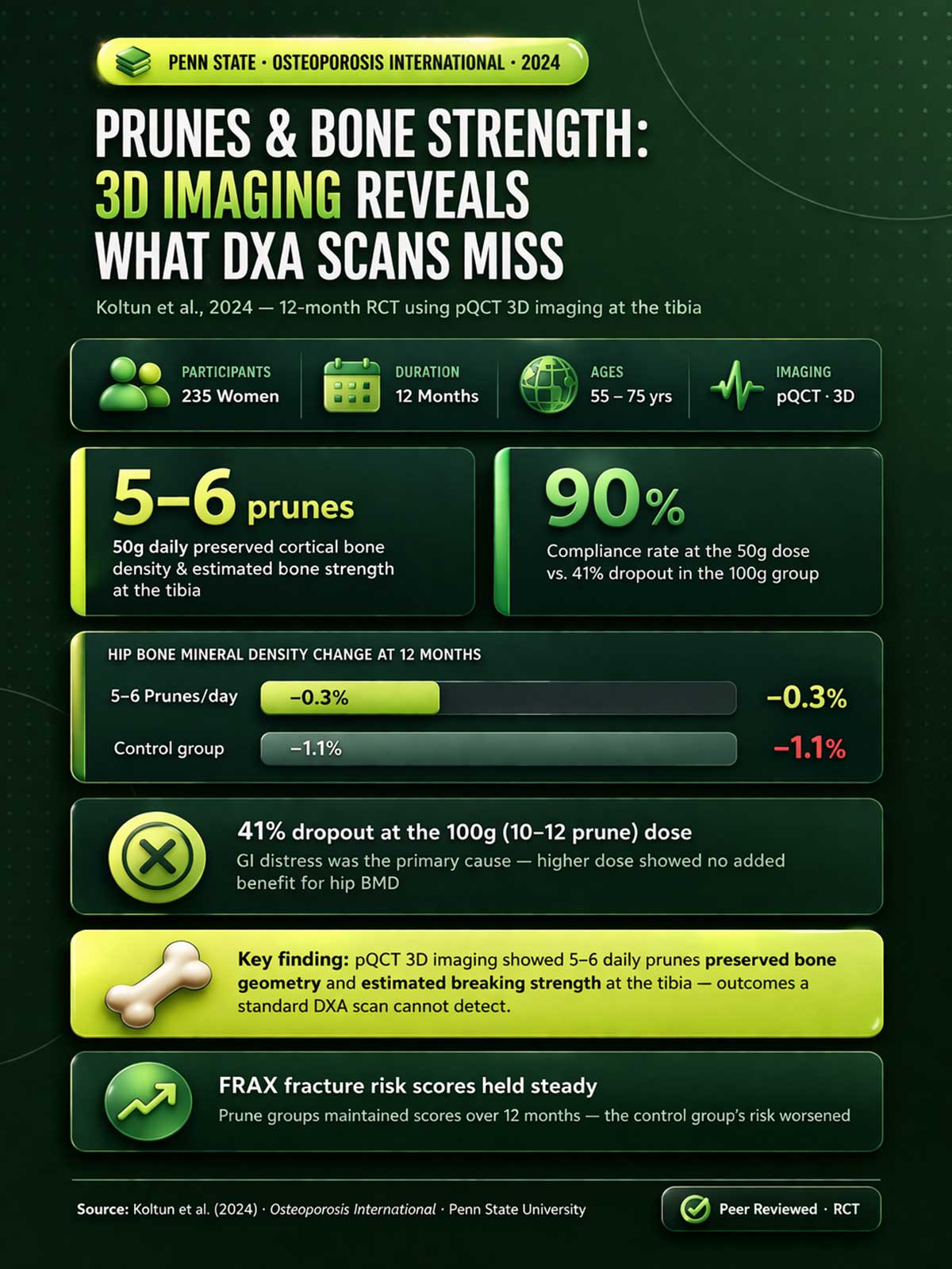
In practical terms, this means researchers could see not just whether women had enough bone mineral, but whether the bone’s structural shape — its architecture — was strong enough to resist fracture. A bone can look reasonably dense on a DXA scan and still be fragile if its structure has deteriorated. Geometry matters.
Who Was Studied — and Why It Matters
The Penn State trial enrolled 235 postmenopausal women between the ages of 55 and 75. Their bone health ranged from slightly below normal (osteopenic) to significantly reduced (osteoporotic), based on T-scores between 0 and -3.0. This is exactly the population most at risk for age-related fractures.
Postmenopausal women lose bone faster than almost any other group. Estrogen withdrawal accelerates bone resorption — the process where specialized cells called osteoclasts break down bone tissue. Finding a food-based strategy that slows this process in this specific group carries real clinical weight.
What the 3D Scans Showed at the Tibia
The study focused on the tibia — the larger shinbone. Why? Because it’s a weight-bearing bone highly susceptible to age-related cortical (outer shell) bone loss. The pQCT scans measured cortical bone density and estimated bone strength at this site over 12 months.
Women who ate 5–6 prunes daily preserved cortical bone density and maintained estimated bone strength at the tibia. The control group — eating no prunes — showed continued decline. In bone health research, holding steady while others decline isn’t a consolation prize. It’s often the whole point.
The Dose That Actually Works — 5 Prunes, Not 10
The 50g vs. 100g Comparison
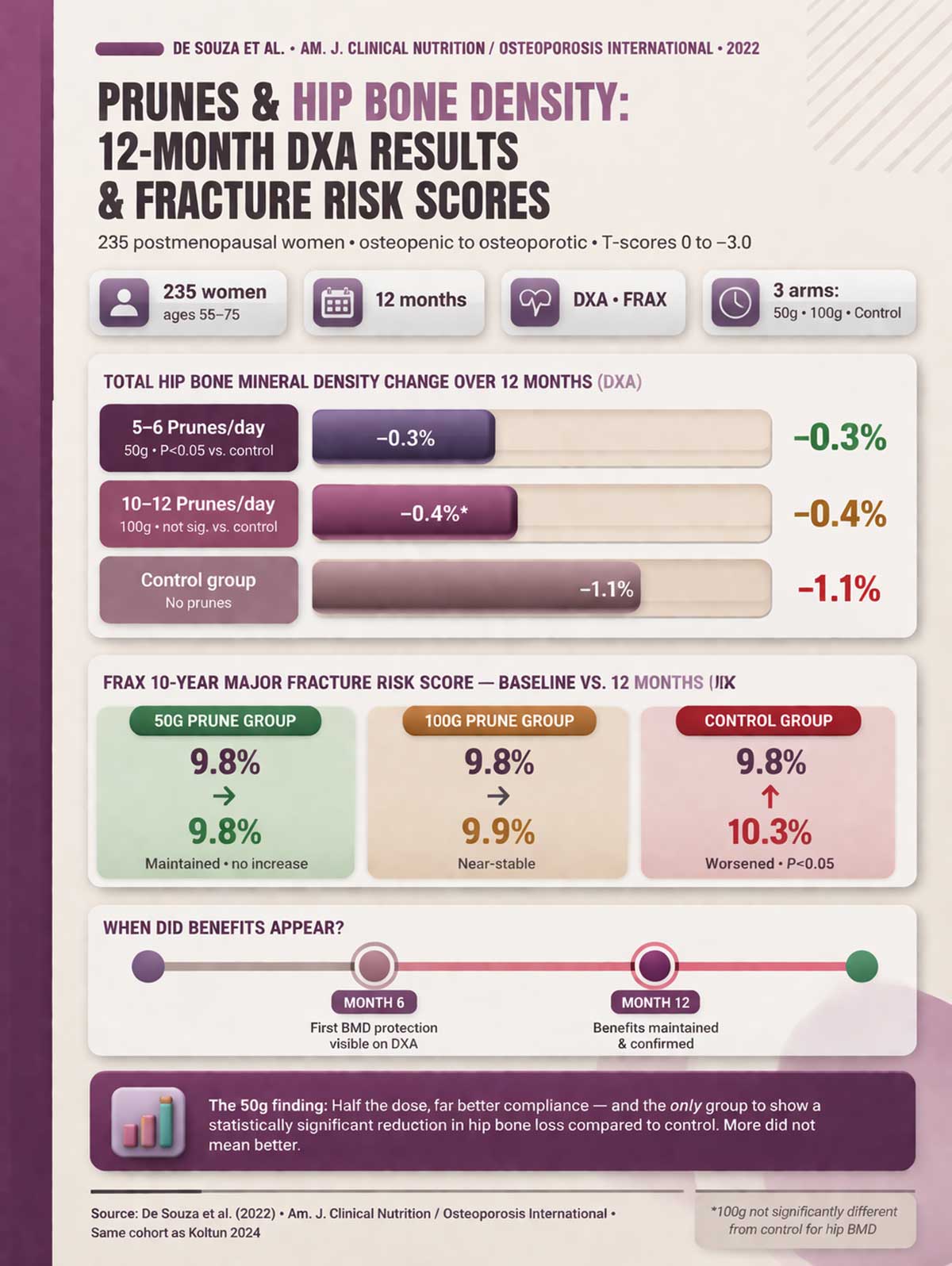
Here’s where things get practical. The Penn State study (building on earlier DXA-focused work by De Souza et al., 2022, using the same 235-participant cohort) tested two doses side by side: 50g per day (roughly 5–6 prunes) and 100g per day (around 10–12 prunes).
The 50g group showed meaningful protection. Hip bone mineral density declined just -0.3% over 12 months in the prune group, compared to -1.1% in the control group — a statistically significant difference. FRAX fracture risk scores held steady in the prune groups but worsened in the control group (moving from 9.8% to 10.3%, P<0.05). Benefits visible at 6 months held through the full year.
Here’s the surprising part: the 100g group didn’t do significantly better than the control group for hip BMD. More prunes did not mean more protection.
The Dropout Problem Nobody Talks About
Why didn’t the higher dose work better? Because most people couldn’t stick to it. The 100g group had a dropout rate of 41%. Digestive distress — bloating, loose stools, general GI discomfort — was the main reason. The 50g group had just 10–15% dropout, with 90% compliance overall.
This is a critical point that most nutrition articles miss entirely. A protocol that works in theory but fails in practice protects no one. Consistency over 12 months is what produced the structural bone changes seen in the 3D imaging. Half the dose, taken reliably, beat double the dose taken sporadically.
If you’re going to try a prune-based bone health protocol, 5–6 prunes per day is both the science-backed and the livable target.
What Happens to Fracture Risk Over a Year
FRAX is a clinical tool that estimates a person’s 10-year probability of a major bone fracture. It combines bone density with risk factors like age, weight, and smoking history. In the De Souza et al. data, the pooled prune groups maintained their FRAX scores over 12 months. The control group’s scores worsened.
This is the practical payoff. Keeping your fracture risk score from climbing — while doing nothing other than eating a small daily portion of dried fruit — is a meaningful outcome for any postmenopausal woman managing bone health.
The 2024 Finding That Changes the Conversation
Why Some Women Responded and Others Didn’t
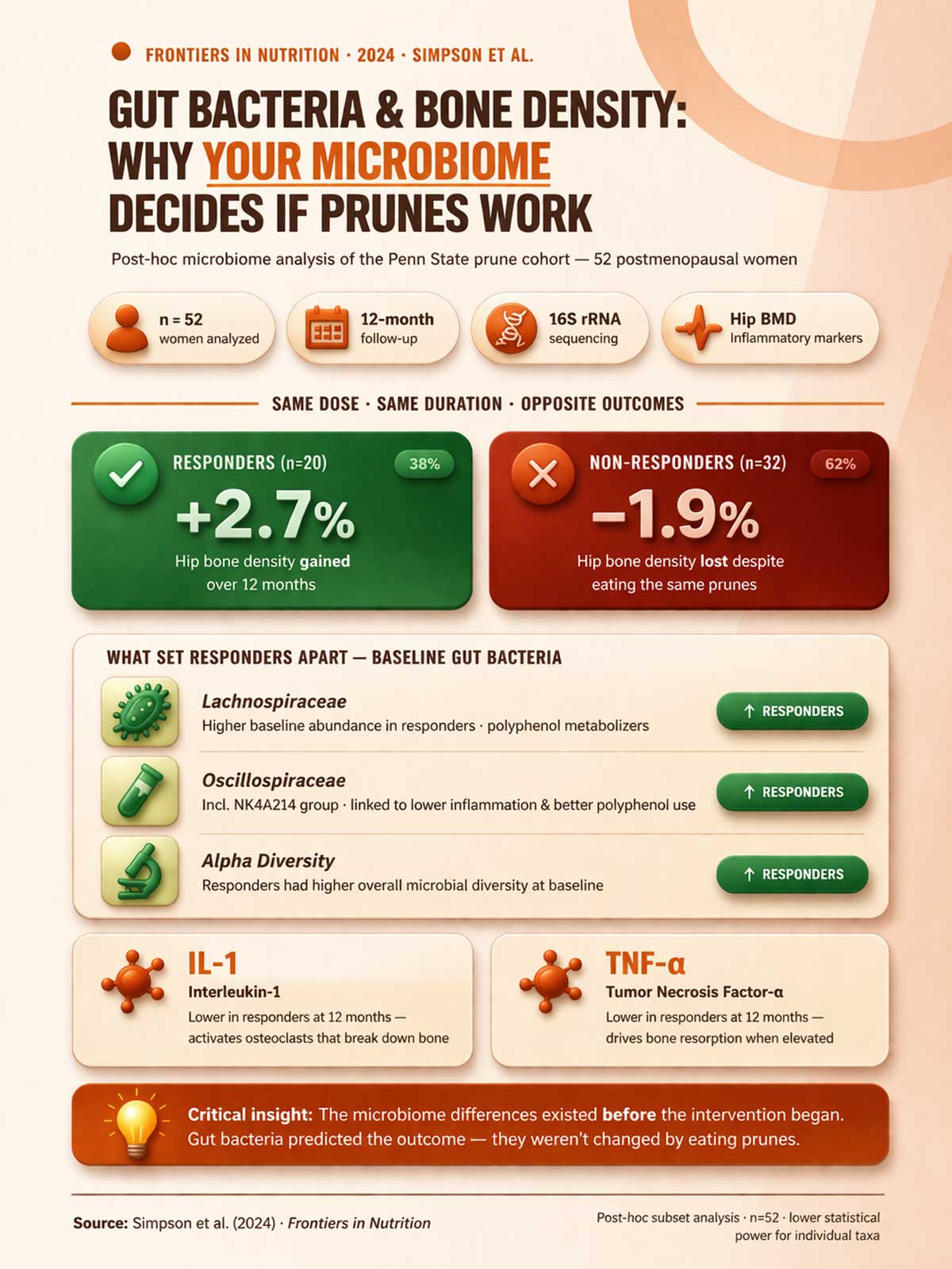
Here’s a mystery buried in the Penn State data that most coverage has completely overlooked. Not everyone who ate prunes saw the same results. In fact, when researchers dug deeper, they found a wide split: some women showed a +2.7% improvement in hip bone density after 12 months. Others in the same study, eating the same amount, showed a -1.9% loss.
Same fruit. Same dose. Wildly different outcomes. Why?
Your Gut Bacteria May Be Calling the Shots
The answer came in a 2024 study by Simpson et al., published in Frontiers in Nutrition. Researchers analyzed a subset of 52 women from the original prune trial — 20 “responders” who gained bone density, and 32 “non-responders” who didn’t. The key difference wasn’t age, weight, or starting bone density. It was their gut microbiome.
Women who responded to the prune intervention had a distinct baseline gut bacterial profile. They showed higher overall microbial diversity and higher levels of two specific bacterial families: Oscillospiraceae and Lachnospiraceae. Notably, these bacterial differences existed before the prune intervention began. The microbiome predicted who would respond — it didn’t change as a result of eating prunes. Women without these bacteria in sufficient amounts got little to no measurable benefit — at least for bone density.
This is precision nutrition in action. Your gut isn’t just digesting the prunes. It’s determining whether the bioactive compounds in those prunes ever reach your bone cells.
The Inflammation Link
The Simpson et al. data added another layer. Responders showed lower levels of two inflammatory markers — IL-1 and TNF-α — at the 12-month mark. These aren’t random numbers. Both IL-1 and TNF-α are pro-inflammatory cytokines directly linked to osteoclast activation — the process that breaks down bone.
When inflammation runs high, osteoclasts work overtime. Bone resorption outpaces bone formation, and density drops. The women with the right gut bacteria seemed to use prune polyphenols to keep that inflammatory signaling in check. The result was measurably less bone breakdown over the course of a year.
The Outer Shell — Why Cortical Bone Deserves More Attention
The Skeleton’s Protective Layer
Bone isn’t uniform throughout. The hard, dense outer layer is called cortical bone. It makes up about 80% of the skeleton’s mass and provides most of its mechanical strength. The inner, spongy layer — trabecular bone — is more metabolically active and tends to show changes faster on scans.
Most research focuses on trabecular bone because it responds to interventions more quickly. The Penn State pQCT approach was valuable precisely because it assessed cortical bone at the tibia with 3D detail — giving a more complete picture of structural integrity.
“No Change” as a Win
Age-related cortical bone loss in postmenopausal women is expected and well-documented. This is why the phrase “no significant change” in the prune groups isn’t a disappointing non-result. It’s a genuine win.
The control group’s cortical bone at the tibia continued declining on the natural trajectory. The women eating 5–6 prunes daily held steady. Over 5, 10, or 20 years, that difference compounds into meaningfully lower fracture risk. Preventing the decline is the whole goal of bone health management in this population.
How Prunes Actually Communicate With Bone Cells
The Osteoclast Connection
Bone is living tissue. It’s constantly being broken down and rebuilt — a process called remodeling. Osteoclasts handle the breakdown; osteoblasts handle the rebuilding. In healthy bone, these two processes stay roughly balanced. In postmenopausal osteoporosis, osteoclasts gain the upper hand.
Prune compounds appear to put a brake on osteoclast activity. Earlier work by Hooshmand et al. (2016), testing 50g and 100g doses in 48 osteopenic postmenopausal women over 6 months, found that both doses significantly reduced TRAP-5b — a direct marker of bone resorption. The ratio of bone formation to bone resorption (measured as BAP/TRAP-5b) improved significantly at 6 months in both prune groups. Osteoclasts were slowing down. Osteoblasts were holding their ground.
The Hooshmand study was shorter (6 months vs. 12) and used a smaller sample, but it provided an early, mechanistic look at how prunes were influencing bone. The key message: it wasn’t just mineral intake doing the work. Prunes were actively changing the balance of bone remodeling.
From Fruit to Bloodstream: The Polyphenol Pathway
Prunes are rich in polyphenols — plant compounds with antioxidant and anti-inflammatory properties. But raw polyphenols don’t simply absorb into the bloodstream and float to your bones. They need to be transformed first.
That transformation happens in the gut. Gut bacteria metabolize polyphenols into smaller, bioactive compounds called metabolites. These metabolites enter circulation and, according to preclinical work (Arjmandi et al., 2002, using ovariectomized rats as a bone loss model), can influence bone signaling directly — increasing IGF-1, reducing oxidative stress, and suppressing bone resorption signals.
This is why gut bacteria matter so much. Without the right microbial community to process prune polyphenols, fewer metabolites reach the bloodstream. Less signal reaches the bone cells. And the protective effect gets lost in translation.
Making the Protocol Work for You
Feed the Bacteria That Feed Your Bones
If Lachnospiraceae and Oscillospiraceae are the gatekeepers of prune-based bone benefits, the logical next step is supporting those bacterial families. Both thrive on dietary fiber — specifically the kind found in a varied, plant-rich diet. One practical side note: like most dried fruit, prunes can carry pesticide residue. Choosing organic is a reasonable option if your budget allows.
Practical steps include eating a wide range of high-fiber vegetables, legumes, and whole grains. Variety matters here more than volume. A gut microbiome fed the same few foods tends toward lower diversity. Rotating your fiber sources — leafy greens, beans, oats, root vegetables — gives diverse bacteria species a chance to establish and grow.
Fermented foods like plain yogurt, kefir, or sauerkraut may also support microbial diversity over time, though the specific strains that prune research flagged aren’t available as targeted probiotics yet. For now, feeding a diverse gut ecosystem broadly is the best available approach.
Timing and the 12-Month Threshold
The Penn State data is clear on one point: structural bone changes, visible on 3D imaging, required a full 12 months. Six months showed some DXA results (De Souza et al., 2022 confirmed effects persisted through month 12), but the pQCT geometry changes needed the full year.
This isn’t a quick fix. It’s a long-game strategy. The most practical implication is simple: start now, and don’t stop after a few months because you don’t “feel” a difference. Bone changes aren’t felt. They’re measured — and only after consistent daily intake over a meaningful duration.
Building a Broader Bone Strategy
Prunes work best as one piece of a larger picture. The research supports them as an adjunct strategy, not a replacement for proven bone health fundamentals. It’s also worth noting that all participants in the Penn State study received calcium (1,200mg daily) and vitamin D (800 IU) throughout the trial. Prunes appear to work best alongside these nutritional basics, not instead of them.
Weight-bearing exercise — walking, hiking, resistance training — applies mechanical stress to bone and stimulates osteoblast activity. Adequate protein intake supports the collagen matrix that gives bone its flexibility and resistance to fracture.
Adding 5–6 prunes to a diet already built around these fundamentals is a low-effort, evidence-based choice. At roughly $2–4 per pound depending on the source, a 50g daily dose costs around $0.20 per day — less than most bone health supplements. The fruit is widely available and — at the right dose — well-tolerated by most people.
Your Bone Longevity Checklist
The research across these studies points to a clear, actionable framework:
Target dose: 50g daily — approximately 5–6 prunes. This is the dose that showed benefits in both DXA and pQCT outcomes, with 90% compliance rates.
Duration: Commit to 12 months. Structural bone geometry changes require sustained, consistent intake over a full year.
Gut health: Prioritize microbial diversity through a high-fiber, varied diet. The bacterial families linked to prune responsiveness (Lachnospiraceae and Oscillospiraceae) depend on diverse plant-based fiber to thrive.
Primary goal: The aim isn’t dramatic bone density increases. It’s preserving bone geometry, estimated strength, and fracture risk scores — all outcomes that directly translate to fewer broken bones as you age.
Full picture: Pair the prune habit with weight-bearing exercise, adequate Vitamin D and calcium, and sufficient protein. No single food works alone.
A note for those on blood thinners: Prunes contain vitamin K, which can interact with warfarin. Five to six prunes daily is unlikely to cause problems, but discuss the amount with your doctor if you’re on anticoagulant therapy.
Who this research applies to: The Penn State studies focused on postmenopausal women, the majority of whom were Caucasian, with existing bone loss. The findings may not apply equally to younger women, men, or those with normal baseline bone density. Men do experience slower, age-related bone loss over time, but whether prunes offer similar benefits for them remains unstudied. Larger, more varied studies would strengthen confidence in the current findings.
The bottom line is straightforward. Prunes have moved well past folk remedy status. A rigorous 12-month trial using 3D imaging showed real structural bone protection at a modest daily dose. A 2024 microbiome study explained why results vary from person to person — and pointed toward a path for optimizing that response.
Five or six prunes a day. A gut fed with diverse fiber. Patience measured in months, not weeks. That’s the protocol the science currently supports.