In a general practice in southern England, thirty volunteers sat down for two very different allergy tests. One used a needle. The other used a machine that never touched their skin, reading tiny electrical changes at an acupuncture point and turning them into a number on a screen.
Neither the volunteers nor the technician running the machine knew who had already tested positive for a dust mite or cat allergy on a conventional skin prick test. When the results came in, the machine could not tell the two groups apart at a rate any better than chance.
That single study sits inside a much bigger, messier picture. Bioenergetic testing is actually a loose family of at least five distinct methods, all built on the idea that the body’s electrical activity can flag problems before symptoms do.
Some of those methods have real, mainstream scientific backing. One of them is the same technology already sitting inside your smartwatch. Others have been tested directly against a gold-standard comparison and lost.
Where the idea came from
The modern version of bioenergetic testing traces back to Dr. Reinhold Voll, a German physician who developed electroacupuncture according to Voll, or EAV, in the 1950s. Voll combined traditional Chinese acupuncture theory with Western electrical measurement equipment, building a device that read skin resistance at points along the body’s meridians.
Around the same period, Wilhelm Reich and later Alexander Lowen were developing a separate but related idea in psychotherapy. Lowen, often credited as the founder of bioenergetic analysis, explored how chronic muscle tension could reflect suppressed emotional states, a body-mind approach that still shapes some somatic therapy practices today.
By the 1970s and 1980s, a second wave of devices arrived, including the VEGA test and MORA therapy, both built on Voll’s original premise. Bioimpedance analysis, a genuinely different and better-validated technology, entered the picture around the same time. The field has kept expanding since, and one of the most widely marketed modern systems, called QEST4, is now a common fixture in naturopathic and chiropractic offices across the US.
The measurement behind the marketing
Every living body generates measurable electrical activity. Nerve conduction, heart rhythm, and skin conductance are all real, well-documented phenomena that clinicians already track using tools like ECGs and EEGs.
Bioenergetic testing takes that same starting point and pushes it much further, claiming that patterns in this electrical activity can reveal functional imbalances in organs and systems before a physical symptom appears.
That’s a much bigger claim than “electricity exists in the body,” and the evidence behind it varies enormously by method. Some devices measure resistance or conductance directly at specific points.
Others expose the body to a range of frequencies and record how it responds. A third category tries to capture the body’s full electromagnetic field rather than a single-point measurement.
Inside a typical session
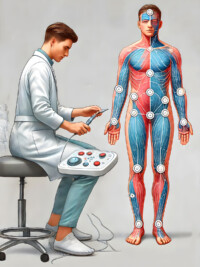
Most sessions follow a similar pattern regardless of which specific device a practitioner uses. You’ll sit while a handheld probe touches points on your hands, feet, or ears, and the device records how your skin’s electrical properties shift in response to different signals. The whole process is painless and typically runs 30 to 60 minutes.
- Initial consultation: the practitioner reviews your health history and current concerns.
- Explanation of the method: you learn which specific device and theory is being used.
- Measurement: readings are taken at various points on your body.
- Real-time feedback: many systems display results on a screen as they’re collected.
- Interpretation: the practitioner explains what the patterns might indicate.
- Recommendations: you receive personalized suggestions based on the results.
Remove metal jewelry before your session. Practitioners commonly flag it as a source of interference with the reading, and it’s one of the few instructions here that are about signal quality rather than theory.
The three types of bioenergetic assessment
Setting aside the biochemistry meaning covered above, bioenergetic testing devices generally fall into three categories. Direct measurement systems record actual electrical properties, resistance or conductance, at specific points on the body. EAV devices and bioimpedance analyzers both work this way.
Resonance-based systems expose the body to a range of frequencies and record how it responds, a category that includes bioresonance devices and radionics instruments. Field detection systems attempt something more ambitious: capturing the body’s entire electromagnetic field at once rather than a single-point reading. Gas discharge visualization cameras, which photograph light emissions from a fingertip after electrical stimulation, sit in this last group.
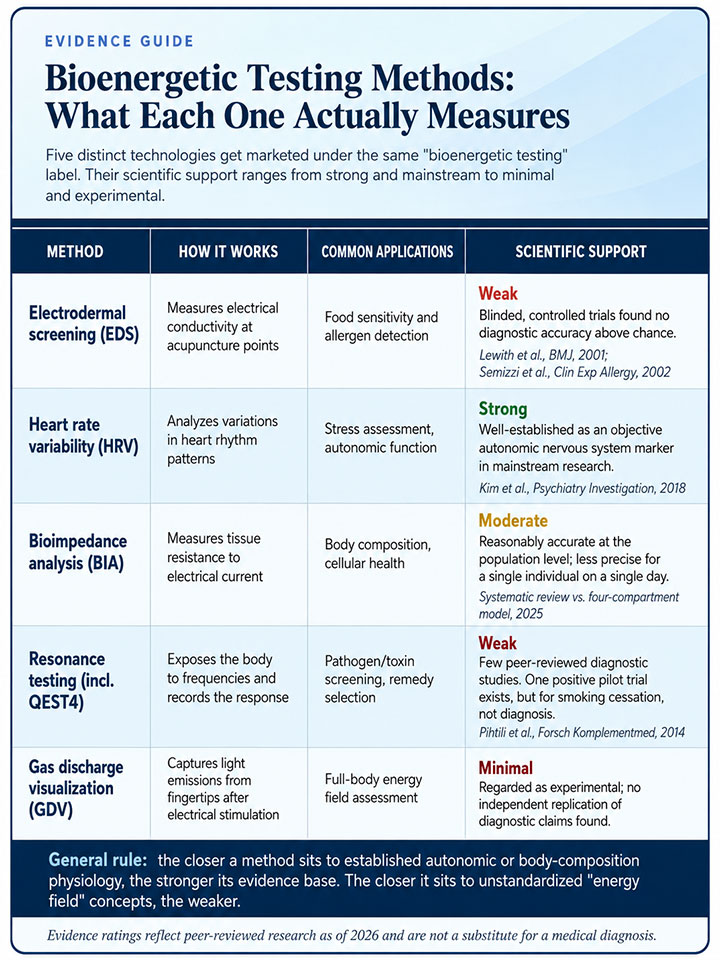
Each category rests on a different theoretical foundation, and, as the table above shows, each carries a very different level of scientific support.
Common reasons people book a session
Food sensitivity testing is probably what brings the most people through the door. A practitioner exposes the body’s energy field, in their framing, to different food frequencies or samples, and then interprets the response as evidence of a sensitivity too subtle to trigger a positive result on a conventional IgE allergy test.
This is also the specific claim the blinded allergy studies described earlier were built to test, and it’s worth carrying that context into any food-sensitivity result a bioenergetic device produces.
Two other applications get less attention but come up often in practice. Some practitioners use readings to locate what they describe as blockages along the body’s energy pathways, a framework borrowed loosely from traditional Chinese medicine’s meridian system. Others focus the same technology on environmental sensitivities, testing for reactions to chemicals, mold, or electromagnetic fields using the same probe-and-response method.
Stress and emotional-state assessment rounds out the common use cases, though it’s the one with the thinnest direct evidence base of the four. Practitioners sometimes measure electrical responses to specific thought patterns or stimuli and use the results to recommend stress-reduction techniques.
Why people try it in the first place
The appeal is straightforward. Bioenergetic testing doesn’t require a needle or a tissue sample, which matters to people who find blood draws unpleasant or who have been through enough conventional testing to want something different.
It also frames health as a set of relationships between systems rather than a list of isolated numbers, an approach some people find more useful for making sense of vague, hard-to-pin-down symptoms.
People with a history like this show up in practitioner offices often: normal blood work, persistent fatigue or digestive complaints, and a growing sense that something is being missed. Proponents point to stories where a bioenergetic test flags a food sensitivity or a stress pattern, the person changes their diet or routine, and symptoms improve within weeks.
It’s a genuinely appealing story, and it’s also almost impossible to distinguish from a placebo response or from symptoms that would have improved anyway, which is exactly the objection critics raise about this category of evidence.
Sorting the science by method
The honest answer is that it depends entirely on which method you’re asking about, and the differences are not small.
Heart rate variability analysis is the strongest performer by a wide margin. A 2018 meta-analysis in Psychiatry Investigation, reviewing 37 studies on HRV as a psychological stress indicator, found consistent support for using it as an objective marker of autonomic nervous system activity.
This is the same underlying measurement your smartwatch uses when it reports a “stress” or “recovery” score, and it’s accepted in conventional cardiology and psychology research, not just in wellness clinics.
Electrodermal screening sits at the opposite end. George Lewith and colleagues at the University of Southampton ran a double-blind study, published in BMJ in 2001, testing whether an EAV-style device could distinguish confirmed allergy sufferers from people without one, and it performed no better than chance.
A second double-blind study, published the following year in Clinical and Experimental Allergy with 100 participants, found the same thing: no meaningful difference in the device’s response to real allergens versus saline controls.
That finding matters more than a single line in a limitations section usually suggests, because food and allergen sensitivity testing is the most common reason people book a bioenergetic session in the first place.
Bioimpedance analysis lands in the middle. A systematic review comparing BIA devices to the four-compartment model, the field’s gold-standard reference method, found BIA performs reasonably well at a population level but loses accuracy for individual body fat and fat-free mass estimates. It’s a legitimate, widely used clinical tool, just not a precise one for any single person on any single day.
The last two methods barely have a research base to argue about. One positive pilot study exists for a resonance-based device, and it measured smoking cessation, not diagnostic accuracy, which is a different claim entirely. GDV has even less: no independent replication of its diagnostic claims, and most researchers who’ve looked at it still call it experimental.
Where critics and practitioners disagree
Critics have one specific, technical objection: there’s no agreed reference range for what a “balanced” reading even looks like, which means two practitioners testing the same person on the same day can reach different conclusions.
Lack of standardization across devices compounds the problem, since an EAV reading from one manufacturer’s equipment doesn’t necessarily mean the same thing as a reading from another.
Proponents don’t really dispute the standardization gap. Their counterargument is that conventional trial design, built around isolating single variables, was never well suited to studying something framed as a dynamic, whole-system process in the first place. That’s a real methodological debate happening in complementary medicine research more broadly, not a dodge invented for this particular technology.
Where the two sides talk past each other most is on placebo. Critics see improved symptoms after a bioenergetic session as evidence of expectation effects, not of anything the device actually detected. Proponents counter that a patient feeling better is the outcome that matters, regardless of mechanism, a position that satisfies almost no one trained in either camp.

What it’s allowed to claim
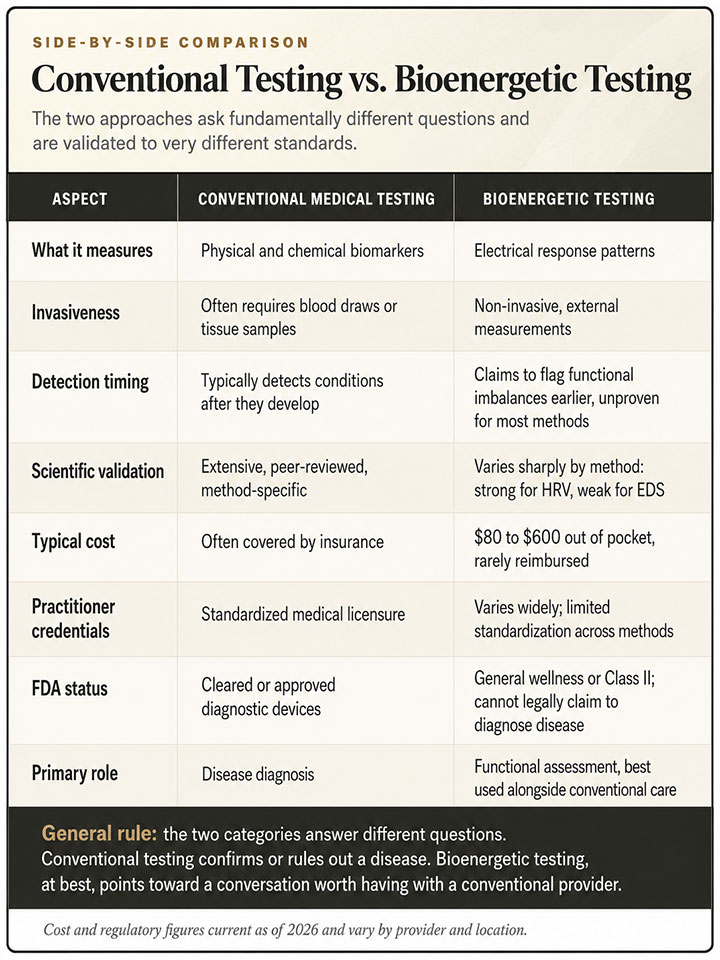
The FDA classifies most bioenergetic devices as general wellness products or, in the case of biofeedback-style devices specifically, Class II medical devices under 21 CFR 882.5050. Under the agency’s General Wellness Policy, updated in January 2026, manufacturers of low-risk wellness products are not required to prove diagnostic accuracy, but they also cannot legally claim the device diagnoses or treats a specific disease.
That distinction rarely makes it onto a clinic’s website. A device can be technically legal to market and still be marketed in ways that outrun what its FDA classification actually permits, and the gap between the two is where most consumer confusion starts.
Regulatory approaches vary outside the US. Some European countries have built more formal frameworks around complementary assessment methods, while others apply restrictions closer to the American model. Practitioners in the US remain bound by their own professional license, meaning a chiropractor, a naturopath, and a medical doctor using the same device may still operate under different legal limits on what they’re permitted to say about the results.
Typical pricing, and why insurance rarely covers it
Pricing varies widely by method, provider, and region, but a single bioenergetic scan typically runs somewhere between $80 and $600, with many full sessions, including an intake consultation and results review, landing between $150 and $400.
Remote testing using a mailed hair or saliva sample is common with some systems and tends to sit at the lower end of that range. Follow-up scans are frequently discounted compared to an initial assessment, and some clinics bundle several sessions into a package.
Conventional insurance almost never covers this category of testing, since it isn’t classified as a diagnostic medical procedure. A flexible spending account or health savings account may reimburse it in some cases, but that depends on the specific plan, so it’s worth a call to your provider before booking.
Finding a practitioner you can trust
None of that price range says anything about whether a given practitioner is any good at this, which turns out to be a separate question entirely. There’s no board exam for this the way there is for a physician.
Training standards vary so much that “certified practitioner” can mean a weekend workshop for one method and years of study for another, so ask specifically what the certification is behind their particular device, whether that’s an electrodermal screening body or a manufacturer-run QEST4 training program, required.
Before booking, it’s worth asking a few direct questions: what their specific training and credentials are, what testing method they use and its theoretical basis, what the test can and cannot determine, how they plan to integrate findings with your conventional healthcare, and what the full cost looks like including any recommended remedies. A practitioner who bristles at those questions is telling you something.
Be wary of anyone who diagnoses a specific disease from a reading, discourages you from seeing a conventional doctor, or pushes expensive supplements framed as a guaranteed fix. None of those behaviors are consistent with how a legitimate general-wellness product is supposed to be marketed.
Practitioner Vetting Checklist
Tap each item you've confirmed before booking a bioenergetic testing session
Its place alongside conventional care
The most defensible way to use bioenergetic testing is as a prompt for further conversation with a conventional provider, not as a replacement for one. A pattern shows up often enough in practitioner accounts to be worth naming directly: a reading flags something in a general area, like thyroid function, and the person requests a standard blood panel from their physician that they might not otherwise have asked for.
Sometimes that panel comes back normal. Sometimes it catches a condition such as subclinical hypothyroidism earlier than it might have been found otherwise.
That’s a real, defensible use case. It’s also a much narrower claim than “this device diagnosed my thyroid problem,” and the difference between those two framings is exactly what a cautious practitioner should be careful to preserve when explaining results to a patient.
What to do with all this
Bioenergetic testing is a bundle of five different technologies wearing the same marketing language, and treating them as interchangeable is where most of the confusion, on both sides of the debate, actually comes from.
Heart rate variability earned its place in mainstream medicine the hard way, through decades of replicated research. Electrodermal allergy screening was tested the same way and came up empty.
The next time a clinic markets “bioenergetic testing” as a single service, ask which specific method is inside the box, and whether that particular one has ever been tested blind. That question, not a verdict on the category as a whole, is the one worth carrying out of the appointment.
Frequently asked questions
Is bioenergetic testing real?
The devices themselves are real, and they do measure genuine electrical activity in the body. Whether the readings mean what practitioners say they mean is a separate question, and the answer depends on the specific method.
Heart rate variability testing has strong, independent scientific support, while electrodermal allergy screening has been tested directly against blinded controls and failed to outperform chance.
Treat any single bioenergetic result as one data point to discuss with a conventional provider, not as a standalone diagnosis.
Is bioenergetic testing the same as biofeedback?
No, though the two are related and sometimes confused. Biofeedback uses instruments to show you real-time data about a physiological process, like heart rate or muscle tension, so you can learn to consciously influence it. Bioenergetic testing measures energy patterns to assess health status, but it doesn’t typically involve training you to change those patterns yourself.
Who is considered the father of bioenergetics?
The answer depends on which “bioenergetics” you mean. In biochemistry, Peter Mitchell won the 1978 Nobel Prize in Chemistry for the chemiosmotic theory, which explains how cells generate ATP and effectively founded bioenergetics as a modern biochemical field. In body-based psychotherapy, Alexander Lowen is usually credited as the founder of bioenergetic analysis, building on earlier work by Wilhelm Reich.
Is energy medicine scientifically proven?
Some forms have real support. Pulsed electromagnetic field therapy, for instance, involves measurable electromagnetic phenomena with published clinical research behind it, while most bioenergetic testing devices have far less independent validation.
The National Institutes of Health’s National Center for Complementary and Integrative Health continues to fund research into various energy medicine modalities, itself a sign that the science here is still unsettled rather than closed.