Many articles about gunpowder tea repeat the same origin story, and it goes like this: a British clerk in the 1800s stared at a heap of tightly rolled green pellets, thought of the gunpowder used in muskets, and gave the tea its name on the spot.
Trade ledgers say otherwise. English newspapers were selling something called gunpowder tea as early as 1770, which puts the real naming roughly thirty years before the story usually claims.
That thirty-year gap matters less for its own sake than for what it says about how this tea usually gets covered. Most articles repeat the same handful of facts in the same order, rarely checking any of them. The health claims fare worse.
A cup of gunpowder green tea gets credited with fighting cancer, melting fat, and reducing inflammation, sometimes all three in one paragraph, almost never with a source attached. Some of that turns out to be true. Some of it is thinner than it sounds.
Origins and History of Gunpowder Green Tea
Gunpowder tea traces back to the Tang dynasty, roughly 618 to 907 CE, in Zhejiang province on China’s eastern coast. Producers there developed a method of withering, steaming, and tightly rolling tea leaves into small pellets, a shape that did double duty: it protected the leaves on long trade routes and slowed the flavor loss that plagues loose-leaf tea. The Chinese name, zhu cha, translates to pearl tea, a nod to the rounded shape rather than anything explosive.
The English name arrived centuries later, and the popular version of that story doesn’t quite hold up. Most tea sites credit a 19th-century British clerk who supposedly looked at a crate of tightly rolled Chinese gunpowder green tea and thought of musket ammunition.
Newspaper archives complicate that timeline. Print references to gunpowder tea appear in England by 1770, including a 1770 report in the Kentish Gazette of a shipment seized at Blackwall docks, which places the name in the 1700s rather than the 1800s.
Nobody has fully settled which visual or verbal cue triggered the name first. One theory points to the pellets themselves, coarse and grayish, resembling the black powder loaded into muskets of the era. A second, less common theory traces the word to a mishearing of a Chinese phrase for freshly brewed tea.
Either way, the tea reached Britain first as a luxury import, then became a staple of the China trade by the 19th century, exported by the ton to meet demand in Europe and, later, North Africa.
How Gunpowder Green Tea Is Made
The processing story is more settled than the naming one. Gunpowder tea follows the same broad process as other Chinese green teas: pick, wither, fire the leaves briefly to stop oxidation, then dry. What sets it apart is a single mechanical step.
Producers load the leaves into rotating drums that tumble and compress them into dense, tightly wound balls, a motion closer to rock polishing than folding. The tighter the roll, the longer the tea keeps, which is exactly why traders favored it centuries ago.
That density also shapes the cup. Gunpowder tea leans toasted and earthy, with a smoky edge and enough body that tasters often compare it to a light black tea or a roasted oolong rather than to the grassy, marine flavor of Japanese sencha. It sits closer in spirit to Chinese Dragon Well than to delicate Japanese greens, though its rolled processing gives it a character neither one shares.
Matcha, for comparison, skips rolling entirely. Producers grind whole shade-grown leaves into a fine powder that gets whisked rather than steeped.
How Gunpowder Green Tea Differs From White and Black Tea
The confusion about gunpowder tea usually comes down to category, not taste. White tea comes from the same Camellia sinensis plant but undergoes far less processing, drying with minimal oxidation, and none of the rolling gunpowder tea gets.
Black tea sits at the other extreme, fully oxidized before drying, which is what gives it a darker liquor and a stronger, more tannic bite. Gunpowder tea’s oxidation lands much closer to white tea’s end of the scale, but its rolling and light firing push the flavor toward something bolder than either.

Gunpowder Green Tea Benefits
The health claims split into two groups: the ones with real trial data behind them, and the ones running well ahead of what anyone has actually measured.
Cardiovascular support is the strongest case. A 2011 meta-analysis in the Journal of the American Dietetic Association pooled multiple randomized trials and found that green tea catechins, the antioxidant compounds concentrated in gunpowder tea, lowered both total and LDL cholesterol.
A separate 2014 meta-analysis in the European Journal of Nutrition reported measurable drops in blood pressure from the same class of compounds, with a larger effect in people whose systolic pressure started above 130. Neither trial used gunpowder tea specifically, since almost no research isolates one green tea style from another, but the active compounds are the same ones gunpowder tea delivers.
Cancer prevention is where the evidence gets thinnest. A 2017 meta-analysis in the journal Medicine linked green tea catechins to a lower risk of prostate cancer, though the pool was small and mostly observational. A larger 2018 meta-analysis in Nutrients found a similar inverse association with breast cancer risk across more than 160,000 women.
Both are real statistical associations, not proof that drinking tea prevents cancer. Observational research like this is good at spotting a pattern but much weaker at proving what caused it, since people who drink more green tea also tend to differ from non-drinkers in diet, exercise, and screening habits that independently affect cancer risk.
The two weakest claims fail for different reasons. A 2010 meta-analysis in the American Journal of Clinical Nutrition found that green tea catechins combined with caffeine did produce a real reduction in body weight and waist circumference across fifteen trials, though the researchers’ own conclusion was that the effect was real but modest at best.
That number is smaller than the marketing suggests, and gunpowder tea alone, sipped without any change to diet or activity, isn’t a shortcut around fat loss.
The gut health claim doesn’t even have that much. In rodent and lab studies, green tea polyphenols have shifted gut bacteria populations toward more beneficial strains, favoring species like Lactobacillus and Bifidobacterium, but nobody has run the equivalent trial in people yet.
One claim has thin human evidence. The other has none at all.
What Are the Side Effects of Gunpowder Green Tea?
The same caffeine that makes gunpowder tea a reasonable coffee substitute for some people works against others. Drinking too much of it can bring on insomnia, jitteriness, stomach upset, or headaches, particularly for anyone who’s caffeine-sensitive or prone to acid reflux.
People on blood thinners or blood pressure medication should check with a doctor before making it a daily habit, since tea catechins can strengthen the effects of both.
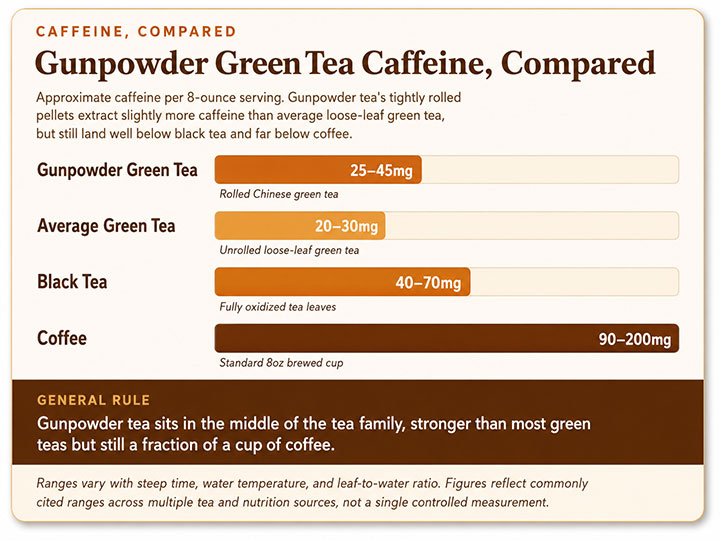
A cup of gunpowder green tea carries roughly 25 to 45 milligrams of caffeine, depending on how long it steeps and how tightly the leaves were rolled. That’s a wide range for one beverage category, so it helps to see it next to familiar alternatives.
How to Brew Gunpowder Green Tea
Water temperature is the one variable that makes or breaks a cup.
Gunpowder tea wants it hot, 175 to 185°F, well short of a rolling boil, which scalds the leaves and pulls out excess tannins. Use about one teaspoon, roughly 3 to 4 grams, per 8 ounces of water, and steep for 1 to 3 minutes depending on how bold you want it.
Watch the pellets rather than the clock on your first attempt. Tightly rolled gunpowder leaves unfurl slowly, and a properly steeped cup lands somewhere between light yellow and medium amber-green.
Pull the leaves out completely once the timer’s done. Leaving them in the water keeps extracting well past the point of pleasant.
The leaves have more to give after the first pour. A second steep, brewed slightly hotter at 185°F, for closer to two and a half minutes, tends to come out smoother and less astringent than the first. Good-quality gunpowder tea can typically handle three to four infusions total, with water temperature and steep time both climbing slightly each round.
Gunpowder Tea Brewing Calculator
Get the exact leaf amount, water temperature, and steep time for your cup
Your Brewing Guide
| Infusion | Water Temp | Steep Time |
|---|

Popular Varieties and Grades of Gunpowder Green Tea
This is the section most gunpowder tea articles skip, since it takes actual digging rather than a rewrite of the same three facts. Not all gunpowder tea comes from the same place, and the differences go beyond marketing.
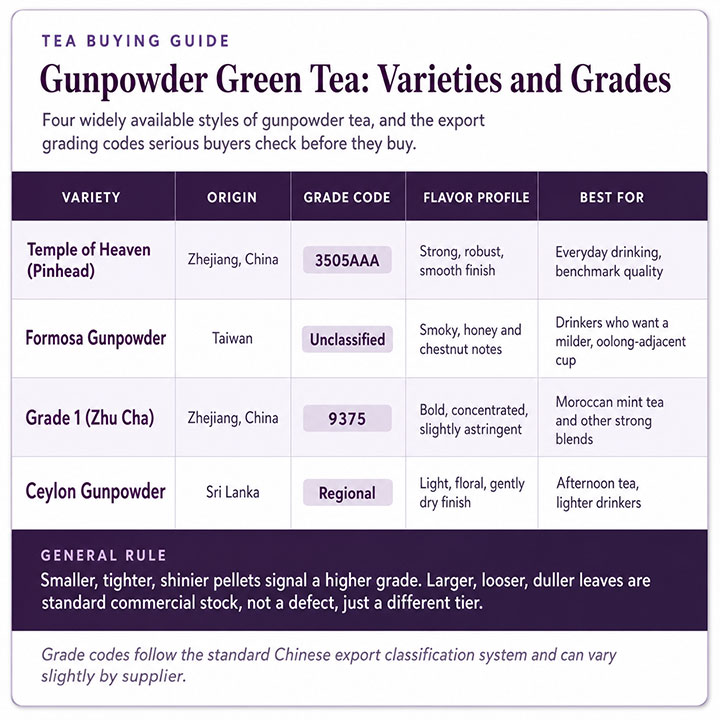
Temple of Heaven, also called Pinhead Gunpowder, sets the benchmark. Its pellets are small, tightly rolled, and glossy. That combination produces a smoother, less aggressive cup than lower grades.
Formosa Gunpowder, made in Taiwan, takes a different path: some producers start with oolong leaves rather than green. The result is a milder profile, with notes of honey and chestnut that set it apart from its mainland Chinese relatives. Ceylon Gunpowder, grown in Sri Lanka, rolls more loosely and delivers a lighter, more floral cup, better suited to an afternoon pour than a strong morning one.
Serious buyers pay attention to the grading codes stamped on export tea, a system most casual drinkers never encounter. The top grade, labeled 3505AAA, refers to small, tightly rolled, uniformly glossy pellets, the kind sold as Pinhead or Temple of Heaven.
Lower commercial grades, like 9375, are larger, looser, and duller in color. A shinier, smaller pellet in the bag is a reasonably reliable sign of the better grade, even without decoding the full code.
How to Store Gunpowder Green Tea
Gunpowder tea must be stored in an airtight, dark, cool, and dry place.
An opaque container blocks light, which fades both color and flavor over time. Moisture is the real enemy, since it invites mold, so skip the spot near the stove or dishwasher.
Away from spices, too. Tea absorbs strong odors fast, and a bag stored next to cinnamon or coffee will start to taste like it within weeks.
Buying in bulk? Split it into smaller sealed portions so most of the tea stays untouched by air until you actually need it.
Gunpowder Green Tea Recipes and Traditions
Most articles mention Moroccan mint tea and stop there, without explaining why gunpowder tea specifically became its base. Moroccan mint tea is the most famous use of gunpowder tea outside China, and the pairing isn’t random.
British merchants, sitting on a surplus of gunpowder tea during the Crimean War, redirected shipments toward North Africa in the mid-1800s.
The tea’s assertive, smoky body held up against generous mint and sugar in a way more delicate teas couldn’t, and the combination stuck. Traditional preparation brews the tea strong, adds fresh spearmint and sugar, then pours it from a height to build a frothy top, usually across three rounds that Moroccan hosts describe as moving from bitter to sweet.
Kashmir has its own version, less internationally known but built on the same base. Kahwa combines gunpowder tea with saffron, cardamom, and often crushed almonds, served without milk in small cups. It’s worth trying if Moroccan mint tea is already familiar territory and you’re curious what else this tea can carry.
Beyond hot drinks, gunpowder tea’s bold flavor holds its own mixed into other things. Steep it strong and blend it cold with spinach and banana for a smoothie with real backbone.
Use the brewed liquid instead of water when cooking rice for a subtle smoky note that pairs well with stir-fries. Infuse it into warm cream before making ice cream, or shake a concentrated brew into a gin and lemon cocktail for something with more edge than a standard sour.
Frequently Asked Questions
Which tea has the most caffeine?
Black tea typically carries the most caffeine among true teas, followed by oolong, then green teas like gunpowder, with white tea generally lowest. Coffee still outpaces all of them by a wide margin.
Is it safe to drink gunpowder green tea every day?
For most healthy adults, yes, within the same 3 to 5 cup range considered safe for green tea generally. People who are pregnant, caffeine-sensitive, or on blood thinners should talk to a doctor about a lower limit.
Does gunpowder green tea go bad?
It won’t spoil in a way that makes you sick, but it does lose flavor and aroma over time, especially if stored somewhere warm, damp, or bright. Properly sealed, it holds its quality for 6 to 12 months.
Does gunpowder green tea contain pesticides?
It can, depending on how the farm operates. Choosing tea with organic certification is the most reliable way to avoid pesticide residue if that’s a concern.
Can gunpowder tea be brewed iced?
Yes. Brew it double-strength using the standard hot method, then pour over ice, or cold-brew by steeping in the refrigerator for 6 to 8 hours for a smoother, less bitter result.