You’ve probably heard that blueberries are good for you. But here’s what most people don’t know: eating just one cup of blueberries daily for eight weeks can drop your blood pressure by 7 mmHg and cut your risk of heart disease by 13%.
That’s not marketing hype. That’s what happens inside your blood vessels when you stick to the plan.
In This Article, You’ll Learn:
- The exact timeline of how blueberries change your cardiovascular system
- Why 8 weeks is the minimum to see blood pressure changes
- How much you actually need to eat (it’s less than you think)
- Which type of blueberries work best (the answer might surprise you)
- Simple recipes that make daily consumption easy
- What results you can realistically expect based on your current health
The Science Behind the 8-Week Sweet Spot
Why eight weeks? It’s not random.
Your blood vessels need time to repair themselves. Think of it like training for a race. You don’t get faster after one workout. You need weeks of consistent effort for your body to adapt and change.
Research on people with high blood pressure, metabolic syndrome, and insulin resistance shows that eight weeks is when the biggest shifts happen. Your arteries become more flexible. Your blood pressure drops. Your cholesterol stops turning toxic.
But the changes start much sooner than you think.
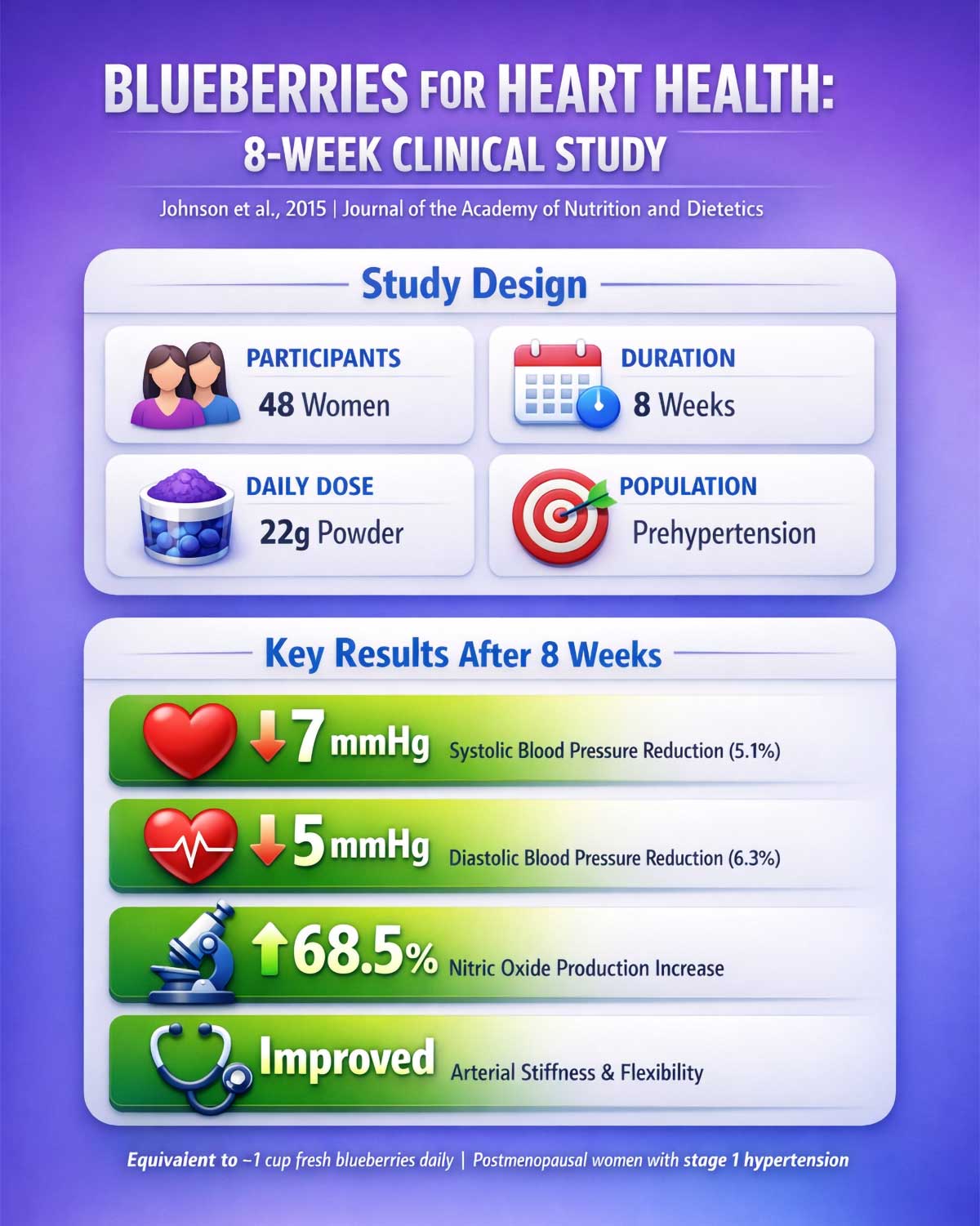
A 2015 study published in the Journal of the Academy of Nutrition and Dietetics tracked 48 postmenopausal women with slightly high blood pressure. After eight weeks of eating blueberries daily, their systolic pressure dropped by 7 mmHg and diastolic by 5 mmHg. Their bodies also produced 68.5% more nitric oxide, a compound that keeps blood vessels relaxed and healthy.
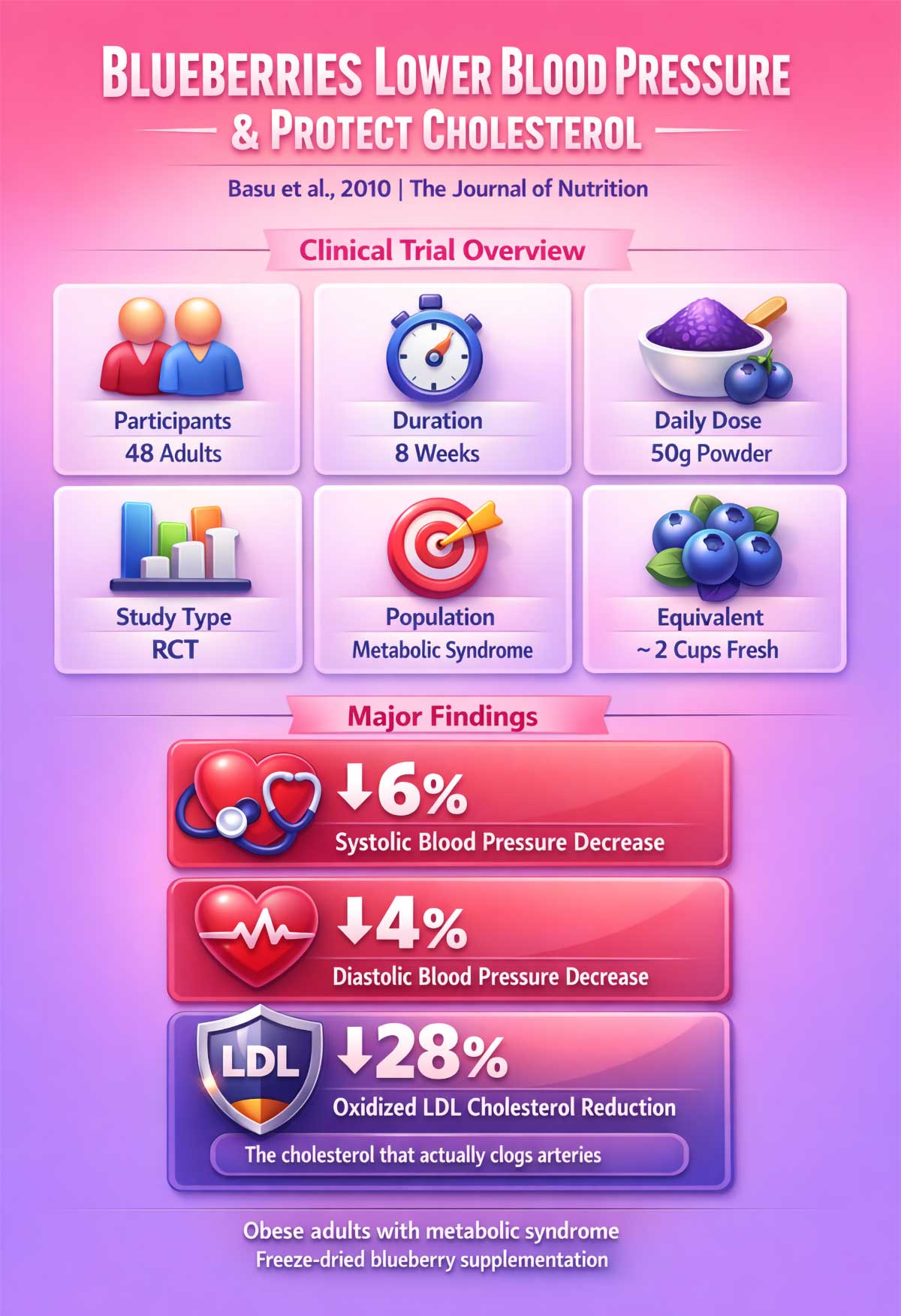
Another study from 2010 followed 48 adults with metabolic syndrome for eight weeks. They consumed about 2 cups worth of freeze-dried blueberries daily. Their blood pressure dropped by 6% systolic and 4% diastolic. But here’s the kicker: their oxidized LDL cholesterol plummeted by 28%. That’s the type of cholesterol that actually clogs your arteries.
What Counts as a “Dose”?
Before we get into the timeline, let’s talk portions.
Most studies use one of two amounts:
- 1 cup of fresh blueberries daily (about 150 grams)
- 22 grams of freeze-dried blueberry powder (equal to about 1 cup fresh)
That’s it. Not three cups. Not a handful here and there. One consistent cup per day.
The magic ingredient? Compounds called anthocyanins. They’re what make blueberries blue. And they’re what make your blood vessels work better.
Study Doses vs. What You Actually Need
Here’s something to keep in mind: not all studies used the same amount.
The Basu study from 2010 used 50 grams of freeze-dried powder, which equals roughly 2 cups of fresh berries. That’s a lot. But the Johnson study from 2015 used just 22 grams of powder (about 1 cup fresh) and still got excellent results. A long-term study from 2019 by Curtis and colleagues used exactly 150 grams of fresh blueberries—one cup—for six months and found significant improvements in blood vessel function.
The takeaway? One cup appears to be the sweet spot. More isn’t necessarily better. Your body can only process so many anthocyanins at once. Eating three cups won’t triple your benefits.
Stick with one cup. Make it a habit. That’s what the research supports.
Your 8-Week Transformation: A Visual Timeline
| Timeline | What’s Happening Inside | Measurable Change | Study Evidence |
|---|---|---|---|
| 2 Hours | Blood vessels widen temporarily | Improved blood flow | Rodriguez-Mateos 2013 |
| Week 2 | Nitric oxide production increases | Up to 68% increase by week 8 | Johnson 2015 |
| Week 4 | Endothelial cells start repairing | Improved arterial flexibility | Curtis 2019 |
| Week 6 | Insulin sensitivity improves | Better blood sugar control | Stull 2010 |
| Week 8 | Full cardiovascular benefits | BP: ↓5-7/4-6 mmHg, Oxidized LDL: ↓28% | Basu 2010, Johnson 2015 |
Hour 2: Your Blood Vessels Start to Relax
Within two hours of eating blueberries, something shifts in your bloodstream.
The polyphenols from the berries show up in your blood. They trigger a process called flow-mediated dilation. Your blood vessels literally widen to let more blood through.
This is temporary. It fades after a few hours. But it proves your body responds fast to what blueberries offer.
A 2013 study gave 21 healthy men different amounts of blueberry drinks and measured their blood vessel function over six hours. The researchers found that the arteries widened most effectively about 1-2 hours after consumption. The effect was dose-dependent—more anthocyanins meant better dilation. But even at the highest dose, blood pressure didn’t change. The benefit was purely in how well the blood vessels functioned.
Think of it as a preview of what’s coming if you keep going.
Weeks 1-2: The Nitric Oxide Factory Turns On
By the end of week two, your body starts making more nitric oxide.
Nitric oxide is a gas your blood vessels produce. It tells the muscles around your arteries to relax. When they relax, blood flows easier. Your heart doesn’t have to work as hard.
The Johnson 2015 study on women with high blood pressure found that blueberries increased nitric oxide by 68.5% after eight weeks. But the process starts in the first two weeks. Your endothelial cells—those single-layer cells lining your blood vessels—begin ramping up production almost immediately.
This is the foundation for everything that follows.
You won’t feel this happening. There’s no sudden rush of energy or noticeable change. But inside your cardiovascular system, the machinery is shifting into a healthier gear.
Week 4: Your Arteries Get Their Flexibility Back
Stiff arteries are a major problem as you age. When your blood vessels lose their stretch, your heart has to pump harder. That raises your blood pressure and wears out your cardiovascular system faster.
Blueberries reverse this.
At the four-week mark, studies show improvements in something called endothelial function. The endothelium is the thin layer of cells lining your blood vessels. It’s only one cell thick, but it controls whether your arteries stay flexible or turn rigid.
Eating blueberries helps repair damage to these cells. They clean up oxidative stress. They reduce inflammation. They restore the signals that keep your vessels soft and responsive.
What the Research Shows About Arterial Repair
A six-month study published in 2019 followed 115 adults with metabolic syndrome. Half ate 150 grams of blueberries daily. Half ate a matched placebo. After six months, the blueberry group improved their flow-mediated dilation by 1.45%.
That might sound small. But researchers calculated that this improvement translates to a 13% drop in future heart attacks and strokes. The people taking statin drugs didn’t see additional benefits, but those not on statins also experienced improvements in their HDL cholesterol—the good kind.
The repair work starts at week four and continues building through month six and beyond.

Week 6: Blood Sugar Stops Damaging Your Arteries
Here’s something most people miss: heart health isn’t just about cholesterol and blood pressure. It’s also about blood sugar.
When your blood sugar spikes after meals, it damages the lining of your arteries. Over time, this sets the stage for plaque buildup and blockages.
Blueberries help fix this problem by improving insulin sensitivity.
A 2010 study gave 32 people with insulin resistance a blueberry smoothie every day for six weeks. Their cells became better at using insulin. The improvement was significant: mean change of +1.7 units compared to +0.4 in the placebo group. Blood sugar stopped spiking as high. The constant assault on their blood vessel walls eased up.
But here’s an important detail: not every study shows this effect.
Another study by the same lead researcher in 2015 gave 44 adults with metabolic syndrome blueberry smoothies twice daily for six weeks. This time, insulin sensitivity didn’t improve. But endothelial function did—significantly. The reactive hyperemia index (a measure of blood vessel health) improved by 0.32 units in the blueberry group compared to a decline of 0.33 in the placebo group.
What does this mean? Blueberries help your cardiovascular system through multiple pathways. Sometimes it’s insulin. Sometimes it’s direct effects on blood vessels. For people with metabolic syndrome or prediabetes, the insulin benefits at week six can be significant. For others, the benefits show up differently.
Week 8: The Big Drop in Blood Pressure and Toxic Cholesterol
This is where the headline numbers come from.
At eight weeks, multiple studies show consistent drops in blood pressure:
- Systolic pressure (the top number) drops by 5-7 mmHg
- Diastolic pressure (the bottom number) drops by 4-6 mmHg
That’s enough to move you from “stage 1 hypertension” to “elevated” or from “elevated” to “normal.”
But here’s the part that gets less attention: oxidized LDL cholesterol.
You’ve heard that LDL is “bad cholesterol.” But LDL only becomes dangerous when it oxidizes. Think of it like butter going rancid. Once LDL oxidizes, it gets sticky. It burrows into your artery walls and starts forming plaques.
Blueberries stop this process.
The Basu 2010 study on people with metabolic syndrome found that eight weeks of blueberry consumption reduced oxidized LDL by 28%. Total cholesterol didn’t change. But the cholesterol in their blood became less likely to clog their arteries.
This is a huge deal. It’s one reason why blueberries protect your heart even if your cholesterol numbers don’t budge on your standard blood panel.
What These Numbers Actually Mean for Your Health
Let’s put these statistics into terms that matter for your life.
The Blood Pressure Drop: A reduction of 5 mmHg in systolic blood pressure is associated with about 10% lower stroke risk and 7% lower risk of death from heart disease, according to large population studies. That 7 mmHg drop seen in the Johnson study? It could translate to even better protection—roughly 14% lower stroke risk.
Think of it like this: your heart is a pump pushing against resistance. Every point of pressure it doesn’t have to overcome is like removing 10-15 pounds from a barbell you’re lifting. Your heart feels the difference, even if you don’t.
The Oxidized LDL Reduction: When LDL cholesterol oxidizes, it’s 10 times more likely to form arterial plaques than regular LDL. A 28% reduction in oxidized LDL means dramatically less material available to clog your arteries. Your total cholesterol number might stay the same, but the quality of your cholesterol improves substantially.
The Endothelial Function Boost: That 1.45% improvement in flow-mediated dilation correlates with a 13% reduction in cardiovascular events. For context, statin drugs improve endothelial function by about 2-3%. You’re getting roughly half the vascular benefit of a pharmaceutical intervention from a cup of berries.
These aren’t abstract numbers. They’re measurable reductions in your risk of the health events that end or severely diminish lives.
Clinical Evidence: What the Studies Actually Show
Here’s a detailed look at the research backing these claims:
| Study | Participants | Duration | Daily Dose | Systolic BP Change | Diastolic BP Change | Other Benefits |
|---|---|---|---|---|---|---|
| Johnson 2015 | 48 women with prehypertension | 8 weeks | 22g powder (~1 cup) | ↓7 mmHg (5.1%) | ↓5 mmHg (6.3%) | Nitric oxide ↑68.5%, improved arterial stiffness |
| Basu 2010 | 48 adults with metabolic syndrome | 8 weeks | 50g powder (~2 cups) | ↓6% | ↓4% | Oxidized LDL ↓28% |
| Stull 2015 | 44 adults with metabolic syndrome | 6 weeks | Smoothie 2x/day | No change | No change | Endothelial function improved significantly |
| Stull 2010 | 32 adults with insulin resistance | 6 weeks | Smoothie (~2 cups) | No change | No change | Insulin sensitivity ↑1.7 units |
| Rodriguez-Mateos 2013 | 21 healthy men | Acute (1-6 hours) | Blueberry drinks | No change | No change | Improved flow-mediated dilation |
| Curtis 2019 | 115 adults with metabolic syndrome | 6 months | 150g fresh (1 cup) | Not primary outcome | Not primary outcome | FMD ↑1.45% (13% ↓CVD risk), HDL improved |
Key Observation: Notice the pattern? Blood pressure changes happen primarily in people who already have elevated pressure or metabolic syndrome. Healthy people see vascular improvements without dramatic BP drops.
Important: Results Vary by Individual
Here’s something critical that often gets lost in health articles: your results depend heavily on your starting point.
If you’re a healthy 30-year-old with normal blood pressure (120/80 or lower), don’t expect your numbers to drop significantly. You might see a point or two of improvement, but that’s it. Your blood pressure is already optimal. There’s not much room to go lower without getting into hypotension territory.
What you will get—even as a healthy person—is improved endothelial function. Your arteries will work better. They’ll be more flexible. They’ll respond to stress more effectively. You’re building protection for decades down the road.
The Rodriguez-Mateos 2013 study proves this. Healthy men consumed blueberry drinks and showed significant improvements in flow-mediated dilation within hours. But their blood pressure didn’t budge. Their vessels worked better, but the pressure inside them was already fine.
Similarly, the Stull 2015 study showed improved endothelial function in people with metabolic syndrome, but zero change in blood pressure or insulin sensitivity. The benefits were real—just different from what other studies found.
Who Sees the Biggest Benefits?
The studies show the strongest effects in:
People with high blood pressure or prehypertension: If your systolic pressure is 120-139 or your diastolic is 80-89, you’re in the sweet spot for seeing measurable drops.
Postmenopausal women: Blood pressure often rises after menopause. The Johnson study specifically targeted this group and found the most dramatic results—7 mmHg systolic drop.
Adults with metabolic syndrome: This means you have at least three of these five markers: high blood sugar, high triglycerides, low HDL cholesterol, belly fat, or high blood pressure. Multiple studies show strong benefits for this population.
People with insulin resistance: Even if you don’t have full diabetes, cells that don’t respond well to insulin create inflammation that damages blood vessels. The Stull 2010 study showed blueberries can help reverse this.
If you’re young and healthy with normal blood pressure, you might not see dramatic drops in your numbers. But your blood vessels will still get healthier. You’re building protection for the future.
Wild vs. Regular Blueberries: Does It Matter?
Wild blueberries are smaller and darker than the big, plump berries you find at the grocery store. They also pack more anthocyanins per gram.
Here’s the actual data: wild blueberries contain about 480-700 mg of anthocyanins per 100 grams, while cultivated highbush blueberries contain about 140-480 mg per 100 grams. That’s a significant difference.
But does it matter for heart health?
Some studies use wild blueberries. Others use regular cultivated varieties. Both show benefits. The key difference is that you might need to eat slightly more cultivated berries to get the same anthocyanin dose as wild berries.
Practically speaking, most people don’t have easy access to wild blueberries. They’re harder to find fresh and usually only available frozen. They’re also more expensive—sometimes double the price of regular blueberries.
The good news? The Curtis 2019 study used regular cultivated blueberries (150g daily) and still found that 13% reduction in cardiovascular risk. The Johnson 2015 study used freeze-dried powder from cultivated berries and got the 7 mmHg blood pressure drop.
Bottom line: Wild blueberries have more anthocyanins per gram. But regular blueberries work just fine if you eat the full cup. Don’t stress about variety. Consistency matters more than source.
Taste-wise, wild blueberries are more intense and tart. Some people prefer them in baked goods or smoothies where the stronger flavor shines. Regular blueberries are sweeter and better for snacking straight from the container.
Fresh vs. Frozen: The Surprising Winner
Frozen blueberries might actually be better for your heart than fresh ones.
Here’s why: blueberries are frozen at peak ripeness. The freezing process doesn’t destroy the anthocyanins. In fact, it breaks down the cell walls slightly, which can make the compounds easier for your body to absorb.
Fresh berries lose nutrients as they sit. If they’ve been on a truck for days and in your fridge for a week, they’re not as potent as they were at harvest. Studies show that anthocyanin content can drop by 10-15% within a few days of picking.
Frozen berries are also cheaper. You can buy them in bulk and always have them on hand. A typical 3-pound bag costs about $7-10, compared to $4-6 per pound for fresh berries in season (and $7-9 off-season).
Most of the major studies used freeze-dried powder, which is concentrated frozen berries. The Johnson 2015 study, the Basu 2010 study, and both Stull studies all used freeze-dried forms. This suggests frozen is perfectly acceptable—if not preferable—for heart health.
One more benefit: frozen blueberries are available year-round. You’re not dependent on growing seasons or paying premium prices in winter.
Cost Analysis: Is the 8-Week Protocol Affordable?
Let’s talk money, because this matters.
A 3-pound bag of frozen blueberries costs about $8-10 at most grocery stores. That bag contains roughly 12 cups of berries. At one cup per day, it lasts 12 days.
Cost breakdown:
- Per day: $0.67-$0.83
- Per week: $4.69-$5.81
- For 8 weeks: $37.52-$46.48
Fresh blueberries cost more. At $4.99 per pound (average), and with about 2.5 cups per pound, you’re paying roughly $2 per cup.
Fresh berry cost:
- Per day: $2.00
- Per week: $14.00
- For 8 weeks: $112.00
Compare that to blood pressure medication. Generic lisinopril costs about $4-12 per month with insurance, but $20-40 without. That’s $16-32 for eight weeks. Seems cheaper than blueberries, right?
But here’s what the medication doesn’t do: improve your endothelial function, reduce oxidized LDL, increase nitric oxide production, or provide fiber, vitamin C, vitamin K, and dozens of other beneficial compounds.
Blueberries aren’t replacing medication—check with your doctor before changing any prescriptions. But they offer benefits beyond what a single drug provides.
Budget strategies:
- Buy frozen in bulk when on sale
- Store brands work just as well as name brands
- Shop at warehouse clubs (Costco, Sam’s Club) for better per-pound prices
- Mix frozen berries into smoothies and oatmeal to make them taste just as good as fresh
For most people, $40-50 over eight weeks is manageable. That’s less than $6 per week. Skip one coffee shop visit and you’ve covered it.
What About Other Berries?
Strawberries, blackberries, and raspberries also contain anthocyanins and other beneficial polyphenols. They’re not bad for your heart.
But the research specifically on cardiovascular outcomes focuses heavily on blueberries.
A 2016 meta-analysis by Huang and colleagues looked at berry consumption and heart health. They found that blueberry and anthocyanin-rich berry interventions were associated with significant reductions in blood pressure and improvements in lipid profiles. The effects were strongest for blueberries specifically.
Another 2020 meta-analysis by Zhu examined randomized controlled trials on blueberries. They found that blueberry consumption significantly improved endothelial function and lowered blood pressure across multiple studies. Other berries weren’t included in this analysis because the evidence wasn’t as strong.
Can you rotate berries for variety? Absolutely. Eating different colored fruits provides a wider range of phytonutrients. But if your specific goal is improving cardiovascular markers based on clinical evidence, blueberries have the strongest research backing.
Strawberries are lower in anthocyanins per gram than blueberries. Blackberries are higher, but there are fewer studies on their cardiovascular effects. Raspberries fall somewhere in between.
Practical approach: Make blueberries your primary berry for heart health, but don’t stress if you occasionally substitute others. The key is consistent berry consumption, period.
Three Simple Ways to Eat Blueberries Every Day
You don’t need fancy recipes. You just need to hit one cup per day.
The Morning Smoothie: Toss a cup of frozen blueberries into your blender with yogurt, a banana, and a handful of spinach. The fiber from the whole fruit keeps your blood sugar steady while the anthocyanins go to work on your arteries. Add a tablespoon of ground flaxseed for omega-3 fatty acids that provide additional heart protection.
The Oatmeal Standard: Cook your oats, then stir in fresh or frozen blueberries. The combination of soluble fiber from oats and polyphenols from blueberries is backed by research as a powerful one-two punch for heart health. Oats lower LDL cholesterol. Blueberries prevent that cholesterol from oxidizing. Together, they protect your arteries from multiple angles.
The Evening Snack: Keep a bag of frozen blueberries in your freezer. When you want something sweet after dinner, grab a handful. They taste like tiny ice pops. This simple swap cuts out processed sugar and delivers antioxidants right when your body is repairing itself overnight.
Three Heart-Smart Blueberry Recipes
Recipe 1: Study-Based Blueberry Smoothie
This recipe mirrors the protocol used in the Stull research studies.
Ingredients:
- 1 cup frozen blueberries
- 1 cup unsweetened almond milk (or milk of choice)
- ½ banana
- 1 tablespoon ground flaxseed
- 5-6 ice cubes
- ½ teaspoon vanilla extract (optional)
Instructions: Combine all ingredients in a blender. Blend on high for 30-60 seconds until smooth. Drink immediately for maximum nutrient absorption.
Nutrition info: Approximately 200 calories, 6g fiber, 5g protein, 380-450mg anthocyanins (estimated)
Why it works: The combination of whole fruit fiber, healthy fats from flaxseed, and potassium from banana creates a heart-healthy package that won’t spike your blood sugar.
Recipe 2: Anti-Inflammation Overnight Oats
Prepare this the night before for an easy grab-and-go breakfast.
Ingredients:
- ½ cup rolled oats
- ¾ cup unsweetened almond milk
- ½ cup blueberries (fresh or frozen)
- 1 tablespoon chia seeds
- Pinch of cinnamon
- 1 teaspoon honey (optional)
Instructions: Mix all ingredients in a jar or container. Stir well. Refrigerate overnight (or at least 4 hours). Eat cold or microwave for 60-90 seconds.
Why it works: Soluble fiber from oats (beta-glucan) has been shown to lower LDL cholesterol by 5-10% in studies. Combined with blueberry anthocyanins that prevent LDL oxidation, you’re attacking heart disease from two angles. Chia seeds add omega-3s and additional fiber.
Recipe 3: No-Sugar Blueberry “Nice Cream”
A healthy dessert that satisfies sweet cravings without added sugar.
Ingredients:
- 2 frozen bananas (peel before freezing)
- 1 cup frozen blueberries
- 2 tablespoons plain Greek yogurt
- Splash of almond milk (just enough to help blend)
Instructions: Add all ingredients to a food processor or high-powered blender. Process until smooth and creamy, stopping to scrape down sides as needed. Serve immediately for soft-serve texture, or freeze for 30 minutes for firmer consistency.
Why it works: This replaces processed ice cream (which often contains 20-30g of added sugar per serving) with whole fruit sweetness. The Greek yogurt adds protein and probiotics. You get your full cup of blueberries in a treat that feels indulgent but supports your cardiovascular goals.
What About Blueberry Supplements?
Some companies sell blueberry extract pills or powders. They’re convenient. But they’re not the same as eating whole berries.
Whole blueberries contain fiber, vitamin C, vitamin K, manganese, and dozens of other compounds that work together. Scientists call this “food synergy.” When you isolate one ingredient—even anthocyanins—you lose the complex interactions that make the whole food effective.
The studies showing heart benefits used whole blueberries or freeze-dried powder made from whole berries. Not extracts. Not isolated anthocyanins.
A cup of blueberries provides about 4 grams of fiber. That fiber slows sugar absorption and feeds beneficial gut bacteria. It also helps lower cholesterol on its own. A supplement pill gives you zero fiber.
Blueberries also contain vitamin K, which plays a role in blood clotting. If you’re on blood-thinning medication, your doctor needs to know about consistent vitamin K intake. A supplement might not provide the same amount, making your dosing unpredictable.
The verdict: Stick with whole berries—fresh or frozen. If you’re traveling and can’t access berries for a few days, a freeze-dried powder mixed into water is acceptable. But don’t make supplements your long-term strategy. The research doesn’t support it, and you miss out on valuable nutrients.
How Blueberries Compare to Other Heart-Healthy Foods
You have many options for protecting your cardiovascular system through diet. Here’s how blueberries stack up:
| Food | Heart Health Benefit | Time to See Results | Daily Amount Needed | Key Mechanism |
|---|---|---|---|---|
| Blueberries | BP ↓5-7 mmHg, improved endothelial function | 6-8 weeks | 1 cup | Anthocyanins increase nitric oxide |
| Dark Chocolate | BP ↓2-3 mmHg | 2-8 weeks | 30-50g (70%+ cocoa) | Flavanols improve vascular function |
| Beetroot Juice | BP ↓4-5 mmHg | 2-4 weeks | 250ml | Dietary nitrates convert to nitric oxide |
| Oats | LDL ↓5-10% | 6 weeks | 3g beta-glucan daily (~1 cup cooked) | Soluble fiber binds cholesterol |
| Walnuts | LDL ↓5%, improved endothelial function | 4-8 weeks | 1.5 oz (~14 halves) | Omega-3s reduce inflammation |
| Fatty Fish | Triglycerides ↓15-30% | 4-8 weeks | 2-3 servings/week | EPA and DHA omega-3s |
Key insight: No single food is a magic bullet. But blueberries offer a unique combination of blood pressure reduction, endothelial improvement, and LDL protection that rivals or exceeds other foods. The fact that they’re easy to eat daily and require zero preparation gives them a practical advantage.
Best strategy: Combine multiple heart-healthy foods. Have blueberries and oats for breakfast. Snack on walnuts. Eat salmon twice a week. Your cardiovascular system will thank you.
Tracking Your Progress: How to Measure What’s Happening
The most important changes from eating blueberries are invisible. But you can track some markers at home.
Blood Pressure Monitoring
If you have a home blood pressure monitor, use it consistently:
Best practices:
- Measure at the same time each day (morning is ideal)
- Sit quietly for 5 minutes before measuring
- Keep your arm at heart level
- Take two readings, one minute apart, and average them
- Track your numbers in a notebook or app
Don’t expect daily changes. Blood pressure fluctuates based on stress, sleep, sodium intake, and dozens of other factors. Look at weekly averages instead.
You might see small improvements by week 3-4. The bigger shifts usually appear by week 6-8.
What to expect: If you start at 135/85 (stage 1 hypertension), you might drop to 128/80 by week 8. That’s the difference between “hypertensive” and “elevated.” Keep going, and you might reach normal (below 120/80) over several months.
Energy and Sleep Quality
Many people report better energy and sleep quality after several weeks of eating blueberries. This isn’t typically measured in studies, but it makes sense.
Better blood flow means better oxygen delivery to tissues. Less inflammation means better sleep. Lower oxidative stress means your mitochondria (cellular power plants) work more efficiently.
Keep a simple log:
- Energy level (1-10 scale)
- Sleep quality (1-10 scale)
- Mood (1-10 scale)
Rate yourself weekly. See if patterns emerge.
When to See Your Doctor
Don’t try to replace medical care with blueberries. If you take blood pressure medication, don’t stop it because you’re eating berries.
But do tell your doctor what you’re doing. If your blood pressure drops significantly over 8-12 weeks, your physician might adjust your medication dose. That’s a good thing—it means the dietary change is working.
Schedule a follow-up appointment around week 8-10 to review your progress.
The Long Game: From 8 Weeks to a Lifetime
Eight weeks proves the concept. Your blood pressure drops. Your arteries work better. Your cholesterol becomes less dangerous.
But the real payoff comes when you make blueberries a permanent part of your diet.
Long-term studies suggest that people who eat berries regularly have significantly lower rates of heart disease. A large prospective study following over 93,000 women for 18 years found that those who ate the most anthocyanin-rich foods (berries) had an 8% lower risk of heart attack, even after controlling for other dietary factors.
The effects compound over years. Your cardiovascular system stays younger longer.
Think of it this way: every cup of blueberries is a small deposit in your heart health bank account. Eight weeks shows you the interest. A lifetime builds wealth.
But you don’t need to be perfect. If you miss a few days here and there, don’t stress. The studies show benefits from consistent consumption, but “consistent” doesn’t mean “never miss a single day.”
Aim for 5-7 days per week. That’s realistic. That’s sustainable. That’s what will actually improve your health over decades.
Potential Side Effects and Precautions
Blueberries are remarkably safe for most people. But there are a few things to know.
Blood Thinning Concerns
Blueberries contain vitamin K, which plays a role in blood clotting. One cup provides about 29 micrograms—roughly 24% of your daily value.
If you take warfarin (Coumadin) or other blood thinners, you need consistent vitamin K intake. Your medication dose is calibrated to your usual diet. Adding a cup of blueberries daily changes your vitamin K intake, which could affect how well your medication works.
Solution: Tell your doctor you’re adding blueberries to your diet. They might need to adjust your medication dose or monitor your INR levels more closely for a few weeks. Once your intake is stable, your dose can be recalibrated.
This doesn’t mean you can’t eat blueberries on blood thinners. It means you need medical supervision to do it safely.
Digestive Adjustments
One cup of blueberries provides 4 grams of fiber. If you currently eat very little fiber, jumping straight to a cup of berries daily might cause bloating, gas, or loose stools.
Solution: Start with ½ cup for the first week. Increase to ¾ cup the second week. Hit the full cup by week three. This gives your digestive system time to adjust.
Drink plenty of water. Fiber needs water to work properly.
Blood Sugar Considerations
Blueberries contain natural sugars—about 15 grams per cup. For most people, including those with diabetes, this is fine. The fiber slows sugar absorption, preventing spikes.
But if you have diabetes and tight blood sugar control, monitor your levels after adding blueberries. You might need to adjust your meal plan or medication.
Note: Most studies on blueberries and metabolic syndrome showed improved insulin sensitivity and blood sugar control. But individual responses vary. Track your numbers.
Allergic Reactions
Blueberry allergies are rare but possible. Symptoms might include itching, swelling, hives, or difficulty breathing.
If you’ve never eaten blueberries before, start with a small amount (¼ cup) and wait 24 hours. If no reaction occurs, you’re likely fine to continue.
Drug Interactions
Beyond blood thinners, be aware of potential interactions:
Diabetes medications: Blueberries might lower blood sugar. Combined with diabetes drugs, this could cause hypoglycemia. Monitor closely.
Blood pressure medications: If blueberries lower your BP by 5-7 mmHg and you’re on BP meds, you could experience dizziness or lightheadedness from blood pressure that’s too low. Your doctor might need to adjust your dose.
Bottom line: Always consult your healthcare provider before using food as medicine, especially if you take medications for chronic conditions.
What to Expect Week by Week: A Realistic Timeline
Week 1: You probably won’t feel anything yet. But your blood vessels are already responding to the polyphenols in your bloodstream. The acute effects happen within hours, but they’re temporary at this stage.
Week 2: Your body ramps up nitric oxide production. Blood flow improves slightly, though you still might not notice. Some people report feeling slightly more alert or energized, but this is subtle and not universal.
Week 3: The endothelial repair process is underway. Inflammation markers in your blood are starting to drop. You still won’t see changes in blood pressure if you’re monitoring at home.
Week 4: If you check your blood pressure, you might see small improvements—maybe 2-3 mmHg lower than baseline. Your arteries are becoming more flexible. The cells lining your blood vessels are healthier.
Week 5: Metabolic improvements are building. If you’re tracking blood sugar, you might notice slightly lower fasting glucose or less dramatic post-meal spikes.
Week 6: This is where insulin sensitivity improves in responsive individuals. Your cells are handling glucose better. The constant low-grade inflammation that damages arteries is easing up.
Week 7: You’re approaching peak benefits. Blood pressure continues dropping. Oxidized LDL levels are falling. Nitric oxide production is significantly elevated.
Week 8: The full effect hits. Blood pressure reaches its lowest point relative to where you started. Oxidized LDL is down by roughly 25-30%. Your cardiovascular risk has measurably decreased. This is the milestone the studies point to.
After week eight, the benefits plateau. You maintain the gains as long as you keep eating blueberries. Stop, and the effects gradually reverse over several weeks.
The Bottom Line on Blueberries for Heart Health
One cup of blueberries per day for eight weeks can:
- Lower systolic blood pressure by 5-7 mmHg
- Lower diastolic blood pressure by 4-6 mmHg
- Increase nitric oxide production by up to 68%
- Improve endothelial function by 1.45% (linked to 13% lower cardiovascular risk)
- Reduce oxidized LDL cholesterol by 28%
- Improve arterial stiffness and flexibility
The effects are strongest in people with existing risk factors like high blood pressure, metabolic syndrome, or insulin resistance. But even healthy people build protection for the future.
Fresh or frozen both work. Aim for one cup daily. Add them to smoothies, oatmeal, or eat them straight from the freezer.
Eight weeks proves it works. A lifetime makes it count.
The research is clear. The mechanism is understood. The cost is reasonable. The side effects are minimal.
You now know exactly what happens to your heart when you eat blueberries every day for eight weeks. The question is: will you do it?
FAQs
Can I eat too many blueberries?
Technically, yes, but it’s hard to do. Eating 3-4 cups daily would give you a lot of fiber (12-16g), which might cause digestive discomfort. You’d also get about 60 grams of natural sugar, which could affect blood sugar levels in sensitive individuals. Stick with 1-2 cups daily. That’s the range used in studies, and it’s sustainable long-term.
Do blueberry supplements work as well as whole berries?
No. The studies showing cardiovascular benefits used whole blueberries or freeze-dried whole berry powder. Isolated anthocyanin extracts don’t provide the fiber, vitamins, minerals, and other compounds that work together to protect your heart. Supplements are convenient for travel, but whole berries should be your primary source.
Will cooking blueberries destroy the heart-healthy compounds?
Anthocyanins are relatively heat-stable, but some degradation occurs with prolonged cooking. Baking blueberries into muffins at 350°F for 20-25 minutes causes minimal loss—maybe 10-15%. Quick cooking methods like microwaving or light sautéing preserve most nutrients. But raw or frozen berries (thawed) give you maximum anthocyanin content.
Can I get the same benefits from other berries?
Strawberries, blackberries, and raspberries contain beneficial compounds. But the strongest research on blood pressure reduction and endothelial function focuses on blueberries specifically. You can rotate berries for variety, but make blueberries your primary choice if cardiovascular health is your main goal.
How long do I need to eat blueberries to maintain the benefits?
Studies show benefits appear at 6-8 weeks and continue as long as you keep eating them. The Curtis 2019 study followed people for six months and found sustained improvements. Stop eating blueberries, and the benefits gradually fade. This isn’t a short-term fix. It’s a lifestyle change.
What if I miss a few days?
Don’t worry about occasional gaps. The studies measured daily consumption, but real life happens. Aim for 5-7 days per week. If you miss 2-3 days, just resume when you can. Consistency matters more than perfection.
Are organic blueberries worth the extra cost for heart health?
Organic blueberries have similar anthocyanin content to conventional ones. The heart health benefits are the same. Buy organic if pesticide residue concerns you or if you want to support organic farming. But don’t skip blueberries entirely because you can’t afford organic. Conventional berries deliver the same cardiovascular protection.
Can blueberries replace my blood pressure medication?
No. Never stop prescribed medication without your doctor’s supervision. Blueberries can complement your treatment plan, and they might allow your doctor to reduce your medication dose over time. But they’re not a replacement for medical care. Always work with your healthcare provider to make medication changes safely.
Medical Disclaimer: This article is for informational purposes only and does not replace professional medical advice. Always consult your healthcare provider before making dietary changes, especially if you take medications or have existing health conditions.