Your brain is tiny. It makes up just 2% of your body weight. Yet it burns through 20% of your daily energy supply. Think about that for a moment. This three-pound organ demands more fuel than your legs, your heart, or any other system in your body.
When that fuel runs low, you feel it. Brain fog sets in. Simple decisions become hard. Your thinking slows to a crawl. Scientists call this an energy crisis. You might call it a bad day.
For years, researchers have studied creatine as a sports supplement. It helps muscles work harder for longer. But your brain runs on the same energy system as your muscles. And when stress hits—whether from lost sleep, tough deadlines, or simply getting older—that system starts to fail.
Hundreds of studies have now moved past the gym. They’ve tested creatine on the human mind. Here’s what they found.
Creatine Helps Your Brain Fight Back When You’re Sleep Deprived
You pull an all-nighter. Or maybe you have a newborn at home. Either way, your brain suffers.
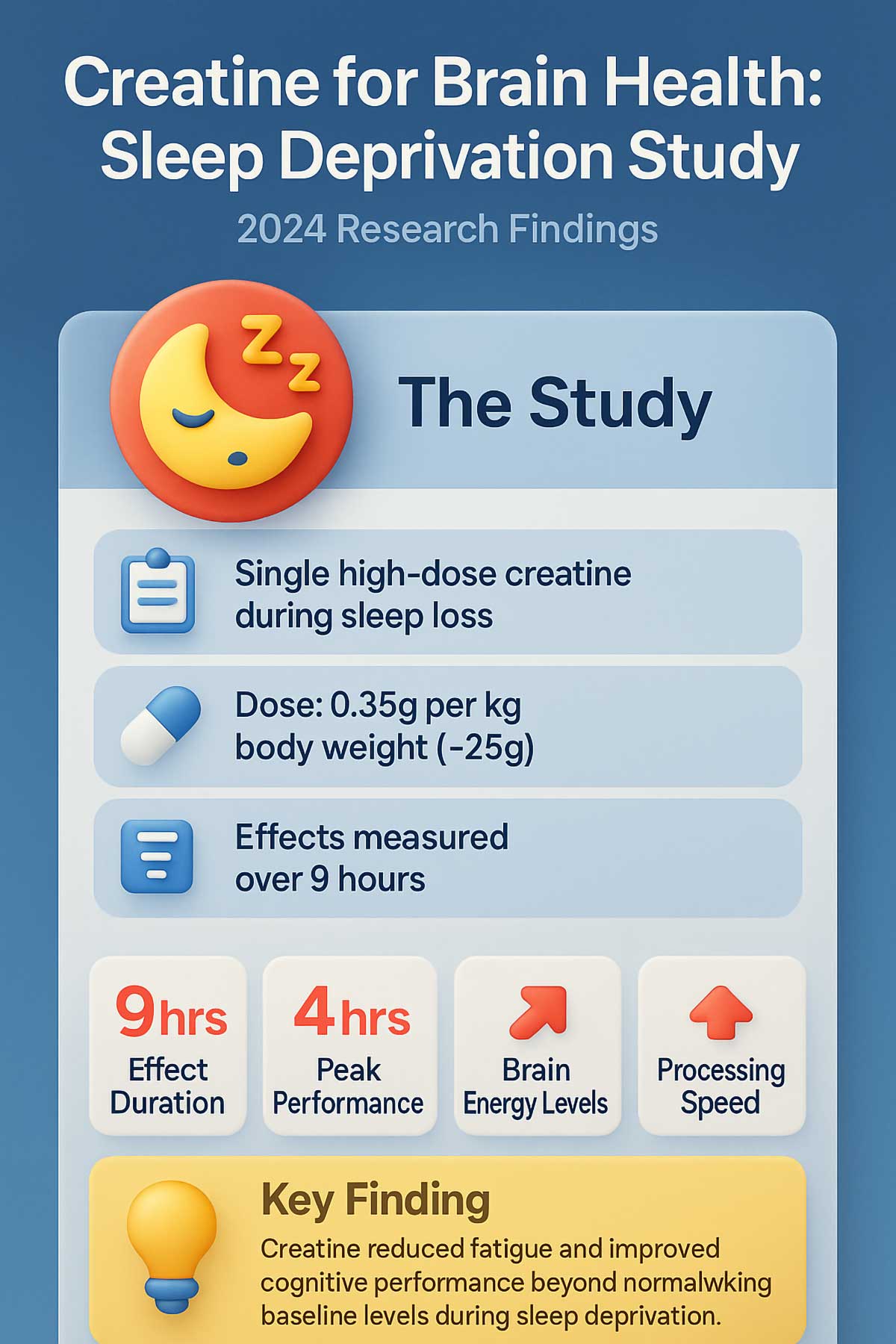
A 2024 study tested what happens when people take a single high dose of creatine during sleep loss. Participants received 0.35 grams per kilogram of body weight—about 25 grams for a 160-pound person. The results were striking. Creatine improved cognitive performance and brain energy levels during sleep deprivation, with effects lasting up to 9 hours and peaking around 4 hours after intake.
Here’s what happens: when you stay awake too long, your brain’s energy stores drop. Cells struggle to make enough ATP—the molecule that powers every thought you have. Stress hormones spike. Your ability to focus, remember, and react all take a hit.
Creatine acts as a backup battery. It doesn’t replace sleep. Nothing does. But it stops your brain from crashing when you’re tired.
The researchers found something else. Creatine reduced subjective fatigue and improved processing speed beyond normal waking baseline levels. This wasn’t just about preventing decline. Under certain conditions, creatine actually pushed performance higher than normal.
The key is this: creatine works best when your brain is under strain. Push yourself hard enough, and you’ll feel the difference.
Plant-Based Eaters Get the Strongest Response
Meat and fish contain creatine. Plants don’t.
If you follow a plant-based diet, your body makes all the creatine it needs. But those stores stay lower than in people who eat animal products. That’s just basic biochem.
The original vegetarian study from 2003 found clear improvements in memory tasks after creatine use. But recent research tells a more complex story. A large 2023 trial with 128 participants—the biggest creatine study to date—found no significant cognitive improvements from creatine in the general population after 6 weeks of daily use.
So what’s going on? The answer likely comes down to baseline levels. Research shows that women have 70-80% lower creatine stores than men, and vegetarians typically have the lowest stores of all. If you already get creatine from steak or salmon, adding more won’t do much. Your brain is already topped off. But if you eat tofu and lentils, there’s room to grow.
A 2024 analysis confirmed this pattern. Studies show that cognitive enhancement effects of creatine may reach a saturation point within a certain time frame, and short-term, high-dose supplementation shows significant effects on cognitive function tests.
This is what scientists call the “low-baseline effect.” The lower your starting point, the bigger the gain.
Creatine Powers Your Brain During Complex Mental Work
Your brain does two kinds of work. Simple stuff—like walking or humming a song—barely taxes your system. Complex tasks—like solving math problems under pressure or juggling three projects at once—drain energy fast.
Scientists call this second category “executive function.” It includes working memory, quick thinking, and the ability to switch between tasks without losing your place.
A July 2024 analysis looked at 16 trials with 492 adults. The researchers found that creatine supplementation produces significant positive effects on memory and attention. The benefits show up most clearly when cognitive load is high.
Here’s the difference between creatine and caffeine: caffeine stimulates. It makes you feel alert by blocking the chemical signals that tell your brain you’re tired. Creatine doesn’t wake you up. It fuels you. It gives your neurons the raw materials they need to keep firing at full speed.
Think of it this way. Caffeine is like turning up the volume on a dying battery. Creatine is like plugging in a charger.
One study tested participants on working memory tasks after 6 weeks of creatine use. Those who took creatine performed better on complex reasoning tests. The effect was modest but consistent. Pop quizzes. Deadlines. Learning new skills. These are the situations where creatine shines.
Women and Creatine: A Special Case
Here’s something most articles miss: women may benefit from creatine more than men. And the effect gets stronger with age.
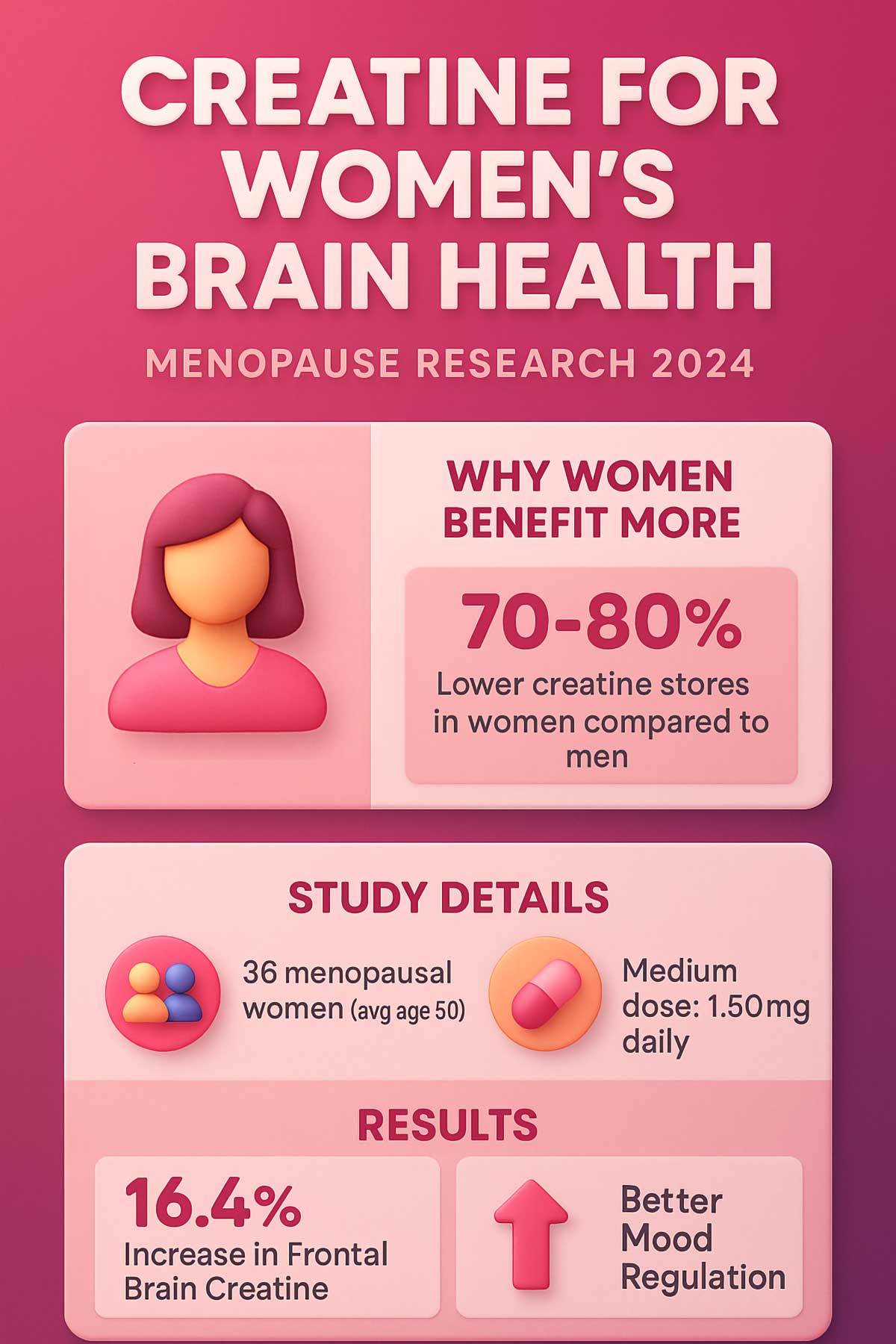
Women naturally have 70-80% lower creatine stores than men. This gap widens during menopause when estrogen drops. Lower estrogen means less efficient creatine production. Less creatine means less brain energy.
A groundbreaking 2024 study tested creatine in women going through menopause. Thirty-six women aged around 50 received either low-dose (750mg), medium-dose (1,500mg), or a combination of creatine types for 8 weeks. The results were clear.
Medium-dose creatine improved reaction time by 6.6% compared to just 1.2% for placebo, and increased frontal brain creatine levels by 16.4% compared to 0.9% for placebo. Women also reported better mood regulation.
Another study looked at sleep quality. Women in perimenopause who took 5g of creatine daily reported fewer sleep disturbances and improved cognitive scores. One-third of postmenopausal participants moved from mild cognitive impairment range to normal range—a clinically meaningful shift.
Why does this matter? Women often face brain fog during menopause. They blame hormones. And they’re right. But creatine offers a practical way to fight back against the energy deficit that declining estrogen creates.
Who Benefits Most From Creatine?
| Your Profile | Likely Response | Recommended Dose |
|---|---|---|
| Vegetarian or vegan | High responder | 5g daily |
| Sleep deprived (under 6 hours) | High responder | 5g daily or 0.35g/kg for acute needs |
| Women 45+ (perimenopause/menopause) | High responder | 3-5g daily |
| Meat eaters with good sleep | Moderate responder | 3-5g daily during stress periods |
| Students during exam periods | Moderate to high responder | 5g daily starting 4 weeks before exams |
| Athletes and active people | Variable for cognition | 5g daily |
Creatine May Protect the Brain After Injury
Traumatic brain injury doesn’t end when the impact stops. The real damage often comes after.
When your brain gets hit, cells enter a state of crisis. They need more energy to repair themselves. But the injury disrupts normal energy production. This creates a vicious cycle. Cells struggle. Symptoms linger. Recovery drags on.
One study looked at children who had suffered head injuries. Half received creatine for six months. The other half didn’t. The creatine group had fewer headaches, less dizziness, and less fatigue.
The mechanism makes sense. Creatine helps maintain cell structure when energy supplies run low. It doesn’t heal the injury. But it may keep damaged neurons alive long enough to recover.
Research on retired NFL players found something disturbing. Players who experienced repetitive head impacts during their careers showed decreased brain creatine in the parietal white matter many years later, along with cognitive and mood symptoms.
This has major implications for contact sports. Athletes in football, hockey, or rugby face repeated head impacts. Loading creatine before the season—not just after an injury—might offer protection. The research here is still early. But it’s promising enough to take seriously.
Creatine Shows Potential for Treatment-Resistant Depression
Depression isn’t just about mood. It’s also about energy.
Brain imaging studies show that people with major depression have lower energy production in certain brain regions. Their cells struggle to make enough ATP. This affects mood regulation, motivation, and the ability to feel pleasure.
One trial tested creatine as an add-on treatment for women with depression who weren’t responding well to standard medications. They took creatine along with their usual SSRI. The creatine group improved faster and showed greater symptom reduction than the placebo group.
This doesn’t mean creatine treats depression on its own. It doesn’t replace therapy or medication. But it may speed up the response to traditional treatments by fixing an underlying energy problem.
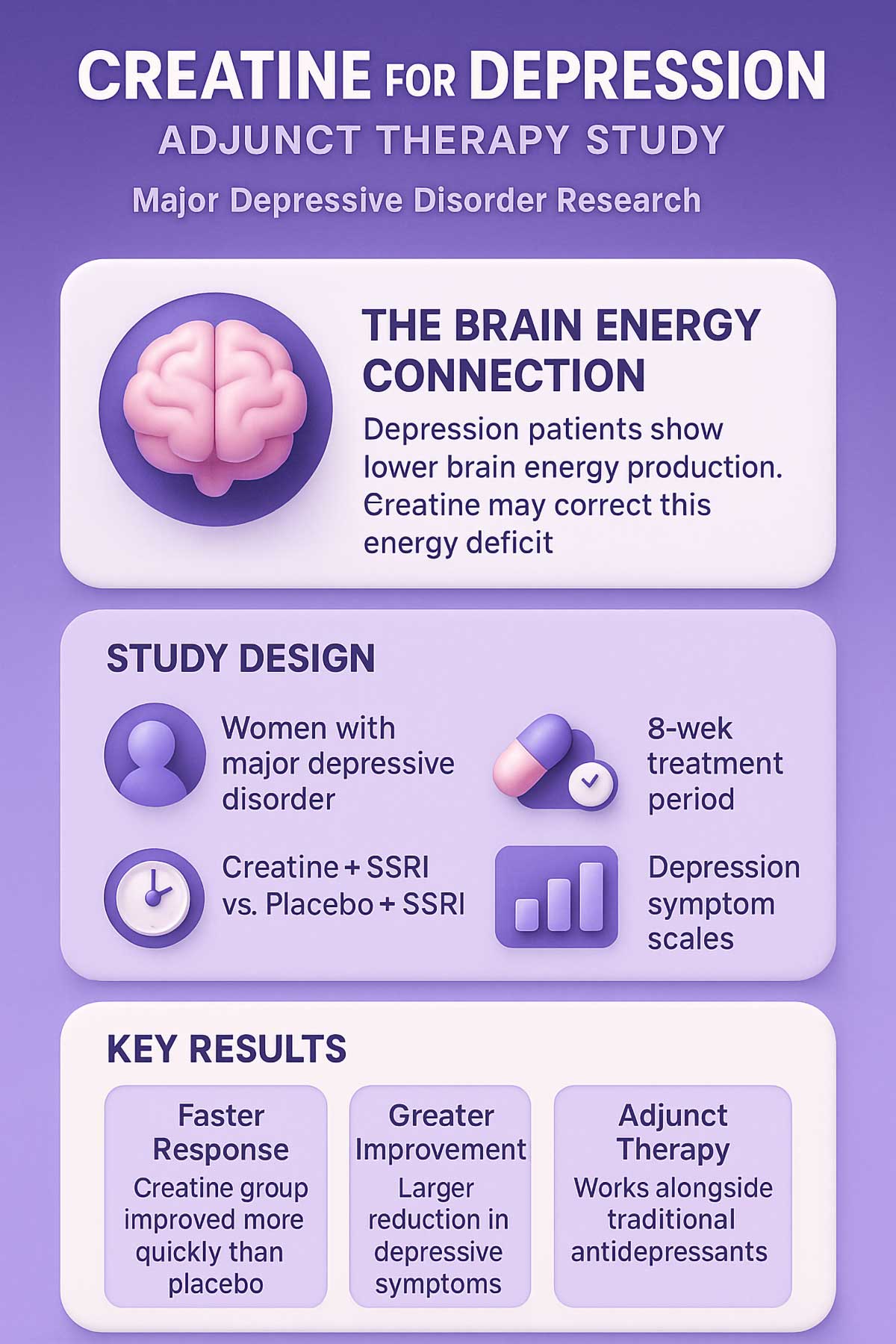
Studies show that women have lower levels of creatine in the brain, particularly in the frontal lobe, which controls mood, cognition, memory and emotion. Several trials have found that creatine combined with regular antidepressants reduced depressive symptoms in female teens and adults with major depression.
The science here is still developing. Most studies focus on women. We need more data on men and different types of depression. But the early results are compelling enough to warrant attention.
Should I Take Creatine?
Take this quiz to find out if creatine is right for you
How Your Brain Gets Saturated With Creatine
Getting creatine into your brain takes time. It’s not like caffeine, which hits in 30 minutes. Your brain needs weeks to fill up its creatine stores.
Brain Saturation Timeline
| Timeline | What’s Happening | What You Might Notice |
|---|---|---|
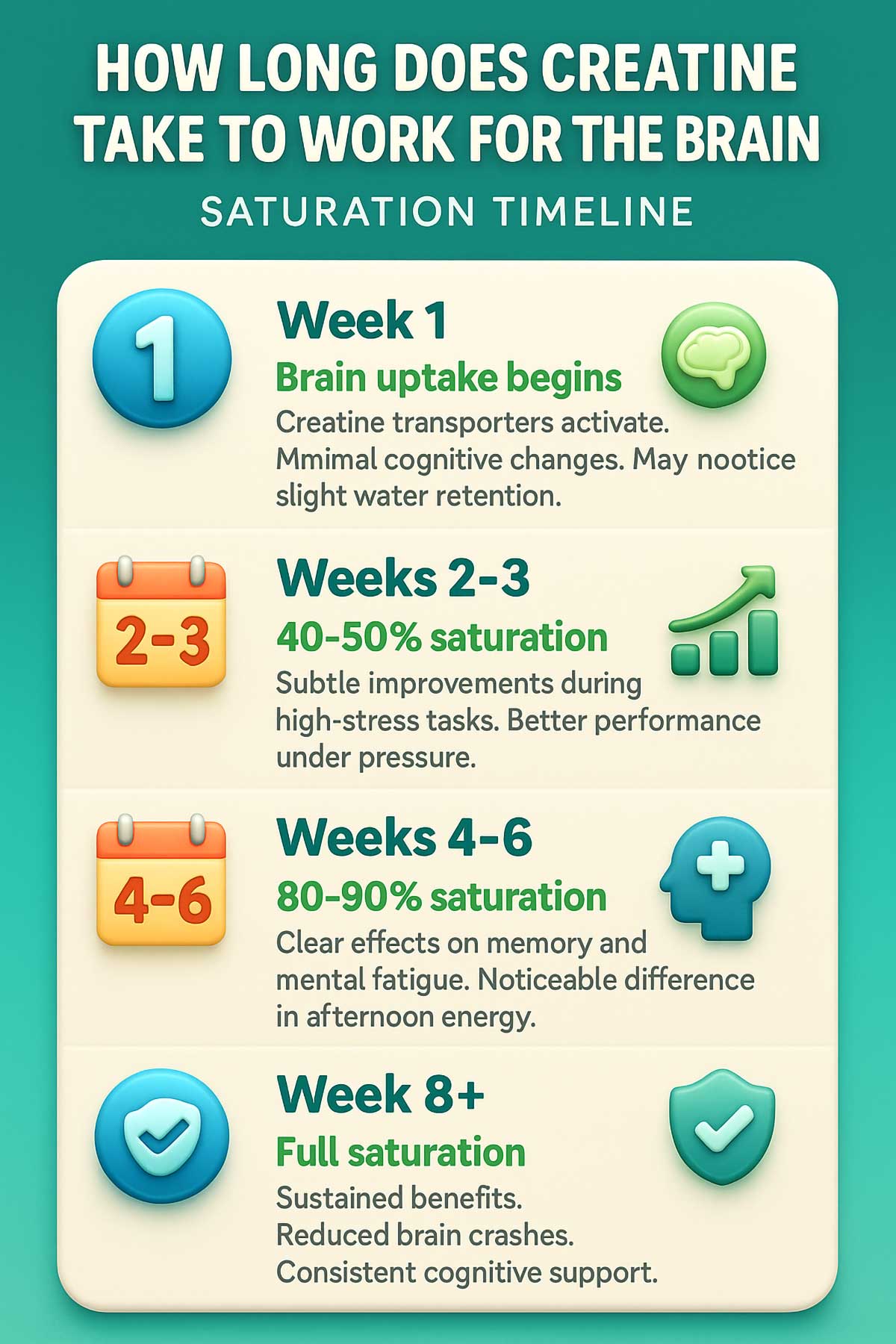
| Week 1 | Brain uptake begins, creatine transporters activate | Minimal changes, possibly slight water retention |
| Week 2-3 | Brain stores reach 40-50% saturation | Subtle improvements during high-stress tasks |
| Week 4-6 | Brain stores reach 80-90% full saturation | Clearer effects on memory and mental fatigue |
| Week 8+ | Maintenance phase, stores stay elevated | Sustained benefits, reduced afternoon crashes |
Most studies investigating creatine’s effects on brain metabolites require a minimum period of 1 week or longer because uptake from the periphery is marginal and takes time. The blood-brain barrier makes it hard for creatine to get in. Your brain has to actively transport it across.
This is why patience matters. Don’t expect overnight results. Give your brain a full month to saturate before you judge the effect.
How to Take Creatine for Brain Health
If you decide to try creatine, here’s what actually matters.
Type: Stick with creatine monohydrate. All 16 studies in the 2024 systematic review used creatine monohydrate exclusively. Other forms—like creatine ethyl ester or liquid creatine—are mostly marketing. They don’t work better. Often they work worse.
Dosage Protocols:
You have three options:
Standard Protocol (Most Common)
- Take 5g daily
- Brain reaches full saturation in 4-6 weeks
- Best for most people
- No loading phase needed
Brain Loading Protocol (Faster Results)
- Take 20g daily for 7 days, then drop to 5-10g for maintenance
- Brain saturates in 1-2 weeks
- Some people get digestive upset from high doses
- Worth trying if you want faster effects
Acute Protocol (Emergency Use)
- Take 0.35g per kilogram of body weight as a single dose
- For a 150-pound person, that’s about 24g
- Use during sleep deprivation or extreme mental demand
- Effects last 4-9 hours
- Not for daily use
Timing: Unlike caffeine, it doesn’t matter when you take it. Morning, evening, with food, without food—none of this changes the effect. What matters is taking it every day. Consistency beats timing.
Absorption: Mix it with water. You don’t need sugar or fancy delivery systems. Your body absorbs creatine monohydrate just fine on its own.
Getting Creatine From Food
Can you get enough creatine from diet alone? Let’s look at the numbers.
Creatine Content in Common Foods
| Food | Creatine per 1 lb (450g) Raw | Creatine per 6 oz Serving | Notes |
|---|---|---|---|
| Herring | 6.5-10g | 2.4-3.7g | Highest natural source |
| Pork | 5g | 1.8g | Good option if you eat pork |
| Beef | 4.5g | 1.7g | Most common source |
| Salmon | 4.5g | 1.7g | Also provides omega-3s |
| Chicken | 3.4g | 1.3g | Lower than red meat |
| Turkey | 3.8g | 1.4g | Similar to chicken |
| Cod | 3g | 1.1g | Lean fish option |
| Milk | 0.1g per cup | Very low | Not a practical source |
| Eggs | 0.1g per egg | Very low | Only in the yolk |
| All plant foods | 0g | 0g | Plants don’t contain creatine |
Here’s the problem: cooking reduces creatine content by 30-50% depending on the method. High heat destroys it. To get 5g of creatine from food, you’d need to eat about 2 pounds of raw beef daily. Or 1 pound of herring. Every single day.
That’s not practical for most people. It’s expensive. It’s hard on digestion. And it comes with a lot of extra calories.
This is why supplementation makes sense. Even people who eat meat regularly don’t get enough creatine from diet alone to saturate their brain stores.
Tracking Your Response
Creatine works slowly. Don’t expect to notice changes immediately. Here’s how to track whether it’s helping:
Week 1-2: Note your baseline. Rate your mental clarity each afternoon on a scale of 1-10. Track when you usually hit the wall. Most people crash between 2-4 PM.
Week 3-4: Start watching for subtle shifts. Do you stay sharp a bit longer? Does the afternoon slump feel less severe?
Week 5-6: By now, effects should be clear if you’re a responder. You might notice you can focus through tasks that used to drain you. Complex problems feel less taxing.
Week 8+: Maintain your dose. Don’t stop and start. Consistency is what keeps your brain stores elevated.
Keep a simple journal. Write down:
- Daily mental clarity rating (1-10)
- Time of day when focus drops
- How well you handle stress
- Any changes in mood or energy
Give it a full 4-6 weeks before you decide if it’s working. Brain saturation takes time.
Common Mistakes People Make
Taking it sporadically: Creatine needs daily dosing. Missing days means your brain stores drop. You won’t get the full benefit.
Expecting immediate effects: This isn’t caffeine. Changes happen over weeks, not minutes. Be patient.
Underdosing for brain benefits: Some people take 3g daily. That might work for muscles. For brain health, 5g daily is better. Research suggests brain creatine requires higher or longer supplementation compared to muscle.
Mixing it up with caffeine: They do different things. Caffeine stimulates. Creatine fuels. Don’t assume they’re interchangeable.
Stopping too soon: If you quit at week 2 because you don’t feel anything, you stopped right before it would have kicked in.
Not drinking enough water: Creatine pulls water into cells. Stay hydrated. This prevents the bloating that some people experience.
How Creatine Stacks Up Against Other Brain Supplements
Creatine vs. Other Cognitive Supplements
| Supplement | Evidence Level | Monthly Cost | Safety Profile | Best For |
|---|---|---|---|---|
| Creatine Monohydrate | Strong | $6-10 | Excellent | Energy under stress |
| Caffeine | Strong | $10-15 | Good (dose-dependent) | Alertness and focus |
| L-Theanine | Moderate | $15-20 | Excellent | Focus with calm |
| Omega-3 (EPA/DHA) | Moderate | $20-30 | Excellent | Long-term brain health |
| B-Complex Vitamins | Moderate | $10-15 | Excellent | Basic energy metabolism |
| Nootropic Stacks | Weak to Moderate | $40-80 | Variable | People with money to waste |
Creatine wins on cost and safety. It’s one of the most studied supplements in existence. And at 20 cents per day, it’s hard to beat.
Safety and Who Should Avoid Creatine
Let’s address the myths and real concerns.
Kidneys: Creatine doesn’t damage healthy kidneys. Period. This myth comes from confusion about a blood test marker called creatinine. Creatine raises creatinine levels. That’s normal. It doesn’t mean kidney damage. Thousands of studies confirm this.
If you already have kidney disease, talk to your doctor. For everyone else, this isn’t a concern.
Bloating: Some people feel bloated when they first start taking creatine. This usually happens with high loading doses. The fix is simple: lower the dose or skip the loading phase. Start with 3g daily and work up to 5g. The bloating goes away.
Hair Loss: One small study in 2009 suggested creatine might increase DHT, a hormone linked to hair loss. But follow-up research hasn’t confirmed this. The link is weak at best. If you’re worried about hair loss, monitor it. But don’t assume creatine is the cause.
Who Should Avoid Creatine:
- People with kidney disease (unless medically supervised)
- Pregnant or breastfeeding women (insufficient safety data)
- People taking medications that affect kidney function
- Anyone with rare creatine metabolism disorders
Who Should Talk to Their Doctor First:
- People over 65 taking multiple medications
- Anyone with a history of kidney stones
- People with diabetes (creatine may affect blood sugar)
- Those on diuretics or NSAIDs regularly
Long-term Safety: People have taken creatine for years with no serious side effects. Multiple safety reviews conclude it’s one of the safest supplements available. Studies lasting 5+ years show no adverse effects in healthy adults.
Quick Start Guide
Want to try creatine for brain health? Here’s your action plan:
Step 1: Buy creatine monohydrate powder. Skip fancy forms. Look for pure creatine monohydrate with no added ingredients. Cost should be $6-10 for a month’s supply.
Step 2: Start with 5g daily. Mix it with water, coffee, or a protein shake. Take it at the same time each day to build the habit.
Step 3: Track your response. Note your mental clarity, energy levels, and afternoon focus for the next 6 weeks.
Step 4: Give it 4-6 weeks before judging results. Remember, your brain needs time to saturate.
Step 5: Stay consistent. Missing days means your stores drop. Make it part of your daily routine like brushing your teeth.
Step 6: Drink plenty of water. Aim for 8-10 glasses daily.
Creatine Dosage Calculator
Get personalized creatine recommendations based on your profile
Conclusion
Current evidence shows that creatine monohydrate supplementation provides beneficial effects on cognitive function, particularly for memory and attention. The effect is strongest in people under metabolic stress—whether from lack of sleep, plant-based diets, aging, menopause, or demanding mental work.
This isn’t a miracle pill. You won’t suddenly get smarter. But you might notice something subtle: the afternoon crash doesn’t hit as hard. Complex tasks don’t drain you as fast. Your thinking stays clear when it used to go fuzzy.
Different people respond differently. Vegetarians and vegans see the biggest gains. Women going through menopause show clear benefits. People who are sleep-deprived or cognitively stressed respond well. Meat eaters with good sleep may see more modest effects.
At about 20 cents per day, creatine is one of the cheapest insurance policies you can buy for your neurons. The science isn’t perfect. No science ever is. But it’s strong enough, and safe enough, that the risk-reward calculation makes sense for most people.
Who Should Try Creatine for Brain Health:
- Vegetarians and vegans (highest potential benefit)
- Women in perimenopause or menopause
- People with chronic sleep issues
- Students during high-stress academic periods
- Anyone with demanding cognitive work
- People experiencing age-related cognitive decline
Next Steps:
- Assess whether you fit a high-responder profile
- Consult your doctor if you have kidney issues or take multiple medications
- Buy pure creatine monohydrate (not fancy forms)
- Start with 5g daily and commit to 6 weeks
- Track your mental clarity and energy
- Adjust based on your response
Don’t expect a buzz. Expect the absence of the crash. That’s what creatine offers: a brain that keeps running when it should be running out of gas.
The research continues. New studies come out regularly. But based on what we know now, creatine stands out as one of the few cognitive supplements with solid science behind it. It’s cheap. It’s safe. And for many people, it works.
FAQs
How long does creatine take to work for the brain?
Brain saturation takes 4-6 weeks with standard dosing of 5g daily. If you use a loading protocol (20g daily for one week), you might see effects in 1-2 weeks. For acute cognitive support during sleep deprivation, a single high dose works within 4 hours.
Can I take creatine if I don’t work out?
Yes. Creatine benefits your brain regardless of whether you exercise. The cognitive effects are separate from the muscle effects. Many people take it purely for mental performance.
Will creatine make me gain weight?
You might gain 1-3 pounds in the first week from water retention in muscles. This isn’t fat gain. It’s water moving into cells, which is actually a good sign. After the initial week, weight stabilizes. For brain benefits, this water retention is irrelevant.
What’s the difference between creatine for muscles vs. brain?
The dosing is similar. But the timeline is different. Muscles saturate faster (1-2 weeks with loading). Brains take longer (4-6 weeks). The mechanisms are the same—both tissues use creatine to recycle ATP for energy.
Do I need to cycle off creatine?
No. Cycling is a myth left over from old bodybuilding forums. Your body doesn’t stop responding to creatine. You don’t need to take breaks. Consistent daily use works best for cognitive benefits.
Can I take creatine with coffee?
Yes. They work through different mechanisms. Coffee stimulates. Creatine fuels. Some people find the combination helpful. Just stay hydrated, as both can have mild diuretic effects.
Is creatine safe for women?
Absolutely. In fact, women may benefit more than men because they typically have lower baseline creatine stores. The research on women in menopause is particularly promising.
Will creatine help with brain fog?
If your brain fog comes from energy deficits—stress, poor sleep, high cognitive demand, or menopause—then creatine might help. It won’t fix brain fog caused by thyroid issues, nutrient deficiencies, or other medical conditions.