Researchers tested similar amounts of chia for similar lengths of time, yet reached very different conclusions. One overlooked variable explains why.
The studies that found chia seeds lower cholesterol and the studies that found no effect at all were testing the same food. Same species, same dose range, similar durations. That contradiction is not a methodological accident. It is the most useful thing the research actually tells you.
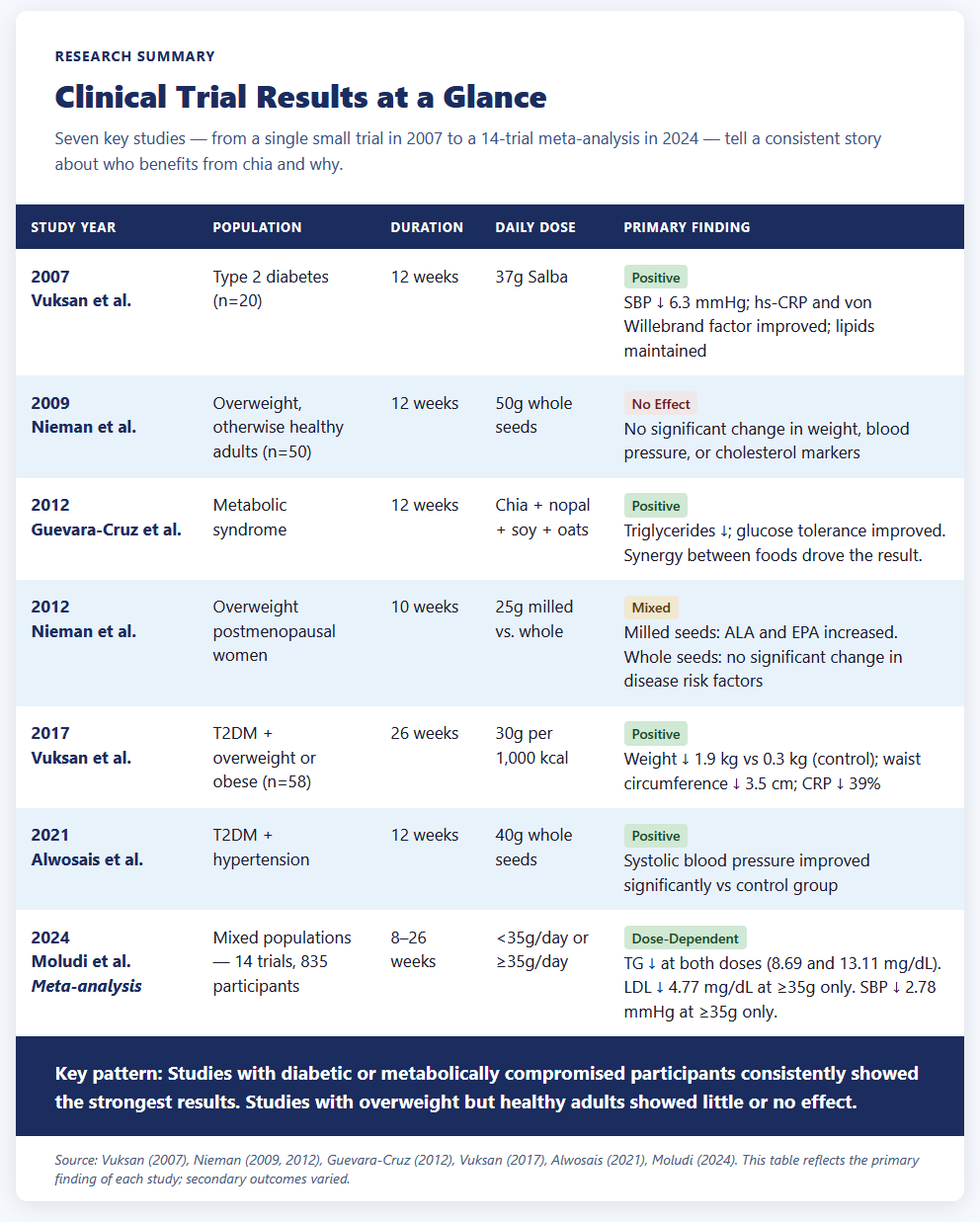
Across fourteen clinical trials, a 2024 meta-analysis led by Jalal Moludi at Iran University of Medical Sciences found measurable reductions in LDL cholesterol and triglycerides.
A 2009 trial by David Nieman and colleagues at Appalachian State University gave overweight adults 50 grams of chia daily for twelve weeks and found that nothing changed. Both findings are solid. The gap between them comes down to who the participants were, how the seeds were prepared, and whether the chia was part of a broader dietary change.
There is also a dose threshold that separates the people who see results from the people who don’t. Most people trying chia never reach it.
What 8 to 26 Weeks of Daily Chia Actually Found
Seven days won’t do it. The shortest trial that produced meaningful lipid changes ran eight weeks, and the clearest results appeared at twelve. If you’ve read that chia seeds can lower your cholesterol this week, the studies behind that claim don’t support it.
The most cited negative result is Nieman’s 2009 trial. Fifty overweight but otherwise healthy adults took 50 grams of whole chia seeds daily for three months. No meaningful changes appeared in body weight, blood pressure, or cholesterol markers. The dose was generous, the duration was sufficient, and the result was null.
What changed the picture in other trials was the population. Vladimir Vuksan and colleagues at the Clinical Nutrition and Risk Factor Modification Centre in Toronto ran what remains one of the most cited studies in this area.
Their 2007 Diabetes Care trial enrolled 20 adults with well-controlled type 2 diabetes, gave them 37 grams daily of Salba, a cultivated white chia variety, alongside existing therapy, and tracked them for twelve weeks.
Systolic blood pressure dropped by an average of 6.3 mmHg relative to the placebo group. Inflammatory markers, including high-sensitivity C-reactive protein and von Willebrand factor, a protein linked to blood clotting risk, also improved.
Lipid levels held steady, which the researchers described as maintaining good glycemic and lipid control. That is a different claim from lowering cholesterol, and a distinction worth keeping.
A 2021 trial by Eman Alwosais and colleagues in Kuwait pushed the dose to 40 grams daily in adults with type 2 diabetes and hypertension. After twelve weeks, systolic blood pressure improved significantly compared to the control group. Some lipid markers shifted, though the changes did not reach statistical significance across every measure the researchers tracked.
The clearest aggregate picture came in 2024. Moludi’s team pooled all fourteen available trials and 835 participants in a systematic review and meta-regression. Three findings stood out. Triglycerides dropped in both lower-dose and higher-dose groups: a reduction of 8.69 mg/dL in people taking less than 35 grams daily and 13.11 mg/dL in those taking more. LDL cholesterol only showed a significant reduction in the higher-dose group, falling by 4.77 mg/dL.
Systolic blood pressure dropped by 2.78 mmHg at higher doses, roughly comparable to cutting sodium intake by 1,000 mg daily or walking briskly for thirty minutes most days.
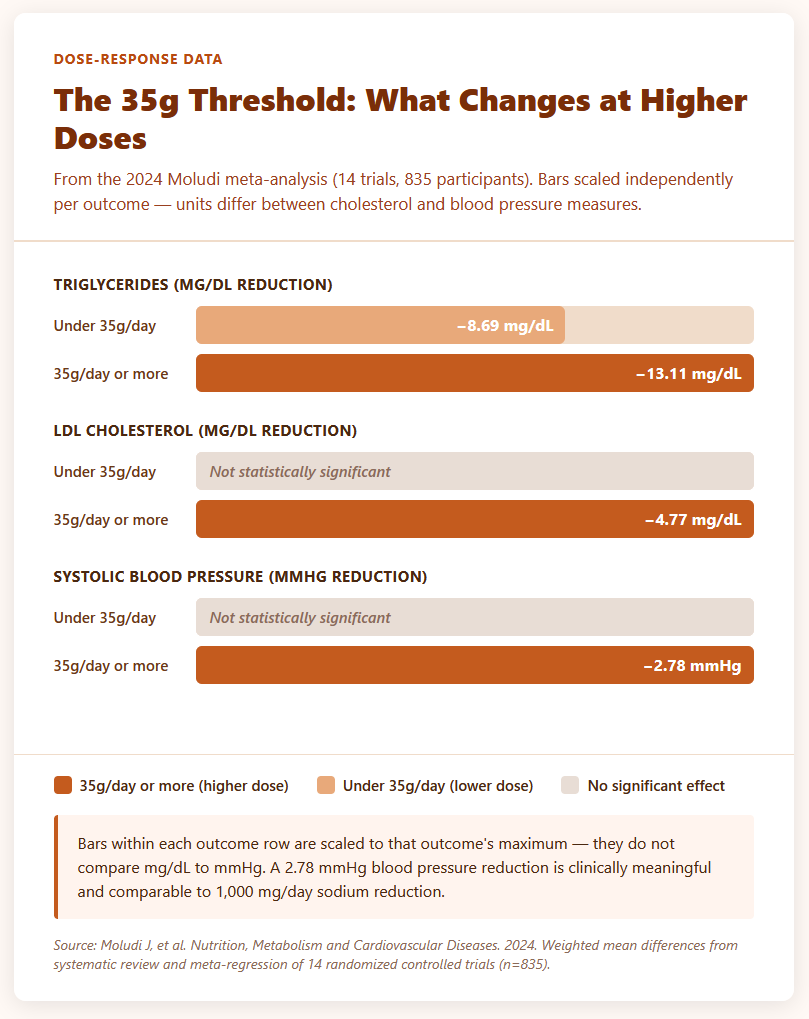
That 4.77 mg/dL LDL reduction is real and replicated. It is also well below what most marketing around chia seeds implies.
A 2021 systematic review by Leticia Silva and colleagues in Food and Function pulled together ten trials and found the overall picture was heterogeneous. Confidence intervals were wide, effects varied considerably across populations, and no single outcome was consistent enough to call settled. The trends pointed in the right direction. The evidence did not support a firm conclusion.
Why the Form You Eat Changes the Outcome
You’ve probably noticed this if you’ve eaten whole chia seeds. They come out looking the same as when they went in. The outer shell protects the seed in nature, and that same shell blocks absorption in your gut.
Nieman’s team tested this directly. In a 2012 trial published in the Journal of Alternative and Complementary Medicine, overweight postmenopausal women received 25 grams daily of either whole chia seeds, milled chia seeds, or a placebo for ten weeks. Milled seeds produced measurable increases in plasma ALA and EPA. Whole seeds did not produce significant changes in disease risk factors.
The fix is direct: grind your seeds before eating them, or buy pre-ground chia. A basic coffee grinder works well. Ground chia stored in an airtight container in the fridge stays fresh for about a month. If you prefer whole seeds, soaking them in water for 24 hours starts breaking down the seed structure and improves how much of the omega-3 fat your body can access.
The second form problem runs deeper and is harder to work around. Chia’s omega-3 fat is ALA, alpha-linolenic acid, which your body must convert into EPA and DHA, the forms that directly protect cardiovascular health. The conversion rate is poor.
Roughly 5 to 10 percent of ALA becomes EPA, and only 2 to 5 percent becomes DHA. Eat 5 grams of ALA from chia and your body may produce 250 to 500 milligrams of EPA. That is a fraction of what a serving of fatty fish delivers directly, which explains why chia’s effects on LDL and triglycerides are more modest than those of fish oil supplements.
Heat adds a third variable. Baking chia at temperatures above 350 degrees Fahrenheit for extended periods degrades the omega-3 fats. Smoothies, overnight soaks, and raw additions to yogurt preserve more of the active compounds than baked goods do.
Blood Pressure and Inflammation: A More Consistent Story
Across all fourteen trials, chia’s effects on blood pressure were more consistent than its effects on cholesterol, and the reason may be simpler than the lipid data suggests. The 2024 Moludi meta-analysis found a 2.78 mmHg systolic reduction in the higher-dose group, confirming a direction the 2007 Vuksan trial first established in a smaller T2DM population.
A 2 to 3 mmHg population-wide reduction in systolic blood pressure is associated with meaningful decreases in stroke and heart attack rates at scale. Individual responses vary considerably, but the directional consistency here is stronger than what the cholesterol data shows.
Inflammation markers followed a similar pattern. In the 2017 Vuksan calorie-restriction trial, adults with type 2 diabetes who received chia saw a 39 percent reduction in C-reactive protein compared to a 7 percent reduction in the oat bran control group. The difference was statistically significant. C-reactive protein is not a cholesterol marker, but it sits on the same cardiovascular risk panel and responds to chia’s anti-inflammatory compounds in ways that LDL often does not.
Two tablespoons of chia seeds provide approximately 95 milligrams of magnesium and 115 milligrams of potassium. Both minerals contribute to blood pressure regulation through their effects on vascular tone and fluid balance. These contributions are small but additive, particularly for people whose diets run consistently low in both.
The Synergy Finding Most People Miss
Martha Guevara-Cruz and colleagues at the National Institute of Medical Sciences and Nutrition in Mexico City tried something the other trials hadn’t. Rather than testing chia alone, they built a dietary pattern around it.
Adults with metabolic syndrome followed a specific combination for twelve weeks: chia seeds, nopal (prickly pear cactus), soy protein, and oats, alongside an overall 500-calorie daily reduction. The 2012 study in the Journal of Nutrition produced significant drops in triglycerides and meaningful improvements in glucose tolerance.
No single ingredient drove that result. Fiber from multiple sources, plant protein from soy, and omega-3 fats from chia created a compound effect that no individual component would have matched alone. Chia added to oatmeal, blended into soy milk, or paired with high-fiber vegetables performs differently than chia eaten on its own.
This is the study the “just add chia to water” advice ignores entirely.
How Chia Compares to Your Other Options
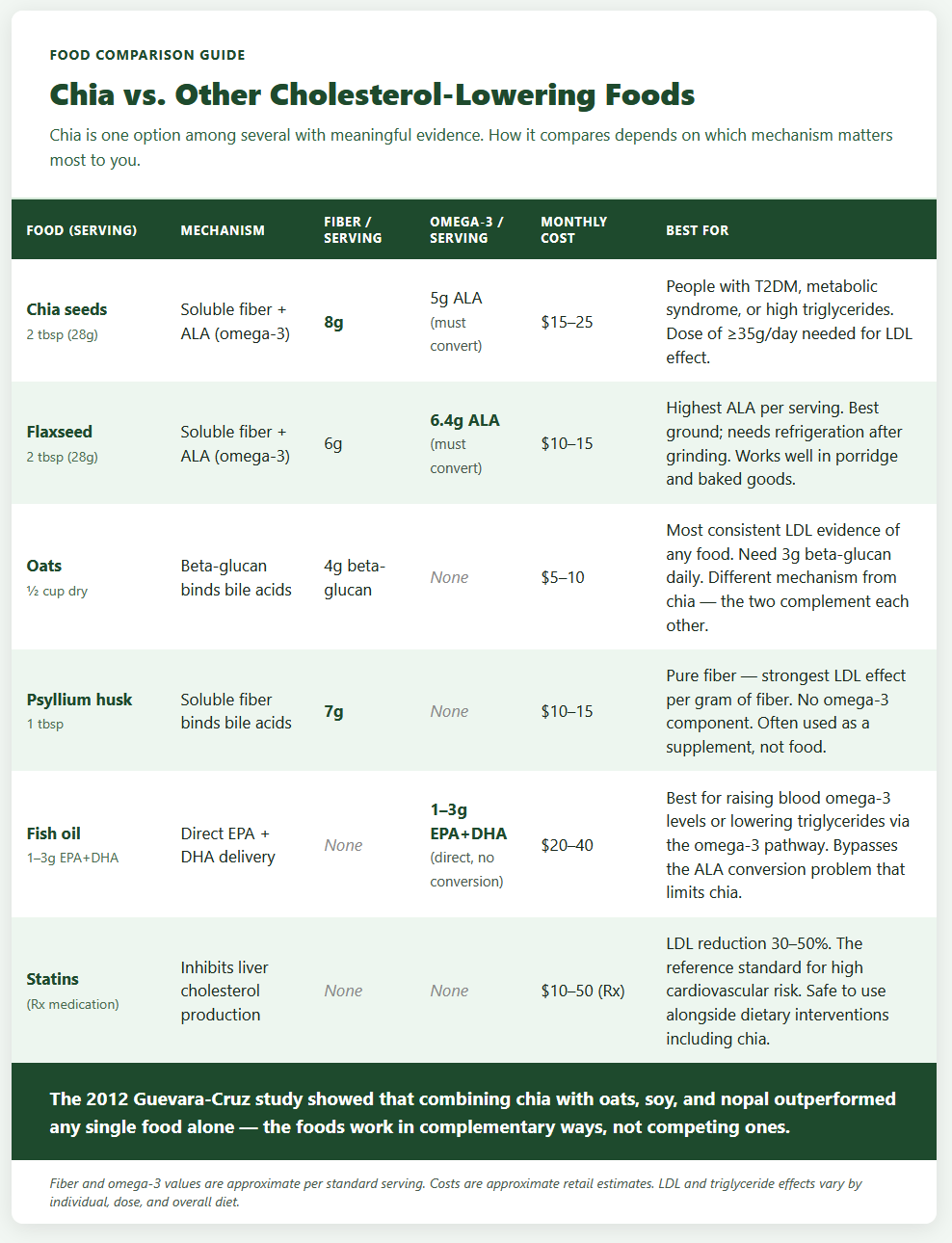
Against statins, the comparison is not close. Statins typically reduce LDL by 30 to 50 percent, a drop of 40 to 70 mg/dL for someone starting at an LDL of 140. Chia reduced LDL by 4.77 mg/dL in the highest-dose group across fourteen trials.
Statins are power tools. Chia is a hand tool. Combining them is safe, and both have a role in a broader protocol. But chia cannot replace prescribed medication in anyone who genuinely needs it, and no clinical trial has tested whether chia prevents cardiovascular events the way statins demonstrably can.
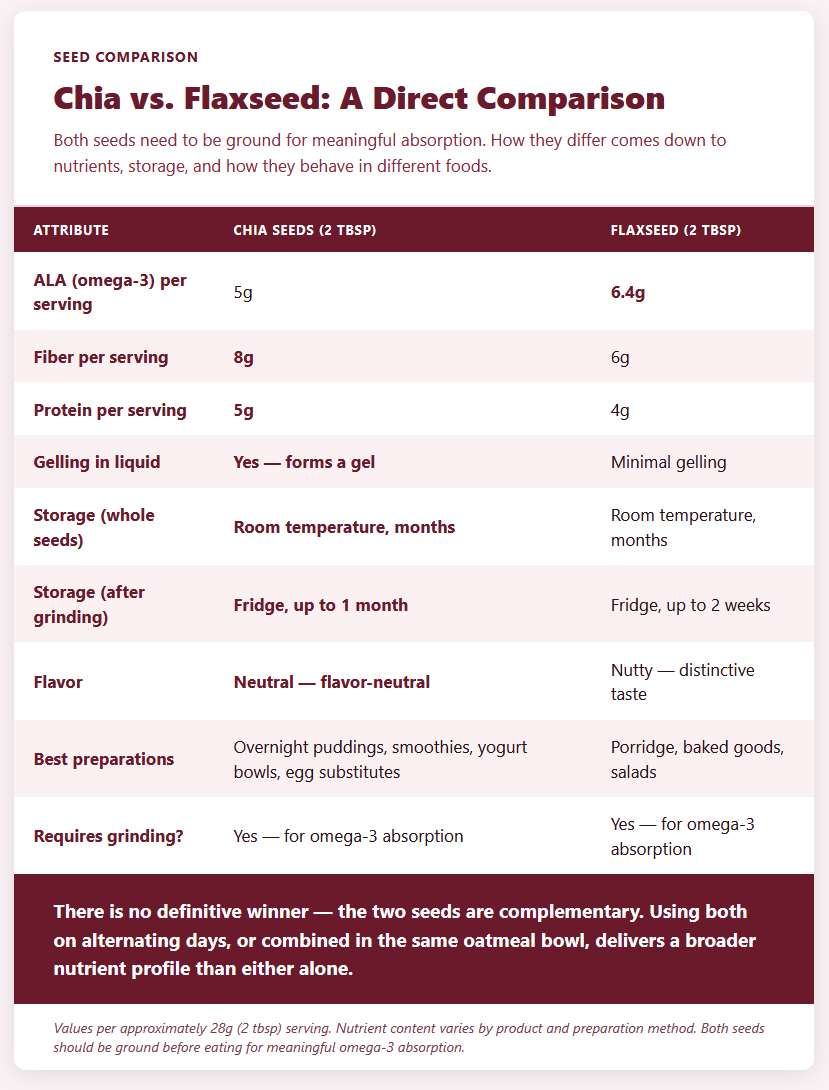
Against flaxseed, the comparison is closer. Flax contains slightly more ALA per serving, about 6.4 grams in two tablespoons versus chia’s 5 grams, and chia has more fiber, roughly 8 grams per two tablespoons to flax’s 6. In practice, which one you reach for depends on the meal.
Chia gels in liquid, which makes it better suited for overnight preparations, high-fiber smoothies, and yogurt bowls where you want body without added sugar. Flax has a nuttier flavor that integrates better into porridge and baked goods, but it goes rancid faster after grinding and needs refrigeration. Both require grinding for meaningful omega-3 absorption.
Using both on alternating days, or combined in the same bowl of oatmeal, covers more nutritional ground than committing to one exclusively.
Oats work through a completely different mechanism: beta-glucan, a soluble fiber that binds bile acids in the digestive tract and forces the liver to draw on cholesterol to make more, a pathway chia does not share.
The two foods complement rather than duplicate each other, which explains why the Guevara-Cruz 2012 study combined them. Against fish oil, chia loses on the omega-3 delivery question. Fish oil supplies EPA and DHA directly, which bypasses the poor ALA conversion that limits chia’s impact on that pathway. If raising blood omega-3 levels is the primary goal, fish oil typically gets there faster.
Who Benefits, and Who Probably Won’t
The clearest predictor of whether chia moves your cholesterol numbers is baseline metabolic health. People with type 2 diabetes or metabolic syndrome showed the most consistent results across the trial data. The Vuksan group’s two studies, the Alwosais 2021 trial, and the metabolic syndrome work all point in the same direction: chia’s fiber and ALA do more when the metabolic system is already under strain.
People who are overweight but metabolically healthy represent the other end. Nieman’s 2009 trial is the clearest data: three months of high-dose chia, no change. Their bodies were managing lipid metabolism adequately, and chia’s contribution was too modest to produce a measurable shift. If your cholesterol numbers are already normal, chia is unlikely to improve them further.
Women going through or past menopause represent a specific case. Hormonal changes alter lipid metabolism in ways that dietary interventions often cannot counteract without additional medical support.
Nieman’s 2012 trial confirmed that milled chia raised plasma ALA and EPA in postmenopausal women (absorption was happening), but those improvements did not translate into changes in disease risk factors.
Evidence across the literature also suggests that sex-based differences in how the body processes omega-3 fats, related in part to the way estrogen interacts with lipid metabolism, contribute to the variability in trial results. Chia is not an adequate stand-alone response to post-menopause lipid changes.
HDL cholesterol is one area where the evidence, while preliminary, suggests chia may be doing something the larger trials haven’t yet adequately measured.
A 2023 pilot study by Brian Dickens and colleagues at Edward Via College of Osteopathic Medicine gave participants two tablespoons of chia seeds mixed with oatmeal daily for thirty days. The chia group averaged an HDL increase of 5.75 mg/dL.
Nine completers in the active group makes any firm conclusion premature, but HDL is a marker the larger trials have consistently underreported, and this study points toward a gap worth investigating.
Chia is not appropriate for everyone. People taking blood thinners such as warfarin, Coumadin, or Plavix should speak with their prescribing physician before starting chia, as its omega-3 content may interact with anticoagulant therapy.
People with a history of diverticulitis should avoid chia during flares. Cross-reactivity with sesame and mustard seed allergies is possible. Start with a small amount if either applies. Anyone with a known swallowing disorder should discuss chia with their doctor before use at any dose.
How to Actually Do This
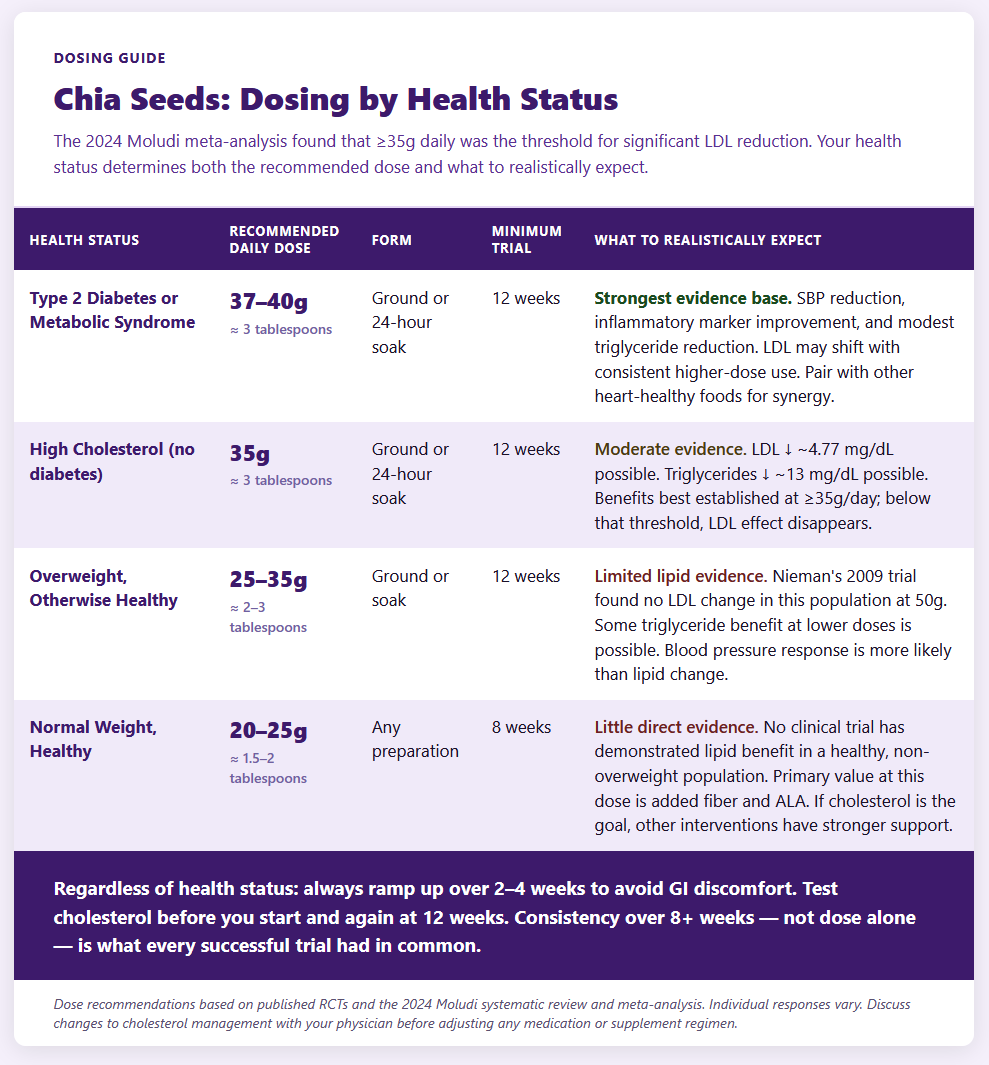
The threshold that separated significant from non-significant LDL results in the 2024 Moludi meta-analysis was 35 grams daily. Two tablespoons of chia seeds weigh about 28 grams. You need closer to three tablespoons, roughly 38 to 40 grams, to consistently match the higher-dose group. Most people using chia for heart health never reach that amount.
Bloating ends more chia experiments than skepticism does. The 35-plus grams daily that produced results in the trial data is a significant fiber load for a gut that isn’t accustomed to it, and most people who skip the ramp-up decide within a week that chia isn’t for them. Start at one tablespoon daily and stay there for two weeks. Increase to two tablespoons in weeks three and four, then to three by week five if you’re comfortable.
Fifty grams of chia provides approximately 240 calories. Plan for those calories from the start by swapping chia in for something else rather than adding it on top of your current diet. Ground chia replaces granola on yogurt, mixes into oatmeal instead of sweetened toppings, and blends into smoothies without changing the flavor much.
For baking, one tablespoon of ground chia mixed with three tablespoons of water, left for five minutes to gel, works as a substitute for one egg. This swap removes approximately 185 milligrams of dietary cholesterol and adds three grams of fiber per egg replaced.
One safety note worth stating plainly. Never eat dry chia seeds by the spoonful. A 2014 case report presented at the American College of Gastroenterology annual meeting described a 39-year-old man with a history of swallowing problems who ate a tablespoon of dry chia seeds followed immediately by water.
The seeds expanded in his esophagus, absorbing up to 27 times their weight in water, and caused a complete obstruction requiring endoscopic removal. Always mix chia with liquid first and let it sit before consuming. This is especially important if you have any history of swallowing difficulty or known narrowing of the esophagus.
For IBS: if you have constipation-predominant IBS, the added fiber may help. Start with half a teaspoon and build slowly over several weeks. If you have diarrhea-predominant IBS, the additional fiber may worsen symptoms. Speak with your gastroenterologist before making significant dietary fiber changes.
For white versus black chia: white varieties like Salba show more consistent nutrient profiles between batches than wild-harvested black chia. If you’re using chia at therapeutic doses for a defined period, buying from a brand that lists nutritional content clearly gives you a more predictable dose.
None of the successful trials specified morning or evening as the optimal consumption window. What they all required was daily intake for at least eight weeks without gaps. Most people who try chia and conclude it doesn’t work have never actually run the experiment the trials ran: they ran a shorter, inconsistent version of it. Set a daily reminder and embed chia in whatever meal you eat most reliably.
Chia Seeds Dosage Calculator
Get a personalized dose recommendation based on the clinical trial data
The 12-Week Case for Trying It
The research was never contradicting itself: it was describing two different groups of people and what the same food does in each. That distinction (population, not ingredient) is what most chia coverage misses entirely, and it is the only interpretation that makes the results useful.
For people with type 2 diabetes, elevated triglycerides, or metabolic syndrome, the data gives a reasonable basis for a twelve-week trial at 35 grams or more daily, ground or soaked, alongside other heart-healthy foods. For people whose metabolic numbers are already within a normal range, the evidence does not support expecting much change. The 2009 trial that found nothing and the 2024 meta-analysis that found modest LDL reductions are both reliable, and they’re not contradicting each other: they’re describing different people.
What twelve weeks buys you is actual data about your own response. No population average can predict that. Baseline bloodwork before you start and a repeat panel at twelve weeks gives you something more useful than any headline claim about what chia will or won’t do for cholesterol.