Your brain isn’t glitching. It’s running a program you never knew existed, and a doorway is the trigger that activates it every time.
You get up from the couch with a clear mission. Maybe it’s to grab your phone charger, write something down, or check on the stove. You walk into the next room. And then… nothing. You’re standing there, staring at the wall, with no idea why you came.
Sound familiar? You’re not losing your mind. You’re not getting old. Your brain is doing exactly what it was designed to do. It’s called the doorway effect, and the science behind it is genuinely fascinating.
You Just Crossed an “Event Boundary”
Before we get into the brain mechanics, here’s the term you’ll want to remember: event boundary.
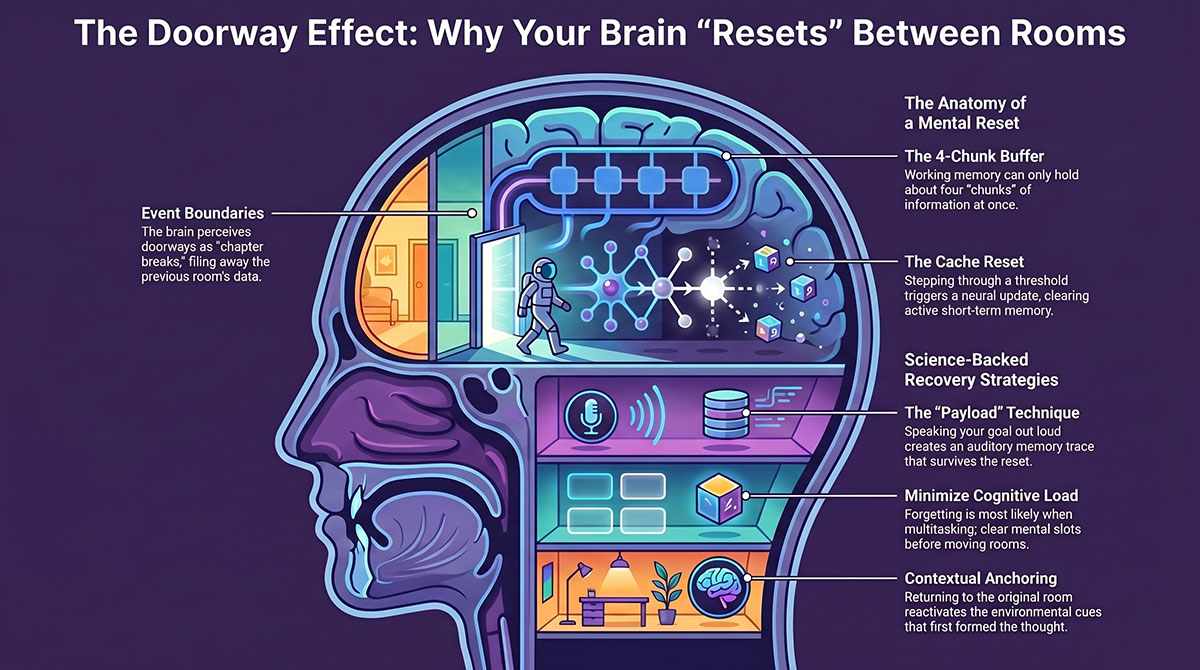
Think of your life like a book. Each room you enter is a new chapter. Your brain doesn’t just record experience as one long, endless stream. It segments it. It divides what’s happening into separate, self-contained episodes. A doorway acts as a physical cut-scene. The moment you step through it, your brain files the previous chapter away and opens a fresh one.
Neuroscientist Jeffrey Zacks and his colleagues at Washington University studied this in a landmark 2007 paper published in Psychological Bulletin. Using fMRI brain scans and behavioral testing, their Event Perception: A Mind/Brain Perspective study found that the brain perceives everyday life as a series of distinct events. When a boundary appears, such as walking through a door, the brain fires a neural “reset.” It updates its internal model of the world. You aren’t forgetting. Your brain is literally turning the page.
That reset is not a flaw. It’s an elegant system. But it does come with a cost.
Your Brain Just Cleared the Cache
Here’s where things get interesting. That “chapter reset” doesn’t just open a new page. It also closes the old one, taking your previous thought with it.
Psychologist Gabriel Radvansky at the University of Notre Dame spent years testing this. In a series of well-known experiments, his team had participants carry objects through virtual and real rooms, then tested their recall.
Their findings, published as Walking Through Doorways Causes Forgetting: Further Explorations in the Quarterly Journal of Experimental Psychology (2011), showed memory for those objects dropped significantly after crossing a doorway, but not after walking the same distance within a single room. The act of passing through the doorway itself was the trigger, not the movement or the time it took.
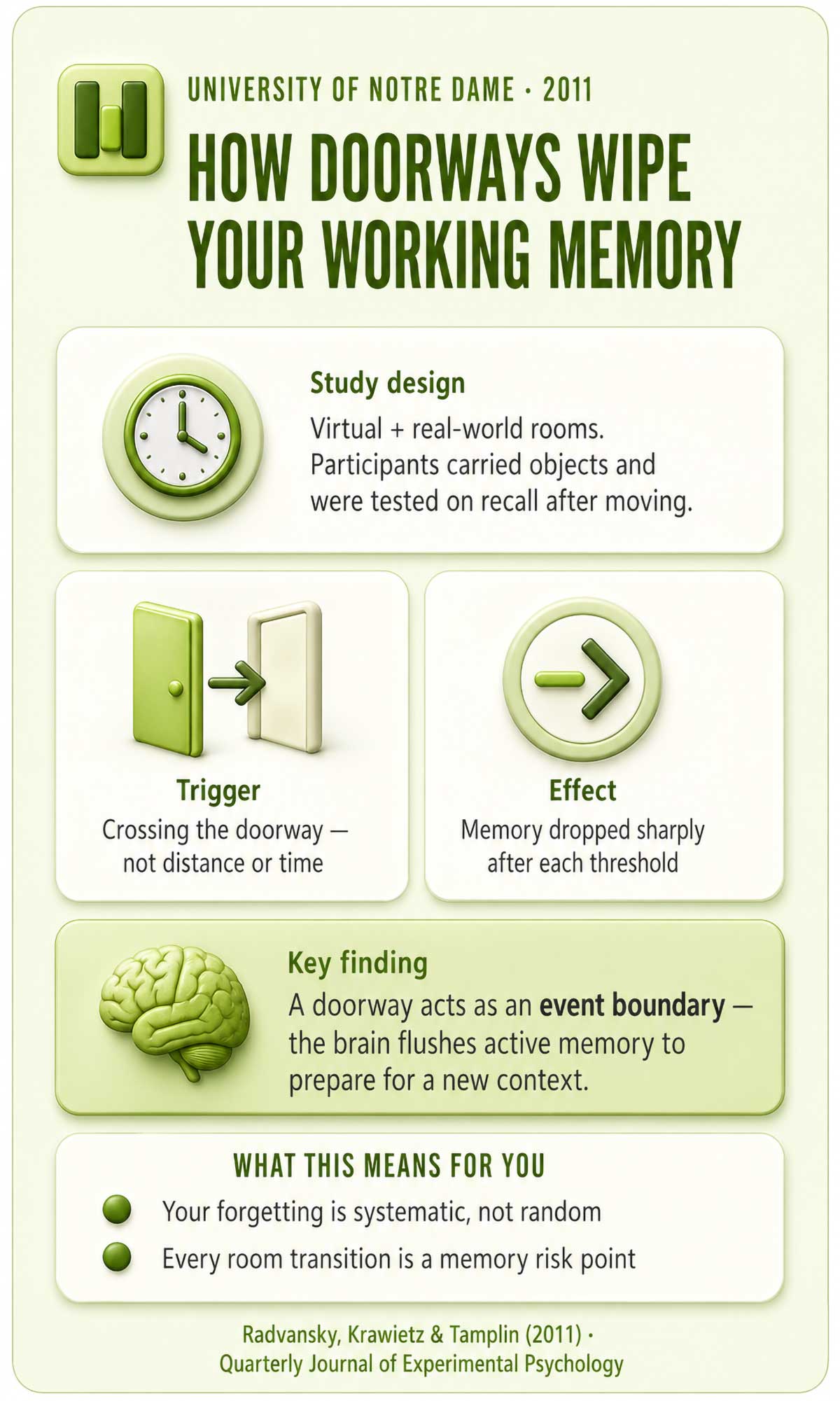
Think of it like a computer clearing its short-term cache when you switch between browser tabs. The old data isn’t lost forever. It’s just been pushed out of quick-access memory to make room for what comes next. The brain does the same thing. It clears the active buffer so it can process the new space efficiently.
The 4-Chunk Limit is Why Your Brain Drops the Ball
Now here’s a detail most people have never been taught, and it explains a lot.
Your working memory, the mental workspace where you hold active thoughts, is tiny. Psychologist Nelson Cowan reviewed decades of data in a landmark 2001 paper and concluded that most people can only hold about four chunks of information at once.
Four. Not ten. Not twenty. His paper, The Magical Number 4 in Short-Term Memory: A Reconsideration of Mental Storage Capacity, published in Behavioral and Brain Sciences, remains one of the most cited findings in cognitive psychology.
A “chunk” can be a word, a task, a number, or a goal. It’s whatever your brain has grouped into a single meaningful unit. “Pick up the charger from the bedroom” is roughly one chunk. But here’s the part most people miss: those chunks are volatile.
They’re not saved to a hard drive. They exist only as active, fragile electrical signals in your brain. The moment something more pressing shows up, a chunk can get knocked right out of the buffer.
Picture your working memory as four parking spaces. Your goal, “get the charger”, pulls into one of them. Then your phone buzzes. You glance at the notification. That notification claims a parking space.
Now you’re at three spaces free, two taken. You start mentally composing a reply. Another space fills. You’re still walking. Your brain registers the approaching doorway and begins its context shift. That update needs a space too. And just like that, the charger thought gets towed. The lot is full, and it was the least recently added car.
If you’re also mentally rehearsing a shopping list or replaying a conversation while you move, those extra chunks are competing for the same tiny, constantly overwritten workspace.
This is where the doorway makes things worse. Crossing that event boundary triggers an update. And that update takes up mental resources. If your working memory was already near full, the old thought, the reason you walked into that room, gets bumped. It doesn’t have anywhere to go. The new chapter opened, and the previous mission didn’t make it through.
This is also explained by what cognitive psychologist Alan Baddeley introduced in his widely cited 2000 paper, The Episodic Buffer: A New Component of Working Memory, published in Trends in Cognitive Sciences. The episodic buffer is the part of working memory that binds different pieces of information into a single, connected episode. A doorway essentially closes one episode and opens another. If the original thought wasn’t strongly anchored before you crossed, the new episodic buffer won’t include it.
The Real Culprit is Multitasking While You Move
For years, the doorway itself got all the blame. Cross a threshold, lose a thought. That was the story.
But a 2021 study added a major twist. Researchers at the University of Queensland and Bond University, led by Jessica McFadyen and Oliver Baumann, ran four separate experiments using virtual reality, video watching, and real-world movement.
Their goal: replicate the doorway effect under controlled conditions. Their paper, Doorways Do Not Always Cause Forgetting: A Multimodal Investigation, published in BMC Psychology, changed the conversation.
What they found was surprising. When participants had a low or normal cognitive load, the doorway effect barely showed up at all. Forgetting only became significant when participants were already under a heavy working memory load, in this case, performing backward counting tasks while moving.
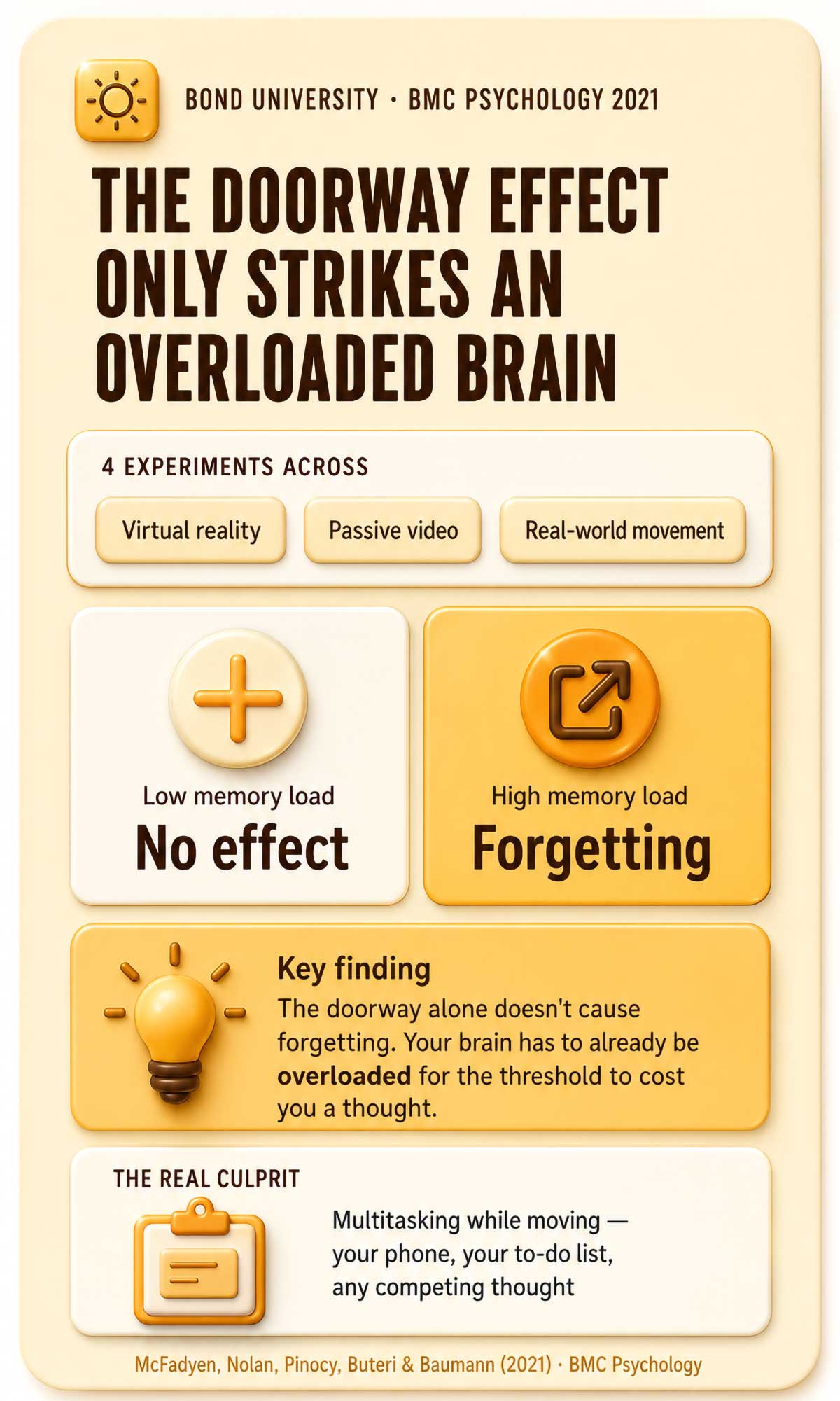
As Baumann explained, the doorway effect appears to be tied to a state of cognitive vulnerability. The doorway alone isn’t enough to wipe your memory. Your brain needs to already be overloaded for the reset to cost you something important.
In other words, the true culprit is multitasking. Scrolling your phone while walking to the kitchen. Running through tomorrow’s schedule while heading to the garage. When your brain is already at its four-chunk limit, any boundary becomes a risk.
This is actually good news. It means the doorway effect is partly within your control.
And it goes further than just physical movement. A 2024 study from Christopher Baldassano’s lab at Columbia University found that event boundaries aren’t only triggered by walking through a door. They can be internal. Using fMRI, Baldassano and his colleagues showed that the brain creates a new chapter based on where your attention is pointed, not just where your body is.
Their paper, Top-Down Attention Shifts Behavioral and Neural Event Boundaries in Narratives with Overlapping Event Scripts, published in Current Biology, showed that when participants shifted their mental focus from one type of story thread to another, the brain registered a fresh event boundary, even with no change in physical location at all.
The takeaway is direct: if you’re walking to the kitchen for a snack and you suddenly start thinking about a text you need to send, your brain may have already closed the “snack” chapter before you even reach the door. The boundary formed in your mind, not at the threshold. This is why multitasking is so reliably destructive to short-term intention. Each focus shift is its own reset.
Why Going Back Actually Works
You’ve done this before. You go back to the original room, and suddenly you remember. It feels like a trick. It isn’t.
The explanation sits in decades of context-dependent memory research. A landmark 1975 study by Godden and Baddeley had scuba divers learn word lists either underwater or on dry land, then tested recall in a matching or mismatching environment.
Their paper, Context-Dependent Memory in Two Natural Environments: On Land and Underwater, published in the British Journal of Psychology, showed that words learned underwater were remembered far better underwater than on land, and vice versa. The environment at encoding gets woven into the memory trace itself. It becomes part of what your brain uses to find the memory again.
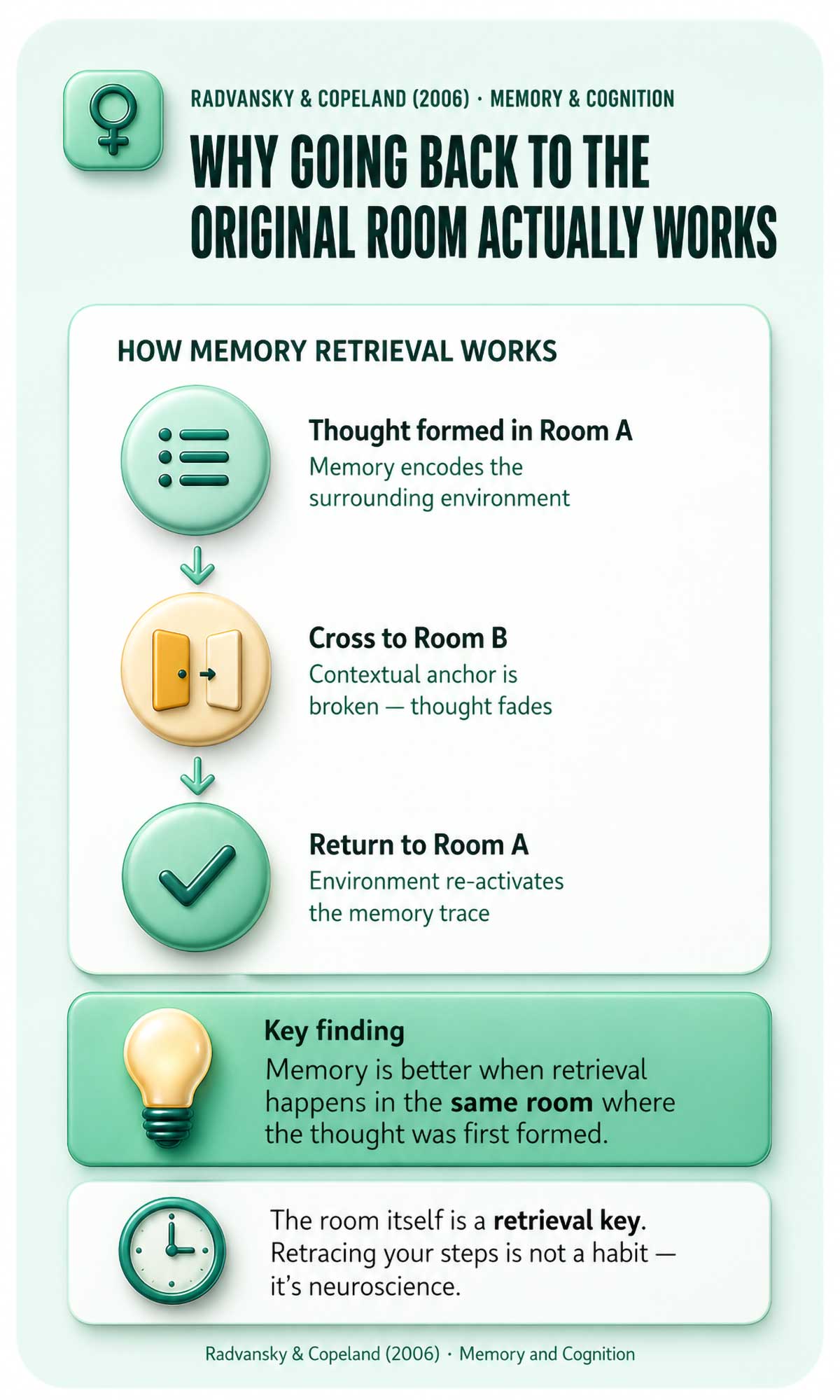
The room itself acts as a contextual anchor. The sights, the sounds, the spatial layout, they’re all bound into the memory at the moment the thought forms. When you leave that room, you leave those cues behind. The thought becomes harder to reach.
But when you physically return to the original space, you reactivate the environmental cues that were present when the thought was born. The room becomes a retrieval key.
A 2001 meta-analysis by Smith and Vela, Environmental Context-Dependent Memory: A Review and Meta-Analysis, published in Psychonomic Bulletin and Review, reviewed over four decades of environmental context studies and confirmed the effect is robust and consistent: matching your retrieval environment to your encoding environment genuinely improves recall.
This isn’t an old wives’ tale. It’s context-dependent memory at work. And it’s one of the most reliable cognitive strategies you can use.
The McFadyen team’s Experiment 1 quietly confirmed this from the other direction. In that trial, their virtual rooms were deliberately designed to look identical. No colour change on the walls, no visual cues to mark the shift. Without that environmental contrast, the doorway effect barely appeared at all. Baumann noted that the rooms had no change in context, and no surprise by how the next room looked.
The brain didn’t register a new chapter, so it didn’t flush the old one. In practical terms: the more visually distinct two rooms are, the more likely your brain is to treat the crossing as a hard reset. Moving from a bright kitchen into a dim bedroom is a stronger trigger than walking between two identically lit, beige-walled rooms.
Earlier research also showed something striking about the timing of this effect
In a 2009 study, Khena Swallow, Jeffrey Zacks, and Richard Abrams examined exactly what happens to memory at the moment an event boundary occurs. Participants watched movie clips of goal-directed activities, and recognition for objects was tested five seconds after each object appeared.
Their paper, Event Boundaries in Perception Affect Memory Encoding and Updating, published in the Journal of Experimental Psychology: General, found that objects present right at an event boundary were actually better recognized than objects from earlier in the same event. The boundary moment itself triggers a spike in attention and encoding — the brain, sensing a chapter change, briefly sharpens its focus.
Three Science-Backed Ways to Work With Your Brain, Not Against It
Understanding the doorway effect gives you real tools. Here’s how to use them.
The “Payload” Technique
Say your goal out loud before you cross the threshold. Literally speak it. “I’m going to the bedroom to get the charger.” Vocalizing a goal creates an additional memory trace, an auditory one, that’s separate from the spatial one your brain is about to file away. Even silently mouthing the goal, or repeating it in your head as you cross, adds enough reinforcement to survive the chapter change. You’re essentially converting a fragile active memory into a more encoded intention.
Drop the Working Memory Load
This is the most practical takeaway from the McFadyen et al. 2021 findings. The doorway effect hits hardest when your brain is already full. Put down the phone before you move rooms. Pause the mental to-do list. Give your brain at least a few empty slots when you’re about to transition between spaces. The fewer chunks you’re juggling, the less likely the crossing will cost you your original thought.
The Object Anchor
Carry something physical from the origin room to represent your task. A pen. A coaster. A sticky note in your hand. This works on two levels. The object serves as a retrieval cue tied to the original context, similar to how returning to a room works. And it keeps the intention physically visible, outside your working memory, so it doesn’t need a mental slot at all. You offload the thought from your brain onto an object. Your brain doesn’t have to hold it. The object holds it for you.
Your Brain Isn’t Broken, It’s Beautifully Efficient
The doorway effect gets misread as a memory failure. It’s actually the opposite. It’s your brain doing exactly what a well-run operating system should do: clearing old processes, freeing up space, and preparing for whatever environment comes next.
The segmentation system described by Zacks and colleagues, the episodic buffer described by Baddeley, the four-chunk capacity limit, the contextual anchoring, all of it points to a brain that’s working hard to stay organized and responsive. The only time it trips you up is when you ask it to multitask across a transition it wasn’t built to handle without your help.
Now that you know the mechanics, you can work with the system instead of being frustrated by it. Slow down before you move rooms. Name your goal. Keep one hand free and one thought in focus. Your brain isn’t forgetting. It’s filing. And once you understand that, you can make sure the right things make it into the new chapter.