You can feel better after one workout, but the brain changes researchers measure take much longer. The timeline might be more important than intensity.
The mood lift hits within minutes of finishing a workout. The structural brain changes take months. That gap (between what exercise feels like and what it actually does to neural tissue) is where most people’s understanding stops, and where the research gets genuinely interesting.
You can track the mood shift in hours. What is harder to see, and what scientists have been piecing together for decades, is the slower process happening underneath: blood flow increasing to specific brain regions, growth proteins rising, the prefrontal cortex getting measurably better at its job. Those changes follow a timeline.
Eight to twelve weeks. That is when the evidence starts to accumulate into something measurable.
The 12-Week Brain Benchmark: Why This Timeline Matters
Most people who start exercising notice the easier effects within days. Sleep improves. Energy rises. Resting heart rate drops. Those are real changes, and they matter. But they are not the same as the structural brain adaptation the cognitive research describes.
True gains in how you plan, focus, and manage competing information take longer to appear. The brain needs time to physically adapt: building new neural connections, increasing blood delivery to regions responsible for attention and memory, releasing proteins that support neuron health. That process has a threshold.
A 2018 systematic review in the British Journal of Sports Medicine offers the clearest picture of where that threshold sits. Northey and colleagues analyzed 36 randomized controlled trials and found that programs lasting 8 to 24 weeks, with sessions of 45 to 60 minutes at moderate intensity on as many days as possible, produced measurable improvements across all major cognitive domains.
Memory, processing speed, executive function, and global cognition all moved in the right direction. Those findings held whether participants were healthy, had mild cognitive impairment, or had been diagnosed with dementia.

The review also identified what did not work. Programs shorter than 8 weeks produced inconsistent results. Sessions under 45 minutes showed weaker effects. Frequency and duration drove the adaptation, not intensity alone.
What makes the timeline work is not just how long you train. Exercising 3 to 5 times per week appears to be the primary driver of what scientists call neural plasticity, the brain’s capacity to reorganize and strengthen itself in response to challenge.
A single large-volume session once a week produces far less adaptation than regular, repeated signals spread across months. The brain responds to frequency.
What Running and Riding Actually Do to the Brain
The mood boost after a workout is real. Your brain releases endorphins and dopamine. Stress hormones drop. You feel better for a few hours. That response and long-term cognitive change, though, work through entirely different mechanisms.
Sustained aerobic exercise at moderate-to-vigorous intensity raises levels of brain-derived neurotrophic factor (BDNF), a protein that supports the growth and maintenance of neurons. Think of it as the soil condition the brain needs to form new connections.
The prefrontal cortex, the region responsible for planning, attention, and decision-making, becomes more efficient at filtering and managing information. Blood flow to this region increases over weeks of consistent training.
These are observable changes. They show up on neuroimaging and on standardized cognitive tests, not just on self-reported mood surveys. They also take time to consolidate, which is why the research keeps pointing back to the 8-to-12-week window rather than the acute post-exercise state.
Aerobic Exercise and the Brain’s Executive Control System
The part of the brain that helps you plan, focus, and shift between tasks is called the executive control system. It lives primarily in the prefrontal cortex. Aerobic exercise acts on this region in specific, measurable ways, and the effect size is larger than most population-level summaries suggest.
Stanley Colcombe and Arthur Kramer at the University of Illinois spent years trying to quantify exactly this. Their 2003 meta-analysis drew on 18 intervention studies conducted with older adults between 1966 and 2001.
The headline finding was that fitness training produced robust benefits to cognition across categories, but the strongest response appeared specifically in executive control processes, with an effect size of 0.68. That is large territory by the standards of psychological research.
Studies with longer intervention periods, longer session durations, and more female participants produced the strongest results. That subgroup pattern turned out to be more informative than the aggregate number alone.
High-Intensity Intervals and the Prefrontal Cortex
Researchers at the University of Washington wanted to know what happened when aerobic intensity was pushed well above the moderate range. The result was a 2010 trial led by Laura Baker and colleagues at Veterans Affairs Puget Sound that enrolled 33 adults between 55 and 85 years old, all diagnosed with amnestic mild cognitive impairment.
Participants exercised at 75 to 85% of heart rate reserve, a level where you can speak in short phrases but not full sentences, for 45 to 60 minutes per session, four times per week, over six months.
The Baker et al. study found measurable improvements in executive function across several standardized neuropsychological tests, including the Stroop test, Trail Making Test B, and the Symbol-Digit Modalities. Processing speed, verbal fluency, and cognitive flexibility all shifted.
One thing worth naming about this study: it was conducted in a clinical setting with a specific population, adults with an existing MCI diagnosis, exercising under direct supervision of a trained fitness specialist.
How directly those outcomes transfer to healthy adults following an unsupervised home routine is not fully established. The Baker data is directionally useful. It is not a direct blueprint, and treating it as one overlooks a real gap between the study design and most people’s circumstances.
Task Switching and Where the Evidence Gets More Complicated
Ann Smiley-Oyen and her colleagues at Iowa State University ran one of the longer aerobic exercise trials in this area, following 57 older adults through a 10-month program of either aerobic or strength training. Their 2008 study in the Annals of Behavioral Medicine set out to test whether exercise selectively improved tasks requiring executive control, or whether it improved cognitive performance more broadly.
What the Smiley-Oyen et al. findings showed was consistent with the Colcombe and Kramer meta-analysis: aerobic training produced its largest benefits on tasks with high executive demand. Tasks requiring little executive control, including simple reaction time, showed no meaningful change.
But the picture was not clean. The aerobic group showed no improvement on certain inhibitory control measures, including go/no-go reaction times. Gains were selective.
Some components of executive function responded, and others did not, and the researchers did not have a complete explanation for why. That finding tends to get smoothed over in summaries of this area. The full picture is less tidy than the headline claim suggests.
Filtering Out Noise
Your brain continuously receives information it does not need. The ability to suppress irrelevant input (what researchers call conflict resolution or selective attention) is an executive function that aerobic training specifically targets, and it tends to be where training effects are most noticeable to people in everyday life.
You don’t experience better task-switching as a measurable improvement on a test. You experience it as the same noisy open-plan office feeling less costly to work in. The 45-to-60-minute session length appears repeatedly in the research as the window where this benefit is most reliably produced: enough stimulus to drive neural adaptation, not so much that fatigue undermines it.
The Gender Gap in Cognitive Gains
This is probably the most informative finding in this entire area of research, and it is the one most exercise content ignores entirely.
When Baker and colleagues broke down the 2010 data by sex, the differences were substantial. Women in the high-intensity aerobic group showed more pronounced cognitive improvements than men across selective attention, processing speed, cognitive flexibility, and multitasking.
The magnitude of those gains was not modest. They showed up cleanly on standardized neuropsychological testing, not just as self-reported changes.
The research team traced this back to specific metabolic shifts. Women in the exercise group showed favorable changes in glucose metabolism and reduced cortisol levels. Those metabolic changes directly predicted their cognitive improvements in the regression analysis.
Men in the same protocol gained cardiovascular fitness and showed cognitive benefits, particularly on complex task-switching, but without the equivalent metabolic or cortisol response pattern.
Two biological mechanisms appear to explain most of the gap.
The first is cortisol, a stress hormone that, when chronically elevated, impairs memory and executive function. Aerobic exercise appears to reduce baseline cortisol more substantially in women, which likely contributes to the stronger cognitive response to the same training load.
The second is BDNF. In the Baker study, women showed BDNF shifts that correlated directly with their cognitive gains. Men showed smaller shifts in the same marker. Whether that reflects a fundamental biological difference or a difference in how specific hormonal context shapes the BDNF response is not settled. Three competing explanations exist in the literature. None of them fully holds.
This does not mean men fail to benefit from aerobic exercise. The Colcombe and Kramer meta-analysis found meaningful cognitive gains across mixed-sex and male-predominant study samples.
The point is that outcomes may differ in magnitude and timing depending on biology, and knowing that in advance is more useful than assuming the research applies evenly to everyone following the same protocol.
Resistance Training and the Brain
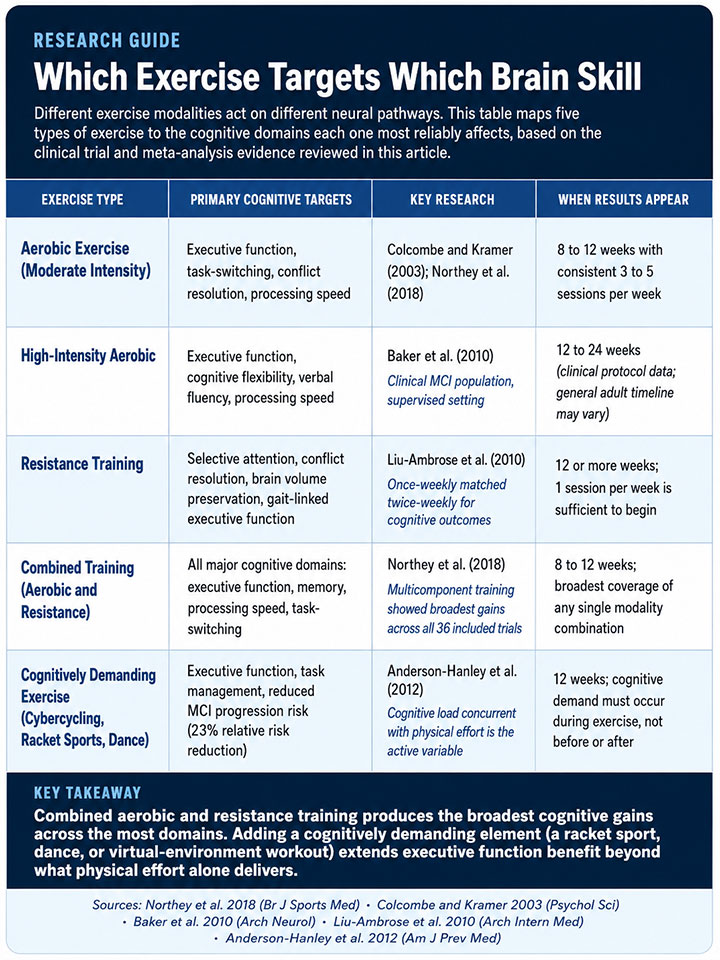
For most of the history of exercise-and-cognition research, resistance training was treated as an afterthought. Running, cycling, and swimming were the headline modalities. Strength work was assumed to be primarily a body composition intervention. That picture changed significantly in the decade after 2010.
What the Numbers Actually Show
Teresa Liu-Ambrose and colleagues at the University of British Columbia designed one of the largest resistance training and cognition trials on record. The Brain Power Study enrolled 155 community-dwelling women aged 65 to 75 and assigned them to one of three conditions: resistance training once per week, resistance training twice per week, or a balance-and-tone control. The trial ran for 12 months.
Both resistance training groups improved on measures of selective attention and conflict resolution compared to the control group, according to the Liu-Ambrose et al. study. The finding that drew the most attention, even from the researchers: the once-weekly group performed comparably to the twice-weekly group on most cognitive outcomes. One well-structured resistance session per week produced cognitive benefits statistically comparable to two.
The study also found reduced brain volume loss in both resistance training groups relative to controls, a meaningful signal given that brain volume typically decreases with age. Improvements in gait speed and leg strength tracked with better executive function. That pattern suggests a pathway where lower-body mobility and brain health are more closely connected than most people expect.
The Case for Combining Both
The 2018 Northey meta-analysis, which covered all major exercise modalities in a single analysis, found that multicomponent training combining aerobic and resistance work produced cognitive gains across every domain measured.
The mechanism appears additive rather than redundant. Aerobic exercise drives cardiovascular improvements and BDNF production. Resistance training targets attention networks and processing speed through separate neural pathways.
Each modality contributes something the other does not fully replicate. The combined protocol in this article is built on that finding, not as a general health recommendation, but as the specific arrangement the evidence points to for cognitive outcomes.
Cybercycling and the Case for Cognitively Demanding Exercise
The standard aerobic exercise and cognition literature mostly skips a specific question: what if the workout itself required active mental engagement?
Cay Anderson-Hanley and colleagues at Union College decided to test it directly. Their 2012 cluster-randomized trial assigned older adults to either standard aerobic cycling or “cybercycling,” pedaling while navigating a virtual environment that demanded real-time spatial awareness, turn anticipation, and decision-making. Both groups exercised three times per week for 12 weeks. Physical effort and fitness improvements were comparable across conditions.
The Anderson-Hanley results showed the cybercycling group achieved significantly better executive function outcomes than the standard cycling group, with a medium effect size (d = 0.50) favoring cybercycling.
The cybercyclists also had a 23% lower relative risk of progression to mild cognitive impairment compared to controls. Since physical effort was matched, the cognitive component of the exercise appears to have been the differentiating variable.
The brain adapts to the demands placed on it while it is already working hard. Physical effort alone produces cardiovascular and BDNF-related benefits. Layering in active attention, decision-making, or spatial navigation produces additional neural adaptation on top of those. The cognitive load needs to be concurrent with the physical effort, not before or after, for this mechanism to apply.
In practice, activities that may deliver broader cognitive outcomes than their physiological effort would predict include racket sports, dance with choreographic sequences, basketball and other decision-heavy team sports, and group fitness formats that require following complex real-time cues. The common factor is active cognitive engagement happening at the same time as physical output.
Your 12-Week Protocol: A Practical Dosage Guide
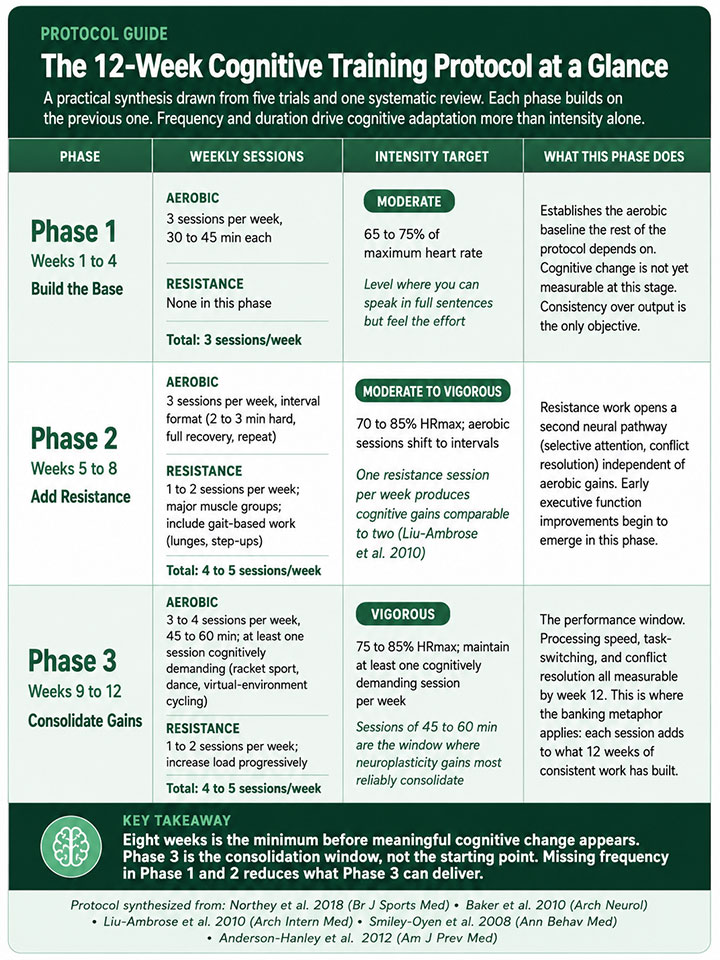
What follows is a practical synthesis drawn from multiple studies, not a direct copy of any single trial. The Baker study used high-intensity aerobic work from the start with a closely monitored clinical population.
The Northey meta-analysis recommended moderate intensity across a broad range of adults. The Liu-Ambrose findings showed that once-weekly resistance training produced meaningful cognitive gains.
This protocol threads those findings together into something applicable to most healthy adults. If you already have significant fitness experience or clinical supervision, you may be able to progress faster through each phase.
Phase 1: Weeks 1 to 4: Build the Aerobic Base
- Complete three aerobic sessions per week.
- Keep sessions to 30 to 45 minutes at moderate intensity, roughly 65 to 75% of maximum heart rate.
- Choose any modality you will actually repeat: brisk walking, cycling, swimming, or a cardio machine.
- Make consistency the only goal for this phase. Showing up three times every week matters more at this stage than how hard you push.
The intensity here is intentionally below the 75 to 85% range used in the Baker protocol. That research was conducted in a supervised clinical environment. For most people starting out, building the aerobic base first reduces injury risk and improves adherence over the full 12 weeks. Both matter more than early intensity.
Phase 2: Weeks 5 to 8: Add Resistance and Raise the Intensity
- Add one to two resistance training sessions per week alongside aerobic work. Total weekly sessions: four to five.
- Structure resistance sessions around major muscle groups: squats, hinges, rows, and presses.
- Move aerobic sessions into an interval format: push for two to three minutes at high effort, recover fully, repeat.
- Increase resistance weight or add a set every one to two weeks as your capacity grows.
- Include at least one gait-based exercise each resistance session: lunges, step-ups, or single-leg variations.
The Liu-Ambrose finding is worth returning to here: one well-structured resistance session per week produced cognitive benefits comparable to two. If your schedule allows two sessions, add the second. But one is enough to start seeing results. Do not feel pressure to add both simultaneously at the start of this phase.
Gait-based training specifically earned its place in the protocol because of the Liu-Ambrose data linking leg strength and mobility improvements to executive function gains. Balance work is not filler. It appears to contribute through its own pathway.
Phase 3: Weeks 9 to 12: The Performance Window
- Target 45 to 60-minute sessions, four to five times per week.
- Keep at least one session per week focused on resistance training.
- Add cognitive challenge to at least one aerobic session per week: a new route, a sport, or any activity requiring real-time decision-making alongside physical effort.
- Maintain frequency. This phase is where accumulated adaptation produces measurable cognitive change.
This is the zone where neuroplasticity gains are most likely to consolidate: sessions long enough to drive adaptation, frequent enough to sustain it, varied enough to challenge multiple cognitive systems at once.
What to Expect After 90 Days
The most noticeable shift at the 90-day mark tends to be speed, not memory. Tasks that previously required deliberate attention start to feel more automatic. The friction of being interrupted mid-task, and then picking up the thread again, reduces. Most people notice this before they can name what changed.
Processing speed and task-switching are where the research shows the most consistent early gains. Selective attention follows: the same noisy or distracting environment that used to cost focus becomes more manageable.
These changes appear on neuropsychological tests, but they also show up in ordinary situations. Meetings become easier to track. Reading retention improves. Context-switching at work feels less draining than it did before.
Working memory gains are real but more modest than the headline findings for executive function. The Northey meta-analysis found that working memory improved across its 36-study dataset, but with effect sizes smaller than those seen for executive control processes.
The strongest measurable gains in the literature are in conflict resolution: handling competing demands, staying organized under pressure, making decisions when the inputs are complicated. That is where the 12-week protocol reliably delivers.
Individual results vary more than population averages suggest. The Baker study found that participants with higher baseline blood glucose had more difficulty adhering to the protocol, and their outcomes reflected that.
Metabolic health and brain health are tightly linked. Sleep quality, baseline fitness, genetics, and how closely you stick to the frequency targets all influence how quickly neural adaptation becomes measurable. Some people show clear change by week 8. Others need closer to 16 weeks. The timeline in this article describes averages across research populations, not a guaranteed personal schedule.
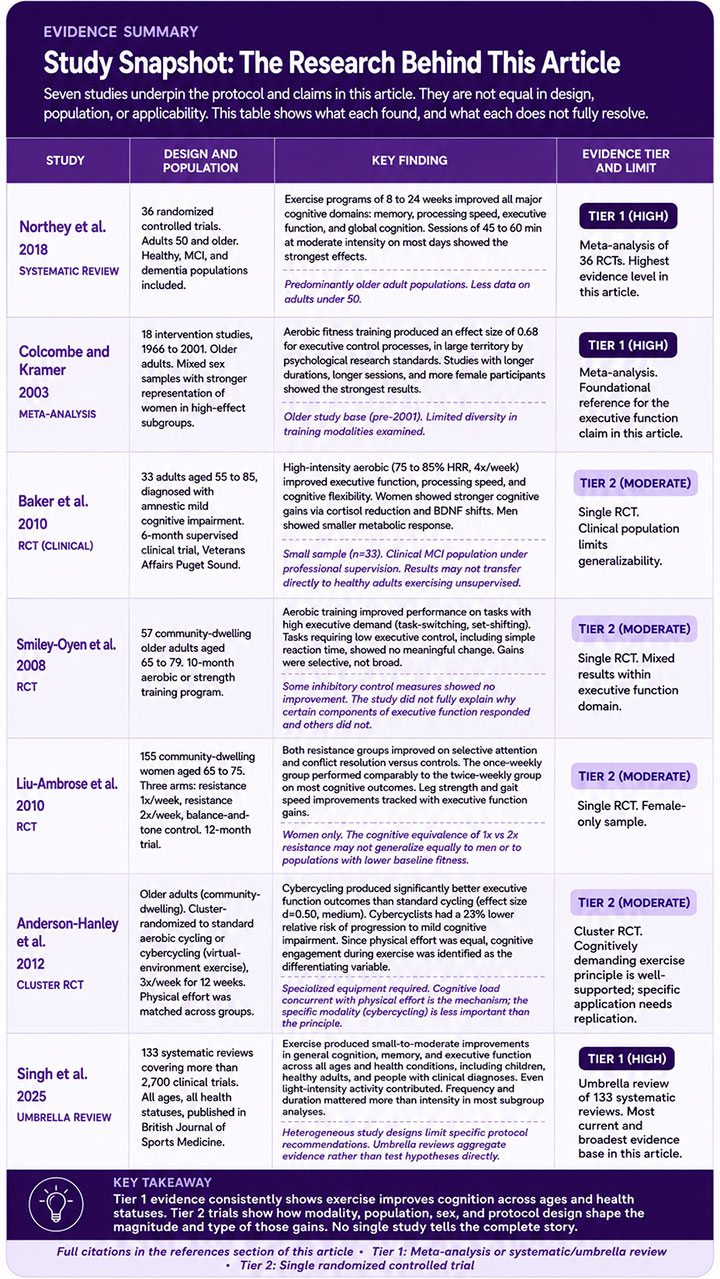
What the research does not support, at any intensity or any modality, is a shortcut. A 2025 umbrella review in the British Journal of Sports Medicine, in which Singh and colleagues synthesized findings from 133 systematic reviews covering more than 2,700 clinical trials across all ages and health statuses, confirmed small-to-moderate improvements in general cognition, memory, and executive function from exercise.
Even light-intensity activity contributed. Frequency and duration mattered more than intensity in most subgroup analyses. Four weeks at high intensity will not produce what 12 weeks of consistent moderate-frequency training produces. The brain responds to consistent repetition, not heroic single efforts.
The Specific Thing the Research Keeps Telling Us
The finding that exercise is good for the brain is not new. Everyone already believed that. What is interesting is how specific the research has become: which cognitive domains respond most, which populations get the strongest gains, which components of a protocol drive the adaptation, and where the evidence actually falls short of the claims being made about it.
The Smiley-Oyen study showed that aerobic training improved high-demand executive tasks and left simpler cognitive operations unchanged. Baker’s data showed that women and men got different things from the same protocol, through different metabolic mechanisms.
Anderson-Hanley found that adding cognitive demand to physical effort produced outcomes that neither produced alone. And Liu-Ambrose demonstrated that one resistance session per week produced cognitive gains comparable to two. Every one of those findings complicates the clean version of the story.
What the whole body of evidence agrees on: frequency and duration over 8 to 12 weeks, more than intensity, produce the structural brain adaptation that shows up on cognitive tests. The mood shift happens in hours. The brain change takes months. The protocol in this article is built around that gap.