Your brain isn’t stuck. It can change, grow, and build new connections—even if you’re well past your twenties. Scientists call this ability neuroplasticity, and one of the most powerful ways to trigger it doesn’t require a prescription or expensive therapy. It requires movement.
But here’s what most articles won’t tell you: Not all exercise creates the same brain changes. And timing matters more than you think.
You’ve probably heard that exercise is “good for your brain.” That’s true, but it’s frustratingly vague. What type of exercise? How often? And most importantly—how long before you actually see results?
The answer lies in a specific window: 8 to 12 weeks of consistent training, done 3 to 5 times per week. This isn’t arbitrary. It’s the timeline your brain needs to shift from temporary chemical spikes to lasting structural growth.
Let me show you what happens inside your skull during those critical 60 to 90 days.
The Two Types of Brain Change (And Why Only One Lasts)
Your brain responds to exercise in two distinct ways. Understanding the difference will help you set realistic expectations—and stay motivated when you don’t feel “smarter” after your first week at the gym.
Chemical plasticity happens fast. After a single workout, your brain floods with proteins and growth factors. You might feel sharper, calmer, or more focused. These effects are real but temporary. They fade within hours or days.
Structural plasticity takes longer. This is when your brain physically remodels itself. New blood vessels form. Brain regions grow larger. Neural networks reorganize. These changes stick around—but only if you give your brain enough time and consistency to build them.
Think of chemical plasticity as turning on a light switch. Structural plasticity is more like building the entire electrical system. One gives you immediate illumination. The other powers your home for years.
The 8-12 week window is where chemical changes accumulate into structural transformation. Here’s how it unfolds.
Your 12-Week Neuroplasticity Timeline: What’s Happening Inside Your Brain
| Timeline | What’s Changing | What You Might Notice | Why It Matters |
|---|---|---|---|
| After 1 Workout | BDNF spikes 30%+ for 2-4 hours | Better mood, clearer thinking (temporary) | Your brain is testing the waters |
| Week 1-2 | Repeated BDNF surges after each session | Improved energy, slight mood boost | Building the foundation for lasting change |
| Week 3-4 | Brain networks start reorganizing; functional connectivity improves | Tasks feel easier, better focus, quality of life improves | Chemical changes are accumulating |
| Week 5-6 | Blood flow to hippocampus increases; early myelination begins | Memory feels sharper | The transition from chemical to structural plasticity begins |
| Week 7-8 | Hippocampal volume starts increasing (detectable on scans) | Noticeable memory improvements, learning feels easier | Age-related brain shrinkage is reversing |
| Week 9-10 | Neurogenesis accelerates in dentate gyrus | Mental clarity, cognitive flexibility improves | New neurons are being born and integrated |
| Week 11-12 | Structural changes solidify; neural networks are remodeled | Peak cognitive benefits, sustained improvements | Your brain has physically rebuilt itself |
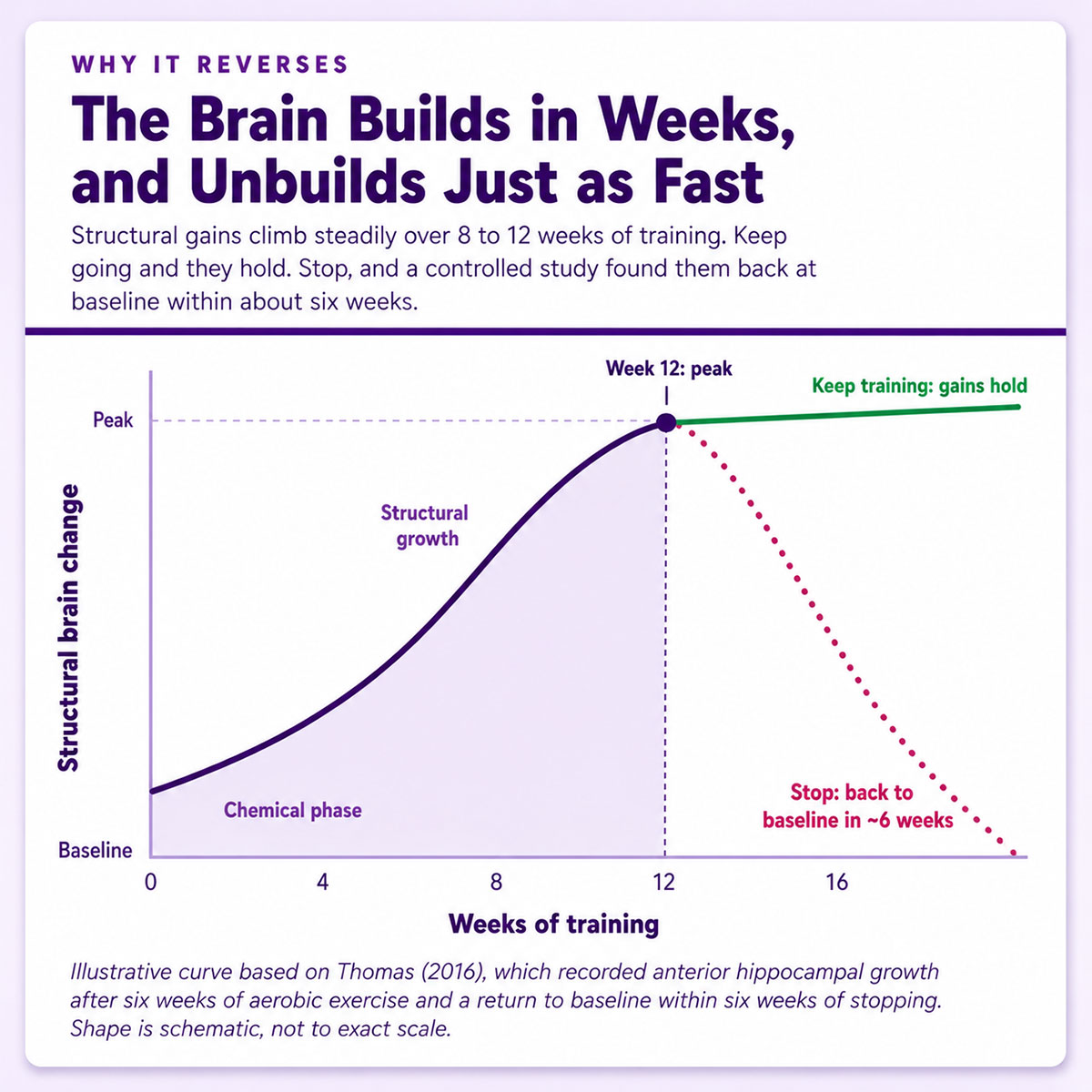
| After Week 12 | Maintenance phase begins | Benefits persist if you continue 3+ sessions/week | Stop exercising and changes reverse within 6 weeks |
Weeks 1-2: The BDNF Surge Begins
Walk into the gym on day one, and something remarkable happens before you even finish your warmup. Your muscles start producing a protein called brain-derived neurotrophic factor, or BDNF.
BDNF acts like fertilizer for brain cells. It helps neurons grow, connect, and survive. Without it, your brain struggles to adapt or learn new information.
After your first few workouts, BDNF levels spike sharply. A 2015 meta-analysis by Szuhany and colleagues examined 29 studies involving both healthy adults and people with clinical conditions. They found that aerobic exercise produces reliable increases in BDNF, with the strongest effects appearing after regular training sessions. A single bout of exercise can increase circulating BDNF by 30% or more. But here’s the catch: these spikes are transient. Your BDNF levels return to baseline within a few hours.

During weeks one and two, you’re essentially priming your brain. Each workout sends another wave of BDNF washing over your neurons. You’re not building new structures yet—you’re preparing the construction site.
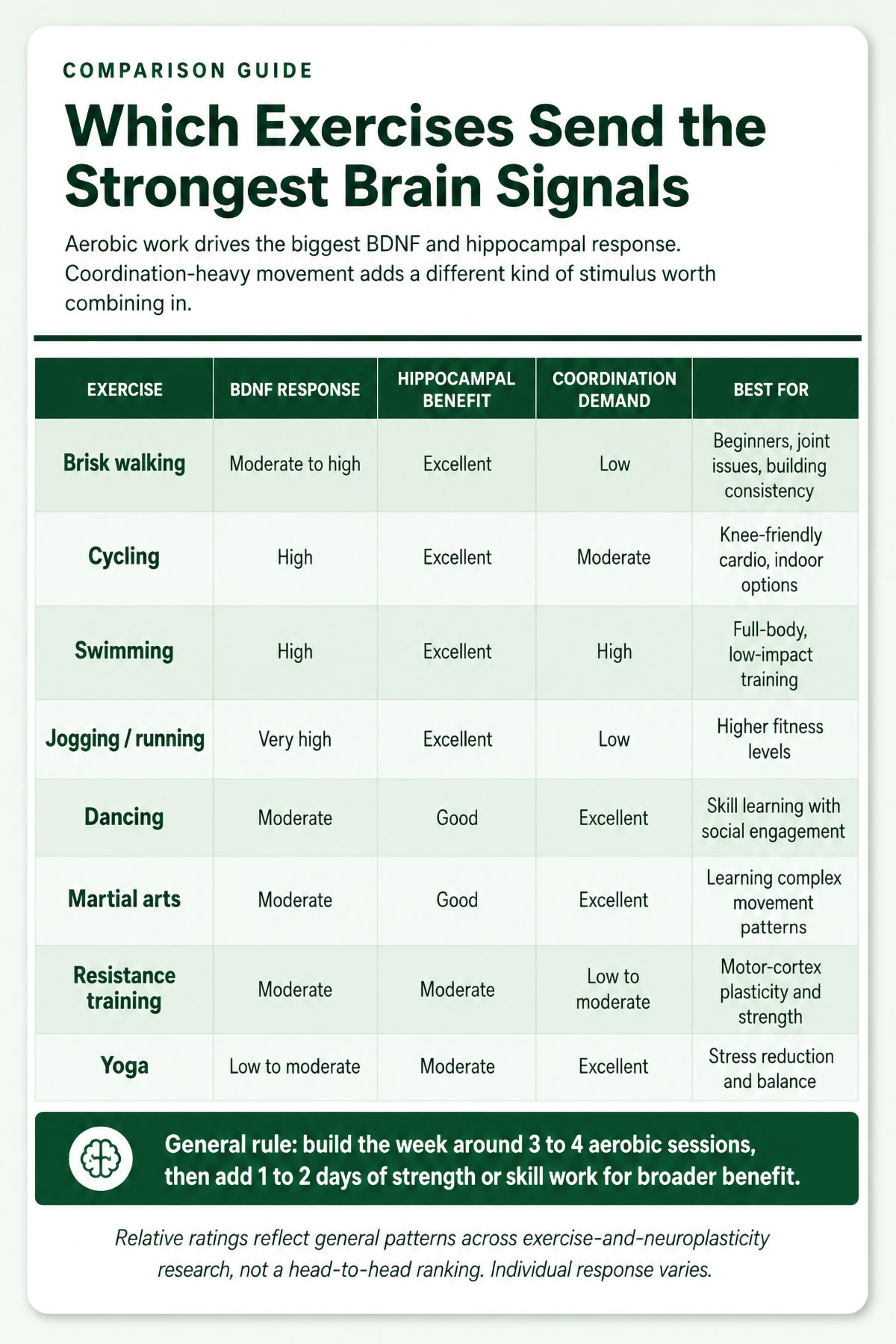
Which Exercises Trigger the Strongest Brain Growth Signals?
| Exercise Type | BDNF Response | Hippocampal Benefits | Coordination Benefits | Best For |
|---|---|---|---|---|
| Brisk Walking | Moderate-High | Excellent | Low | Beginners, joint issues, consistency |
| Cycling | High | Excellent | Moderate | Those with knee problems, indoor options |
| Swimming | High | Excellent | High | Full-body, low-impact |
| Jogging/Running | Very High | Excellent | Low | Higher fitness levels |
| Dancing | Moderate | Good | Excellent | Skill learning, social engagement |
| Martial Arts | Moderate | Good | Excellent | Coordination, learning complex movements |
| Resistance Training | Moderate | Moderate | Low-Moderate | Motor cortex plasticity, strength |
| Yoga | Low-Moderate | Moderate | Excellent | Stress reduction, balance |
Key insight: Aerobic exercises (walking, cycling, swimming, running) produce the strongest BDNF increases and hippocampal growth. But combining them with coordination-based activities (dancing, martial arts) provides broad brain benefits.
What should you do during this phase? Focus on consistency over intensity. Moderate aerobic exercise—walking briskly, cycling at a comfortable pace, swimming—triggers strong BDNF responses without exhausting you. Aim for 30 to 40 minutes per session, at about 60-70% of your maximum heart rate.
Your Personal Heart Rate Zones for Brain Growth
| Age | Maximum Heart Rate | 60% (Lower Limit) | 70% (Upper Limit) | Optimal Zone |
|---|---|---|---|---|
| 25 | 195 bpm | 117 bpm | 137 bpm | 117-137 bpm |
| 35 | 185 bpm | 111 bpm | 130 bpm | 111-130 bpm |
| 45 | 175 bpm | 105 bpm | 123 bpm | 105-123 bpm |
| 55 | 165 bpm | 99 bpm | 116 bpm | 99-116 bpm |
| 65 | 155 bpm | 93 bpm | 109 bpm | 93-109 bpm |
| 75 | 145 bpm | 87 bpm | 102 bpm | 87-102 bpm |
How to use this table: Find your age range. During aerobic sessions, keep your heart rate between the lower and upper limits. You can check your pulse manually (count beats for 15 seconds, multiply by 4) or use a fitness tracker.
Your brain won’t feel dramatically different yet. That’s normal. You’re laying groundwork that will pay off in the weeks ahead.
Week 4: Networks Start Rewiring
By the time you hit 20 sessions—roughly one month of training 5 times per week—something shifts. Your brain stops just reacting to exercise. It starts reorganizing.
A 2004 study by Schulz and team worked with 28 people who had multiple sclerosis. Half trained on bicycles twice weekly for 8 weeks at 60% of their maximum oxygen capacity. The other half stayed sedentary. At the 4-week mark, researchers noticed interesting patterns. While resting BDNF levels didn’t change significantly, the training group showed descriptive increases while the control group’s levels decreased. More importantly, quality of life improved and coordination got better—signs that functional brain changes were underway even before structural growth appeared.
But the most interesting changes happen in brain connectivity. Functional MRI studies show that regular exercisers develop stronger communication between brain regions. The default mode network—the system that activates when you’re not focused on a specific task—becomes more efficient. Executive function improves.
You’re not growing new brain tissue yet. Instead, existing neurons are forming stronger connections. Synapses multiply. Neural pathways that were rarely used start firing more frequently.
This is functional plasticity in action. Your brain is getting better at using what it already has.
Some people notice mental shifts during this phase. Tasks that required intense focus might feel easier. Your mood might stabilize. You may find it simpler to switch between different types of thinking. These aren’t placebo effects—they’re early signs that your neural networks are adapting.
Weeks 6-8: The Hippocampus Starts Growing
Now things get interesting. Between weeks 6 and 8, your brain crosses a threshold. Chemical changes start producing structural results.
The hippocampus—a seahorse-shaped structure deep in your brain—is ground zero for these changes. This region controls memory formation, spatial navigation, and emotional regulation. It’s also one of the few places in the adult brain that can generate new neurons.
A 2016 study by Thomas and colleagues examined healthy young and middle-aged adults who cycled aerobically for 6 weeks. Using detailed brain imaging, they found measurable increases in hippocampal volume. The growth appeared in the anterior portion, which handles memory consolidation. What made this study particularly interesting: the researchers also tracked what happened after participants stopped exercising. The volume increases reversed within 6 weeks of stopping, suggesting these early structural changes need ongoing maintenance to persist.

Here’s what makes this remarkable: the hippocampus typically shrinks as you age. You lose about 1-2% of hippocampal volume per year after age 60. But 8 weeks of regular exercise can reverse that decline.
“Your hippocampus typically shrinks 1-2% per year after 60. Eight weeks of walking can reverse that decline.”
The famous Erickson study from 2011 followed 120 older adults aged 55-80 for an entire year. Half walked around a track three times per week for 40 minutes. The other half did stretching and toning. By the end, the walking group showed 2% growth in hippocampal volume—essentially reversing one to two years of age-related decline. Their blood tests showed increased BDNF levels that correlated with the volume increases. And their performance on spatial memory tests improved significantly. While that study lasted 12 months, brain imaging at earlier timepoints revealed that changes were detectable much sooner—often by the 8-week mark.

What drives this growth? Part of it is increased blood flow. Your brain needs oxygen and nutrients to build new structures. Regular aerobic exercise improves cerebral circulation, delivering more resources to areas that are adapting.
Another factor is myelination—the process of wrapping neural pathways in insulating material that speeds up signal transmission. Exercise promotes myelination in the hippocampus, making existing connections more efficient.
But you’re also growing new neurons. Exercise triggers neurogenesis in the dentate gyrus, a specific subregion of the hippocampus. These newborn cells need time to mature and join existing networks. That’s why structural changes take weeks, not days.
Weeks 10-12: Blood Flow Meets Brain Growth
By week 10, your brain is in full construction mode. The changes that began as temporary chemical spikes have solidified into lasting physical adaptations.
One of the most significant shifts happens in the dentate gyrus. A 2015 study by Maass and colleagues put older adults through 12 weeks of aerobic exercise. Using specialized brain imaging techniques, they measured cerebral blood volume—essentially how much blood flows through different brain regions. After 12 weeks, participants showed increased blood flow specifically in the dentate gyrus. This region is where adult neurogenesis occurs, and more blood flow means more oxygen, glucose, and growth factors reaching the neurons that need them most.

This matters because the dentate gyrus is where adult neurogenesis occurs. New neurons born here eventually migrate into other parts of the hippocampus, where they help form new memories and support cognitive flexibility.
But neurogenesis is fragile. Most newborn neurons die unless they receive the right signals to survive. Exercise provides those signals. BDNF, which has been flooding your brain for weeks, acts as a survival factor for young neurons. Increased blood flow delivers the nutrients they need. The result? More of those newborn cells survive, mature, and contribute to your cognitive function.
Studies also show improvements in functional connectivity throughout the brain. The networks that were reorganizing in week 4 are now operating more efficiently. Different brain regions communicate better. Information flows faster.
A 2010 controlled intervention by Voss and team examined how 6 to 12 months of aerobic training affected brain connectivity in older adults. They found that exercise improved functional brain network connectivity—a marker of neuroplastic adaptation. The connections between different brain regions became stronger and more coordinated, allowing for better information processing and cognitive control.
This is when people often notice the most dramatic cognitive benefits. Memory improves. Mental fog lifts. Learning new information feels easier. These aren’t just subjective feelings—they reflect real structural changes in your brain.
The Consistency Question: Why Frequency Matters
You might wonder: Can you get these results with 2 workouts per week instead of 5? Or by exercising intensely for 4 weeks instead of spreading it out over 12?
The research suggests no. Neuroplasticity operates on a principle called “use it or lose it.” Your brain needs repeated, consistent signals to commit resources to structural change.
Training 3-5 times per week provides that consistency. Each session delivers another dose of BDNF. Each workout increases blood flow to your hippocampus. Each bout of movement reinforces the message: “This body moves regularly. The brain needs to adapt.”
Drop below 3 sessions per week, and the signals become too sporadic. Your brain receives conflicting information. It invests less in long-term adaptation.
The type of exercise matters too, but perhaps less than you’d think. Most studies showing neuroplastic benefits used aerobic exercise—walking, cycling, swimming, jogging. These activities raise your heart rate steadily for extended periods, which maximizes BDNF release and cerebral blood flow.
But resistance training and coordination-based activities also contribute. Lifting weights triggers different neuroplastic pathways, particularly in the motor cortex. Skill-based movement—dancing, martial arts, racquet sports—engages your brain in learning new motor patterns, which promotes synaptic plasticity.
The ideal approach? Combine them. Build your schedule around 3-4 aerobic sessions per week, and add 1-2 days of strength or skill-based training.
What Happens If You Stop?
Here’s the part most articles skip: Neuroplasticity is reversible.
Remember that Thomas study from 2016? Those participants who gained hippocampal volume after 6 weeks of cycling? When they stopped exercising, their brains returned to baseline within 6 weeks. The volume increases they’d gained simply disappeared.
This doesn’t mean your efforts were wasted. The capacity for neuroplasticity remains. Your brain proved it can change. And restarting exercise will likely produce results faster the second time around—a phenomenon called “muscle memory” that applies to neural tissue too.
But it does mean you can’t treat exercise like a one-time intervention. The brain changes you want require ongoing maintenance.
After your initial 8-12 week building phase, you can likely reduce frequency slightly without losing gains. Many studies suggest that 3 sessions per week are sufficient for maintenance once you’ve established a baseline of fitness and neuroplasticity.
But drop to zero, and your brain will eventually revert to its pre-exercise state.
Your Week-by-Week Action Plan
Ready to start? Here’s a practical protocol based on the research we’ve covered.
Weeks 1-2: Build the habit
- Exercise 3-5 days per week
- Keep sessions moderate: 30-40 minutes of walking, cycling, or swimming
- Target heart rate: 60-70% of your maximum (roughly 220 minus your age)
- Focus on consistency, not intensity
Weeks 3-4: Add variety
- Continue 3-5 sessions per week
- Include at least one skill-based activity: yoga, dance, tennis, martial arts
- Increase aerobic sessions to 40-45 minutes
- Notice improvements in mood and focus—these are early signs of functional plasticity
Weeks 5-8: The growth window
- Maintain 3-5 weekly sessions without fail
- This is when structural changes speed up
- If you miss workouts during this phase, you delay results
- You may not feel dramatically different yet—trust the process
Weeks 9-12: Solidify the changes
- Continue your established routine
- Consider adding intervals: brief periods of higher intensity within aerobic sessions
- Pay attention to memory, learning, and mental clarity—these often improve noticeably during this phase
- Start planning your long-term maintenance schedule
Beyond week 12: Maintenance mode
- Reduce to 3-4 sessions per week if needed
- Maintain intensity and duration
- Mix aerobic, strength, and coordination work
- Remember: stopping completely reverses most gains within weeks
Sample Week: Your Brain-Building Exercise Schedule
For Beginners (Weeks 1-4):
- Monday: 30 min brisk walk (60-65% max heart rate)
- Tuesday: Rest or gentle yoga
- Wednesday: 30 min cycling or swimming (60-70% max heart rate)
- Thursday: Rest or 20 min coordination practice (balance exercises, tai chi)
- Friday: 35 min brisk walk (60-70% max heart rate)
- Saturday: 20-30 min nature walk (light activity)
- Sunday: Rest
For Intermediate (Weeks 5-12):
- Monday: 40 min brisk walk or jog (65-70% max heart rate)
- Tuesday: 30 min dance class or martial arts
- Wednesday: 40 min cycling (65-70% max heart rate)
- Thursday: 20 min strength training (bodyweight or light weights)
- Friday: 45 min swimming or brisk walk (65-70% max heart rate)
- Saturday: 30 min skill-based activity (tennis, pickleball, hiking)
- Sunday: Rest or gentle yoga
Key principles:
- Never skip more than 2 days in a row during weeks 5-12
- If you miss a session, don’t double up—just continue your schedule
- Listen to your body, but don’t confuse discomfort with harm
When to Modify Your Exercise Approach
Not everyone should jump into a 5-day-per-week protocol. Here are signs you need to adjust:
Start with 3 days per week instead of 5 if you:
- Haven’t exercised regularly in over a year
- Are over 65 and new to structured exercise
- Have joint problems or chronic pain conditions
- Are managing a chronic health condition
Consult a doctor before starting if you have:
- Heart disease or high blood pressure
- Diabetes (exercise affects blood sugar)
- Recent surgery or injury
- Dizziness or balance problems
- Any condition requiring medication adjustments with activity changes
Warning signs to stop and seek medical advice:
- Chest pain or pressure during exercise
- Severe shortness of breath
- Dizziness or lightheadedness that doesn’t resolve quickly
- Joint pain that worsens over multiple sessions
- Extreme fatigue that lasts for days after exercise
Good news: Even 3 sessions per week produces neuroplastic benefits. It just takes slightly longer. Studies show that walking 3 times weekly still increases hippocampal volume—you’ll just see peak results closer to week 16-20 instead of week 12.
How to Track Your Progress
You can’t see your hippocampus growing, but you can track indicators that suggest neuroplastic adaptation is happening.
Week 1-4: Track consistency
- Log each workout (date, duration, type, heart rate if available)
- Rate your mood daily (1-10 scale)
- Note sleep quality (hours slept, how rested you feel)
Week 5-8: Add cognitive markers
- How quickly can you recall a grocery list after reading it once?
- Can you learn a new phone number or address more easily?
- Are you solving problems or making decisions faster?
- Has your mental fog or afternoon slump improved?
Week 9-12: Look for structural benefits
- Memory for recent events (can you recall conversations from 2-3 days ago?)
- Learning new skills (are you picking up new information faster?)
- Emotional regulation (are you less reactive to stress?)
- Spatial navigation (are you finding your way in new places more easily?)
Simple self-test: At week 0, week 6, and week 12, try this: Look at a list of 15 random words for 2 minutes. Close your eyes and recall as many as possible. Most people improve by 20-30% between week 0 and week 12 if they’ve been consistent with exercise.
The Mistakes That Sabotage Your Brain-Building Efforts
Mistake 1: Going too hard, too fast
Problem: High-intensity exercise can spike cortisol, which impairs neurogenesis if chronically elevated.
Solution: Stick to moderate intensity (60-70% max heart rate) for the first 8 weeks. Add intervals only after you’ve built a consistent base.
Mistake 2: Skipping workouts during weeks 5-8
Problem: This is when structural changes speed up. Missing sessions during this window delays results significantly.
Solution: Treat weeks 5-8 as non-negotiable. Schedule workouts like doctor appointments.
Mistake 3: Not sleeping enough
Problem: Neurogenesis happens primarily during deep sleep. Sleep deprivation blocks the very changes you’re trying to create.
Solution: Prioritize 7-9 hours of sleep nightly. Exercise earlier in the day if evening workouts disrupt your sleep.
Mistake 4: Doing the exact same workout every time
Problem: Your brain adapts to predictable patterns. Variety promotes broader neuroplastic adaptations.
Solution: Rotate between different aerobic activities. Add coordination work 1-2 days per week.
Mistake 5: Expecting instant results
Problem: You won’t “feel smarter” after week 2. Structural changes take 6-8 weeks minimum.
Solution: Trust the timeline. Focus on consistency, not immediate cognitive improvements.
Nutrition That Amplifies Your Exercise Results
Exercise triggers neuroplasticity. Nutrition provides the raw materials your brain needs to complete the construction project.
Nutrients that support BDNF production and neurogenesis:
Omega-3 Fatty Acids (DHA and EPA)
Found in: Fatty fish (salmon, mackerel, sardines), walnuts, flaxseeds, chia seeds
Why it matters: DHA is a structural component of brain cell membranes. EPA reduces neuroinflammation.
Target: 2-3 servings of fatty fish per week, or 1000mg combined EPA/DHA supplement daily
Flavonoids
Found in: Blueberries, dark chocolate (70%+ cacao), green tea, citrus fruits
Why it matters: Increases blood flow to the hippocampus and supports neurogenesis
Target: 1-2 cups of berries daily, or 1-2 cups of green tea
Protein (especially leucine)
Found in: Eggs, chicken, Greek yogurt, lentils, tofu
Why it matters: Provides amino acids needed for BDNF synthesis and neuron repair
Target: 0.8-1g per kg of body weight daily (more if you’re adding resistance training)
Magnesium
Found in: Spinach, almonds, black beans, avocado, dark chocolate
Why it matters: Required for synaptic plasticity and BDNF signaling
Target: 400-420mg daily for men, 310-320mg for women
Foods to limit during your neuroplasticity protocol:
- Excess sugar (impairs BDNF signaling)
- Trans fats (promote neuroinflammation)
- Alcohol (inhibits neurogenesis, especially in the hippocampus)
Simple daily eating pattern:
- Breakfast: Greek yogurt with berries and walnuts
- Lunch: Salmon salad with leafy greens and avocado
- Snack: Apple with almond butter or a small piece of dark chocolate
- Dinner: Grilled chicken or tofu with roasted vegetables and quinoa
- Hydration: 8-10 glasses of water (dehydration impairs cognitive function)
Neuroplasticity Across the Lifespan: What to Expect
| Age Group | Baseline Neuroplastic Capacity | Exercise Impact | Special Considerations | Realistic Timeline |
|---|---|---|---|---|
| 20-35 | High natural neuroplasticity | Boosts peak cognitive function, builds reserve capacity | Can handle higher intensity; 5 days/week is achievable | Results visible at 6-8 weeks |
| 36-50 | Moderate; early decline begins | Slows age-related decline, maintains cognitive function | Balance intensity with recovery; 4-5 days/week optimal | Results visible at 8-10 weeks |
| 51-65 | Declining; hippocampus shrinking ~1%/year | Reverses atrophy, improves memory significantly | Joint health matters; lower-impact options preferred | Results visible at 10-12 weeks |
| 66+ | Reduced but still responsive | Can reverse 1-2 years of brain aging in 12 weeks | Start at 3 days/week; prioritize safety and balance | Results visible at 12-16 weeks |
Key insight: Older brains benefit as much or more from exercise than younger brains. The timeline just extends slightly. If you’re over 60, don’t be discouraged if results take 14-16 weeks instead of 8. The structural changes are just as real.
A 2020 review by Stillman and colleagues examined numerous studies on exercise and brain plasticity across different age groups. They found that exercise consistently linked to both structural and functional brain changes in humans, regardless of age. The effects varied by population and intervention characteristics, but the core finding remained: regular aerobic and resistance exercise produces measurable neuroplastic adaptations across the lifespan.
The Biology of a Smarter Brain
Let’s zoom out and review what happens during those 8-12 weeks:
Chemical phase (Weeks 1-4): BDNF surges after each workout. Neurotransmitter systems adjust. Functional connectivity improves. Your brain uses existing resources more efficiently.
Early structural phase (Weeks 5-8): Blood flow to the hippocampus increases. Myelination speeds up. New neurons are born in the dentate gyrus. Hippocampal volume starts expanding.
Consolidation phase (Weeks 9-12): Neurogenesis continues. Blood vessel density increases. Functional networks operate more efficiently. Structural changes become measurable on brain scans.
“Each workout sends another wave of BDNF washing over your neurons. You’re not building new structures yet—you’re preparing the construction site.”
This timeline isn’t rigid. Some people see changes faster. Others need more time. Factors like age, baseline fitness, genetics, and exercise intensity all affect the pace of neuroplasticity.
But the general pattern holds: Regular aerobic exercise, done consistently for 8-12 weeks, produces real, measurable changes in brain structure and function.
Why This Matters More Than You Think
We often discuss exercise through the lens of physical health. Weight loss. Heart fitness. Muscle strength. These are valid goals.
But the neuroplastic effects of exercise might be even more important. Your brain determines your quality of life in ways your biceps never will.
Memory problems? Exercise offers a solution. Age-related cognitive decline? Exercise slows it down and can partially reverse it. Difficulty learning new skills? Exercise creates the biological conditions that support learning.
Depression and anxiety? Both conditions are associated with reduced hippocampal volume and decreased BDNF. Exercise addresses both factors directly.
A 2008 study by Castellano and White examined 22 participants—11 with multiple sclerosis and 11 healthy controls—who cycled at 60% of their peak oxygen capacity three times weekly for 8 weeks. They found that BDNF increased at week 4 in the MS subjects, though it returned to baseline by week 8. Resting BDNF was lower in MS participants compared to controls at baseline. This study showed that even in people with neurological conditions, exercise can trigger early neuroplastic changes, though sustained benefits may require longer training periods.
You don’t need to become an athlete. You don’t need expensive equipment or a gym membership. You just need to move your body consistently, at a moderate intensity, for 30-45 minutes at a time, 3-5 days per week.
Do that for 8-12 weeks, and your brain will rebuild itself.
Conclusion
Neuroplasticity isn’t magic. It’s biology responding to consistent signals.
Exercise provides those signals more powerfully than almost any other intervention. Each workout releases growth factors, increases blood flow, and activates genes that support neural adaptation.
But these effects only accumulate into lasting change if you give your brain enough time and consistency. That’s what the 8-12 week window represents—the minimum duration for temporary chemical spikes to solidify into permanent structural growth.
Your brain is waiting to change. It’s ready to grow new neurons, build new connections, and expand the regions that support memory and learning. You just need to move.
Start today. Give it 8-12 weeks. Three to five sessions per week. Moderate intensity. Consistent effort.
FAQs
Can I get brain benefits from strength training alone, or do I need cardio?
Aerobic exercise produces the strongest BDNF increases and hippocampal growth. Strength training supports motor cortex plasticity and executive function. For maximum neuroplastic benefits, do both—but if you can only choose one, choose aerobic.
I’m 70 years old. Is it too late to start?
Absolutely not. The Erickson study showing 2% hippocampal growth included adults aged 55-80. Many saw their best results after age 65. Your brain remains capable of neuroplasticity throughout life.
What if I can only exercise 2 days per week?
Two days is better than zero, but it falls below the threshold for consistent structural adaptation. Try to hit 3 sessions minimum. Even 20-minute sessions count if you can’t manage 40 minutes.
Do I need to sweat to get brain benefits?
No. Moderate intensity (60-70% max heart rate) is ideal. You should be able to hold a conversation with some difficulty—that’s the sweet spot for BDNF release.
Can I split my 40-minute workout into two 20-minute sessions?
Probably not optimal. BDNF increases peak after about 20-30 minutes of continuous activity. Splitting sessions may not sustain elevated levels long enough.
Will these benefits help with depression or anxiety?
Yes. Both conditions are linked to reduced hippocampal volume and low BDNF. Exercise addresses both factors directly. Studies show 8-12 weeks of aerobic exercise can be as effective as antidepressants for mild to moderate depression.
What happens if I miss a week due to illness or travel?
Don’t panic. One week off won’t erase your progress. But try not to miss more than 5-7 days during weeks 5-12 when structural changes are most active. If you do, just extend your protocol by the number of weeks missed.
Do I need fancy equipment or a gym membership?
No. Walking costs nothing. Bodyweight exercises work. Nature trails are free. Consistency matters far more than equipment.