Your brain has a dedicated transporter for a compound it can’t make. One food is the only source. Most people eat it less than once a week.
Most aging research starts by asking what goes wrong. A team at Tufts Medical Center asked a different question. They wanted to know what goes right, specifically in people who reach 100 in good health, and what those people had in common at a biological level.
What they found wasn’t one magic compound or one superfood. It was a pattern. They analyzed over 400 substances in the blood of more than 2,700 people from families known for long, healthy lives. Certain compounds kept showing up at healthier levels in the people who lived the longest. The pattern pointed to a handful of very ordinary foods.
What Blood Tests Reveal About People Who Live to 100
The Tufts study screened 408 substances found in blood and grouped them into 19 clusters. Some clusters were linked to aging. Others were linked to a higher risk of dying early. And some were specifically tied to living longer than average in good health. The researchers could tell the difference between substances that signal damage and those that signal protection.
Two clusters stood out because of what they point to in food. The first involved flavones, plant compounds found in foods like celery and parsley. The second included a marker for chocolate consumption called salsolinol. And a third substance, ergothioneine, found almost entirely in mushrooms, kept showing up as a longevity marker in people who lived the longest.
To be clear about what that means: the study didn’t prove that eating mushrooms or dark chocolate makes you live to 100. What it found is that people who live to 100 tend to have blood profiles that look like those of people who eat these foods regularly. That’s a meaningful distinction. But it also tells us that the biological pathways these foods affect are the same ones tied to extreme longevity.
“Aging-associated metabolites point to nutrition as a source of intervention for healthy aging.”
→ See how blueberries support memory and brain function
Why the Body Treats Mushrooms Like a Required Nutrient
Ergothioneine is strange in one specific way. Neither plants nor animals can make it. Only certain fungi and bacteria produce it. That means the only way you get it is by eating food, and mushrooms are by far the richest source available.
What makes this scientifically interesting isn’t just that ergothioneine acts as an antioxidant. It’s that the human body has built a dedicated system just to absorb it. There’s a specific gene, called SLC22A4, that produces a protein whose entire job is pulling ergothioneine out of food, moving it into the bloodstream, and then recapturing it in the kidneys so none gets wasted. That kind of dedicated machinery is rare. The body reserves it for things it really needs, like vitamins and essential amino acids.
Studies on the SLC22A4 transporter show that animals without this gene have zero ergothioneine in their blood and tissues, and they become significantly more vulnerable to cell damage and inflammation. There’s no workaround. No backup. If the food isn’t there, the body simply goes without.
A large study from Singapore showed what that gap might mean for the brain. Researchers tracked 663 adults aged 60 and older and looked at how often they ate mushrooms alongside tests for mild cognitive impairment (MCI), an early stage of memory and thinking problems.
People who ate mushrooms more than twice a week had about 57% lower odds of MCI than those who rarely ate them. The link held up even after accounting for age, education, smoking, exercise, diabetes, and heart disease. And it didn’t matter much which mushrooms they ate, shiitake, oyster, and plain white button mushrooms all counted.
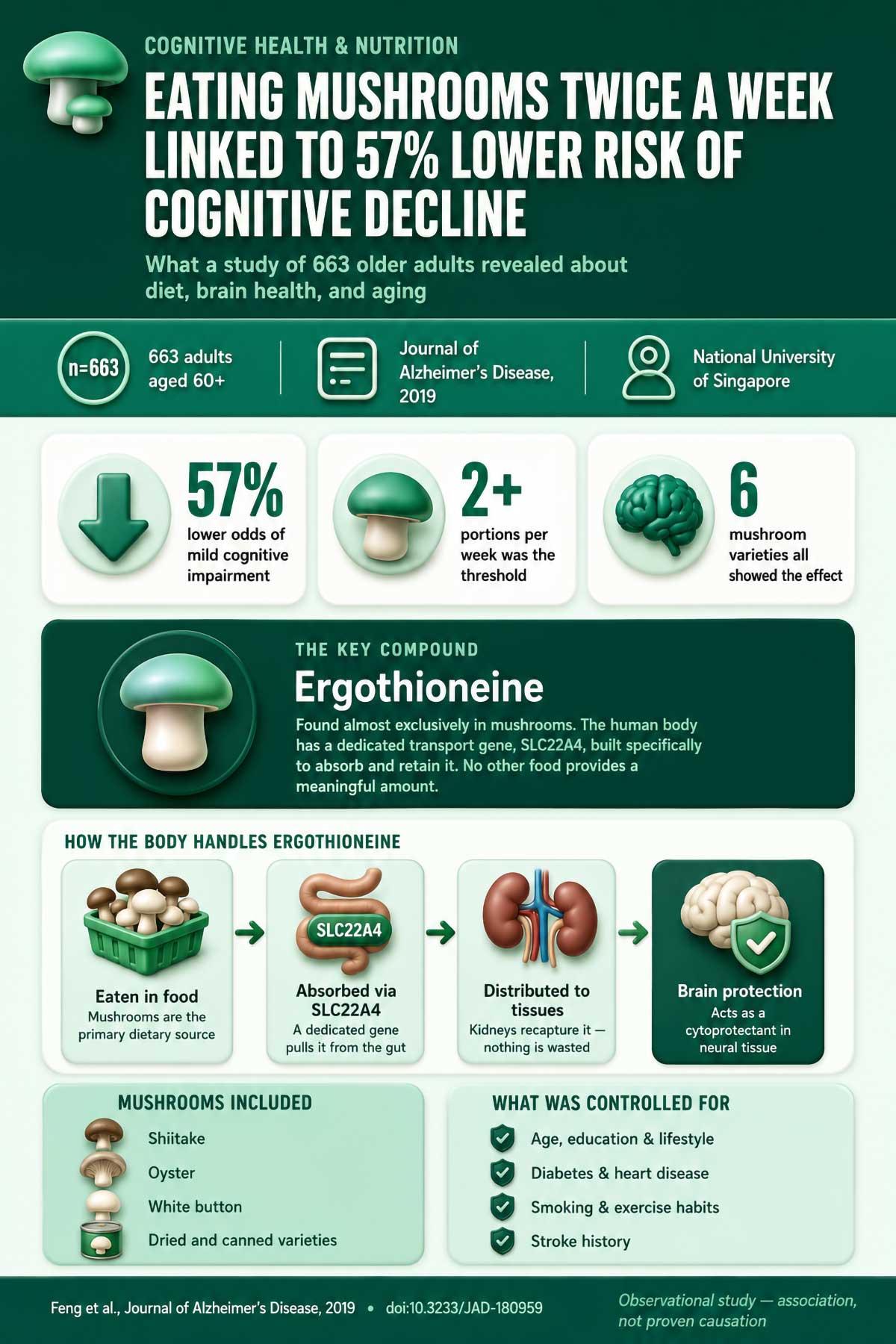
The study was observational, so it can’t prove cause and effect. But a 57% difference in odds is a large gap, and the ergothioneine-transporter biology gives researchers a plausible reason for why it might be real.
What Cocoa Does to the Aging Brain
There’s a part of the brain called the hippocampus that handles memory. Inside it is a smaller zone called the dentate gyrus, which helps you tell similar things apart, like distinguishing where you parked today versus yesterday. This zone tends to slow down with age. It’s one reason people in their 50s and 60s start losing track of small things. It’s not Alzheimer’s. It’s just a normal part of brain aging that happens to almost everyone.
Cocoa contains compounds called flavanols, and researchers at Columbia University wanted to know if these compounds could actually affect that specific part of the brain. They gave healthy adults aged 50 to 69 either a high-flavanol or a low-flavanol diet for three months and scanned their brains before and after. The high-flavanol group performed about 25% better on a memory test designed to measure dentate gyrus function, and their brain scans confirmed improved activity in that specific region. The diet had physically changed how that part of the brain was working.
Nearly a decade later, a much bigger study tested this across 3,562 older adults. Half got 500mg of cocoa flavanols per day for three years. Half got a placebo. The overall result at year one wasn’t statistically significant, which is what the study reported. But that framing misses the most important part. Among people who started with the lowest flavanol intake, memory scores improved by 10.5% compared to the placebo group, and 16% compared to their own starting point. The people who were already eating enough flavanols didn’t see the same benefit, because they presumably didn’t need it.
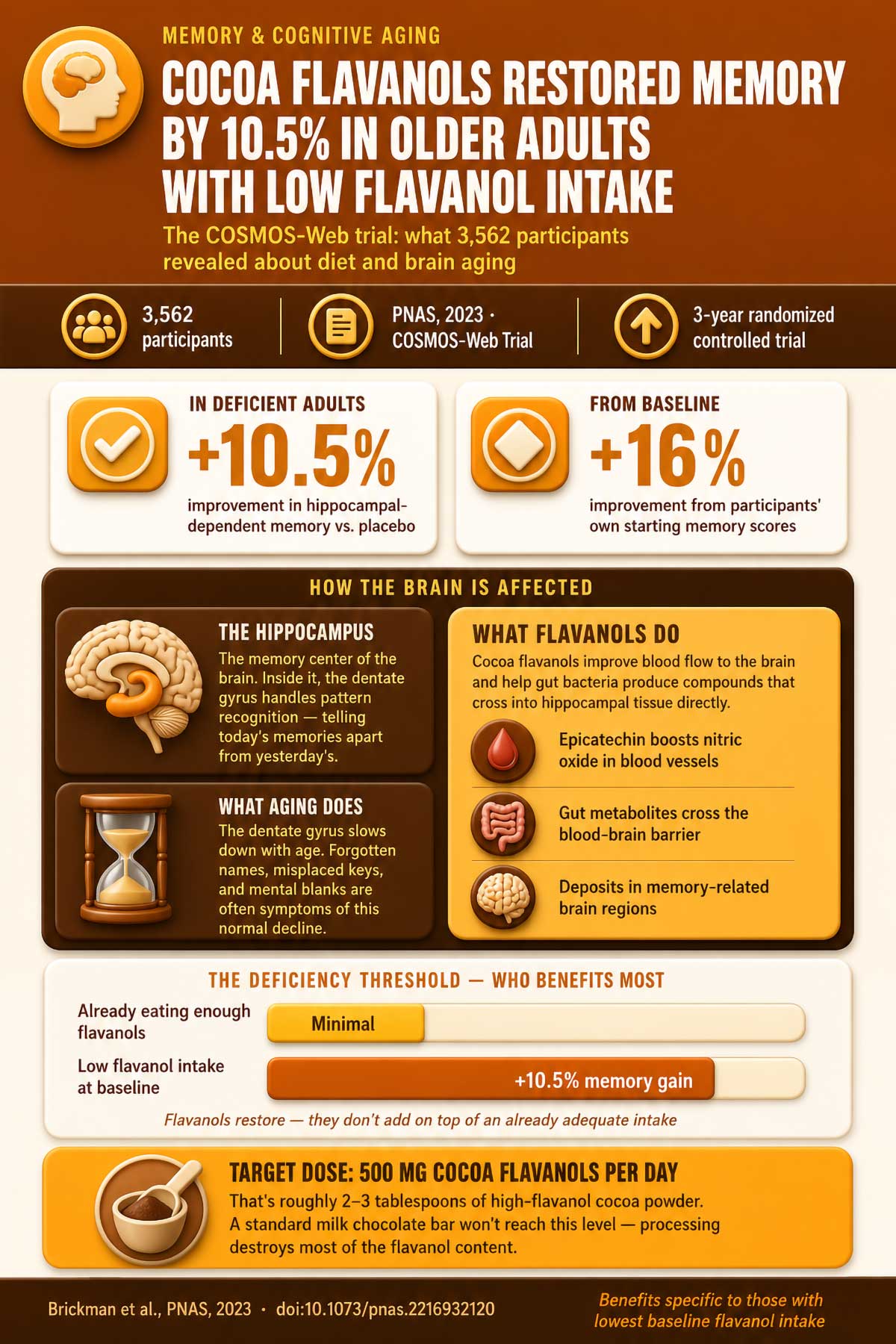
This is actually the key finding. Flavanols don’t seem to improve memory beyond a certain point. They restore it when it’s been missing. Most people in Western countries eat far below the estimated optimal range of 400 to 600mg per day. A standard milk chocolate bar won’t get you there. Two to three tablespoons of a high-flavanol cocoa powder might.
How does cocoa affect the brain from the gut? One main path runs through a compound called epicatechin, which is absorbed in the small intestine and reaches the brain partly through improved blood flow. Epicatechin helps blood vessels produce more nitric oxide, which relaxes them and increases blood flow to the brain. Gut bacteria also break flavanols down into smaller molecules that appear to cross into the brain directly, reaching the exact regions involved in memory.
Chocolate and the Biological Clock
Scientists can now estimate how fast your body is aging using something called an epigenetic clock. It looks at patterns of chemical changes on your DNA, changes that happen predictably as cells get older. One of the most reliable versions, called GrimAge, is calibrated specifically against risk of death, not just calendar age. If your GrimAge is running ahead of your actual age, your risk of age-related disease is measurably higher.
Researchers at King’s College London asked whether specific compounds from cocoa might show up in this biological record. They looked at six compounds in coffee and cocoa, testing them against epigenetic aging measures in blood samples from 509 women, then repeated the analysis in 1,160 people from a separate German study to confirm what they found. Theobromine, the main active compound in cocoa, had the strongest and most consistent link to slower biological aging across both groups. People with higher theobromine levels in their blood showed roughly 1.6 fewer years of GrimAge acceleration. Caffeine, by comparison, didn’t show the same effect.
This was an observational study, and the researchers are careful not to overstate it. Diet quality and lifestyle could be playing a role. Both groups were European, which limits how broadly the findings apply. But the fact that the signal held up in two completely separate groups, and that it was specific to theobromine rather than just any stimulant, makes it worth paying attention to.
Why Your Overall Diet Still Matters
There’s a tempting story here: eat dark chocolate, protect your brain. Clean, simple, easy to sell. It’s probably not the whole picture.
A controlled trial from Columbia tested flavanol supplements in 211 healthy adults aged 50 to 75. The main memory test the researchers designed specifically to measure dentate gyrus function showed no significant improvement across the full group. A secondary test, one that measured list-learning ability, did improve, but only in people who were already eating a lower-quality diet before the study started. People who were eating well got little extra benefit from adding more flavanols.
That’s an important finding. These compounds seem to work best when they’re filling a real gap. Pouring flavanols into a diet already rich in fruits, vegetables, and whole grains produces a different result than adding them to a diet that’s been missing them for years. The same logic likely applies to ergothioneine from mushrooms. You can’t sprinkle one compound onto a poor nutritional foundation and expect the same results you’d get from a genuinely good diet.
Most Western adults eat well below the flavanol range linked to cognitive benefits. Most don’t eat mushrooms twice a week. If the Tufts blood data is right that centenarians carry the molecular signature of people who eat these foods consistently, then a big part of the gap between how most people age and how the longest-lived people age comes down to two foods that are relatively cheap, widely available, and easy to add to any meal.
One More Thing the Data Suggests
The biggest open question in longevity research is whether any of this applies to you before problems start showing up. One detail from the PNAS flavanol trial is worth sitting with: when participants stopped taking the supplements, their memory scores drifted back toward the placebo group. The benefit didn’t stick around on its own. That’s not how a one-time fix behaves.
It looks more like a system that needs regular input to keep working, the same way the body’s dedicated ergothioneine transporter implies this compound isn’t meant to be occasional. The most practical takeaway from all of this research isn’t a supplement stack or a specific protocol. It’s that the foods most closely linked to healthy aging at the molecular level are the ones quietly missing from most people’s weekly grocery run.