A 28-year study of 92,000 people found the brain benefit kicks in at just half a tablespoon a day. Even people with the highest genetic risk for Alzheimer’s saw protection.
A landmark 28-year study tracking more than 92,000 adults found that people who consumed at least 7 grams of olive oil daily, roughly half a tablespoon, had a 28% lower risk of dying from dementia. That’s not a small number. And the findings hold up even when researchers adjusted for genetics, diet quality, and dozens of other factors.
This isn’t about following a trend. It’s about a specific habit, a specific dose, and a growing body of evidence that points in the same direction.
The 7-Gram Threshold: Why This Specific Dose Matters
Most advice around healthy eating is frustratingly vague. “Eat more olive oil.” “Follow the Mediterranean diet.” But a 2024 study published in JAMA Network Open put a real number on it.
Researchers at Harvard followed 92,383 adults across two long-running studies, the Nurses’ Health Study and the Health Professionals Follow-Up Study, from 1990 to 2018. Over that 28-year period, 4,751 participants died of dementia-related causes. When researchers analyzed dietary patterns, one finding stood out: those who consumed 7 grams or more of olive oil per day had a 28% lower risk of dying from dementia compared to those who rarely or never used it (expressed as a hazard ratio of 0.72, meaning a 28% reduction in risk, with a 95% confidence interval of 0.64–0.81).
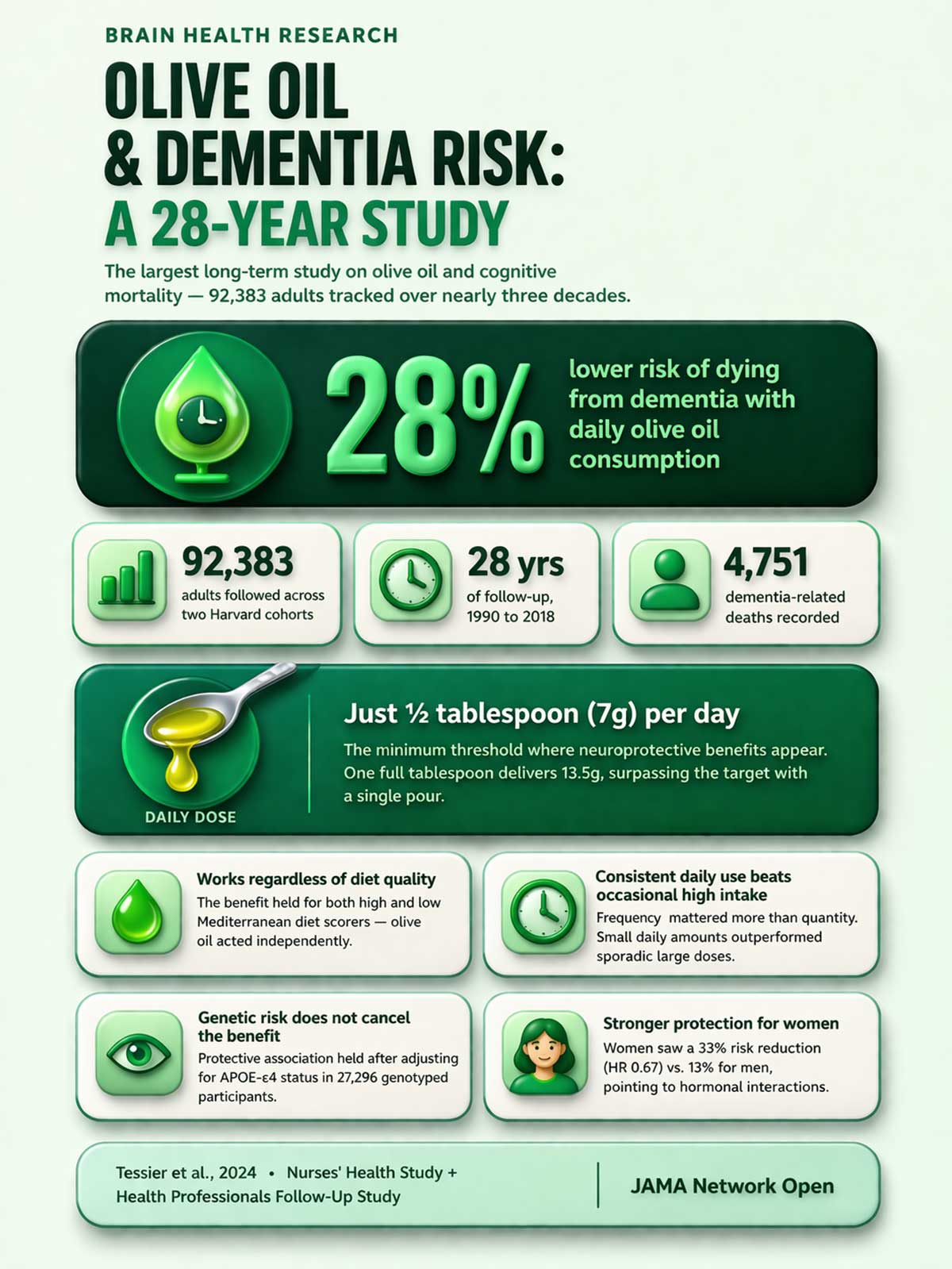
Seven grams is about half a tablespoon. One full tablespoon is 13.5 grams. So the minimum protective dose sits comfortably within a single daily drizzle.
What makes this significant isn’t just the size of the reduction. It’s the consistency. The benefit held up regardless of how healthy the person’s overall diet was. Those with high Mediterranean diet scores benefited. So did those with lower diet quality scores. Olive oil appeared to work as an independent protective factor, not just as part of a broader dietary pattern.
This matters for people who don’t follow a perfect diet. You don’t have to overhaul everything at once.
The “Swap” Effect: It’s About What You Replace
Here’s where the research gets practical, and a little surprising.
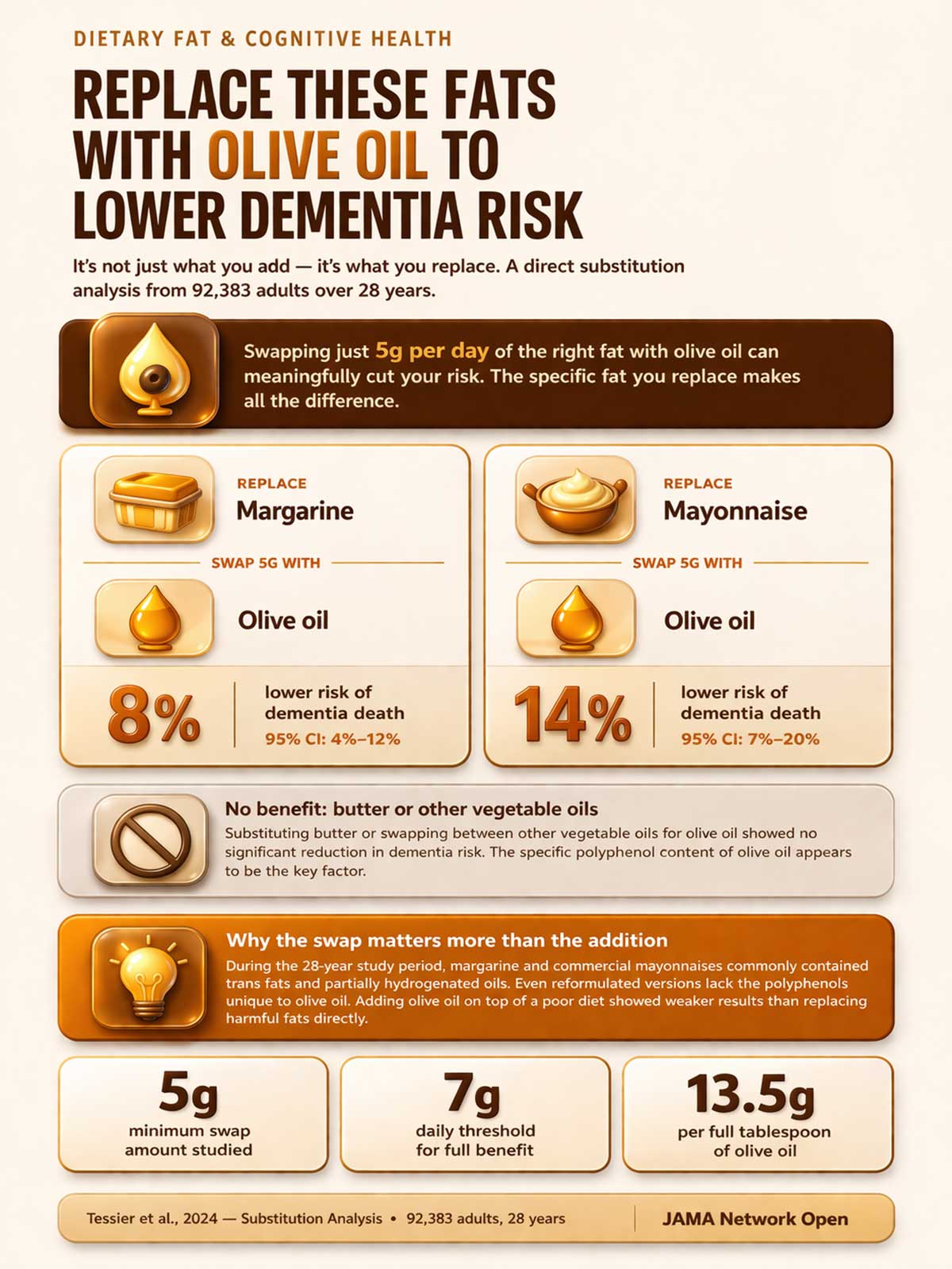
The same 2024 study included a substitution analysis. Researchers looked at what happened when people replaced other fats with olive oil, gram for gram. The results were specific.
Replacing margarine with olive oil: Swapping just 5 grams of margarine for olive oil was linked to an 8% lower risk of dementia death (95% CI, 4%–12%).
Replacing mayonnaise with olive oil: This swap showed an even stronger effect: a 14% lower risk (95% CI, 7%–20%). Switching your salad dressing from store-bought mayo to an olive oil base, even partially, appears to move the needle.
What didn’t work: Substituting butter or other vegetable oils for olive oil showed no significant protective effect. Neither did swapping between two similar healthy oils.
This tells us something important: olive oil’s benefits aren’t just about adding fat. They’re about replacing the right fats. During the 28-year study period, margarine and commercial mayonnaises commonly contained trans fats or partially hydrogenated vegetable oils, ingredients strongly linked to inflammation. Even in products that have since reformulated, these fats lack the polyphenol compounds that appear to drive olive oil’s protective effect. Olive oil doesn’t just avoid the harm. It actively adds something beneficial.
The practical takeaway is simple. Don’t just pour olive oil on top of your current diet and expect results. The stronger benefit comes from using it instead of the inflammatory fats you’re already eating.
Why Women Benefit More: A Gap in the Research Nobody Talks About
One of the most under-reported findings from this study involves sex differences.
When researchers broke down the data by gender, the protective effect was notably stronger in women. Women who consumed at least 7 grams of olive oil daily had a hazard ratio of 0.67, a 33% lower risk of dementia-related death. Men in the same category had a hazard ratio of 0.87, which still suggests a benefit, but a smaller one.
Why the difference? The honest answer is that researchers don’t know for certain yet. Some scientists point to potential interactions between the polyphenols in olive oil and female hormonal pathways. Estrogen influences inflammation and oxidative stress in ways that may amplify olive oil’s protective compounds. Post-menopausal changes in metabolism could also affect how these compounds are processed and used by the body.
This finding doesn’t mean men should skip the olive oil. A 13% risk reduction is still clinically meaningful. But it does suggest women in particular may have strong reason to prioritize this habit, and it’s an area where future research should look more carefully, since nutritional studies have historically skewed toward male participants.
Defying Your DNA: What Genetics Has to Do with It
A common concern about dementia risk is the APOE-ε4 gene variant. Carrying one copy raises your lifetime dementia risk significantly. Carrying two copies (one from each parent) raises it by five to nine times compared to people without the variant.
Many people who know they carry this gene feel like the odds are stacked against them. But the Harvard study offers a compelling counterpoint.
In a subsample of 27,296 participants who had genetic testing done, researchers adjusted the olive oil findings for APOE-ε4 status. The protective association held. People who consumed at least 7 grams of olive oil per day still had a significantly lower risk of dementia death after controlling for their genetic risk (HR 0.66, 95% CI 0.54–0.81).
Put plainly: even if you carry the gene variant most associated with Alzheimer’s, a regular olive oil habit still appears protective. In the study’s genotyped subsample, about 36% of participants carried at least one APOE-ε4 allele, and roughly 7% were homozygous (two copies). If you already know from genetic testing that you carry this variant, these findings apply directly to you. Genetics loads the gun, as the saying goes, but diet may influence whether the trigger gets pulled.
This is a genuinely hopeful finding. It suggests that lifestyle choices aren’t overridden by genetics, at least not completely. For people with a family history of dementia, this kind of data is worth knowing.
How Olive Oil Works Inside the Brain
The benefits of olive oil don’t happen by accident. There are real biological mechanisms at work, and understanding them makes the habit feel less abstract.
Crossing the Blood-Brain Barrier
Most substances in the bloodstream can’t enter the brain. The blood-brain barrier acts as a strict filter, blocking toxins and pathogens. But the polyphenols in extra virgin olive oil, particularly a compound called oleocanthal, can cross this barrier. Once inside, they get to work.
Oleocanthal reduces the production of pro-inflammatory proteins in brain tissue. Chronic, low-grade brain inflammation (called neuroinflammation) is strongly linked to cognitive decline. By dampening this process, olive oil may slow the damage before it becomes noticeable.
Clearing the Plaques
Alzheimer’s disease is characterized partly by the build-up of amyloid-beta plaques between brain cells. These plaques disrupt communication between neurons and trigger further inflammation.
Animal studies and early human research suggest that oleocanthal may help activate the brain’s waste-clearance system, known as autophagy. This system tags and removes damaged proteins, including amyloid-beta, before they can accumulate. Think of it as the brain’s internal cleaning crew, and oleocanthal as something that keeps that crew on schedule.
Keeping the Brain’s Plumbing Flexible
The brain is one of the most vascular organs in the body. It depends on healthy, flexible blood vessels to deliver oxygen and nutrients to billions of neurons. Olive oil’s effect on cardiovascular health extends directly to this “brain plumbing.”
The polyphenols and monounsaturated fats in olive oil help reduce oxidative stress in blood vessel walls, improve vascular tone, and lower the kind of low-density lipoprotein (LDL) that contributes to arterial stiffness. A brain with good blood flow is a brain with better long-term function.
Not All Olive Oil Is Created Equal
This is where many people make a mistake that quietly undermines the whole habit.
The brain benefits described above depend heavily on polyphenol content. Polyphenols, including oleocanthal, oleacein, and hydroxytyrosol, are the active compounds found in high-quality olive oil. The problem is that processing strips them away.
“Light” olive oil is refined. The refining process uses heat and chemicals that remove much of the flavor, and nearly all of the polyphenols. You’re left with mostly monounsaturated fat, which has some cardiovascular value, but lacks the brain-specific compounds that the research points to.
Extra virgin olive oil (EVOO) is the gold standard. It’s cold-pressed, minimally processed, and retains the full polyphenol profile. If your goal is neuroprotection, this is the only variety worth using for this purpose.
Reading the Label
Look for:
- “Extra virgin” designation: This is not just marketing. It has a specific legal definition tied to acidity levels and processing standards.
- Harvest date: Polyphenols degrade over time, and a bottle with a harvest date within the last 12–18 months will have meaningfully higher polyphenol content than one that has sat in a warehouse. The timing of the harvest also matters: olives picked earlier in the season (while still green) contain significantly more polyphenols than those harvested later when fully ripe. Earlier harvest oils tend to be more peppery and bitter, a sign of higher polyphenol concentration, not lower quality.
- Dark glass or tin packaging: Light accelerates oxidation, which destroys polyphenols. Clear bottles look beautiful on a kitchen shelf. They’re not ideal for preserving the oil’s active compounds.
Storing It Correctly
Heat and light are the two main enemies of olive oil quality. Store your oil in a cool, dark cabinet, not next to the stove or on a sunny countertop. A bottle stored properly can maintain good polyphenol levels for 18–24 months from the harvest date. Once opened, try to use it within a few months.
One practical tip: buy in smaller bottles more frequently rather than one large bottle that sits around.
A Full-Day Brain Health Menu: How to Hit Your 7 Grams
Seven grams per day sounds clinical. In practice, it’s one small habit repeated across meals. Here’s how to build it without overthinking it.
Breakfast
Drizzle half a tablespoon over a bowl of Greek yogurt with cucumber and a pinch of salt, a savory option that’s common in Mediterranean cooking and surprisingly satisfying. Alternatively, stir it into your morning smoothie; the flavor is mild enough that it disappears behind fruit and greens.
If you prefer something warm, try dipping whole-grain bread into a small dish of EVOO with cracked black pepper. This is how much of southern Europe starts the morning.
Lunch: The 14% Risk-Reduction Salad Dressing
This is the easiest habit to build. Stop buying commercial mayonnaise-based dressings and make a simple olive oil vinaigrette instead. Combine one tablespoon of EVOO, one teaspoon of red wine vinegar, half a teaspoon of Dijon mustard, and a pinch of salt. Shake and pour.
That single tablespoon covers your daily 7-gram requirement with room to spare. It takes less than a minute to make, it keeps for several days in the refrigerator, and it replaces one of the dietary swaps the study specifically identified as beneficial.
Dinner: The Finishing Drizzle
Polyphenols in extra virgin olive oil start to break down around 375°F. For medium-heat cooking, sautéing at around 325–350°F, brief exposure is tolerable, but prolonged high heat will strip out the active compounds. Using olive oil as a finishing touch after cooking sidesteps this entirely and preserves significantly more bioactive content. It doesn’t need to be used on hot food at all: a finishing drizzle works just as well over cold grain bowls, chilled soups, or the smoothie mentioned above.
The key habit here is using olive oil as a condiment, not just a cooking fat. It’s the final touch, not just the thing you heat the pan with.
One Habit That Works Even If the Rest of Your Diet Doesn’t
The 2024 Tessier study found something worth repeating: the association between olive oil and lower dementia mortality held regardless of overall diet quality. Whether participants scored high or low on the Mediterranean Diet Score, the olive oil benefit persisted.
This doesn’t mean diet quality doesn’t matter. It clearly does. But it does mean that olive oil appears to have independent neuroprotective properties. It’s not simply a marker of “eating well overall.”
For many people, the idea of completely changing their diet feels too big to start. This finding suggests a different entry point. You don’t need to do everything at once. You can start with half a tablespoon of good olive oil, used daily, and build from there.
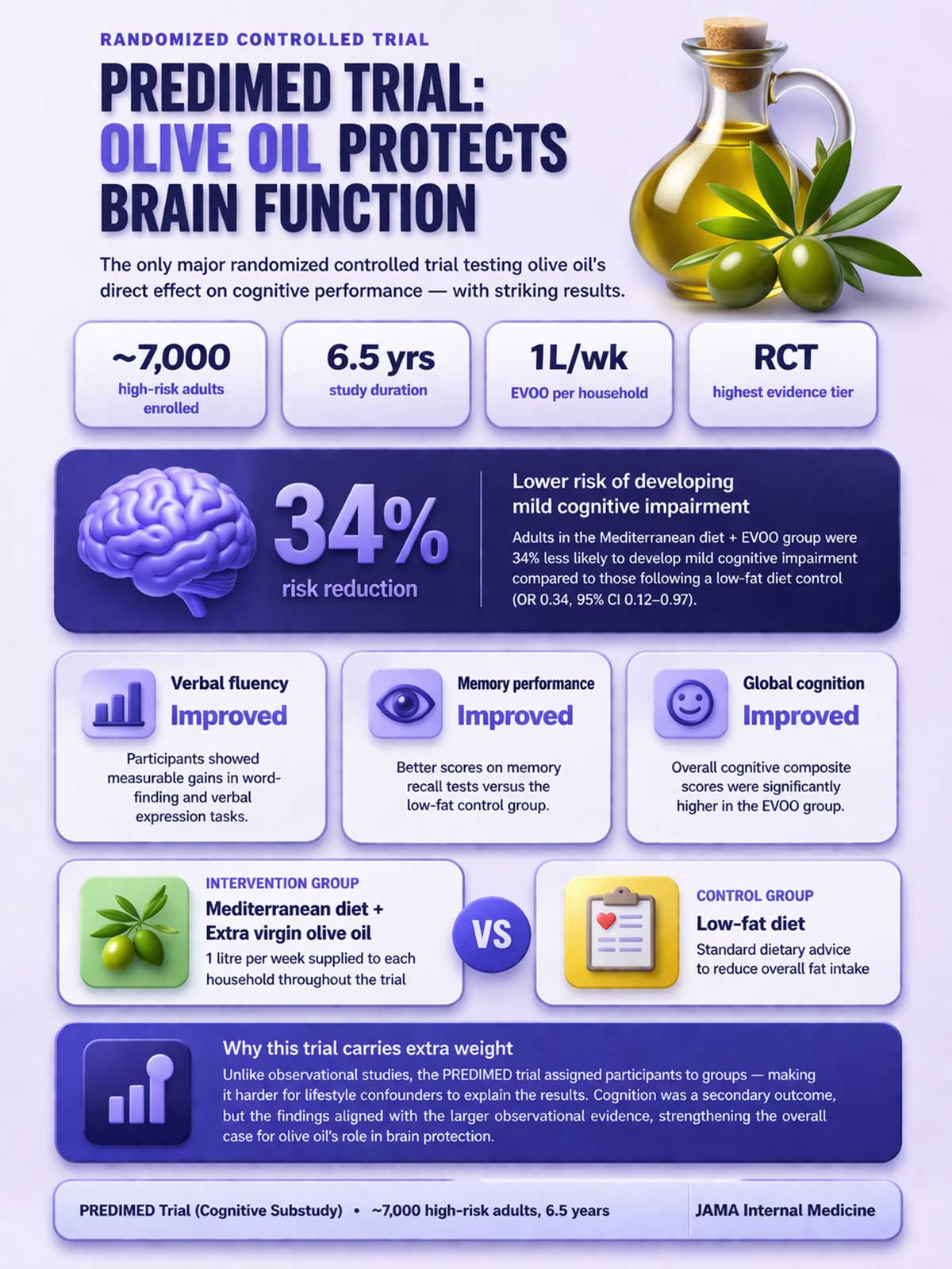
Earlier research adds further support to this picture. The PREDIMED trial, a large randomized controlled trial involving around 7,000 high-risk adults, found that a Mediterranean diet supplemented with extra virgin olive oil reduced the risk of developing mild cognitive impairment by 34% (OR 0.34, 95% CI 0.12–0.97) compared to a low-fat control diet. Participants also showed improvements in verbal fluency, memory, and global cognitive scores over the 6.5-year study period.
A separate French study, the Three-City Study, followed nearly 7,000 adults aged 65 and older for four years. Higher olive oil intake was linked to a 17% lower risk of visual memory decline (95% CI, 1%–29%), along with protective effects on verbal fluency. These findings suggest the benefit may extend beyond just reducing the risk of death. It may also help preserve day-to-day cognitive function as people age.
A Note on What This Research Can and Cannot Tell Us
The 2024 JAMA study is observational. It followed people over time and tracked what they ate alongside health outcomes. That design is powerful for identifying associations, but it can’t definitively prove that olive oil causes lower dementia risk. People who regularly consume olive oil may also have other healthy habits that weren’t fully captured.
What makes this evidence compelling despite that limitation is its scale (92,000 people, 28 years), its adjustment for many confounders including genetics, and its consistency with the biological mechanisms described above. The association is strong, specific, and biologically plausible.
For practical purposes, adding half a tablespoon of quality extra virgin olive oil to your daily routine carries no meaningful downside for most people. The evidence supporting it is among the strongest we have for any single dietary factor and cognitive longevity.
Conclusion
The habit is simple enough to begin at the next meal.
Buy a bottle of extra virgin olive oil with a recent harvest date. Use it to make a vinaigrette for lunch. Drizzle a little over dinner. That’s it. You’ve hit your 7 grams, you’ve replaced a potentially harmful fat, and you’ve done something that 28 years of data suggests may matter for the long-term health of your brain.
Small daily habits, maintained consistently, tend to outperform dramatic changes that don’t stick. Half a tablespoon is a place to start, not because it sounds impressive, but because the evidence says it may be enough.