Most people think confidence comes first, then action follows. Behavioral psychology shows the opposite. Action creates confidence. Not the other way around.
Think of confidence as a side effect, not a starting point. You don’t need to feel brave to act brave. You act, then the feeling catches up.
This isn’t about fake positivity or forcing yourself to “think different.” It’s about understanding how your brain actually builds belief in itself. Psychologists call this self-efficacy: your brain’s trust in its ability to handle specific tasks.
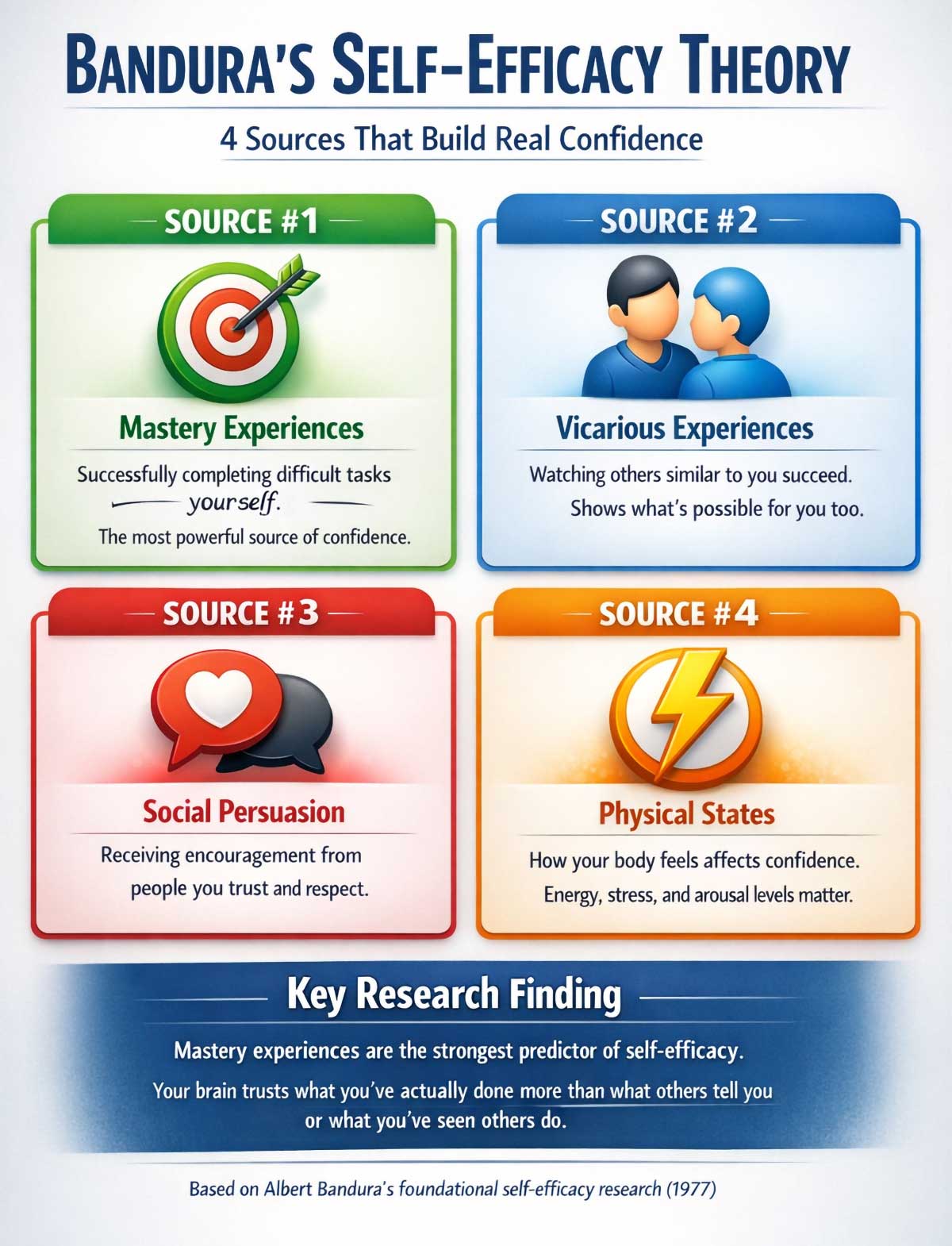
Psychologist Albert Bandura introduced self-efficacy theory in 1977, and it remains the most validated framework for understanding confidence. His research showed that self-efficacy beliefs predict performance better than actual ability in many situations.
Understanding Self-Efficacy: The Science Behind Real Confidence
Self-efficacy differs from self-esteem. Self-esteem is how you feel about yourself overall. Self-efficacy is concrete. It’s knowing you can learn Excel, give a presentation, or have a tough talk with your boss.
Self-Esteem vs. Self-Efficacy: What’s the Difference?
| Aspect | Self-Esteem | Self-Efficacy |
|---|---|---|
| Definition | General sense of self-worth | Belief in ability to complete specific tasks |
| Scope | Global and broad | Task-specific and measurable |
| Stability | Relatively stable over time | Changes based on experience and context |
| Impact on Action | Can be high even with low skills | Directly predicts performance |
| How to Build | Acceptance and self-compassion | Mastery experiences and skill development |
| Example | “I’m a good person” | “I can run a 5K” or “I can lead this meeting” |
You can build self-efficacy with specific habits. Research shows four sources fuel self-efficacy:
The Four Sources of Self-Efficacy
- Mastery Experiences (Most Powerful): Successfully doing hard things yourself
- Vicarious Experiences: Watching others like you succeed
- Social Persuasion: Receiving encouragement from people you trust
- Physical States: How your body feels (energy, stress, arousal levels)
These aren’t equally powerful. Mastery experiences carry the most weight. Your brain trusts what you’ve actually done more than what people tell you or what you’ve seen others do.
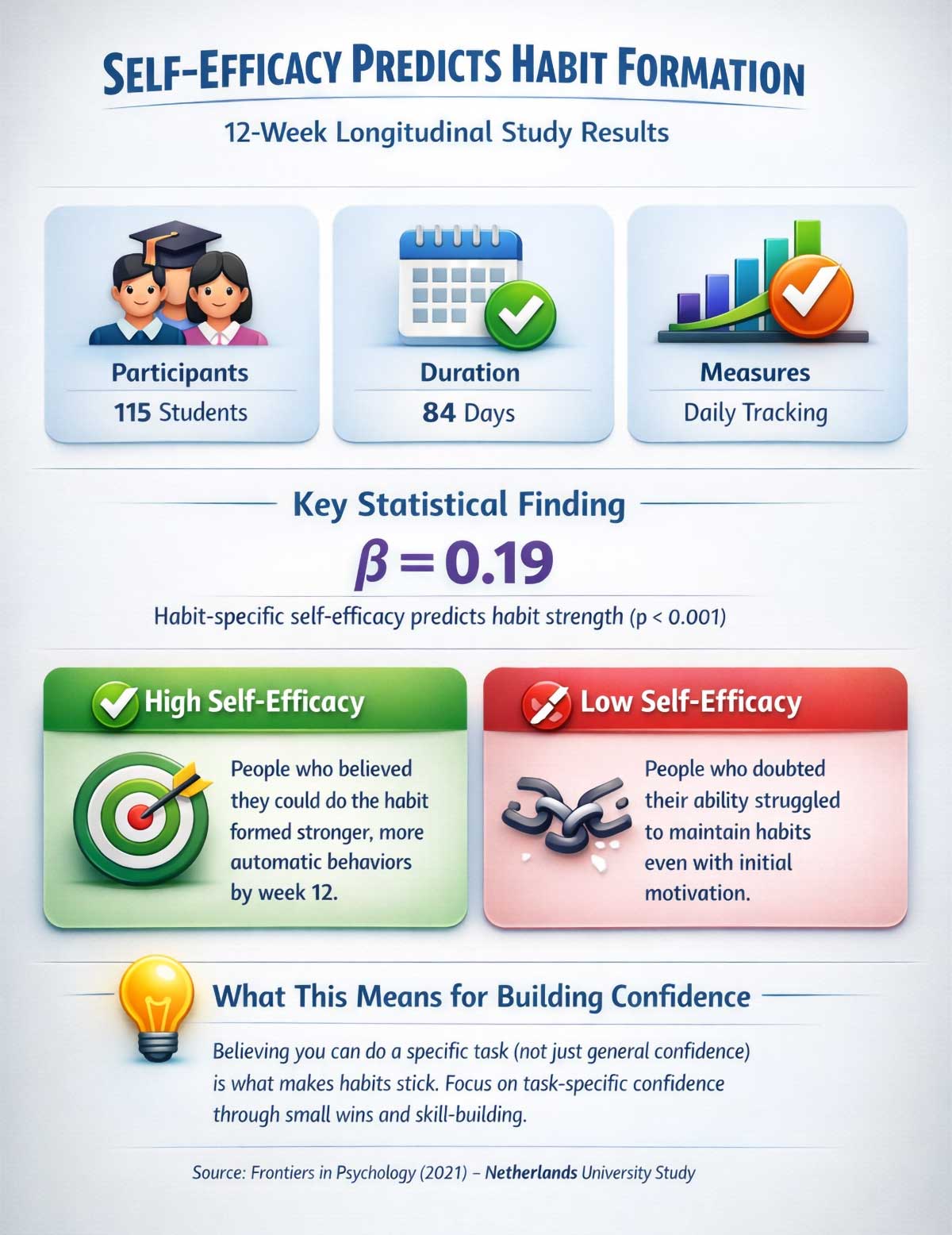
A 2021 study published in Frontiers in Psychology tracked 115 university students over 84 days and found that habit-specific self-efficacy predicted habit strength with statistical significance (β = 0.19, p < 0.001). This means believing you can do a specific task makes you far more likely to follow through consistently.
The next 12 habits tap into these sources. They’re backed by behavioral psychology, tested in clinical settings, and proven to work.
The Mastery Pillar: Building Your Evidence Base
Habit 1: Make Small Promises You Can Keep
Your brain tracks whether you follow through. Each kept promise builds internal trust. Each broken one tears it down.
Start tiny. Wake up when your alarm goes off. Take a five-minute walk. Drink water before coffee.
These aren’t life-changing on their own. But they send a signal to your brain: “I do what I say I’ll do.”
Psychologist Albert Bandura showed that mastery experiences are the strongest source of self-efficacy. Successfully doing something hard proves you can handle challenges. In his foundational work, Bandura found that performance accomplishments provide the most dependable source of efficacy expectations because they’re based on personal mastery experiences.
The morning matters most. Win the first hour, and you set a mental baseline for the day. Your brain carries that “I’m capable” feeling forward.
Track your promises. Write three micro-commitments each night. Check them off the next day. The visual proof matters more than you think.
Your brain has a negativity bias. It remembers failures more than wins. An evidence log forces it to see what you’re actually accomplishing.
How to Create Your Evidence Log
Choose one method that works for you:
| Method | Best For | Time Required | Example |
|---|---|---|---|
| Bullet journal | Visual people | 5 mins/day | Write 3 wins each evening in notebook |
| Phone notes app | Always-on-the-go types | 2 mins/day | Quick entries throughout the day |
| Spreadsheet | Data lovers | 10 mins/week | Track wins with categories and ratings |
| Voice memos | Audio processors | 3 mins/day | Record wins while commuting |
Sample Evidence Log Entry:
- Monday: Asked clarifying question in team meeting (even though nervous)
- Tuesday: Completed workout despite low energy
- Wednesday: Sent follow-up email without overthinking for an hour first
Review your log every Sunday. Look for patterns. You’ll notice capabilities you didn’t see before.
Habit 2: Build Skills, Not Just Mindset
Affirmations feel good. But saying “I’m confident” won’t make you confident if you can’t do the thing.
Real confidence comes from competence. Period.
If public speaking scares you, practice in front of a mirror. Join a speaking group. Record yourself. Get better at the actual skill.
Your brain knows when you’re faking. It also knows when you’re learning. Growth feels different than pretending.
Create Your Personal Learning Curriculum
Think of this as your confidence roadmap. Here’s how to build one:
Step 1: Identify Your Confidence Gap Where do you want to feel more confident? Be specific.
- Example: “I want to feel confident leading team meetings”
Step 2: Break Down Required Skills What specific abilities do you need?
- Agenda creation
- Clear speaking
- Handling questions
- Managing time
- Reading the room
Step 3: Find Learning Resources for Each Skill
| Skill Needed | Learning Method | Timeline | Success Marker |
|---|---|---|---|
| Agenda creation | Review 5 good meeting agendas | Week 1 | Create template |
| Clear speaking | Toastmasters or practice group | Weeks 2-8 | Give 3 practice talks |
| Handling questions | Watch TED speakers handle Q&A | Week 3 | Note 5 techniques |
| Managing time | Shadow experienced leader | Week 4 | Run 1 timed practice |
| Reading the room | Study body language basics | Week 5 | Identify 3 engagement signals |
Step 4: Practice Deliberately Don’t just repeat. Focus on one skill at a time. Get feedback. Adjust. Repeat.
Studies show that task-specific self-efficacy predicts success better than general confidence. The student who believes “I can solve math problems” does better than the one who just thinks “I’m smart.”
Focus on one skill at a time. Master it. Then move to the next.
Habit 3: Track Wins Like Data
Feelings lie. Your brain will tell you nothing’s working even when it is.
Start an evidence log. Each day, write three things you did well. Not what felt good. What you actually accomplished.
Examples: “Asked a question in the meeting.” “Went to the gym even though I didn’t feel like it.” “Finished the report on time.”
These seem small. But they’re proof your brain can’t argue with.
Research on self-efficacy shows that tracking mastery experiences helps overcome the negativity bias. Your brain defaults to remembering what went wrong. The log forces it to see what went right.
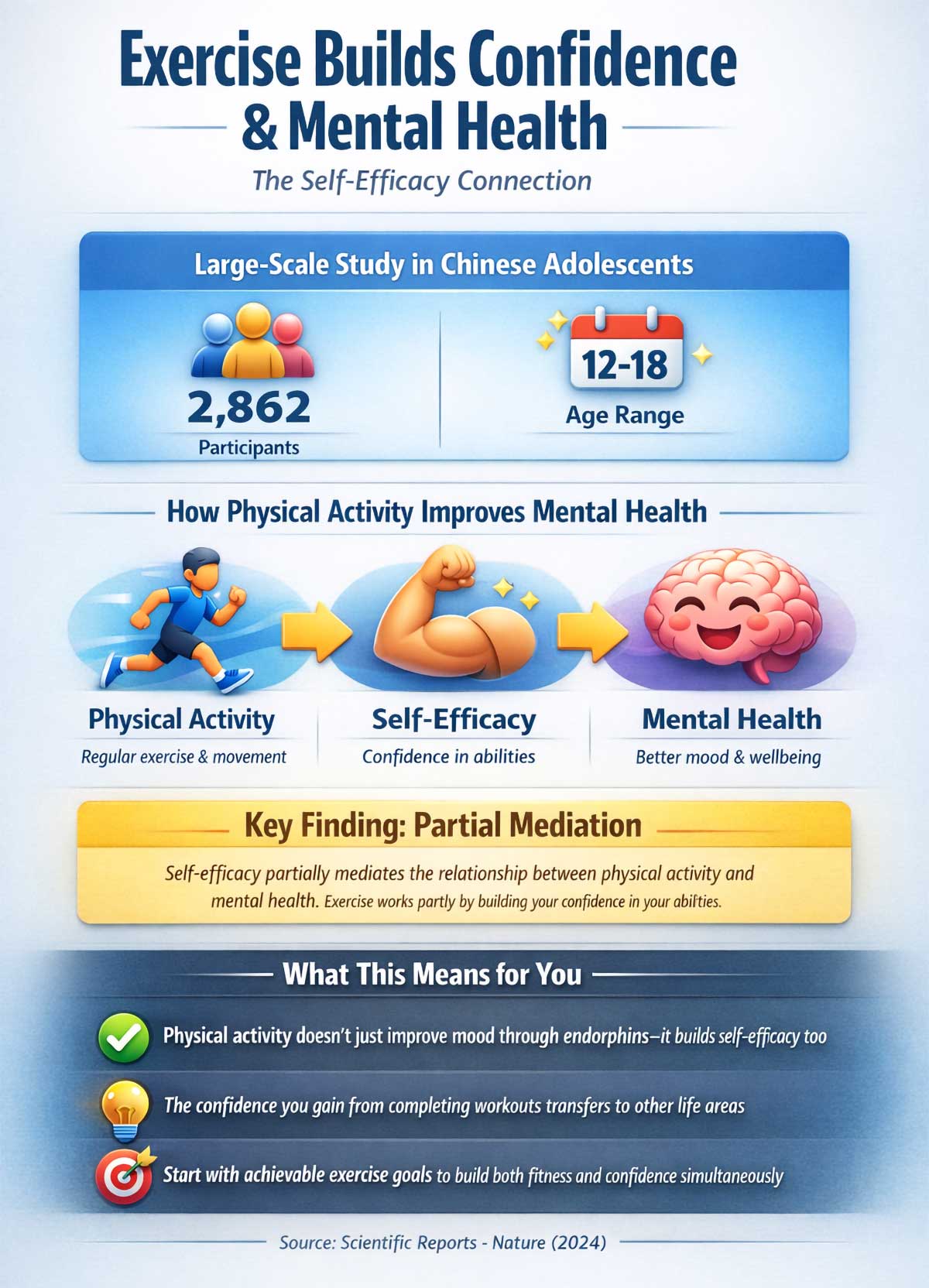
A 2024 study published in Scientific Reports examined 2,862 Chinese adolescents and found that self-efficacy partially mediates the relationship between physical activity and mental health outcomes. When people track their accomplishments, they can literally see their growing capability, which reinforces the confidence-building cycle.
Look back at your log weekly. You’ll see patterns. You’ll notice growth you’d otherwise miss.
This isn’t about toxic positivity. It’s about accurate self-appraisal. Your brain needs to update its view of what you can do.
The Behavioral Pillar: Act Before You Feel Ready
Habit 4: Move While You’re Still Afraid
Waiting for fear to disappear is a trap. It won’t leave on its own.
Your amygdala (the fear center in your brain) activates when you face something new. That’s normal. The trick is moving anyway.
Try the five-second rule. When you know you should do something, count down from five and move. Don’t give your brain time to talk you out of it.
This works because hesitation feeds fear. Action cuts through it.
Behavioral activation is a core principle in treating anxiety and depression. Therapists teach clients to act first, feel better later.
You don’t need to feel confident to send the email. Send it, then notice the confidence that follows.
Think of action as medicine. You take it even when you don’t feel like it. The relief comes after, not before.
Start with one action today that scares you slightly. Not terrifying. Just uncomfortable. Do it before you can overthink.
Habit 5: Climb Your Fear Ladder Slowly
Jumping into the deep end backfires more often than it works. Psychologists call this “flooding,” and it can make anxiety worse.
Instead, use graded exposure. Create a ladder of fears, ranked from easiest to hardest.
Building Your Personal Fear Ladder
Here are examples for common confidence challenges:
Fear Ladder Example: Networking
| Step | Challenge | Difficulty (1-10) | When to Move Up |
|---|---|---|---|
| 1 | Message one person you already know | 2 | After 3 successful tries |
| 2 | Comment on a LinkedIn post | 3 | When Step 1 feels easy |
| 3 | Attend virtual event, camera off | 4 | After 2 events |
| 4 | Attend virtual event, camera on | 6 | When comfortable with Step 3 |
| 5 | Attend in-person event, stay 15 mins | 7 | After 2 short visits |
| 6 | Start conversation with one stranger | 8 | When Step 5 feels manageable |
| 7 | Exchange contact info with someone | 9 | After 3 conversations |
Fear Ladder Example: Public Speaking
| Step | Challenge | Difficulty (1-10) | Practice Method |
|---|---|---|---|
| 1 | Speak up once in small team meeting | 3 | Prepare one comment beforehand |
| 2 | Present idea to 3 colleagues | 5 | Use notes, no time limit |
| 3 | Give update in larger meeting (10+ people) | 6 | Stick to 2 minutes |
| 4 | Present with slides to team | 7 | Rehearse 3 times minimum |
| 5 | Facilitate full meeting | 8 | Co-lead with experienced person first |
| 6 | Present to senior leadership | 9 | Record practice run, review it |
Your Fear Ladder Template
Use this to build your own:
- Choose your confidence challenge (Example: ____________)
- List 6-8 steps from easiest to hardest
- Rate each step’s difficulty (1-10)
- Only move up when current step feels like a 3 or below
- Expect some backsliding (that’s normal)
Each step builds on the last. You prove you can handle Step 1 before moving to Step 2.
This matches how exposure therapy works in clinical settings. Gradual exposure reduces anxiety more reliably than sudden immersion.
Research consistently shows that graded exposure is more effective than flooding (jumping into the hardest challenge immediately). A comprehensive review of exposure-based treatments found that systematic, gradual approaches lead to better long-term outcomes with lower dropout rates.
The goal isn’t to stop feeling nervous. The goal is to feel nervous and do it anyway.
Habit 6: Drop Your Safety Behaviors
Safety behaviors are crutches. They make you feel better in the moment but prevent real confidence growth.
Examples: over-preparing for every conversation, checking your phone to avoid eye contact, staying in the corner at events, having a drink to “loosen up.”
These behaviors whisper: “You can’t handle this without help.”
They prevent you from learning the truth: you can handle more than you think.
Common Safety Behaviors by Situation
| Situation | Safety Behavior | Why It Hurts Confidence | Alternative Action |
|---|---|---|---|
| Presentations | Reading every word from slides | Prevents learning you can speak naturally | Use bullet points only, practice eye contact |
| Social events | Staying glued to one friend | Blocks meeting new people | Set goal: talk to 2 new people, then reunite |
| Meetings | Staying silent unless certain | Keeps you invisible | Share one idea per meeting, even if rough |
| Dates | Over-rehearsing conversation topics | Makes you seem scripted | Prepare 2-3 topics, then be spontaneous |
| Phone calls | Writing full scripts | Prevents natural conversation | Use outline only |
| Networking | Immediately exchanging cards to exit | Stops real connection | Have 3-minute conversations minimum |
How to Drop a Safety Behavior
- Identify it: What do you do to feel safer?
- Understand the cost: How does it limit you?
- Choose low-stakes practice: Where can you test without it?
- Expect discomfort: You’ll feel exposed (that’s the point)
- Debrief: What actually happened vs. what you feared?
Try this: identify one safety behavior you use. Then drop it in a low-stakes situation.
Go to coffee without rehearsing what to say. Give a presentation without reading every word from notes. Attend the party without planning an early exit strategy.
You’ll feel exposed at first. That’s the point. You need to prove to your brain that you’re safe without the crutch.
Research on anxiety treatment shows that safety behaviors maintain fear. Dropping them is uncomfortable but necessary for building genuine confidence.
A meta-analysis of cognitive behavioral therapy studies found that interventions targeting safety behaviors significantly improved treatment outcomes. When people eliminated their safety behaviors, their anxiety decreased faster and confidence increased more than those who kept relying on crutches.
Start small. Pick the easiest crutch to release. Build from there.
The Cognitive Pillar: Rewire How You Talk to Yourself
Habit 7: Make Your Self-Talk Precise
“I can’t do this” is vague and final. It shuts down learning.
Try this instead: “I’m currently learning how to handle this.”
The word “currently” changes everything. It makes your state temporary, not permanent.
This is cognitive restructuring, a technique from CBT (cognitive behavioral therapy). Meta-analyses show it reduces negative thinking and improves outcomes across mental health conditions.
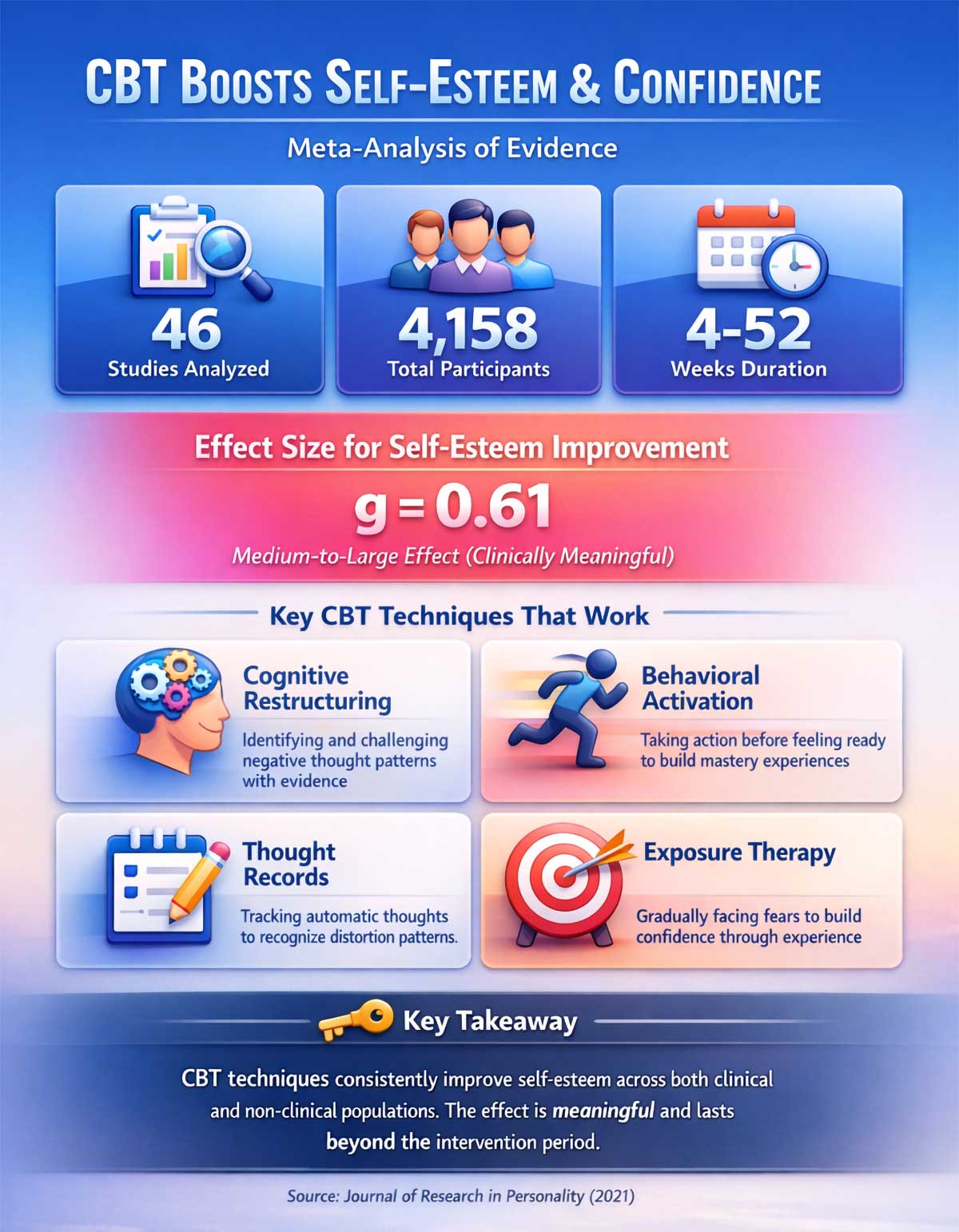
A 2021 meta-analysis published in the Journal of Research in Personality examined 46 studies with 4,158 participants and found that CBT interventions produced a medium-to-large effect size (g = 0.61) for improving self-esteem. The cognitive restructuring component was particularly effective at reducing self-critical thinking patterns.
The goal isn’t toxic positivity. It’s accurate thinking.
Cognitive Distortion Translation Guide
Your brain lies to you in predictable ways. Here’s how to catch and correct common distortions:
| Distortion Type | What You Think | Accurate Reframe |
|---|---|---|
| All-or-Nothing | “I’m terrible at presentations” | “I’ve given 3 presentations. Two went okay. One was rough. I’m learning what works” |
| Overgeneralization | “I always mess things up” | “I made a mistake today. That doesn’t define my whole performance” |
| Mind Reading | “Everyone thinks I’m incompetent” | “I don’t know what they think. Some gave positive feedback. Some stayed quiet” |
| Fortune Telling | “I’ll definitely fail the interview” | “I can’t predict the future. I can only prepare and try” |
| Catastrophizing | “This presentation will ruin my career” | “One presentation won’t make or break anything. It’s one data point” |
| Should Statements | “I should be confident by now” | “I’m building confidence at my own pace. Progress isn’t linear” |
| Labeling | “I’m a failure” | “I failed at one task. That doesn’t make me a failure as a person” |
Your Thought Log Template
Track your negative thoughts for one week using this format:
- Situation: What happened?
- Automatic Thought: What did your brain say?
- Distortion Type: Which pattern is this?
- Evidence For: What supports this thought?
- Evidence Against: What contradicts it?
- Balanced Thought: What’s more accurate?
Example:
- Situation: Gave input in meeting
- Automatic Thought: “That was a stupid comment. Everyone thinks I’m an idiot”
- Distortion Type: Mind reading + labeling
- Evidence For: One person looked confused
- Evidence Against: Two people nodded. My manager asked follow-up questions. No one laughed or dismissed it
- Balanced Thought: “My comment wasn’t perfectly clear, but it sparked discussion. I can clarify next time”
You’ll notice patterns. “Always” and “never” are usually lies. “Can’t” often means “haven’t yet.”
Language shapes belief. Choose words that leave room for growth.
Habit 8: Treat Failure as Data, Not Definition
You mess up. Your brain screams: “See? You’re not good enough.”
This is self-criticism, and it’s killing your confidence.
Studies on self-compassion show that people who treat themselves kindly after failure perform better next time. Self-criticism creates stress, which impairs learning.
Radical self-compassion means responding to failure the way you’d respond to a friend.
When you make a mistake, try this three-step process:
- Name what happened without judgment: “I stumbled during the pitch.”
- Acknowledge it’s human: “Everyone messes up sometimes.”
- Ask what you can learn: “Next time, I’ll practice the opening more.”
This isn’t about excusing poor performance. It’s about separating your performance from your worth.
A bad presentation doesn’t make you a bad person. It makes you a person who gave a bad presentation.
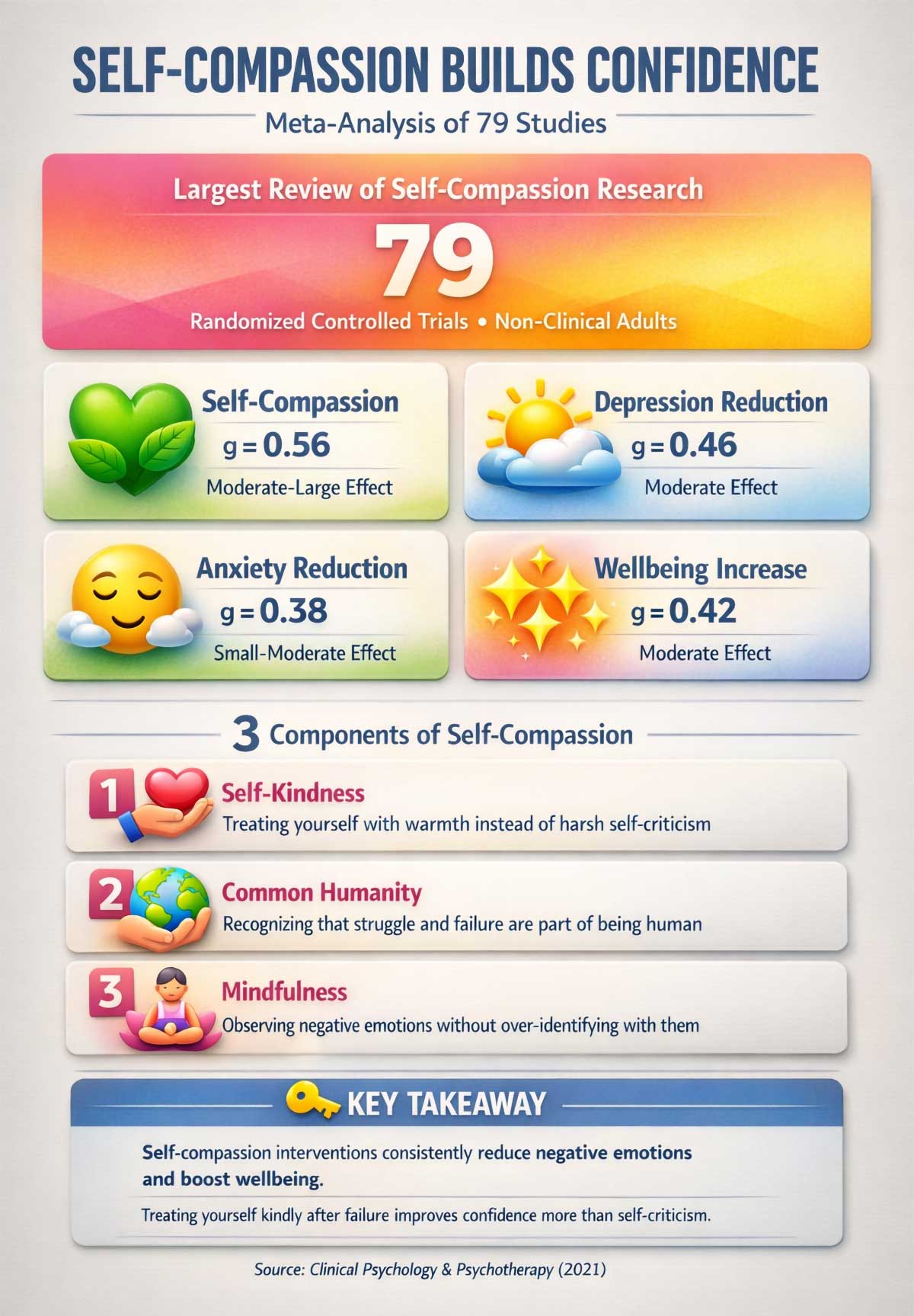
Research shows self-compassion interventions reduce depression and anxiety while boosting well-being. A 2021 meta-analysis in Clinical Psychology & Psychotherapy examined 79 randomized controlled trials and found meaningful effect sizes: self-compassion increased (g = 0.56), depression decreased (g = 0.46), anxiety decreased (g = 0.38), and well-being increased (g = 0.42).
Failure is feedback. It shows you where to improve. It’s not a verdict on your character.
Habit 9: Curate Who You Compare Yourself To
Social comparison is automatic. Your brain constantly checks where you stand relative to others.
The problem? Social media shows you everyone’s highlight reel. You compare your behind-the-scenes to their finished product.
This kills confidence fast.
Try a social media audit. For one week, notice how you feel after scrolling. If someone’s posts make you feel worse about yourself, mute or unfollow them.
Self-evaluation maintenance theory explains this. When people close to you succeed in areas you care about, it can threaten your self-esteem.
The solution isn’t avoiding all comparison. It’s comparing wisely.
Instead of asking “How do I measure up?” ask “What can I learn from them?”
Shift from competitive comparison to learning-focused comparison.
Follow people who are two steps ahead, not 20. Someone slightly further along shows you the next move. Someone too far ahead feels unreachable.
You can also compare yourself to yourself. Track your progress over time. Are you better than you were last month?
That’s the only comparison that truly matters.
The Regulatory Pillar: Stabilize Your Foundation
Habit 10: Regulate Your Nervous System
Your body shapes your mind more than you realize.
When your nervous system is dysregulated (heart racing, breath shallow, muscles tight), your brain interprets this as danger. Confidence drops automatically.
Physical state is one of Bandura’s four sources of self-efficacy. How you feel physically affects how capable you think you are.
Quick Nervous System Regulation Techniques
Use these before confidence-testing situations:
| Technique | How to Do It | Time Needed | Best Used For |
|---|---|---|---|
| Box Breathing | Breathe in 4 counts, hold 4, out 4, hold 4. Repeat 4 times | 2 minutes | Before presentations or calls |
| 4-7-8 Breathing | Inhale 4 counts, hold 7, exhale 8. Repeat 4 times | 2 minutes | Calming racing thoughts |
| Progressive Muscle Relaxation | Tense each muscle group 5 seconds, release. Start with toes, move to head | 10 minutes | Before bed or high-stress events |
| Cold Water Reset | Run cold water on wrists or splash face | 30 seconds | Quick anxiety reduction |
| Humming/Singing | Hum or sing for 2 minutes (activates vagus nerve) | 2 minutes | When feeling disconnected |
| Body Scan | Notice sensations in each body part without judging | 5 minutes | General stress management |
The 5-Minute Pre-Performance Routine
Use this before any confidence-testing situation:
- Minutes 1-2: Box breathing (4 rounds)
- Minute 3: Body scan (notice tension, don’t fight it)
- Minute 4: Power pose (stand tall, open chest, hands on hips)
- Minute 5: State your intention: “I’m here to ”
Research on physical activity and mental health shows that exercise boosts self-efficacy, which then improves psychological well-being. The 2024 study in Scientific Reports found that among 2,862 adolescents, physical activity improved mental health outcomes partly through building self-efficacy. The confidence gained from physical accomplishments transfers to other life areas.
Even posture matters. Studies on “power posing” have mixed results, but one thing is clear: changing your posture changes your internal state.
Stand up straight. Open your chest. Take up space. Not because it makes others see you as confident, but because it helps you feel more capable.
Daily Practices for Baseline Regulation
| Practice | Frequency | Impact on Confidence | How It Helps |
|---|---|---|---|
| 20+ minutes exercise | 4-5x/week | High | Reduces cortisol, builds physical self-efficacy |
| 7-9 hours sleep | Nightly | Very High | Regulates emotions, improves decision-making |
| 10-minute morning routine | Daily | Medium | Sets positive tone for day |
| Limit caffeine after 2pm | Daily | Medium | Prevents nervous system overstimulation |
| Protein with breakfast | Daily | Low-Medium | Stabilizes blood sugar and mood |
Physical regulation isn’t optional. It’s the foundation for everything else.
Habit 11: Ask for Feedback, Not Reassurance
There’s a trap many people fall into: constantly asking “Did I do okay?”
This seems like confidence-building. Actually, it’s confidence-eroding.
Each time you seek reassurance, you signal to your brain: “I can’t trust my own judgment.”
Feedback is different. Feedback asks specific questions: “What could I improve about the opening?” “Which section was clearest?” “What should I focus on next time?”
Feedback helps you grow. Reassurance just temporarily soothes anxiety.
Practice asking for constructive input instead of validation. Your brain will learn to self-evaluate rather than constantly seeking external approval.
This distinction matters in professional settings. People who can process criticism without taking it personally grow faster.
When you receive feedback, separate it from your identity. The work can be criticized without you being criticized.
Your worth isn’t up for debate. Your performance is always up for improvement.
Habit 12: Set Goals That Match Who You Want to Be
Most people set goals based on what they want to achieve. That’s backward.
Better approach: anchor habits in who you are becoming.
Instead of: “I want to lose 20 pounds.” Try: “I’m someone who moves my body daily.”
Instead of: “I want to grow my business.” Try: “I’m someone who shows up consistently for my clients.”
This is identity-based goal setting. When you tie behavior to identity, it sticks better.
Research on habit formation shows it takes about 66 days for a new behavior to become automatic. But the key is consistency, not perfection. A 2009 study published in the European Journal of Social Psychology found that on average, it takes 66 days for a habit to become automatic, though this ranged from 18 to 254 days depending on the behavior and person.
You’re not trying to do something. You’re becoming someone.
This shifts how you handle setbacks. If you’re becoming “someone who exercises,” missing one workout doesn’t break your streak. It’s just a missed rep.
Each action is a vote for the person you want to be. You don’t need to win every vote. You just need to win most of them.
Self-efficacy research shows that people with stronger identity connections to their goals maintain them better over time.
Ask yourself: who do I want to be a year from now? Then act like that person today.
The Long Game: How These Habits Compound
Confidence doesn’t arrive in one moment. It builds slowly, action by action.
Each small win makes the next one easier. Each skill learned opens new doors. Each fear faced shrinks the next one.
Psychologists call this an upward spiral. Self-efficacy leads to action. Action leads to success. Success boosts self-efficacy. The cycle reinforces itself.
A 2024 meta-analysis published in BMC Psychiatry examined psychotherapy outcomes and found that self-efficacy improvements during treatment predicted better long-term results. People who developed stronger belief in their abilities during therapy maintained their gains better than those who improved symptoms without building self-efficacy.
The Compound Effect of Confidence Habits
| Timeline | What’s Happening | What You’ll Notice |
|---|---|---|
| Week 1 | Building awareness of patterns | Catching negative thoughts more often |
| Weeks 2-3 | Initial behavior changes | Small wins accumulating, still feels hard |
| Weeks 4-6 | Neural pathways forming | Actions feel slightly easier, less resistance |
| Weeks 8-10 | Confidence feedback loop starting | Others notice your changes, you take bigger risks |
| Week 12+ | Habits becoming automatic | New identity forming, confidence feels natural |
You won’t see dramatic changes in a week. That’s okay. You’re not looking for drama. You’re looking for direction.
Think of confidence as a muscle. You don’t build muscle by thinking about the gym. You build it by showing up, lifting slightly heavier each time, and recovering.
Same process applies here.
Your 7-Day Confidence Kickstart Plan
Don’t try all 12 habits at once. That’s a recipe for burnout. Start here:
Day 1-2: Assessment
- List three areas where you lack confidence
- Identify which habits apply to each area
- Choose ONE habit to focus on this week
Day 3-4: Setup
- If you chose Evidence Log: set up your tracking method
- If you chose Fear Ladder: build your 6-step ladder
- If you chose Learning Curriculum: map your skill gaps
- If you chose Self-Talk: start your thought log
Day 5-7: Action
- Take one small step toward your habit
- Notice what happens (don’t judge it)
- Adjust your approach based on results
Week 2 Preview
- Continue your first habit until it feels easier (not easy, just easier)
- Add a second habit from a different category
- Review your progress each Sunday
Confidence-Building Habit Pairing Guide
Some habits work better together. Here’s how to combine them:
For Social Confidence:
- Primary: Habit 5 (Fear Ladder)
- Support: Habit 10 (Nervous System Regulation)
- Boost: Habit 9 (Curate Comparisons)
For Performance Confidence:
- Primary: Habit 2 (Skill Building)
- Support: Habit 7 (Precise Self-Talk)
- Boost: Habit 1 (Small Promises)
For Decision-Making Confidence:
- Primary: Habit 4 (Act Before Ready)
- Support: Habit 8 (Treat Failure as Data)
- Boost: Habit 11 (Feedback Optimization)
For Overall Self-Trust:
- Primary: Habit 1 (Small Promises)
- Support: Habit 3 (Evidence Log)
- Boost: Habit 12 (Identity-Based Goals)
Troubleshooting Common Confidence Challenges
“I keep starting and stopping”
- You’re trying too many habits at once
- Pick ONE habit and do it for 30 days minimum
- Lower the bar: make it so easy you can’t say no
“I don’t see progress”
- You’re expecting feelings to change before behavior
- Check your Evidence Log: what’s actually different?
- Progress is invisible until you look back
“I failed at my habit and feel worse”
- Perfection isn’t the goal; direction is
- One missed day doesn’t erase previous wins
- Apply Habit 8: treat this failure as data
“Other people don’t notice my changes”
- Internal confidence builds before external signs show
- Others often notice but don’t comment
- You’re not doing this for their validation anyway
“I feel confident in some areas but not others”
- That’s normal (remember: self-efficacy is task-specific)
- Use your confident areas as templates
- Apply the same process to new domains
Measuring Your Confidence Growth
Track these markers every 30 days:
Behavioral Markers:
- How many times did I do something that scared me?
- How many new skills did I practice?
- How often did I speak up when I normally wouldn’t?
Cognitive Markers:
- Am I catching negative thoughts faster?
- Do I challenge distortions more often?
- Is my self-talk getting more precise?
Physical Markers:
- Can I regulate my nervous system more quickly?
- Am I sleeping better?
- Do I notice body tension sooner?
Social Markers:
- Am I initiating conversations more?
- Do I maintain eye contact longer?
- Am I saying yes to opportunities I’d usually avoid?
Your “Habit 0” is the first step. Pick the easiest habit from this list. The one that feels most doable right now. Do it today.
Not tomorrow. Not when you feel ready. Today.
That’s how confidence starts: with one small action while you’re still uncertain.
The doubt doesn’t disappear. You just learn to move with it instead of waiting for it to leave.
You’ve got this. Not because you feel confident right now, but because confidence isn’t a feeling. It’s a skill you build through repeated action.
Start small. Stay consistent. Trust the process.
The confidence will follow.
Quick Reference: The 12 Habits at a Glance
Mastery Pillar:
- Make small promises you keep
- Build skills, not just mindset
- Track wins like data
Behavioral Pillar: 4. Move while you’re still afraid 5. Climb your fear ladder slowly 6. Drop your safety behaviors
Cognitive Pillar: 7. Make your self-talk precise 8. Treat failure as data 9. Curate who you compare yourself to
Regulatory Pillar: 10. Regulate your nervous system 11. Ask for feedback, not reassurance 12. Set goals that match who you want to be
Remember: Confidence is built through action, not acquired through feeling. Each step forward, no matter how small, is proof your brain can’t argue with.
FAQs
What causes a lack of confidence?
Lack of confidence typically stems from four main sources:
- Limited mastery experiences – You haven’t successfully completed enough challenges to prove to yourself you’re capable
- Negative self-talk patterns – Your inner dialogue focuses on failures rather than progress
- Physical dysregulation – Poor sleep, high stress, and lack of movement affect how confident you feel
- Comparison traps – Constantly measuring yourself against others’ highlight reels
The good news? All of these are fixable with the right habits.
How do I gain confidence in myself?
Start with action, not feeling. Pick one area where you want more confidence, then:
- Make one small promise to yourself and keep it (builds self-trust)
- Learn one specific skill related to that area (builds competence)
- Take one small action while still feeling afraid (proves you can handle discomfort)
- Track one win per day (gives your brain evidence)
Confidence builds through repeated proof, not positive thinking alone.
What are 5 ways you can build your self-confidence?
Based on research, these five methods are most effective:
- Build mastery through small wins – Keep promises to yourself and track completed tasks
- Act before you feel ready – Take action while afraid instead of waiting for courage
- Replace harsh self-talk with accurate thoughts – Use cognitive restructuring to challenge distortions
- Regulate your nervous system – Use breathing exercises and physical activity to manage stress
- Create a fear ladder – Break big challenges into small, graduated steps
Each method addresses a different source of self-efficacy.
Can I build confidence alone?
Yes, but it’s harder. Self-efficacy comes from four sources, and only one requires other people (social persuasion).
You can build confidence alone by:
- Creating mastery experiences yourself
- Watching others succeed (vicarious learning through videos, books)
- Managing your physical state through exercise and regulation
Social support helps, but it’s not required. Many of the 12 habits in this article work independently.
What daily habits build confidence?
The most effective daily practices:
Morning:
- Keep one small promise (make your bed, wake on time)
- Move your body for 20+ minutes
Throughout the day:
- Take one action that scares you slightly
- Catch and reframe one negative thought
- Practice one skill you’re building
Evening:
- Write three wins in your evidence log
- Review tomorrow’s small commitments
Consistency beats intensity. Daily small actions compound faster than occasional big ones.
How do I fix low self-confidence?
Low confidence isn’t broken – it’s underdeveloped. Fix it by:
- Identify your lowest pillar – Take the self-efficacy assessment to see where you score lowest
- Start with one habit – Don’t try all 12 at once
- Give it 66 days – That’s how long habit formation takes
- Track objective progress – Use the evidence log to see actual improvement
- Adjust based on results – If one habit isn’t working, try another from the same pillar
Low confidence responds to systematic skill-building, not motivation.
What is the best confidence booster?
According to Bandura’s research, mastery experiences are the strongest confidence builder.
Successfully doing something hard proves to your brain that you’re capable. Nothing else comes close. In his 1977 foundational paper in Psychological Review, Bandura established that performance accomplishments provide the most influential source of efficacy information because they’re based on authentic personal experiences.
The fastest path:
- Pick something slightly beyond your current ability
- Break it into small steps
- Complete each step successfully
- Let your brain register the win
One real success beats 100 affirmations.
What should you not do when being confident?
Avoid these common mistakes:
Don’t wait to feel confident first – Action creates confidence, not the other way around
Don’t use safety behaviors – Over-preparing, avoiding eye contact, and other crutches prevent real growth
Don’t compare your beginning to someone else’s middle – You’re seeing their polished result, not their messy process
Don’t mistake confidence for competence – Feeling confident without actual skill is false confidence that breaks under pressure
Don’t expect linear progress – Confidence builds in waves, with setbacks mixed in
Real confidence comes from honest self-appraisal plus proven capability.
What are the 5 C’s of self-esteem?
While this article focuses on self-efficacy (task-specific confidence) rather than general self-esteem, the 5 C’s provide a useful framework:
- Competence – Having skills and abilities you can rely on
- Confidence – Believing in your capacity to handle challenges
- Connection – Feeling supported by others
- Character – Acting according to your values
- Contribution – Making a positive impact
Self-efficacy (covered in this article) maps most closely to Competence and Confidence.
How to stop being self-conscious?
Self-consciousness comes from excessive self-monitoring. Reduce it by:
Shift focus outward:
- Pay attention to others instead of how you’re being perceived
- Focus on the task, not your performance
- Ask questions to engage with others
Drop safety behaviors:
- Stop checking how you look/sound constantly
- Eliminate pre-rehearsed scripts
- Allow natural pauses and imperfections
Use exposure gradually:
- Build a fear ladder for social situations
- Start with low-stakes practice
- Increase difficulty as comfort grows
Self-consciousness fades when you prove (through action) that most of what you worry about doesn’t happen.
What is the biggest confidence booster?
Completing something difficult you thought you couldn’t do.
This works because:
- It provides undeniable evidence (your brain can’t argue with results)
- It updates your self-image (“I’m someone who can do hard things”)
- It creates momentum for the next challenge
- It proves fear is a poor predictor of outcomes
The difficulty matters. Easy wins don’t build much confidence. Choose challenges that stretch you just beyond your current comfort zone.
How can I appear more confident?
Appearing confident can actually help you feel confident through a feedback loop:
Physical changes:
- Stand tall with open posture
- Make eye contact for 3-5 seconds
- Speak slightly slower and lower
- Take up appropriate space
- Use calm, deliberate movements
Behavioral changes:
- Speak first in meetings occasionally
- Ask questions instead of apologizing
- State opinions without excessive hedging (“I think maybe possibly…”)
- Pause before responding (shows thoughtfulness)
But remember: appearing confident without building real competence leads to imposter syndrome. Pair these with actual skill development.
What are the 7 types of confidence?
Different domains require different types of confidence:
- Social Confidence – Comfort in social situations and relationships
- Performance Confidence – Belief you can execute tasks under pressure
- Physical Confidence – Trust in your body’s capabilities
- Intellectual Confidence – Belief in your thinking and learning ability
- Creative Confidence – Trust in your ability to generate ideas
- Emotional Confidence – Ability to handle and regulate emotions
- Decision Confidence – Trust in your judgment and choices
Self-efficacy is task-specific, so you might have high confidence in one area and low confidence in another. That’s normal. Use the 12 habits to build confidence in your target domain.
How do I get 100% confidence in myself?
You don’t – and that’s a good thing.
100% confidence is either:
- Arrogance (overestimating your abilities)
- Delusion (ignoring reality)
- Brittle (shatters when you face failure)
Healthy confidence is:
- 70-80% belief you can handle challenges
- Includes room for uncertainty and growth
- Flexible (adjusts based on feedback)
- Grounded in real competence
The goal isn’t certainty. It’s trust that you can figure things out even when uncertain.
Aim for “confident enough to try” not “certain I’ll succeed.”