Researchers followed 2,800 older adults for 20 years. Only one intervention reduced dementia risk. It wasn’t medication, diet, or the exercises doctors usually recommend.
Most people who worry about dementia do the same things. They do crossword puzzles. They take omega-3s. They stay social. They read about lifestyle tips and feel like they’re doing enough, even when, quietly, they’re not sure any of it is actually working. That gap between wanting control over your aging brain and having real evidence that something works has been one of the more uncomfortable silences in cognitive health research.
For a long time, science didn’t have a clean answer. Broad lifestyle advice accumulated. The list of “maybe helpful” things kept growing. But no randomized trial had ever shown that a specific intervention, given to a large group of real older adults, measurably reduced how many of them were diagnosed with dementia years down the line. Not diet. Not drugs. Not exercise. Nothing had cleared that bar.
Until one thing did, and the intervention that worked isn’t the one most people would guess.
The Largest Cognitive Training Trial Ever Run
The ACTIVE study (Advanced Cognitive Training for Independent and Vital Elderly) began enrolling participants in 1998. Researchers at six sites across the United States recruited 2,802 healthy, independently living adults aged 65 and older. None had significant cognitive impairment at the start. They were randomly assigned to one of four groups: memory training, reasoning training, speed-of-processing training, or a no-contact control group that received nothing at all, not even a placebo task.
The people in this study were ordinary older adults. Three-quarters were women. About 70% were white. Their average age at the start was 74. By the time the 20-year follow-up was completed, those still alive were mostly in their 90s. That’s not a minor detail. It means researchers were tracking real cognitive outcomes across the full arc of late life, not just measuring short-term test performance in relatively young seniors.
The training itself was brief. Each participant completed up to 10 sessions over five to six weeks. About half the people in each training group also received booster sessions: up to four additional sessions at 11 months, and another four at 35 months. Then researchers tracked what happened to everyone for two decades.
At the 10-year mark, Rebok and colleagues found something meaningful already taking shape. Roughly 60% of trained participants had maintained or improved their baseline functional abilities, compared to about 50% of controls. All three training types showed some benefit for everyday tasks. That was encouraging but not the whole story, because the arms diverged in a way nobody had fully anticipated.
Why Only One Type Worked, and What That Tells Us
Memory training improved people’s performance on memory tasks. Reasoning training improved people’s performance on reasoning tasks. Both produced real, measurable improvements in the specific skills they targeted. But when researchers asked the harder question, whether those improvements actually reduced the rate of dementia diagnoses over time, the answer for both was no. Memory and reasoning training did not significantly lower dementia risk compared to the control group.
Speed-of-processing training did, by a lot.
At the 10-year follow-up, Edwards and colleagues reported that speed training was the only arm associated with a 29% lower risk of dementia diagnosis compared to controls. Memory and reasoning training produced hazard ratios that were statistically indistinguishable from the control group. Speed training’s effect also had a clear dose-response quality: every additional session completed was linked to a 10% further reduction in dementia hazard. That detail matters. It suggests the benefit scales with engagement, and it means the intervention isn’t a fixed dose where more is irrelevant.
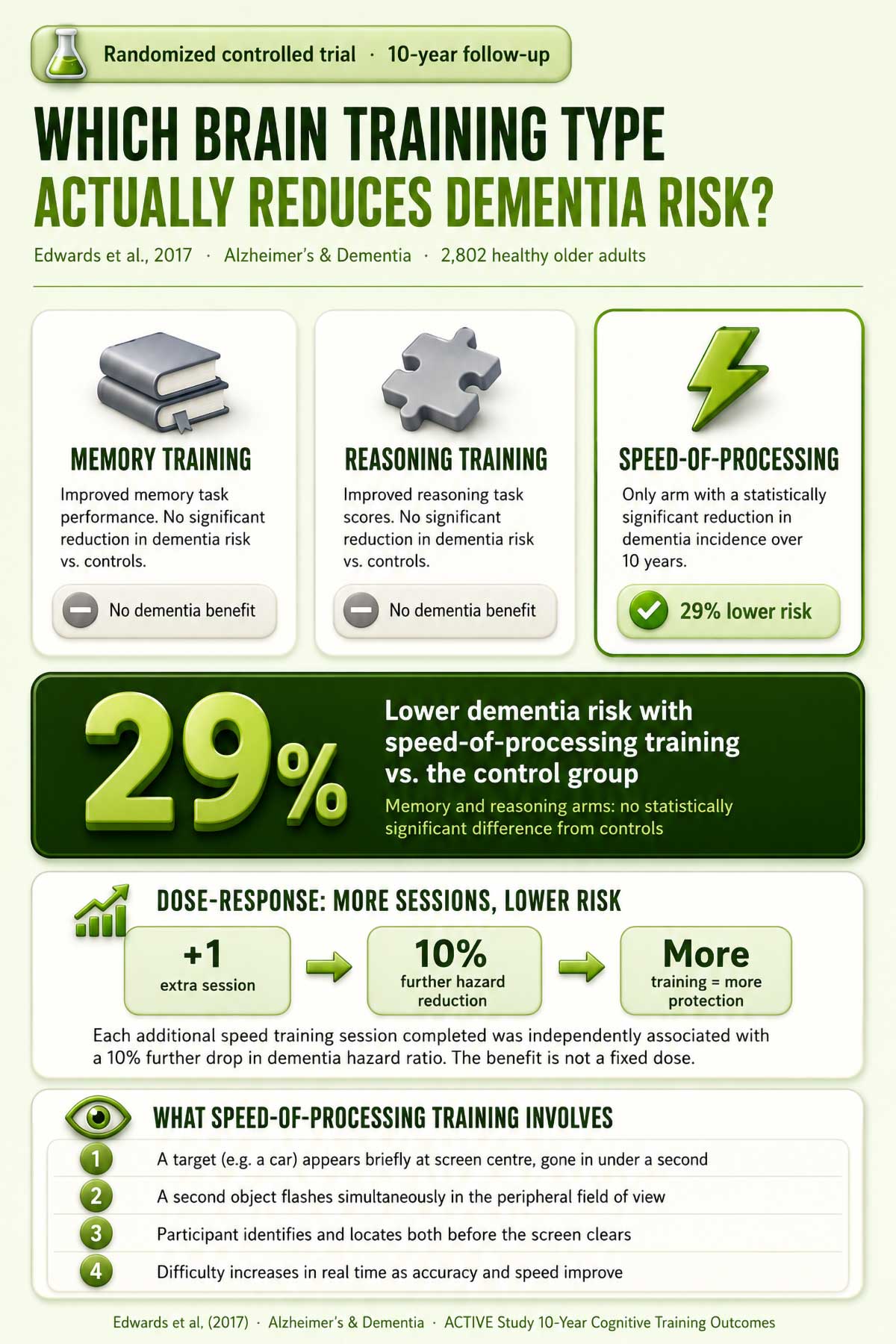
The reason memory and reasoning training fall short likely comes down to how the brain processes each type of task. Memory and reasoning exercises train explicit, consciously controlled skills. You learn a strategy, apply it deliberately, and get better at that specific kind of problem. The benefits are real but narrow. Speed-of-processing training works differently. It targets implicit, automatic pathways, the brain’s ability to route and react to incoming information before conscious thought kicks in.
Current thinking among researchers is that strengthening these pathways builds broader cognitive reserve, a kind of structural resilience that may resist the changes associated with dementia rather than simply compensating for them. That’s why the protective effect extends beyond the specific skill being trained.
The speed-of-processing task itself is worth understanding, because it’s not what most people picture when they hear “brain training.” Participants weren’t memorizing word lists or solving logic puzzles. They were sitting in front of a computer screen, identifying and locating visual targets that appeared briefly and across an increasingly wide field of view. The task got harder as they got faster and more accurate. It was training the brain’s ability to process information quickly under pressure, not its ability to store or reason through it deliberately.
→ See how blueberries support memory and brain function
Twenty Years Later, the Numbers Get Harder to Ignore
The 10-year findings were striking. The 20-year findings are something else entirely.
In a 2026 follow-up published in Alzheimer’s & Dementia: Translational Research & Clinical Interventions, Coe and colleagues linked the ACTIVE participant data to two decades of Medicare records to capture actual dementia diagnoses. Among participants who received speed training and completed booster sessions, 40% were diagnosed with dementia over the follow-up period. In the control group, that figure was 49%. That’s a 25% lower incidence, and it held up after statistical adjustment (adjusted hazard ratio 0.75, 95% CI 0.59 to 0.95).
Memory and reasoning training again showed no statistically significant difference from controls. And speed training without the booster sessions also failed to reach significance. The protective effect required both the initial training and the reinforcement. That detail matters because it shifts the picture from a one-time intervention to something that needs repetition to take hold. Brief as those boosters were, they appear to have been the difference between a temporary cognitive workout and lasting structural change.
The researchers conducting this analysis were, by their own account, surprised at the scale of the effect. Michael Marsiske, one of the study’s principal investigators, noted that seeing benefits persist this long was not what the team had expected. “These 20-year findings strongly suggest that engagement in cognitive training does no harm and may confer substantial benefit,” he said.
What a Session Actually Involves
For anyone trying to picture this: you sit in front of a screen. A car appears briefly at the centre, gone in under a second. Somewhere in your peripheral vision, a road sign flashes at the same moment. Both disappear before you’ve had time to think about them. You identify the car and point to where the sign appeared. Then it happens again, slightly faster. Each time you respond correctly, the task gets harder. Each time you struggle, it eases back. The whole thing feels less like a cognitive exercise and more like a reflex test.
That adaptive quality is what separates it from a static puzzle. The software tracks your speed and accuracy in real time and adjusts the difficulty accordingly, which means it’s always working at the edge of your current ability. Your brain can’t coast. There’s no strategy to learn that makes it easier. The only way to get better is to actually get faster, and that process appears to drive the structural changes researchers believe underlie the long-term protection.
What Changed for the People Who Trained
The dementia statistics are the headline, but the experience of the people in the study tells a different story underneath them. Across multiple secondary analyses by Wolinsky and colleagues, speed training participants showed improvements in internal locus of control and health-related quality of life that persisted for years after the training ended.
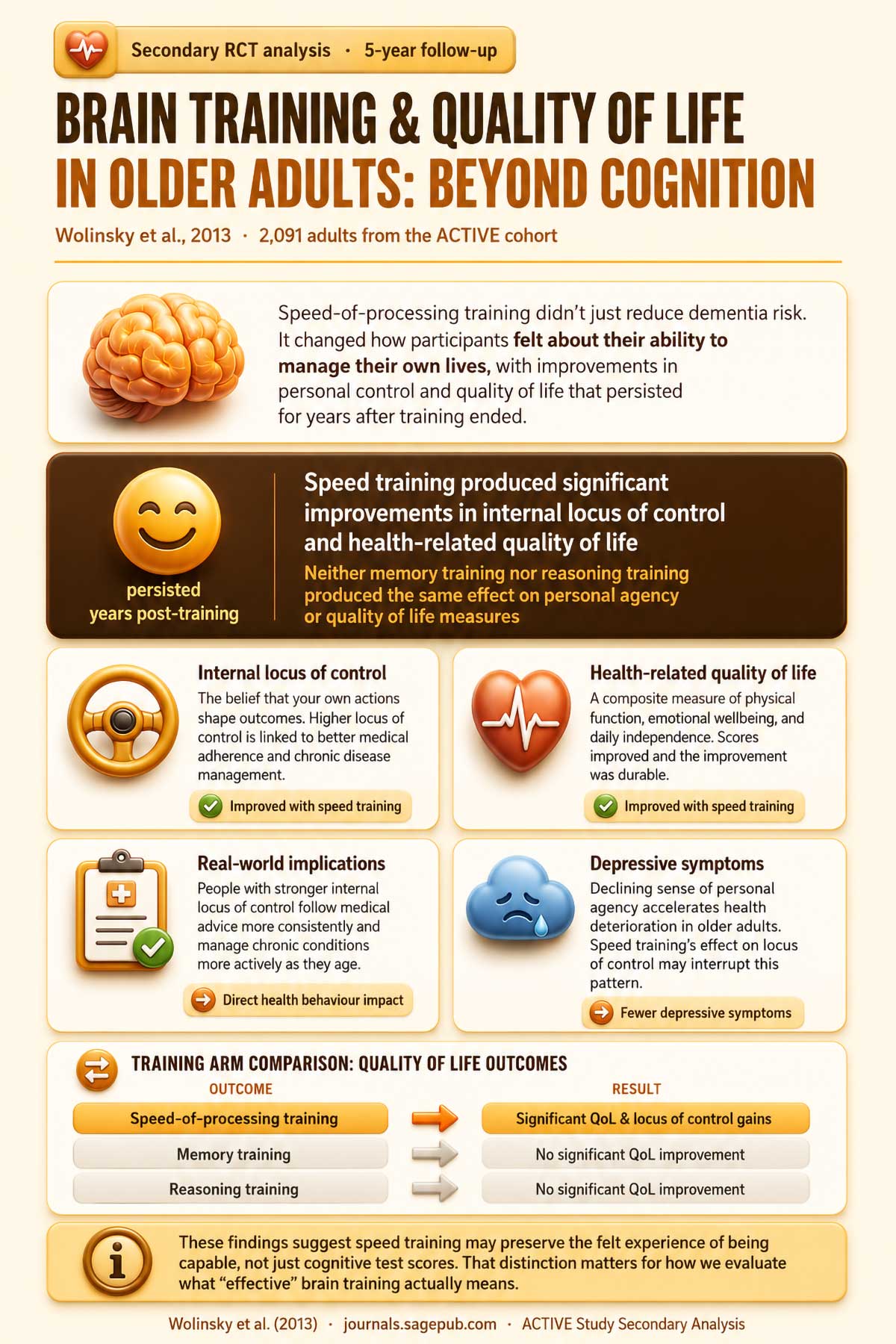
Internal locus of control is a measure of whether people believe their own actions shape what happens to them. For older adults, it’s not a soft metric. People with a stronger internal locus of control follow through on medical advice more consistently, manage chronic conditions more actively, and report fewer depressive symptoms as they age.
The decline in this sense of personal agency is one of the quieter losses that comes with getting older, and it tends to accelerate the very health deterioration people fear most. Speed training was the only arm to protect against it. Memory training didn’t produce the same effect. Neither did reasoning training.
That’s a meaningful distinction, and one that tends to get lost when the conversation stays fixed on dementia incidence rates alone. The data suggests that what speed training may actually be doing, beyond protecting against a diagnosis, is preserving the felt experience of being capable. That’s not a small thing.
Where the Science Still Has Limits
The ACTIVE results are exceptional within the landscape of dementia research. But they don’t settle everything, and it would be wrong to say they do.
A Cochrane systematic review of computerized cognitive training in healthy older adults found evidence that CCT can improve various aspects of cognition, but concluded that high-quality evidence specifically linking it to reduced dementia incidence remains limited. That’s not a contradiction of the ACTIVE findings; it’s a statement about how hard it is to replicate them. ACTIVE was an unusually large, long, and rigorously designed randomized controlled trial. Most brain training research doesn’t come close to that standard.
The commercial brain training industry has often sold products on the back of research like this without the research actually supporting the specific product being sold. The 29% and 25% figures belong to a specific, computerized, adaptive speed-of-processing protocol tested in a specific population under controlled conditions, not to brain games in general.
Doing puzzles on a smartphone app is not the same thing, and treating it as equivalent would be a mistake. For readers who want to find the actual protocol, the ACTIVE speed-of-processing task is now available as an exercise called Double Decision, part of the BrainHQ platform by Posit Science. It’s worth knowing that at least one study author has disclosed financial ties to that company, so approach the product with the same critical eye you’d bring to any commercial health tool.
The Question Worth Considering
There’s something quietly disorienting about what the ACTIVE study found. The intervention that worked wasn’t the intuitive one. Nobody thinks of processing speed drills as a way to protect their mind. Memory work feels like memory protection. Reasoning exercises feel productive. Speed training feels like a video game.
And yet two decades of data, across nearly three thousand real people, say the video game won.
That doesn’t mean everything else is useless. Diet, exercise, cardiovascular health, and sleep all have genuine evidence behind them. But ACTIVE is the first randomized trial of any kind, behavioral or pharmaceutical, to show a statistically significant reduction in dementia incidence over this kind of time horizon. That’s a bar that nothing else has cleared yet, and the specific type of training that cleared it is one most people have never seriously considered.