Most narcissists don’t start cold. They start perfect. Here’s why the best relationship of your life might be the most dangerous one.
You’ve probably searched “signs of a narcissistic partner” and found the same list everywhere. Explosive anger. Constant lying. Zero empathy. Total selfishness.
But that’s not how it starts.
If you’re reading this, chances are your relationship didn’t begin that way. It began with something that felt extraordinary. Almost too good to be true.
That feeling? It’s worth paying attention to.
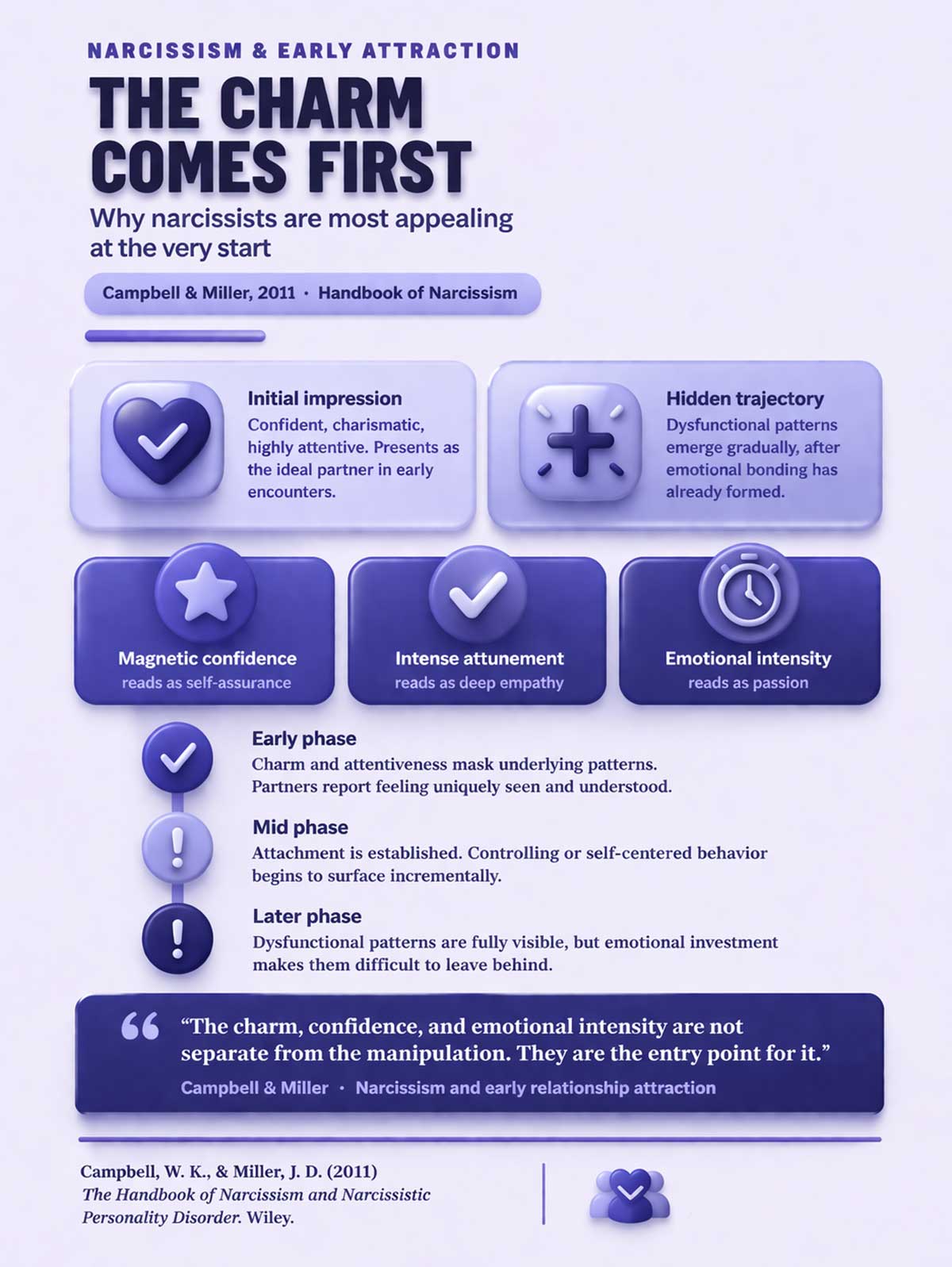
Research by W. Keith Campbell and Joshua Miller (2011) found that people with narcissistic traits tend to come across as magnetic, confident, and genuinely charming early on. Their charm isn’t incidental. It’s the entry point. It sets the stage for everything that comes later, and it makes the later behavior so much harder to name.
This article isn’t about the “monster” version of narcissism you see in movies. It’s about the version that shows up looking like the best relationship of your life.
The Paradox of the Perfect Partner
Most people expect a narcissistic partner to seem cold or arrogant from the start. They expect to feel small or invisible early on.
That’s rarely what happens.
What actually happens is closer to the opposite. The early phase often feels like the most connected, most electric, most “finally, someone gets me” experience you’ve ever had.
Clinical psychologist Craig Malkin (2015) found that narcissism in the early stages tends to show up as charisma, emotional intensity, and passionate attentiveness, not as selfishness. The self-centeredness comes later, after the bond has already formed.
This is the part most articles skip over entirely. And it’s the part that keeps people confused.
If the early signs looked ugly, you’d leave. The problem is that the early signs look beautiful.
Red Flag #1: The “Instant Soulmate” Feeling
Think back to the beginning of your relationship. Did it feel like you’d known this person your whole life? Did they seem to instinctively understand your fears, your passions, your humor, almost immediately?
That feeling of hyper-connection can be intoxicating. It can also be manufactured.
Some individuals with narcissistic tendencies use a technique called “mirroring.” Early in a relationship, they pay close attention to what you say about yourself: your values, your wounds, your dreams. Then they reflect it all back to you. They become the person you’ve always wanted to meet.
Research on attachment and emotional perception (Edelstein et al., 2010) shows that our attachment patterns shape how we read a partner’s attunement. People with anxious attachment styles are particularly prone to interpreting strong emotional responsiveness as evidence of deep intimacy. When someone seems attuned to you very quickly, it can trigger the same feelings that real intimacy does. The brain doesn’t always know the difference.
A healthy new connection has chemistry, sure. But it also has uncertainty. It grows slowly. It has awkward moments.
If it felt like a film script from week one, check that.
Red Flag #2: Love Bombing Disguised as Romance
A narcissistic partner rarely starts by being cruel. They start by being overwhelming.
Constant texts. Big declarations. “I’ve never met anyone like you.” Plans for the future within the first few weeks.
Sandra Brown (2009), who spent years researching women in relationships with high-risk partners, identified this pattern (called “love bombing”) as a consistent feature of the early phase. It feels like romance. It functions like a strategy.
The goal, whether conscious or not, is to create a fast emotional debt. If someone showers you with attention and affection early on, you feel grateful. You feel chosen. That gratitude becomes a kind of tether.
Think about it this way: if a stranger walked up and handed you a hundred gifts, you’d feel overwhelmed and a little uneasy. When a romantic partner does it, we call it love.
The question isn’t whether grand gestures are romantic. The question is whether the intensity matches the amount of time you’ve actually known each other.
Too much, too soon is not a love language. It’s a pressure tactic.
Red Flag #3: Sharing Everything, Including the “Pity Play”
Here’s one that almost nobody talks about.
A partner who opens up with deep personal disclosures very early, especially stories about how everyone in their past has wronged them, can feel refreshingly honest. It can feel like trust.
But there’s another way to read it.
Over-sharing vulnerability early on is a known way to fast-track closeness. Research on early self-disclosure in relationships shows that rapid, intimate revelations create a sense of accelerated bonding, one that can feel indistinguishable from earned trust. When someone tells you their deepest pain in the first few dates, it bypasses your natural instinct to take time and assess. You feel trusted, so you open up too. Suddenly you’re emotionally bonded before you’ve had the chance to see who this person actually is over time.
Pay particular attention if their past stories share a common theme: they were always the victim, and everyone else was always the villain. Every ex is “crazy.” Every boss was abusive. Every friend “betrayed” them.
A pattern like that isn’t just context. It’s a preview.
Red Flag #4: “Isolation by Inclusion”
This one is subtle. It doesn’t feel like control. It feels like closeness.
The partner who wants to spend every waking moment with you. Who gets a little quiet when you mention plans with friends. Who says things like, “I just love being with you so much. I get jealous of the time you give other people.”
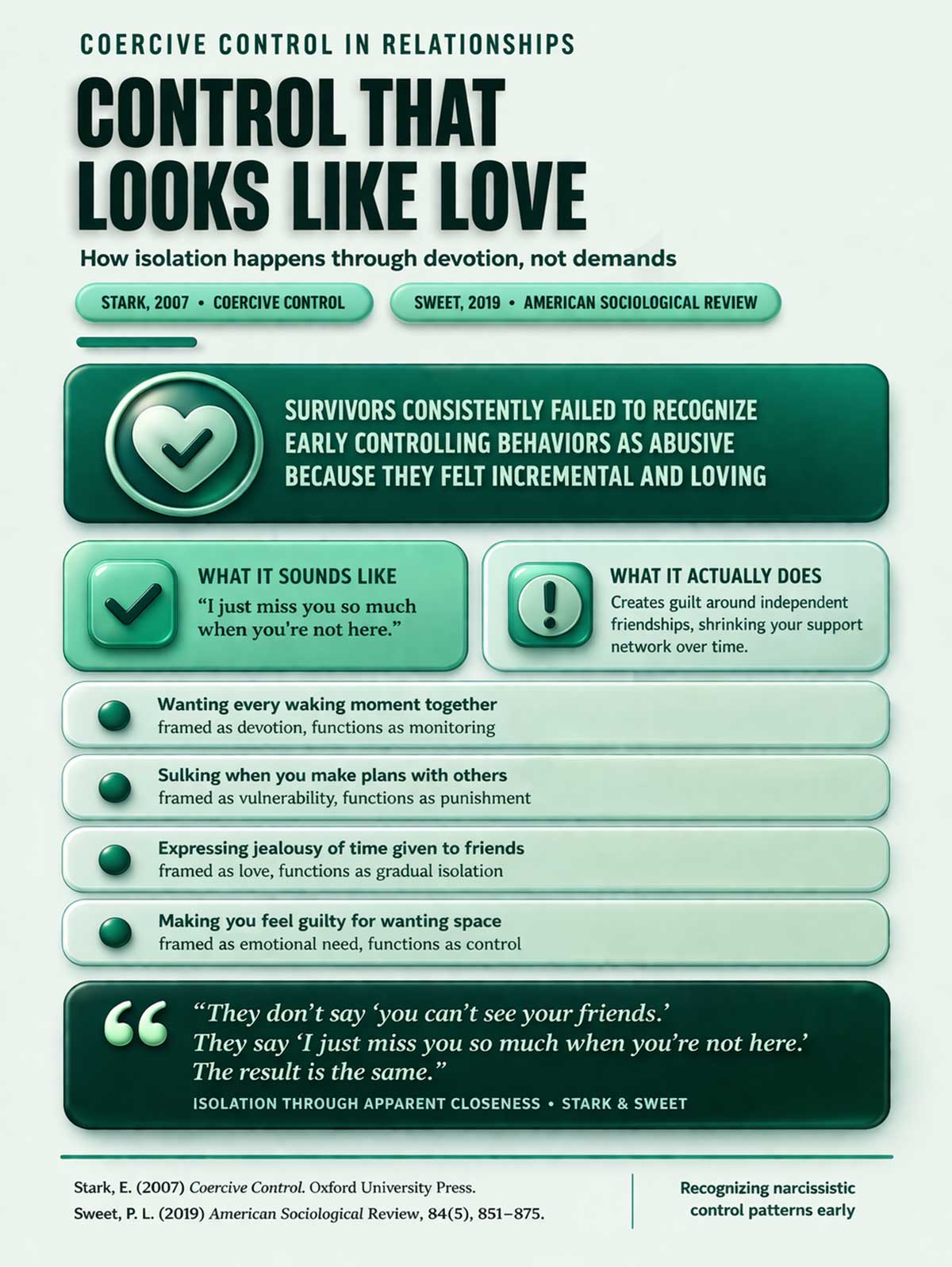
Research on coercive control patterns (Stark, 2007; Sweet, 2019) reveals that isolation rarely happens through obvious demands. It happens through what looks like devotion. The gradual erosion of your outside relationships starts with making you feel guilty for wanting them.
They don’t say “you can’t see your friends.” They say “I just miss you so much when you’re not here.”
The result is the same. Over time, your support network shrinks. And a person without a support network is much harder to leave.
Paige Sweet’s study (2019) of survivors found that people consistently failed to identify early controlling behaviors as abusive because those behaviors felt incremental and even loving in the moment.
Ask yourself: do you see your close friends and family as often as you used to?
Red Flag #5: The Kind of Empathy That Watches You
Here’s a distinction that can change how you see everything.
There are two types of empathy. Affective empathy means you actually feel what another person feels; their pain affects you emotionally. Cognitive empathy means you can identify and read what another person feels, without necessarily caring about it.
Narcissistic individuals often have very high cognitive empathy. They’re skilled at reading people. They notice your mood shifts quickly. They know exactly what to say when you’re upset to bring you back.
It can feel like they know you deeply. And in a way, they do.
But watch what happens during a conflict. Do they use your sensitivities against you? Do they know precisely which words will make you feel small, or guilty, or confused? That’s not love guiding their emotional radar. That’s strategy.
The partner who always knows what you need to hear is worth observing carefully. Is that attunement working for your benefit? Or are they just very good at keeping you close?
The Slot Machine Effect: Why You Can’t Just Walk Away
If you’ve noticed some of these patterns and you’re still in the relationship, there’s a good reason for that. It’s not weakness. It’s chemistry.
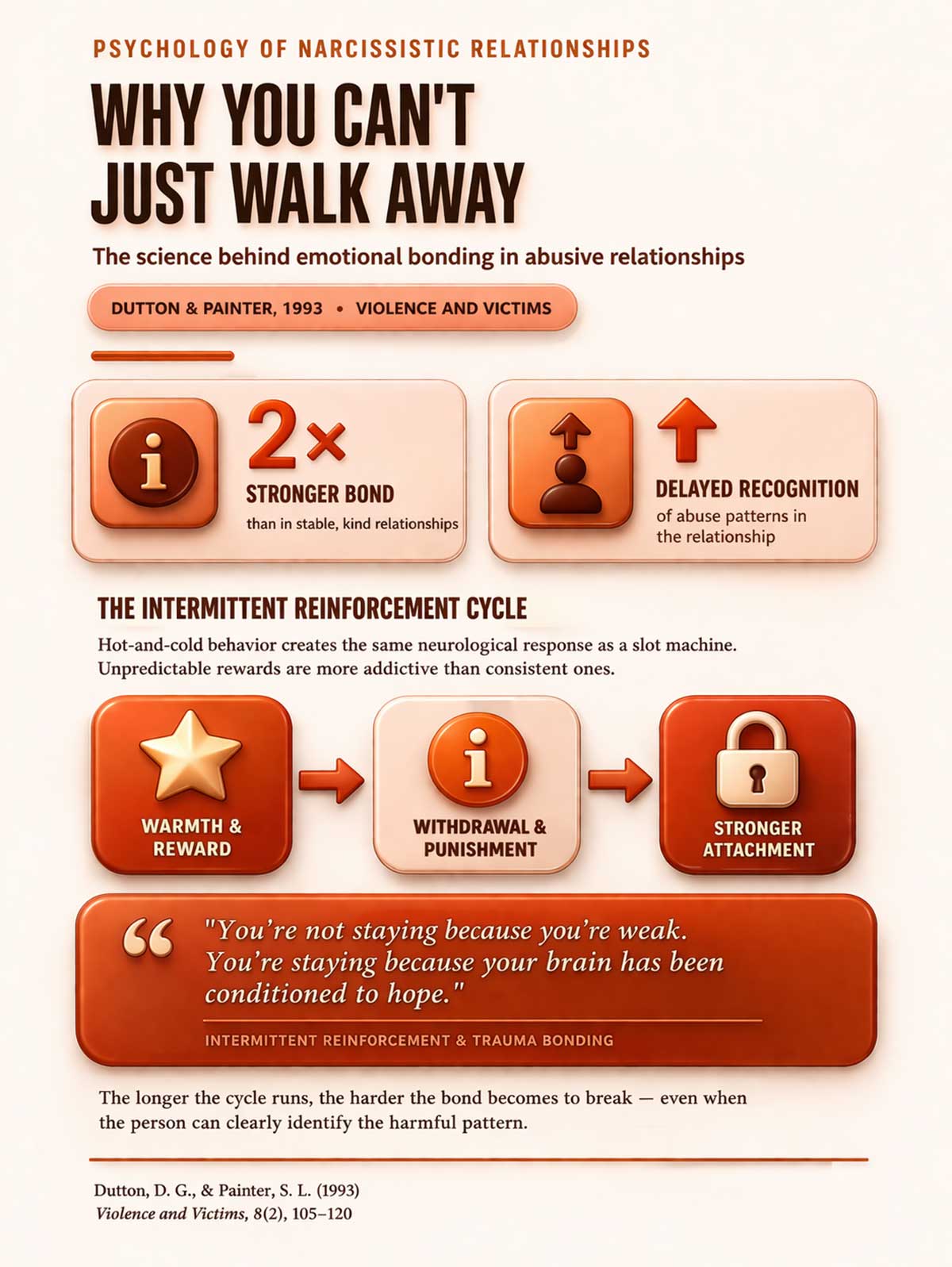
Donald Dutton and Susan Painter’s research (1993) showed something striking: relationships with alternating cycles of warmth and withdrawal create stronger emotional bonds than consistently kind relationships. The psychological term is intermittent reinforcement.
Think about a slot machine. It doesn’t pay out every time. If it did, you’d get bored and walk away. It pays out occasionally, unpredictably, and that’s exactly what keeps people pulling the lever.
A relationship that swings between wonderful and painful works the same way. The wonderful moments (the apologies, the tenderness, the “old them” making a brief reappearance) hit like a reward. Your nervous system gets wired to wait for that hit.
So you’re not staying because you’re foolish. You’re staying because your brain has been conditioned to hope.
Knowing that doesn’t make leaving easy. But it does make the confusion make sense.
Ramani Durvasula (2019) has written extensively about how victims of narcissistic relationships routinely rationalize or normalize early warning signs, not because they’re naive, but because emotional investment and bonding make those behaviors genuinely hard to see clearly.
The Slow Fade: How Healthy Communication Breaks Down
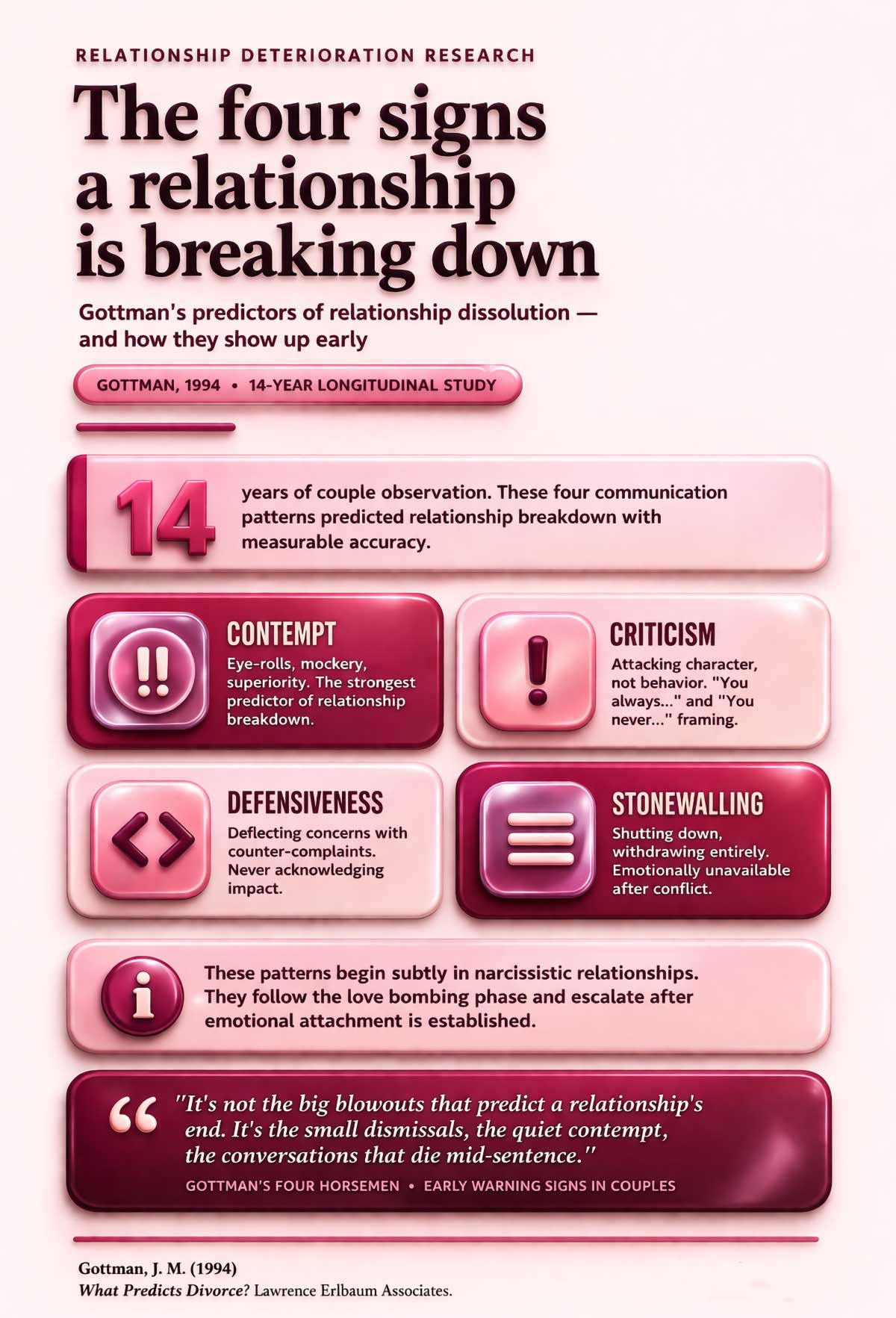
John Gottman’s long-term research (1994) tracking couples across more than 14 years found that destructive relationship patterns tend to emerge slowly and subtly, long before they become visible as serious problems.
He identified four key warning signs: contempt, criticism, defensiveness, and stonewalling. They usually start small. An eye-roll here. A dismissive comment there. A conversation that ends with one person shutting down entirely.
In a narcissistic dynamic, these patterns tend to follow the love bombing phase. Once the initial intensity fades and you’ve grown attached, the contempt begins to surface. At first, it’s rare enough that you write it off.
Over time, it becomes the norm.
Pay attention to how disagreements go in your relationship. Not the big blowouts. Those are obvious. The small ones. Does your partner listen to your point of view? Do they get defensive when you raise concerns? Do they ever make you feel ridiculous for feeling what you feel?
Those small moments compound.
The Slowdown Test
Here’s one of the most telling things you can do.
Say no to something. Slow things down. Set a small limit. It doesn’t have to be big. Decline a plan. Ask for a little space. Tell them you’d like to wait before taking the next step together.
One important note: if you’re already afraid of your partner’s reactions, or if setting limits has previously led to threats or aggression, skip this test entirely. Your safety matters more than any insight it might offer.
Then watch the response.
A healthy partner might feel a little disappointed. They’ll say so. And then they’ll respect it.
A partner with narcissistic traits will often respond to a boundary as if it’s an attack. They may sulk, withdraw, guilt-trip, or frame your need for space as a sign that you don’t really love them. They may escalate. Suddenly everything is a bigger deal than you expected.
Finkel’s longitudinal relationship research noted that intense early attraction often masks problematic dynamics that only become visible when the relationship faces stress. A small boundary is a low-stakes stress test.
The reaction to a boundary tells you far more than behavior during the easy, comfortable times.
Trusting the Feeling You Keep Explaining Away
This part is important, and it’s not in most articles.
A lot of people in confusing relationships know something is off before they can name it. They feel a low hum of anxiety. They catch themselves watching their words. They notice they apologize a lot, without being sure what they did wrong.
And then the good moments come, and they dismiss the unease.
If you find yourself constantly explaining to yourself why the uncomfortable feeling isn’t valid, that’s worth pausing on. The narrative of a fairy tale romance is very good at drowning out the quieter signals your nervous system is sending.
Your nervous system keeps score even when your mind is busy making excuses.
This doesn’t mean every intense relationship is dangerous. It means that genuine connection doesn’t usually require you to constantly manage your own doubt.
If the relationship feels like a fairy tale, ask who wrote it, and whether it has a second act.
What to Do Next
If this article has resonated with you, the most useful next step isn’t a quiz or a checklist. It’s a conversation with someone outside the relationship.
A quick note on the research cited here: much of the published work on narcissistic relationship dynamics has focused on women as the non-narcissistic partner. These patterns affect people across all genders and relationship types. If you’re a man or in a same-sex relationship, what’s described in this article applies to you too.
A therapist can help you name what you’re experiencing. Look for someone with specific training in narcissistic abuse dynamics or trauma-informed care, since not all therapists are familiar with these patterns and a general therapist may not recognize the subtleties. They can offer clarity that’s hard to find when you’re emotionally inside a confusing situation.
If you’re not ready for therapy, start by reconnecting with someone you trust. A friend. A family member you’ve drifted from. Rebuilding outside relationships is one of the most protective things you can do, for your clarity and your safety.
You don’t need certainty to take that step. You just need to decide your confusion is worth taking seriously.