In 2005, a biologist at a food-science lab in Philadelphia swallowed a spoonful of fresh olive oil and felt a familiar sting at the back of his throat. He had felt it before, in an unrelated study testing liquid ibuprofen.
That sting turned out to share more than a sensation with the drug. Gary Beauchamp and his colleagues had stumbled onto a compound now known as oleocanthal, and their paper in Nature showed it worked through the same anti-inflammatory pathway as the painkiller in a typical medicine cabinet.
Greek extra virgin olive oil carries more of that compound than almost any other oil on supermarket shelves, and the reason has less to do with marketing than with how the country has pressed olives for thousands of years.
Not every bottle labeled Greek earns that reputation, though, and the difference between bottles that earn it and bottles that only borrow the name matters more than most shoppers realize.
Ancient roots of a tradition still shaping the bottle
Olive trees have grown in Greece for more than 6,000 years, making it one of the oldest continuous olive oil-producing regions on earth. Archaeological evidence from Crete places production as early as 3500 BCE.
The tree carried enough weight in Greek life that it became a symbol of peace and victory, and legend credits Athena’s gift of the first olive tree as the reason Athens carries her name rather than her rival Poseidon’s.
- 3500 BCE: earliest evidence of olive oil production on Crete
- 1700 to 1450 BCE: Minoan civilization develops large-scale olive oil storage
- 776 BCE: olive oil awarded to Olympic victors
- 600 BCE: the Athenian lawmaker Solon writes the first olive protection laws
- 146 BCE to 330 CE: the Roman period spreads Greek olive oil trade across the Mediterranean
- 1950s to present: production modernizes while many family groves stay in the same hands
The ancient Greeks called the oil “liquid gold” and used it for cooking, religious ceremony, medicine, and lamp fuel all at once. Many of today’s producers are still working groves their families have held for generations.
The olive varieties behind the flavor
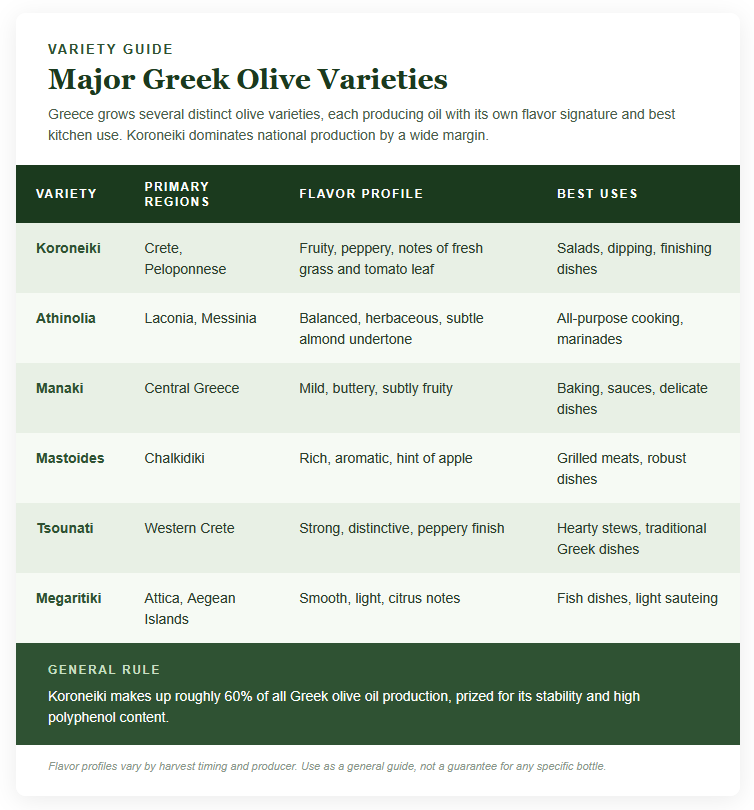
Greece grows a wide range of olives, but production leans hard on one in particular. Koroneiki accounts for roughly 60% of the country’s total output, and its small fruit produces an oil with unusual stability and a high concentration of the polyphenols responsible for that peppery, throat-catching finish.
The variety a bottle comes from tells you more about what to expect in the glass than almost any other label detail.
How the oil gets from grove to bottle
Harvest runs from October through January, and timing changes the oil more than most buyers expect. Early harvest oils, picked in October and November, come out pungent and peppery with a higher antioxidant load. Oils from later in the season turn milder and fruitier.
Most premium Greek oil is still picked by hand, either directly from the tree or by gentle shaking onto nets laid below. Workers sort out damaged fruit before it ever reaches the mill.
Modern production relies on cold extraction to protect flavor and nutrient content. The olives are crushed into a paste, slowly mixed to help oil droplets merge, then spun in a centrifuge that separates oil from water and solids.
Some producers filter the result, while others leave it unfiltered with natural sediment intact. The best oils reach the mill within hours of picking, since the fruit begins oxidizing almost immediately.
Quality classifications: what the label means
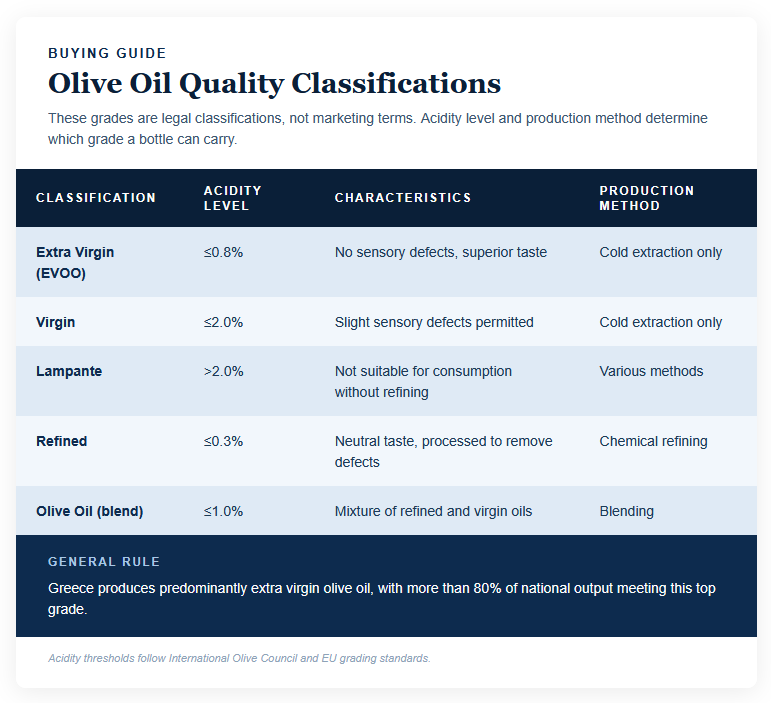
Greece produces a disproportionate share of extra virgin olive oil compared with most producing countries, with more than 80% of national output meeting that top grade. The classification system below determines what a bottle is legally allowed to call itself.
A regional map of flavor
Greece’s microclimates produce genuinely different oils from one region to the next, and the Protected Designation of Origin and Protected Geographical Indication systems exist to keep that regional identity from getting flattened by blending.
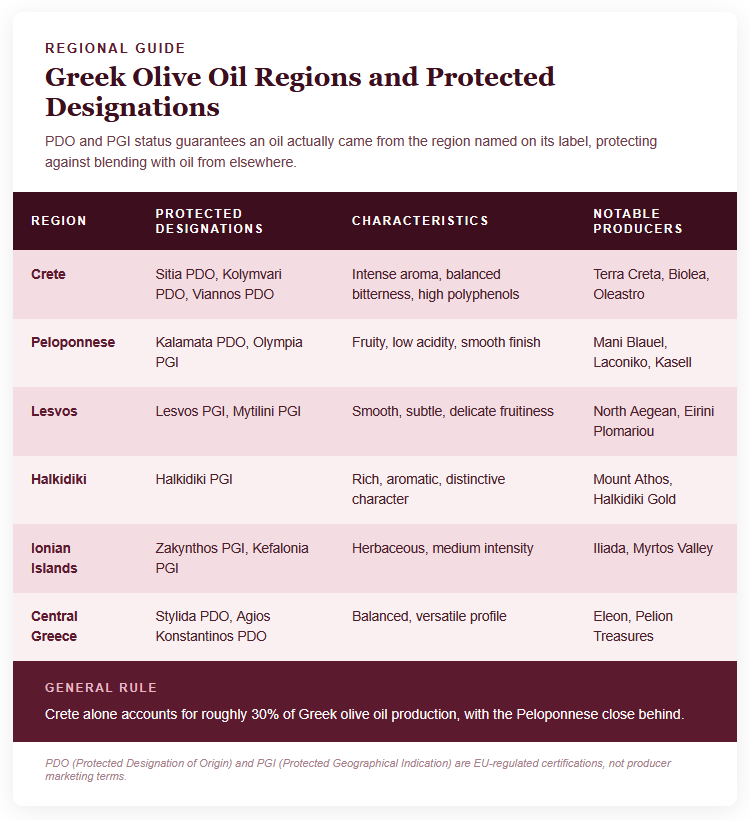
Crete alone accounts for roughly 30% of national production, with the Peloponnese close behind. Both regions have pressed olives long enough that the practice predates most written history in the area.
How it stacks up against Italian olive oil
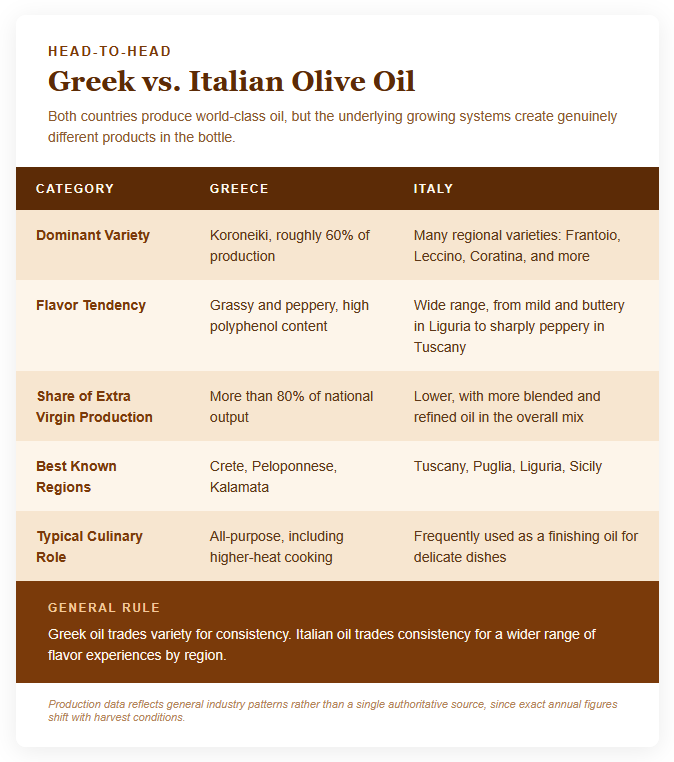
The comparison comes up constantly, and the honest answer depends on what a buyer actually wants from the bottle. Italy grows far more distinct olive varieties across separate regions, which is why Italian oils vary widely from one bottle to the next. Greek production leans overwhelmingly on a single variety, which makes Greek oil more consistent but less varied by comparison.
What the research actually shows about health benefits
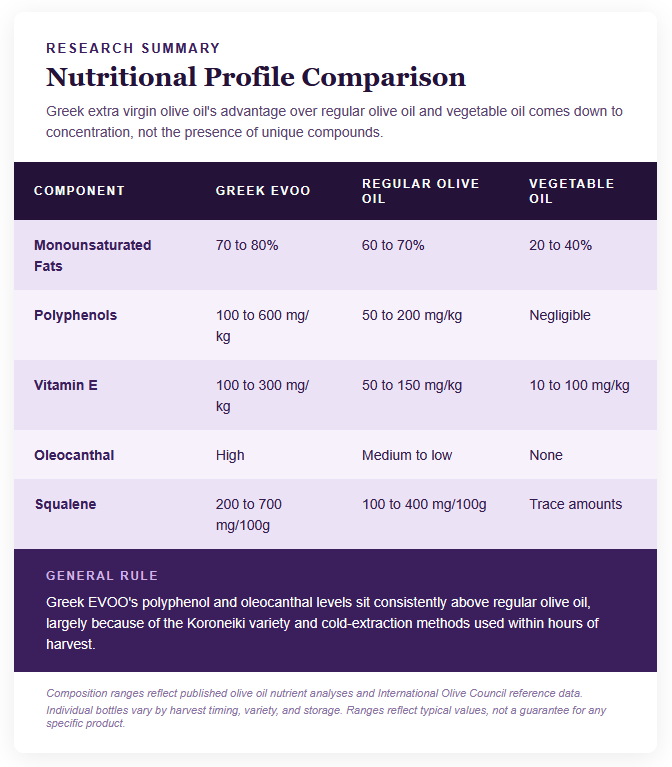
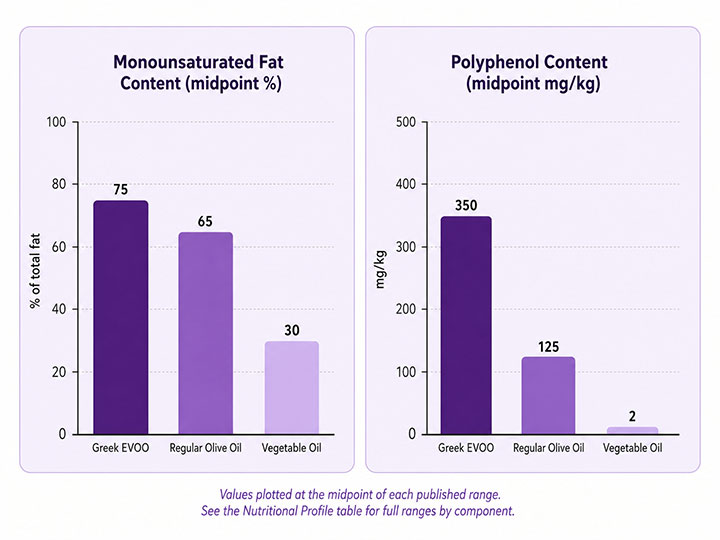
Greek extra virgin olive oil’s health reputation rests on more than tradition. A growing body of clinical research backs specific, measurable effects, though the strength of that evidence varies considerably depending on which claim is under discussion.
Heart and blood vessels
A 2020 study tracking over 90,000 adults for more than two decades found that people who consumed more than half a tablespoon of olive oil daily had a 14% lower risk of cardiovascular disease, according to the Journal of the American College of Cardiology. What’s notable is how consistent that finding is across study designs. The landmark PREDIMED trial, a randomized controlled trial rather than an observational cohort, found a similar pattern: a Mediterranean diet supplemented with extra virgin olive oil cut major cardiovascular events by around 30% compared with a low-fat diet, in results published in the New England Journal of Medicine.
Oleocanthal, the ibuprofen-like compound from the introduction, appears to contribute meaningfully here too. A meta-analysis in the journal Nutrients pooling 15 clinical trials found that regular olive oil consumption meaningfully lowered C-reactive protein, a standard marker doctors use to track inflammation in the body.
Stroke, cognition, and a distinction worth making
The Three-City Study, a long-running French cohort published in Neurology, tracked older adults for stroke incidence based on how heavily they used olive oil in cooking and as a dressing. Those who used it the most showed a 41% lower stroke rate than those who never used it at all.
That finding gets lumped in with Alzheimer’s claims in a lot of olive oil writing. It shouldn’t be.
Stroke and Alzheimer’s disease involve different mechanisms, and conflating the two overstates what either study actually measured.
On Alzheimer’s specifically, a 2025 meta-analysis in the journal GeroScience found that Mediterranean diet adherence was associated with roughly 30% lower Alzheimer’s risk. That is a diet-wide finding, not an olive-oil-specific one.
Researchers still haven’t fully separated olive oil’s individual contribution from the rest of the diet’s effect. The distinction is easy to skip past, and it changes what the 30% figure is telling you.
The cancer question, honestly
This is the shakiest evidence of the group. A 2022 meta-analysis in PLOS ONE pooling data from 45 studies found that high olive oil consumption was associated with a 33% lower risk of breast cancer and a 23% lower risk of gastrointestinal cancers.
Those numbers sound decisive. Most of the underlying studies were observational, meaning they show a pattern rather than proof that olive oil itself caused the lower rates.
Laboratory research suggests olive oil polyphenols can slow cancer cell growth in a dish, which is a mechanism, not a guarantee that translates to a full diet. The gap between what happens to isolated cells and what happens in a living body eating whole meals is real, and it hasn’t closed yet.
Bringing it into the kitchen
Greek olive oil earns its reputation as a finishing oil, but its high monounsaturated fat content also makes it more heat-stable than most people assume. Contrary to the common warning against cooking with extra virgin oil, Greek EVOO holds up well through most home cooking methods, including sautéing and roasting. Save the most delicate, early-harvest bottles for drizzling raw, and reach for a milder mid-range oil when the pan gets hot.
A few traditional dishes put the oil to work more directly than a simple drizzle ever could.
Ladolemono
This lemon and olive oil sauce mixes three parts Greek extra virgin olive oil with one part fresh lemon juice, minced garlic, dried oregano, salt, and pepper. It’s traditionally spooned over grilled fish, meat, or vegetables right before serving.
Horiatiki
Most people have eaten a version of Horiatiki without knowing its name. The dish layers tomatoes, cucumber, red onion, green pepper, Kalamata olives, and a block of feta under a generous pour of oil and oregano. The dressing here is the oil itself, not a separate vinaigrette, which is part of why the dish falls apart if the oil is mediocre.
Dakos
This Cretan rusk salad tops barley rusks with grated tomato, crumbled feta or mizithra cheese, capers, olives, and oil, finished with oregano.
Flavor intensity should guide which bottle goes where. A robust, peppery early-harvest Koroneiki pairs best with grilled meats, hearty stews, and bitter greens, standing up to strong flavors instead of disappearing under them.
Milder, more balanced oils from Athinolia olives work across most everyday Mediterranean cooking. The gentlest, fruitiest oils, often Manaki, suit fish, delicate salads, and even desserts, where a stronger oil would overwhelm.
Buying and storing it well
Greek producers are represented disproportionately often among the medal winners at the New York International Olive Oil Competition, the largest quality contest of its kind in the world. That track record is worth knowing, because the label alone often isn’t enough to tell a genuine bottle from an imitation.
A few label details are worth checking before you buy. Look for a harvest date less than 12 to 18 months old, since olive oil doesn’t improve with age the way wine does.
A PDO or PGI certification guarantees the oil actually came from where the label claims. Single-estate or single-variety bottles tend to indicate tighter quality control, and a dark glass bottle protects the oil from light damage sitting on a store shelf.
Watch for two specific misleading phrases. “Product of Greece” can legally mean the oil was only bottled there, not grown or pressed there. “Light” olive oil refers to a milder flavor, not fewer calories, despite what the word suggests on a supermarket shelf.
A few sensory red flags separate real quality problems from normal variation. An oil that smells waxy, like crayons or putty, has likely turned rancid and should be returned rather than used. A fermented or swampy smell signals a fusty defect from olives that sat too long before pressing.
A flat taste with none of the expected pepperiness usually means heat damage from poor storage. Cloudy sediment, on the other hand, is often completely normal in unfiltered oils and simply settles at the bottom of the bottle.
Store the bottle in a cool, dark spot between 57 and 70 degrees Fahrenheit, sealed tightly and away from the stove. Use it within three to six months of opening, and transfer to a smaller container as the level drops to limit the oil’s exposure to air.

Greek Olive Oil Freshness Calculator
Enter the harvest date on your bottle to check where it stands
Sustainability, briefly
Greek producers have leaned into water conservation, with drip irrigation systems cutting usage by as much as 70% on some farms. More than 10% of Greek olive groves are now certified organic, and a growing number of mills run on solar power. The Slow Food Foundation has recognized several Greek olive varieties in its Ark of Taste catalog for their cultural and agricultural importance.
Farmer cooperatives remain the backbone of the industry’s economics, distributing profit more evenly than a single large producer model typically allows. Whether that structure survives the next wave of industry consolidation is an open question, and nobody in Greek agriculture seems fully confident of the answer.
What a bottle of it is really worth
Greek olive oil’s reputation was built well before anyone could measure a polyphenol or name a compound after the sting in the throat. The chemistry caught up to the tradition, not the other way around. That’s the part worth sitting with the next time a bottle labeled “Product of Greece” turns out to have never touched Greek soil until it reached the bottling line.
FAQs
What makes Greek olive oil unique compared to other types?
Greek olive oil stands out for its unusually high share of extra virgin production, its reliance on the Koroneiki variety, and small-scale production methods that many other oil-producing countries have largely moved away from. The combination of Greece’s climate, soil, and ancient olive stock produces oils with higher polyphenol content than oils from many other producing countries.
How is Greek olive oil traditionally produced?
Traditional production hand-harvests the olives, then crushes them, historically with stone mills and now more often with metal crushers, before separating the oil from water and solids. Centrifugal separation has replaced the older method of pressing paste between fiber mats, but many small producers still hand-harvest and process the fruit within hours, preserving techniques that predate the machinery.
Can Greek olive oil be used for frying?
Yes. Its smoke point, generally between 375 and 405 degrees Fahrenheit depending on grade and filtration, holds up for most home cooking, including frying. Research has found that olive oil is actually more stable during frying than many seed oils, thanks to its antioxidant content and fatty acid structure.
How long does Greek olive oil last?
Properly stored and unopened, extra virgin Greek olive oil holds peak quality for 18 to 24 months from harvest. Once opened, plan to use it within three to six months.
The printed expiration date is often closer to marketing than science. The harvest date is the one that actually tells you something.
Does Greek olive oil affect cortisol or stress levels?
The evidence here is genuinely mixed. A randomized controlled trial in patients with major depression found that extra virgin olive oil improved mood symptoms without measurably changing salivary cortisol levels.
Smaller preliminary studies in animals have suggested olive oil compounds might blunt stress-hormone spikes, but that hasn’t been confirmed in rigorous human trials yet. Anyone drawn to olive oil specifically as a cortisol fix is likely to be disappointed by what the research currently supports.