


Many people think brain gains work like a permanent upgrade. The research suggests the brain treats them more like a subscription that requires renewal.
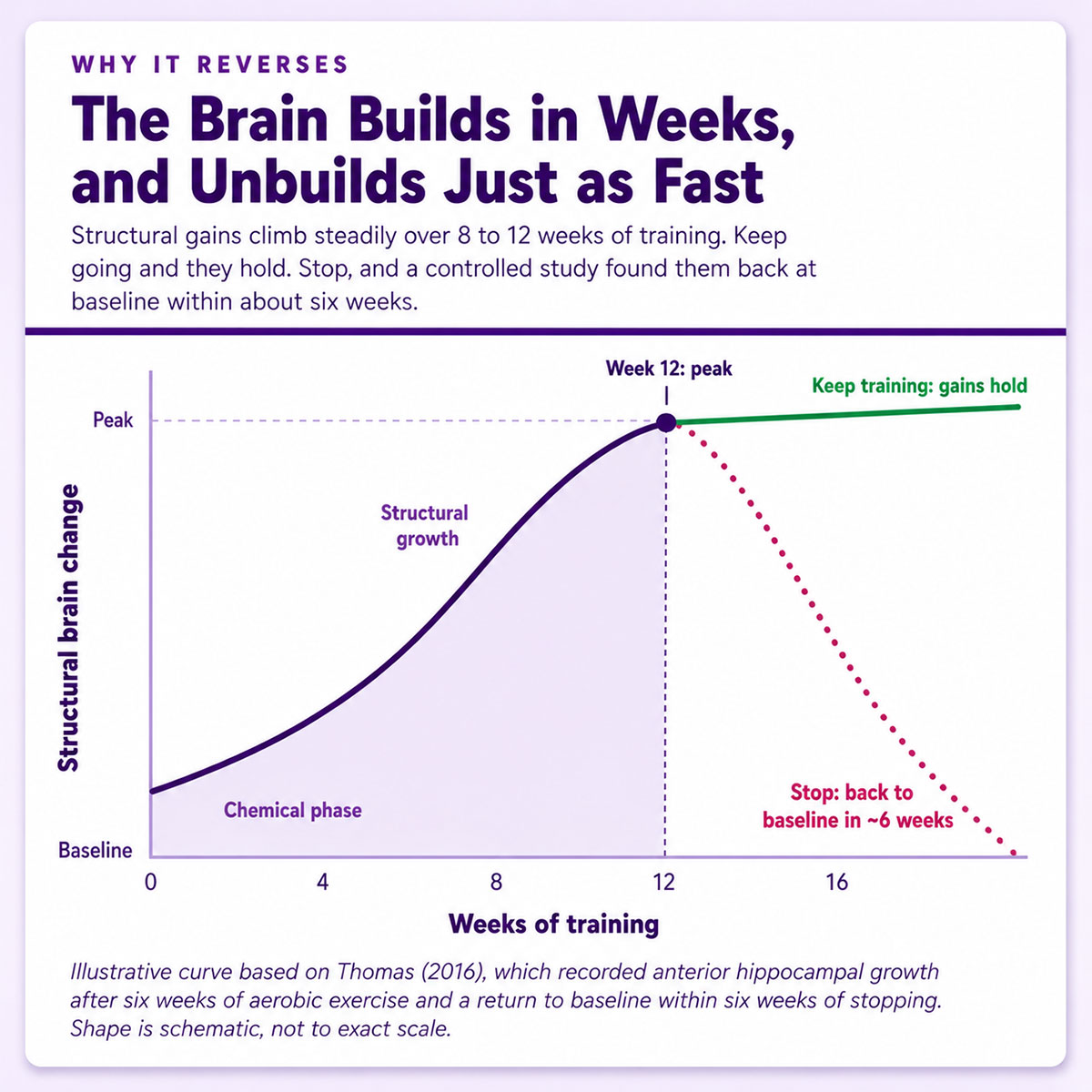
Sedentary adults who took up cycling grew measurable new tissue in their hippocampus in six weeks. Then they stopped, and within another six weeks, the new tissue was gone. The brain had built something real, then quietly took it back.
That finding, from a 2016 study at Oxford, complicates the usual promise that exercise rewires your brain. It does. The rewiring is just more conditional than the statement suggests.
So the useful questions are sharper than whether movement helps. What kind, how much, how long before anything changes, and what becomes of those changes when life gets in the way?
Two kinds of brain change, and only one is built to last
Exercise changes the brain in two ways, and the difference explains why timing matters so much.
Chemical plasticity happens fast. A single workout floods the brain with growth factors and neurotransmitters, and for a few hours, you may feel calmer or quicker. Then the levels fall back, often by the next day.
Structural plasticity is slower and more literal. Blood vessels form. Regions thicken. Networks reorganize. These changes hold, but only while the signal that produced them keeps coming.
One flips a light on. The other wires the house. The first effect is instant and temporary, while the second takes weeks to build and, as those cyclists discovered, comes apart once the current stops.
What rebuilds, and when
The shift from chemical to structural change follows a rough schedule. It varies from person to person, but the sequence holds.
In the first week or two, the work is chemical. Each session increases brain-derived neurotrophic factor, or BDNF, a protein that helps neurons grow, connect, and survive. A 2015 meta-analysis in the Journal of Psychiatric Research pooled 29 studies and found that a single bout of exercise reliably increases BDNF, and that regular training sharpens the response. The spikes are real and short. You are priming the ground, not yet planting.
Around week three or four, the picture starts to shift. Researchers using functional MRI have asked what changes before any new tissue appears, and the answer is communication. A 2010 trial led by Michelle Voss found stronger connectivity in the brain’s default mode and executive networks, the systems that flag and coordinate higher-level thinking. Some of that coordination registers early, while the structure underneath remains unchanged.
By weeks six to eight, structure follows. The hippocampus, a seahorse-shaped region buried deep in the brain, governs memory and spatial navigation, and it is one of the few adult regions that can grow new neurons. In the 2016 Oxford study, sedentary adults who cycled five times a week added volume to the front of the hippocampus. Kirk Erickson and his colleagues observed the same direction of change in a 2011 trial that followed 120 older adults for a year, when walking three times a week grew the hippocampus by about two percent and improved spatial memory. Two percent sounds small. In a structure that shrinks with age, it is a year or two of decline reversed.
The mechanism turned out to be a surprise.
Everyone expected new blood vessels. When the Oxford team looked closely, they found no vascular change at all. The added volume was better explained by myelination, the insulating wrap that speeds signals along fibers that the brain already had.
Blood flow does matter elsewhere: a separate 2007 study found that twelve weeks of training raised blood volume in the dentate gyrus, the hippocampal corner where new neurons are born. But the blood-flow story is not clear.
When a 2015 study by Maass and colleagues ran a similar protocol in adults aged 60 to 77, hippocampal perfusion tended to fall rather than rise, even as fitness and memory improved. Researchers still do not agree on which mechanism leads, or when.

What detraining undoes, and how fast
Those Oxford cyclists are the cautionary half of the story. Six weeks after they stopped, the volume they had gained was back to baseline. The brain treats structural change less like a purchase and more like a subscription.
The chemistry behaves the same way. In a 2008 trial, people with multiple sclerosis raised their BDNF after four weeks of cycling, then watched it settle back to where it started by week eight, even though they kept training. Single doses fade within hours. Build gains fade within weeks. Without a renewing signal, the brain stops maintaining what it has made.
This is not a reason to despair, and it is not the same as starting over. There is some evidence that the second build comes faster, the way retrained muscle returns more quickly than it first appeared. The capacity does not vanish. What vanishes is the upkeep.
The practical version is simple. After an initial eight to twelve weeks, most people maintain their gains at three sessions a week. Drop to zero, and the brain drifts back toward its untrained state. Use it or lose it is not a slogan here. It is the rule the tissue follows.
Which kind of exercise, and how much
Most of the studies that produced measurable brain change used aerobic exercise. Walking, cycling, swimming, jogging. Activities that lift the heart rate and hold it there feed the BDNF response and the circulation that supports it.
Intensity matters less than people fear. Moderate effort, the pace at which you can still talk but not comfortably sing, sits in the range most trials used, roughly 60 to 70 percent of your maximum heart rate. Harder is not obviously better. Very high intensity can raise cortisol, which works against new neuron survival when it stays high.
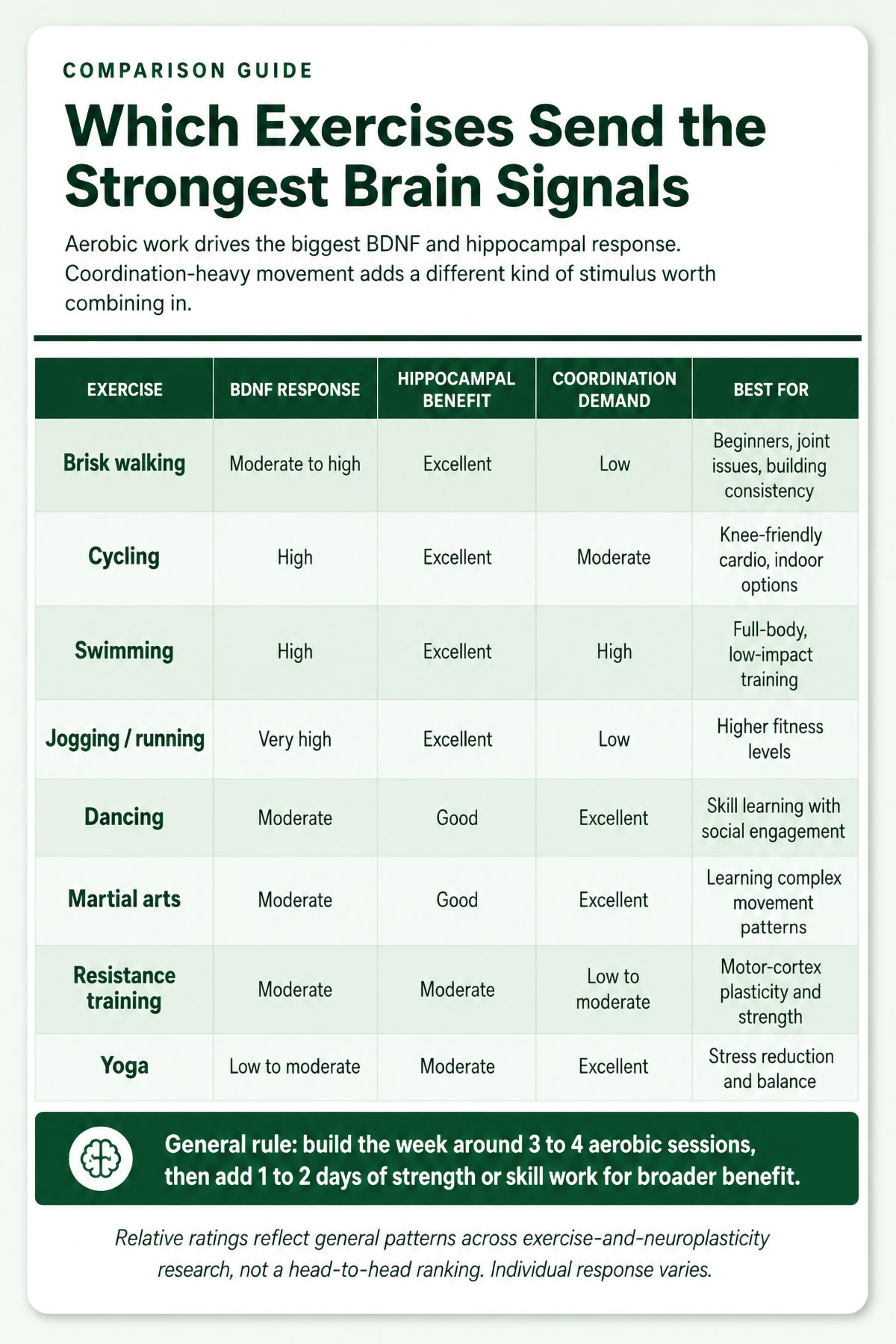
Other forms still earn their place. Resistance training drives plasticity in the motor cortex. Coordination-heavy activities such as dance, martial arts, and racquet sports push the brain to learn new movement patterns, which is its own kind of stimulus. The strongest approach blends them: three or four aerobic sessions a week, plus a day or two of strength or skill work.
Frequency is not negotiable the way that intensity is. The brain commits resources to structures it expects to use, and it reads frequency as the signal. Three to five sessions a week reads as a pattern. One or two reads as noise.
Does age change the math?
Less than people assume. Older brains are slower to show change, not unable to make it.
The largest body of evidence resides with older adults, because that is who researchers were most concerned about. Erickson’s walking trial reversed age-related shrinkage in people aged 55 to 80, and several of the strongest results came from participants past 65.
A 2020 review by Chelsea Stillman reached the same conclusion across age groups: exercise produces structural and functional brain change at every stage of adult life, with the timeline stretching as age rises.
If you are over 60, expect results closer to fourteen or sixteen weeks than eight.
A starting protocol that respects the timeline
The schedule matters more than the details, so keep the details simple.
- For the first two weeks, exercise three to five days, thirty to forty minutes per session, at a moderate pace you could hold while talking. Consistency is the only goal.
- Through weeks three and four, keep the frequency and add one skill-based session, a dance class, or a racquet sport, to widen the kind of stimulus the brain receives.
- Across weeks five to eight, maintain the sessions. This is when structure starts forming, and missed weeks here cost the most.
- From weeks nine to twelve, hold the routine and let intensity drift up slightly with short, faster intervals inside your aerobic sessions.
- After twelve weeks, settle into maintenance at three or four sessions a week, and treat that as the floor rather than the ceiling.
One habit pays off more proportionally to its effort. Because exercise leaves the brain in a more plastic state for a window afterward, learning something demanding soon after a workout, a language, an instrument, an unfamiliar route, tends to stick better than the same practice done cold.
Two mistakes account for most stalled progress. The first is starting too hard and burning out before the structural phase begins. The second is treating sleep as optional, since most neuron growth happens during deep sleep, and a training plan without a sleep plan undercuts itself.
A note of caution before the first session. Anyone with heart disease, high blood pressure, diabetes, a recent injury, or balance problems should speak to a doctor before starting a new routine. Anyone who feels chest pain, severe breathlessness, or lasting dizziness during exercise should stop and seek advice.
Why this is better news than it sounds
The statement that exercise rewires the brain is true and slightly misleading. It implies a permanent edit. What the research describes is closer to nurturing something. It grows under a steady input and recedes without one.
That sounds like a burden. It reads more like a reprieve. A brain that can rebuild in a few months of walking is a brain that answers to whatever you give it next, at any age, after any gap. The tissue you built and lost is not lost capacity. It is proof that the capacity is still there, waiting for the next eight weeks to start.
FAQ
Is it ever too late to start?
No. The clearest evidence for hippocampal growth came from adults aged 55 to 80, and many saw their strongest results after 65. The brain stays responsive across adult life. Expect a slightly longer timeline with age, not a closed door.
What if I can only manage two days a week?
Two days beat none, but it sits below the frequency most structural studies relied on. Aim for three sessions as a minimum, even short ones. Twenty focused minutes count when forty is not possible.
Does it help with depression or anxiety?
Both conditions are linked to lower BDNF and reduced hippocampal volume, the same measures that exercise improves. Several trials show aerobic exercise easing mild to moderate depression, in some cases at a level comparable to medication. It is best used alongside proper care, not as a replacement for it.