Your brain can grow new grey matter in 12 weeks. Researchers tracked exactly which skills trigger it — and how long each one takes.
Your brain is not fixed. It’s not a finished product that peaks in your twenties and slowly fades. It’s a living, changing structure that physically reshapes itself based on what you do, learn, and practice. Scientists call this neuroplasticity and learning, and researchers have now spent decades tracking exactly what happens — not just in theory, but in real brain tissue — when adults commit to learning something new. In just 12 weeks of consistent practice, your brain doesn’t just feel sharper — structural brain scans show measurable physical changes in grey matter density, white matter pathways, and cortical thickness.
What they found changes how you should think about picking up a new hobby.
This isn’t about vague benefits like “staying sharp.” We’re talking about measurable changes: grey matter growth, white matter restructuring, and shifts in cortical thickness that show up on brain scans within weeks. The brain you’ll have in 12 weeks can be structurally different from the one you have today — if you know what to do with it.
Here’s what the science actually shows.
What Is Neuroplasticity, Exactly?
Think of your brain like a city. Roads get worn down or built up depending on traffic. Neighborhoods expand or shrink based on demand. The city is never truly “done” — it responds to what people need from it.
Neuroplasticity works the same way. Every time you learn a new skill, your brain rewires itself to handle that task more efficiently. As neuroscientists say, neurons that fire together wire together. Repeat an action enough, and your brain physically builds infrastructure to support it — stronger connections, denser tissue, faster signal pathways.
Two primary types of physical change occur during learning. Functional plasticity refers to how your brain reallocates its existing resources — which areas activate during a task and by how much. Structural plasticity goes deeper: the physical size and density of brain tissue actually changes. This is where the grey matter and white matter growth discussed below comes in. Tissue grows. Pathways thicken.
For a long time, scientists assumed structural changes like these were limited to childhood. The research below proves otherwise.
Skill 1: Finger-Thumb Sequences — Fast Motor Change in 4–6 Weeks
Let’s start small — but don’t underestimate it.
In 2009, Scholz and colleagues published a study in the Journal of Neuroscience tracking 24 healthy adults who spent just 10 minutes a day practicing sequential finger-thumb movements over six weeks. The results surprised even the researchers. Within that short window, participants showed measurable changes in the white matter pathways that run through their motor networks — specifically, increased myelination in the circuits used during the task.
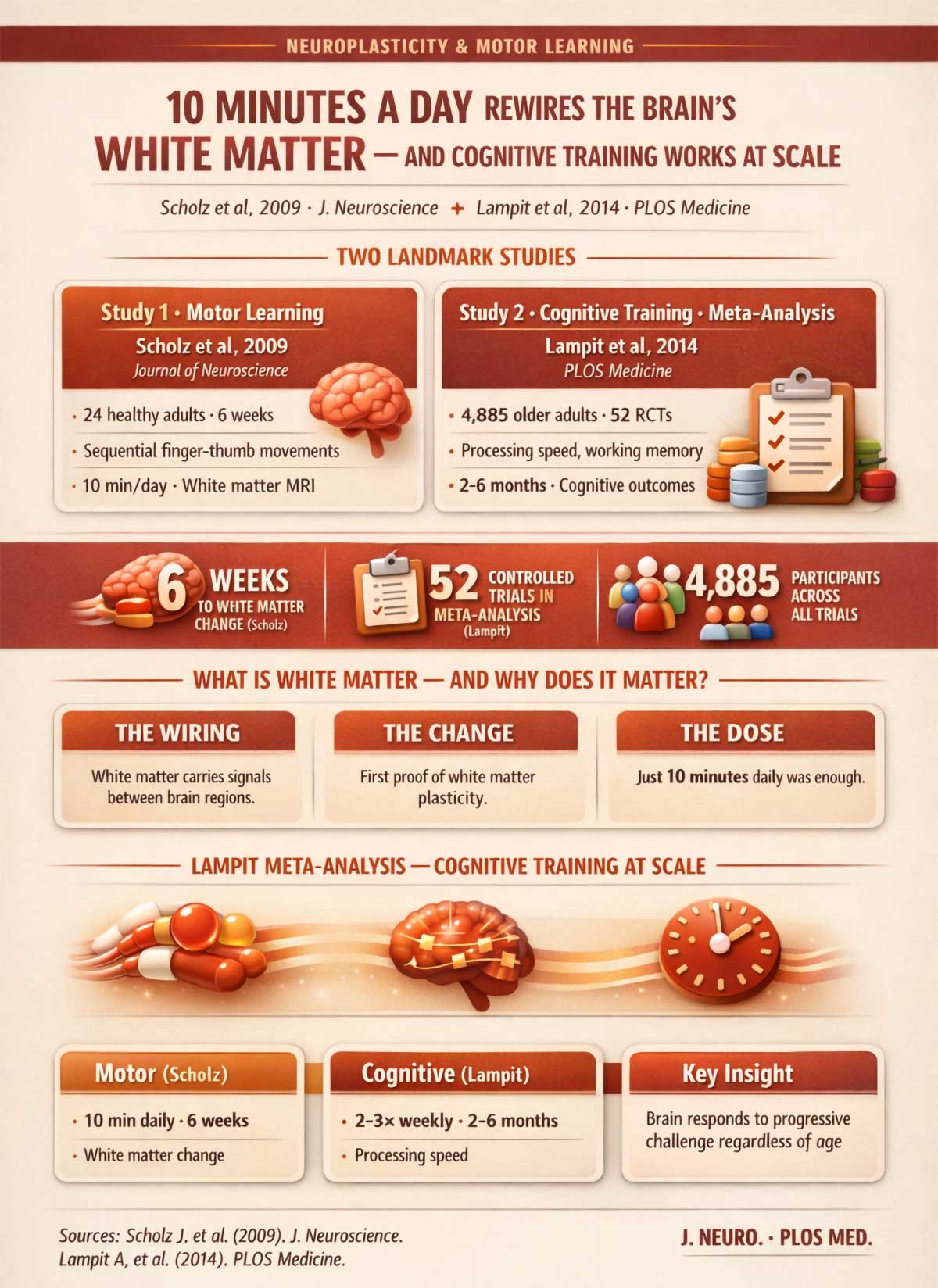
White matter is the brain’s wiring system. More myelin around those wires means faster, more efficient signal transmission. In other words, the brain didn’t just learn the movement — it rebuilt the road to carry it better.
This was a landmark finding. It was the first longitudinal evidence that structural white matter changes occur in healthy adult brains as a direct result of motor skill training.
The takeaway for everyday practice: short, consistent daily sessions beat occasional long workouts for rewiring motor circuits. Ten minutes a day is enough to start a structural shift.
A related 2013 study by Sampaio-Baptista and colleagues in the same journal confirmed these white matter effects using a visuo-motor tracking task over six weeks. Participants trained on a complex visual tracking exercise for around five hours per week. The team found that motor skill learning extended changes beyond grey matter — into the myelin organization of the pathways themselves.
Skill 2: Juggling — Visible Grey Matter Growth by Week 12
Here’s where things get striking enough to make headlines.
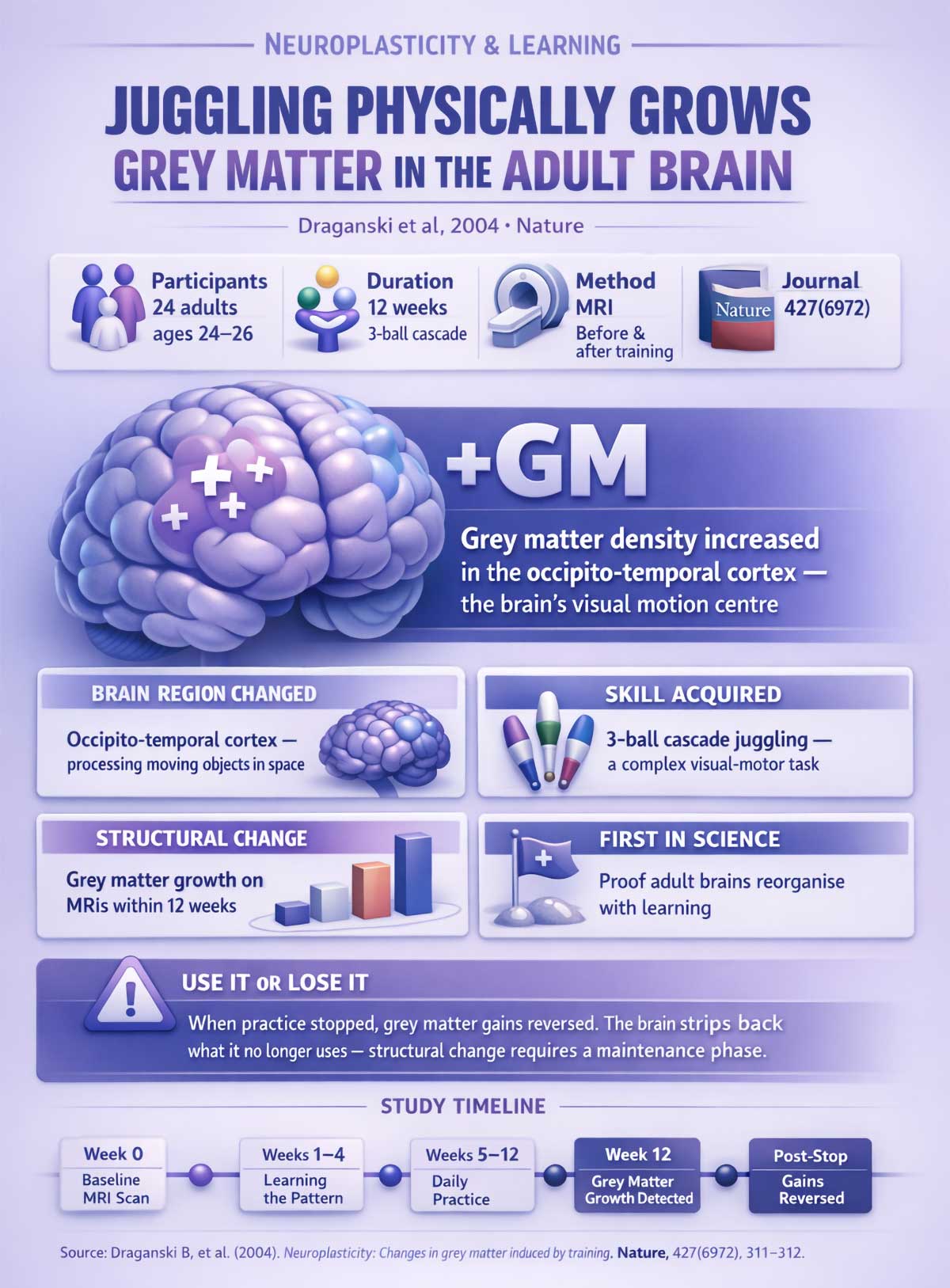
In 2004, Draganski and colleagues published a now-famous study in Nature with a simple but bold design: take 24 adults between ages 24 and 26, teach them to juggle a three-ball cascade pattern, scan their brains before and after, and see what changes.
After 12 weeks of practice, brain scans showed a significant increase in grey matter density in the occipito-temporal cortex — the region your brain uses to process visual motion. The jugglers’ brains had physically grown tissue in the area most needed for the task.
Then the researchers stopped the training.
The grey matter gains reversed.
That second finding is just as important as the first. Neuroplasticity runs in both directions. The brain builds what it uses and strips back what it doesn’t. This is the “use it or lose it” principle in its most literal form — visible on a brain scan.
The researchers called the period after skill acquisition a “maintenance phase.” It’s the period that most people skip. They learn something, feel competent, and reduce their practice. What this study suggests is that once you’ve built that structural change, you need to keep going — not to improve further, but to preserve the gains you’ve already made.
Skill 3: Learning a New Language — Hippocampus Growth in 12 Weeks
The hippocampus is best known for its role in memory. But it does something else that’s often overlooked: it grows in response to intense learning.
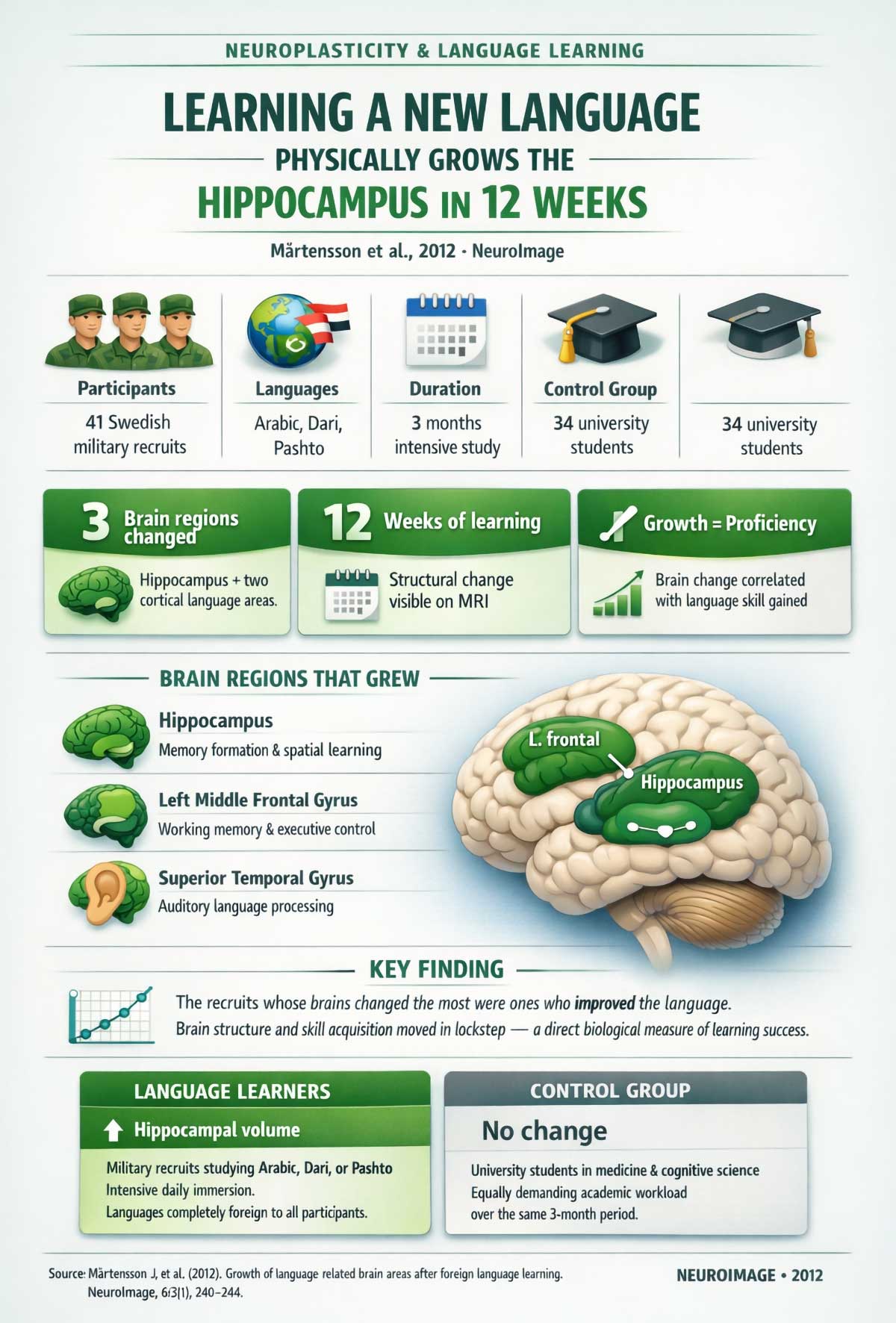
In 2012, Mårtensson and colleagues published a study in NeuroImage tracking 41 Swedish military recruits who were tasked with reaching operational proficiency in Arabic, Dari, or Pashto within three months. These were languages completely foreign to the recruits. The learning was intensive, daily, and demanding. A control group of similar age underwent equally demanding university-level study in medicine and cognitive science.
The recruits who learned the new language showed significantly greater structural brain growth than the control group. Their hippocampal volume increased. Cortical thickness grew in language-related regions, particularly the left middle frontal gyrus and areas of the superior temporal cortex.
Here’s what makes this finding especially meaningful: the degree of hippocampal growth correlated with how well each recruit learned the language. The recruits whose brains changed the most were the ones who improved the most. Brain structure and skill acquisition moved in lockstep.
Language learning appears to act as a full-body workout for the brain’s memory and executive function systems at the same time. It demands that you hold new vocabulary in working memory, apply grammatical rules you’ve never used before, and process sounds your auditory system wasn’t trained on. All of that cognitive demand seems to be exactly what drives structural growth.
Skill 4: 3D Video Games — Spatial Memory Rewired in 8 Weeks
If you needed scientific justification for gaming, this study might be it.
Kühn and colleagues published a 2013 study in Molecular Psychiatry in which young adults — average age around 23 — played Super Mario 64 for 30 minutes daily over two months. Brain scans before and after revealed increased grey matter density in two key areas: the hippocampus and the cerebellum.
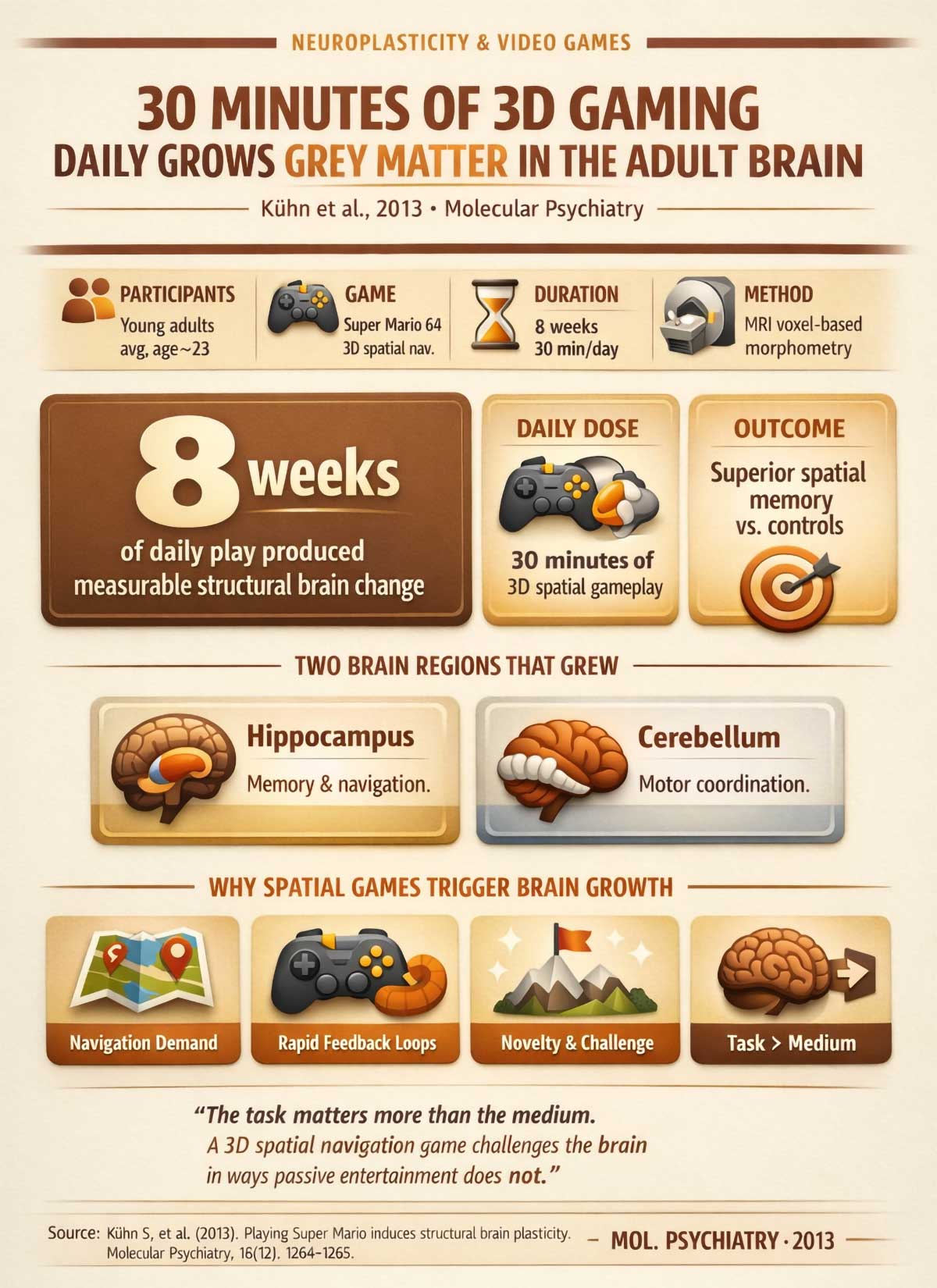
The hippocampus gain mirrors what we saw in language learners, but for a completely different reason. Navigation through 3D space appears to be one of the hippocampus’s core jobs. When you’re learning a complex virtual environment — judging distances, memorizing spatial layouts, adapting routes on the fly — your brain is running a similar process to memorizing a real city.
The cerebellum findings matter too. This region handles coordination and fine motor timing. Consistent video game play, with its rapid visual feedback and precise control demands, appears to challenge and reshape the cerebellum in ways that support motor coordination beyond the game itself.
The participants who played also showed superior performance on spatial memory tasks compared to controls. Structure and function improved together.
This has real implications for how we think about screen time and cognitive training. The task matters more than the medium. A 3D spatial navigation game challenges the brain in ways that passive entertainment does not.
Skill 5: Golf — Precision Leisure That Reshapes the Cortex in 10 Weeks
You don’t need a demanding training program to trigger neuroplasticity. You need the right kind of challenge.
In 2011, Bezzola and colleagues published a study in the Journal of Neuroscience following adults new to golf. Over approximately 10 weeks — and around 40 total hours of practice — participants received golf instruction and practiced the swing technique. None of them were athletes. They were ordinary adults taking up a new leisure activity.
Brain scans showed increased grey matter in the sensorimotor cortex — the region that plans and executes movement — as well as in the prefrontal cortex, which handles attention, planning, and decision-making. The growth correlated with how much each participant’s performance improved.
What this study adds to the picture is important. It shows that leisure activities can trigger the same type of structural changes as formal training — as long as the task is genuinely complex and demands precision. A golf swing requires the integration of posture, balance, grip pressure, rotational force, timing, and visual tracking. That multi-system demand is what triggers the plastic response.
Low-challenge repetitive tasks — like walking the same route every day — don’t appear to produce the same effect. The brain seems to reserve structural investment for tasks that genuinely stretch it.
Skill 6: Cognitive Training Programs — Building Mental Processing Speed Over 8 Weeks to 6 Months
Motor skills get most of the attention in plasticity research. But the brain’s processing speed and working memory respond to training too — at scale.
A major 2014 meta-analysis by Lampit and colleagues, published in PLOS Medicine, pulled together data from 52 randomized controlled trials covering nearly 5,000 older adults. The training programs in these trials targeted processing speed, working memory, attention, and multi-domain cognitive tasks. Duration ranged from two to six months.
The results showed small but statistically significant improvements in both memory and processing speed — not just on the tasks that were trained, but across untrained cognitive domains as well. The training effect transferred. The most effective protocol was supervised, center-based training done two to three times per week.
The broader implication here is that mental processing is trainable in the same way physical fitness is. You can apply progressive resistance. You can overload the system, recover, and come back stronger. The effect size was modest (g = 0.22 overall), but the consistency across 52 independent trials and thousands of participants is hard to dismiss.
For older adults especially, this research suggests that cognitive decline is not simply a fixed rate of loss. Training the brain’s processing systems can slow, offset, or partially reverse some of those losses.
Your Neuroplasticity Roadmap: 6 Skills at a Glance
| Skill | Duration | Brain Region Changed | What Improved |
|---|---|---|---|
| Finger-thumb sequences | 4–6 weeks | White matter in motor pathways | Faster, more accurate finger movements |
| 3D video games | 8 weeks | Hippocampus; cerebellum | Superior spatial memory performance |
| Golf swing | ~10 weeks (40 hours) | Sensorimotor cortex; prefrontal cortex | Improved swing accuracy |
| Juggling | 12 weeks | Grey matter in occipito-temporal cortex | Sustained 3-ball cascade |
| Foreign language learning | 12 weeks | Hippocampus; frontal and temporal cortex | Operational language proficiency |
| Cognitive training programs | 8 weeks–6 months | Cognitive processing networks (broad) | Faster processing speed; better working memory |
How to Run Your Own 12-Week Brain Training Cycle
The research above isn’t just interesting — it’s actionable. Here’s what the data consistently suggests about how to get results.
The task needs to be hard enough to matter. Every study that produced structural changes involved tasks that genuinely stretched participants. The brain doesn’t invest in building new infrastructure for tasks it already handles easily. Find the edge of your ability — the place where it’s difficult but still doable — and stay there.
Daily short sessions beat occasional long ones. Across the motor learning studies, consistent daily practice of 10 to 20 minutes produced structural changes that hour-long weekly sessions likely wouldn’t match. The brain consolidates learning incrementally. Short, regular exposures give it the signal it needs to keep building.
Sleep is where much of the rewiring happens. Sleep consolidation research — built on decades of work from neuroscientists studying memory and motor learning — shows that during REM sleep, the brain replays and consolidates learned skills. This is a measurable process, not just a metaphor. Cutting sleep short during a learning period doesn’t just make you tired. It appears to actively interfere with the structural changes you’re trying to build.
Plan for a maintenance phase. The juggling study made this non-negotiable. Once you’ve built something, sustaining it requires continued practice. You don’t have to maintain the intensity of the learning phase, but you can’t stop entirely and expect to keep the gains.
Don’t wait for the perfect skill. The six skills above span motor learning, spatial navigation, language, leisure, and mental processing. The consistent finding across all of them is that the brain responds to novelty and challenge — regardless of category. Pick something you’re genuinely curious about. The mechanism is the same.
Conclusion
The old view of the adult brain was essentially that it’s a storage device — full of fixed circuits, slowly degrading with time. The research collected here tells a completely different story.
Your brain can be structurally different after 12 weeks of focused learning on the right task. White matter thickens. Grey matter density increases. The hippocampus grows. Cortical thickness shifts. These aren’t abstract improvements in “cognitive reserve” — they’re physical changes visible on a scan.
The brain you’ll have at the end of a 12-week skill-building period is not the same brain you started with. That’s not a figure of speech. That’s what the MRI data shows.
What you choose to learn doesn’t seem to matter as much as the fact that you’re learning something that genuinely challenges you. Language, golf, juggling, spatial navigation, finger exercises, cognitive training programs — they all produced measurable structural outcomes in healthy adult brains.
The question isn’t whether your brain can still change. The research is clear on that. The question is what you’re going to do with the next 12 weeks.