Chasing better experiences won’t make you happier. A Harvard study tracked 2,250 people in real time and found something most of us get completely backwards.
Most people assume the fix for feeling flat is to do something better. Book a trip. Find a new hobby. Upgrade something. The logic seems obvious: more good experiences should equal more happiness. But there’s a problem with that logic, and it’s sitting in a 2010 study published in Science that most people have never read.
Researchers Matthew Killingsworth and Daniel Gilbert tracked 2,250 adults in real time using a smartphone app. They pinged participants throughout the day, recording what people were doing, what they were thinking about, and how happy they felt. What they found was interesting to say the least.
People spent roughly 47% of their waking hours thinking about something other than what they were actually doing. And mind-wandering, no matter what activity the person was engaged in, reliably predicted lower happiness. Not just somewhat lower. It was a stronger predictor of unhappiness than the activity itself.
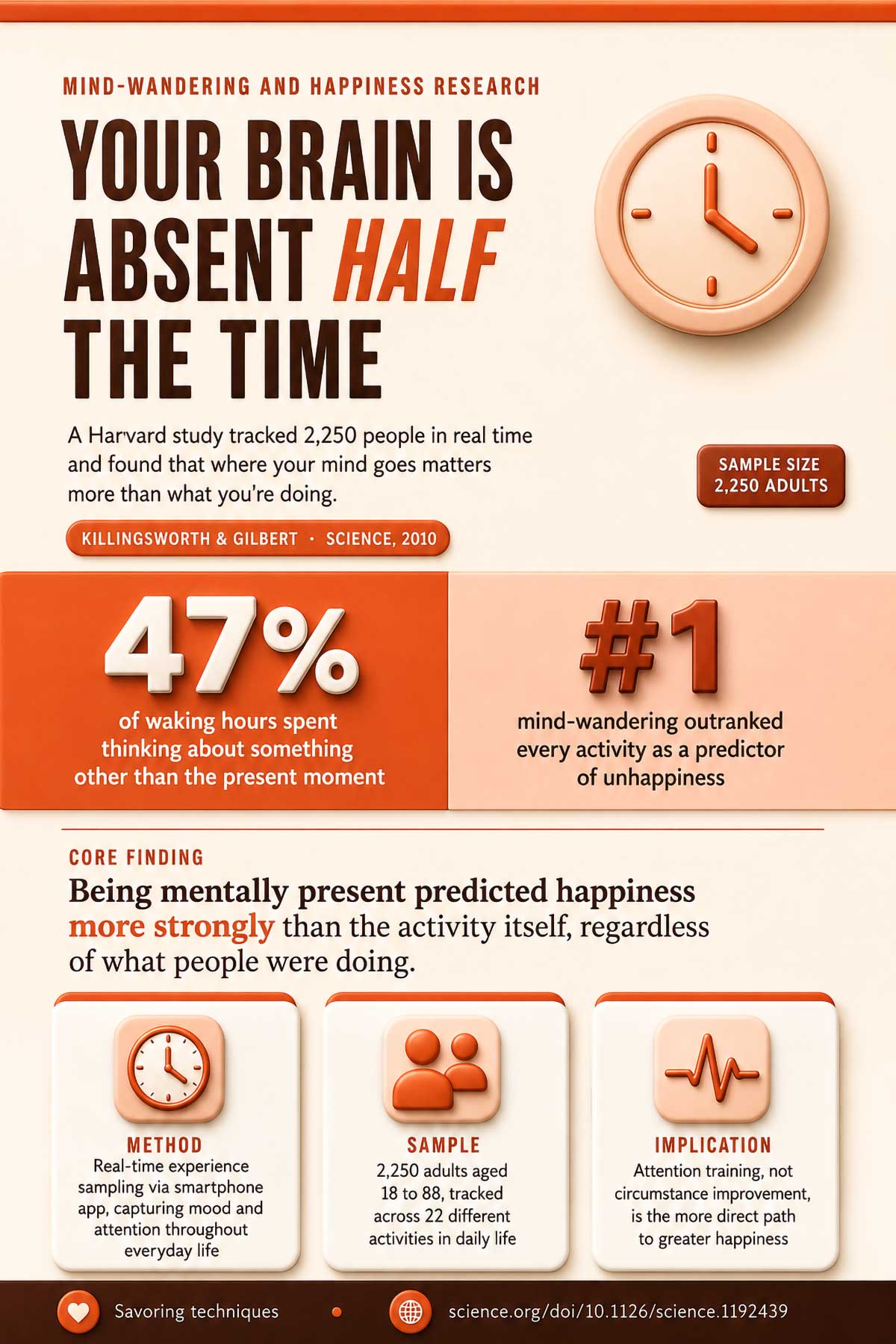
That’s worth noting. You could be doing something you genuinely enjoy, and if your mind is elsewhere, you’ll feel worse than someone doing something completely neutral with their full attention on it. The problem isn’t the quality of your life. It’s where your attention goes while you’re living it.
Why Happiness Gets Misdefined
The cultural script for happiness is almost entirely about acquisition: more experiences, more pleasure, more stimulation. Arthur C. Brooks, a social scientist and author of From Strength to Strength, argues that this script is missing two-thirds of the equation.
His framework identifies three components of genuine happiness: enjoyment (conscious, social pleasure, not passive consumption), satisfaction (the feeling earned through effort and striving), and meaning (a sense of purpose that extends beyond yourself). Pleasure without the other two is hollow, and chasing it tends to produce exactly the dissatisfaction it was supposed to cure.
This reframe matters because it shifts the question. If happiness were purely about pleasure, you’d always need more of it, and you’d always be falling short. If it’s about enjoyment, satisfaction, and meaning, then it becomes something you can actually practice.
What Savoring Actually Is
Psychologists Fred Bryant and Joseph Veroff spent decades studying what they called savoring: the deliberate, conscious act of noticing and appreciating a positive experience while it’s happening. Their 2007 book, Savoring: A New Model of Positive Experience, laid out a framework of specific strategies: sensory sharpening, memory-building, sharing with others, self-congratulation, temporal awareness, and counting blessings.
These aren’t vague mindfulness platitudes. They’re attention-direction techniques. Each one works by pulling the mind back from its default drift and anchoring it to what’s actually good right now.
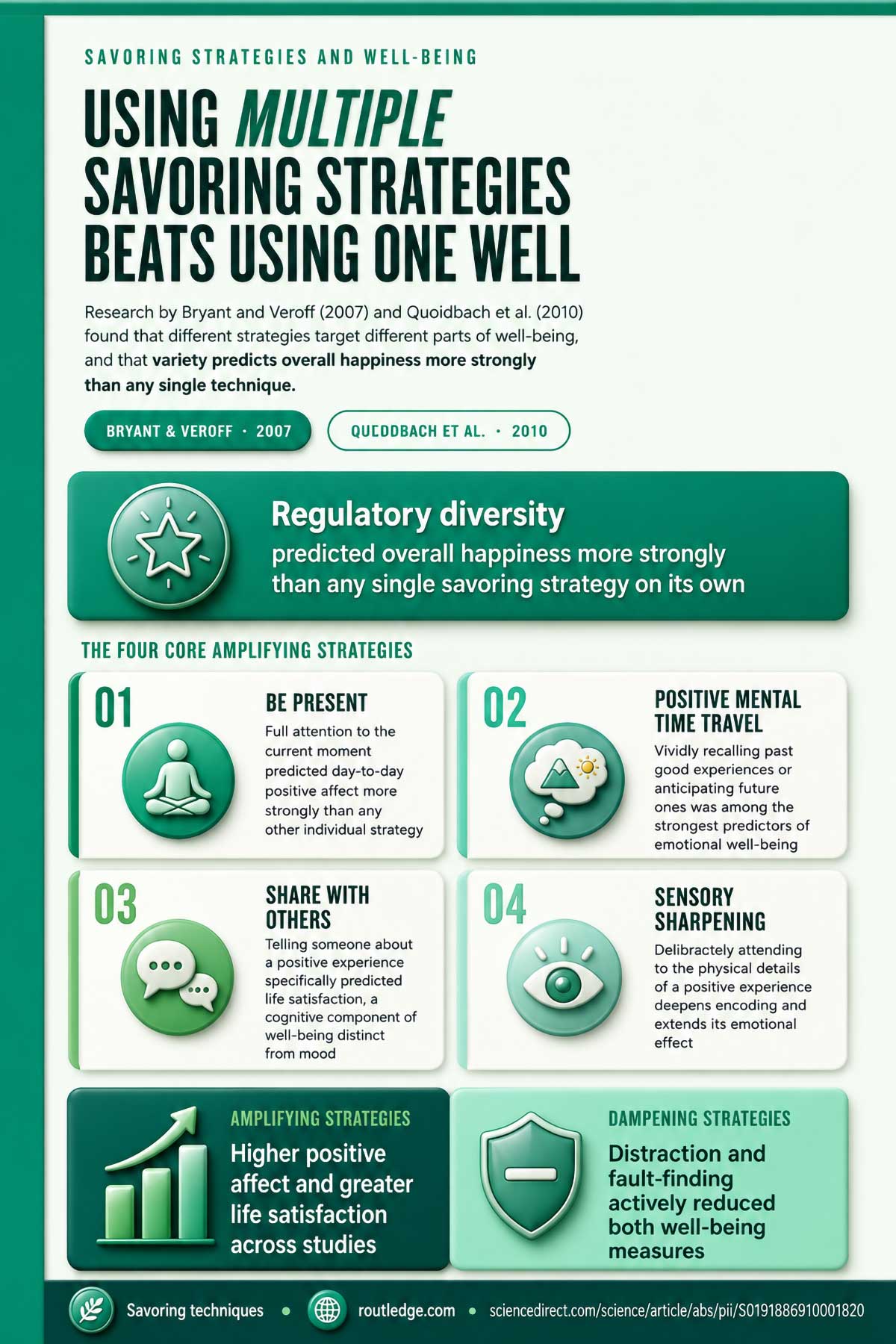
Research by Quoidbach and colleagues (2010), published in Personality and Individual Differences, tested eight savoring and dampening strategies and found they target different parts of well-being. Being fully present in the moment and positive mental time travel, meaning vividly recalling past good experiences or anticipating future ones, were the strongest predictors of day-to-day positive affect.
Sharing with others predicted life satisfaction specifically. Dampening strategies, including distraction and fault-finding, pushed both measures down. The paper’s most striking result was that using a range of strategies, rather than relying heavily on one, predicted overall happiness more strongly than any single technique on its own.
The 4 Techniques That Actually Work
1. Sensory sharpening. This is the most accessible entry point. It means deliberately slowing attention down to the physical details of an experience: the specific warmth of a cup, the exact color of light in a room, the particular texture of a sound. The goal isn’t to perform mindfulness. It’s to give the brain something precise to encode. Vague positive experiences don’t stick. Specific ones do.
2. Sharing. Telling someone else about a good thing that happened, or experiencing something pleasant alongside another person, amplifies the positive effect. This isn’t just social bonding. The act of articulating what’s good forces the brain to attend to it more carefully. In Bryant and Veroff’s research, sharing with others was one of the most reliably effective savoring strategies across populations.
3. Memory-building. Taking a mental photograph, or an actual one, with the specific intention of remembering the moment, deepens encoding. The key is conscious intention. Snapping a photo while distracted doesn’t do it. Pausing to say to yourself, “I want to remember this,” does.
4. Temporal awareness. Knowing that something is temporary doesn’t have to diminish it. Bryant and Veroff found that deliberately acknowledging the transience of a good moment can sharpen attention and intensify appreciation. The nuance is how you hold that thought. Jose et al.’s (2012) data showed that passive, anxious reminders of impermanence, the kind that turn into “this will be over soon,” loaded onto dampening factors in their analysis. Accepting acknowledgment works differently. Saying to yourself, “this won’t last, so I want to be here for it,” pulls focus inward rather than forward into dread.
A daily diary study by Jose, Lim, and Bryant (2012), tracking 101 adults over 30 consecutive days, found that using amplifying strategies like these on a day-to-day basis predicted higher happiness and lower depressive symptoms. Dampening strategies predicted the opposite. The relationship held across days, not just as a trait difference between people.
The Counterintuitive Case for Giving
One of the more surprising findings in happiness research concerns spending. Most people, when they get money, direct it toward themselves. That’s what consumption culture encourages. But a study by Dunn, Aknin, and Norton (2008), published in Science, found that spending money on yourself showed no consistent positive link to happiness and trended mildly negative.
Prosocial spending, meaning money given to others or donated to charity, reliably predicted happiness, and the effect held even after controlling for income. People with very little who gave some of it away were happier for it.
This fits the broader framework. Giving requires attention to someone else’s experience. It generates meaning and connection. It pulls attention outward from the relentless internal monologue about what you don’t yet have.
When Life Doesn’t Give You Much to Work With
The objection that comes up here is a reasonable one. Savoring sounds manageable when life is basically going well. But what about when it isn’t? When there are very few genuinely good moments to work with, does any of this still hold?
Two studies by Hurley and Kwon (2012 and 2013) in the Journal of Happiness Studies addressed this directly. The first study found that a two-week savoring intervention improved positive outcomes and reduced negative ones across participants. The second found something more striking: savoring was most protective precisely for people who had the fewest positive daily events available.
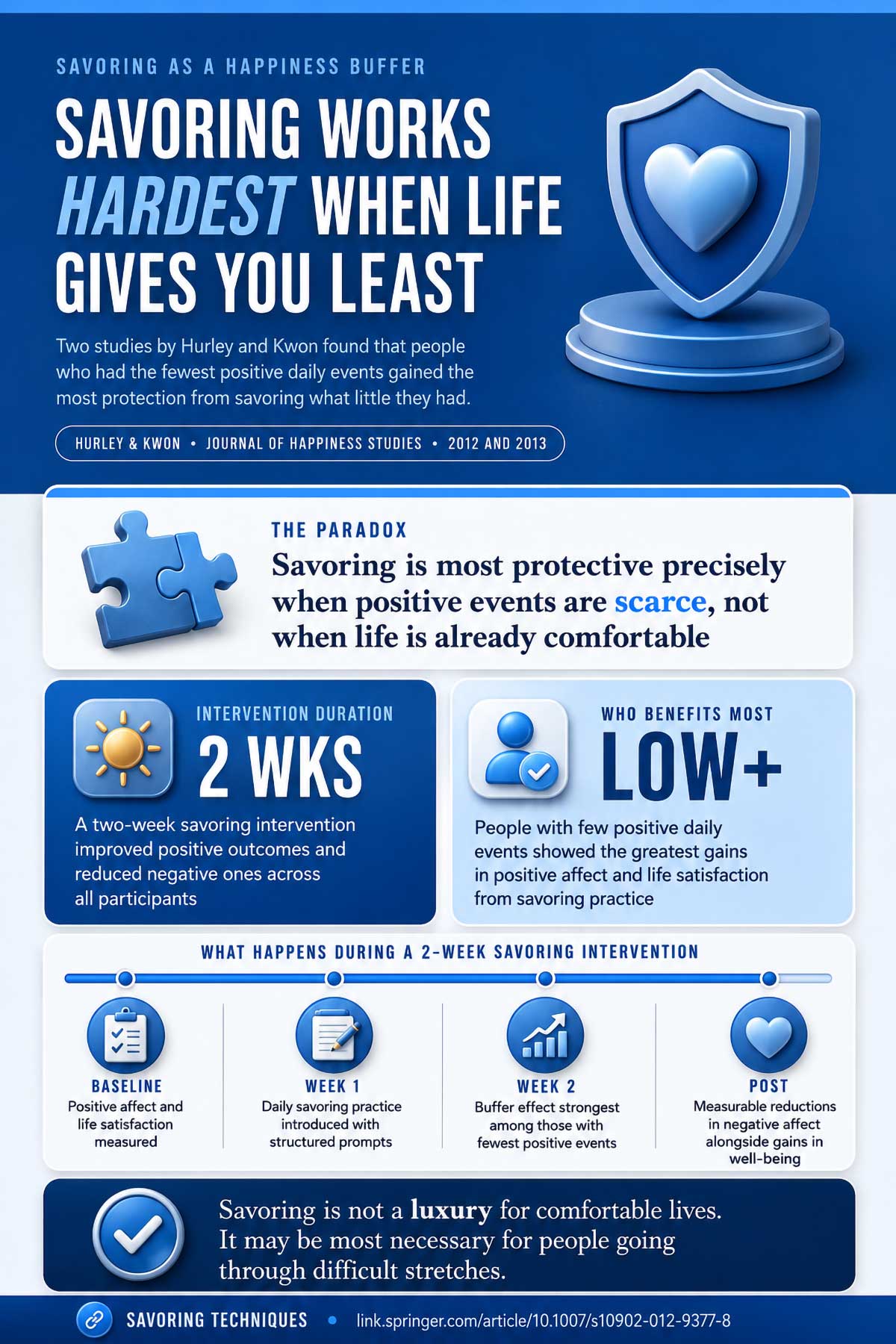
Among people whose daily lives offered little that was obviously pleasant, the ability to savor what was there acted as a buffer against low positive affect and low life satisfaction. The skill mattered most when there was the least to work with.
That reframes savoring entirely. It’s not a luxury practice for people whose lives are already comfortable. It may be most necessary and most effective for people going through hard stretches.
Whether This Can Actually Change You Long-Term
A reasonable question is whether any of this produces lasting change or just temporary mood lifts. Neuroscience suggests structural change is possible. A review by Davidson and McEwen (2012) in Nature Neuroscience found that contemplative practices, including mindfulness training, reshape neural circuits governing emotional regulation across the lifespan. Brain plasticity doesn’t stop in adulthood. Deliberate attention training, done consistently, alters the hardware, not just the mood.
That mechanism shows up in behavioral data too. A study following 235 adults through an eight-week mindfulness program found that people whose state mindfulness increased most steeply during the program showed the greatest gains in trait mindfulness and the greatest reductions in psychological distress by the end. Present-moment attention isn’t fixed. It’s trainable, and the more steeply you build it, the more it becomes part of how you habitually orient to experience.
A landmark randomized controlled trial by Seligman and colleagues (2005), published in American Psychologist, tested several positive psychology interventions in a six-group RCT. One of the most durable was the “Three Good Things” exercise: writing down three positive events each day for a week.
Participants who kept practicing beyond that initial week showed increases in happiness and decreases in depressive symptoms that persisted through the six-month follow-up. The habit, once established, appears to compound over time rather than fade.
The Shift That Makes It Work
None of these techniques are complicated. What’s complicated is accepting that the problem was never the quality of your experiences. The wandering mind was producing unhappiness not because life was objectively bad, but because attention was chronically elsewhere. Training that attention doesn’t require buying anything, going anywhere, or waiting for better circumstances to arrive.
The research is consistent on this: what you do with your attention matters more than what you’re attending to. That’s an uncomfortable finding for a culture built on the promise that the next thing will finally be enough. But it’s also, quietly, the most hopeful finding in the data.