Your body’s stress response can spiral in minutes, but science shows you can interrupt it just as quickly. Several techniques begin calming your nervous system in just a couple of minutes.
Most people try to think their way out of stress. They analyze the problem, make mental lists, and remind themselves it’ll pass. The research is clear that none of that works during the acute phase, because the part of the brain that handles rational thinking has partially gone offline.
Your body isn’t waiting for a good idea. It’s already committed to a physiological response: elevated heart rate, rising blood pressure, stress hormones entering your bloodstream. Thinking harder into that state doesn’t change the chemistry. The right techniques for stress management bypass cognition entirely and speak directly to your nervous system.
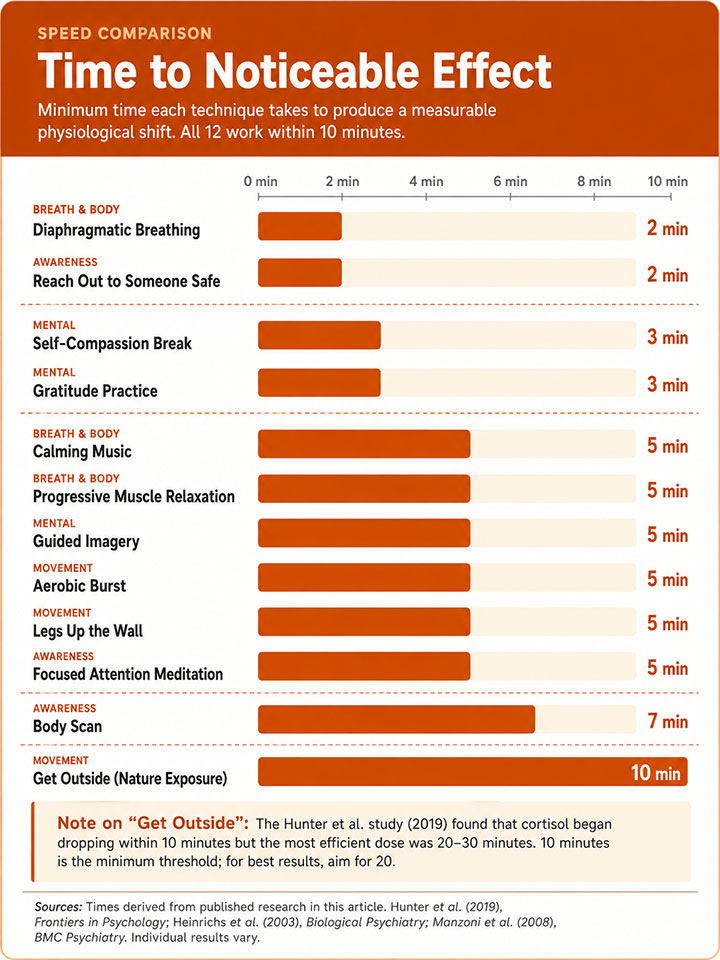
The 12 methods in this article do exactly that. Each one activates your parasympathetic nervous system (your body’s recovery mode) using inputs it’s designed to recognize: specific breathing patterns, muscle release, movement, sensory contact with the environment, and directed attention. Several work in under two minutes. All of them work in under ten.
What Happens in Your Body During Stress
When a threat appears (real or perceived), your hypothalamic-pituitary-adrenal (HPA) axis activates. Your hypothalamus signals your pituitary gland, which tells your adrenal glands to release cortisol and adrenaline. Heart rate jumps. Blood pressure rises. Blood shifts away from digestion and toward your muscles. Your pupils widen. The whole sequence takes about 90 seconds.
Your brain’s threat-detection center, the amygdala, drives this response. Your prefrontal cortex (the part responsible for judgment, planning, and perspective) gets suppressed when the amygdala is firing hard. This is why stressed people make worse decisions and why telling yourself to calm down rarely works: the system that processes that instruction has been partially taken offline by the one generating the alarm.
The good news is the system has a physical off switch. The vagus nerve runs from your brainstem through your body, connecting to your heart, lungs, and gut. Stimulate it and your parasympathetic system takes over: heart rate drops, breathing slows, digestion restarts. Every technique in this article works through that nerve or through related pathways, and your body responds to those inputs whether or not your mind has caught up.

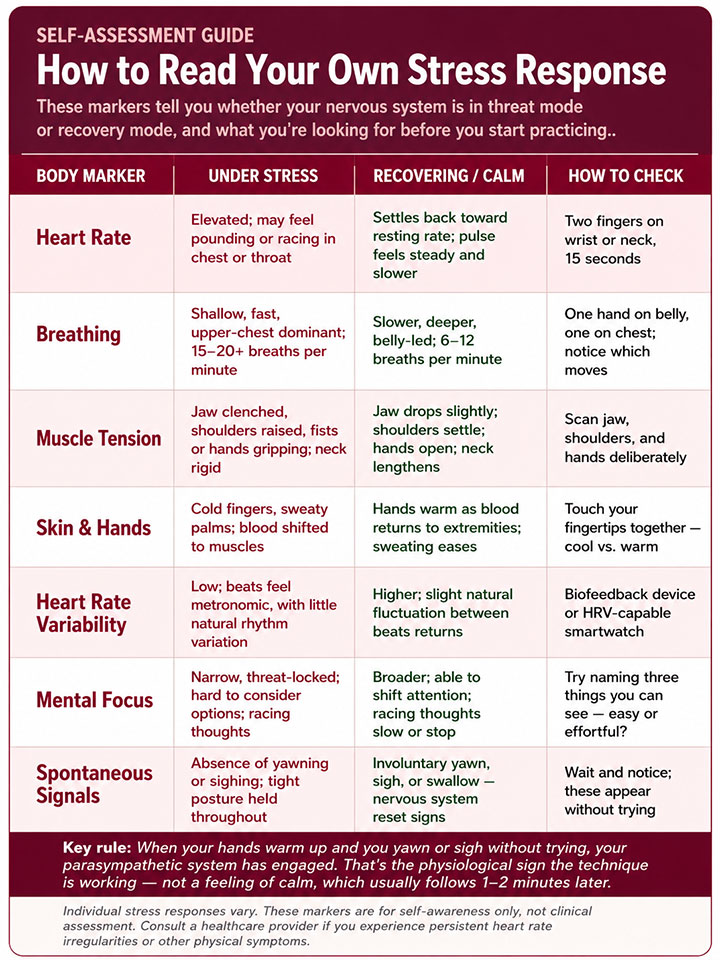
The table below shows how your body’s markers shift between stressed and relaxed states. It’s worth knowing what you’re looking for before you start practicing.
Stress Situation Matcher
Answer 3 quick questions to find your best technique right now.
I. Breath and Body Techniques
1. Diaphragmatic Breathing: The Fastest Route to Your Nervous System
Breathing is the one autonomic function you can control voluntarily, which makes it the most direct access point to your nervous system available to you. When you slow your breath to six cycles per minute (slower than the typical 12 to 15), you directly increase heart rate variability, which is the clearest measure of parasympathetic activation.
The mechanism doesn’t depend on belief or focused effort. Slow breathing at six cycles per minute directly stimulates the vagus nerve through a pressure-receptor pathway in the lungs, and the parasympathetic shift follows whether or not your mind has settled. The heart rate change typically appears within two to three minutes. It works even when you don’t believe it will.
What most people don’t know is that the exhale matters more than the inhale. An extended exhale (twice as long as the inhale) is more effective at vagal stimulation than an equal-ratio breath. The 4-7-8 pattern (inhale for 4 counts, hold for 7, exhale for 8) puts this principle to work. Box breathing (4 counts in, 4 hold, 4 out, 4 hold) is easier to recall in the middle of a stressful situation and still shifts your nervous system toward recovery.
To practice:
- Sit or lie down. Loosen anything tight around your waist.
- Place one hand on your chest and one on your belly.
- Inhale slowly through your nose for 4 counts. Your belly hand should rise. Your chest hand should barely move.
- Hold gently for 7 counts. Don’t strain.
- Exhale completely through pursed lips for 8 counts. Feel your belly fall.
- Pause for 1 to 2 counts before the next inhale.
- Repeat 5 to 10 cycles.
Signs it’s working: your heart rate slows (you can feel your pulse settle), your hands warm as circulation returns to your extremities, your shoulders drop, and you yawn or sigh involuntarily. That sigh is a nervous system reset signal. If you feel dizzy at any point, return to your normal breathing pattern. You don’t need to push the breath hold.
The at-work version is exactly the same, done at your desk with eyes open. The ratio matters more than the hand placement or closed eyes. For those with COPD or other respiratory conditions, slow breathing is still beneficial, but the holds and ratios should be adapted with a doctor’s guidance.
2. Progressive Muscle Relaxation: Breaking the Physical Feedback Loop
Stress creates muscle tension. And muscle tension feeds stress signals back to the brain, keeping the alarm running. Progressive muscle relaxation (PMR) interrupts this loop directly: by deliberately tensing and releasing muscle groups in sequence, you teach your nervous system to recognize the difference between a contracted muscle and a released one, a distinction many chronically stressed people have lost track of.
A 2008 meta-analysis in BMC Psychiatry reviewed 27 studies on relaxation training, including PMR, and found a medium-to-large effect on anxiety with benefits lasting several hours after practice. The mechanism is straightforward: when your muscles send “safe” signals to your brain, your amygdala has less evidence that you’re in danger.
- Sit or lie in a comfortable position.
- Start with your feet. Curl your toes tight for 5 seconds.
- Release completely. Notice the difference for 10 seconds.
- Work up through calves, thighs, glutes, abdomen, fists, arms, shoulders, and face.
- Tense each group at about 70 percent effort: firm, not painful.
- At the end, tense your whole body at once for 5 seconds, then release.
People who rush through this miss the point. The release phase is where the technique works, not the tension phase. Spend at least 10 seconds noticing each area after letting go. Many people discover tension in their jaw, the base of their skull, or the backs of their hands that they had no idea they were carrying.
The desk-friendly version covers just hands, arms, shoulders, neck, and jaw, a 3-minute sequence that’s invisible to anyone nearby and addresses exactly where office workers accumulate the most daily tension.
3. Calming Music: Using Sound to Pace Your Heart Rate
Music at 60 to 80 beats per minute (slower than a resting heart rate) tends to pace your cardiovascular system downward. The mechanism is called entrainment: your heart rate, breathing, and even brainwave activity synchronize with external rhythmic stimuli. Listening before a stressor (not just during it) reduces the cortisol response more reliably than using music as an after-the-fact remedy.
Put on headphones, lower your gaze, take three deliberate breaths, and focus on one instrument or layer of sound. If your mind drifts to whatever is stressing you, redirect attention back to the music. Five minutes is enough for most people to notice something.
What to play: Debussy’s Clair de Lune, Bach’s Air on the G String, Brian Eno’s ambient catalog, Max Richter’s Sleep recordings, or rain and ocean sounds all work. The genre matters less than the tempo. Most people notice their breathing slow down within 90 seconds, not because they’re trying to breathe differently, but because the body is already tracking the music’s rhythm. That’s the entrainment effect doing its job.
II. Mental and Emotional Techniques
The body techniques above target your nervous system through physical inputs. The approaches below work from the other direction, changing the mental signals being sent to the body’s alarm system.
4. Quick Gratitude Practice: Redirecting Your Brain’s Threat Scanner
Your brain operates on a negativity bias: it scans for threats more persistently than it registers positive experiences. This was adaptive for survival. In modern life, it keeps your threat system activated by email, news, interpersonal friction, and anticipated problems. Gratitude practice doesn’t eliminate the stressors: it temporarily redirects where your attention is pointing.
The psychological research on gratitude is unusually consistent. Adults who practice specificity-focused gratitude (naming concrete things rather than abstract blessings) show measurable reductions in perceived stress, with the effect appearing within two weeks of daily practice.
Brain imaging work has found the mechanism: less amygdala activity, more prefrontal engagement (the same neural shift the breathing and movement techniques produce, reached by a different route). Three minutes with a phone note produces changes that appear in brain scans. That’s worth sitting with for a second.
To practice:
- Get paper or open your phone’s notes. Set a timer for 3 minutes.
- Write down three specific things you’re grateful for right now.
- For each one, add why it matters and how it makes you feel.
- Read back through what you wrote, then take one slow breath.
Specificity is what separates this from a platitude exercise. “My family” produces little effect. “The way my daughter laughed at something this morning” produces more. The specificity forces genuine attention, which is what redirects the brain’s scanner.
5. Guided Imagery: A Mental Break That Your Body Treats as Real
The brain does not cleanly distinguish between a vivid imagined scenario and a real one. This is well-documented in neuroimaging work and is the same mechanism behind performance visualization in athletes.
When you imagine a genuinely safe place in enough sensory detail, your amygdala responds to the imagined safety as if it were real: heart rate drops, muscle tension releases, cortisol follows. The technique asks your nervous system to be deceived in a useful direction.
- Sit or lie comfortably. Close your eyes and take three slow breaths.
- Picture a place where you feel completely safe. Build the scene slowly: colors, quality of light, what’s in the distance.
- Add sounds. What do you hear: wind, water, birds, silence?
- Add sensation. What do you feel on your skin? Temperature? A surface beneath you?
- Add smell if you can access it.
- Stay in this place for several minutes, returning your attention to the details when your mind wanders.
- When ready, take three breaths and slowly open your eyes.
If you draw a blank on a place to visualize, use one of these: a warm beach with gentle waves, a forest with dappled light and a soft path underfoot, a mountain cabin with a fire and snow outside the window. The technique doesn’t require a real memory: an imagined place works equally well. The key is enough sensory detail that your brain briefly accepts it as real. Don’t push too hard if the image is hazy. A somewhat vague peaceful scene still produces the physiological shift.
One honest caveat: guided imagery is the most variable technique in this article. It works extremely well for some people and produces almost nothing in others. Difficulty generating vivid mental imagery is more common than most people realize. If the scene stays stubbornly abstract no matter how long you try, that’s not a failure of effort. Switch to music or nature exposure and return to this one later.
6. Self-Compassion Break: Soothing the Stress That Comes From Self-Criticism
When things go wrong, most people respond with self-criticism, which layers additional stress onto whatever was already happening. Kristin Neff at the University of Texas, whose lab has spent years studying self-compassion, finds that self-compassionate responses during difficult tasks produce measurably lower cortisol than self-critical ones.
The physical touch aspect is stranger: a hand on your own heart or arms wrapped around your body releases oxytocin, which directly suppresses HPA axis activity. You can trigger your own stress-buffering neuropeptide through self-touch. That’s a genuinely odd thing to be true.
- Sit comfortably and close your eyes. Place your hand over your heart.
- Acknowledge what you’re feeling: “This is really hard right now.”
- Recognize common humanity: “Other people feel this way. This is part of being human.”
- Offer yourself kindness: “May I give myself what I need. May I accept this moment as it is.”
- Keep your hand on your chest and breathe slowly for another minute.
This technique can feel awkward the first time. Most people weren’t taught to respond to their own distress this way. If the words feel forced, write what you’d say to a close friend who was struggling with exactly what you’re going through, then say it to yourself. That shift in perspective usually bypasses the resistance.
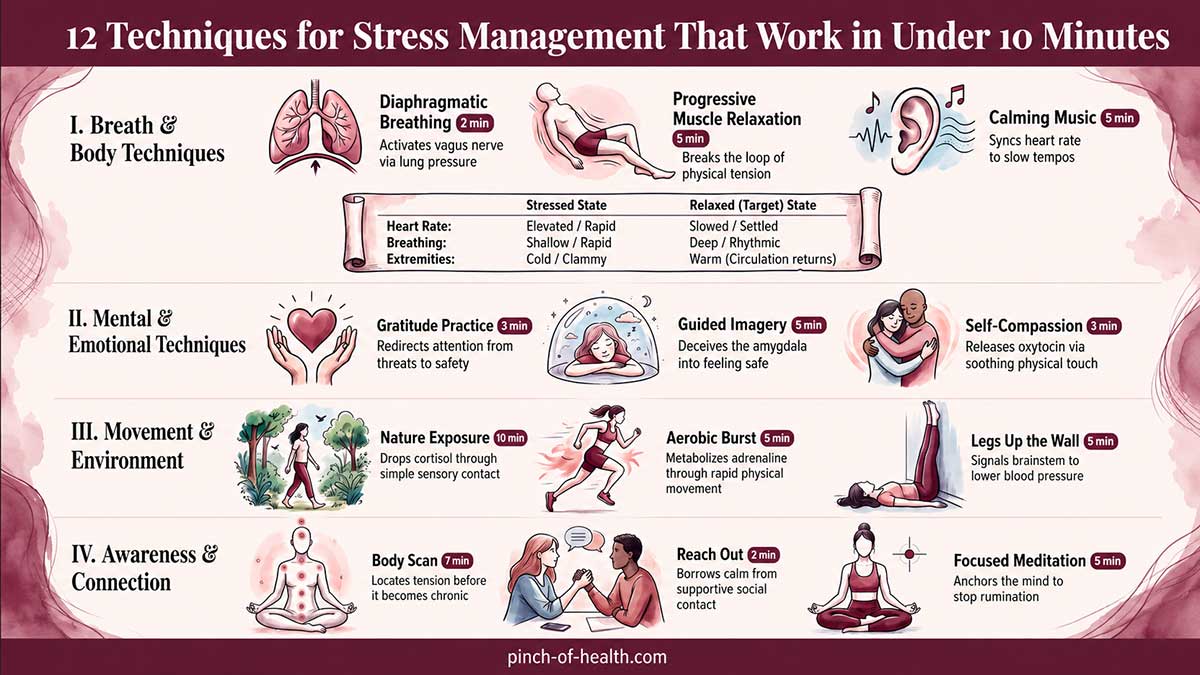
III. Movement and Environment Techniques
When stress has a physical signature (restlessness, a need to move, a body that feels coiled), changing the environment or the body’s activity level often works faster than mental approaches.
7. Get Outside: The Dose of Nature That Actually Moves the Numbers
A 2019 study by researchers at the University of Michigan, published in Frontiers in Psychology, gave the most precise dose guidance on nature exposure to date. The researchers tracked 36 urban adults over eight weeks, measuring salivary cortisol before and after time spent in natural outdoor settings.
A 20-minute nature experience produced a measurable cortisol drop. The most efficient dose (where cortisol fell at the greatest rate per unit of time) was 20 to 30 minutes. After 30 minutes, benefits continued to accumulate but more slowly.
That implication is stranger than it sounds: you don’t need a park, a forest, or a long walk. A 20-minute sit in a backyard or on a tree-lined street works. The key is staying off your phone. The cortisol reduction in the study required only that participants feel a sense of contact with nature. It didn’t specify wilderness or significant green space.
To practice:
- Step outside. Leave your phone in your pocket or inside.
- Stand or sit where you can see sky, trees, plants, or water.
- Look. Listen for natural sounds. Take slow breaths of outdoor air.
- If possible, touch something: tree bark, grass, soil.
- Stay for at least 10 to 20 minutes.
If you genuinely can’t get outside, nature images and recordings provide partial benefit, measurably less than direct exposure, but real against a blank-wall or silence baseline. A window with a view of trees reduces physiological stress markers compared to a window facing a blank wall. This has been replicated enough to take seriously. Do what’s actually available. Don’t skip the technique because the ideal version isn’t accessible.
8. Quick Aerobic Burst: Burn Off What Your Body Primed For Action
The stress response primes your body to move: to fight or flee. When you don’t, the cortisol and adrenaline your body released stay in your system. A short burst of aerobic movement gives the body the movement it chemically prepared for, and the hormones get metabolized rather than just circulating.
The sport science community treats this as settled: single aerobic sessions reliably reduce stress reactivity and improve mood, with effects beginning during exercise and lasting 2 to 4 hours. This is not a subtle finding: the effect sizes are large enough to appear consistently across different populations, fitness levels, and exercise types.
- Clear a small space. Set a timer for 5 minutes.
- Choose a movement: jumping jacks, running in place with high knees, stair climbing, or fast walking.
- Move at a pace where you’re breathing hard but could say a short sentence.
- If you need to slow down briefly, do it, then speed back up.
- When the timer goes off, walk slowly for 1 to 2 minutes.
Restless energy after a stressful event is a sign your body is looking for a movement outlet. This technique works particularly well before a high-stakes situation (to burn off adrenaline) and at mid-afternoon when stress hormone levels tend to peak. Avoid it in the two hours before bed. Aerobic exercise this close to sleep can delay melatonin release in some people.
9. Legs Up the Wall: Using Gravity to Signal Safety
This restorative yoga posture works because of what it communicates to your nervous system. With your legs elevated and your body horizontal, your baroreceptors (pressure sensors in your aorta and carotid arteries) detect increased blood pressure in your upper body as venous blood returns from the legs.
They respond by signaling your brainstem to lower heart rate and blood pressure. You cannot be running or bracing for impact in this position, and your body knows it. Studies on restorative yoga report consistent reductions in cortisol and improved heart rate variability after 10-minute sessions.
Elevated-leg postures outperform other positions in this research, which makes sense given how directly they engage the baroreceptor pathway. That’s an unusual amount of physiological return from simply lying on your floor.
- Sit sideways next to a wall, your hip touching it.
- In one smooth motion, swing your legs up the wall as you lower your back to the floor.
- Scoot your hips close to the wall. Some gap is fine if hamstrings are tight.
- Let your arms rest by your sides, palms up. Close your eyes.
- Breathe naturally. Stay for 5 to 10 minutes.
- To come out, bend your knees and roll to one side. Pause before sitting up.
If straight legs are uncomfortable, place a folded blanket under your hips or move your hips further from the wall. Coming out too quickly can cause brief lightheadedness. The slow roll exit matters. Skip this posture if you have glaucoma, serious back problems, or have been advised against inversions.
IV. Awareness and Connection Techniques
The final four techniques work through attention: redirecting where the mind is pointing, or accessing the calming effect of other people’s nervous systems.
10. Body Scan: Locating Tension Before It Compounds
Chronic stress teaches the body to hold tension without registering it consciously. A body scan reverses this: by moving your attention slowly through your body, you notice areas of tightness or holding that the nervous system is maintaining below your awareness.
The body scan is a core component of MBSR (Mindfulness-Based Stress Reduction), the most extensively researched stress protocol in clinical psychology. Three weeks of practice produces measurable reductions in physiological stress markers and something harder to quantify: people consistently report becoming better at catching stress early, before it escalates. That earlier-warning function turns out to be the more useful long-term benefit.
- Sit or lie down. Close your eyes and take three slow breaths.
- Bring your attention to your feet. Notice any sensation: tingling, warmth, pressure, or nothing.
- Don’t try to change what you find. Just notice it.
- Breathe gently into that area for 30 seconds, then move up to your ankles.
- Continue through calves, knees, thighs, hips, lower back, stomach, chest, upper back, hands, arms, shoulders, neck, jaw, and face.
- When you reach the top of your head, take three more breaths, then open your eyes slowly.
The most common mistake is interpreting “nothing” as failure. Some areas simply don’t register sensation readily, especially early in practice. Move on rather than straining to feel something that isn’t there. If you discover tension in a surprising place (the base of the skull, the back of the tongue, the tops of your hands), that’s the technique working.
11. Reach Out to Someone Safe: Borrowing Calm Through Contact
In 2003, a team at the University of Zurich led by psychologist Markus Heinrichs tested what happened to cortisol levels when 37 healthy men had a brief interaction with a supportive friend before undergoing a standardized stress task.
The cortisol response was measurably suppressed compared to men who went through the task alone. The mechanism involves oxytocin, which is released during supportive social contact and directly inhibits HPA axis activity. Your nervous system, in other words, can borrow calm from another person’s presence through a biochemical pathway.
You don’t need to explain everything. Simple approaches work:
- “I’m having a rough few minutes. Can I hear your voice for a bit?”
- “I don’t need advice. I just need to talk to someone for two minutes.”
- “Tell me about something that made you smile today.”
The person doesn’t need to do anything except be present. That’s enough to activate the pathway. If no one is available, a brief text exchange produces some effect. Physical co-presence is optimal but not required. Keep a short list of “safe people” in your phone so you don’t have to think about who to call when stress is already high.
Avoid reaching out to someone who tends to add to your stress burden, match your anxiety level, or immediately offer solutions when you haven’t asked for them. The technique depends on the regulation coming from the other person, not from your own effort to manage the conversation.
12. Focused Attention Meditation: An Anchor Against Rumination
Rumination (replaying stressful events, anticipating future problems, cycling through worst-case scenarios) is one of the primary drivers of chronic stress. It keeps the amygdala active long after the actual stressor has passed.
Focused attention meditation interrupts this by giving the mind a simple, neutral object to return to whenever it wanders away from rumination. This is the most research-backed technique in this article. Dozens of controlled trials find measurable stress reduction from sessions as short as 5 minutes, and neuroimaging studies locate the mechanism: reduced activity in the default mode network, the neural circuit most responsible for rumination and self-referential worry. The longer you practice, the more durable that shift becomes.
- Sit comfortably. Set a timer for 5 to 10 minutes.
- Choose your anchor: the physical sensation of your breath at your nostrils, the weight of your hands on your legs, or the sound of the room.
- Close your eyes or lower your gaze.
- Put all your attention on the anchor. Notice its qualities: temperature, texture, movement, rhythm.
- When your mind wanders (it will), gently bring it back to the anchor without judging the wandering.
- Each time you notice you’ve wandered and return, you’re practicing the skill.
- When the timer sounds, take three breaths before opening your eyes.
A blank mind is not the goal and not the standard. The standard is noticing that you’ve drifted and returning. That noticing-and-returning is the practice. Most beginners spend the first several sessions convinced they’re doing it wrong because their mind keeps wandering. That’s exactly right. The wandering is what gives you something to return from.
Stress Relief Recipes: Combine Techniques for Specific Situations
A single technique provides relief. The right combination for a specific situation works faster and lasts longer. These six protocols match technique sequences to the situations people actually face.
Recipe 1: The “Desk Reset” (10 minutes total)
Use when: You’re overwhelmed at work and can’t leave your desk.
The practice: Diaphragmatic breathing for 3 minutes, eyes open at your screen. Progressive muscle relaxation targeting only shoulders, neck, jaw, and hands for 3 minutes. Gratitude practice (write three specifics in a phone note) for 3 minutes. Put on calming music while you return to work (ongoing).
Why this combination works: It addresses physical tension from sitting, redirects negative thought loops, and creates a calming sensory environment without requiring you to leave your workspace.
Recipe 2: The “Can’t Sleep” Protocol (15 minutes total)
Use when: Lying awake with racing thoughts.
The practice: Body scan for 7 minutes, lying in bed. Legs up the wall for 5 minutes. Return to bed and do diaphragmatic breathing for 3 minutes.
Why this combination works: Releases physical tension you’re unaware you’re holding, uses the inverted position to prompt a parasympathetic shift, then anchors attention on breath to prevent thought-cycling as you fall asleep. If you’re still awake after 20 minutes, get up and do something boring in dim light rather than lying there becoming anxious about not sleeping.
Recipe 3: The “Pre-Presentation” Prep (8 minutes total)
Use when: Before a meeting, presentation, or high-stakes conversation.
The practice: Aerobic burst (stair climbing or jumping jacks) for 3 minutes. Self-compassion break for 2 minutes. Diaphragmatic breathing for 3 minutes.
The sequence matters here. Aerobic movement first: it burns the adrenaline your stress response already released, so the self-compassion and breathing steps land on a less flooded nervous system. Do this 10 to 15 minutes before the event, not right before walking in. The goal is calm and alert, not the slightly sedated feeling that breath-work produces if you skip the movement step.
Recipe 4: The “Morning Anxiety” Routine (12 minutes total)
Use when: You wake up with dread or preemptive worry.
The practice: Gratitude practice while still in bed for 3 minutes. Brief nature exposure (coffee outside or sitting by an open window) for 5 minutes. Focused meditation for 4 minutes.
Why this combination works: Redirects threat-focused thinking before your mind has a chance to run its morning worry routine, uses morning light to support cortisol’s natural daytime rhythm, and sets your attentional baseline before the day’s inputs arrive. Do this before checking email or news.
Recipe 5: The “Emergency Reset” (5 minutes total)
Use when: Acute anxiety or panic strikes.
The practice: Extended exhale breathing (inhale for 4, exhale for 8) for 2 minutes. Text or call someone safe for 2 minutes. Cold water on wrists and face for 1 minute.
If you can’t step away for even 2 minutes, the 3-3-3 rule works in any situation without being visible: name three things you can see, identify three sounds you can hear, then move three parts of your body (fingers, shoulders, ankles work well). It doesn’t resolve the stress, but it pulls your attention out of the anxiety loop and back into the present moment, which is often enough to make the extended techniques accessible again.
Three separate mechanisms, stacked for speed. Extended exhales hit the vagus nerve first. Social contact accesses the oxytocin pathway. Cold water triggers the diving reflex, a deep evolutionary response that drops heart rate rapidly. Any one of these alone helps. All three together, sequenced correctly, work faster than most people expect. Keep a list of safe people in your phone so you’re not making that decision under pressure.
Recipe 6: The “End of Day Wind-Down” (15 minutes total)
Use when: You’re carrying work stress home.
The practice: Fast walk or stair climbing for 5 minutes. Nature exposure (sit outside or look out a window) for 5 minutes. Legs up the wall for 5 minutes.
The movement metabolizes the hormones the day accumulated. The nature exposure gives your threat-detection system a genuine break from information and faces. The legs-up-wall posture signals, through baroreceptor pathways, that you are not in motion and not in danger.
Changing clothes between work and home time adds a physical ritual that reinforces the mode shift, a small action that your nervous system notices more than your conscious mind does.
What If These Techniques Don’t Work?
“I can’t focus long enough to do any of these”
This usually means your nervous system is highly activated. The stress response is so strong that you can’t settle enough to try something calming. Start with the physical techniques, not the mental ones.
Thirty seconds of jumping jacks or 10 extended exhales work better at high arousal than anything that requires sustained attention. Once your body state has shifted, the mental techniques become accessible.
“I feel worse after meditation or body scans”
Some people experience increased anxiety when turning attention inward, particularly those with trauma history or severe anxiety. This is not failure. Your internal landscape may genuinely feel unsafe.
Use the external-focus techniques instead: music, nature exposure, movement. Keep your eyes open during any meditation attempt. Start with 30 seconds rather than 5 minutes. Build the internal practice slowly with support from a therapist if needed.
“I don’t feel anything when I try these”
Emotional numbness and dissociation, which can develop as protective responses to chronic stress, make the sensation-based techniques less accessible. Start with stronger sensory inputs: aerobic exercise, cold water, time outside. Focus on physical descriptions rather than emotional ones (“my hands feel cold”) rather than trying to name an emotional state. Look for small changes rather than a dramatic shift.
“These work temporarily but stress comes right back”
Quick techniques are first aid. They’re not a fix for the underlying cause. If your life circumstances are genuinely overwhelming, no breathing pattern makes that go away. Use these techniques to stay functional while you address root causes, which may require practical changes (a job, a relationship, a boundary) or longer-term work with a therapist.
Regular daily practice for 2 to 3 weeks measurably lowers baseline stress reactivity, which means the same situation produces a smaller response. That’s a different goal from crisis management.
“I feel self-conscious doing these”
Start with the techniques that are invisible to others: breathing, gratitude, body scan, self-compassion. Many of the physical techniques can be done in a bathroom or stairwell. The self-consciousness usually fades within a week of regular practice. If it doesn’t, find one other person who will practice with you, and that shifts the social frame from “this is unusual” to “this is what we do.”
“I keep forgetting to use them when I’m stressed”
When your stress response fires, your prefrontal cortex (the part that stores your stress responses and decides what to do) gets partially suppressed. You cannot reliably recall these techniques in the moment if you haven’t practiced them in calm moments.
Link one technique to an existing daily habit: breathing after morning coffee, a body scan during your commute, gratitude before sleep. Build the neural pathway during low-stress conditions so it’s accessible when you need it.
Your Next Steps
Right now (2 minutes)
Choose one technique from the list above. Set a timer for 3 minutes. Try it before you close this article. Your brain will suggest doing it later, and later rarely comes with a task this specific.
Today (10 minutes)
Pick three techniques that appeal to you: one breathing technique, one movement practice, one mental strategy. Write them in a note on your phone under “Stress First Aid.” Try each one once and notice which feels most natural. These are your starting tools.
This week (5 minutes daily)
Practice your preferred technique every morning before checking email or news. Track which technique you used and what you noticed. After a week, most people can identify one or two that produce a reliable shift. That’s your core practice.
This month
Build one personal stress recipe for a situation you face regularly: morning anxiety, desk overwhelm, pre-event nerves. Teach that recipe to someone you care about. Teaching it reinforces your own practice and tends to make you more consistent about using it.
When to Seek Additional Help
These techniques are genuine first-aid tools. They’re not substitutes for professional help when that’s what’s actually needed.
See a healthcare provider if any of the following apply:
- Stress interfering with work, relationships, or daily life for more than two weeks
- Panic attacks or severe anxiety occurring regularly
- Sleep problems persisting after two weeks of using these techniques
- Feelings of depression, hopelessness, or thoughts of hurting yourself
- Use of alcohol, cannabis, or other substances to manage stress
- Concern expressed by people close to you about how you are doing
Resources available include your primary care doctor (who can assess and refer), therapists trained in CBT or DBT, the 988 Suicide and Crisis Lifeline (US), employee assistance programs through your employer, and community mental health centers, which often operate on sliding-scale fees. These techniques work best alongside professional support when you need it, not instead of it.
Conclusion
The research behind these 12 techniques points to the same basic fact: your nervous system is not a fixed state. It’s responsive to inputs, and you can provide those inputs deliberately. That’s not a minor point. Most people experience stress as something that happens to them, a condition they have to wait out. The techniques here are evidence that recovery is something you can actively initiate.
Start with one. Practice it enough that your nervous system learns what you’re doing. Then the next time stress fires, you won’t need to recall a list. You’ll already know where the off switch is.
FAQs
How long before I see results?
Most techniques provide relief within 2 to 10 minutes during the practice itself: heart rate slows, breathing deepens, tension releases. For lasting changes in stress resilience, daily practice for 2 to 3 weeks produces measurable reduction in baseline reactivity. You’ll notice you feel less reactive overall, not just calmer during the technique.
What is the 3-3-3 rule for stress management?
The 3-3-3 rule is a grounding technique that interrupts anxious thought loops by redirecting attention to the present moment: name three things you can see, identify three sounds you can hear, then move three parts of your body (fingers, shoulders, and ankles work well).
Unlike the breath-focused or body-scan techniques in this article, it doesn’t require a quiet space, a specific position, or any visible practice, making it easy to use mid-meeting or anywhere a more obvious technique would be noticed. Think of it as a quick mental handbrake, not a sustained relaxation practice. It’s most useful as a first step when acute anxiety makes the longer techniques feel inaccessible.
What are the 5 C’s of stress management?
The 5 C’s (Connection, Compassion, Coping, Community, and Care) originated as a social media mnemonic rather than a clinical framework. The elements are all legitimate concepts that overlap with the techniques in this article (the social connection and self-compassion practices, in particular). The 5 C’s framing is a useful memory aid but doesn’t add research-backed specificity beyond what’s covered here.
Which technique is most effective?
Diaphragmatic breathing and mindfulness meditation have the strongest evidence base across the most populations and situations. But the most effective technique in practice is the one you’ll actually use.
Try three techniques from different categories (one breathing, one movement, one mental), use each twice, and pick the one that produces a reliable shift for you. Personal fit matters more than small differences in effect size between methods.
Can children use these techniques?
Most are suitable for children 6 and up, with adjusted language and shorter durations. Breathing exercises work well as “balloon belly” or “smell the flower, blow out the candle.” Progressive muscle relaxation can be “squeeze like a lemon, melt like ice cream.”
Gratitude at bedtime, movement breaks, and nature time all transfer directly. The most effective approach for children is practicing alongside them rather than instructing them. Kids adopt stress management tools faster when they see adults using them genuinely.
Can these replace therapy or medication?
No. These techniques complement professional treatment but don’t substitute for it. Use them for everyday stress management, for relief during acute stress, and to support whatever other treatment you’re receiving. If stress is significantly interfering with your daily functioning, see a healthcare provider. Techniques work alongside treatment. The two aren’t in competition.
What if I have chronic anxiety or PTSD?
These techniques can help but are best used alongside professional treatment. Internal-focus practices like body scans and breath-work can occasionally feel activating or destabilizing for people with trauma history.
If that happens, stop and switch to an external-focus technique (music, nature, movement, social connection). Keep durations very short initially (30 to 60 seconds) and build slowly. A trauma-informed therapist can help you sequence these approaches safely.
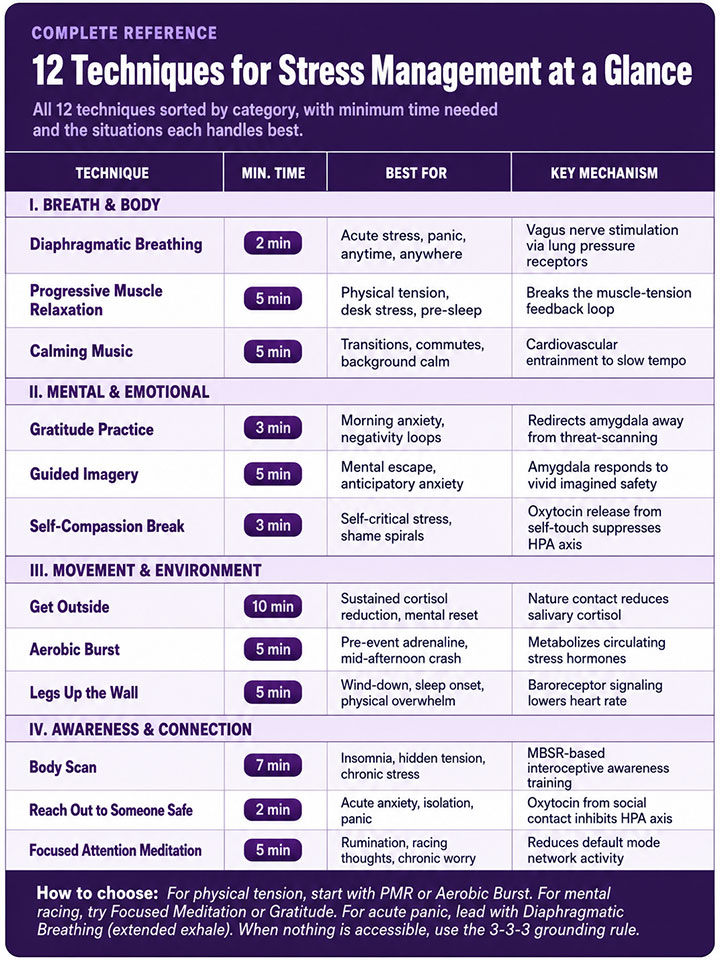
How do I know which technique to use when?
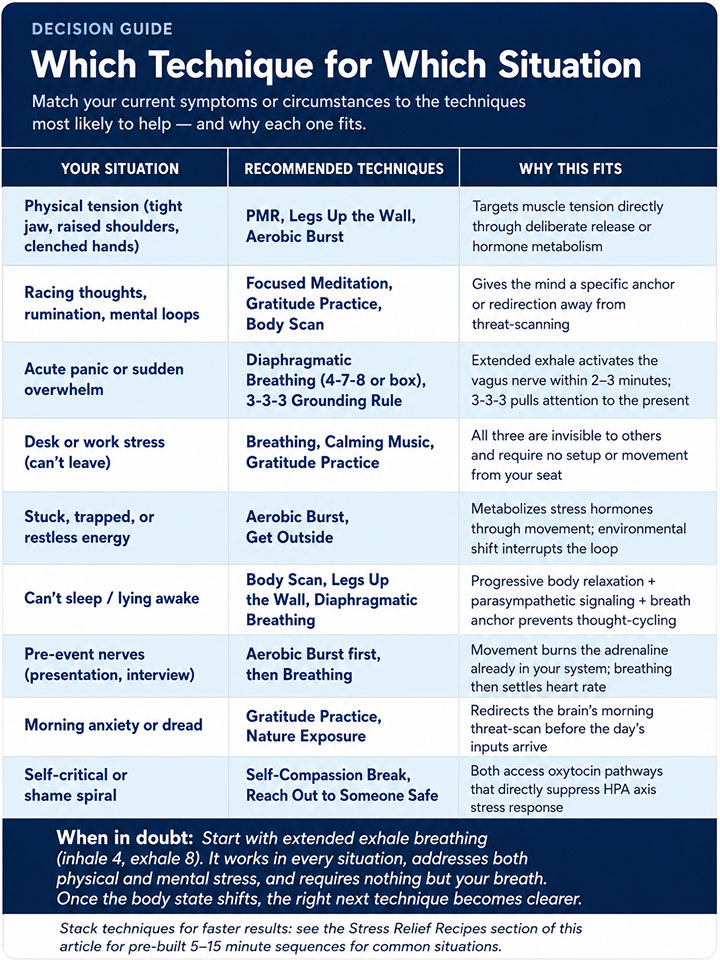
The quick-reference table earlier in this article gives the full breakdown. The short version: for physical tension (tight jaw, raised shoulders), use progressive muscle relaxation, legs up the wall, or an aerobic burst.
For racing thoughts, try focused meditation, body scan, or gratitude. For acute panic, lead with extended exhale breathing or the 3-3-3 rule. For feeling stuck or trapped, use nature exposure or movement. For sleep, use body scan, legs up the wall, or diaphragmatic breathing.
How do I know if a technique is working?
The immediate signals are physical: heart rate drops (you can feel your pulse settling), hands warm as blood returns to the extremities, shoulders and jaw drop without deliberate effort, breathing slows and deepens on its own. A spontaneous yawn or sigh is one of the clearest signs: it’s a nervous system reset reflex. Mental clarity often follows the physical shift by one to two minutes.
Are there any risks or side effects?
These techniques are safe for most people. Dizziness from breathing exercises is the most common minor issue. Return to normal breathing if that happens. Some people notice emotional release during body scans or self-compassion practices.
This is normal and often useful. Some techniques (legs up the wall, body scan) can produce significant sleepiness. Don’t do them before driving or other activities requiring full alertness. Stop any technique that produces pain, severe discomfort, or increasing panic. With 12 options available, there’s always a different approach to try.