Most people focus on the wrong things when trying to protect their brain as they age. Research points to five surprisingly ordinary habits that deserve far more attention.
For most of the twentieth century, neuroscientists treated the aging hippocampus the way engineers treat a worn engine part: something to protect, never something to rebuild. Then a group of sedentary adults in their late fifties and sixties started walking briskly three times a week, and a year later, brain scans showed their hippocampus had grown.
Cognitive decline tends to get talked about like the weather, something that simply happens to you as the years pass. A growing body of research treats it more like a garden bed than a forecast, shaped less by fate than by what gets planted in it and tended to.
The Lancet Commission’s 2024 update on dementia prevention put a number on that idea that surprised even some of the researchers involved. Across 14 identified risk factors, up to 45% of dementia cases worldwide may be traced back to something people can actually change.
None of that erases the genetic slice. Genetics load the gun, but lifestyle pulls the trigger, and a parent or sibling with Alzheimer’s roughly doubles or triples individual risk on its own.
Even carriers of APOE4, the best-known genetic risk factor for the disease, still benefit meaningfully from the same changes, according to that same Lancet analysis.
This piece walks through five of those changeable habits, the ones with the clearest research behind them for people over 50. Some of the evidence is tidy.
Some of it, as you’ll see with the most famous study on this list, got directly challenged by other scientists within months of publication. Real research usually looks like that.
Understanding Cognitive Function vs. Normal Aging
Cognitive function is the set of mental processes that let you take in information, hold onto it, and use it: attention, memory, language, and the planning skills researchers call executive function. It’s what lets you follow a recipe, remember why you walked into a room, and hold a conversation while also deciding what to say next.
Some of that softens with age, and it does so earlier than most people assume. Processing speed and multitasking measurably decline starting in a person’s forties, well before anyone would call it a medical problem.
Occasionally forgetting where you put your keys is part of that ordinary drift. Forgetting what keys are for is not.
Normal aging might look like this:
- Occasionally forgetting appointments, but remembering them later
- Taking longer to learn new things
- Struggling to find the right word sometimes
- Getting distracted more easily than you used to
These are speed bumps, not warning signs. A doctor’s attention is better reserved for a different set of changes: getting lost somewhere familiar, trouble following a conversation, struggling to manage money or bills, forgetting recent events on repeat, sudden personality shifts, or judgment lapses that put someone’s safety at risk.
Any one of those, more than once, is worth a conversation with a physician. Early evaluation opens more options than waiting does.
Brain Age Estimator
Five short tests. About four minutes total. No account needed.
Habit 1: Move Your Body to Boost Your Brain’s Memory Center
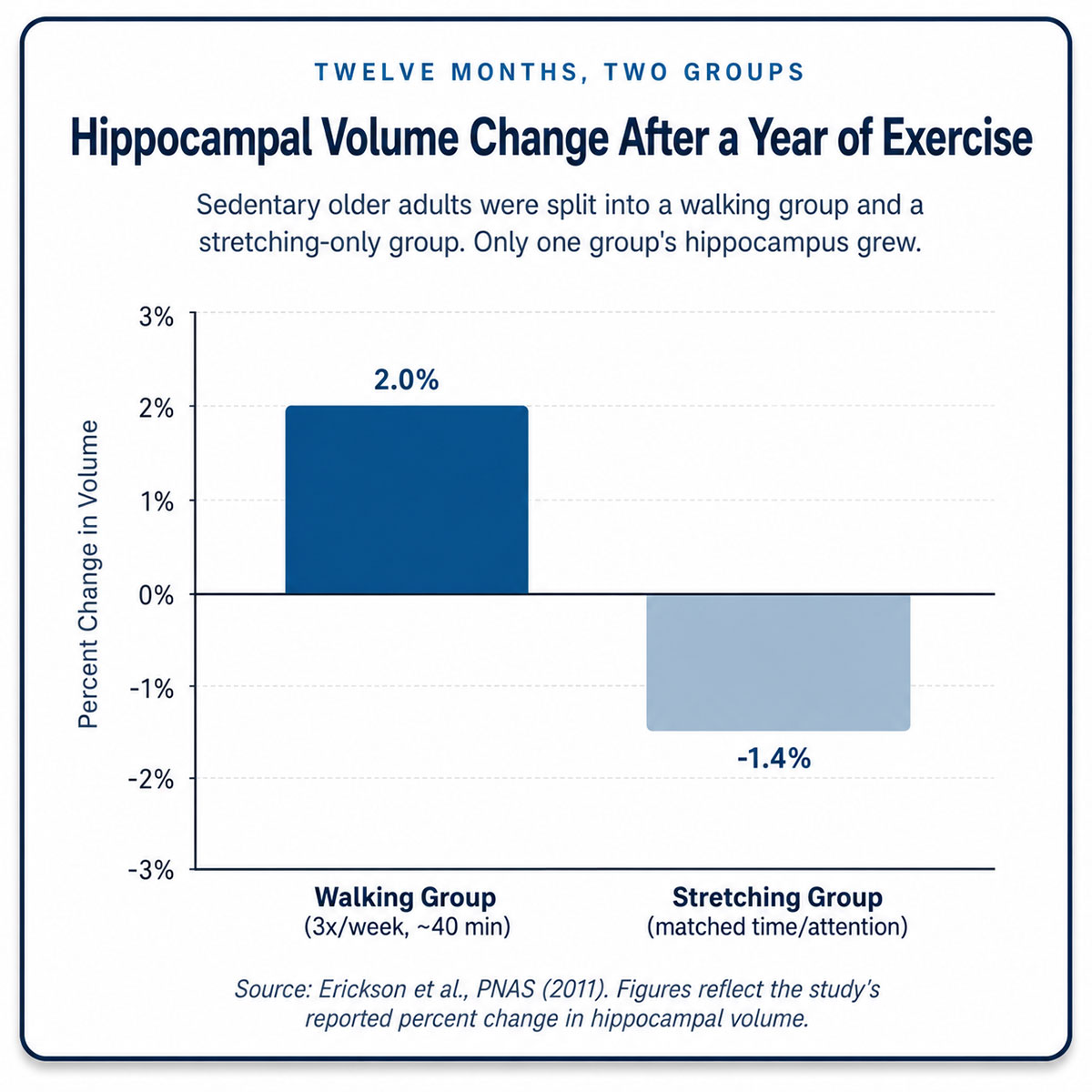
In 2011, Kirk Erickson and a team at the University of Pittsburgh put roughly 120 sedentary older adults, ages 55 to 80, through a year-long experiment. Half walked briskly for about 40 minutes, three times a week. The other half did stretching and toning exercises instead, matched for time and attention but without the cardiovascular demand.
After 12 months, the walkers’ hippocampus had grown by about 2%, reversing roughly one to two years of the volume loss that typically comes with age. The stretching group’s hippocampus kept shrinking on schedule. The walkers also outperformed the stretchers on memory tests, and their improvement tracked with blood levels of BDNF, a protein tied to the growth of new brain cells.
Researchers still don’t agree on why the effect appeared so cleanly in this one trial and not always in others. A pair of Irish physicians published a formal challenge in the same journal a few months later, arguing the memory gains showed up in both groups, walkers and stretchers alike, which muddies the claim that hippocampal growth was what drove the benefit.
Erickson’s team stood by the finding. Walking’s effect on the hippocampus is well replicated, but the exact mechanism connecting that growth to memory is still being argued over by the people who ran the original study.
Your Weekly Exercise Plan
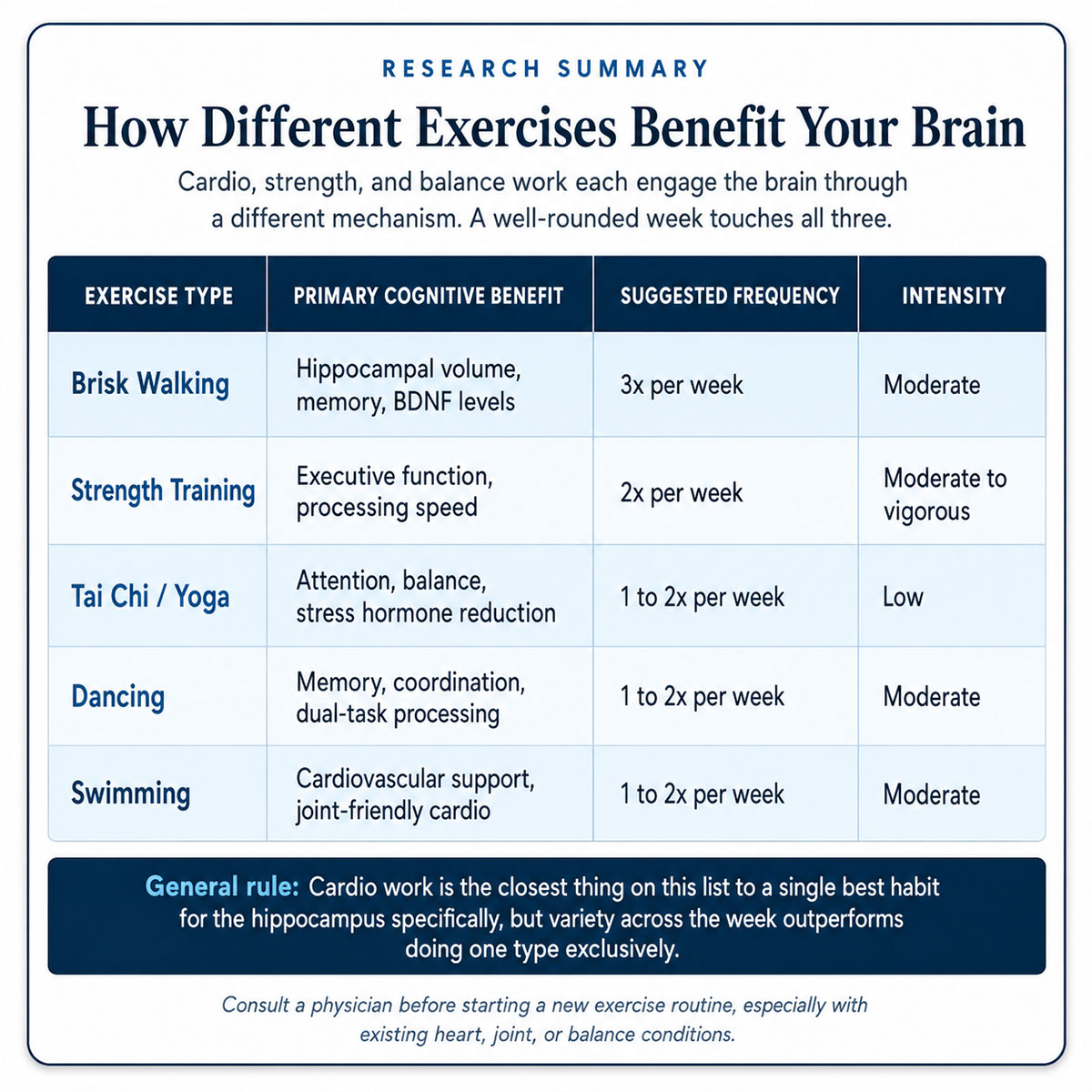
Start smaller than feels necessary. A beginner-friendly ramp:
Weeks 1 to 2: A 10-minute walk on Monday, Wednesday, and Friday.
Weeks 3 to 4: The same three days, now at 20 minutes each.
Week 5 and beyond: 30-minute brisk walks Monday, Wednesday, and Friday. Add 15 minutes of bodyweight strength work on Tuesday, tai chi or stretching on Thursday, dancing or swimming on Saturday, and a rest or gentle-activity day on Sunday.
Finding Your Target Heart Rate
- Subtract your age from 220 to estimate your maximum heart rate.
- Your moderate-intensity zone sits at 50 to 70% of that number.
- At age 60, that’s a maximum of 160, so aim for 80 to 112 beats per minute.
No heart rate monitor, no problem. The talk test works nearly as well: you should be able to speak in short sentences but not sing.
Safety Tips for Starting Exercise Over 50
Talk to a doctor first if it’s been over a year since you last exercised regularly, or if you have heart disease, high blood pressure, diabetes, joint problems, or a history of chest pain or dizziness during exertion.
Pain means stop. Discomfort means you’re working, and learning the difference matters more than pushing through either one.
Good shoes, steady hydration, and a walking partner all help more than they get credit for.
Habit 2: Eat for a Sharper Mind with the MIND Diet
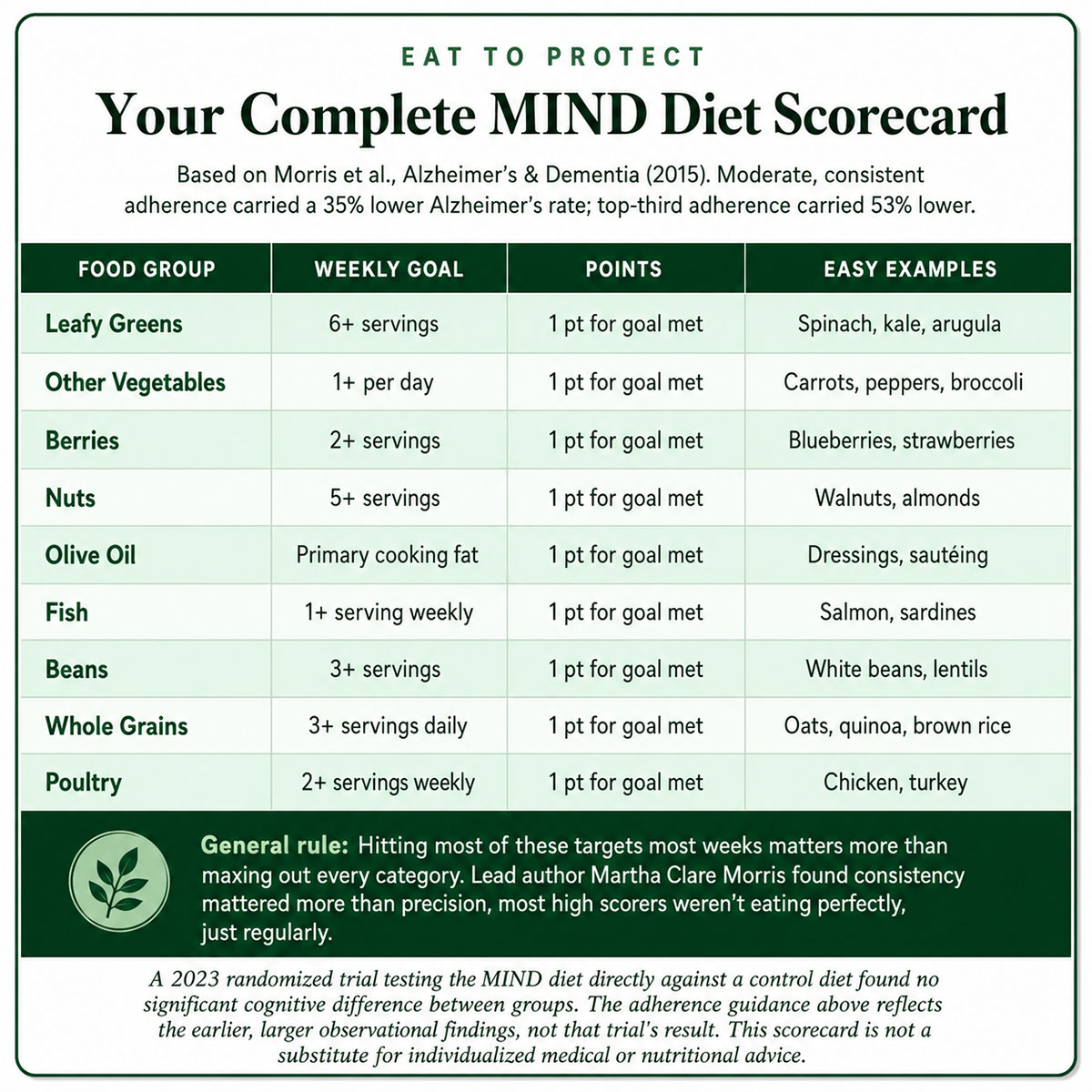
The MIND diet blends the Mediterranean and DASH diets, weighted toward the foods with the clearest ties to brain health: leafy greens, berries, nuts, olive oil, and fish. Rush University nutritional epidemiologist Martha Clare Morris built the score specifically to test which foods protected cognition, rather than borrowing wholesale from diets designed for heart health.
Morris and her colleagues tracked more than 900 older adults for close to five years, publishing the results in Alzheimer’s & Dementia in 2015. People whose diets scored in the top third for MIND adherence had a 53% lower rate of developing Alzheimer’s disease than those in the bottom third. Moderate adherence, not strict, still carried a 35% lower rate.
Morris herself flagged what she considered the most useful part of the finding: most of the high scorers weren’t eating perfectly. They were eating consistently. That distinction, between rigor and routine, is doing a lot of work in this diet’s results.
That tidy story got more complicated in 2023, and it was Morris’s own trial that complicated it. She helped design a three-year randomized trial that tested the MIND diet directly against a calorie-controlled comparison diet in 604 older adults with a family history of dementia.
Both groups improved by similar amounts on a 12-test cognitive battery, a gap of 0.035 standardized units that didn’t reach statistical significance. Morris died in 2020, three years before the results were published in the New England Journal of Medicine, dedicated to her memory.
On the other side of the ledger, red meat, butter, cheese, pastries, and fried food aren’t banned so much as budgeted. Keep red meat under four servings a week, sweets under five, and fried food to roughly one serving or less. None of that requires elimination, just a ceiling.
Brain-Healthy Recipes You Can Start Today
Brain-Boosting Berry Smoothie Bowl
Prep time: 5 minutes | Serves: 1 | MIND diet points: 4
Blend 1 cup frozen blueberries, 1/2 cup frozen strawberries, half a banana, 1/2 cup unsweetened almond milk, 1 tablespoon ground flaxseed, and a large handful of spinach until smooth. Pour into a bowl and top with chopped walnuts, fresh berries, chia seeds, and an optional drizzle of honey.
The walnuts and flax supply omega-3s for cell structure, the berries bring antioxidants, and the spinach adds folate, which supports neurotransmitter function. Prep freezer bags of the fruit and greens ahead of time so that this takes ninety seconds most mornings.
Mediterranean Salmon with Quinoa and Kale
Prep time: 10 minutes | Cook time: 20 minutes | Serves: 2 | MIND diet points: 5
Rinse 1 cup quinoa and simmer it in 2 cups water or low-sodium broth for 15 minutes, then let it sit. Place two 4 to 6-ounce salmon fillets on a lined baking sheet, drizzle with olive oil, season with oregano, garlic powder, salt, and pepper, and roast at 400°F for 12 to 15 minutes until they flake easily.
While that cooks, sauté minced garlic in olive oil, then wilt 3 cups of chopped kale for 3 to 4 minutes. Plate the quinoa, top with kale and salmon, scatter halved cherry tomatoes over the top, and finish with lemon juice and optional feta.
Salmon’s DHA content is one of the more studied nutrients for brain health. A study of postmenopausal women in the Women’s Health Initiative Memory Study, described by researchers at the University of South Dakota, found that women with higher blood levels of omega-3s had larger brain volumes overall, with the difference especially pronounced in the hippocampus.
Quick Walnut-Spinach Scramble
Prep time: 3 minutes | Cook time: 5 minutes | Serves: 1 | MIND diet points: 3
Wilt 2 cups of fresh spinach in a teaspoon of olive oil, pour in two beaten eggs, and scramble gently until just set. Top with 2 tablespoons of chopped walnuts and black pepper.
Eggs supply choline, which the brain converts into acetylcholine, a neurotransmitter tied directly to memory formation.
Blueberry Oat Breakfast Bars
Prep time: 10 minutes | Cook time: 30 minutes | Makes: 12 bars | MIND diet points: 3
Mix 2 cups rolled oats, 1 cup whole wheat flour, 1/2 cup chopped walnuts, and a teaspoon of cinnamon in one bowl. In another, combine 2 mashed ripe bananas, 1/3 cup honey, 1/4 cup olive oil, and a teaspoon of vanilla. Combine the two, fold in 1 1/2 cups of blueberries, press into a lined 8×8 pan, and bake at 350°F for 28 to 32 minutes.
The anthocyanins in blueberries cross the blood-brain barrier and concentrate in memory-related regions, while the oats provide steady glucose without the spikes that can interfere with focus.
White Bean and Kale Soup
Prep time: 10 minutes | Cook time: 25 minutes | Serves: 4 | MIND diet points: 4
Sauté a diced onion, 3 diced carrots, and 2 diced celery stalks in olive oil for 5 to 6 minutes, then add minced garlic for another minute. Pour in 6 cups of low-sodium vegetable broth, two 15-ounce cans of drained white beans, thyme, and rosemary, and simmer for 15 minutes. Stir in 4 cups chopped kale until wilted, season, and finish with lemon juice.
A 2018 study in Neurology found that people who ate one daily serving of leafy greens showed cognitive test scores equivalent to those of people roughly 11 years younger. This soup alone gets you most of the way to that serving.
Pick one change this week rather than overhauling everything at once. Add blueberries to breakfast.
Next week, add something else. The habit compounds faster than willpower does.
What About Drinks? Coffee, Tea, and Brain Health
Food gets most of the attention in this conversation, but what fills your cup matters too. Moderate coffee drinkers show consistently lower rates of cognitive decline in long-running observational studies, likely tied to caffeine and the plant compounds coffee carries alongside it, though researchers still debate how much of that link is caffeine itself versus everything else in the cup.
Green and black tea carry similar associations, with the added benefit of L-theanine, an amino acid that seems to take the jitter out of caffeine’s focus boost.
Water matters more than either. Even mild dehydration measurably slows processing speed and shortens attention span, an effect that shows up within hours, not weeks. If a single daily habit change feels more doable than the rest of this list, drinking water on a schedule rather than waiting for thirst is one of the cheapest ones available.
Habit 3: Train Your Brain Like a Muscle
What if the biggest cognitive training study ever run didn’t actually prove what it’s usually credited with proving? In 2002, researchers published the original results of the ACTIVE trial in JAMA: nearly 2,800 adults aged 65 to 94, recruited across six U.S. sites, were split into three training groups (memory, reasoning, or speed of processing) plus a no-contact control. Each group received ten 60 to 75-minute training sessions over five to six weeks.
That alone would be a solid, forgettable study. What made it notable came a decade later.
A 2014 follow-up in the Journal of the American Geriatrics Society tracked the same participants ten years out and found that reasoning and speed-of-processing training still showed measurable effects on the targeted cognitive skill, a decade after ten hours of total instruction. Roughly 60% of trained participants were still at or above their baseline level of daily functioning ability at year ten, compared with about 50% of the untrained control group.
Memory training didn’t hold up the same way. Its effect on actual memory performance had faded by year ten, even though participants in that group still reported less difficulty with daily tasks than the control group did. Ten years is a long time for a ten-hour intervention to keep paying dividends at all, and the fact that two of the three training types did so is arguably a more interesting story than any single-number headline could capture.
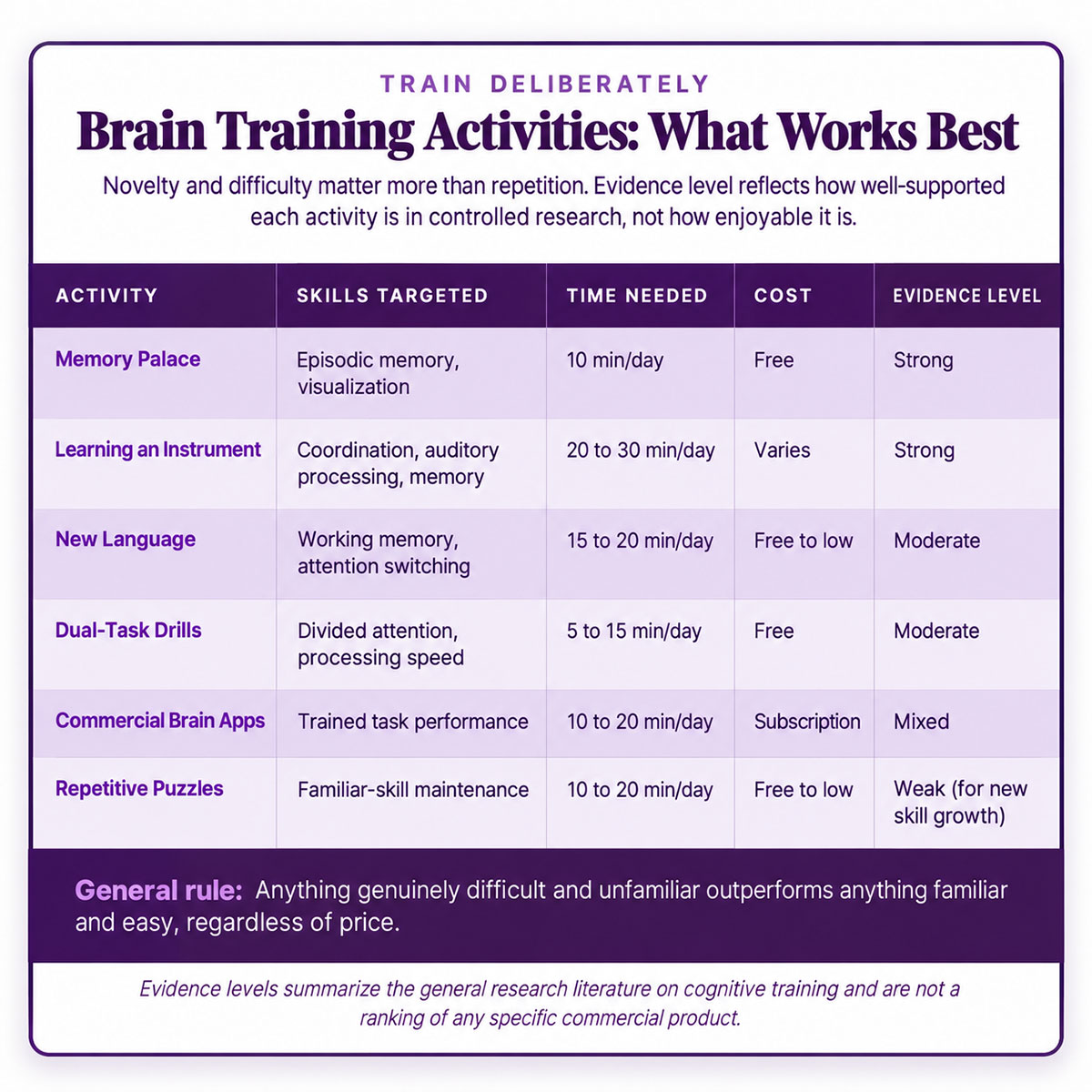
Three Brain Training Exercises You Can Start Today
The Memory Palace Technique
- Picture a route you know well, like the layout of your own home.
- Choose five or six specific spots along that route: front door, coat closet, couch, kitchen table, bedroom.
- Attach a vivid, slightly absurd image of what you need to remember to each spot.
- To recall the list, mentally walk the route in order.
A grocery list might turn into giant milk cartons blocking the front door, a coat made of lettuce leaves, and eggs cracked across the kitchen table. The stranger the image, the better it sticks.
Progressive Number Sequences
Start with a 4-digit number held for 30 seconds, then add a digit each week: five digits in week two, six in week three, seven and beyond by week four. Once that feels manageable, try recalling the sequence backward or adding the digits together in your head. Ten minutes a day, and most people notice improvement within two weeks.
Dual-Task Training
Pick a physical task and pair it with a mental one. Easy pairings include walking while spelling simple words backward or counting down from 100 by threes while doing dishes. Harder versions might mean walking a figure-eight while subtracting sevens from 100, or naming animals alphabetically while balanced on one foot.
Start with the easy pairings for five minutes and build toward ten or fifteen as it gets more automatic. Splitting attention between a physical and mental demand at the same time is one of the more direct ways to practice the kind of multitasking that daily life actually requires.
Learning New Skills: The Gold Standard
Novelty appears to matter more than repetition. A brain that’s done the Wednesday crossword for forty years is exercising a skill it already has, not building a new one.
Music is a strong candidate precisely because it demands so much at once: reading notation, coordinating both hands, tracking pitch, holding rhythm. Multiple brain regions have to fire together to pull it off, which is part of why musicians tend to show different memory profiles than non-musicians in cognitive testing, even accounting for age.
Language learning taxes memory and attention in a similar way, and doesn’t require fluency to matter. Basic conversational skills through a free app still count. So does dance, which layers physical coordination on top of sequence memory, or picking up a new craft that uses your hands in ways they haven’t worked before.
Brain Training Apps: Do They Work?
The evidence is mixed, and it’s worth saying so plainly rather than dressing it up. Some programs show benefits in controlled studies. Others show gains on the trained task that never transfer to anything resembling real life.
Use them if you enjoy them. Don’t rely on them exclusively. A crossword from the newspaper, a library book on a subject you’ve never studied, or a free YouTube tutorial for a skill you don’t have yet will likely do as much good as a paid app, for a fraction of the cost.
Habit 4: Prioritize High-Quality Sleep for Memory Consolidation
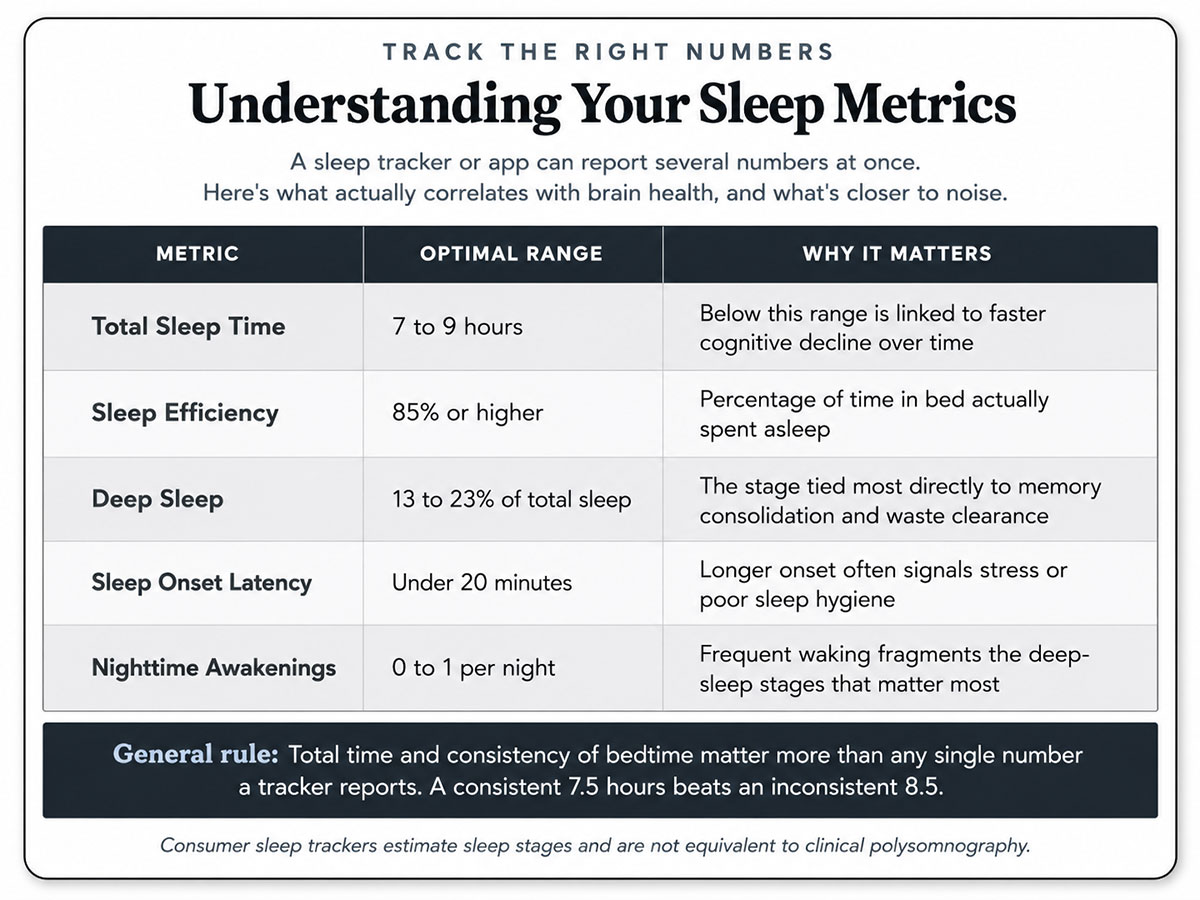
Sleep works less like downtime for the brain and more like a shift change, with an entirely different set of processes clocking in the moment the lights go out.
A 2015 review in Perspectives on Psychological Science laid out what happens during deep sleep: memories move from short-term to long-term storage, and metabolic waste products get cleared out, including beta-amyloid, the protein that clumps together in Alzheimer’s disease.
In 2019, a team led by Laura Lewis at Boston University put numbers behind the mechanism. Using accelerated brain imaging, they watched cerebrospinal fluid pulse through the brain in slow waves during deep sleep, timed precisely to dips in blood flow and to the brain’s own electrical slow waves.
Less blood in the skull at that moment means more room for fluid to move through and carry waste out with it. The study, published in Science, only looked at healthy sleepers. It doesn’t directly prove that poor sleepers get less of this cleansing wave, a reasonable inference but not something this particular study measured.
Your Complete Sleep Environment Checklist
Temperature
Keep the room between 65 and 68°F, use breathable cotton or linen bedding, and adjust blanket weight with the season.
Light
Blackout curtains or an eye mask, covered or removed electronic lights, and no bright light for at least two hours before bed. A dim red or orange nightlight, if needed, won’t disrupt sleep hormones the way white or blue light does.
Sound
A white noise machine or fan to mask disruptions, earplugs if a partner snores, and phone notifications off after 9 p.m.
Comfort
Replace a mattress every 7 to 10 years, use a pillow that keeps the neck aligned, and wash bedding weekly in hot water.
Bedroom Use
Reserve the bed for sleep and intimacy only. No work, no eating, no television.
Natural Sleep Aids That Actually Work
Magnesium-rich foods, like almonds, spinach, pumpkin seeds, and dark chocolate, help the body relax. A 2012 double-blind trial in the Journal of Research in Medical Sciences gave 46 elderly adults with insomnia either 500 milligrams of magnesium or a placebo for eight weeks. The magnesium group showed measurably better sleep efficiency, longer sleep time, and higher melatonin levels than the placebo group.
Tart cherry juice contains natural melatonin. In a small trial of eight adults over 50 with chronic insomnia, drinking about 8 ounces of Montmorency tart cherry juice twice daily for two weeks extended average sleep time by 84 minutes compared to a placebo, according to researchers at Louisiana State University. Eight participants is a small sample, worth remembering before treating the number as gospel, but the direction of the effect is consistent with cherry juice’s known melatonin content.
Chamomile and passionflower tea carry mild sedative effects, and the ritual of a warm cup thirty to sixty minutes before bed does some of the work all on its own. Progressive muscle relaxation rounds out the list:
- Lie on your back and start with your toes, tensing the muscles for five seconds.
- Release and notice the relaxation for ten seconds.
- Move upward through calves, thighs, stomach, chest, arms, and face.
- By the time you reach your face, the whole body should feel heavy.
When Sleep Problems Need Professional Help
Loud snoring paired with gasping, more than three weeks of poor sleep despite good habits, morning headaches, unintentional daytime sleep, or restless legs are all reasons to talk to a doctor rather than wait it out. Sleep disorders respond well to treatment. There’s little upside to suffering through one quietly.
Habit 5: Stay Socially Connected to Build Cognitive Reserve
Loneliness gets filed under emotional health, but the data increasingly treat it as a brain health issue in its own right.
Researchers at the Rush Institute for Healthy Aging, led by Lisa Barnes, followed more than 6,000 older adults for an average of 5.3 years, publishing the results in Neurology in 2004. Social engagement, measured through questions about visiting friends, attending religious services, volunteering, and going to social events, predicted meaningfully slower cognitive decline, even after the researchers adjusted for education, baseline brain function, and physical health.
Why would something as informal as a conversation function like a brain exercise? Reading facial expressions, tracking a conversation’s thread, and responding appropriately in real time all draw on several cognitive systems simultaneously. Scientists call the buffer that this builds cognitive reserve, a kind of backup capacity that lets the brain reroute around age-related damage rather than being derailed by it.
How Your Social Environment Shapes Cognitive Function
Who surrounds you and how those relationships are structured seem to matter almost as much as how often you socialize. Living alone doesn’t predict decline on its own, but living alone combined with infrequent contact does, a distinction that shows up across multiple long-running aging studies.
A social environment that offers variety (family, neighbors, a faith community, a hobby group) appears more protective than a single close relationship carrying all the weight. That’s a useful reframe for anyone whose social life has narrowed to one or two people since retirement: breadth carries real weight of its own.
Finding Social Connections When You Feel Isolated
Starting feels hardest right before it happens. A week-by-week approach helps.
Week 1: Reach out to one person you’ve lost touch with. A short, low-pressure text works: “Hi, I was thinking about you. How have you been?”
No reply doesn’t mean rejection. Try someone else.
Week 2: Attend one group activity once, without committing to more. Walking groups, library book clubs, community classes, and volunteer shifts all count.
Week 3: Return to that same activity and introduce yourself to a familiar face. Friendships tend to form through repetition, not a single great conversation.
Week 4: Deepen one connection specifically (coffee, a shared walk, whatever fits). One good friend outperforms ten acquaintances on almost every measure researchers use.
Using Technology to Stay Connected
Video calls activate more of the brain than voice-only calls, since reading a face and tracking gestures add a layer that a phone call skips. FaceTime, WhatsApp, and Zoom all work well for older adults, and the biggest hurdle is usually the first setup, not the ongoing use. Ask a family member to help configure one app, then set a standing weekly call time rather than leaving it to chance.
Virtual connection helps but doesn’t fully substitute for being in a room with someone. Aim for a mix rather than either extreme.
Warning Signs You’re Too Isolated
Going three or more days without a real conversation, declining invitations out of habit rather than preference, feeling invisible even in a group, or noticing your main daily interaction is with a cashier or mail carrier are all worth a monthly self-check.
If several apply at once, start small. Text one person. Show up to one thing.
The Power of Volunteering
Volunteering compresses several protective habits into one activity: social contact, physical movement, purpose, and mental engagement. Research on volunteering in later life consistently links it to stronger executive function, the planning and organizing skills involved in daily life, particularly at a moderate weekly commitment rather than an exhausting one.
Two to three hours a week appears to capture most of the benefit, and piling on more time doesn’t obviously add much on top of that.
Schools, libraries, animal shelters, food banks, and senior centers all tend to need volunteers, and matching the role to something you already care about makes the habit far more likely to stick.
Building Friendships After 50
New friendships get harder to form with age, mostly because the built-in structures that used to manufacture them (school, young kids, a shared commute) thin out. The fix is less about charisma and more about repetition.
Show up to the same activity weekly rather than sampling a new one each time. Be the one who extends the invitation instead of waiting for it, and ask real questions about someone’s life, then follow up on the answers next time you see them.
Share something small and personal in return. Researchers studying friendship formation estimate it takes upward of 200 hours together to build a close friendship.
That number doesn’t explain why some acquaintances never cross that line no matter how many hours accumulate.
The Complete Cognitive Health Risk Assessment
Some risk factors carry more weight than others. Use this as a reasonable way to see where your own effort might do the most good, not as a diagnostic tool.
Zero to two factors checked means the current habits are working, so the job is maintenance. Three to five calls for picking one or two to address this month.
Six to eight is worth a conversation with a doctor about a plan, starting with the “very high” impact items. Nine or more is a reason to see a doctor soon, not as an emergency, but as a starting point.
Every change still counts, regardless of how many boxes got checked.

Habit Stacking: Your 30-Day Challenge
Trying to overhaul five habits simultaneously is a reliable way to abandon all five within a week. One habit at a time holds up better.
Week 1, exercise: a 10-minute daily walk, checked off on a calendar. Five days in, a new walking playlist is the reward.
Week 2, diet: one added serving of berries daily, tracked with a quick photo. Five days in, try a new MIND-friendly recipe.
Week 3, brain training: ten minutes of a puzzle or new skill, logged in a few words each day. Five days in, a new puzzle book or class sign-up marks the milestone.
Week 4, sleep and social: lights out by 10 p.m., plus one call or text to a friend daily. Five days in, plan an actual coffee date.
After 30 days, the same tracking approach, a checkmark on a calendar, a quick photo, a one-line note, works just as well for holding onto all four habits at once as it did for building them one by one.
Weeks 5 through 8 mean raising the dose slightly: 20-minute walks instead of 10, a second MIND diet serving, a harder brain-training activity.
By weeks 9 through 12, most people report the habits starting to feel automatic rather than effortful, at which point a group class or accountability partner tends to matter more than a tracking sheet.
Bonus Strategies: Going Beyond the Basics
Protect Your Hearing
Hearing loss forces the brain to work harder to process unclear sound, pulling resources away from memory and thinking in the process. A study of older adults in the HealthABC cohort, published in JAMA Internal Medicine, found that hearing loss was independently associated with a meaningfully faster rate of cognitive decline, even after accounting for other health factors.
Get hearing tested every two to three years after 50, use hearing aids if recommended, and protect ears from loud noise the same way sunscreen protects skin. Vanity is an expensive reason to skip a device that keeps you socially engaged and mentally sharp.
Manage Chronic Conditions Aggressively
Brain health depends on cardiovascular health more than most people expect. High blood pressure damages small blood vessels in the brain directly, so keeping it under roughly 120/80 and checking it monthly at home matters. Diabetes harms brain cells and vessels through elevated blood sugar, high cholesterol contributes to stroke and vascular dementia risk, and atrial fibrillation raises stroke risk on its own.
None of that is a reason to abandon lifestyle change in favor of medication, or the reverse. Most people need both to work together.
The Mediterranean Lifestyle Beyond the Plate
The Mediterranean approach to eating comes bundled with a slower way of living: long meals shared with people, a walk after dinner, an afternoon rest, less rushing. Moving to a Greek village isn’t required to borrow the mindset. Slowing down around meals and prioritizing relationships over productivity support the same cognitive systems the diet itself does.
Keep Learning Throughout Life
Psychologist Denise Park ran an experiment at the University of Texas at Dallas that put older adults through 15 hours a week of learning to quilt or shoot digital photography for three months, then compared them to groups doing lower-demand activities like socializing or simple games.
Only the high-challenge groups, the ones actually learning something new and difficult, showed improved episodic memory. The socializing group didn’t show the same gain, a result Park herself called somewhat surprising given how much emphasis social contact usually gets in this research.
The lesson isn’t that novelty beats connection. It’s that a life with both, something genuinely new to learn and people to share it with, appears to ask more of the brain than either one alone.
Conclusion
None of these five habits work like a switch. They work more like compound interest, small and unglamorous at first, meaningfully different only in hindsight.
The walkers in Erickson’s study didn’t feel their hippocampus growing in month three. They just kept walking.
The research keeps returning to how these five habits reinforce each other rather than which one wins on its own. Better sleep makes exercise easier the next day.
Exercise makes social plans feel less like an obligation. None of that shows up in a single study, and all of it shows up in a life.
FAQs
How long before I see results from these habits?
It varies by habit. Exercise changes brain blood flow within two to three weeks, with structural changes like hippocampal growth building over six to twelve months. Diet affects blood sugar within days and inflammation markers within two to three months, though real brain protection builds over years.
Brain training shows task-specific improvement within one to two weeks, with real-world transfer taking closer to two to three months of consistent practice. Sleep can improve memory within days, and social engagement tends to lift mood within one to two weeks, with cognitive benefits arriving later still.
Consistency matters more than any of these timelines individually. None of the five is a quick fix.
Can I reverse existing cognitive decline?
It depends heavily on cause and severity. For ordinary age-related change, these habits can genuinely improve function, and some people see measurable gains in specific areas.

For mild cognitive impairment, lifestyle changes may stabilize function or slow its progression, and some people with MCI return to normal cognition over time. For dementia itself, these habits won’t reverse the underlying disease, though they may slow its progression and improve day-to-day quality of life. Starting earlier helps more, but starting later still helps.
Do supplements work for brain health?
Mostly, no, and it’s worth being direct about that rather than softening it. Ginkgo biloba has failed to show benefit across multiple large trials, and high-dose vitamin E may actually raise mortality risk.
Omega-3 supplements add little for people who already eat fish regularly, since the food source does the job. Most proprietary “brain-boosting” blends simply lack evidence either way.
The exceptions are narrow: vitamin B12 or vitamin D, but only if testing confirms an actual deficiency, which is common enough in older adults to be worth checking. Supplements to improve cognitive function are, for most people, a weaker bet than the food already sitting in a well-stocked kitchen. Get tested before spending money on a bottle.
How do I stay motivated when progress feels slow?
Track non-scale victories. Walking up stairs without getting winded, remembering a neighbor’s grandchild’s name, falling asleep faster, these count for more than any single test score.
An accountability partner, a class with other people in it, and a clearly written reason for doing any of this in the first place all outperform willpower alone. Off days happen, and one doesn’t erase a month of good ones.
Is it normal to forget things as I age?
Yes, mostly. Forgetting a name but recalling it later, misplacing keys, and taking longer to learn new software all fall within the range of ordinary aging.
Forgetting conversations entirely, getting lost somewhere familiar, or losing track of what a common object is for do not, and are worth a doctor’s attention. Vitamin deficiencies, thyroid problems, depression, medication side effects, and sleep disorders can all mimic memory loss and are frequently treatable once identified.
Can stress affect my cognitive function?
Yes, and the mechanism is fairly direct. Elevated cortisol, the body’s primary stress hormone, is linked to a shrinking hippocampus and measurably worse memory. A 2018 study in Neurology, drawing on the Framingham Heart Study, found that higher circulating cortisol correlated with both worse memory performance and smaller brain volume in middle-aged adults, well before any of them showed signs of dementia.
Regular exercise lowers cortisol on its own. So does meditation, time outdoors, adequate sleep, and talking to someone rather than carrying stress alone. Chronic, unmanaged stress and poor sleep tend to feed each other, which makes breaking into that cycle from either direction, sleep or stress, a reasonable place to start.