Everyone talks about probiotics and “healing your gut.” But when scientists finally tested the claim in healthy adults, the biggest finding wasn’t what anyone predicted.
Type “sauerkraut gut health” into Google, and a dozen tidy promises show up. Three weeks, and your microbiome transforms.
A 2025 crossover trial out of Germany put that promise to an actual test. Researchers fed healthy adults sauerkraut for weeks at a time, then sequenced their stool before and after.
The gut microbiome turned out to be more stubborn than the marketing suggested. A few things did shift. Most didn’t move nearly as much as expected.
That gap, between what gets promised and what actually gets measured, is worth thinking about. What sauerkraut does to a gut over three weeks turns out to be a more interesting story than the simple version, and a more useful one.
The Science Behind Sauerkraut’s Gut Power
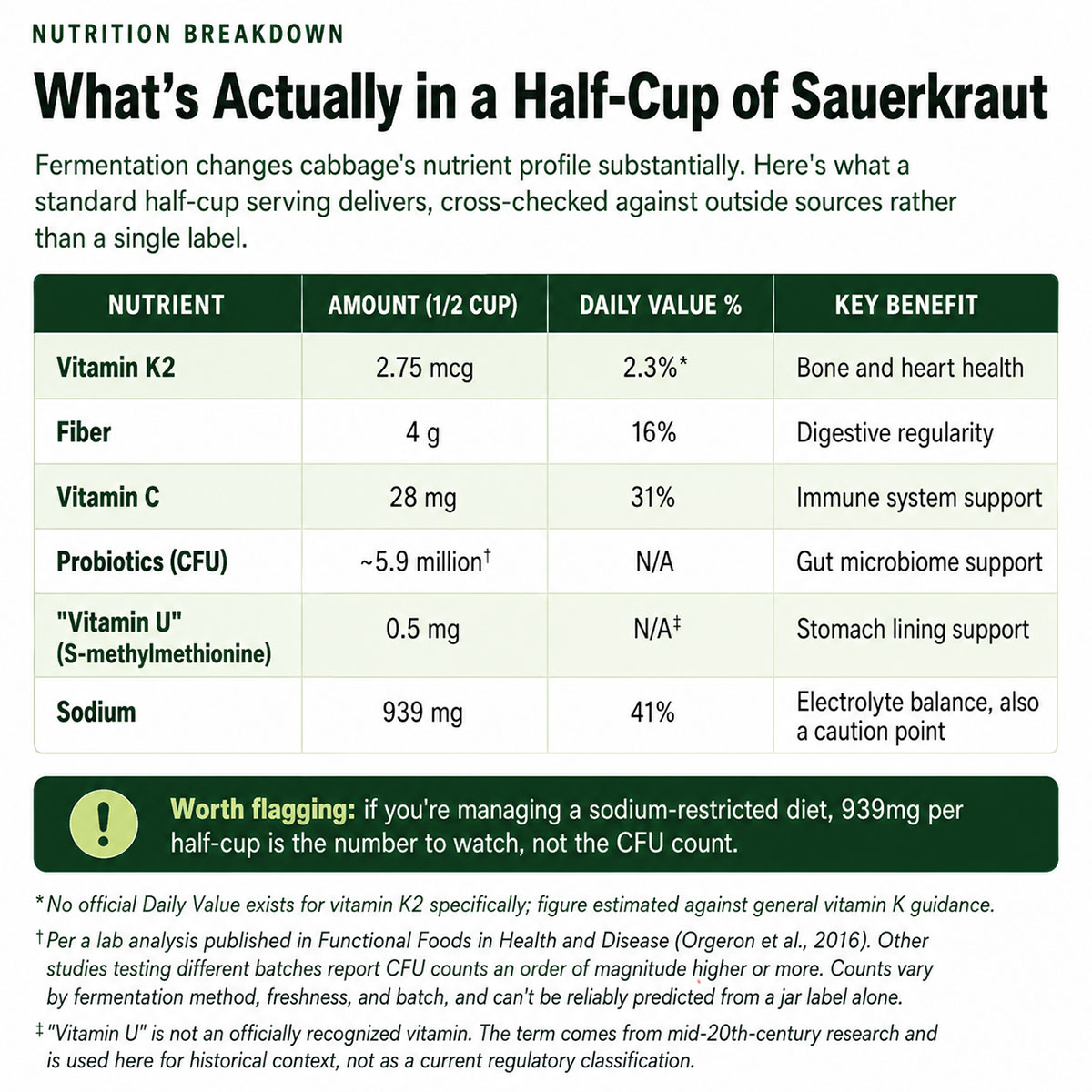
Quality sauerkraut carries a real bacterial load, though the exact number depends heavily on who’s counting and which batch they tested. One lab analysis, published in Functional Foods in Health and Disease, measured roughly 5.9 million CFU in a half-cup of home-fermented kraut. Other studies testing different batches have reported densities in the hundreds of millions to over a billion CFU per gram.
That range is nearly useless as a single number. It’s honest information anyway, since fermentation isn’t a factory process, and two jars from the same brand, made three months apart, can carry meaningfully different bacterial loads.
What’s more consistent across the research is which bacteria show up. Lactobacillus plantarum breaks down proteins and produces vitamin B12.
Leuconostoc mesenteroides kicks off the fermentation process before more acid-tolerant species take over. Pediococcus pentosaceus contributes to the tang and helps preserve nutrients, while Lactobacillus brevis produces compounds with antimicrobial activity.
A 2025 study from the University of California, Davis offers the clearest mechanistic picture yet. Lei Wei and Maria Marco exposed intestinal cells to fermented cabbage, raw cabbage, and plain brine, then triggered inflammation in the lab.
Only the fermented cabbage protected the cells. Raw cabbage and brine alone did nothing. The researchers found no meaningful difference between store-bought sauerkraut and lab-fermented batches, a genuinely useful finding for anyone deciding whether homemade is worth the effort.
That study was done in cell cultures, not in people, so it explains a mechanism rather than proving what happens inside a human gut over three weeks. It’s still the strongest evidence so far for why fermented cabbage specifically, and not just cabbage, appears to matter.

Nutritional Profile: More Than Just Probiotics
The full nutritional picture goes beyond bacteria count. Here’s what a half-cup delivers, and how those numbers hold up against outside sources.
The First Week: What Happens
Day 1 to 3
The first few days are mostly about gas. Sometimes a lot of it.
None of that means anything’s wrong. It means billions of Lactobacillus bacteria are meeting your digestive system for the first time and starting to establish themselves, producing short-chain fatty acids like butyrate as they go, which feed intestinal cells and help reduce local inflammation.
Marco and colleagues, in a widely cited review of fermented food research, found that fermented foods like sauerkraut can shift gut microbiota composition and increase populations of beneficial Lactobacillus species. The review doesn’t pin down an exact timeline for when that shift begins, and most single-strain colonization research suggests it’s gradual rather than immediate.
One tablespoon a day, taken with a meal, is enough to start. The food already in your stomach buffers the acid a little and makes early digestion easier, and the natural enzymes in the sauerkraut help with the rest of the meal too.
Day 4 to 7
By day four or five, the initial gas typically eases. Bowel regularity tends to improve around this point too, as the fiber in sauerkraut, about 4 grams per half-cup, adds bulk and helps move waste through the digestive tract more efficiently.
Fermentation enzymes also continue breaking down proteins and carbohydrates from other foods eaten alongside the kraut.
Sauerkraut also contains a compound often called vitamin U, though it isn’t an officially classified vitamin. The name comes from mid-20th-century research on cabbage juice and ulcer healing, and while the compound, S-methylmethionine, does appear to support the stomach lining, the “vitamin” label is more historical than scientific.
21-Day Symptom Timeline
Individual timelines vary, but here’s the general pattern most commonly reported. One caveat is worth keeping in view while reading it, and it’s covered in full further down.

Week Two: The Part Most Articles Overstate
Here’s the detail that tends to surprise people most in this whole topic: somewhere close to 90 percent of the body’s serotonin is made in the gut, not the brain.
Gut bacteria don’t produce serotonin directly in large amounts themselves, but some species, including Lactobacillus plantarum, appear to increase available tryptophan, the amino acid the body converts into serotonin. A 2021 review of the gut-brain axis laid out several of the bacterial pathways involved, though researchers are still working out how much of an effect food-based intake has compared to what the gut produces on its own.
By the second week, many people report steadier energy and a clearer head. That’s plausible biologically. Gut bacteria by this point are producing B-vitamins the body uses for energy, along with gamma-aminobutyric acid, or GABA, a calming neurotransmitter.
Short-chain fatty acids, especially butyrate, are also being produced in larger quantities by now. Acetate, in particular, can cross the blood-brain barrier, and animal research links it to reduced brain inflammation, though human evidence for a cognitive effect from food-based intake specifically is thinner than the animal data.
Week Three: What the Evidence Actually Supports
By the third week, the story most people expect is a clear one: stronger immunity, better skin, sustained energy. Some of that holds up. Not all of it does, and the exceptions matter.
Roughly 70 percent of the body’s immune system is associated with gut-linked tissue, and a more diverse bacterial community does appear to help train immune cells to distinguish real threats from harmless substances. Vitamin K2, also present in sauerkraut, supports bone density and activates proteins that route calcium toward bone rather than arterial walls.
Here’s the complication. The same 2025 crossover trial mentioned at the very beginning, published in Microbiome, tested regular sauerkraut consumption in healthy adults directly, rather than fermented foods in general. Its conclusion: a healthy gut microbiome holds fairly steady against short-term dietary changes, even when specific bacterial species shift in response to the sauerkraut itself.
That doesn’t mean nothing happens. It means the “three weeks to a new gut” framing oversold things, not the sauerkraut. Three weeks of any single food was never going to overhaul an already-healthy microbiome.
The clearer, better-supported wins are the inflammatory and functional ones. A 2021 Stanford trial found that healthy adults eating a high-fermented-food diet for 10 weeks saw levels of 19 different inflammatory proteins in their blood decrease, including interleukin-6, a marker tied to chronic inflammatory conditions.
A comparison group eating a high-fiber diet instead didn’t see the same drop.
Daily Sauerkraut Calculator
Body weight and fermented-food experience both change how much you should be eating and when. This calculator accounts for both.
Daily Sauerkraut Calculator
Get a serving schedule and timing recommendation based on your body weight, experience, and goal.
Your Recommended Timing
-
Personalized Tips
-
Best Time to Eat Sauerkraut for Gut Health
Ask five sources when to eat sauerkraut, and you’ll get five different answers, which is useful to know before picking one.
Some argue for the morning, on the theory that starting the day with live bacteria gives digestion an early boost. Others make the case for eating it with meals specifically, since food in the stomach buffers acid and helps more of the live bacteria survive the trip to the intestines. A smaller group favors the evening, arguing it supports overnight digestion.
None of these positions has strong head-to-head trial evidence behind it specifically for sauerkraut. What most sources do agree on is that consistency matters more than the exact hour. Eating it most days beats eating a large amount occasionally.
The practical version: pick a time that fits a meal you already eat regularly, since sauerkraut alongside food is gentler on digestion than sauerkraut on an empty stomach, and stick with it. If gas or bloating shows up in the first week, moving your serving to earlier in the day, with food, tends to help.
One habit does have more consensus behind it than timing. Don’t cook it. Heat above about 115°F kills the live bacteria, so sauerkraut works best as a cold topping added after cooking is done, not an ingredient simmered into a hot dish.
Most people can eat sauerkraut daily without issue once their gut adjusts, though there’s no requirement to eat it every single day for it to help. A few times a week, consistently, is a reasonable middle ground if daily feels like too much.
How Sauerkraut Changes Your Gut
When gut bacteria ferment the fiber in sauerkraut, they produce three short-chain fatty acids that do most of the heavy lifting: butyrate, propionate, and acetate. Butyrate feeds the cells lining the colon directly and helps reduce inflammation there.
Propionate plays a role in regulating blood sugar and cholesterol, while acetate is one of the few bacterial metabolites that can cross into the brain. People with inflammatory gut conditions tend to have measurably lower levels of all three, which is why researchers keep circling back to foods that help the body produce more of them.
The gut and brain also talk to each other more directly than most people realize. The vagus nerve provides a physical connection between the two, and inflammatory signals from the gut can influence mood directly.
Gut bacteria also manufacture some of the same neurotransmitters the brain uses, and bacterial byproducts circulate into the bloodstream and eventually reach the brain itself. None of these routes work in isolation, and sauerkraut’s fermentation byproducts appear to touch several of them at once.
Choosing Your Kraut: What Matters
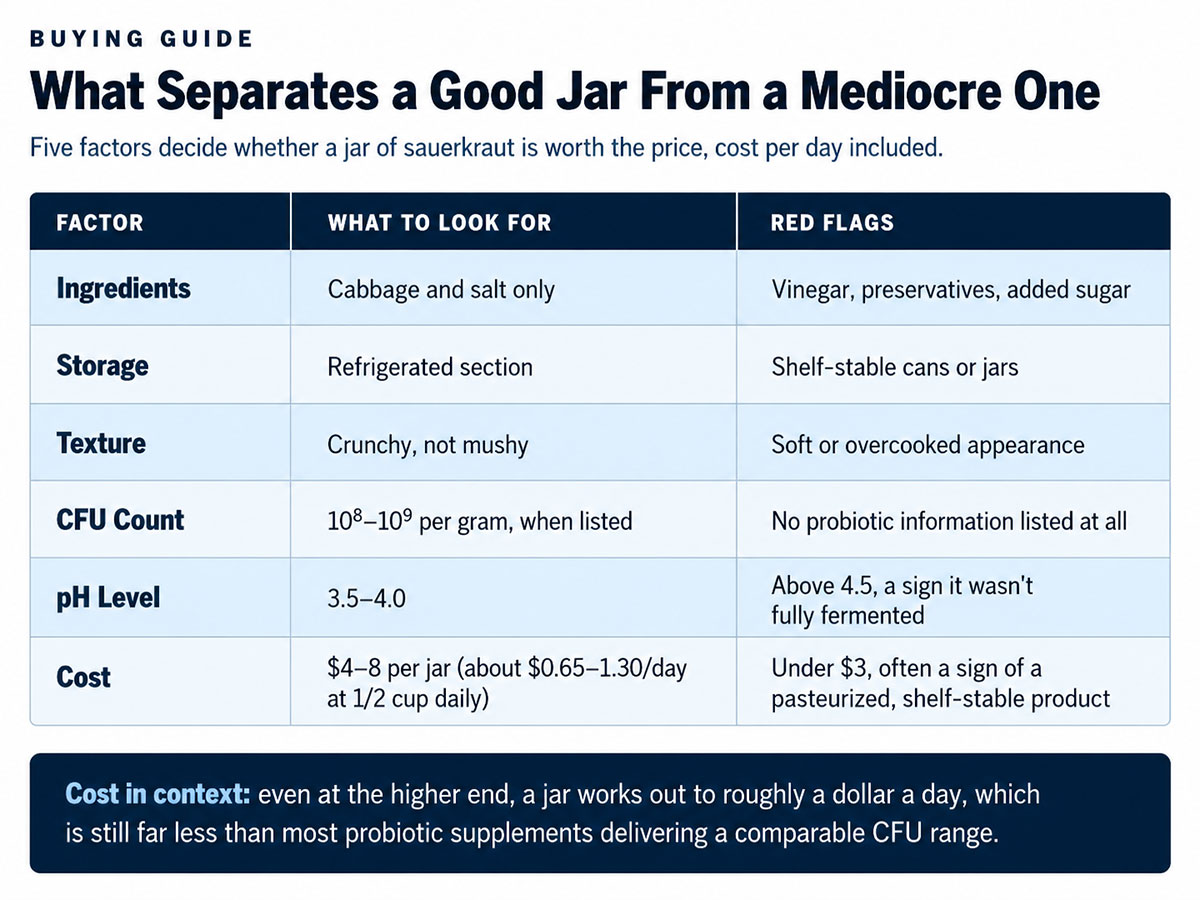
Pick refrigerated over shelf-stable. This is the one buying rule with essentially no exceptions worth chasing: heat kills the bacteria that make sauerkraut worth eating for gut health, and if a jar has been sitting unrefrigerated on a regular grocery shelf, assume the probiotics are gone.
Check the label for a few specific terms: “unpasteurized” or “raw,” “naturally fermented,” and “contains live cultures.” The ingredient list matters just as much.
The best jars contain nothing more than cabbage and sea salt, sometimes with caraway seeds or juniper berries added for flavor. Vinegar, sugar, and preservatives are signs the product was pickled rather than fermented, and pickled sauerkraut doesn’t carry the same live bacterial content.
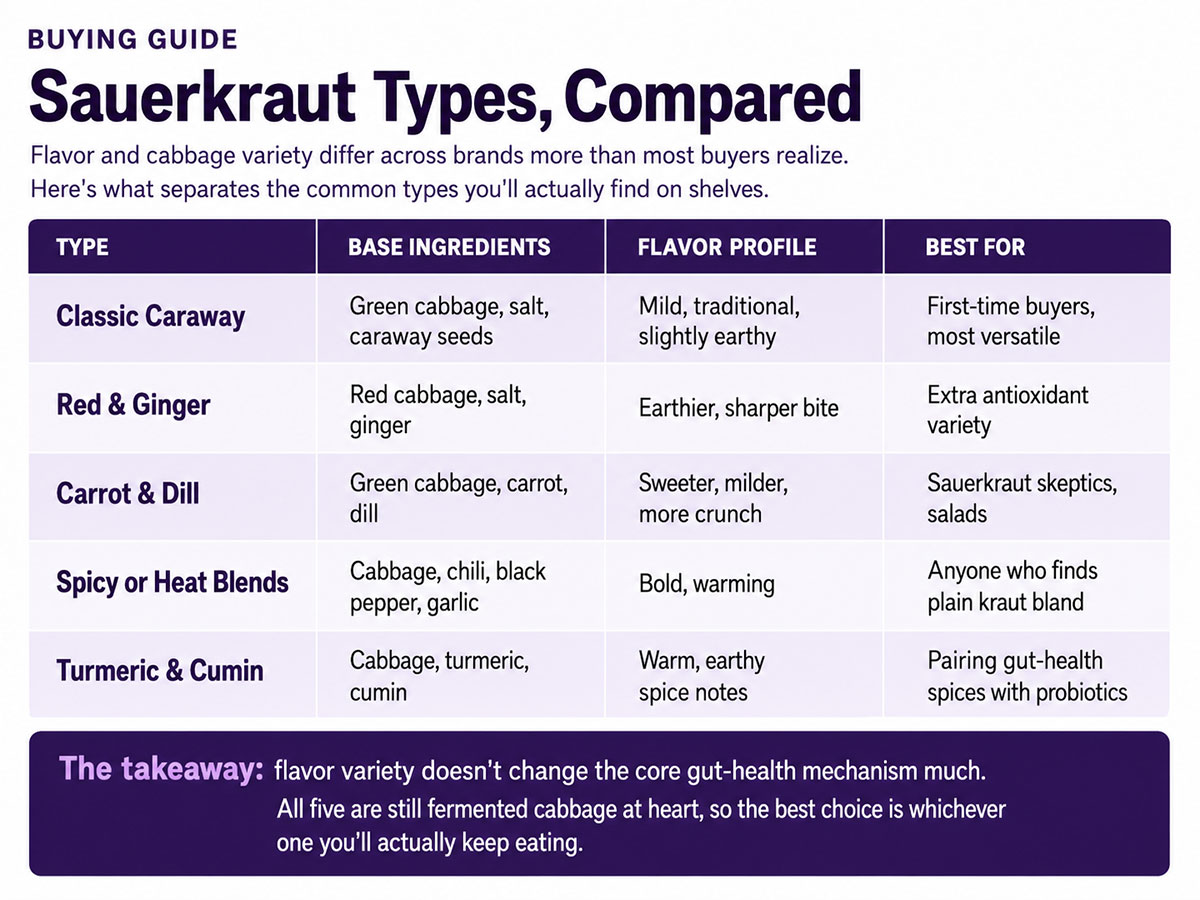
Flavor and cabbage variety differ across brands as well, and the differences aren’t purely cosmetic.
Beyond flavor, a few practical factors separate a good jar from a mediocre one, cost included.
Brand Comparison Tool
Plug in the numbers from any jar’s label, or use the pre-loaded examples below, to see how brands stack up on cost per billion CFU.
Brand Comparison Tool
Three example brands are pre-loaded. Replace them with numbers from your own local jars to compare real options.
| Brand | CFU/Serving | Price/Jar | CFU per $ | Cost per Billion CFU | Quality |
|---|
A Simple DIY Sauerkraut Recipe
Ingredients
- 2 pounds organic green cabbage
- 1 tablespoon sea salt, no additives
- 1 teaspoon caraway seeds, optional
Instructions
- Remove the outer leaves, cut the cabbage into quarters, remove the core, then slice it thin, about 1/8 inch.
- Toss the cabbage with the salt in a large bowl and massage it with clean hands for about 5 minutes, until liquid starts to pool.
- Pack the cabbage tightly into a clean mason jar, pressing down firmly so the liquid covers it by about an inch.
- Cover the jar with a cloth secured by a rubber band and keep it at room temperature, between 68 and 75°F, for 3 to 10 days.
- Start tasting after day 3, and once it reaches the tanginess you like, move it to the refrigerator.
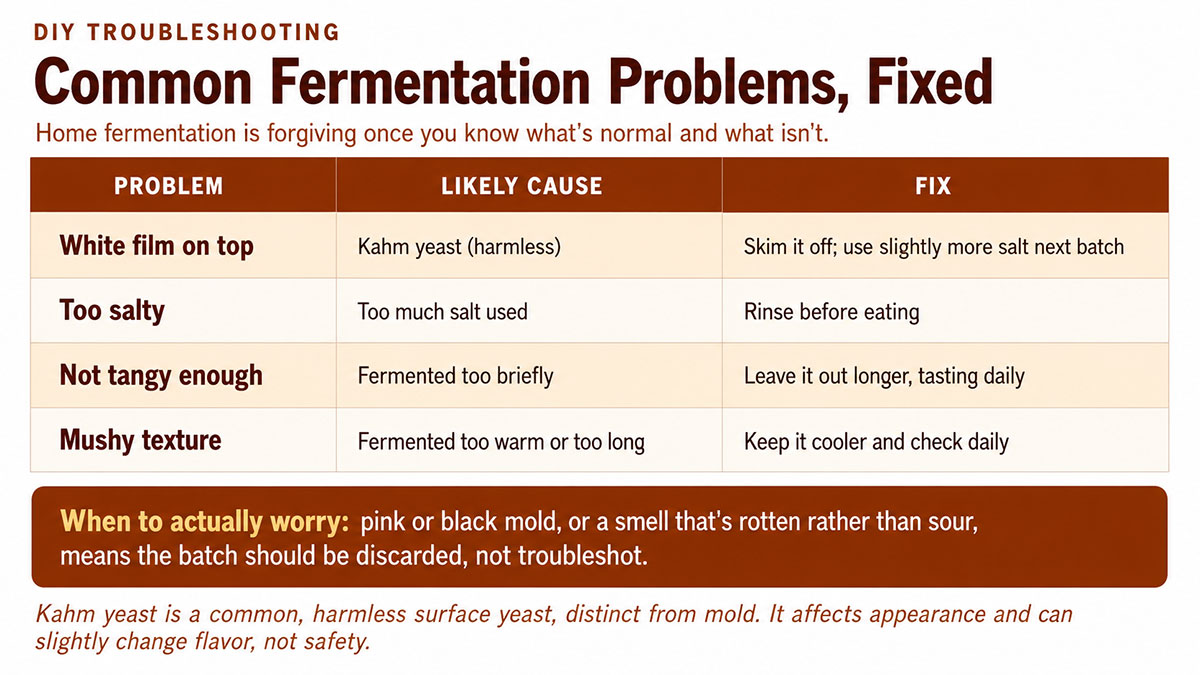
A few things commonly go wrong during fermentation, and most have simple fixes.
12 Ways to Work Sauerkraut Into Your Day
Quick Serving Ideas
- Mixed into a salad, it adds both probiotics and crunch.
- On avocado toast, the tang balances the creamy texture well.
- Stirred into scrambled eggs, it pairs with the protein and adds a digestive boost.
- Adding it to soup after cooking, rather than during, keeps the bacteria intact.
- Used as a baked potato topping, it works as a sour cream substitute.
- Mixed into tuna or chicken salad, it cuts down on how much mayonnaise is needed.
- Sprinkled over a grain bowl, it pairs especially well with quinoa or brown rice.
- Tucked into a quesadilla, it adds probiotics to an otherwise indulgent dish.
- Served alongside grilled meat, it helps with digesting the protein and fat.
- Swirled into Greek yogurt, it doubles the probiotic content of the dish.
- Used as a taco garnish, it’s a livelier substitute for plain shredded cabbage.
- Eaten straight from the jar, it’s the simplest way to hit a daily serving.
Complete Recipes
Probiotic Bowl
Serves 2
Ingredients: 1 cup cooked quinoa, 1/2 cup sauerkraut, 1 sliced avocado, 2 hard-boiled eggs, 2 tablespoons pumpkin seeds, 2 tablespoons olive oil, 1 tablespoon lemon juice.
Divide the quinoa between two bowls, top with sauerkraut, avocado, eggs, and pumpkin seeds, then drizzle with olive oil and lemon juice. Between the quinoa, eggs, and sauerkraut, this bowl draws on several different probiotic and fiber sources at once.
Sauerkraut Bone Broth Soup
Serves 4
Ingredients: 4 cups bone broth, 1 cup chopped carrots and celery, 1/2 cup sauerkraut, 2 cloves minced garlic, 1 teaspoon turmeric, salt and pepper to taste.
Heat the broth and vegetables until tender, then remove from heat before stirring in the sauerkraut, garlic, and spices. The residual heat warms the kraut through without getting hot enough to kill off its bacteria.
Morning Sauerkraut Smoothie
Serves 1
Ingredients: 1 cup unsweetened almond milk, 1/2 banana, 1 tablespoon almond butter, 1 tablespoon sauerkraut (trust us), 1 teaspoon fresh ginger, 1 cup spinach.
Blend everything until smooth. The sauerkraut disappears into the other flavors, so you get the probiotic boost without tasting much of the tang.
Who Should Be Careful
A few groups should approach daily sauerkraut with more caution than a general daily-habit recommendation allows for.
People managing high blood pressure should know that a half-cup carries close to 939mg of sodium, a meaningful chunk of a low-sodium daily target. Rinsing the sauerkraut before eating, or choosing a lower-sodium variety, cuts that load down.
Anyone on blood thinners like warfarin should talk to a doctor before making sauerkraut a daily habit, since the vitamin K2 content can interact with how those medications work. Consistency matters here too, since a wildly fluctuating intake is more likely to cause problems than a steady one.
Fermented foods are high in histamines, so people with histamine intolerance should start with very small amounts and watch for headaches or flushing. Anyone with SIBO, small intestinal bacterial overgrowth, should be cautious as well, since introducing more bacteria can worsen symptoms at first. Working with a healthcare provider on timing makes sense here.
IBS deserves a more careful note than a blanket warning. A small randomized trial found that lacto-fermented sauerkraut improved symptoms in IBS patients over six weeks, regardless of whether the sauerkraut was pasteurized, which suggests the effect may come more from fiber and plant compounds than from live bacteria specifically.
That’s not a green light for everyone with IBS. It does mean the usual advice to avoid all fermented foods isn’t fully supported by the sauerkraut-specific evidence.
Older research also flags a less common risk. A bibliometric review of sauerkraut studies found that regular intake can cause local gut inflammation in some people, with repeated servings occasionally triggering diarrhea. It’s not the norm, but it’s worth knowing if digestive symptoms show up and don’t improve.
When to Start Slowly
Anyone with a history of digestive issues, a recent course of antibiotics, no prior experience with fermented foods, or a sensitive stomach should start smaller than the standard advice suggests, at around one teaspoon daily, and increase gradually over two weeks rather than one.
When to Talk to a Doctor First
Severe digestive symptoms that don’t improve within a week or two, signs of infection like fever or significant pain, immunosuppressive medication use, and pregnancy or breastfeeding, generally fine but worth confirming, all warrant a conversation with a healthcare provider before making sauerkraut a daily habit.
Common Problems and Fixes
Too Much Gas
Cutting the serving size in half usually resolves this within a few days. Taking a digestive enzyme with meals can help too, and eating sauerkraut alongside other food rather than alone slows things down further. Drinking enough water throughout the day makes a noticeable difference as well.
Not Seeing Results
Start by checking that the sauerkraut actually contains live cultures. Increasing the serving size gradually toward a half-cup daily, rather than staying at a single tablespoon indefinitely, sometimes makes the difference.

Adding other fermented foods to the rotation, like kefir or kimchi, broadens the range of bacterial strains reaching the gut, since no single fermented food covers everything. If none of that helps within a few weeks, an underlying gut issue that needs medical attention is worth considering.
Digestive Upset
Rinsing the sauerkraut cuts down on sodium and acidity. Smaller, more frequent servings tend to sit better than one large one, and eating on an empty stomach makes irritation more likely. Switching brands is also worth trying, since fermentation methods vary and some products are simply gentler than others.
Making Sauerkraut a Habit That Sticks
Three weeks is enough time to notice real changes, but it isn’t a finish line. The habit matters more than the finish line itself.
Keeping a jar in the refrigerator and adding a spoonful to meals already on the weekly rotation works better than treating sauerkraut as a separate wellness task. Over the following months, many people report steadier energy, better tolerance of other foods, and occasionally milder seasonal allergy symptoms, though these later benefits have thinner evidence behind them than the earlier ones and are harder to separate from other lifestyle changes happening at the same time.
Your gut bacteria need consistent feeding to keep doing their job, not unlike caring for a small, low-maintenance pet. Keep offering the good stuff, and the tangy taste that seemed strange in week one usually turns into something you find yourself craving by month two.
Conclusion
The honest version of this story isn’t as tidy as “three weeks to a new gut,” and that’s not a disappointing finding. It’s a more accurate one.
A healthy microbiome resists quick, dramatic change on purpose. That resistance is a feature of a well-functioning gut, not evidence that sauerkraut isn’t working. The inflammatory and functional shifts researchers have actually measured, things like steadier digestion, lower local inflammation, and a modest but real assist to the immune system, happen on a slower, less photogenic timeline than a three-week countdown implies.
Which is a better reason to keep a jar in the fridge than any headline promising a transformation. The payoff isn’t a finish line you hit and move past. It’s just what a good habit, kept up quietly, looks like from the inside.
FAQs
How much sauerkraut should I eat daily?
Most people do well starting with a tablespoon and working up to about a half-cup, roughly 75 grams, over a week or two. That amount delivers a meaningful bacterial dose without overloading the digestive system with sodium and fiber all at once.
Can I eat too much sauerkraut?
Yes. More than a cup a day tends to cause digestive upset in most people, mainly from the sodium and fiber load rather than the bacteria itself.
Does cooking sauerkraut kill the probiotics?
Heat above about 115°F kills the live bacteria, so cooking it does defeat much of the purpose. Add it to hot dishes after they’ve come off the heat instead.
Can children eat sauerkraut?
In smaller amounts, generally yes. A teaspoon a day is a reasonable starting point for kids under 12, though as with adults, it’s worth introducing gradually rather than all at once.
What if I don’t like the taste?
Blending it into a smoothie, salad dressing, or soup masks the tang for most people while keeping the bacterial content intact, since none of those preparations involve heat. It’s one of the few cases where hiding a food actually makes sense nutritionally.
Is homemade better than store-bought?
Not necessarily. Both can deliver comparable benefits when properly fermented, and the UC Davis research found no meaningful difference between lab-made and store-bought batches. Homemade gives more control over salt levels and ingredients, which matters mainly for people managing sodium intake closely.
How long does sauerkraut last in the fridge?
Six months or longer, if it’s properly fermented and kept refrigerated. It keeps fermenting slowly the whole time, so expect it to get more sour the longer it sits.
How long does sauerkraut take to heal your gut?
“Heal” oversells what the evidence supports, honestly. Measurable shifts in inflammatory markers and digestive comfort tend to show up within one to three weeks of daily intake, but a 2025 trial found the broader microbiome itself changes far less than most timelines suggest, even over several weeks of consistent eating.
What’s the best time of day to eat sauerkraut?
There’s no single correct answer here, and sources disagree. Eating it with a meal, so stomach acid is buffered and more bacteria survive digestion, has the most consistent logic behind it, but showing up daily matters more than picking the perfect hour.