The same drink associated with lower mortality in kidney patients also sent one man into kidney failure. One overlooked factor explains both outcomes.
Tea is one of the few everyday drinks almost no doctor warns anyone about. So it was strange when a 56-year-old man checked into an Arkansas hospital with kidneys that were shutting down, and the only unusual thing anyone could find in his life was how much tea he drank.
The same leaf now linked to a lower risk of death in people with kidney disease had, in his case, helped wreck the organ it is supposed to be gentle on. Both things are true. The difference between them comes down to a single number most people have never been told.
How a “healthy” drink put a man on dialysis
When he arrived in May 2014, his creatinine, a blood marker of how well the kidneys clear waste, had climbed to a level that signals serious failure. A year earlier it had been close to normal. He had no history of kidney stones, no family history of kidney disease, and none of the usual culprits.
A biopsy gave the answer. His kidney tissue showed deposits of calcium oxalate crystals throughout. On further questioning, he reported drinking sixteen 8-ounce glasses of iced black tea every day. His kidneys failed badly enough to need dialysis, and his doctors published the case as a letter in the New England Journal of Medicine in 2015, calling it iced-tea nephropathy.
The detail that stuck with his physicians was how ordinary the cause looked. No supplement, no toxin, no rare disease. Just a glass refilled too many times a day, for years.
The real culprit is a compound called oxalate
Oxalate is a natural compound found in many plants, from spinach to nuts to cocoa. The kidneys clear it constantly. In small amounts it does no harm, but in large amounts it binds with calcium to form sharp crystals that can lodge in the kidney tubules and cause injury.
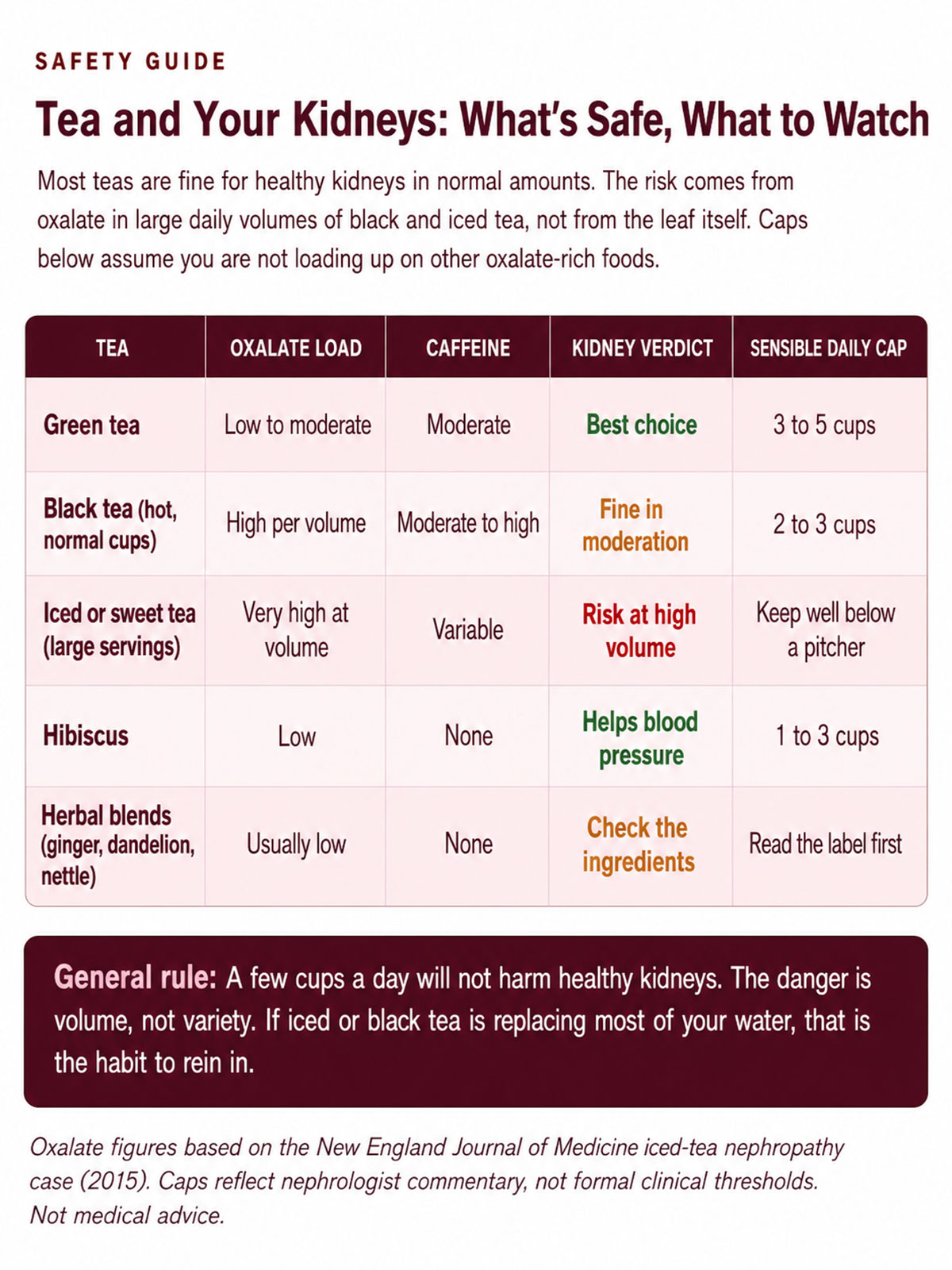
Black tea happens to be one of the richer dietary sources. It carries roughly 50 to 100 milligrams of oxalate per 100 milliliters, a concentration comparable to or higher than many foods regarded as oxalate-rich. At sixteen glasses a day, the Arkansas patient was taking in more than 1,500 milligrams of oxalate daily. The Academy of Nutrition and Dietetics suggests keeping intake under about 40 to 50 milligrams a day.
His habit therefore delivered approximately thirty times the recommended ceiling each day, processed through two organs roughly the size of a fist.
Why Black Tea Is an Oxalate Heavyweight
Oxalate content per 100 ml of beverage or 100 g of food. Black tea sits alongside foods long considered oxalate-rich, which is why volume is what tips it from harmless to harmful.
Values are approximate midpoints from published oxalate data and the 2015 New England Journal of Medicine case report (black tea, 50 to 100 mg per 100 ml). Green tea is generally lower than black. For context, the Academy of Nutrition and Dietetics suggests keeping total daily oxalate under roughly 40 to 50 mg.
So how much is actually too much?
This is the number the headlines leave out. Nephrologists who commented on the case set a reasonable daily ceiling at two to three glasses of black or iced tea for someone who is not also loading up on other oxalate-rich foods. Ramya Malchira, an attending nephrologist at UCLA Health, put the safe range at two to three glasses per day under those conditions.
That is a wide margin of safety for most tea drinkers. A couple of cups will not produce crystals in anyone’s kidneys. Problems arise at the pitcher-a-day end of the scale, particularly in hot climates where iced tea replaces water for extended periods.
One honest caveat: brewing strength and steeping time affect how much oxalate is present in the final cup, and no one has mapped that precisely across every tea and method. The dose matters more than the label, and the dose is more difficult to determine than it should be.
The other half of the story: tea that helps
Moderate tea drinking, however, seems to be genuinely good for the kidneys. A 2025 analysis in the journal Renal Failure followed 17,575 American adults who already had chronic kidney disease, drawn from national health survey data collected between 1999 and 2018. Over the follow-up period, there were 5,835 deaths, including 1,823 from cardiovascular causes.
Tea drinkers in that group had a lower risk of all-cause mortality, with the benefit increasing up to approximately three to five cups per day and showing most clearly in people in the earlier stages of kidney disease. The effect held after the researchers adjusted for diet, smoking, and other health conditions.
That finding deserves a caveat. This was an observational study, so it shows an association, not proof that tea itself extends life. People who sip tea daily may differ in other ways that the data could not fully capture. Still, it points in the opposite direction from the alarming coverage, and it speaks directly to those most likely to have concerns about their daily consumption.
Green tea, in particular, has a plausible mechanism behind it. Its polyphenols, especially a catechin called EGCG, act as antioxidants and reduce inflammation. In animal studies, the evidence is strong: a 2024 review in Phytochemistry Reviews pooled 37 animal studies and found EGCG improved markers of kidney function across the board. Green tea has also been tied to a lower risk of kidney stones.
The honest answer about humans is that the proof is thinner. Most of the strong data comes from animals and lab models, with only small human trials so far, and none large enough to settle whether drinking green tea protects human kidneys over a lifetime. The mechanism is established. The human benefit is promising rather than proven.
Beyond green tea: hibiscus, ginger, and the herbal crowd
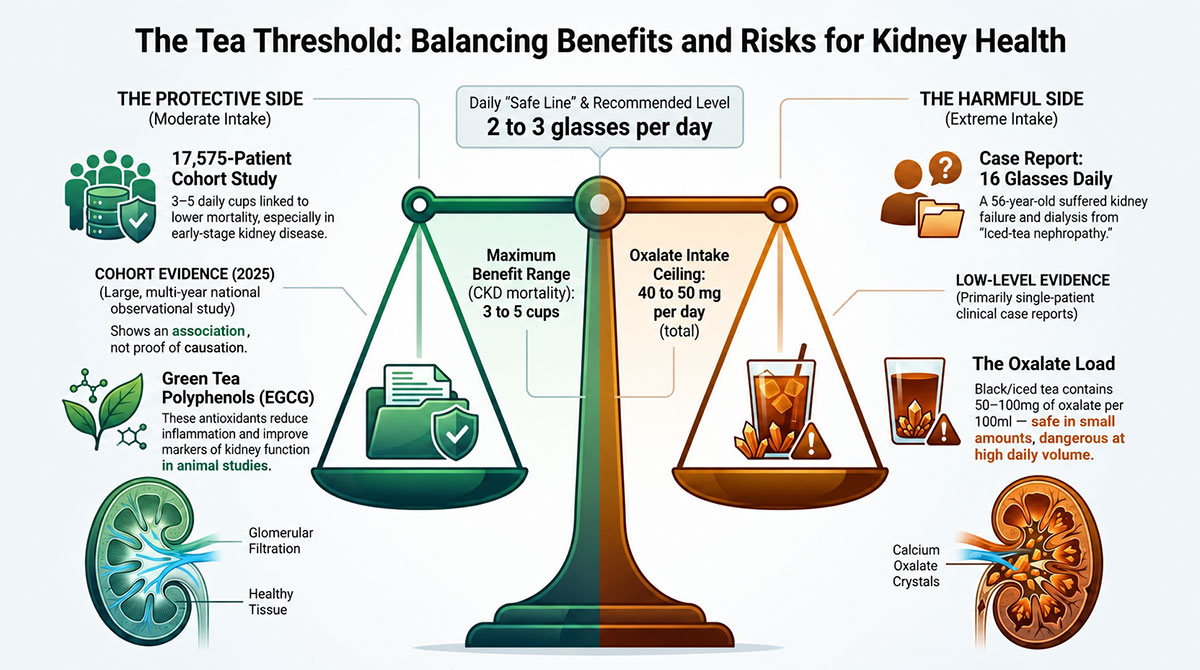
The “kidney” shelf at most tea shops stocks hibiscus, ginger, dandelion root, nettle, and marshmallow root, each marketed as cleansing, flushing, or supporting the organ. The marketing runs well ahead of the science.
Most of these herbal claims rest on tradition rather than clinical trials in people with kidney concerns. Ginger has antioxidant properties. Dandelion and nettle act as mild diuretics, which increase urinary output but do not restore kidney function. The kidney-specific evidence for any of them is sparse, and a few herbal blends carry their own risks, which is the next problem.
Hibiscus is the interesting exception, though not for the reason the labels suggest. Its strongest evidence is for lowering blood pressure, and since high blood pressure is one of the leading drivers of kidney damage, that matters indirectly. It helps the kidneys by protecting the system that feeds them, not by detoxing the organ itself.
What about “kidney cleanse” and “detox” teas?
A common misconception warrants a direct answer. Healthy kidneys filter waste continuously without assistance. No tea has been shown to clear toxins the organs would not eliminate on their own.
The bigger concern is what hides in the blends. The National Kidney Foundation warns that some herbal mixtures contain more potassium or phosphorus than a person with kidney disease should take in, and that unlabeled ingredients can interact with medications. For a healthy person, a cleanse tea is largely an unnecessary expense. For someone with kidney disease, an unknown blend can be a genuine hazard.
Is Your Tea Habit Kidney-Safe?
Three quick questions. No data leaves this page.
If you already have kidney disease
The reassuring news from the 2025 data is that moderate tea is not the enemy many patients assume it to be, and may even sit on the helpful side of the ledger in the earlier stages. A cup or two of plain tea is reasonable for most people. The caution is in the details.
Skip the sweetened bottled teas, which load on sugar and can push blood pressure the wrong way. Check herbal blends for potassium and phosphorus content, or avoid unspecified mixtures altogether. And bring it up with the nephrologist who knows your numbers, because the appropriate amount depends on disease stage and current medications, not on a general guideline.
The line that changes everything
The man in Arkansas was harmed by sixteen glasses of tea a day, not by tea itself. Set aside the alarming headline, and the same beverage that nearly cost him his kidneys is, in ordinary amounts, one of the better beverages a person can drink.
That is what the evidence actually shows. The question was always one of quantity, not of whether tea is beneficial or harmful to the kidneys. It is how much, and the safe amount turns out to be close to what most people already consume.
This article is for general information and is not medical advice. If you have kidney disease or take prescription medication, talk to your doctor before making changes to what you drink.