At 50, something shifts in the body. Movements that once felt automatic start to take more effort. Getting up from the floor, keeping your balance on an uneven sidewalk, lifting something overhead — these things get harder in ways that catch people off guard.
But here’s what research shows: the right kind of yoga practice can reverse that decline. And the timeline is shorter than most people think.
This isn’t about bending into impossible shapes or mastering an ancient discipline. It’s about using your own body weight — smartly, consistently — to rebuild the strength and flexibility that aging quietly takes away.
What’s Happening to Your Body After 50
Starting around age 40, adults lose about 1% of muscle mass per year. After 60, that rate climbs to 2–3% annually. Doctors call this sarcopenia — age-related muscle loss — and it’s one of the main drivers of falls, fractures, and shrinking independence as people get older.
Traditional advice usually points to weight training. That works. But it’s not the only path. For many older adults, heavy lifting means joint pain, a steep learning curve, and a gym environment that feels like it wasn’t built for them.
Yoga offers something different. It uses sustained positions, body-weight resistance, and controlled breathing to build the muscles you use most — while also improving flexibility, balance, and posture in the same session.
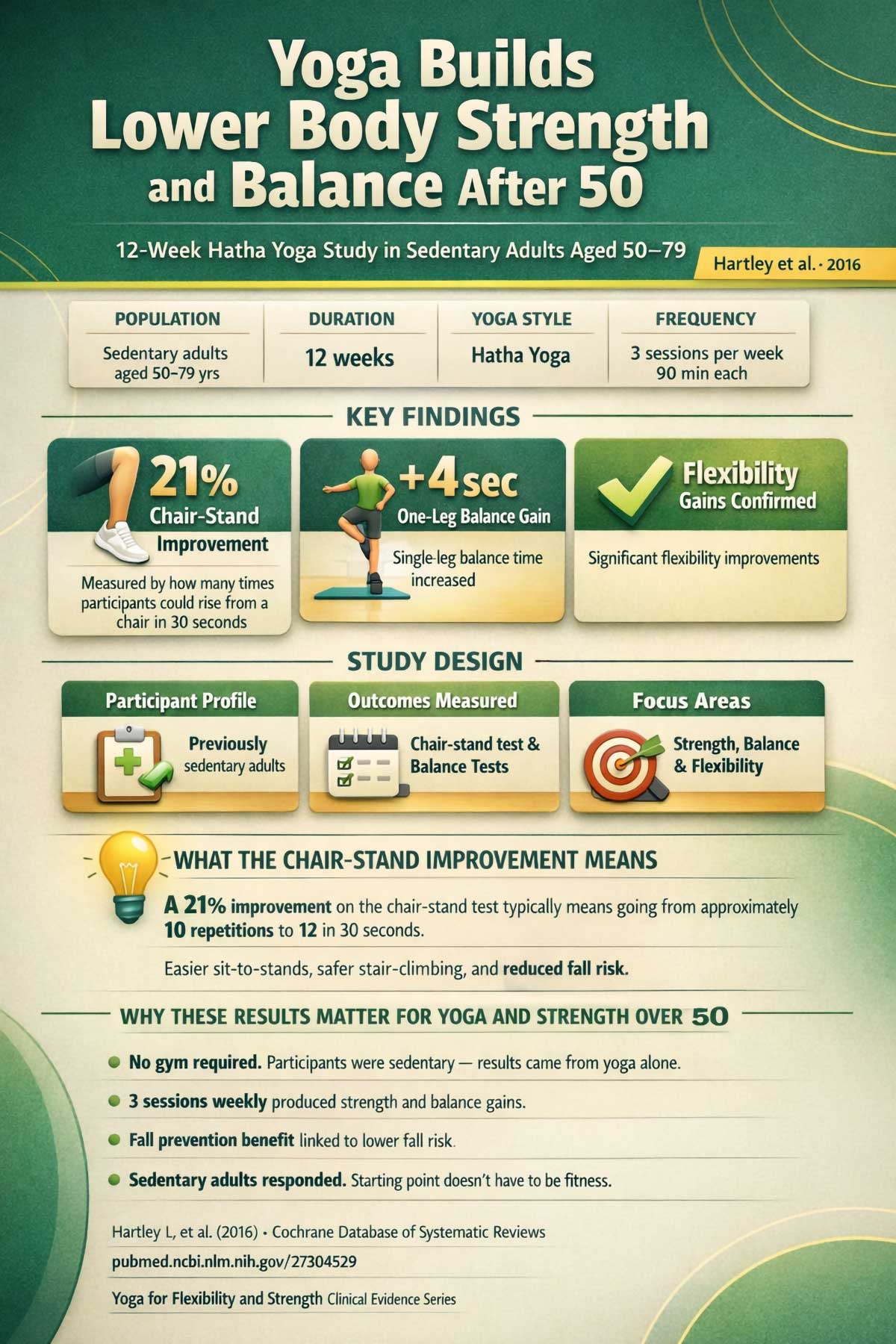
A 2016 study by Hartley et al. followed sedentary adults aged 50–79 through 12 weeks of Hatha yoga, three times a week. By the end, participants improved their chair-stand test score by 21%. That test measures how many times you can rise from a chair in 30 seconds — going from roughly 10 repetitions to 12 represents a real, daily-life gain in strength. Participants also added four seconds to their one-leg balance time — a meaningful result, given that single-leg stability is one of the strongest predictors of fall risk in older adults.
How Often You Need to Practice — and Why It Matters
Most yoga content tells you what to do. Very few articles say how often — or what “consistent practice” actually means in clinical terms.
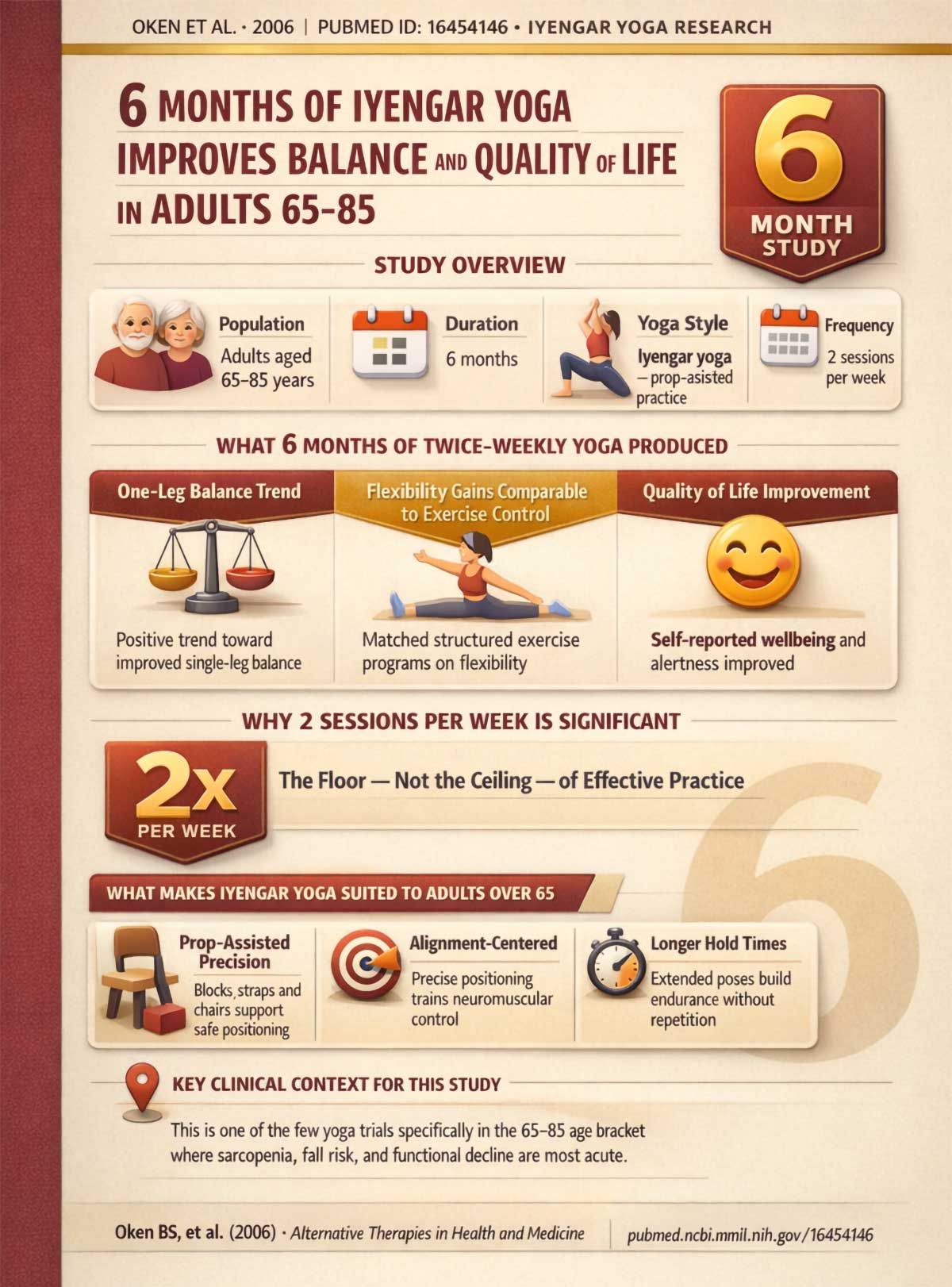
Here’s what the research suggests: two sessions a week gives your body a foundation to work from. Three to four sessions a week is where more significant gains in strength, range of motion, and endurance tend to appear.
A six-month study by Oken et al. (2006) tracked adults aged 65–85 through Iyengar yoga twice a week. That group showed steady, meaningful gains in balance and flexibility — gains that held up against other structured exercise programs, from just two sessions a week. Two sessions is the floor.
For faster and stronger results, frequency matters. A study by Tran et al. (2001) put adults through Hatha yoga four times a week for eight weeks. The participants had a mean age of around 35 — younger than the 50+ focus here — but the strength-building mechanisms involved are not age-specific, and comparable protocols have shown similar patterns in older populations across other trials. In that study, deadlift capacity improved by 13%, curl-up endurance jumped 57%, and flexibility gains ranged from 13% to 188% depending on the joint measured.
The clearest takeaway: two sessions a week builds the habit and maintains what you have. Three to four sessions accelerates the results.
How These 7 Poses Were Chosen
An important note before getting into the poses: none of the studies discussed in this article tested individual yoga poses in isolation. They examined complete yoga programs — Hatha, Iyengar, and Ashtanga — practiced as full sessions over several months.
The research tells us that yoga, done consistently, produces measurable strength and flexibility improvements in adults over 50. It doesn’t isolate which poses drove those results.
The seven poses below were selected based on the muscle groups and movement patterns the studies consistently measured: lower-body strength, single-leg balance, core endurance, and whole-body flexibility. Each pose trains one or more of those patterns and is representative of the kinds of movements used in the programs that produced the research outcomes.
Think of these as a well-reasoned starting set — not a clinical prescription, but a careful translation of what the research shows actually works.
One more thing worth saying: individual results in these studies varied widely. Some participants improved dramatically. Others saw modest changes. The averages reported throughout this article are group findings. Your own results will depend on your starting fitness level, consistency, and overall health.
The 7 Poses
1. Chair Pose (Utkatasana) — Lower Body Strength
Picture sitting down into a chair that isn’t there. Feet hip-width apart, knees bend, arms reach overhead. The lower you sit, the harder your quadriceps and glutes work to hold the position.
This movement directly mirrors the sit-to-stand pattern — the same one the chair-stand test measures. Hatha and Iyengar yoga programs consistently improved that measure in research trials. Chair Pose is the yoga movement that most closely replicates it, making it a logical fit for any program aimed at lower-body strength.
Hold for 20–30 seconds. Rest. Repeat two to three times.
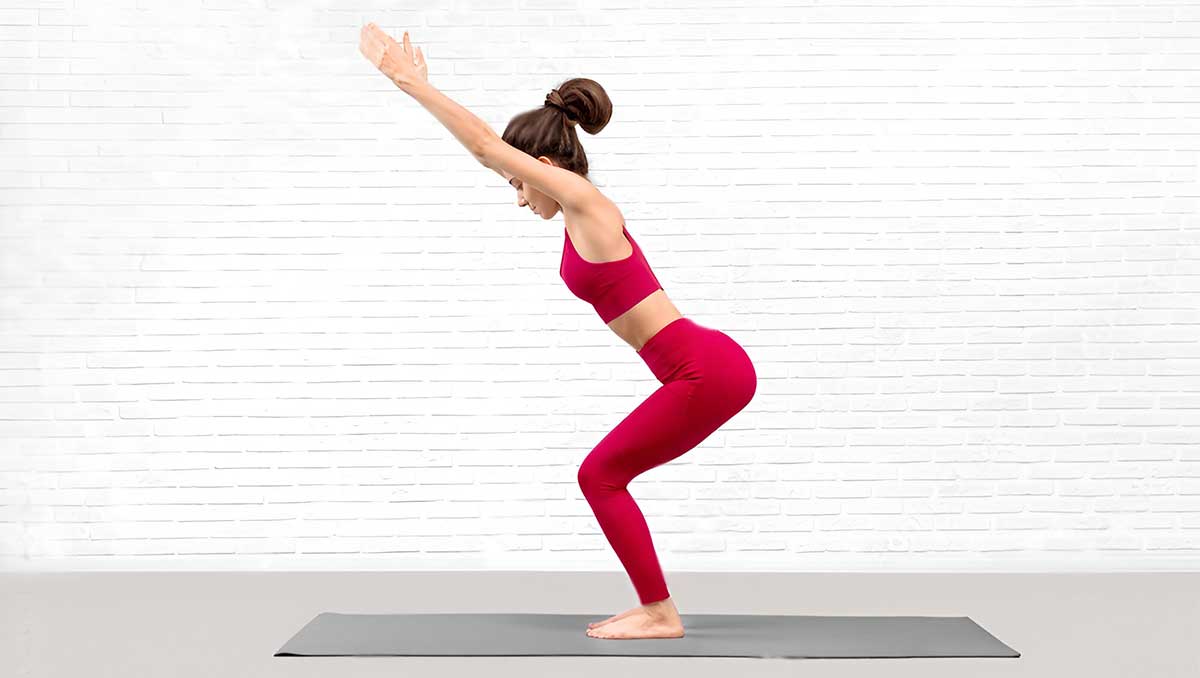
Why it works for 50+: Quads and glutes are the primary muscles for rising from chairs, climbing stairs, and recovering from a stumble. Training them specifically matters.
Safety note: If sharp knee pain appears, reduce the depth of your bend. A shallower position still trains the same muscles with less joint stress.
2. Warrior II (Virabhadrasana II) — Hip Strength and Joint Mobility
Feet step wide apart. The front knee bends into a lunge. Arms extend out to both sides. You hold. That stillness is the point.
Warrior II is isometric training — muscles work under load without moving. This builds endurance and strength without the repetitive joint stress of dynamic exercises like squats or leg presses. It also opens the hips and challenges multiple joints at once.
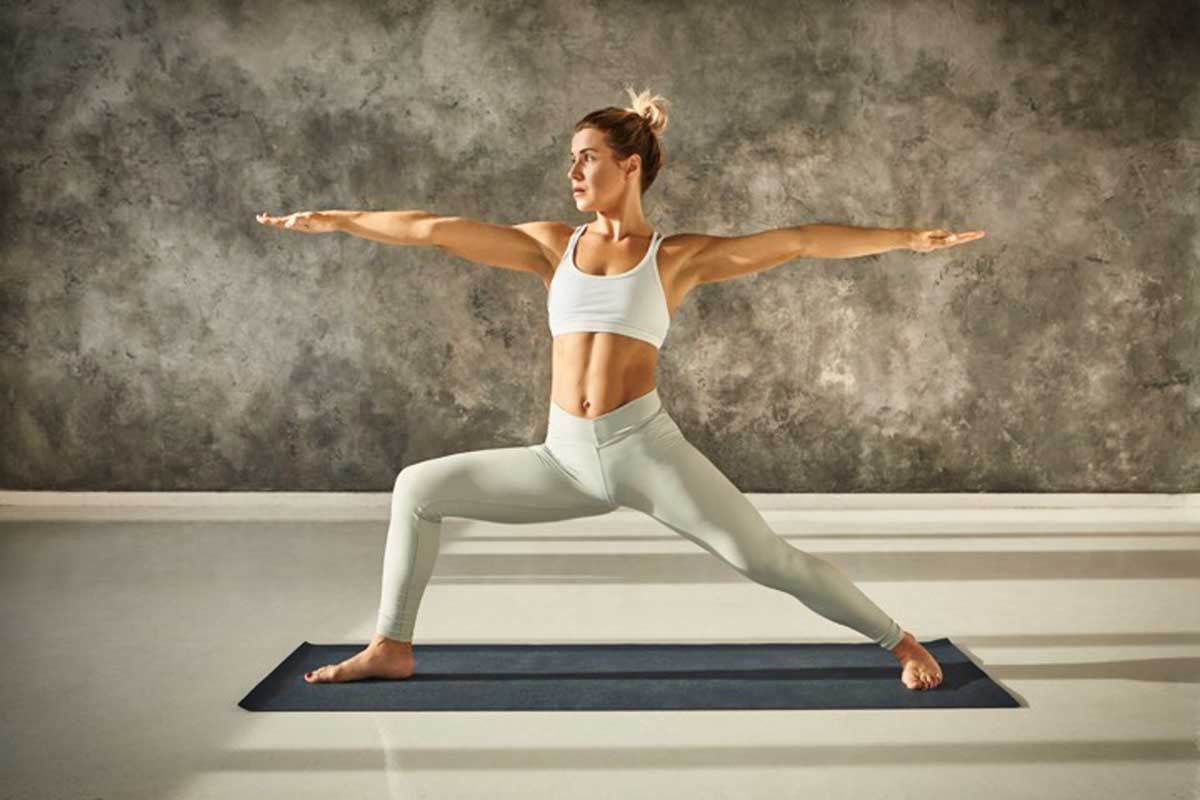
A 2009 study by Chen et al. compared a full Hatha yoga program to standard stretching in adults aged 50–79. The yoga group showed greater gains in knee extension strength and improved range of motion across several joints — results the stretching group didn’t match. Wide-stance, isometric holds like Warrior II are typical of Hatha programs and represent the kind of multi-joint work those outcomes reflect.
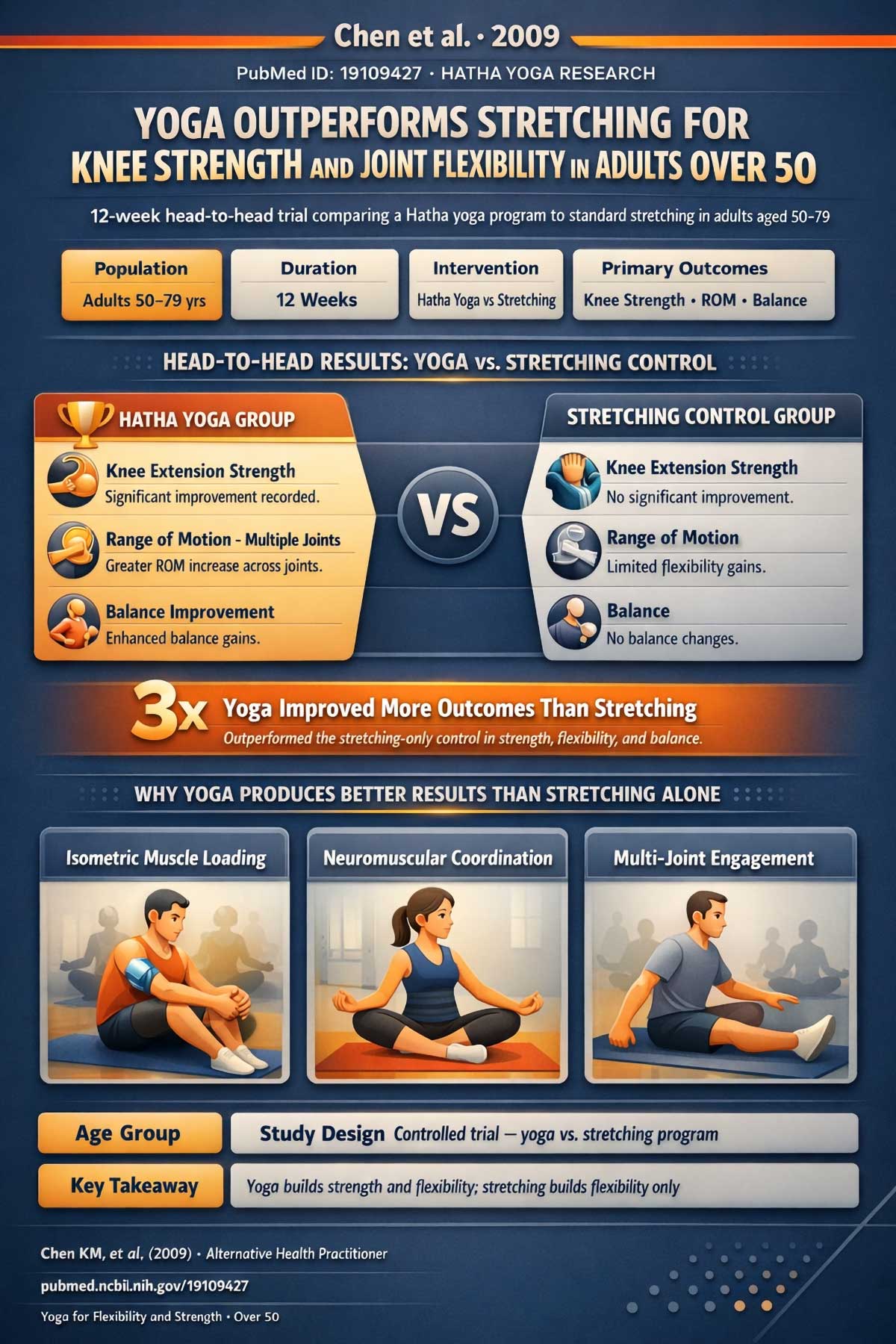
Why it works for 50+: Hip strength and joint mobility tend to decline together. Poses like this train both at the same time.
Safety note: If the front knee tracks past your toes, shorten your stance slightly. The knee should stay stacked above the ankle.
3. Plank Pose (Phalakasana) — Upper Body and Core Endurance
A straight line from head to heels, supported by hands and toes. Every muscle in the midsection fires to keep the body rigid. Shoulders, chest, and arms work to hold position.
For adults who spend most of the day seated, the muscles plank targets have often been inactive for years. This pose wakes them up. It builds shoulder stability, trains the deep abdominals, and creates the kind of upper-body endurance that makes everyday tasks — pushing open a heavy door, catching yourself on a wet floor — feel less effortful.
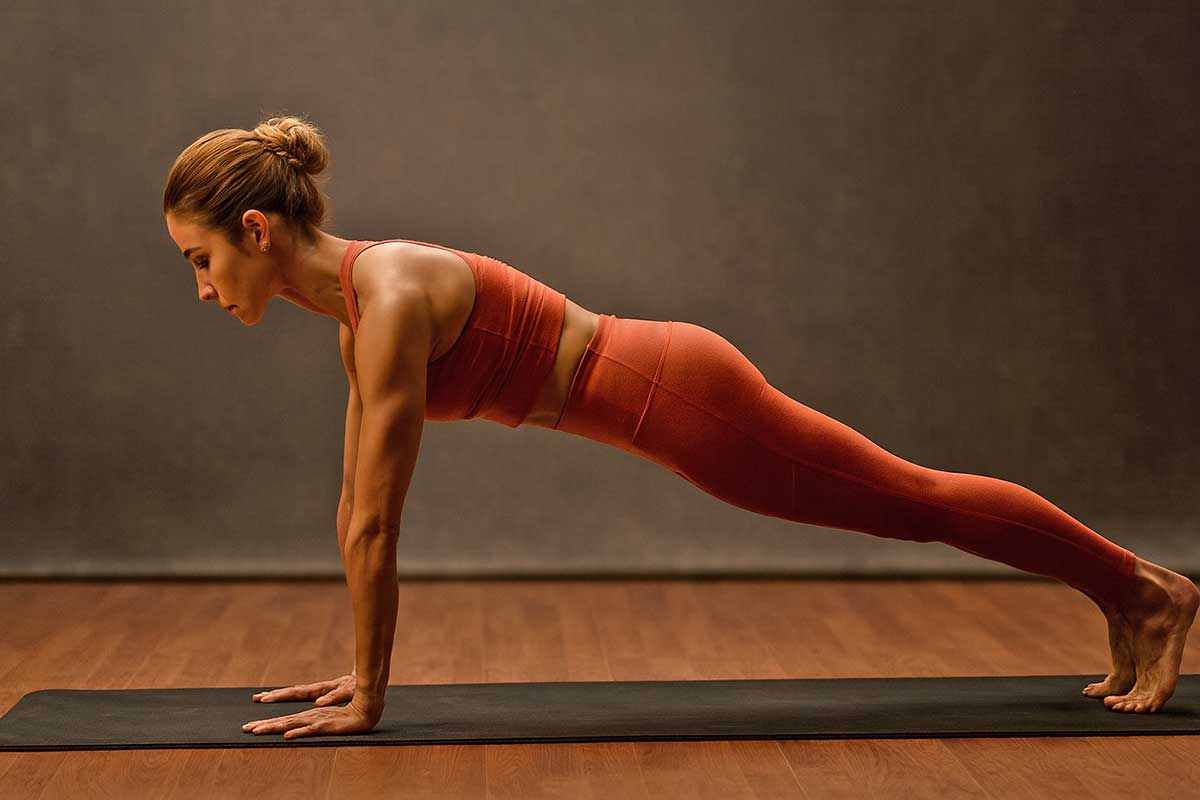
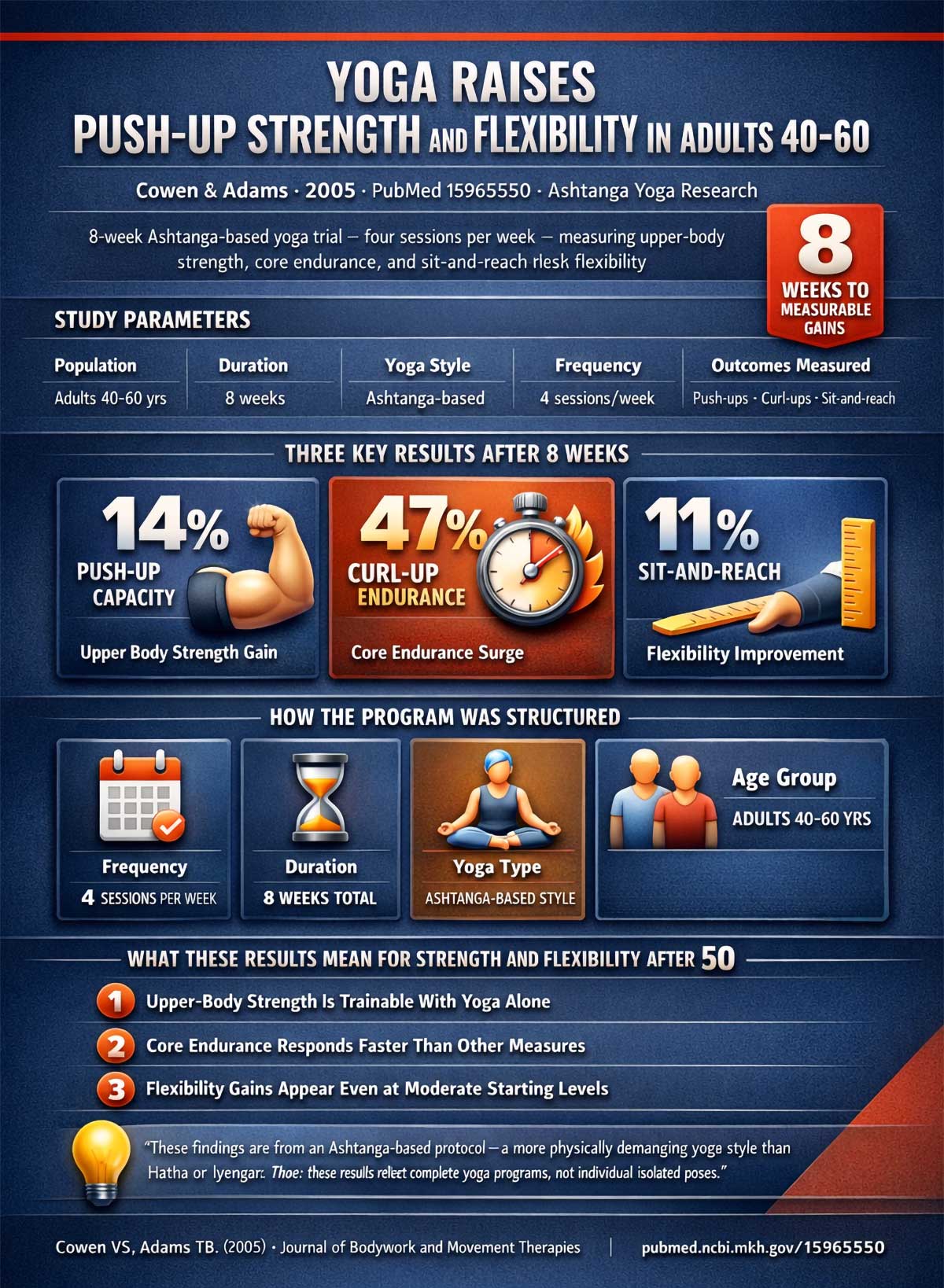
A study by Cowen and Adams (2005) followed adults aged 40–60 through eight weeks of Ashtanga-based yoga, four times a week. Push-up capacity increased by 14% and curl-up endurance rose by 47%. Plank-style holds are a standard component of Ashtanga practice. These results reflect the kind of upper-body adaptation that sustained core and arm work produces across yoga programs.
Why it works for 50+: Core strength underpins almost every other movement. It also protects the spine and contributes to stability during daily activities.
Safety note: For wrist discomfort, shift to forearm plank. Spread your fingers wide and press through all four corners of your hand to reduce strain at the wrist.
4. Tree Pose (Vrksasana) — Single-Leg Balance
Stand on one leg. Place the other foot on your inner calf or thigh. Hold. It sounds simple. It isn’t.
Single-leg balance is one of the most direct measures of fall risk in older adults. Training it builds the communication between your brain and lower body — the reflexes that catch you when you slip, step off a curb wrong, or turn quickly.
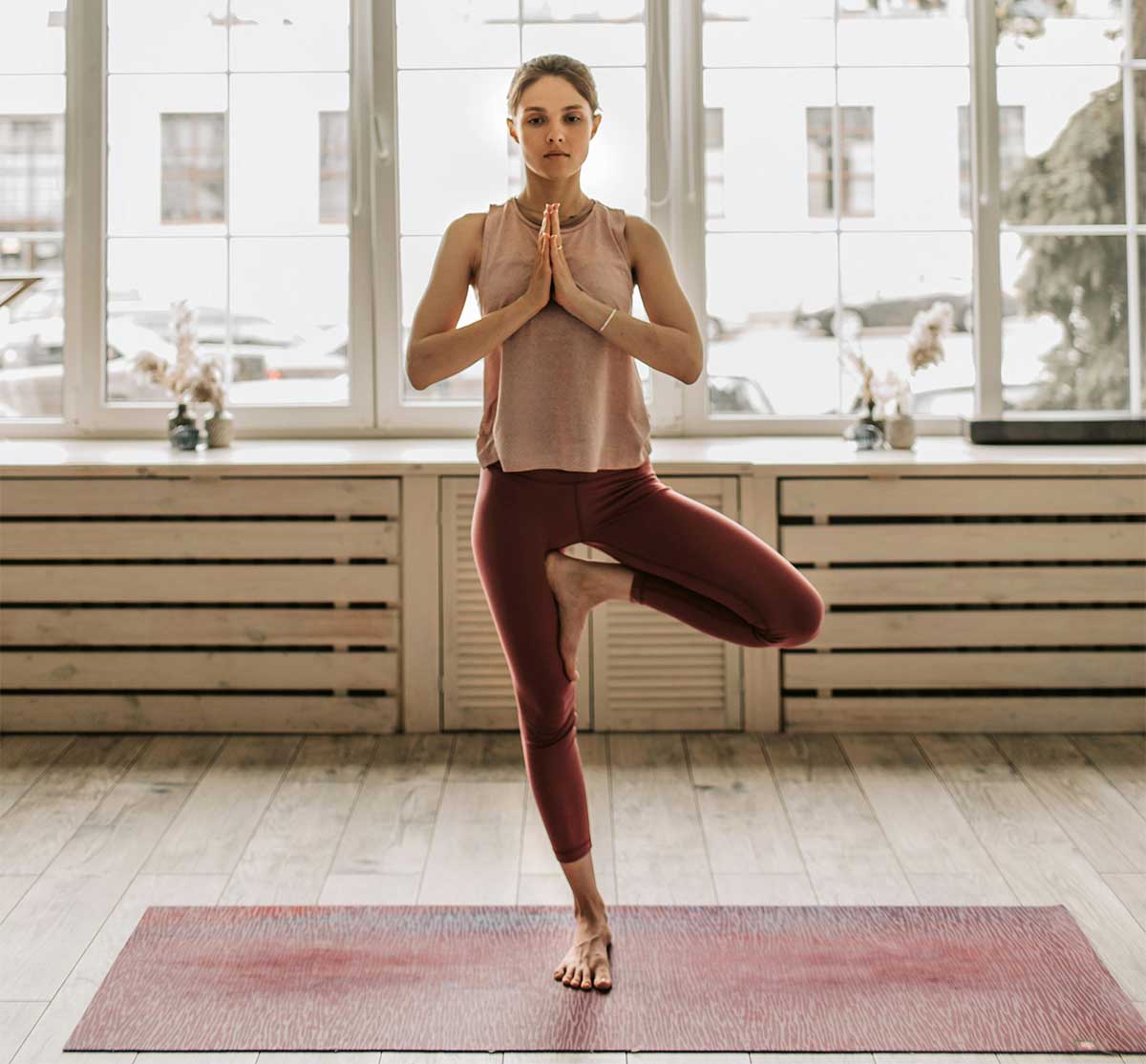
The Hartley et al. study found that after 12 weeks of Hatha yoga practice, participants improved their one-leg balance time by four seconds. That may sound like a small number. In terms of fall prevention, it’s not — those extra seconds represent a meaningful increase in the body’s ability to self-correct before a stumble becomes a fall.
Why it works for 50+: Balance is a nervous system issue as much as a muscle issue. Poses that demand single-leg stability build the coordination that keeps the body upright in real-world conditions.
Safety note: Start with one hand touching a wall or chair back. Progress to a fingertip touch, then to free-standing balance over several weeks.
5. Downward-Facing Dog (Adho Mukha Svanasana) — Flexibility and Spinal Length
An inverted V-shape. Hands flat on the floor, hips pressing up and back, heels reaching toward the ground. The hamstrings and calves lengthen. The spine decompresses. The shoulders and arms work to support the position.
What makes this pose different from a simple hamstring stretch is that the muscles are active while they lengthen. The arms hold load. The back stays engaged. This combination — strength alongside stretch — is part of why yoga programs tend to outperform stretching-only protocols in flexibility research.
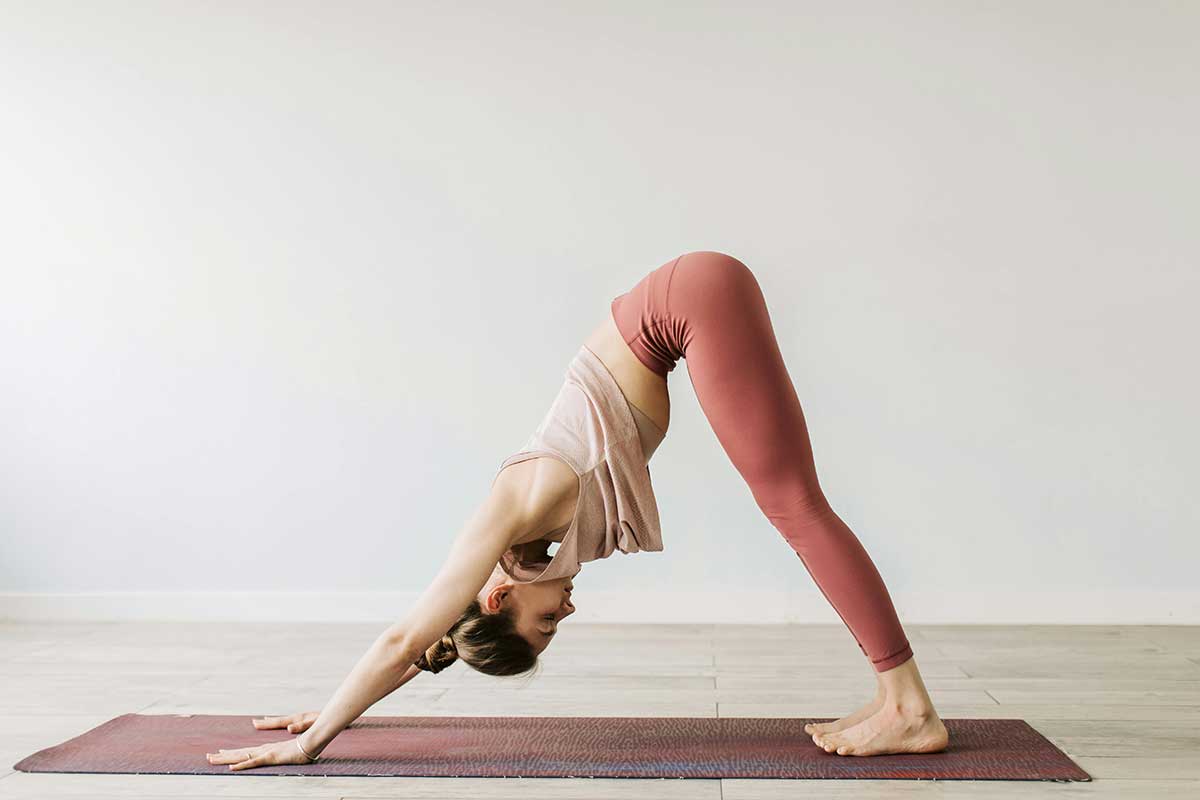
The Chen et al. study, which compared Hatha yoga directly to a stretching control group, found yoga participants gained greater range of motion across multiple joints. Active stretching movements that combine load-bearing and length, like Downward Dog, are characteristic of that kind of program.
Why it works for 50+: Tight hamstrings and compressed spinal discs are among the most common physical complaints after 50. This pose targets both.
Safety note: Bent knees are completely fine — prioritize length through the spine over straightening the legs. Avoid this pose if you have uncontrolled high blood pressure.
6. Boat Pose (Navasana) — Core and Hip Flexor Strength
Sit on the floor, lean back slightly, and lift both feet off the ground. The body makes a V-shape. The hip flexors, lower abdominals, and deep stabilizing muscles all engage to hold it.
Weak hip flexors affect walking speed, stair-climbing ability, and the capacity to lift the feet high enough to clear obstacles — a key factor in trip-related falls. Boat Pose places direct demand on this muscle group in a way that few other yoga positions do.
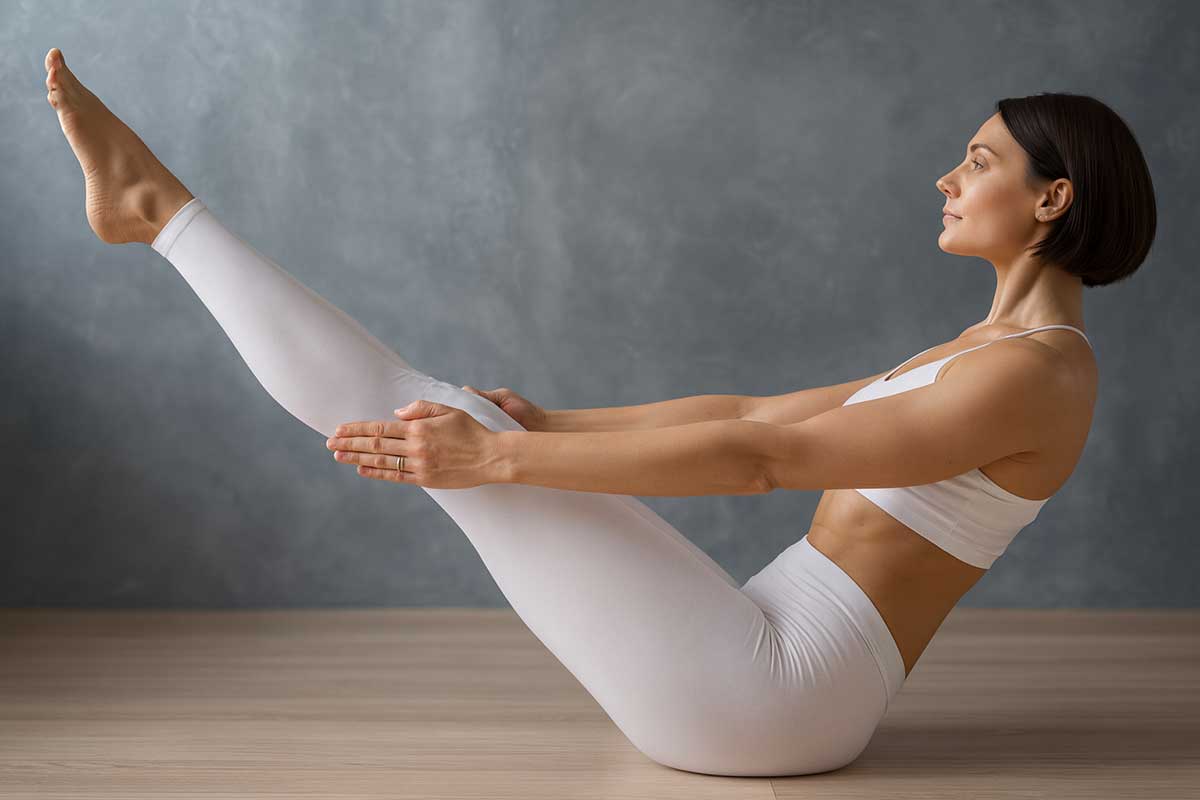
The Tran et al. study — which used a younger adult population but measured the same core endurance patterns — found that an eight-week Hatha yoga program produced a 57% increase in curl-up endurance. Core-intensive, hip flexor-heavy poses like Boat are common in Hatha programs, and this kind of sustained effort is what drives those endurance gains.
Why it works for 50+: The core muscles link the upper and lower body. A weak core shows up as back pain, poor posture, and reduced stability during daily movement.
Safety note: Start with feet resting on the floor and hands gripping the backs of your thighs. Only lift the feet once you can hold the position without rounding the lower back.
7. Cobra Pose (Bhujangasana) — Posture and Spinal Extension
Lie face down. Hands under the shoulders. Press the chest off the floor using the muscles of the upper and middle back. The chest opens. The shoulders draw back and down.
Years of sitting — at desks, in cars, on couches — reinforce a forward-rounded posture. The chest closes. The upper back weakens. This shape compresses the lungs, strains the neck, and shifts balance forward in ways that increase fall risk over time.
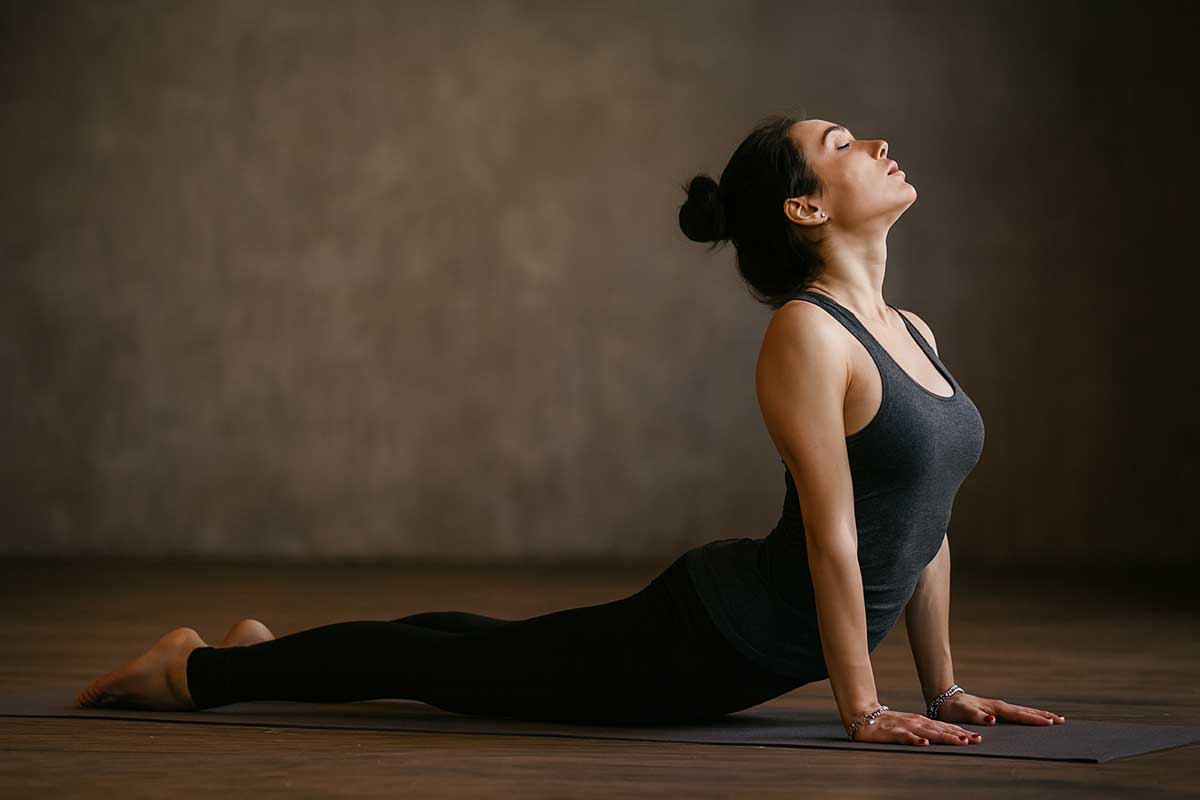
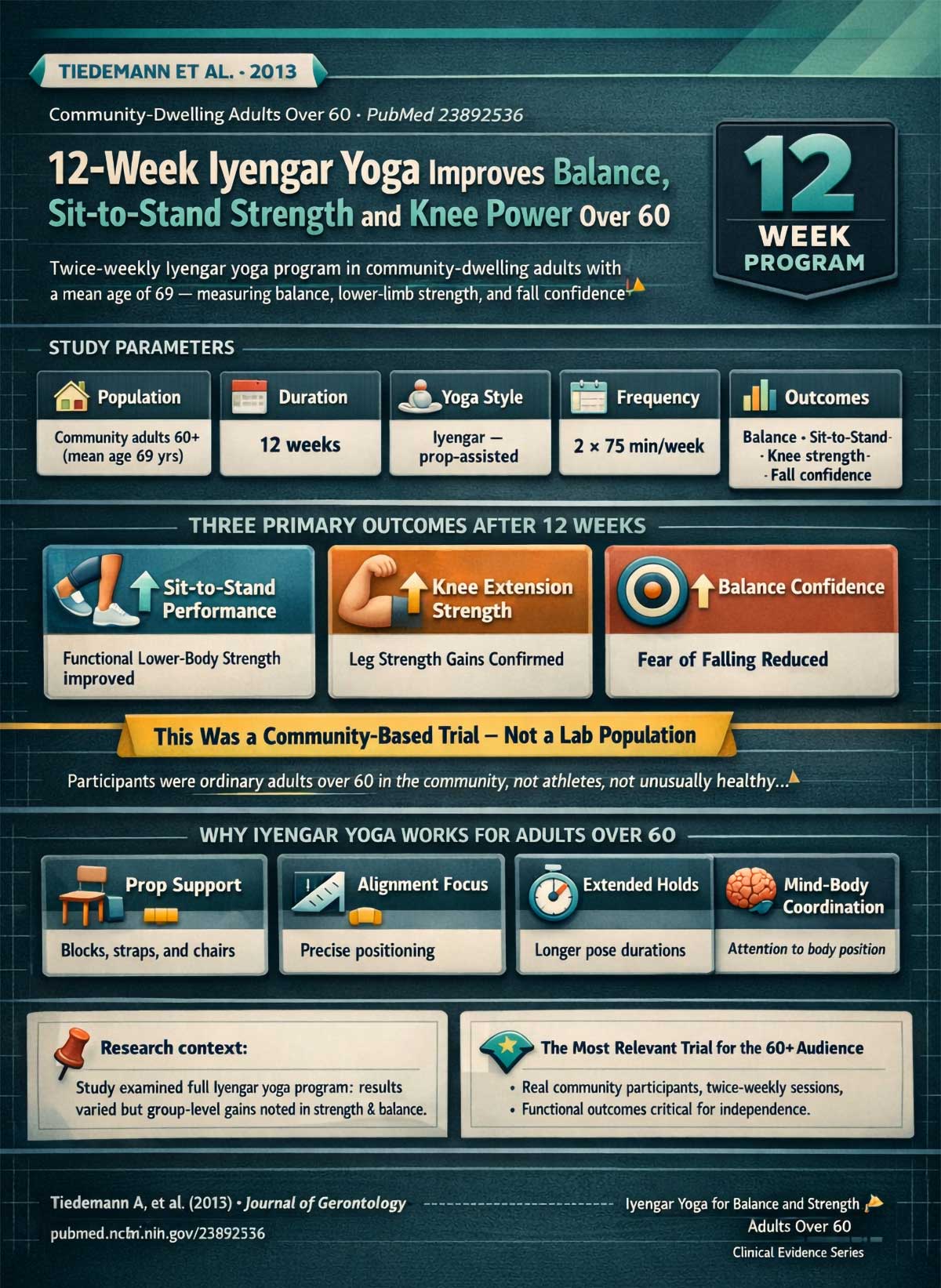
Cobra works directly against that pattern. Spinal extension work is a central feature of Iyengar yoga, the style examined in the Tiedemann et al. study (2013), which tracked adults over 60 through 12 weeks of twice-weekly practice. That group improved sit-to-stand performance, knee extension strength, and balance confidence. Poses that restore upright spinal posture are part of how Iyengar programs are built, and they’re a sensible addition to any routine aimed at those outcomes.
Why it works for 50+: Better posture means better breathing, less neck tension, and a more stable stride.
Safety note: Keep a slight bend in the elbows and stop if you feel sharp pain in the lower back. You don’t need to straighten your arms fully to get the benefit.
A Note on Yoga Styles
The studies referenced here draw from three different traditions: Hatha, Iyengar, and Ashtanga. These are not the same practice.
Hatha is a broad, moderate-paced style focused on posture and breath. It’s the most common form and a practical starting point for most people. Iyengar is precision-based — it uses props like blocks, straps, and chairs to help people hold positions safely and correctly. This makes it especially well-suited to older adults with joint concerns. Ashtanga is the most demanding of the three, involving set sequences performed at a brisk pace.
All three produced meaningful results in the research. The poses above appear across these traditions in various forms. If you’re new to yoga, Hatha or Iyengar are typically the most accessible entry points — especially if joint sensitivity or balance are factors.
Your 12-Week Framework
This framework is a progressive structure built on the combined timelines of multiple studies. It’s not drawn from a single trial but reflects the patterns that appear consistently across the research.
Weeks 1–4: Learn the Movements
Start with two sessions a week. Prioritize form over depth or duration. Hold each pose for 15–20 seconds. Rest fully between poses. The goal in this phase is to build a repeatable routine and let the body learn the positions before asking it to work harder.
This is where most people stop. Keep the sessions short, manageable, and consistent.
Weeks 5–8: Add Time Under Tension
Move to two to three sessions per week. Begin holding poses longer — 25 to 40 seconds each. This is where the body starts adapting. Muscles build endurance. The positions that felt unstable begin to feel more controlled.
Both the Tran et al. and Cowen and Adams studies found measurable strength and endurance gains within eight weeks of regular practice at this kind of frequency. This is the phase where those changes begin to appear.
Weeks 9–12: Build Frequency for Bigger Gains
Aim for three to four sessions per week. By this point, form is established and the body can handle more repetition. Flexibility tends to accelerate in this window. The Hartley et al. study found significant gains in chair-stand performance and balance at the 12-week mark with three sessions per week.
Expect improvements in how you move through daily tasks — rising from chairs, climbing stairs, moving on uneven ground.
What 8–12 Weeks Can Realistically Look Like
The research shows meaningful averages. But “meaningful” in clinical terms translates differently for different people.
A 21% improvement on the chair-stand test might mean going from 10 repetitions to 12 in 30 seconds. For someone who has been struggling to get off the couch, that’s significant. For someone already fairly active, it may feel modest. Four additional seconds of one-leg balance may not sound like much — until you realize that’s often the difference between catching yourself and hitting the floor.
Individual results varied across every trial reviewed here. Some participants saw dramatic changes. Others saw smaller shifts. What the research consistently shows is that regular practice — done at the right frequency, over 8 to 12 weeks — produces real, physical improvements in the things that matter most after 50.
Conclusion
Yoga is a practical, research-supported method for rebuilding the strength, balance, and range of motion that tends to fade with age.
Two sessions a week starts the process. Three to four sessions a week drives it further. Eight to twelve weeks is when the changes become measurable — in how a body performs in a clinical test, and in how it feels to move through a regular day.
A mat and some floor space is all the equipment required. The seven poses here target the muscle groups and movement patterns that the research consistently links to improved function in adults over 50. They’re a starting point, not a ceiling.
Pick two sessions this week. Show up for both. Then decide what comes next.