Your muscles don’t care about gym memberships. Science says 12 minutes, twice a week, triggers real growth. Here’s the exact routine.
You’re doing everything right. You eat well, you stay active, and yet something feels off. Your clothes fit differently. Climbing stairs takes a little more effort. That jar lid that used to twist open easily? Not so much anymore.
This isn’t just aging. It’s muscle loss, and it starts earlier than most people think.
By your early 40s, your body naturally begins shedding muscle tissue. Doctors call this sarcopenia. It’s a slow, quiet process at first, losing roughly 1% of muscle mass per year after 40. But after 50, that rate can nearly triple. By 60, the effects on your strength, balance, and daily energy become hard to ignore.
You don’t need a gym. You don’t need heavy weights. And you don’t need to spend an hour a day exercising. The latest science shows that as little as 12 focused minutes, done twice a week, is enough to trigger real muscle growth at any age.
This is a guide built on that science. It’s written for the 41-year-old who’s just starting to notice the changes, and the 59-year-old who wants their strength back. The routine is different for each stage of life, and we’ll show you exactly why.
The Science of Training Smarter, Not Longer
Most fitness content talks about training hard. What it rarely tells you is that, for adults over 40, training smart matters far more than training long.
You Don’t Need to Train Every Day
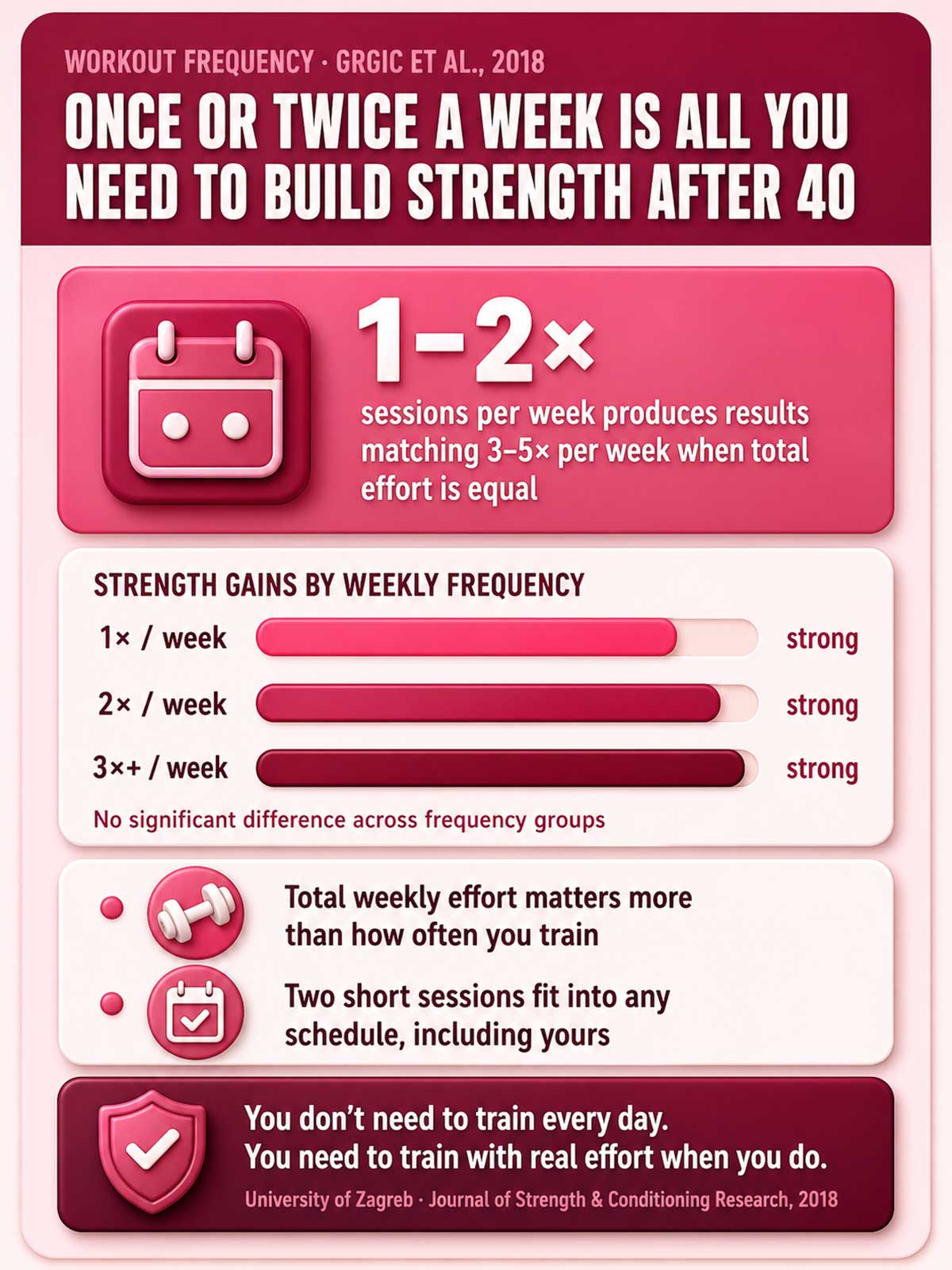
A 2018 analysis by Grgic and colleagues looked at how training frequency affects strength gains. Their review found that when total weekly effort stays the same, training once or twice a week produces results that match training three or more times a week. What matters most is how hard you work during each session, not how many sessions you log.
This is good news if the idea of a daily gym schedule feels impossible.
An earlier paper by Borde and colleagues (2015), which reviewed dose-response data from older adults aged 65 and up across trials running from nine to 52 weeks, reinforced this point. Their analysis found that training intensity and time under tension matter far more than the total time you spend exercising. Short sessions with real effort beat long, lazy workouts every single time.
Light Weights Build Real Muscle
This is the finding that changes everything for people who are intimidated by heavy lifting.
In 2012, Mitchell and colleagues published a landmark study showing that lifting lighter loads to the point of near-fatigue produces the same muscle growth as lifting heavy weights. The key variable isn’t the weight itself. It’s whether your muscles are genuinely challenged by the end of each set.
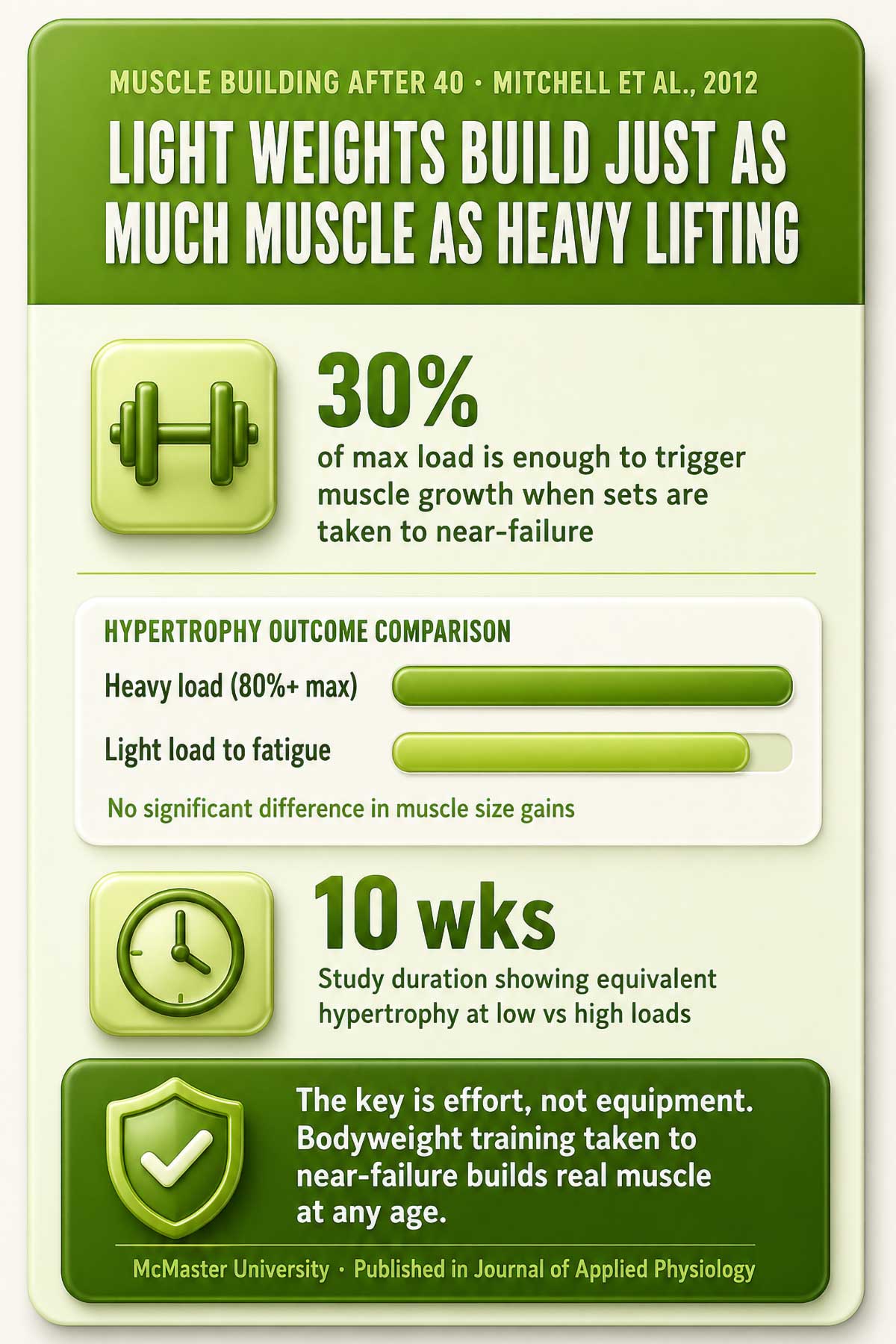
A meta-analysis by Loenneke and colleagues, published the same year, confirmed this across a wider body of research. Low-load training was shown to be a clinically sound method for stimulating muscle growth (hypertrophy), even in older populations with joint concerns or limited mobility. This means bodyweight exercises, done with proper form and effort, are not a compromise. They’re a legitimate tool.
Older Bodies Respond Differently at Different Ages
A person in their early 40s still has strong hormonal support for muscle growth. The nervous system is still highly adaptive. The main challenge is consistency and learning proper form.
By the mid-to-late 50s, the picture shifts. Hormonal changes (declining estrogen in women, declining testosterone in men) begin to slow muscle protein synthesis. Recovery takes longer. The joints carry more history. This doesn’t mean less progress is possible. It means the approach needs to be smarter: shorter sessions, more controlled movement, and a stronger focus on not skipping the warm-up.
Before You Start: The Warm-Up That Actually Matters
Cold muscles tear. Warm muscles adapt. For adults over 40, three to five minutes of gentle movement before training is not optional.
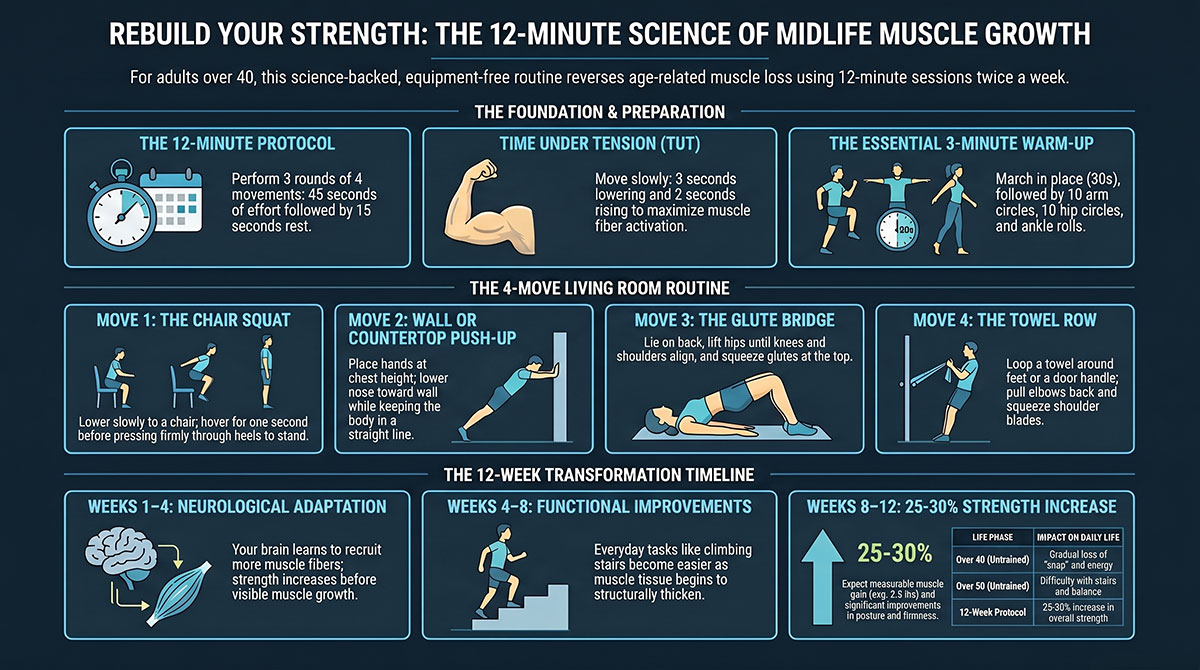
Start with 30 seconds of slow marching in place to raise your heart rate slightly. Follow with 10 slow arm circles in each direction to open the shoulder joint. Then do 10 gentle hip circles, standing with hands on hips, to prepare the lower back and hips for load. Finish with five slow ankle rolls on each foot.
This isn’t wasted time. Your joints need a little more preparation now than they did at 25. Giving them that preparation is what keeps you training consistently for months, not days.
The 12-Minute Living Room Routine
Here’s how the routine works. You’ll perform five movements. Each movement gets 45 seconds of effort followed by 15 seconds of rest. You’ll complete three full rounds. That’s 15 minutes of actual training.
The secret to making this work is something called Time Under Tension, or TUT. This means you move slowly and deliberately, taking two to three seconds going down into each movement and two seconds coming back up. This keeps your muscles under continuous load, which is exactly what triggers growth signals in the body.
Don’t rush. Slow is strong.
Move 1: The Chair Squat
Why it works: This is functional strength at its most direct. Standing up from a chair, climbing stairs, stepping off a curb, all of these daily movements rely on the same muscles this exercise trains: the quadriceps, glutes, and hamstrings.
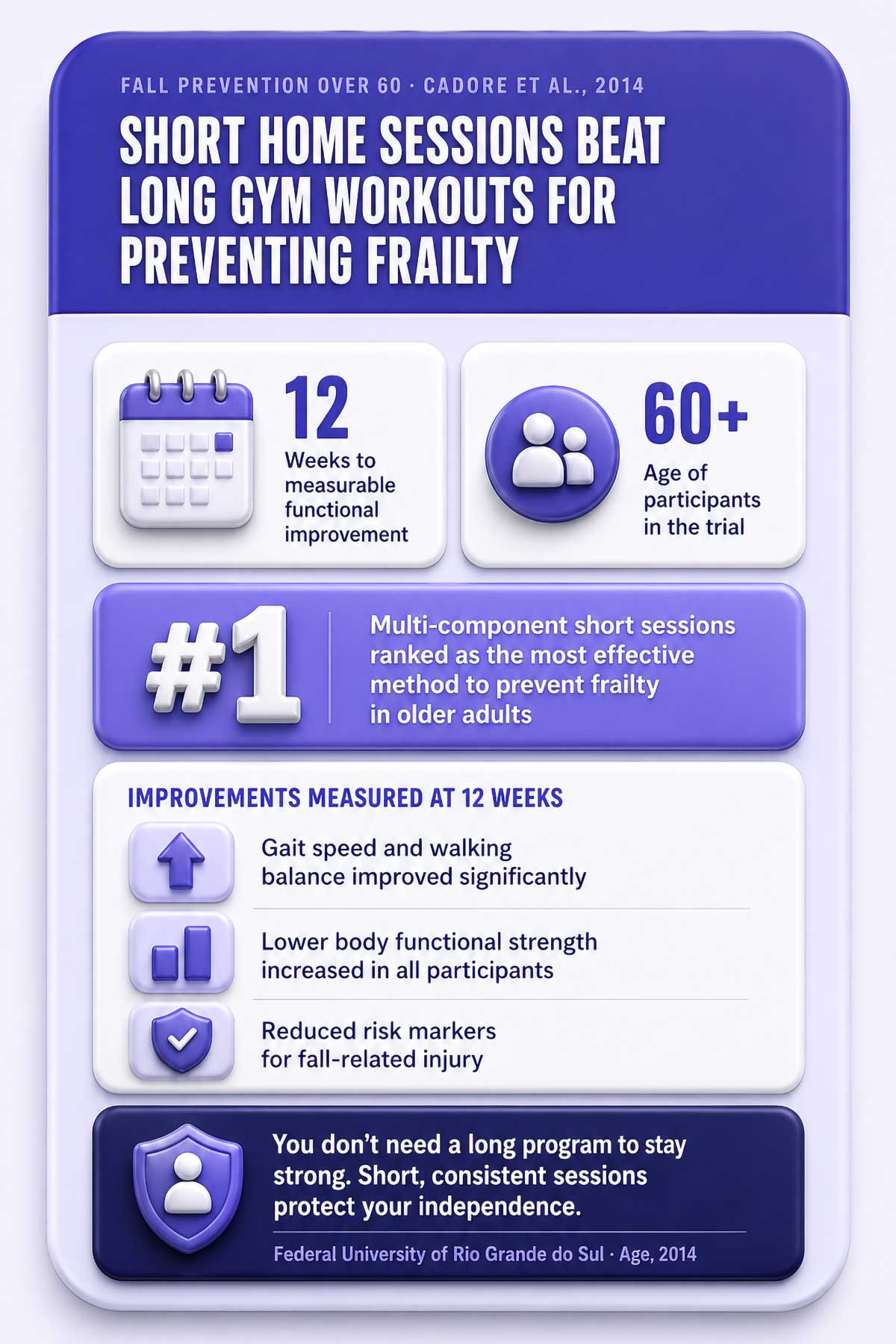
A 2014 study by Cadore and colleagues, which followed adults over 60 through a 12-week program, found that short, multi-component sessions like this one were the most effective approach for preventing frailty and improving functional strength. The chair squat checks every box: it’s safe, it’s scalable, and it directly maps to movements that keep you independent.
The chair squat checks every box: it’s safe, it’s scalable, and it directly maps to movements that keep you independent.
Step by step:
- Place a sturdy chair behind you on a flat, non-slip surface.
- Stand with your feet hip-width apart, toes pointing slightly outward, with your back to the chair.
- Extend your arms in front of you for balance or cross them over your chest.
- Take two to three seconds to hinge at the hips and lower yourself slowly, as if you’re about to sit down.
- Stop just before your weight settles onto the seat, hovering an inch above it.
- Press firmly through your heels and take two seconds to stand back up to the starting position.
- At the top, squeeze your glutes briefly before starting the next rep.
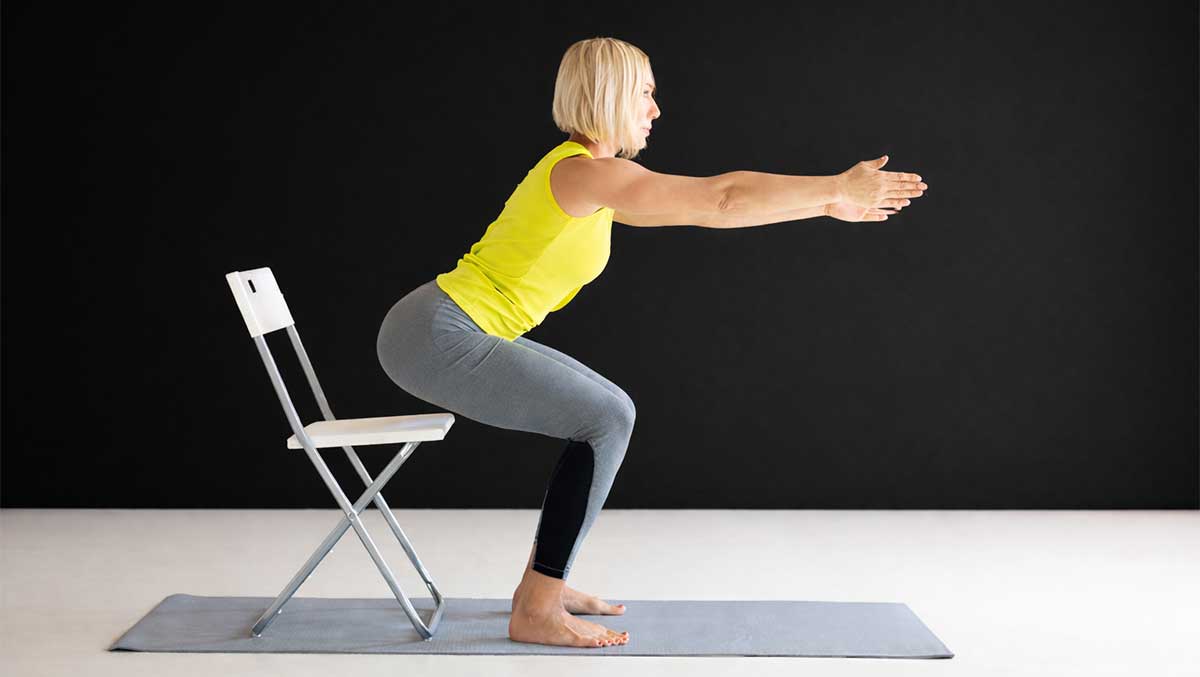
For adults in their 40s: aim to hover without touching the chair at all. For adults in their 50s or beyond: a light touch on the seat is fine. Just don’t rest your full weight between reps.
Breathing: Inhale on the way down. Exhale as you push up.
Move 2: The Wall Push-Up or Countertop Push-Up
Why it works: Floor push-ups are excellent, but they place significant load on the wrists and shoulders. For many adults over 40, especially those with desk jobs or previous shoulder issues, a wall or countertop push-up is not a lesser version. It’s a smarter version.
A 2011 study by Tschopp and colleagues reviewed resistance training approaches in older adults and found that bodyweight and low-resistance training produced meaningful improvements in upper body power and overall mobility. The key was progressive challenge, which means making the movement slightly harder each week.
Step by step:
- Stand facing a wall, roughly arm’s length away. Place your palms flat on the wall at chest height, slightly wider than shoulder-width apart.
- Step your feet back slightly so your body is at a mild angle to the wall. Keep your feet together or hip-width apart, whichever feels more stable.
- Engage your core so your body stays in a straight line from head to heels throughout the movement.
- Take two to three seconds to bend your elbows and lower your chest toward the wall in a controlled way.
- Stop when your nose is close to the wall without touching it.
- Take two seconds to push back to the starting position without locking out your elbows at the top.
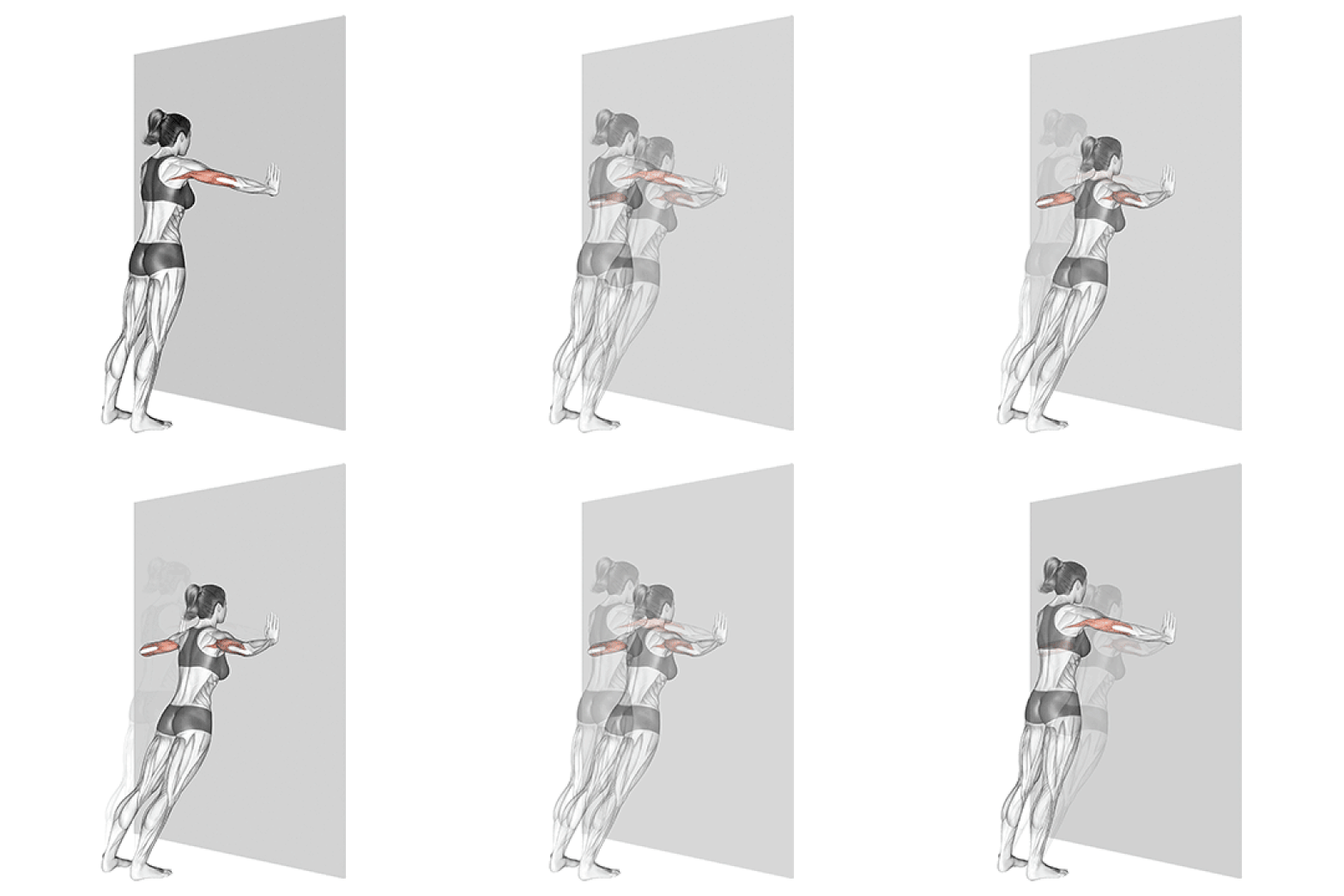
To progress over time: after two weeks at the wall, move to a countertop angle. After four weeks, try a sturdy table. The lower the surface, the more challenging the movement becomes.
For adults in their 40s: aim for the countertop or table angle from week one if you’re reasonably active. For adults in their 50s with shoulder sensitivity: begin at the wall and move to the next level only when every rep feels fully controlled.
Breathing: Inhale as you lower. Exhale as you push away.
Move 3: The Glute Bridge
Why it works: If you sit for more than four hours a day, your glutes are likely underactive. This is one of the most common and least-discussed contributors to lower back pain in middle-aged adults. The glute bridge directly activates the posterior chain, which includes the glutes, hamstrings, and lower back stabilizers, all of which are essential for fall prevention and pain-free daily movement.
Step by step:
- Lie on your back on a mat or carpeted surface. Bend both knees and place your feet flat on the floor, hip-width apart, with your heels about a foot from your glutes.
- Rest your arms at your sides with your palms facing down for stability.
- Take a breath in. On the exhale, press firmly through both heels and lift your hips off the floor in a slow, controlled movement over two seconds.
- Rise until your body forms a straight line from your knees to your shoulders. Do not push beyond this point, as going higher arches the lower back and takes the work away from the glutes.
- Squeeze your glutes firmly at the top and hold for one full second.
- Take two to three seconds to lower your hips back to the floor with control.
- Touch the floor briefly without resting your full weight, then go straight into the next rep.
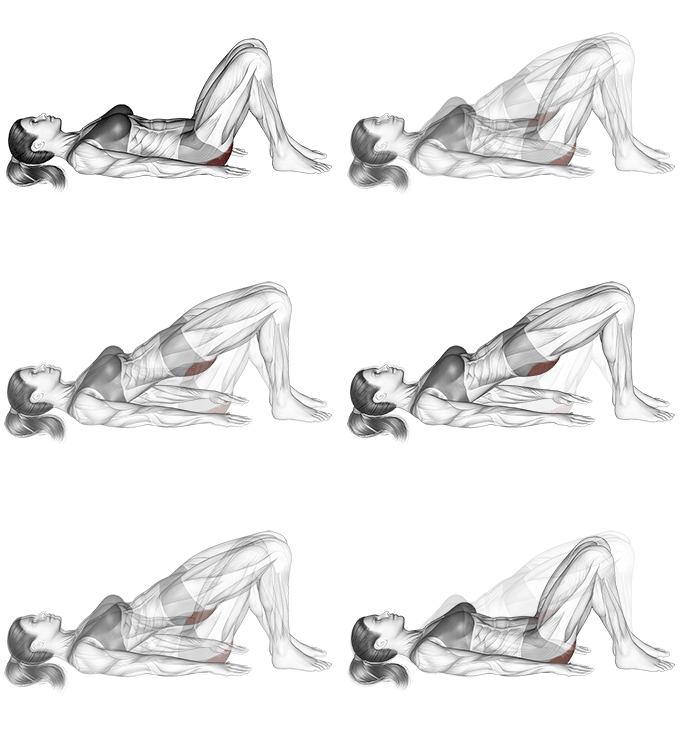
For adults in their late 50s who experience lower back discomfort: place a folded towel under the lower back for light support and reduce the range of motion slightly until strength builds over the first few weeks.
Breathing: Exhale as you lift. Inhale as you lower.
Move 4: The Towel Row
Why it works: Most home exercise routines focus entirely on pushing movements like squats and push-ups, and skip pulling movements almost entirely. This creates a muscular imbalance that worsens posture and increases shoulder injury risk. For anyone spending hours at a desk or phone, the muscles of the upper back are likely already overstretched and weak.
The Towel Row fixes this. It trains the rhomboids, rear deltoids, and biceps, which are the muscles responsible for pulling the shoulders back and keeping the spine upright.
Step by step (floor version):
- Sit on the floor with your legs extended in front of you. If your hamstrings are tight, sit on a folded blanket to tilt your pelvis slightly forward.
- Fold a bath towel lengthwise and loop it around the soles of both feet. Hold one end in each hand with a relaxed grip.
- Sit tall with your back upright, not leaning backward. This is your starting position.
- Take a breath in. On the exhale, draw both ends of the towel toward your lower ribcage, leading with your elbows pulling back and past your sides.
- At the finish, pause and squeeze your shoulder blades together firmly for one second.
- Take two to three seconds to extend your arms back out to the starting position with control.
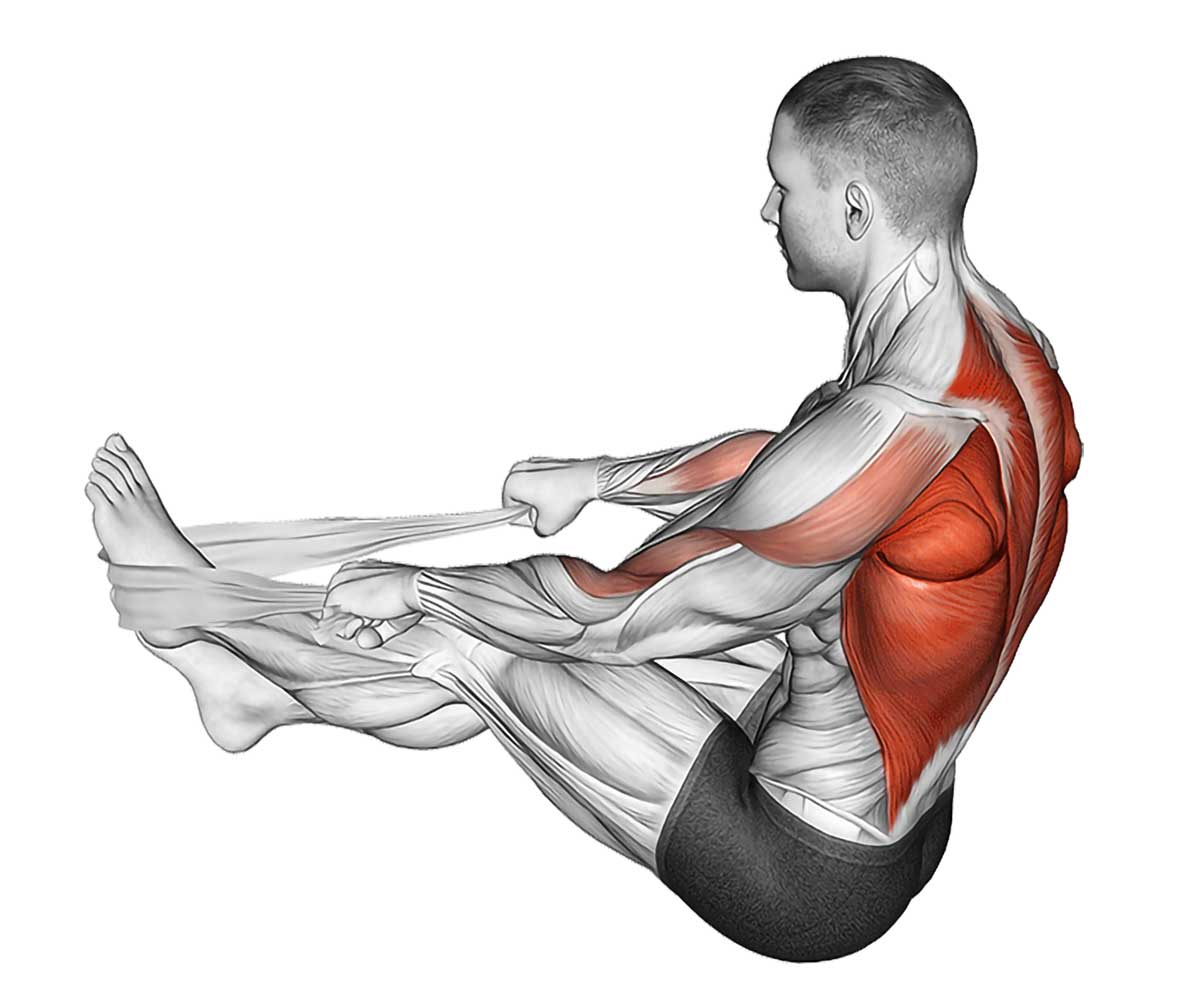
Standing alternative: If getting up and down from the floor is difficult, stand facing a sturdy, closed door that opens away from you or loop the towel around a heavy, stable piece of furniture at waist height instead. Make sure the anchor point is completely secure before adding any load or pulling force. Grip one end in each hand and hinge slightly at the hips. Perform the same rowing motion, pulling both ends toward your ribcage and squeezing the shoulder blades at the finish.
For adults in their 40s: focus on the shoulder blade squeeze throughout, not just at the end. The arms are the secondary movers here. For adults in their 50s with wrist sensitivity: wrap the towel ends loosely around your forearms instead of gripping tightly with the fingers.
Breathing: Exhale as you pull. Inhale as you extend.
Move 5: The Bird-Dog
Why it works: The Bird-Dog is one of the most underused exercises in home training, and one of the most effective for adults over 40. It trains the deep stabilizing muscles of the spine, specifically the multifidus and transverse abdominis, which are responsible for keeping the lumbar spine stable during any loaded movement. These muscles weaken significantly with age and prolonged sitting, and their decline is directly linked to chronic lower back pain.
Unlike the glute bridge, which builds posterior chain strength in isolation, the Bird-Dog demands coordination between opposite limbs while the spine stays completely still. That anti-rotation demand is exactly what the core needs to function safely in daily life, whether you’re picking something up from the floor, reaching overhead, or simply walking on uneven ground.
Step by step:
- Start on all fours on a mat or carpeted surface, with your wrists directly below your shoulders and your knees directly below your hips.
- Keep your back flat, as if balancing a glass of water on your lower back. Your spine should be neutral, not arched or rounded.
- Take a breath in. On the exhale, slowly extend your right arm straight forward at shoulder height while simultaneously extending your left leg straight back at hip height.
- Hold this extended position for two full seconds, keeping your hips level. Resist the urge to let the raised-leg hip rotate upward.
- Take two to three seconds to return both limbs back to the floor with control. That’s one rep.
- On the next exhale, extend the left arm and right leg. That’s the second rep.
- Continue alternating sides for the full 45-second window.
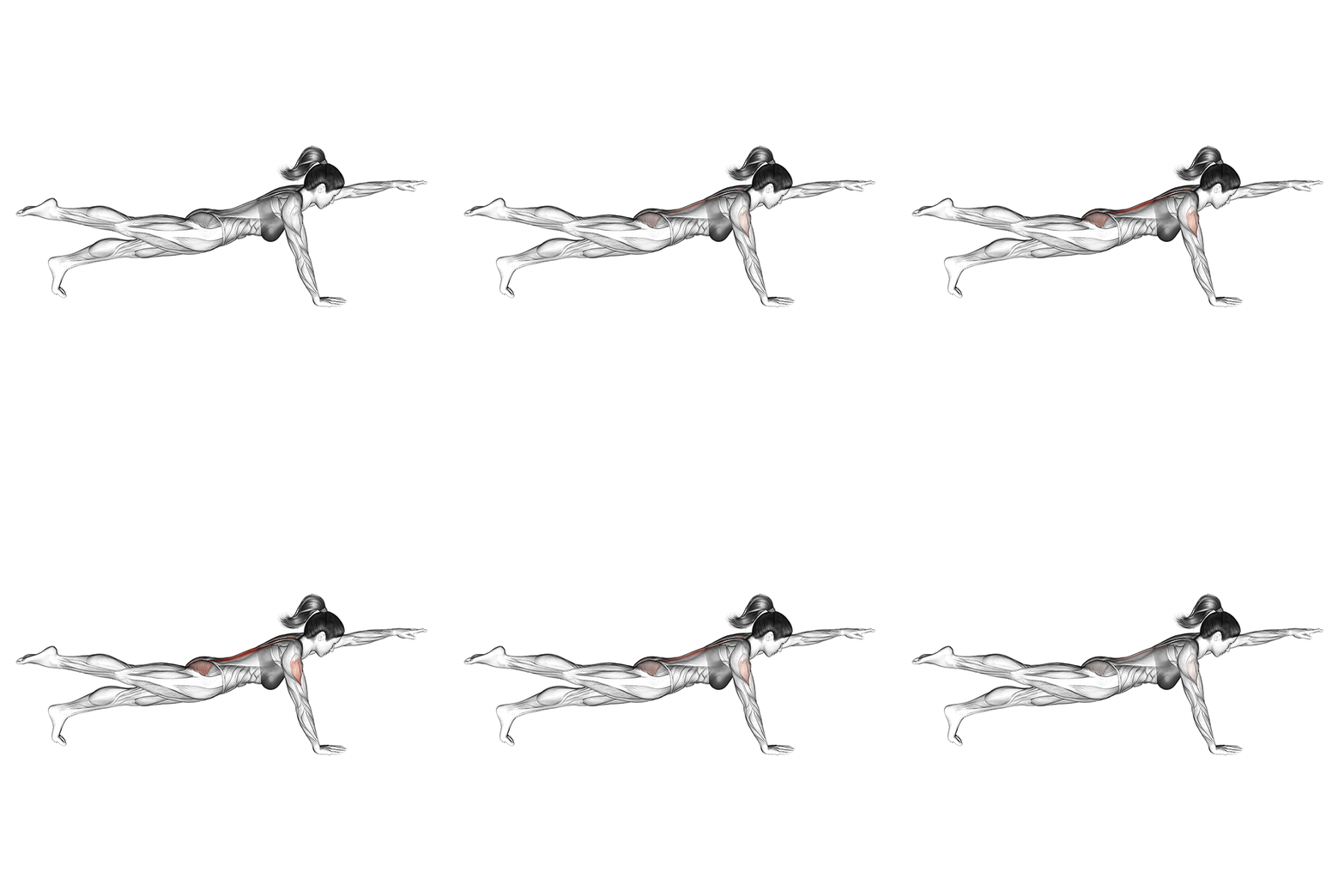
The movement should feel slow and deliberate. If your lower back arches or your hips shift to one side when you extend, reduce the range of motion until your core can hold the position steady.
For adults in their 40s: aim for full extension of both arm and leg on every rep, holding at the top for a full two-count. For adults in their 50s with knee sensitivity on the floor: place a folded towel under both knees for padding before starting.
Breathing: Exhale as you extend. Inhale as you return.
Your 12-Week Transformation Timeline: What to Expect Week by Week
One of the most common reasons people quit exercise programs is that they expect to see physical changes in the mirror within two weeks. When they don’t, they assume it isn’t working. This is a misunderstanding of how the body adapts, and it causes a lot of unnecessary frustration.
Here’s the real timeline.
Weeks 1 to 4: Your Brain Gets Stronger First
This is one of the most surprising and well-supported findings in exercise science. In a 2010 analysis, Steib and colleagues reviewed progressive resistance training studies in adults aged 65 and older across durations ranging from six to 52 weeks. They found that the most rapid strength gains in the early weeks are largely neurological, not muscular. Your brain gets better at sending signals to your existing muscle fibers, recruiting more of them with each movement.
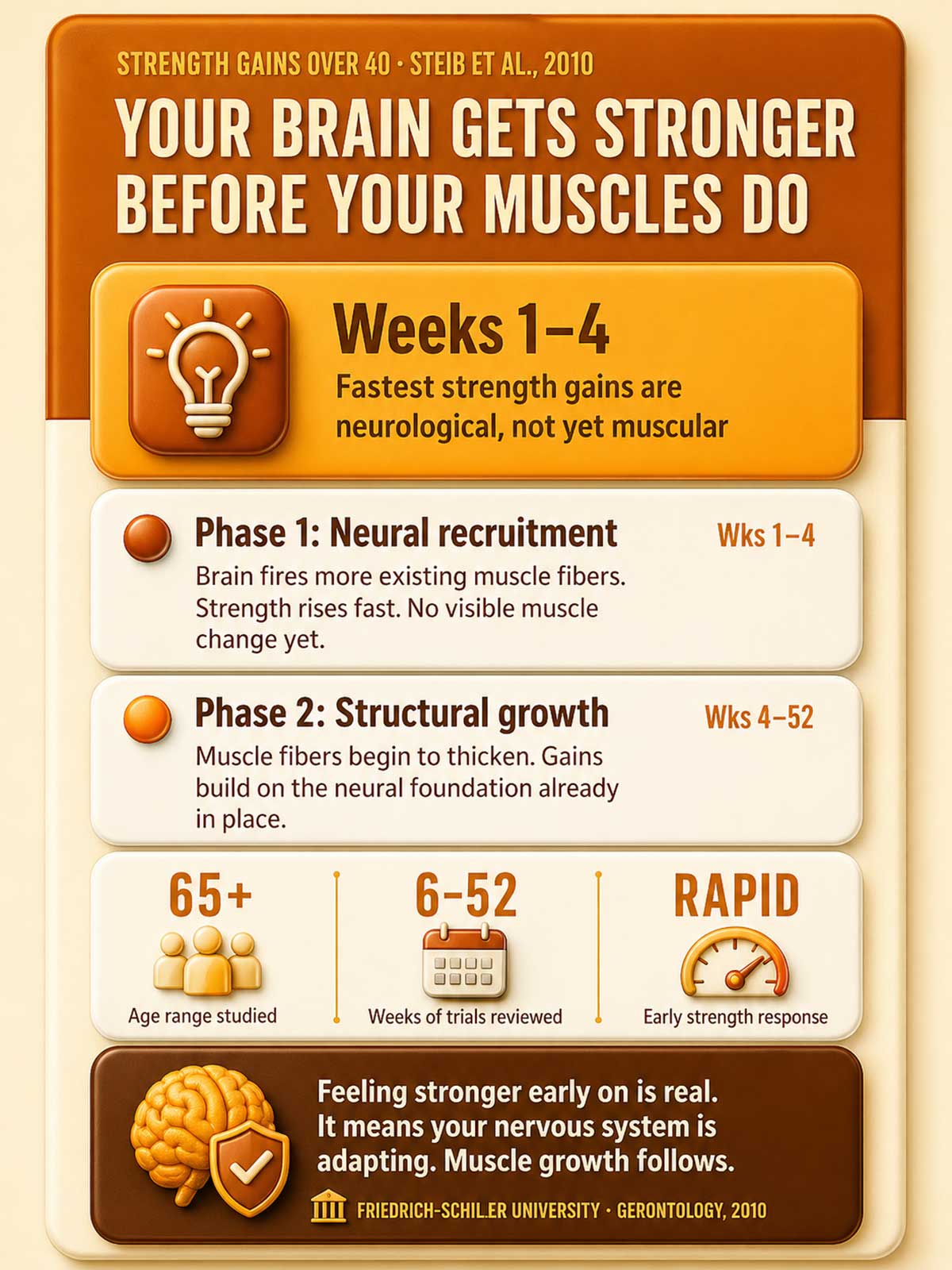
In plain terms: you’ll feel stronger faster than your muscles actually grow. This is real progress, and it’s exactly what’s supposed to happen. Your nervous system is laying the groundwork.
What to expect in weeks 1 to 4: Movements will start to feel more coordinated. You may feel less soreness after sessions two and three. Balance during the chair squat will improve noticeably.
Weeks 4 to 8: Your Daily Life Starts to Change
This is where most people notice the shift. Not in the mirror, but in the world around them. Stairs feel easier. You carry grocery bags without that familiar forearm ache. You stand up from the couch without the slight grunt.
These functional changes happen because your nervous system adaptations are now paired with early structural changes in muscle tissue. Your muscle fibers are beginning to thicken. Energy production in the cells becomes more efficient.
For adults in their 50s: you may also notice that your sleep quality begins to improve around this phase. Resistance training has a well-documented effect on sleep depth and duration in older adults, and this is often one of the first unexpected benefits people report.
What to expect in weeks 4 to 8: You’ll be able to perform more reps in the 45-second windows. The movements will feel more automatic. You may find the wall push-up is ready to progress to a countertop angle.
Weeks 8 to 12: Visible Muscle Growth and Measurable Strength
This is the phase the research speaks to most clearly. Peterson and colleagues (2011) conducted a meta-analysis that looked at the effects of resistance training on lean body mass in adults between 50 and 83 years old across program lengths of 18 to 20 weeks.
They found that even low-volume resistance training produced an average increase of approximately 2.5 pounds of lean muscle mass, along with strength gains averaging 25 to 30 percent across older age groups.
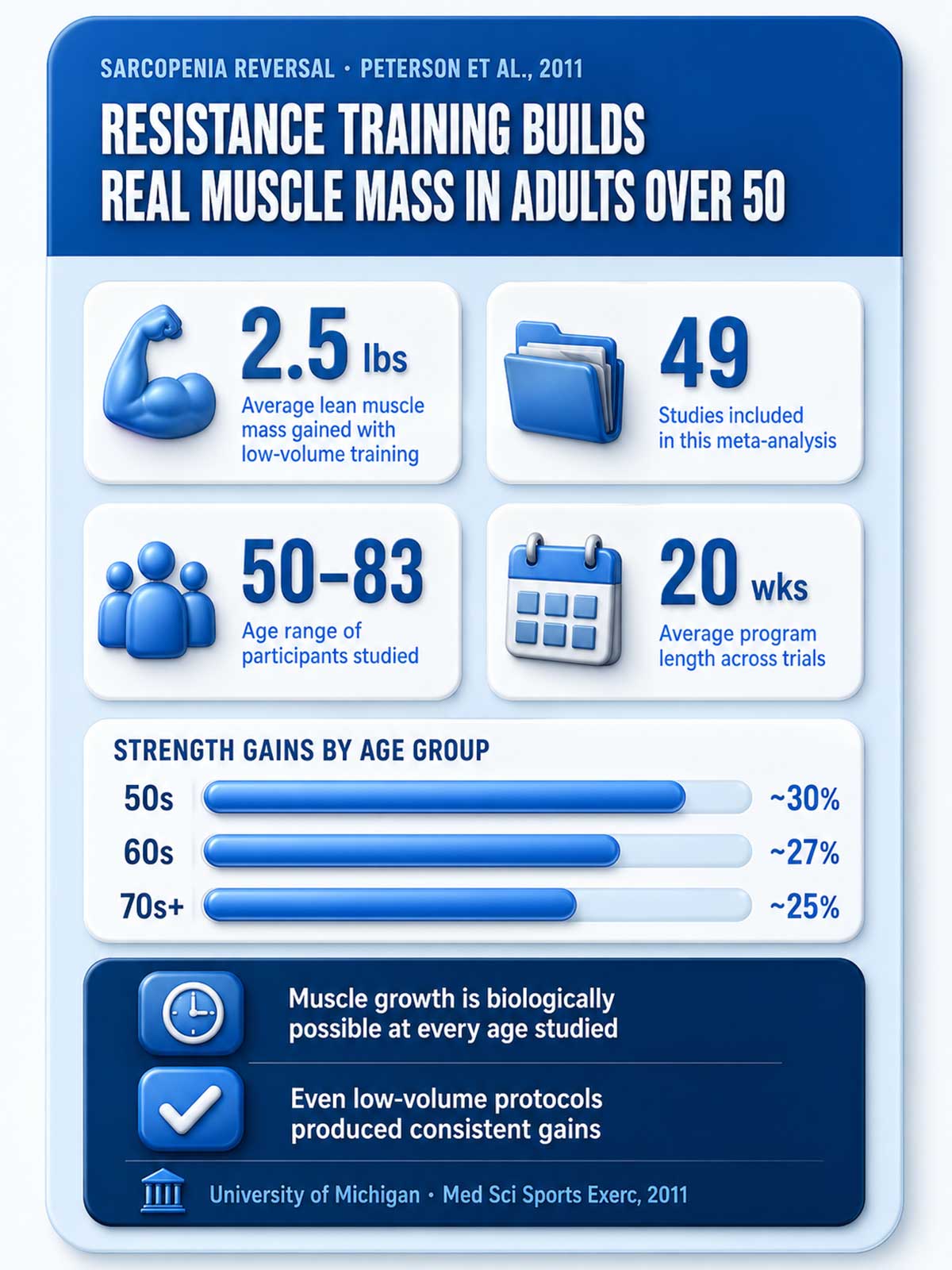
That’s not a small shift. A 25 to 30 percent strength increase changes how your body moves through daily life in ways that are genuinely visible: improved posture, greater muscle firmness, more upright walking stance.
For adults in their 40s: consider adding a fifth exercise or an additional round of the circuit if three rounds have become comfortable. For adults in their 50s: consistency still beats intensity. Stick with the protocol and let the compound effect do its work.
If the Bird-Dog has become effortless by week eight, try adding a one-second pause at the top of each rep, or place a light resistance band just above the knees to increase the stability demand without adding weight.
What to Eat Before and After Training
Exercise is only half of the equation. Muscle rebuilding requires protein, and most adults over 40 are not eating enough of it.
Before training, a light snack containing protein and a small amount of carbohydrate about 60 to 90 minutes beforehand gives your muscles readily available fuel. A handful of nuts with a banana, or Greek yogurt with berries, both work well.
After training, protein intake within 60 minutes of finishing your session is when muscle protein synthesis is most active. Aim for 20 to 30 grams of protein in this window. Eggs, cottage cheese, a protein shake, canned fish, or a chicken-based meal all hit this target easily.
For adults over 50, research consistently shows that protein needs increase with age, not decrease, due to a condition called anabolic resistance, where the body becomes less efficient at converting dietary protein into muscle tissue. A rough target of 1.2 to 1.6 grams of protein per kilogram of body weight per day is a practical goal for most older adults trying to build or preserve muscle.
How Sleep Connects to Muscle Growth
Here’s something most fitness content ignores entirely: muscle is not built during exercise. It’s built during sleep.
When you train, you create tiny tears in muscle fibers. During deep sleep, your body releases growth hormone and sends repair signals to those fibers, rebuilding them slightly thicker and stronger than before. If sleep is poor or too short, this repair process is incomplete.
For adults over 40, getting seven to nine hours of sleep is not a luxury. It’s a biological requirement for the training you’re doing to produce results. A consistent bedtime, a cool room, and limiting screens for an hour before bed are small habits that make your 12 minutes of exercise far more effective.
After Training: The Cool-Down
Ending a session abruptly can leave your heart rate and blood pressure elevated. Two to three minutes of movement is all it takes.
Walk slowly around the room for 60 seconds to let your heart rate come down. Then stand and perform a slow standing quad stretch, holding each leg for 20 seconds. Follow with a gentle chest opener: clasp your hands behind your back, straighten your arms, and gently lift them while opening your chest. Hold for 20 seconds. Finish with three slow deep breaths, in through the nose for four counts and out through the mouth for six.
This takes less than three minutes. It lowers cortisol, reduces post-exercise stiffness, and tells your nervous system that the effort is done.
The Simple Rule That Beats Every Fitness Trend
Every fitness trend of the last two decades has been sold on the idea that more is more. More intensity. More time. More equipment. More supplements. More complexity.
The research points in the opposite direction for adults over 40.
Consistency beats intensity. Twelve minutes, twice a week, performed with genuine effort and proper form, will produce more results over six months than three exhausting gym sessions that leave you too sore to move for three days.
Start with one round instead of three if that’s where you are. Do the wall push-up instead of the table push-up. Touch the chair on the squat. There is no version of this routine that is “too easy.” There is only the version you actually do.
The science is settled: your body can rebuild muscle at 40, at 50, and well beyond. The biology works in your favor when you give it the right signal. Two short sessions a week, done consistently, is that signal. Start this week.