Mullein tea has been used for centuries to ease breathing problems. But what does the actual science say? Here’s what researchers have found about this traditional remedy and how it might help your respiratory system.
The “Great Soother”: Mullein’s Role in Respiratory Health
Mullein (Verbascum thapsus) is a tall plant with soft, velvety leaves and bright yellow flowers. For hundreds of years, people across Europe and Asia have brewed it into tea to treat coughs, bronchitis, and throat pain.
This isn’t just folklore. The European Medicines Agency reviewed mullein in 2018 and gave it the green light for soothing sore throats tied to dry coughs. They based this on its long history of safe use—not on large clinical trials, but on generations of people finding relief.

A 2005 review published in Phytotherapy Research documented mullein’s extensive use across cultures for pulmonary problems. The authors noted that traditional practices consistently turned to mullein for cough, bronchitis, and asthma.
Think of mullein as a comfort blanket for your airways rather than a cure. It won’t treat pneumonia or chronic lung disease. But for that annoying tickle in your throat? It might offer some real help.
5 Science-Backed Ways Mullein Works on Your Respiratory System
1. The Saponin Effect: Thinning Out Stubborn Mucus
Mullein contains natural compounds called saponins. These act like tiny soap bubbles in your airways.
Here’s how it works: mucus gets thick and sticky when you’re sick. Saponins are surfactants—they reduce the surface tension of that gunk, making it thinner and easier to cough up. Think of how dish soap breaks up grease on a pan. Saponins do something similar to the phlegm coating your throat.
A 2023 study in South African Journal of Botany used advanced phytochemical profiling to identify mullein’s active compounds. Researchers found significant levels of triterpenoid saponins—the exact molecules responsible for this mucus-thinning action.

2. The Soothing Layer: How Mullein Coats Your Throat
Ever wonder why some teas feel thick and syrupy? That’s mucilage—a gel-like substance found in mullein leaves and flowers.
When you drink mullein tea, this mucilage creates a protective film over your irritated throat lining. Doctors call this a “demulcent” effect. It’s like putting a cool compress on a burn. The coating doesn’t heal the damage instantly, but it calms the nerve endings that trigger your cough reflex.
This explains why people with dry, hacking coughs often report fast relief. The mucilage doesn’t cure what’s making you cough—it just gives your throat a break from the constant irritation.
3. Verbascoside: Fighting Inflammation Where It Starts
Here’s where things get interesting. Mullein contains a powerful compound called verbascoside—a type of antioxidant that specifically targets inflammation.
Lab studies show verbascoside blocks certain inflammatory markers in lung tissue. When your airways are inflamed, they produce extra mucus, swell up, and become hypersensitive. Verbascoside appears to interrupt this process at a cellular level.
A 2013 study in Pharmaceutical Biology tested mullein extracts and found a strong link between polyphenol content (including verbascoside) and anti-inflammatory activity. The researchers noted this could explain mullein’s traditional use for breathing problems.
Does this mean mullein is as strong as an anti-inflammatory drug? No. But it suggests there’s real biochemical activity happening—not just a placebo effect.
4. Antimicrobial Properties: Early Signs of Virus-Fighting Potential
This is the newest frontier in mullein research. A 2023 study tested mullein extracts against several viruses in the lab, including influenza A and a type of coronavirus (HCoV-229E, which causes common colds).
The results? Mullein showed antiviral activity in test tubes. The extracts seemed to interfere with the viruses’ ability to infect cells.
Before you get too excited, let’s be clear: this was done in a lab, not in humans. Test tube results don’t always translate to real-world effects. But it’s a promising starting point.
A 2015 study published in BMC Complementary and Alternative Medicine also found that mullein extracts showed antibacterial activity against both gram-positive and gram-negative bacteria. Combined with the antiviral findings, mullein appears to have some antimicrobial punch.

Could mullein tea help fight off a cold or flu? We can’t say for sure yet. But the early evidence is worth watching.
5. Relaxing Tight Airways: The Expectorant Action
When you have a chest cold, your airways can go into spasm. The smooth muscles around your bronchial tubes tighten up, making breathing harder and triggering more coughing.
Animal studies suggest mullein has bronchorelaxant effects—it helps those muscles calm down. This is part of what makes it an “expectorant.” It doesn’t just loosen mucus; it also makes your airways less reactive.
One review described mullein as having both mucolytic (mucus-breaking) and antispasmodic properties. In practical terms, this means it might help you cough more productively while reducing that tight, wheezy feeling in your chest.
The Clinical Reality Check: What Human Studies Actually Show
Let’s be honest. Most of what we know about mullein comes from lab work, animal studies, and traditional use—not from gold-standard human clinical trials.
Why the gap? Herbal research often lacks funding compared to drug studies. Plants can’t be patented, so there’s less financial incentive for expensive trials.
But here’s what we do have:
The Data Gap: No large-scale studies have tested mullein tea alone in humans with respiratory infections. We can’t point to a randomized controlled trial that says, “Yes, mullein definitely works better than placebo for your cough.”
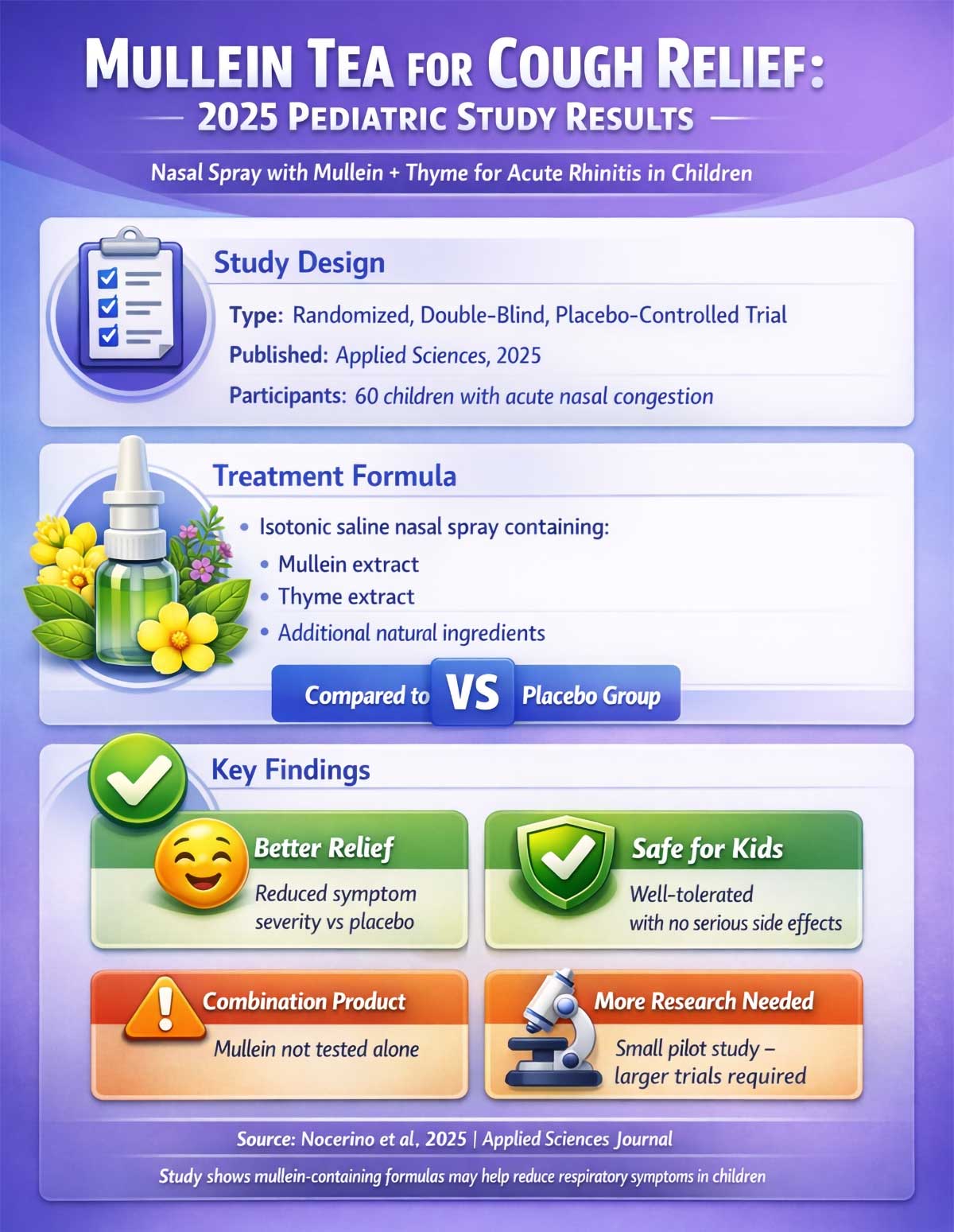
Combination Success: A 2025 pediatric study published in Applied Sciences tested a nasal spray containing mullein extract plus thyme and other ingredients. Kids with acute nasal congestion who used the spray had better symptom relief than those who got a placebo.
The catch? Mullein wasn’t tested alone. We can’t separate its effects from the other ingredients. But the study does show that formulations containing mullein can be effective and safe for children.
Wound Healing Evidence: Here’s an interesting side note. A 2021 randomized trial published in BMC Complementary Medicine and Therapies tested topical mullein cream on women recovering from episiotomy wounds after childbirth. The mullein group healed faster than the control group.
This isn’t about lungs, but it tells us something vital: mullein has measurable biological activity in humans. Its anti-inflammatory and tissue-healing properties work—at least on skin. Could similar effects happen in the mucous membranes of your throat? It’s plausible.

How Much Mullein Tea Should You Drink?
Dosage matters. Too little and you won’t get relief. Too much might not be safe for extended use.
Adults
Standard dosing is 1-3 cups daily. Each cup should contain:
- 1-2 teaspoons of dried mullein leaves or flowers
- 8 ounces of water
- Steeped for 10-15 minutes
Historical use suggests 3-4 grams of dried herb daily is typical. Most people drink 2 cups per day—one in the morning and one before bed.
For acute symptoms (like a bad cough), you can drink up to 4 cups daily for short periods (up to 2 weeks). After that, take a break or reduce to 1-2 cups daily.
Children
Mullein is safe for kids when dosed correctly. Use body weight to calculate the dose:
- Under 2 years: 1/2 to 1 teaspoon of tea, 2-3 times daily
- 2-4 years: 2 teaspoons, 2-3 times daily
- 4-7 years: 1 tablespoon (1/2 ounce), 2-3 times daily
- 7-11 years: 2 tablespoons (1 ounce), 2-3 times daily
- 12+ years: Adult dose
For infants under 6 months who are breastfed, the nursing mother should drink the tea. The benefits pass through breast milk.
Some pediatric herbalists note that mullein is mild enough for even young children with lingering coughs after a cold. It won’t aggravate sensitive lung tissue like some stronger respiratory herbs might.
When to Use It
- Best timing: At the first sign of a cough or throat irritation
- Acute use: 3-4 cups daily for up to 2 weeks
- Maintenance: 1-2 cups daily for ongoing respiratory support (max 4 weeks, then take a break)
- Before bed: Helps reduce nighttime coughing
5 Therapeutic Mullein Tea Recipes
1. Classic Mullein Tea (Basic Recipe)
Ingredients:
- 1-2 teaspoons dried mullein leaves or flowers
- 8 ounces water (heated to 200°F, just below boiling)
- Honey (optional)
Instructions:
- Place mullein in a cup or teapot
- Pour hot water over the herb
- Cover and steep for 10-15 minutes
- Strain through a fine-mesh filter or coffee filter
- Add honey if desired
Best for: General respiratory support, dry cough
Flavor: Mild, slightly earthy, gentle
2. Honey-Lemon Respiratory Soother
Ingredients:
- 2 teaspoons dried mullein
- 1 teaspoon dried thyme
- 8 ounces hot water
- 1 tablespoon raw honey
- Juice from 1/4 fresh lemon
Instructions:
- Steep mullein and thyme together for 12 minutes
- Strain well
- Add honey and lemon juice while tea is still warm
Best for: Sore throat, wet cough with congestion
Flavor: Sweet, tangy, herbal
The thyme adds extra antimicrobial power. A 2025 study found this combination particularly effective in children.
3. Spiced Mullein Chai (Anti-Inflammatory Blend)
Ingredients:
- 2 teaspoons dried mullein
- 1/2 teaspoon grated fresh ginger (or 1/4 teaspoon dried)
- 1 cinnamon stick (or 1/4 teaspoon ground)
- 2 whole cloves
- 8 ounces water
- Splash of milk or milk alternative (optional)
- Honey to taste
Instructions:
- Simmer ginger, cinnamon, and cloves in water for 5 minutes
- Remove from heat, add mullein
- Steep covered for 10 minutes
- Strain thoroughly
- Add milk and honey if using
Best for: Chest congestion, inflamed airways, warming relief
Flavor: Spicy, warming, comforting
4. Cold-Brew Mullein (For Sensitive Stomachs)
Ingredients:
- 2-3 teaspoons dried mullein
- 8 ounces room temperature filtered water
Instructions:
- Place mullein in a glass jar
- Add room temperature water
- Cover and let sit for 8-12 hours (or overnight)
- Strain through coffee filter (this is critical—cold brewing may release more tiny hairs)
Best for: Gentle mucilage extraction, those with sensitive digestion
Flavor: Very mild, smooth, less bitter
Cold brewing extracts more mucilage and less of the bitter compounds. It’s gentler on your stomach.
5. Mullein-Mint Refresher (Iced Version)
Ingredients:
- 2 teaspoons dried mullein
- 1 teaspoon dried peppermint or spearmint
- 8 ounces hot water
- Ice
- Fresh mint leaves for garnish
- Honey (optional)
Instructions:
- Steep mullein and mint in hot water for 10 minutes
- Strain very well
- Sweeten if desired
- Pour over ice
- Garnish with fresh mint
Best for: Summer colds, allergies, soothing throat irritation when you want something cold
Flavor: Refreshing, cooling, slightly sweet
Mullein Preparation Methods: What Works Best
Different brewing methods extract different compounds. Here’s what you need to know:
| Method | Temperature | Time | Best For | Compounds Extracted |
|---|---|---|---|---|
| Hot Steep (Standard) | 200°F | 10-15 min | All-around relief | Mucilage, saponins, moderate flavonoids |
| Hot Steep (Short) | 212°F (boiling) | 5-7 min | Quick symptom relief | Flavonoids, tannins, less mucilage |
| Cold Brew | Room temp | 8-12 hours | Sensitive stomachs, maximum mucilage | High mucilage, minimal bitterness |
| Decoction (Simmered) | 200-212°F | 15-20 min | Roots (if using), intensive extraction | Maximum compound extraction, stronger dose |
Pro tip: For sore throat relief, go for the standard hot steep or cold brew. These extract more of the soothing mucilage.
For anti-inflammatory benefits, a shorter hot steep works well. It pulls out more of the flavonoids and phenolic compounds.
Comparing Mullein Product Forms
Not everyone wants to brew loose tea. Here’s how different forms stack up:
| Form | Pros | Cons | Best Use Case | Typical Dose |
|---|---|---|---|---|
| Dried loose leaf | Most potent, customizable strength, affordable | Requires straining, prep time | Home brewing, bulk use | 1-2 tsp per cup |
| Tea bags | Convenient, pre-filtered, portable | Less potent, can’t adjust strength | On-the-go, beginners | 1-2 bags per cup |
| Tincture (alcohol-based) | Fast absorption, concentrated, long shelf life | Alcohol content, strong taste | Acute symptoms, travel | 1-2 droppers (60-120 drops), 2-3x daily |
| Glycerite (alcohol-free) | Good for kids, sweet taste, no alcohol | Less potent than tincture, sticky | Children, those avoiding alcohol | 1-2 droppers, 2-3x daily |
| Capsules | No taste, precise dosing, convenient | Delayed effect, can’t adjust dose easily | Daily supplementation, taste-sensitive | 500-1000mg, 2-3x daily |
| Syrup | Pleasant taste, coats throat, easy for kids | Added sugar, shorter shelf life | Coughs, children, immediate relief | 1-2 teaspoons, up to 4x daily |
Herb Combinations That Work
Mullein plays well with other respiratory herbs. Here are science-backed pairings:
| Herb Pairing | Primary Benefit | How They Work Together | Recipe Ratio (Mullein:Other) |
|---|---|---|---|
| Mullein + Thyme | Cough suppression | Mullein soothes, thyme fights bacteria | 2:1 |
| Mullein + Marshmallow Root | Maximum throat coating | Double demulcent action for severe irritation | 1:1 |
| Mullein + Ginger | Anti-inflammatory boost | Mullein cools, ginger warms and circulates | 3:1 |
| Mullein + Licorice Root | Natural sweetness + soothing | Both are expectorants and demulcents | 2:1 |
| Mullein + Peppermint | Decongestion | Mullein loosens mucus, mint opens airways | 2:1 |
| Mullein + Elderberry | Immune support | Mullein for symptoms, elderberry for viral defense | 1:1 |
A note on the 2025 study: Researchers tested a nasal spray with mullein and thyme in 60 children with acute rhinitis. The combination reduced symptom severity better than placebo. While we can’t say mullein alone caused this, the pairing has both traditional and modern support.
Consumer Safety: The Fine Print You Need to Know
Mullein tea is generally safe, but there are a few things to watch out for.
The Hair Problem: Why You Must Filter Your Tea
This is the most common mistake people make with mullein.
Mullein leaves and flowers are covered in tiny, hair-like structures called trichomes. These hairs can irritate your throat if you swallow them—turning your soothing tea into a scratchy nightmare.
How to filter properly:
- Use a fine-mesh metal strainer AND a coffee filter
- Or use cheesecloth (folded 3-4 layers thick)
- Never use just a regular tea strainer—it won’t catch the tiny hairs
- Cold-brewed tea needs even more careful straining
Some people skip this step and end up with more throat irritation than they started with. Don’t be that person.
Contamination Risks: The Pyrrolizidine Alkaloid Concern
Pyrrolizidine alkaloids (PAs) are toxic compounds found in certain plants. Mullein itself doesn’t produce high levels of PAs. But if it’s harvested from fields where other PA-containing weeds grow (like ragwort or groundsel), contamination can happen.
Long-term exposure to PAs can damage your liver. This is rare with mullein, but it’s why sourcing matters.
The European Food Safety Authority has raised concerns about PAs in herbal teas overall. A 2018 review noted that contamination during harvest is the main risk—not the mullein itself.
How to protect yourself:
- Buy from reputable brands that test for contaminants
- Look for “third-party tested” labels
- Avoid wildcrafting unless you’re 100% sure of plant identification
- Check that products are from clean growing areas
Medication Interactions: What You Need to Know
Mullein may interact with certain medications. Here’s what the research shows:
Blood thinners (anticoagulants): Mullein contains coumarin, a natural compound that may increase bleeding risk. If you take warfarin (Coumadin), aspirin, heparin, clopidogrel (Plavix), or NSAIDs like ibuprofen or naproxen, talk to your doctor first.
Diabetes medications: Some reports suggest mullein might affect blood sugar levels. If you take insulin or oral diabetes drugs, monitor your blood sugar closely and consult your healthcare provider.
Muscle relaxants: Mullein may intensify the effects of muscle relaxants. Use with caution if you take these medications.
Lithium: Mullein might affect how your body processes lithium. If you take this medication for bipolar disorder, check with your doctor.
Diuretics (water pills): Mullein has mild diuretic properties. Taking it with prescription diuretics could cause excessive fluid loss. Talk to your doctor about timing.
Sedatives: Some sources suggest mullein may have mild sedative effects. If you take sleeping pills or anxiety medications, start with a low dose of mullein to see how you respond.
The good news? Most herbs have theoretical interactions that rarely cause problems in practice. But it’s always smart to tell your healthcare provider about any herbs you use.
Age-Specific Safety Guidelines
Infants (Under 6 Months):
- Breastfed babies: Mother drinks the tea; benefits pass through milk
- Bottle-fed babies: Very small amounts (1/2 teaspoon) can be added to bottle, but consult a pediatrician first
- Mullein ear oil: Safe for external use only (never put in ear if eardrum is damaged)
Toddlers and Young Children (6 Months – 12 Years):
- Generally safe when dosed by body weight (see dosage section above)
- Tea should be lukewarm, not hot
- Add honey for kids over 12 months (never give honey to babies under 1 year)
- Strain extra carefully—children’s throats are more sensitive to plant hairs
Teens (12-17 Years):
- Can use adult doses
- Safe for athletic teens with exercise-induced respiratory issues
- Good option for teens who want natural alternatives
Adults:
- Safe for most healthy adults
- Use caution if you have existing liver disease (rare, but PAs could be a concern)
- No special precautions for older adults
Pregnancy and Breastfeeding: The safety data here is limited. Traditional use suggests mullein is safe, but modern guidelines recommend caution. Skip it during pregnancy unless your healthcare provider approves. For breastfeeding, small amounts are likely fine, but watch your baby for any reactions.
Who Should Avoid Mullein Tea
Absolute contraindications:
- Known allergy to plants in the Scrophulariaceae family (snapdragons, figwort)
- Severe liver disease (due to potential PA contamination risk)
Use with caution:
- Pregnancy (insufficient safety data)
- Breastfeeding (use short-term only, observe infant)
- Scheduled for surgery (may affect bleeding; stop 2 weeks before)
- Bleeding disorders
- Taking multiple medications (interaction risk increases)
Signs you should stop using mullein immediately:
- Skin rash or hives
- Swelling of face, tongue, or throat
- Difficulty breathing (allergic reaction)
- Severe stomach pain
- Yellowing of skin or eyes (possible liver issue)
- Unusual bruising or bleeding
Contact dermatitis from handling fresh mullein plants has been reported. If you harvest your own, wear gloves. One 2017 case report described simultaneous contact dermatitis from both Asteraceae plants and mullein.
Troubleshooting Common Issues
“My tea tastes too bitter”
Solutions:
- Reduce steep time to 8-10 minutes instead of 15
- Use slightly cooler water (195°F instead of boiling)
- Add honey, lemon, or stevia
- Mix with naturally sweet herbs like licorice root (1 part licorice to 3 parts mullein)
- Try cold brewing—it extracts less bitterness
“I still feel throat irritation after drinking it”
Likely causes:
- You didn’t strain it well enough (those plant hairs are the problem)
- The tea was too hot when you drank it
- You’re allergic to mullein (rare, but possible)
Fix it:
- Always use double filtration (fine mesh + coffee filter)
- Let tea cool to lukewarm before drinking
- If irritation continues after proper straining, stop using mullein
“How do I know if my mullein is contaminated?”
Quality checks before brewing:
- Color: Should be grayish-green to olive green; if it’s dark brown or black, it’s oxidized
- Smell: Faint, pleasant, slightly hay-like; musty or moldy smell means it’s gone bad
- Texture: Soft and fuzzy; if it crumbles to dust, it’s too old
- Visible signs: No mold, no insect parts, no other plant material mixed in
While brewing:
- Tea should be golden to amber colored
- Should not taste moldy or rotten
- No unusual floating particles (after straining)
“Can I reuse the leaves for a second cup?”
Technically yes, but the second steep will be much weaker. You’ll get maybe 30-40% of the strength of the first cup.
Best practices for re-steeping:
- Add 5 minutes to your steep time
- Use the same day (don’t store damp leaves overnight—they’ll grow mold)
- Good for mild symptom relief, not acute issues
- Consider it a bonus cup, not a primary dose
Where to Buy & What to Look For
Quality varies wildly between brands. Here’s how to find the good stuff:
Quality Indicators
| Factor | What to Look For | Red Flags |
|---|---|---|
| Certifications | USDA Organic, Non-GMO Project, third-party tested (BSCG, NSF, USP) | No certifications at all |
| Origin | Europe (Bulgaria, Albania, Croatia), North America (clearly stated) | “Country of origin: Unknown” or no information |
| Color | Grayish-green to olive green, not faded | Dark brown, black, or very pale/bleached |
| Smell | Faint, pleasant, slightly sweet or hay-like | Strong musty, moldy, or no smell |
| Processing | “Harvested at peak” “Air-dried” “Wild-harvested” or “Certified organic” | “Mass produced” or highly processed look |
| Packaging | Airtight bags or tins, opaque or dark glass | Clear plastic bags, loose packaging |
| Price Range | $8-15 per oz for high quality; $5-8 for acceptable | Under $3 per oz (likely low quality); way over $20 (overpriced) |
| Freshness Date | Harvest date or “packed on” date listed | No date information |
| Brand Reputation | Established herbal companies, transparency about sourcing | Unknown brands, no company info |
Reputable Sources
While I can’t endorse specific brands, look for companies that:
- Specialize in herbal products (not general supplements)
- Provide third-party testing results
- Have transparent sourcing practices
- Respond to customer questions about testing and origin
- Have been in business for 5+ years
You can find quality mullein at:
- Health food stores (ask staff for their most trusted brands)
- Online herb retailers specializing in medicinal herbs
- Co-ops and natural grocers
- Direct from small herb farms (if they test for PAs)
Avoid:
- Gas station supplements
- Extremely cheap bulk sources with no info
- Products with mullein buried in a long list of ingredients (you want pure mullein or simple blends)
Storage Tips for Maximum Freshness
Dried mullein leaves/flowers:
- Store in airtight containers (glass jars with tight lids work best)
- Keep in a cool, dark place (pantry, cupboard away from stove)
- Ideal temperature: Below 75°F
- Keep away from moisture—never store near sink or in bathroom
- Don’t use wet hands or spoons to scoop out tea
Shelf life:
- Properly stored: 12-24 months from harvest date
- After opening: 12-18 months if you’re careful
- Signs it’s expired: Faded color, loss of smell, brittle texture, no flavor when brewed
Mullein tea bags:
- Keep in original sealed packaging until ready to use
- After opening: Transfer to airtight container
- Shelf life: 12-18 months
Mullein tinctures:
- Keep in dark glass bottles (amber or cobalt blue)
- Store in cool place (room temp is fine; no need to refrigerate)
- Shelf life: 2-3 years unopened; 12-18 months after opening
Brewed mullein tea:
- Refrigerate in airtight container
- Use within 3-5 days maximum
- Do NOT leave at room temperature more than 2 hours
- Signs it’s gone bad: Sour smell, cloudy appearance, off taste
Freezing options:
- Freeze brewed tea in ice cube trays for up to 3 months
- Thaw and reheat gently (don’t boil)
- Good for when you want to brew a big batch at once
Other Ways to Use Mullein
While this article focuses on tea, mullein has other forms worth knowing about:
Mullein Ear Oil
Possibly the most research-supported use of mullein. A 2003 study published in Pediatrics tested a naturopathic ear drop containing mullein (along with other herbs) for children’s ear pain. The drops worked as well as anesthetic ear drops.
When to use it: Swimmer’s ear, external ear infections, earache from colds
When NOT to use it: If the eardrum is ruptured (never put anything in the ear if there’s drainage)
Always: Consult a pediatrician before using, especially in young children
Topical Applications
The 2021 wound healing study showed mullein cream accelerated episiotomy healing. While more research is needed, traditional use includes:
- Salves for minor burns
- Poultices for bruises
- Skin irritation relief
Mullein for Smoking?
Some people smoke dried mullein leaves as a tobacco substitute or for respiratory relief. This is NOT recommended. Inhaling smoke of any kind can damage your lungs. If you want the respiratory benefits, stick with tea.
Science-to-Kitchen: Practical Applications
Here’s how to match your symptoms to the best mullein prep:
If you have a dry, hacking cough:
- Use: Standard hot-brewed mullein tea or cold brew
- Why: Maximum mucilage extraction to coat and soothe
- How often: 3 cups daily
- Boost it: Add marshmallow root (equal parts)
If you have chest congestion with thick mucus:
- Use: Hot-brewed mullein-thyme combination
- Why: Saponins break up mucus; thyme adds antimicrobial action
- How often: 2-3 cups daily
- Boost it: Add a slice of fresh ginger for circulation
For seasonal allergies with post-nasal drip:
- Use: Mullein-peppermint iced tea
- Why: Mullein soothes irritation; mint opens airways
- How often: 2 cups daily during allergy season
- Boost it: Add local raw honey (if you’re over 12 months old)
For acute bronchitis (with medical supervision):
- Use: Strong mullein-thyme-ginger decoction
- Why: Maximum anti-inflammatory and antimicrobial compounds
- How often: 3-4 cups daily for up to 2 weeks
- Boost it: Alternate with mullein tincture for faster absorption
For a sore throat from talking/singing too much:
- Use: Cold-brewed mullein, sipped slowly
- Why: Maximum throat coating without hot liquid irritation
- How often: Sip 1-2 cups throughout the day
- Boost it: Add a pinch of sea salt (makes a mild gargle)
Research Timeline: The Evolution of Mullein Science
Understanding where mullein research has been helps us see where it’s going:
Pre-2000: Traditional Use Documentation
- Ethnobotanical studies recorded mullein use across cultures
- Folk medicine practices were cataloged
- No mechanism studies yet
2000-2015: In Vitro & Phytochemical Studies
- 2002: Animal study showed biological activity (Türker & Camper)
- 2005: Major review summarized traditional uses and early science (Türker & Gürel)
- 2013: Anti-inflammatory activity linked to polyphenol content
- 2015: Antibacterial effects documented in lab studies
2015-2020: Mechanism Exploration
- Researchers identified specific compounds: verbascoside, saponins, flavonoids
- Animal studies showed expectorant and bronchorelaxant effects
- Safety profiling began
2020-2025: Clinical Applications & Combinations
- 2021: Human RCT on wound healing (topical use)
- 2023: Advanced phytochemical profiling reveals antiviral potential
- 2025: Pediatric RCT shows combination product with mullein reduces nasal symptoms
Future Directions: What We Still Need
- Large-scale human trials on mullein alone for respiratory infections
- Standardized extracts to determine optimal doses
- Long-term safety studies
- Comparison trials: mullein vs. common cough suppressants
- Mechanism studies in human lung tissue
- Optimal extraction methods for different compounds
The pattern is clear: science is catching up to traditional use. Each decade brings us closer to understanding exactly how and why mullein works.
Mullein Tea Quick Reference
Here’s everything you need to know at a glance:
BEST FOR:
- Dry, hacking cough
- Sore throat
- Respiratory irritation
- Chest congestion
- Post-nasal drip from allergies
DOSAGE:
- Adults: 1-3 cups daily
- Children: Dose by body weight (see full section above)
- Acute symptoms: Up to 4 cups daily for 2 weeks max
- Maintenance: 1-2 cups daily for up to 4 weeks, then break
PREPARATION:
- Water temp: 200°F (just below boiling)
- Steep time: 10-15 minutes
- Amount: 1-2 teaspoons dried herb per 8 oz water
CRITICAL STEP:
- ALWAYS strain through fine mesh filter + coffee filter
- Never skip this—plant hairs cause throat irritation
BEST PAIRINGS:
- Raw honey (throat coating)
- Thyme (antimicrobial boost)
- Marshmallow root (extra soothing)
- Ginger (anti-inflammatory)
- Lemon (vitamin C, flavor)
AVOID IF:
- Pregnant or breastfeeding (without medical approval)
- Allergic to Scrophulariaceae family
- Taking blood thinners (without doctor approval)
- Severe liver disease
STORAGE:
- Airtight container, cool, dark place
- 12-24 months shelf life
- Brewed tea: refrigerate, use within 3-5 days
WHEN TO EXPECT RESULTS:
- Throat soothing: 20-30 minutes
- Cough relief: 1-3 hours
- Congestion improvement: 1-2 days
STOP USE IF:
- Rash, hives, or swelling occurs
- Breathing difficulty
- Symptoms worsen after 3 days
- No improvement after 7 days
QUALITY MARKERS:
- USDA Organic certification
- Third-party tested for contaminants
- Origin clearly stated
- Grayish-green color (not brown)
- Faint, pleasant smell (not musty)
- Price: $5-15 per oz
Conclusion
You came here wondering if mullein tea really works for lungs. Here’s what you need to know:
The evidence says: Mullein tea offers real benefits for upper respiratory symptoms. It won’t cure pneumonia or replace your asthma inhaler. But for that nagging cough, scratchy throat, or chest congestion from a cold, it can help.
What makes it work:
- Mucilage that coats and soothes irritated tissues
- Saponins that thin stubborn mucus
- Anti-inflammatory compounds like verbascoside
- Antimicrobial properties that fight bacteria and viruses (in lab studies)
- Bronchorelaxant effects that ease airway spasms
The science is:
- Strong for traditional use (centuries of history)
- Solid for the phytochemistry (we know what’s in it)
- Promising for mechanisms (we understand how it should work)
- Limited but positive for human trials (mostly combination products)
- Growing each year (2023-2025 brought new findings)
Start here if you want to try it:
- Buy high-quality, organic dried mullein (leaves or flowers)
- Brew your first cup using the classic recipe (1-2 teaspoons, 10-15 minutes, strain well)
- Drink 2 cups daily at the first sign of a cough or sore throat
- Give it 2-3 days to work
- Adjust the recipe based on your symptoms (add thyme for coughs, honey for throat pain)
When to call your doctor:
- Fever over 101°F lasting more than 3 days
- Cough producing green or bloody mucus
- Difficulty breathing or chest pain
- Symptoms getting worse instead of better
- No improvement after a week of home treatment
The realistic expectation: Mullein tea is a supportive therapy. It makes you more comfortable while your body fights off whatever’s bothering your respiratory system. It’s not a magic cure, but it’s a gentle, evidence-based tool that can help.
For most people dealing with common colds, seasonal allergies, or minor respiratory irritation, mullein tea delivers on its promises. The coating relief is real. The mucus-thinning effect is measurable. The anti-inflammatory action has biological plausibility.
Is it as strong as prescription medications? No. Does it work for everyone? No herb does. But for a natural, safe, affordable option with centuries of use and growing scientific support, mullein tea earns its place in your home remedy toolkit.
“`html
Frequently Asked Questions
Can I drink mullein tea every day?
Yes, for short periods (2-4 weeks). For longer use, take a 1-2 week break every month. Daily use beyond 2 months hasn’t been studied for safety.
How long until I feel results?
For throat soothing: within 20-30 minutes. For cough relief: 1-3 hours. For reducing congestion: 1-2 days of regular use.
Can children drink mullein tea?
Yes, when dosed by body weight (see dosage section). It’s considered safe for children over 6 months. For younger infants, the nursing mother should drink it.
Does mullein tea expire?
Dried mullein doesn’t spoil but loses potency. Use within 12-24 months of harvest. Check for faded color, loss of scent, or musty smell—these mean it’s too old.
Can I mix mullein with my prescription medications?
Maybe. Mullein may interact with blood thinners, diabetes meds, muscle relaxants, and lithium. Tell your doctor about any herbs you’re taking. Start with a small dose to test your response.
What’s the difference between mullein leaf and mullein flower tea?
Both work for respiratory issues. Flowers are slightly milder and sweeter. Leaves contain more mucilage. Many products combine both parts. Either one is effective—choose based on availability and taste preference.
Can I smoke mullein instead of drinking it?
This is not recommended. Smoking anything damages your lungs. If you want respiratory benefits from mullein, stick with tea, tinctures, or syrups.
Is mullein tea safe for pets?
Some holistic vets use mullein for dogs and cats with respiratory issues. But dosing for animals is different. Always consult a veterinarian before giving herbs to pets.
Can pregnant women drink mullein tea?
Safety data during pregnancy is limited. Traditional use suggests it’s probably safe, but modern guidelines recommend avoiding it unless your healthcare provider approves.
Will mullein tea show up on a drug test?
No. Mullein contains no compounds that trigger standard drug tests.
Can I use fresh mullein instead of dried?
Yes, but use 2-3 times more fresh plant material (the drying process concentrates the compounds). Make sure to strain very carefully—fresh plants have more irritating hairs.
Does mullein help with asthma?
It may provide some symptom relief, but it’s not a replacement for asthma medications. Some people with asthma find mullein helpful for the inflammatory component. Always keep your rescue inhaler available and follow your treatment plan.
Can I drink mullein tea cold?
Absolutely. Cold or iced mullein tea still contains the beneficial compounds. Some people prefer it cold, especially in summer or when their throat is very sore.
How does mullein compare to over-the-counter cough syrups?
Mullein works differently. OTC syrups often contain dextromethorphan (suppresses cough reflex) or guaifenesin (thins mucus). Mullein coats and soothes while also thinning mucus naturally. For some people, mullein works as well without the drowsiness some cough medicines cause.
“`