Peanuts have been regarded as junk food for decades. Salty and cheap, something you grab at a ballgame without thinking twice. Penn State researchers tracked what happened when people ate them every day
Researchers put adults with high cholesterol on a diet built around peanuts and peanut butter, then tracked what happened to their blood. What they found held up against one of the most trusted heart-healthy foods there is.
A Cholesterol Result That Rivals Olive Oil
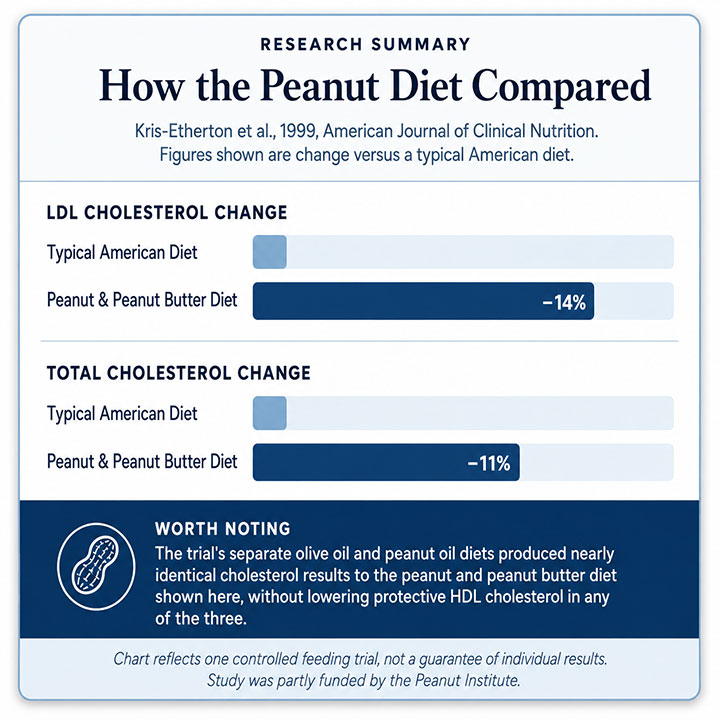
The trial, led by Penn State nutrition researcher Penny Kris-Etherton and published in 1999 in the American Journal of Clinical Nutrition, ran participants through five diets in sequence: a typical American diet, an AHA-style low-fat diet, an olive oil diet, a peanut oil diet, and a fifth built around peanuts and peanut butter.
Compared to the typical American diet, that peanut arm of the trial lowered LDL, the artery-clogging kind of cholesterol, by 14 percent, and total cholesterol by 11 percent. HDL, the protective kind, barely moved. The peanut oil and olive oil diets produced nearly identical numbers.
That number is bigger than it looks. Many physicians consider a 10 percent LDL drop clinically meaningful on its own. In this case, a grocery store legume matched an oil most people already treat as a health halo.
Worth knowing: the trial was partly funded by the Peanut Institute. That doesn’t undo the findings, which have held up in later reviews, but it’s the kind of detail a careful reader deserves to see stated plainly.
Why Peanuts Work: Inside the Chemistry
Peanuts contain plant sterols, compounds that resemble cholesterol closely enough at a molecular level to compete with it for absorption in the gut. Cholesterol loses that competition more often than not, and less of it ends up in the bloodstream.
Not everyone absorbs sterols at the same rate. Two people can eat the exact same handful of peanuts and see very different cholesterol shifts, and researchers still don’t fully understand why.
Fat itself is the second factor, though not in the way most people assume. Peanuts are rich in oleic acid, the same monounsaturated fat that gives olive oil its reputation. A one-ounce serving is roughly 50 percent fat by weight, and most of that fat is unsaturated, leaving a saturated fraction smaller than the label suggests.
Fiber does a third kind of work. Soluble fiber binds to cholesterol in the digestive tract and carries it out of the body before it can be absorbed, the same mechanism that makes oats a familiar cholesterol-lowering food. It also slows digestion, which helps blood sugar stay level after a meal.
Beyond Cholesterol: What Happens to the Blood Vessels
Arteries aren’t rigid tubing. They’re living tissue that widens and narrows depending on what the body needs, a property researchers call endothelial function, and it matters as much for heart disease risk as cholesterol numbers do.
Peanuts are one of the richer plant sources of L-arginine, an amino acid the body converts into nitric oxide, the molecule that signals blood vessels to relax and stay flexible.
The evidence that this translates into a measurable vascular benefit is less settled than the cholesterol data. A 2010 trial led by Rovira i Virgili University researcher Patricia López-Uriarte gave adults with metabolic syndrome 30 grams of mixed nuts daily for 12 weeks and found no significant change in endothelial function compared with a nut-free diet, though no harm either. Nobody’s pinned down yet how much of that mechanism shows up on an actual vascular test.
That gap between a plausible mechanism and a proven outcome is worth sitting with rather than smoothing over. It’s one reason nutrition science moves slower than headlines suggest.
The Weight Gain Question
Calories are the real objection most people raise. A single ounce of peanuts runs about 160 calories, hardly a diet food on paper.
A 2002 study by Purdue researchers Cheryl Alper and Richard Mattes had healthy adults add peanuts to their normal diet for eight weeks, roughly 500 extra calories a day. If a nutrition label told the whole story, that math should have added up fast. It didn’t.
Participants gained a fraction of the weight the added calories would predict, on the order of a couple of pounds rather than eight or more. Two things seem to explain the gap. Protein and fiber blunt appetite more than refined snacks do, so people eat less elsewhere without trying to.
Peanuts also have a cell structure that resists complete digestion, meaning some of the fat passes through the body unabsorbed, a pattern seen across nuts more broadly in nutrient-absorption research. Exactly how much applies to peanuts specifically isn’t fully nailed down yet.
What the Wider Research Adds
A single trial only tells you so much. The picture gets more convincing once decades of cohort data come in, and three research teams asking versions of the same question keep landing in the same place.
Harvard’s decades-long Nurses’ Health Study and Health Professionals Follow-Up Study, tracking more than 118,000 people since 1980, found nut eaters living measurably longer, full stop, before anyone broke the number down by cause.
A 2013 analysis of that data by Harvard epidemiologist Ying Bao and colleagues, published in the New England Journal of Medicine, put the gap at 20 percent lower all-cause mortality for people eating nuts seven or more times a week. That’s an overall figure, not a cardiovascular-specific one, though heart disease deaths were part of what dropped.
When a follow-up pooled analysis of the same cohorts, led by nutrition researcher Marta Guasch-Ferré in 2017, narrowed the lens specifically to peanuts and tree nuts, the cardiovascular-specific numbers held: 13 to 19 percent lower cardiovascular disease risk, 15 to 23 percent lower coronary heart disease risk among the highest consumers versus the lowest.
A larger 2016 meta-analysis led by researcher Dagfinn Aune, spanning 20 studies and roughly 800,000 participants, pushed the question further, asking whether more nuts meant progressively lower risk.
The highest intake category came in at 24 percent lower coronary heart disease risk than the lowest. Each additional 28 grams eaten per day tracked with an even steeper drop still, closer to 29 percent, a separate kind of comparison than the highest-versus-lowest figure above.
None of this proves peanuts caused the difference on their own. People who eat nuts regularly tend to differ from people who don’t in other ways too. But when three different methods, run by three different teams over three decades, all arrive at the same direction, that’s a harder coincidence to write off than any one of them alone.
Peanuts aren’t the only food with this kind of long-term backing.
How You Eat Them Matters
Not all peanuts deliver the same benefit. Preparation changes the picture more than most people expect.
Boiled peanuts, more common in the Southern United States than in most grocery aisles, concentrate isoflavones, a class of antioxidants tied to lower inflammation, at higher levels than roasted peanuts typically show. Raw and roasted peanuts still carry solid evidence behind them.
Peanut butter can go either way. A heart-healthy jar has one or two ingredients: peanuts, and maybe salt. Once hydrogenated oils, added sugar, or corn syrup show up on the label, the product is working against the very benefit that made peanuts worth eating in the first place.
Check every ingredient on your label below. The tool scores your peanut butter in real time and explains exactly what each ingredient does to your cardiovascular health.
The skin matters too. That thin red layer is where most of a peanut’s polyphenols concentrate, plant compounds that reduce oxidative stress in blood vessels. Blanched peanuts lose a meaningful share of that protection along with the skin.
A Few Ways to Fit Them In
None of this requires a diet overhaul. The research above generally used somewhere around an ounce a day, a small handful, though exact amounts varied by study. The irony is hard to miss: the same bag of ballpark peanuts that started this whole junk-food reputation is, in reasonable amounts, part of what undoes it.
- Stir two tablespoons of natural peanut butter into a morning smoothie alongside a banana and a handful of spinach.
- Swap an afternoon vending machine run for a small bag of unsalted, skin-on peanuts.
- Whisk natural peanut butter with a splash of soy sauce and rice vinegar for a quick sauce over vegetables or rice.
Who Should Be Careful
For most people, peanuts are safe and worth including regularly. A few groups need to think twice.
Anyone with a peanut allergy can’t follow this advice, obviously. People on blood thinners like warfarin should talk to a doctor first, since peanuts contain vitamin K, which can interact with those medications.
Severe kidney disease can also change how much protein and potassium a person should be eating, which makes peanuts worth discussing with a physician rather than adding on autopilot.
Conclusion
Peanuts were competing with olive oil in a controlled trial, and they came close to matching it.
That’s a strange thing to learn about a food best known for ballpark concession stands. Cheap, unglamorous, and backed by three decades of population data that all point the same direction. For most people, that combination is hard to find anywhere else in the snack aisle.
Frequently Asked Questions
How many peanuts should I eat for heart health?
Most of the research behind these findings used about one ounce a day, a small handful or 28 grams. More isn’t necessarily better once you’re above that range, since the calories add up quickly.
Are salted peanuts still good for your heart?
Lightly salted peanuts still carry the core cholesterol and fiber benefits. The tradeoff is sodium, so unsalted or lightly salted varieties are the safer default if blood pressure is already a concern.
Do peanuts raise cholesterol or lower it?
The controlled trials above consistently found peanuts lower LDL and total cholesterol without lowering HDL, the opposite of what the old “peanuts are junk food” assumption would predict.
Can peanuts raise blood pressure?
Unsalted peanuts aren’t associated with raised blood pressure in the research behind this article. Heavily salted versions are more about sodium intake generally than anything specific to peanuts.
Are honey roasted peanuts still heart healthy?
They carry some of the same fat and fiber profile, but added sugar and oil coatings dilute the benefit. Plain roasted or boiled peanuts are the more evidence-backed choice.
Should people with heart disease avoid peanuts?
Generally not. The research points the other direction, though anyone with existing heart disease should still run new dietary habits past their cardiologist, particularly if medication interactions are a factor.
Do peanuts interact with heart medications?
The main interaction to know about is with blood thinners like warfarin, due to peanuts’ vitamin K content. Anyone on anticoagulants should check with their doctor before making peanuts a daily habit.