People size you up in five seconds or less. They judge your status, your competence, and whether you deserve their attention. This happens before you say hello or shake hands.
This snap judgment isn’t random. It’s based on signals you send through posture, movement, and facial cues. You can control these signals. You can shift how people see you by changing how you carry yourself.
This isn’t about faking it. It’s about using your body’s built-in system for showing strength and calm. These nonverbal signals combine to create what observers perceive as an “aura of confidence”—a field of presence that exists before you speak your first word.
The Confidence Baseline Assessment
Before you learn specific techniques, find out where you stand right now.
Confidence Baseline Assessment
Find out where you stand right now
Rate yourself honestly on each item. Your assessment is saved automatically and you can return to it anytime.
`;
resultsDiv.classList.add('confidence-assessment-show');
// Play success tone
playTone(523.25, 0.15, 0.08); // C5
setTimeout(() => playTone(659.25, 0.15, 0.08), 150); // E5
setTimeout(() => playTone(783.99, 0.3, 0.08), 300); // G5
// Scroll to results within the container
resultsDiv.scrollIntoView({ behavior: 'smooth', block: 'nearest' });
}
// Event listeners
form.addEventListener('change', function(e) {
if (e.target.type === 'radio') {
saveData();
updateProgress();
// Play selection tone
playTone(440, 0.05, 0.05);
}
});
calculateBtn.addEventListener('click', function() {
displayResults();
});
resetBtn.addEventListener('click', function() {
if (confirm('Are you sure you want to retake the assessment? This will clear your current answers.')) {
form.reset();
resultsDiv.classList.remove('confidence-assessment-show');
localStorage.removeItem(STORAGE_KEY);
updateProgress();
// Play reset tone
playTone(330, 0.1, 0.05);
// Scroll to top of form
form.scrollIntoView({ behavior: 'smooth', block: 'start' });
}
});
// Initialize
loadSavedData();
updateProgress();
})();
The Science Behind Instant Judgments
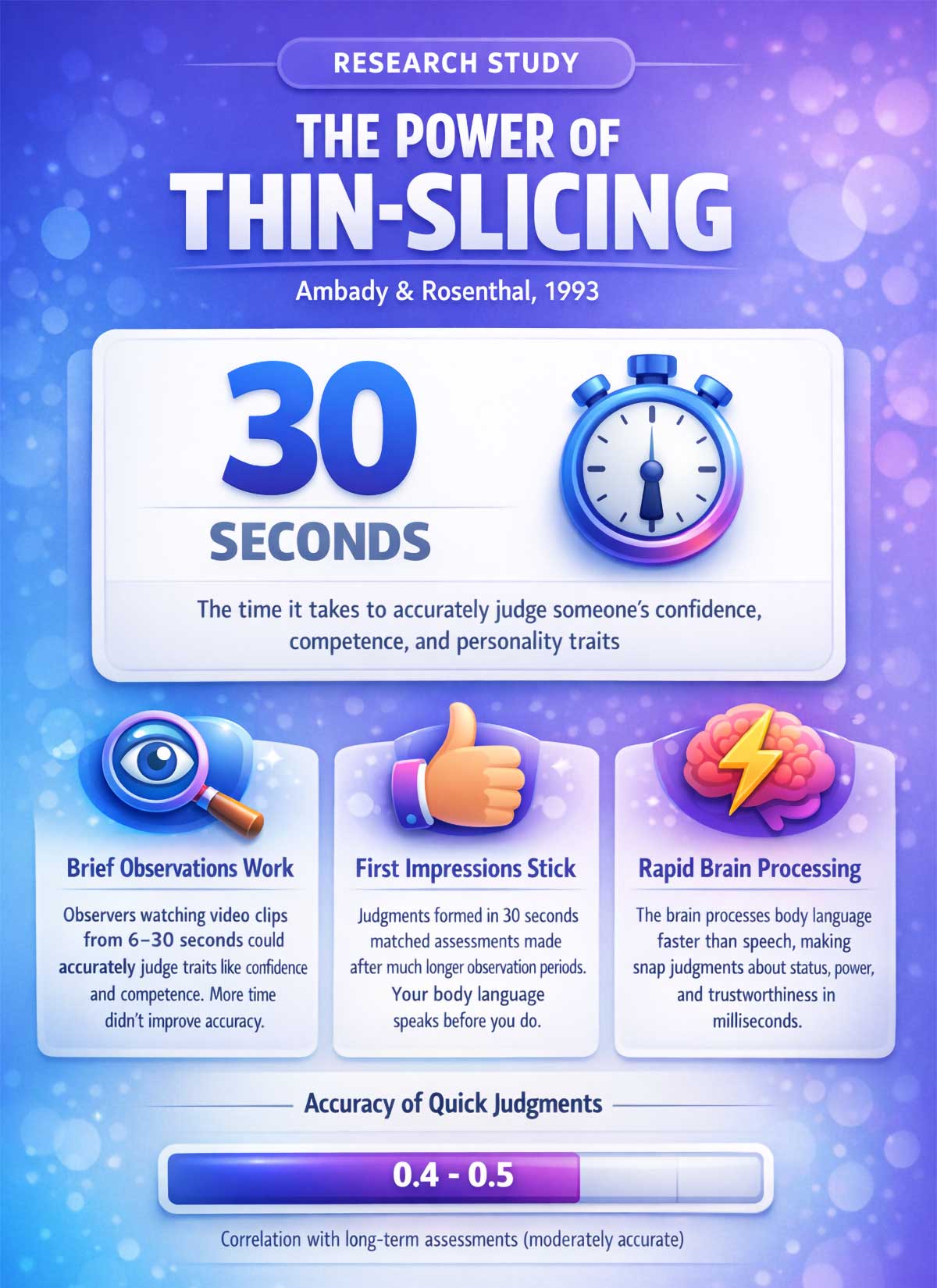
Researchers Nalini Ambady and Robert Rosenthal analyzed how fast we form opinions about others. They reviewed studies where people watched brief video clips of strangers—ranging from 6 to 30 seconds. Observers then rated these strangers on various traits including confidence, competence, and warmth.
The results were striking. Judgments made from 30-second clips correlated highly with judgments made after much longer observation periods. Brief exposure gave observers enough information to make moderately accurate predictions.
How People Judge Confidence in Seconds
This phenomenon is called “thin-slicing”—the brain’s ability to make rapid assessments about someone from small samples of behavior. These judgments correlate about 0.4 to 0.5 with longer-term assessments. Think of it like this: if you rated someone’s confidence on a scale of 1 to 10 after 30 seconds, you’d probably get within 2-3 points of their true level. Close, but not perfect.
This means first impressions can be overcome with consistent contrary evidence over time. But why make it harder on yourself? Why not align your body language with your actual competence from the start?
Your brain processes body language faster than speech. When someone walks into a room, observers decode their posture, gait, and facial expression in milliseconds. These cues trigger automatic responses about who holds power and who doesn’t.
In our ancestral past, quick threat and ally assessment was survival-critical. You had seconds to decide if an approaching stranger meant harm or help. That ancient system still runs in modern brains. Your LinkedIn photo, your Zoom appearance, your walk into a conference room—all trigger the same rapid evaluation mechanism humans have used for thousands of years.
Master These 7 Body Language Signals
Here’s your roadmap. This table shows the difference between signals that drain your presence and signals that build it.
Body Area
Low-Status Signal
High-Status Signal
Quick Fix
Posture
Hunched shoulders, collapsed chest
Shoulders back, chest open
Shoulder-blade reset (3 seconds)
Movement Speed
Rushed, jerky, fidgety
Slow, deliberate, smooth
Count to 2 before each action
Spatial Use
Arms close to body, legs crossed tight
Arms away from torso, open stance
“Doorframe width” stance
Eye Contact
Darting eyes, looking down first
Steady gaze, looking away last
Hold gaze 1 second longer
Hands
Fidgeting, touching face/hair
Still or purposeful gestures
Rest hands on table or at sides
Facial Expression
Tight jaw, furrowed brow
Half-smile, relaxed face
Relax jaw, slight lip curve
Head Position
Chin down, head tilted submissively
Chin level, head centered
Imagine string pulling head up
Use this as your daily checklist. Pick one area each morning and focus on it for the whole day.
Why Confident People Use More Space (And How You Can Too)
High-status people use more space. They spread their arms. They lean back. They don’t fold themselves into small shapes.
Amy Cuddy and her team at Harvard tested this in 2010. They brought 42 adults into a lab and had them hold either expansive poses (arms raised, legs spread) or contractive poses (arms crossed, legs together) for two minutes. Then they measured how powerful participants felt and whether they’d take a gambling risk.
People who held expansive poses reported feeling 20-30% more powerful. They were also more willing to take the gambling risk. The original study claimed these poses changed testosterone and cortisol levels, but those hormonal findings didn’t hold up in later replication attempts. Co-author Dana Carney even issued a statement in 2016 walking back the hormonal claims.
But here’s what did stick: the subjective feelings of power and the increased risk tolerance. Multiple follow-up studies confirmed these effects.
The key isn’t the pose itself. It’s what expansion signals to others and to your own brain.
When you open your stance, you tell observers: “I belong here. I’m not afraid.” Your brain also gets the memo. Physical openness creates mental openness.
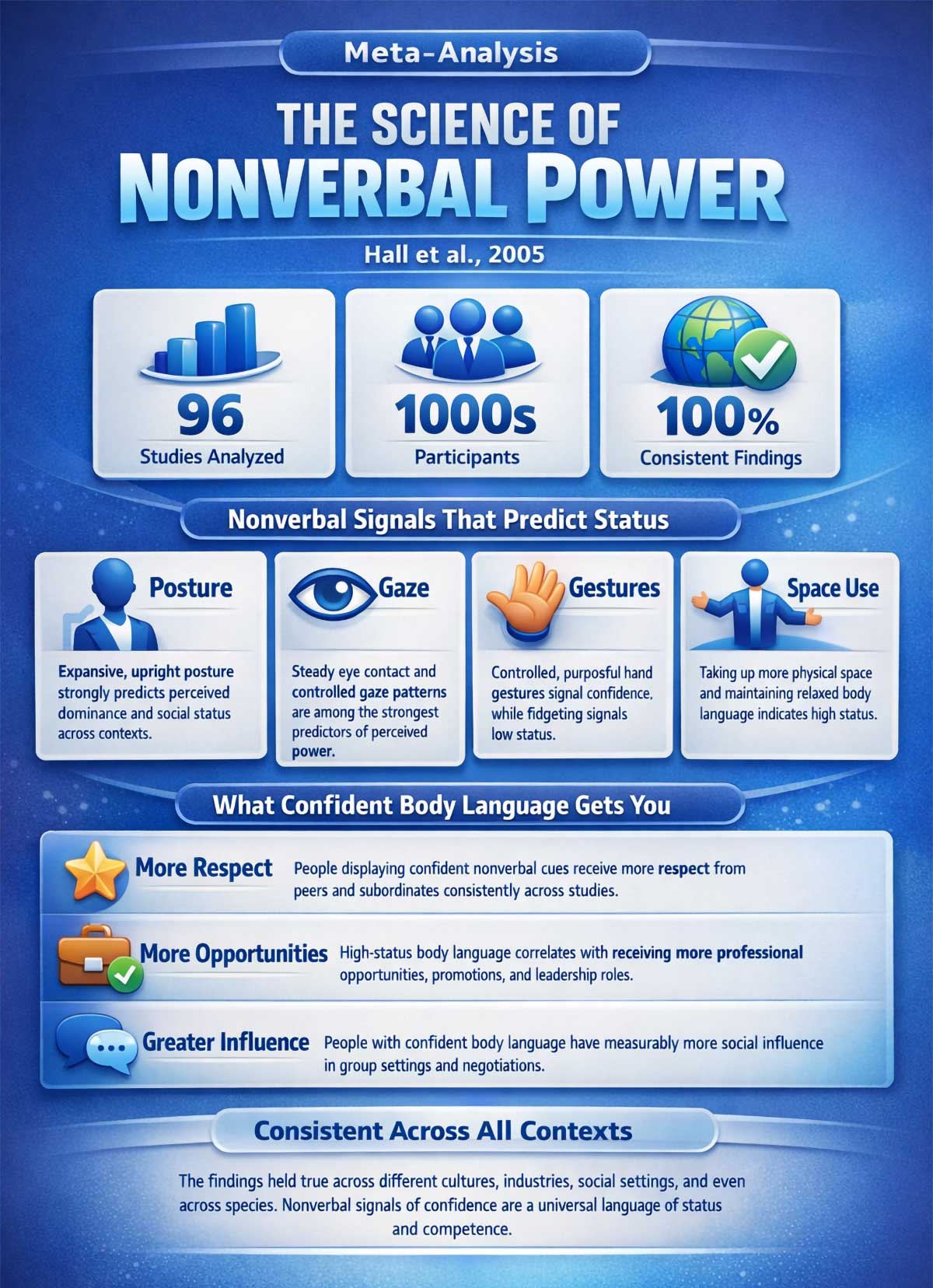
This isn’t just a human thing. Judith Hall and her colleagues analyzed 96 studies examining nonverbal behavior across different contexts. They found that expansive postures, relaxed body language, and controlled gestures strongly predicted how others perceived someone’s social status and dominance. The effect held across species—primates, wolves, and other social animals also link space use with hierarchy.
The Shoulder-Blade Reset
Try this right now.
Roll your shoulders back. Squeeze your shoulder blades together like you’re holding a pencil between them. Hold for three seconds. Release.
Your chest naturally lifts. Your head rises. You’ve just reset your posture with minimal effort.
Do this before meetings, presentations, or tough talks. It takes three seconds and shifts your whole presence.
The Doorframe Width Stance
When standing, position your feet about as wide as a doorframe. This is expansive without being exaggerated.
Too narrow and you look uncertain. Too wide and you look like you’re trying too hard. Doorframe width hits the sweet spot.
Keep your arms away from your torso. Not crossed. Not clutching things to your chest. Let them hang naturally at your sides or rest one hand on a table.
You’re not invading anyone else’s space. You’re just taking yours.
Slow Down: The Speed of Status
Here’s something that surprises most people: moving slower makes you look more confident.
Li Huang and her research team conducted a series of studies at Northwestern University. They showed participants videos of people performing identical tasks with different body movements. Some used quick, contracted movements. Others used slower movements that also appeared more expansive and open.
Viewers rated the slower-moving people with more expansive gestures as significantly more confident, competent, and suitable for leadership roles. Fast, contracted movements made people seem anxious and low-status.
Why? Rushed movements suggest you’re reactive, not in control. They say: “I’m scrambling. I’m overwhelmed.”
Slow movements say: “I have time. I’m not worried.”
Watch someone with real authority walk into a room. They don’t rush. They move with purpose but not panic. Their gestures are smooth, not frantic.
This doesn’t mean you should move in slow motion. It means being intentional. If you normally take one second to pick up a pen, take two. If you usually walk briskly to your car, reduce your pace by 20%.
The 2-for-1 rule works well: for every second you think an action should take, give it two.
The Pause Technique
Practice this in your next conversation.
When someone asks you a question, wait two seconds before you answer. Let the silence sit. Then speak.
This pause does two things. It gives you time to think. And it shows you’re not desperate to fill every gap with words. People who pause seem thoughtful. People who blurt seem nervous.
You can use pauses in movement too. Before you sit, stand still for a beat. Before you gesture, let your hands rest. Stillness creates weight.
Exception: emergency situations or genuinely time-pressured tasks require faster movement. These techniques are for social and professional contexts where you control the pace.
Your Posture Shapes Your Mind
Here’s where it gets interesting. Your body doesn’t just signal to others. It signals to you.
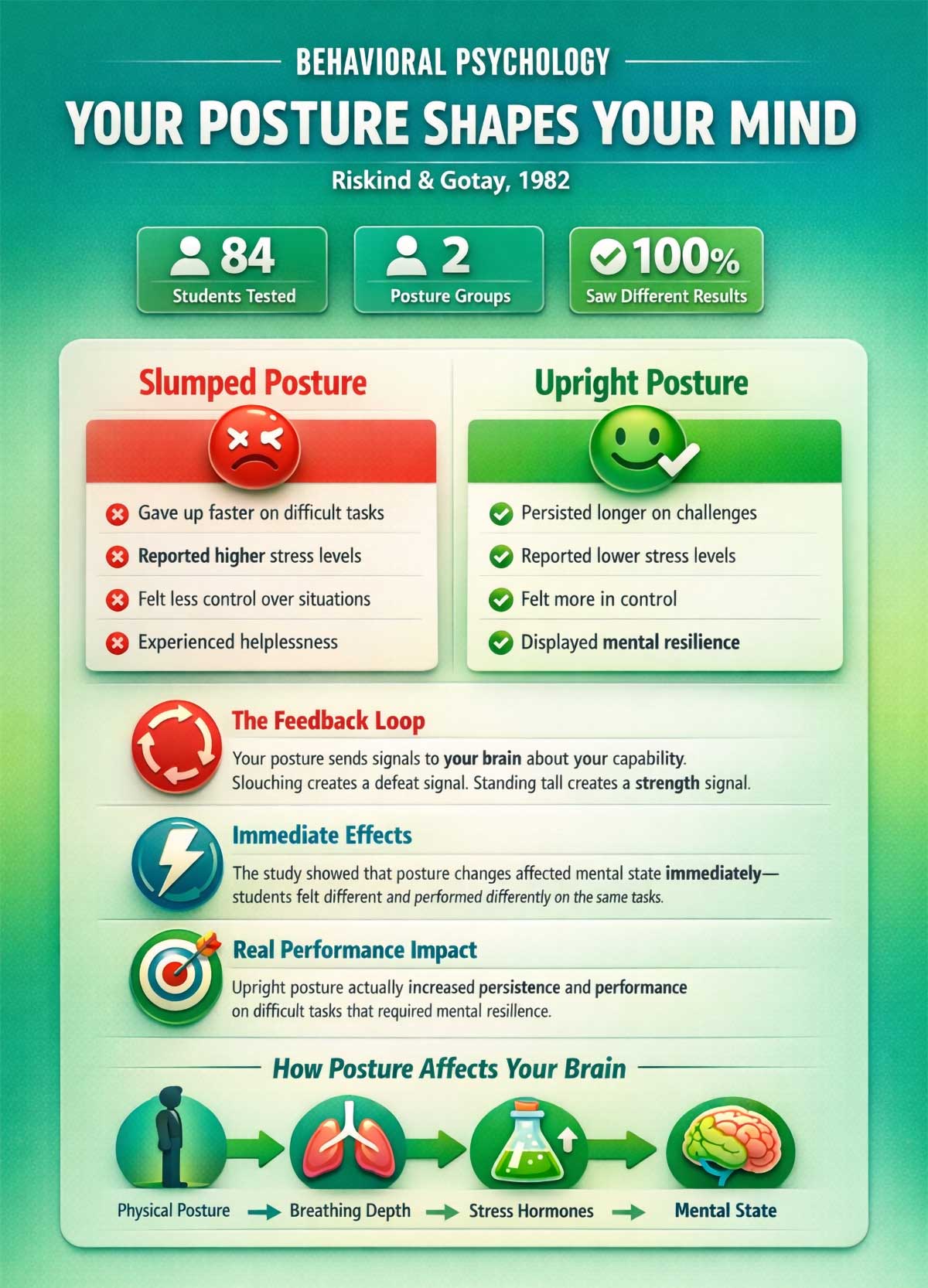
James Riskind and Carolyn Gotay ran a study in 1982 with 84 college students. They had some students sit in a slumped position—head down, shoulders forward, spine curved. Others sat upright with straight backs and lifted chests. Then they gave everyone a series of challenging puzzles and unsolvable tasks.
The slumped students gave up faster. They reported more stress and less control over the situation. They felt helpless.
The upright students stuck with hard tasks longer. They reported feeling more capable and less stressed. Same tasks. Different postures. Completely different mental states.
How Body Position Affects Mental Resilience and Persistence
This creates a feedback loop. When you slouch, your brain interprets the signal as defeat. You feel less able to handle pressure. When you stand tall, your brain reads it as strength. You actually become more persistent.
The mechanism works through your breathing. Slumped posture restricts breathing and reduces lung capacity. Your chest is compressed. Your diaphragm can’t fully expand. This leads to shallow breathing, which triggers a mild stress response and increases cortisol production.
Upright posture allows full, deep breaths. Deep breathing activates your parasympathetic nervous system—the one responsible for calm and focus. Lower cortisol. Better mood. Clearer thinking.
Sara Nair’s team tested this with 74 adults who had mild to moderate depression. They randomly assigned people to sit either upright or slumped while completing various tasks and questionnaires. The upright group showed significant improvements in positive emotions and self-esteem compared to the slumped group. They also used fewer first-person singular pronouns like “I” and “me” in their speech, suggesting less obsessive self-focus.
Your physical stance literally changes your mental state. Slump and you’ll feel beaten. Stand straight and you’ll feel ready.
Try this experiment yourself. Spend two minutes sitting with terrible posture—shoulders forward, head down, chest collapsed. Try to think about something challenging you need to do. Notice how it feels.
Now sit upright for two minutes. Shoulders back, chest open, head level. Think about the same challenge. The problem didn’t change. But your capacity to face it did.
Use Your Body’s Natural Victory Signal
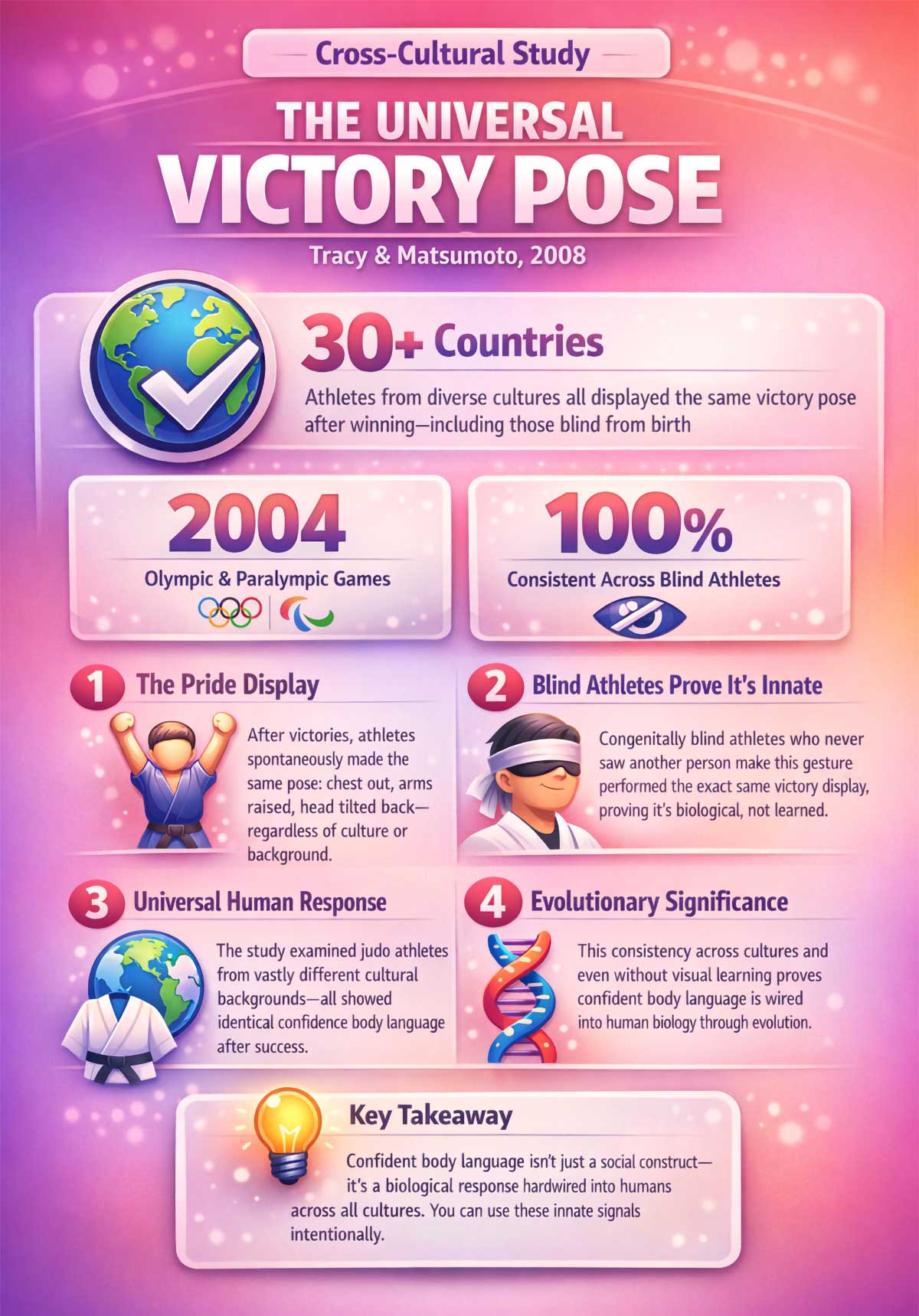
Jessica Tracy and David Matsumoto studied athletes from over 30 countries at the 2004 Olympic and Paralympic judo competitions. They examined athletes’ spontaneous reactions immediately after winning or losing matches. After victories, athletes from vastly different backgrounds made the same pose—chest out, arms raised, head tilted back.
What made this study remarkable: it included congenitally blind athletes who had never seen another person make this gesture. Yet they performed the exact same victory display.
Universal Confidence Body Language Across Cultures
This tells us something huge. Confident body language isn’t just learned. It’s wired into human biology.
You can use this on purpose. Before a job interview, step into a private space. A bathroom. Your car. An empty hallway. Stand with your feet wide, hands on hips or arms raised. Hold it for 60 seconds. Breathe deeply.
You’re not trying to change your hormones. Recent meta-analyses from 2017 to 2020 found that while these poses create small-to-moderate effects on subjective feelings of power, they don’t produce reliable hormonal changes. This technique works through self-perception—using a biological victory signal that may prime emotional states, though the hormonal effects have been disproven.
Think of it like warming up before a workout. You’re telling your system: “It’s time to perform.”
The Subtle Victory Variant
You can’t throw your arms up in a job interview or client meeting. That would be weird.
But you can use a subtle version in public spaces. Chest out. Chin up. Shoulders back. Walk like you just accomplished something important.
This sends the same biological signal without the dramatic gesture. It works while walking down a hallway, standing in a lobby, or entering any room.
Daily Practice
Start your morning with 60 seconds of an open stance. Feet shoulder-width apart, hands on hips, chin up. Breathe deeply.
You’re not being silly. You’re activating a biological response that humans have used for thousands of years.
The Gaze of Authority
Eye contact separates confident people from nervous ones. But there’s a trick to it.
Judith Hall’s meta-analysis of 96 studies on nonverbal behavior found that gaze is one of the strongest predictors of perceived dominance. High-status people hold eye contact longer than low-status people. They look at you while you’re talking. They don’t dart their eyes away when you look back.
But there’s a balance. Staring too hard looks aggressive. Looking away too fast looks submissive.
Aim for what researchers call a “warm but firm” gaze. You’re engaged but not challenging. You look at someone’s eyes when they speak. When you talk, you can break eye contact briefly to think, but you return to their face.
Here’s a simple rule: match or slightly exceed the other person’s eye contact duration. If they look at you for three seconds, you look back for three to four. Don’t look away first unless you have a reason.
The Eye Contact Ratio
When you’re listening, maintain strong eye contact—roughly 80% of the time. This shows you’re fully present.
When you’re speaking, 50-60% eye contact is natural. Looking away briefly while you think doesn’t signal low confidence. It signals you’re actually thinking, not reciting a script.
The problem comes when you look away immediately upon making eye contact, especially if you look down. This is called a submissive glance.
Avoiding the Submissive Glance
Watch out for this pattern: looking at someone, then quickly looking down or away when they notice you.
This signals: “I don’t want conflict. You’re higher status than me.”
If you catch yourself doing it, pause. Look back. Hold the gaze for two beats. Then look away naturally—to the side or at something else in the room, not down.
The Triangle Technique
Some people find direct eye contact uncomfortable or intense. Here’s a workaround.
Look at the triangle formed by both eyes and the mouth. Shift your gaze between these three points. To the other person, this appears like normal eye contact. But it feels less intense for you.
Your Face Tells Your Brain How to Feel
Your facial expression isn’t just a result of emotion. It creates emotion.
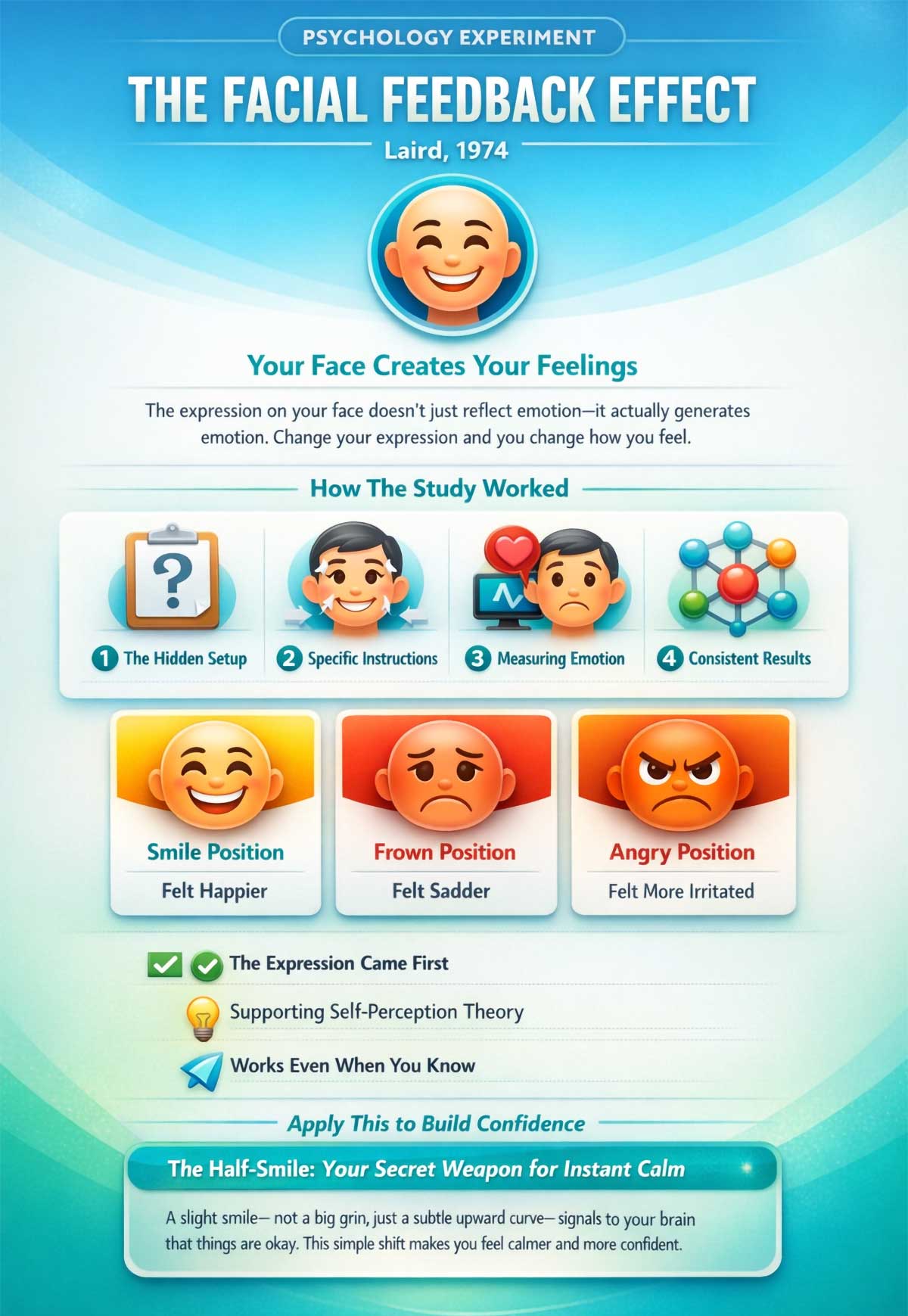
James Laird tested this in 1974 with undergraduate students. He told them he was measuring facial muscle activity. He gave them specific instructions: “Contract these muscles. Raise this area. Pull back here.” He was making them create facial expressions—smiles, frowns, angry faces—without telling them that’s what they were doing.
Afterward, he asked how they felt. People who had arranged their faces into smiles reported feeling happier. Those who made angry faces felt more irritated. Those who frowned felt sadder.
They created the expression first. The emotion followed.
Facial Feedback Effect
This is called the facial feedback effect. Your brain uses your face as a gauge for how you should feel. The mechanism works through self-perception theory, developed by Daryl Bem in 1972. Laird’s study tested predictions of this theory through facial feedback effects.
For confidence, try the half-smile. Not a big grin—that can look fake or nervous. Just a slight upward curve at the corners of your mouth. Enough that someone could see you’re at ease.
This simple shift makes you look approachable but composed and genuinely makes you feel calmer.
Your brain constantly monitors your body for clues about your internal state. When your facial muscles form a smile, your brain thinks: “My face is smiling. I must feel good. Things must be okay.”
Relax Your Jaw
Tension shows in your face, especially your jaw. A clenched jaw signals stress or anger.
Check in with your jaw right now. Is it tight? Are your teeth touching? If so, consciously relax it. Let your teeth separate slightly. Let your tongue rest on the roof of your mouth.
This subtle shift softens your whole expression.
Stop the Fidgets
Small, repetitive movements drain your presence.
Tapping your foot. Adjusting your collar. Playing with your phone. Touching your face. Clicking a pen. Twirling your hair. Pacing back and forth.
These are called “leakage” in body language research. They leak your internal anxiety to everyone watching. They tell observers: “This person is uncomfortable.”
The same research by Hall and colleagues that examined dominance cues found that stillness and controlled gestures strongly predict how others see your status. Fidgeting does the opposite.
The Quiet Hands Method
For one day, track your fidgets. Notice when your hands move without purpose.
Then practice keeping your hands still. When you’re standing, let them hang loose at your sides or clasp them lightly in front. When you’re sitting, rest them on the table or in your lap.
Move your hands when you have a reason—to gesture, to pick something up, to shake hands. Otherwise, keep them quiet.
This isn’t about being stiff. It’s about being intentional. Every movement should mean something.
Start with just your hands. Once that feels natural, expand to other areas. Notice if you tap your feet. Shift your weight constantly. Adjust your clothes repeatedly. Pace unnecessarily. Eliminate one fidget at a time.
Gender and Cultural Context: Adapting Confidence to Your Environment
Body language doesn’t exist in a vacuum. The same confident signals can be interpreted very differently based on your gender, culture, and professional context.
The Gender Factor
Women face a unique challenge with confident body language. Research shows they often encounter what psychologists call the “competence-warmth tradeoff.” When women display the same confident body language as men, they may be labeled as cold, aggressive, or unlikeable, while men displaying identical behavior are simply seen as confident.
This isn’t fair. But it’s real.
The solution isn’t to shrink yourself. It’s to add warmth signals alongside confidence signals. For women using these techniques:
Pair upright posture with genuine smiles (not just half-smiles) when appropriate
Use confident eye contact while also showing active listening (nodding, facial responsiveness)
Take up space while remaining facially warm and engaged
Balance assertive body language with collaborative verbal language
Men can benefit from adding warmth too, but they typically don’t face the same social penalty for confident body language alone.
If you’re a woman and you get feedback that you seem “intimidating” or “cold,” don’t automatically retreat to submissive body language. Instead, check: Are you smiling when appropriate? Are you showing genuine interest in others? Are you balancing your confidence with visible warmth?
Cultural Variations
Confident body language varies significantly across cultures. What signals confidence in New York might signal arrogance in Tokyo. What shows respect in Seoul might look submissive in São Paulo.
Eye Contact: In many Asian cultures (including Japan, Korea, China, and Vietnam), extended direct eye contact—especially with elders or authority figures—can be seen as disrespectful or aggressive. In some Middle Eastern cultures, women are expected to lower their gaze as a sign of modesty. Many Indigenous cultures view prolonged eye contact as confrontational.
If you’re working in or with these cultures, adapt your eye contact accordingly. Use the triangle technique. Look at someone’s face without staring directly into their eyes. Break eye contact more frequently and naturally.
Personal Space and Expansion: The “doorframe width” stance and expansive postures work well in North American and many European contexts. But in Japanese, Korean, and many Southeast Asian business settings, physical restraint signals respect and professionalism. Taking up too much space can seem brash or disrespectful.
In these contexts, focus on upright posture without excessive expansion. Keep movements controlled and precise. Let your competence show through composure rather than size.
Touch and Gestures: Some cultures are high-touch (Mediterranean, Latin American, Middle Eastern). Others are low-touch (East Asian, Northern European, British). Some gestures that seem neutral in one culture are offensive in another.
Research your specific cultural context before applying these techniques wholesale.
The Rule: Use these techniques as a starting framework, then calibrate to your specific cultural and professional environment. Watch people who are successful in your context. What body language do they use? How do they balance confidence with respect? Follow their lead.
Calibrating Confidence to Your Role
The appropriate level of confident body language varies by profession and context. A startup founder pitching to venture capitalists needs different signals than a nurse comforting a patient.
High-Assertion Roles
If you’re in sales, leadership, entrepreneurship, law, or consulting, more assertive body language serves you well. Use expansive postures. Maintain strong eye contact. Move deliberately. Take up space.
Service and Care Roles
If you’re a teacher, nurse, therapist, social worker, or in hospitality, balance confidence with approachability. Yes to upright posture and steady movements. But also use warmer facial expressions, more frequent smiles, and slightly softer eye contact. Your confidence should say “I’m capable of helping you” not “I’m in charge here.”
Creative and Collaborative Roles
If you’re in design, engineering, research, or creative fields, your confidence should suggest competence without dominance. Focus on calm, steady presence. Avoid excessive expansion that might intimidate collaborators. Let your work speak while your body language says “I’m confident in my abilities and open to ideas.”
Technical and Academic Roles
In technical fields or academia, confident body language should emphasize thoughtfulness over dominance. Use pauses liberally. Maintain good posture but avoid aggressive eye contact. Your confidence should communicate “I know my material” not “I know more than you.”
The goal is appropriate confidence for your context, not universal dominance.
When Not to Use These Techniques
Confident body language isn’t always the right choice. Here are contexts where you should dial it back or skip it entirely:
Delivering Bad News: When firing someone, sharing a difficult diagnosis, or communicating loss, confident body language can seem callous. Use more closed postures, softer eye contact, and slower, gentler movements. Show empathy through your body.
Apologizing: A genuine apology requires some vulnerability. Too much confident body language makes you seem insincere or defensive. You can maintain dignity without expansive postures or aggressive eye contact.
Consoling Someone: When someone is grieving or upset, matching their energy level is more appropriate than projecting confidence. Sit beside them rather than across from them. Use softer eye contact. Mirror their posture slightly.
Receiving Criticism: When your boss or partner is giving you feedback, overly confident body language can seem dismissive. Maintain upright posture to avoid looking defeated, but don’t use expansive gestures or dominant eye contact. Show you’re listening and considering their words.
Situations Requiring Genuine Vulnerability: Therapy, intimate conversations, or moments when you need to ask for help all benefit from less guarded body language. You can be confident in your willingness to be vulnerable without projecting dominance.
Cultural or Religious Settings: In some religious services, formal ceremonies, or traditional cultural events, deferential body language may be expected and appropriate. Respect the norms of the setting.
Sophisticated use of body language means knowing when to turn it down as much as knowing how to turn it up.
Real-World Applications: Confidence in Action
Let’s see how these techniques work in actual situations.
The Job Interview (First 60 Seconds)
Sarah parks her car outside the office building. She has 90 seconds until she’s in the interview chair.
She starts in the car. Shoulder-blade reset—squeeze, hold three seconds, release. She checks her face in the mirror and relaxes her jaw into a half-smile.
Walking from the parking lot, she slows her pace. She counts to three for every four steps. No rushing.
In the lobby, she greets the receptionist. She pauses for two seconds before responding to the greeting. While waiting, she stands with feet doorframe-width apart, hands relaxed at her sides.
She takes one full breath before entering the interview room.
The handshake: slow grip, three-second hold, steady eye contact. She matches the interviewer’s gaze duration.
Sitting: she sits back in the chair rather than perching on the edge. Feet flat on floor. Hands resting on the armrests.
These seven micro-actions set the tone for the entire interview. The interviewer’s brain has already categorized her as competent before she answers the first question.
The Difficult Team Meeting
Marcus needs to disagree with his boss’s plan. He knows this could go badly if he seems defensive or aggressive.
He prepares his body first. He sits upright with feet flat on the floor. He rests his hands visibly on the conference table—still, not fidgeting.
He maintains a half-smile to signal he’s not hostile. When others speak, he gives them strong eye contact.
He waits for a natural pause rather than interrupting. When the pause comes, he takes two seconds before speaking. This pause makes everyone focus on him.
He keeps steady eye contact with his boss while presenting his alternative. He uses one deliberate hand gesture to emphasize his main point—palm up, open, showing he’s offering an idea, not attacking.
His disagreement lands as “thoughtful alternative” rather than “subordinate complaint.” His boss actually thanks him for the input.
The content of Marcus’s idea mattered. But his body language determined whether anyone would listen to it.
The Networking Event (Entering a Group)
Lisa spots a group of four people talking at a conference reception. She wants to join but doesn’t want to seem desperate or intrusive.
She approaches using a slow walk—not rushed or hesitant. She stops about three feet from the group’s edge. Comfortable distance.
She makes eye contact with the person closest to her and gives a half-smile. She doesn’t interrupt. She waits.
Someone in the group notices her and shifts slightly to make room. This is her invitation. She steps into the circle.
She stands with feet shoulder-width apart. She holds her drink at mid-chest level—not clutched to her body, but not waving it around either. Her arms stay away from her torso, creating an open shape.
She’s now part of the group without having said a word. When she does speak, people are already primed to listen because her body language said: “I belong here.”
The Presentation Recovery
Twenty minutes into his talk, David blanks on his next point. He feels panic rising.
Instead of filling the silence with “um” or nervous laughter, he stops talking completely. He takes a visible breath.
He maintains his upright posture. He doesn’t slump. He keeps the half-smile on his face—not a huge grin, just ease.
He makes eye contact with a friendly face in the audience. This grounds him.
He says calmly, “Let me find that specific data,” while checking his notes. No apology. No self-deprecation.
He finds his place and resumes with a slow, deliberate pace.
His audience sees composure, not panic. Several people later tell him they admired how smoothly he handled that moment. They didn’t realize he’d been lost. His body didn’t broadcast distress, so they didn’t perceive distress.
The First Date Transition
Emma has been talking with her date for 30 minutes. The conversation is good. She wants to signal interest without seeming desperate or overeager.
She shifts her body language deliberately. She leans slightly forward—moving from upright-neutral to engaged. Not far. Just a few inches.
She increases her genuine smile. She’s been using the half-smile. Now she allows full smiles when he says something funny or interesting.
She slightly increases her eye contact duration. Instead of looking away every three seconds, she holds for four or five.
She uncrosses her legs to a more open position. Still appropriate for the setting, but less guarded.
She maintains calm hand position. No fidgeting with her napkin or glass. Hands rest gently on the table.
She speaks slightly slower and softer. More intimate tone without being obvious about it.
Her body language now says: “I’m interested and confident about it” rather than “I’m desperate for approval.”
The difference is subtle. It’s also clear. He leans forward too.
Situation-Specific Confidence Strategies
Different situations call for different emphases. Here’s your tactical guide.
Situation
Primary Challenge
Top 3 Techniques
What to Avoid
Job Interview
First impression in 30 seconds
1. Shoulder-blade reset before entering<br>2. Slow handshake (3-second grip)<br>3. Pause 2 seconds before answering
Rushed speech, fidgeting with resume, breaking eye contact first
Presentation
Maintaining presence for 20+ minutes
1. Wide stance (doorframe width)<br>2. Deliberate hand gestures only<br>3. Pause between major points
Pacing unnecessarily, self-touching, apologetic language
Difficult Conversation
Managing confrontation
1. Upright posture (increases persistence)<br>2. Steady eye contact (warm but firm)<br>3. Slower speech pace
Crossed arms, backing away, rushed explanations
Networking Event
Meeting 10+ new people
1. Half-smile default expression<br>2. Open stance in groups<br>3. Match eye contact duration
Checking phone, hovering near walls, fake enthusiasm
First Date
Balancing confidence with warmth
1. Relaxed but upright posture<br>2. Genuine smile (not half-smile)<br>3. Leaning slightly forward when listening
Excessive stillness, staring, closed-off body
Video Call
Limited visibility
1. Camera at eye level<br>2. Visible hand gestures in frame<br>3. Look at camera when making points
Looking at own image, slumping out of frame, no facial expression
Performance Review
Receiving criticism calmly
1. Upright posture (reduces defensiveness)<br>2. Steady breathing<br>3. Pause before responding
Crossed arms, looking down, interrupting
Choose one situation you face regularly. Practice the top three techniques for that context until they become automatic.
Common Mistakes and How to Fix Them
You’ll hit obstacles. Here’s how to handle them.
“I Feel Fake When I Do This”
This is the most common objection. It feels artificial at first.
Here’s the thing: you’re not pretending to be confident. You’re using your body’s natural system for generating confidence.
James Laird’s facial feedback research showed that conscious manipulation of your body still affects your emotions. You’re not faking a feeling. You’re creating the physical conditions that produce the feeling.
Reframe it this way: when you’re nervous but force yourself to slouch and fidget, you make the nervousness worse. When you’re nervous but choose an upright posture and steady movements, you reduce the nervousness.
Which one is fake? Neither. Both are you making a choice about how to respond to your internal state.
The difference: one choice makes things better. One makes things worse.
After two to three weeks, these techniques won’t feel artificial anymore. They’ll feel normal. That’s when you know they’ve become automatic.
“People Think I’m Arrogant Now”
If you’re getting this feedback, check two things.
First: are you maintaining warm facial expressions? Confidence without warmth reads as arrogance. Make sure you’re using the half-smile. Make sure your face is relaxed, not tense.
Second: are you still listening actively? Confident body language should pair with genuine interest in others. If you’re taking up space but not giving people attention, you seem self-centered.
The distinction: taking your space vs. taking other people’s space.
Your space: standing with an open stance, sitting back in your chair, keeping your shoulders back.
Other people’s space: standing too close, interrupting, dismissive gestures, ignoring what others say.
Confidence is about claiming your right to be there. Arrogance is about denying others the same right.
“It Works at First, Then I Forget”
This is normal. Changing posture and movement patterns takes time.
Research suggests it takes three to four weeks for postural changes to become automatic. You need consistent repetition.
Use implementation intentions. These are if-then plans that link a cue to an action.
Examples:
“When I walk through a doorway, I will reset my shoulders.”
“When I sit down, I will place my feet flat and sit back in the chair.”
“When someone asks me a question, I will pause for two seconds.”
You can also use environmental cues. Put a small sticky note on your computer monitor that says “Shoulders.” Set a phone reminder every two hours to check your posture. Pair the reset with something you already do regularly, like checking email.
The key is to practice in low-stakes environments first. At home. Walking alone. Driving. During solo work. Once techniques feel natural there, add them to social settings one at a time.
“I’m Confident Alone But Not in Groups”
Social anxiety is real. These techniques can help, but they’re not a replacement for therapy if anxiety significantly impairs your daily functioning.
That said, here’s a progression that works for many people.
Start with one-on-one interactions. Practice eye contact and posture with one person you trust. Get comfortable there.
Then move to small groups of three to four people. Use the “anchor person” technique: maintain confident body language with one familiar person in the group. Let your confidence with them extend to the others.
Finally, tackle larger groups. By this point, the techniques are more automatic.
Don’t force yourself into situations that trigger severe anxiety. Build gradually.
“My Job Requires Me to Be Submissive”
If you work in customer service, hospitality, or any role where you serve others, you might think confident body language is inappropriate.
Not true. Confidence doesn’t equal dominance. You can be warm and confident at the same time.
Service workers with upright posture and calm movements actually get better outcomes. Customers perceive them as more competent and trustworthy. This leads to better tips, higher satisfaction ratings, and fewer complaints.
The goal is competence signaling, not power signaling. You’re showing: “I’m capable of helping you” not “I’m better than you.”
Pair upright posture with warm facial expressions. Smile genuinely. Nod when customers speak. Use open hand gestures. Maintain good eye contact while listening.
You can serve others with grace while still carrying yourself with dignity.
“I’m Too Self-Conscious to Focus on My Body”
This gets easier with practice. At first, you’ll be hyperaware of every movement. Your shoulders. Your hands. Your face.
This self-consciousness actually fades faster than you think. After about a week of consistent practice, your attention shifts from “Am I doing this right?” to “This just feels normal.”
The beginning is awkward. Push through it. The payoff is worth it.
If you find yourself obsessing or getting anxious about body language, scale back. Choose just one technique and make it automatic before adding another. Don’t try to monitor seven things at once.
The 7-Day Confidence Building Protocol
You’ve learned the techniques. Now here’s your structured path to making them automatic.
Each day focuses on one area. Master it before moving to the next. By day seven, you’ll integrate everything.
Day
Focus Area
Morning Practice (5 min)
All-Day Awareness
Evening Reflection
1
Posture
Shoulder-blade reset x 10<br>1-min victory pose
Notice when you slouch; reset immediately
Count: How many times did I reset? Target: 10+
2
Movement Speed
Walk slowly to bathroom/kitchen<br>Practice 2-second pauses
Pause 2 seconds before each action
Did anyone comment on me seeming calmer?
3
Spatial Expansion
Stand in doorframe-width stance for 2 min<br>Arms away from body
Keep arms away from torso when standing
Measure: How much space did I use in meetings?
4
Eye Contact
Practice in mirror (hold own gaze 10 sec)<br>Count to 3 before looking away
Hold gaze 1 second longer than feels natural
Who held eye contact back? Who looked away first?
5
Facial Expression
Hold half-smile for 3 minutes while reading<br>Jaw relaxation check
Maintain relaxed jaw and slight smile
Did I feel different? Did others respond differently?
6
Hand Stillness
5-min hands-at-sides meditation<br>Notice every urge to fidget
Track every fidget; stop and reset hands
Total fidgets: ___ (Goal: 50% reduction from Day 1)
7
Integration
2-min victory pose + scan each body area<br>Check all 6 techniques
Use all techniques together in one interaction
Biggest change noticed: ___
How to Use This Protocol
Morning Practice: Set your alarm five minutes earlier. Do the practice before checking your phone or email. This primes your body for the day.
All-Day Awareness: Set reminders every two hours. When the reminder goes off, check: “Am I doing today’s focus technique?”
Evening Reflection: Spend two minutes writing answers to the reflection question. This cements the learning and helps you track progress.
After Day 7: Repeat the protocol or maintain all seven techniques simultaneously. Most people benefit from repeating the cycle 2-3 times before the habits fully stick.
Tracking Your Progress
Use this simple scoring system at the end of each day:
Rate your consistency with today’s focus technique:
1 = Forgot most of the time
2 = Remembered occasionally
3 = Remembered about half the time
4 = Remembered most of the time
5 = Technique felt automatic
Aim for a 4 or 5 by the end of each day. If you score below 3, repeat that day before moving forward.
The Feedback Loop of Presence
When you change your body language, people treat you differently.
They give you more space in conversations. They ask for your opinion. They assume you’re competent until you prove otherwise, instead of the reverse.
A 2005 meta-analysis by Judith Hall and colleagues reviewed 96 studies examining how nonverbal behavior affects perceived status. The findings were consistent across contexts: people who display confident body language receive more respect, more opportunities, and more social influence.
Body Language Meta Analysis
But here’s the deeper benefit: you treat yourself differently.
An upright posture makes you feel more capable. Slow movements make you feel more in control. Steady eye contact makes you feel more worthy of attention.
This creates a cycle. You carry yourself with more presence. People respond better. Their response reinforces your confidence. You carry yourself with even more presence.
The research is clear. Your body and your mind are linked. Change one and you change the other.
After two weeks of consistent practice, most people report a shift. The techniques stop feeling like techniques. They become your natural way of moving through the world.
You stop thinking: “I should reset my shoulders now.” You just notice your shoulders are already back.
You stop thinking: “I should slow down.” You just move at a calmer pace.
You stop thinking: “I should hold eye contact.” You just find yourself engaged in the conversation.
That’s when you know it’s working. The external technique has become an internal reality.
Conclusion
You have everything you need. The research. The techniques. The protocol. The troubleshooting guide.
Now comes the only part that matters: action.
Here’s your immediate next step. Don’t wait. Don’t plan. Just do this right now.
60-Second Body Scan:
Stand up. Roll your shoulders back. Squeeze your shoulder blades together. Hold for three seconds. Release.
Take a deep breath. Feel your chest expand.
Let your arms hang naturally at your sides. Don’t cross them. Don’t clutch anything.
Relax your jaw. Let your teeth separate slightly.
Put the hint of a smile on your face. Not a big grin. Just ease.
Feel the difference. This is what an aura of confidence feels like from the inside.
Next 24 Hours:
Go back to your baseline assessment score. Look at which area you scored lowest on. That’s your starting point for tomorrow.
If posture was weak, do the shoulder-blade reset every time you walk through a doorway tomorrow.
If movement speed was the issue, practice the 2-second pause before every action.
If eye contact makes you uncomfortable, use the triangle technique in your next three conversations.
Next 7 Days:
Follow the protocol exactly. Don’t skip days. Don’t rush ahead. One technique per day. Build the foundation properly.
Track your progress using the scoring system. Be honest with yourself. If a day doesn’t stick, repeat it.
Day 8:
Retake the baseline assessment. Compare your new score to your old one. Most people improve by 8-12 points, moving up at least one category.
That improvement isn’t just a number. It’s how you move through the world. It’s how people respond to you. It’s how you respond to challenges.
Remember This:
People judge you in under 30 seconds based on thin slices of your behavior. When you shift your signals, their response shifts just as quickly.
You don’t need to say a word. Your body is already talking.
FAQs
How long does it take to change my body language?
Basic awareness and implementation: two to three days. You can start using these techniques immediately and see results.
Becoming automatic: three to four weeks of daily practice. This is when you stop thinking about it and your body just does it.
The study by Riskind and Gotay showed immediate effects from posture changes—students felt more capable and persistent right away. But lasting habit formation requires consistent repetition.
Think of it like learning to drive. The first few times, you consciously think about every action. After a month, you do it without thinking.
Can body language actually make me more confident or does it just make me look confident?
Both. This is one of the most well-supported findings in the research.
The facial feedback effect (Laird, 1974) and self-perception theory (Bem, 1972) show that body positions actually change your internal emotional state, not just external appearance. The posture studies by Nair and colleagues (2015) and Riskind and Gotay (1982) confirmed that upright posture improved mood, self-esteem, and persistence on difficult tasks.
Your brain interprets your body’s signals. When you stand tall, your brain thinks: “I’m in a powerful position. I must be capable.” When you slouch, your brain thinks: “I’m in a defeated position. Things must be bad.”
The internal change is real, not just perceived.
What’s the single most important body language change for confidence?
Posture. Hands down.
An upright, open posture affects both how others see you (Hall and colleagues’ meta-analysis, 2005) and how you see yourself (Riskind and Gotay, 1982). It influences your breathing, which affects your stress hormones, which affects your mood and thinking.
If you only fix one thing, fix your posture. Everything else builds from there.
Does this work over video calls?
Yes, but with modifications.
On video, people can only see your upper body and face. Focus on:
Upper body posture (shoulders back, chest open)
Facial expressions (half-smile, relaxed jaw)
Eye contact with the camera (not the screen) when making important points
Hand gestures within the frame (deliberate, not fidgety)
The expansion effect is limited because viewers can’t see your full stance. But posture and facial cues still matter just as much.
Pro tip: position your camera at eye level. Looking up at the camera makes you seem smaller and less confident. Looking down makes you seem dismissive.
I’m naturally introverted. Will this make me seem fake?
No. Introversion is about energy management, not body language.
You can be introverted and still have confident body language. These techniques help you show your competence clearly, which actually conserves energy by preventing misunderstandings.
Introverts often struggle because their quiet demeanor gets misread as uncertainty or disinterest. Confident body language fixes that misunderstanding. People see your competence without you having to prove it verbally over and over.
You’re not becoming extroverted. You’re just making your existing capabilities more visible.
How do I practice this without people noticing?
Start in low-stakes environments. Practice at home. While walking alone. In your car. During solo work.
Once techniques feel natural, add them to social settings one at a time. Most changes are subtle anyway. People notice the effect—you seem more confident—but not the specific technique.
If someone does notice and asks, “You seem different lately,” take it as a compliment. Say something like, “I’ve been working on my posture” or “I’m trying to slow down and be more present.”
Most people won’t ask. They’ll just treat you differently.
What if my job requires me to sit all day?
Seated confidence is just as important as standing confidence.
When sitting:
Sit back in your chair rather than perching on the edge
Keep feet flat on the floor (both feet, not crossed)
Rest hands on the desk or armrests, not hidden in your lap
Keep shoulders back and chest open
Position your screen at eye level so you’re not hunching forward
Stand and reset your posture every 60 to 90 minutes. Walk to get water. Stand during phone calls. Use a standing desk if possible.
Your body wasn’t designed to sit for eight hours straight. Build movement into your day.
Can I overdo this and seem aggressive?
Yes. The line between confident and aggressive is real.
The key is “warm but firm.” Pair expansive posture with friendly facial expressions. Smile genuinely when appropriate. Nod when others speak. Show interest in what they say.
If your body language is open but your face is cold, you’ll seem threatening rather than confident. If you take up space but never give others attention, you’ll seem arrogant.
Confidence says: “I have value.” Aggression says: “I have more value than you.” Make sure you’re communicating the first message, not the second.
Do these techniques work for women as well as men?
Absolutely. Tracy and Matsumoto’s research (2008) found that victory poses were universal across genders and cultures.
But there’s a complication. Women often face what researchers call the “competence-warmth tradeoff.” When women display confident body language, they sometimes get labeled as cold or aggressive, while men displaying the same behavior get labeled as confident.
The solution: combine upright posture with warm facial expressions and active listening cues. Show competence and warmth simultaneously. This is possible and gets easier with practice.
Don’t shrink yourself to avoid negative judgments. Instead, add warmth to your confidence.
Is there a difference between confidence and dominance in body language?
Yes. Big difference.
Confidence includes:
Expansive but respectful space use
Steady but not aggressive eye contact
Open posture without invading others
Calm, deliberate movements
Relaxed facial expressions
Dominance includes all of those plus:
Invading personal space
Staring without warmth
Dismissive gestures
Interrupting
Ignoring social cues
Aim for confidence, not dominance. You want to show capability and self-assurance, not intimidation.
What if I work in a culture where direct eye contact is disrespectful?
Adapt the techniques to your cultural context. Use the triangle technique—look at someone’s face without staring directly into their eyes. Break eye contact more frequently and naturally.
Focus on the other elements: upright posture, controlled movements, facial composure. These signal confidence across cultures without violating local norms about eye contact.
Watch successful people in your specific cultural environment. How do they balance confidence with respect? Follow their lead.
What if I have a physical condition that affects my posture?
Work with what you have. These principles adapt.
If you can’t stand upright due to a medical condition, focus on the elements you can control: facial expression, eye contact, hand stillness, movement speed.
If you use a wheelchair, you can still practice expansion (arms away from body), steady gaze, and deliberate movements. The same principles apply.
The goal isn’t perfect posture. It’s using your body to communicate your internal confidence as clearly as possible given your circumstances.
How do I maintain confident body language when I’m genuinely uncertain?
This is nuanced. You can be uncertain about a topic while still confident in your ability to figure it out or ask good questions.
Maintain upright posture and steady eye contact. But pair it with language that acknowledges uncertainty: “I don’t know the answer to that, but I can find out” or “That’s outside my expertise. Let me connect you with someone who knows more.”
Confident body language says “I’m capable.” Your words can say “I don’t have this specific knowledge” without undermining your overall competence.
Can I practice these techniques if I have social anxiety disorder?
These techniques can help with mild to moderate social anxiety. They may reduce some symptoms by changing your physical state, which affects your mental state.
However, they’re not a treatment for clinical social anxiety disorder. If your anxiety significantly impairs your daily functioning, causes you to avoid important activities, or creates intense distress, please seek professional help from a therapist who specializes in anxiety disorders.
Use these techniques as one tool in your toolkit, but don’t rely on them as a substitute for proper treatment if you need it.
Do these techniques work in virtual reality or metaverse settings?
That’s an interesting question. The research hasn’t caught up yet.
In theory, if your avatar displays confident body language, it might affect how others perceive your avatar and possibly how you feel. But we don’t have solid data on whether physical body language in the real world while using VR affects your virtual presence or emotional state.
As VR becomes more common for work and social interaction, this will be an area to watch.
How do I know if it’s working?
Track these markers:
External signs:
People maintain eye contact with you longer
Others ask for your opinion more often
You get interrupted less in meetings
Strangers approach you for help or directions
People remember you after brief interactions
Internal signs:
You feel calmer in stressful situations
You persist longer on difficult tasks
You feel less apologetic about taking up space
Your self-talk becomes more neutral or positive
You notice your body position throughout the day
If you see three or more of these changes within two weeks, it’s working.
Adrian is an independent health researcher. His interest in nutrition and gut health started after a bout of amoebic dysentery while on a surf trip to Peru. He's spent the past decade as a fitness and nutrition coach for a competitive karate athlete.