Most people don’t lose their balance the day they fall. They lose it years earlier, one skipped challenge at a time, and nothing about it feels dramatic enough to notice. By the time a wobble shows up on a curb or a bathmat, the system behind it has usually been coasting for a while.
Physical therapists have a blunt term for the fix: challenge, not comfort. A handful of exercises, done consistently, retrain that system before a fall forces the issue. Three of them come up again and again in the clinical research on fall prevention, and together they cover ground that walking alone never touches.
Why Your Body Needs Three Kinds of Balance Training
Balance isn’t one skill. It’s three, and most people only ever train one of them by accident.
Static balance keeps you steady while you’re still, the kind you use standing at a bus stop or reaching for a top shelf. Dynamic balance keeps you stable while you’re moving, walking down a hallway, or climbing stairs.
Functional balance covers the transitions: getting out of a chair, stepping over a curb, catching yourself after a stumble. Most falls happen in that third category.
Each type trains separately. Holding a still position for thirty seconds a day will do very little for the balance you need mid-stride.
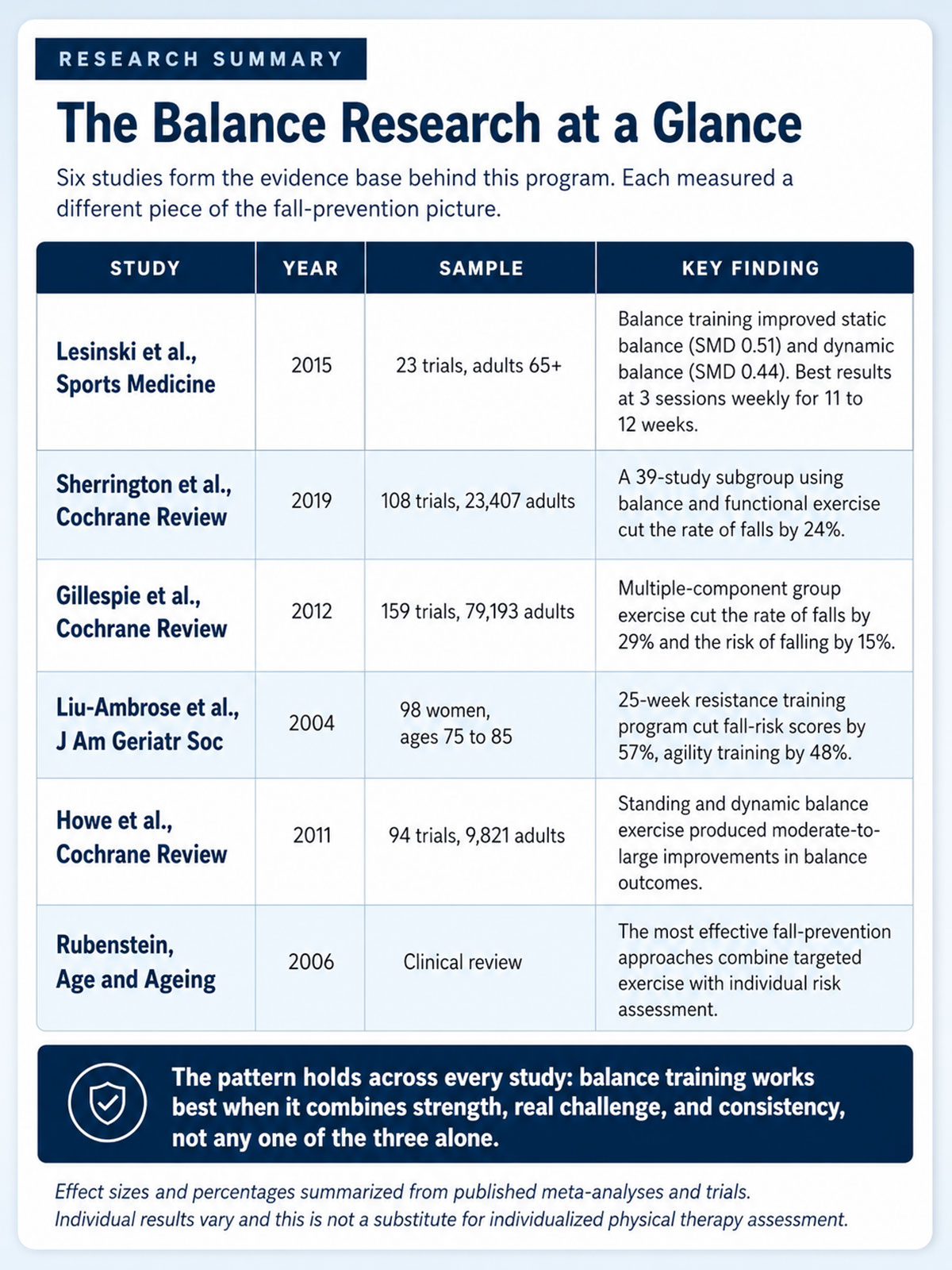
That finding took longer to pin down than you’d expect. Balance training works best when it’s frequent and specific, according to a 2015 review in Sports Medicine that pooled 23 controlled trials on adults over 65.
Training at least three times a week, for a period of roughly 11 to 12 weeks, produced the strongest gains. The effect on static balance, a standardized mean difference of 0.51, slightly outpaced the effect on dynamic balance at 0.44, which suggests the two really do respond to separate kinds of practice.
There’s a catch. The exercise has to be hard enough to matter.
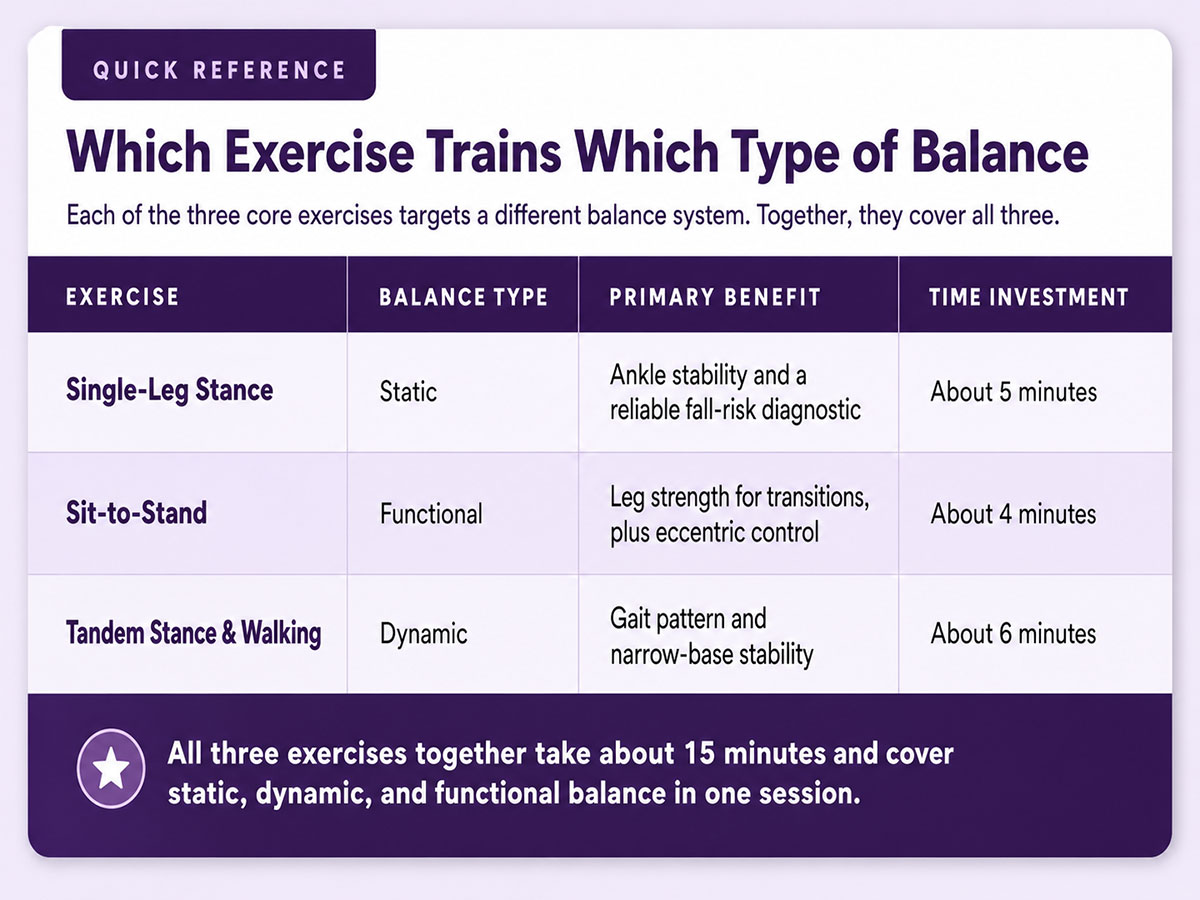
Physical therapists call this the balance challenge principle: safely stress the center of gravity, because too easy means no adaptation and too hard means quitting or getting hurt. Three exercises, chosen well, cover static, dynamic, and functional balance in about 15 minutes a session, three times a week.
What the Research Actually Shows
Researchers wanted to know which fall-prevention programs actually worked, not just which ones sounded reasonable. Two major reviews, both run through Cochrane’s evidence process, went looking for an answer.
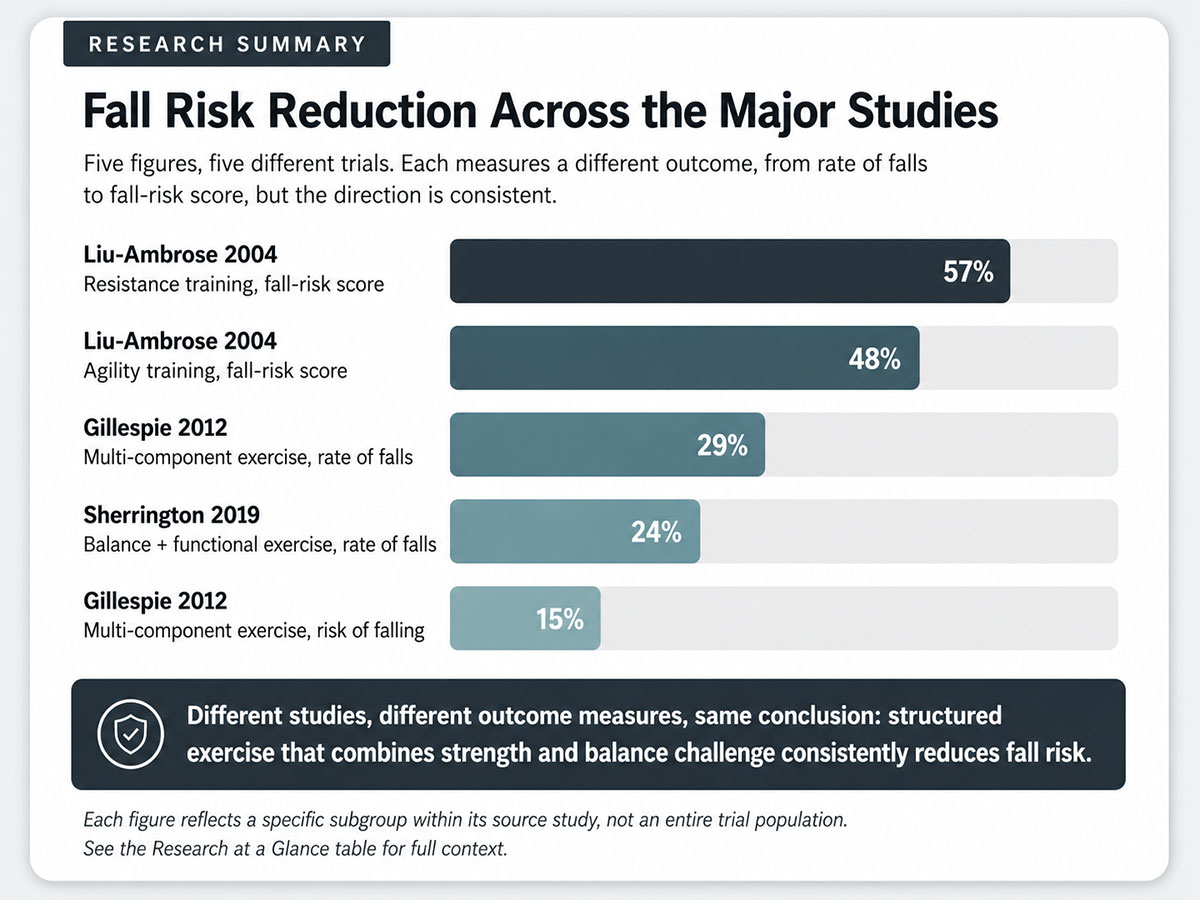
The larger of the two, led by Catherine Sherrington in 2019, pooled 108 trials and 23,407 older adults, the largest dataset on the subject to date. Within that pool, a 39-study subgroup using balance and functional exercises specifically reduced the rate of falls by 24%.
An earlier 2012 Cochrane review led by Lesley Gillespie, covering 159 trials and more than 79,000 participants, found something similar within its own exercise subgroup: multiple-component group programs that combined strength and balance work cut the rate of falls by 29% and lowered the risk of falling at all by 15%.
Different reviews, different subgroups, same direction. Programs that combine strength with balance challenge outperform anything that trains only one or the other.
One trial makes the case at the individual level. Teresa Liu-Ambrose spent six months following 98 women in their late seventies and eighties through group resistance and agility training, part of a broader look at fall risk in women with low bone mass.
By the end of the 25-week program, fall-risk scores had dropped 57% in the resistance training group and 48% in the agility group, driven mostly by improvements in postural sway and leg strength.
That’s the kind of effect size that changes how a clinic designs a program, not a rounding error in a spreadsheet.
The Hidden Upside of Balance Work
Falls are the obvious reason to care about balance. They’re not the only one.
Improved posture tends to show up without anyone trying for it, since balance work strengthens the core muscles that support the spine. Better sports performance follows for the same reason: golf, tennis, and hiking all depend on a stable base. Many people also notice less back pain, since a more engaged core takes some of the strain off the lower back.
Ankle mobility tends to improve too. Single-leg work loosens joints that have gone stiff from years in supportive shoes.
There’s a cognitive angle researchers are still sorting out. Balance training demands real concentration, and some evidence links it to sharper attention and faster reaction time. Nobody has fully mapped why a leg exercise would sharpen a mental one, and the honest answer is that this connection isn’t settled science yet.
Test Your Balance in 60 Seconds
Before starting anything, it helps to know where you stand. Four quick questions do most of the work.
Try standing on one leg for 10 seconds, using a fingertip on a chair if needed. Stand up from a dining chair with arms crossed, no hands.
Walk heel-to-toe for 10 steps along a wall. And be honest about whether you’ve fallen in the past year, even a fall that didn’t hurt.
Answer the first three questions confidently, and say no to the falls question, and baseline balance is solid enough to start at Level 1 across all three exercises below. Answer one or two confidently and progress will be slower but still real. Struggle with most of them, or answer yes to the falls question, and the right first step is a conversation with a physical therapist before anything else.
Balance Assessment Calculator
Answer 4 quick questions to get your score and a starting point for each exercise
Who This Program Fits
This program works well for adults over 50 who want to protect the balance they already have, people who’ve noticed small changes but haven’t fallen, and anyone rebuilding a baseline after a period of inactivity.
It needs modification for anyone with significant balance impairment, multiple recent falls, a neurological condition, or a recent lower-body surgery. A physical therapist can adjust the program for those situations far better than a general guide can.
Your 4-Week Training Plan
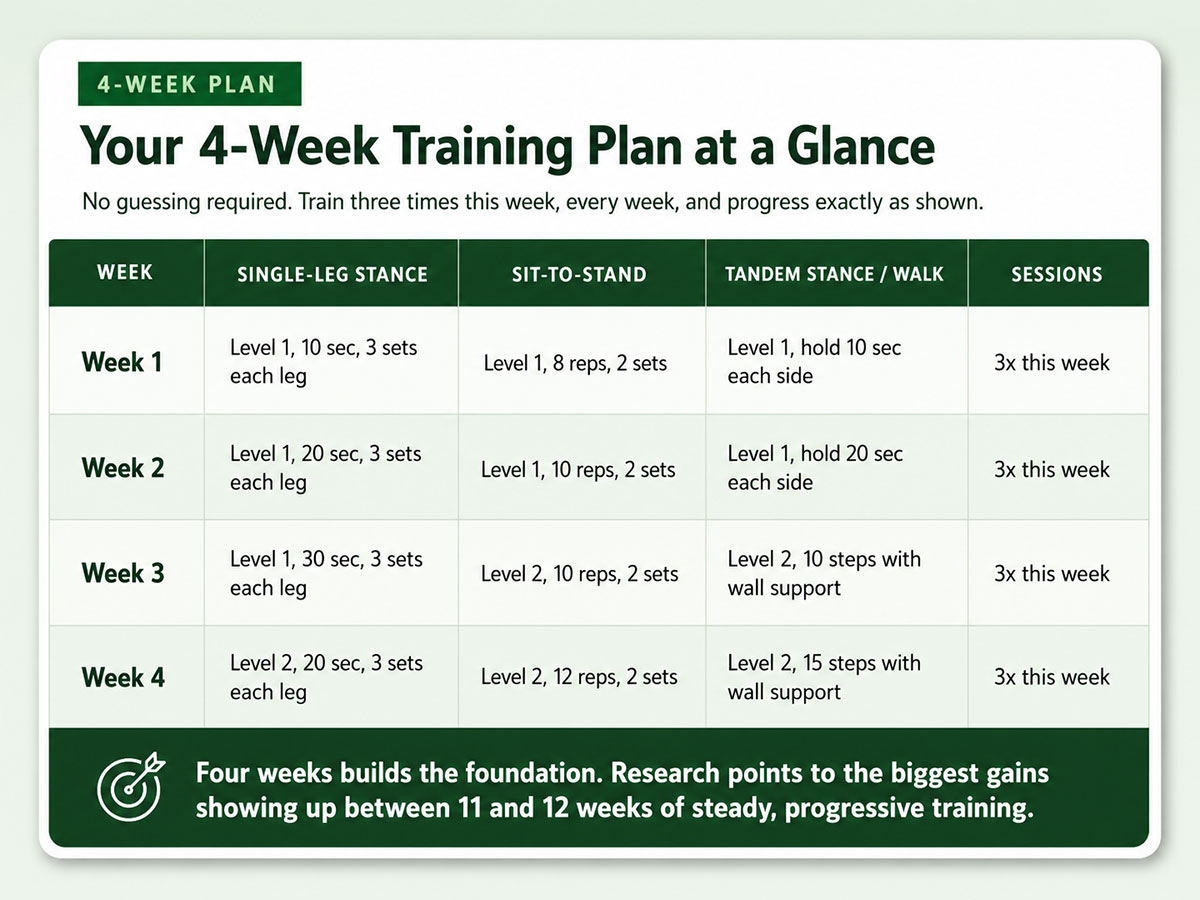
No guessing required. Here’s exactly what each week looks like.
Four weeks builds the foundation. The research points further out than that, though.
The same Sports Medicine review found the biggest gains came from programs running 11 to 12 weeks with steady progression, not from short bursts. Plan to keep going past week four rather than treating it as a finish line.
Exercise 1: The Single-Leg Stance
Stand on one foot right now. Ten seconds. Go ahead.
If it fell apart after three seconds, that’s useful information, not a failure. This one test tells physical therapists more about fall risk than almost anything else in a clinical assessment.
Why This Exercise Works
Single-leg stance is pure static balance. The ankle makes constant tiny adjustments, the core fires to hold the trunk upright, and the eyes, inner ear, and joints all feed information to the brain at once.
People who can’t hold this position for at least 20 seconds carry a measurably higher fall risk. The good news is that this responds quickly to training. A 2011 Cochrane review by Tracey Howe’s team, pooling 94 trials and nearly 9,800 older adults, found standing balance work produced moderate-to-large improvements in balance outcomes, a range clinicians generally consider clinically meaningful.
How to Do It
- Stand near a sturdy chair or counter with feet hip-width apart.
- Shift your weight onto one leg and rest just your fingertips on the chair for light support.
- Lift the other foot a few inches off the ground, keeping a slight bend in the standing knee.
- Fix your gaze on a spot on the wall, not the floor, and hold for 10 seconds, breathing normally.
- Lower slowly and repeat for three sets on each leg.
What to Expect in Your First Week
Day one often lands at five seconds, not ten, and that’s normal. By the third session, most people notice the ankle shaking less. Week two usually brings ten seconds within reach with less pressure through the fingertips.
That speed of change comes down to neuroplasticity, new neural pathways forming in response to a new demand. It’s a faster process than most people expect from something as unglamorous as standing still.
Your Progression Path
Level 1: fingertip support, 10 to 30 seconds, at least two weeks or six sessions before moving on.
Level 2: no hands, same timing, usually two to three weeks to build a steady 30-second hold.
Level 3: standing on a folded towel or foam pad, which forces the ankle to work harder and trains proprioception, the body’s sense of where it is in space. Three to four weeks to build from 10 to 30 seconds here.
Level 4: eyes closed, removing visual input entirely so the inner ear and joints carry the full load. Even trained athletes struggle with this one. Five seconds is a reasonable starting point.
Two weeks minimum per level. Some people need a month. That’s the nervous system adapting on its own schedule, not a sign of falling behind.
When to Progress
Three questions decide it: can three sets be completed without a break, has this level been trained for at least six sessions, and does it feel stable, not just survivable, through all three sets?
A no to any of them means one more week at the current level. A yes to all three means moving up.
The PT Secret
New clients tend to read an ankle wobble as failure, when the shake actually means the opposite: the balance system is problem-solving in real time, recruiting small stabilizer muscles that have gone dormant from years in supportive shoes. A stance that never wobbles usually isn’t being challenged enough to matter.
Exercise 2: The Sit-to-Stand
Most falls happen during transitions, not while standing still. Standing up from the couch, stepping off a curb, shifting from one position to the next: balance changes by the second during all of it.
Why This Exercise Works
Resistance training cut fall-risk scores by more than half in one closely watched trial of older women, the same Liu-Ambrose trial mentioned earlier, and sit-to-stand-style movements were a core part of what drove those numbers.
The quadriceps do most of the work getting the body up. The glutes finish the job by extending the hips.
The core keeps the torso from tipping forward, and the calves make the small ankle adjustments that stop a forward lean from becoming a stumble. All four systems have to fire in the right order, which is balance in action, even though the exercise looks like pure strength work.
Readers who want to build that core stability on its own can find a dedicated routine in our guide to core stabilization exercises.
The lowering phase matters as much as the standing phase, maybe more. Sitting down slowly builds eccentric strength, the kind of control that catches a stumble before it becomes a fall, and it’s a likely reason postural stability drove more of that trial’s effect than raw strength did.
How to Do It
- Sit on a sturdy dining chair with feet flat and knees at nearly 90 degrees, scooted slightly forward on the seat.
- Lean the torso forward a little to shift weight over the feet.
- Push through the heels to stand, avoiding the hands unless needed.
- Pause standing tall for a beat, then lower back down over a slow three-count instead of dropping into the seat.
- Complete 10 reps, rest 30 seconds, then repeat for a second set.
Your Progression Path
Level 1: Use the armrests for support.
Level 2: Cross the arms over the chest once that 10 reps feel manageable, no hands at all.
Level 3: Hover three seconds just above the seat before standing back up.
Level 4: Move to a lower chair or stool once Level 3 feels controlled.
Most people spend a week or two at each stage. The quads should burn on the way down, and that’s the muscle working, not a warning sign, as long as the knee itself stays pain-free.
Exercise 3: Tandem Stance and Walking
Real-world balance rarely happens while standing still. It happens in a crowded room, a narrow hallway, or the two feet of space between a coffee table and a couch.
Why This Exercise Works
Normal walking uses a stance several inches wide. Tandem stance narrows that to almost nothing, heel touching toe, which forces the core, hips, and ankles to work overtime to keep the body from tipping sideways.
That’s the same Howe review behind the single-leg stance numbers earlier, and it found that dynamic, gait-based balance work produced comparably strong improvements. It tracks: a narrowed base of support and a moving base of support both demand the same kind of active correction.
Shuffling gait is common in older adults, and it’s partly self-reinforcing. A shuffle keeps the feet low, which raises the odds of catching a toe on a rug edge or an uneven sidewalk.
Tandem walking retrains the pattern directly. It teaches deliberate foot placement instead of a low, dragging step.
How to Do It
- Stand near a wall, then place the right heel directly against the left toes, forming a straight line.
- Fix your gaze forward, not down, and hold for 10 seconds before switching feet.
- Once 30 seconds feels solid on each side, begin walking the same pattern, heel to toe, for 10 steps along an imagined line.
- Turn around and walk back. That’s one set. Complete three sets.
Your Progression Path
The four levels here move from a static hold, to walking with a hand on the wall, to walking unsupported with arms out for balance, to walking while turning the head left and right. That last stage asks the vestibular system, the inner ear’s balance organ, to recalibrate mid-step, which is a genuinely advanced skill.
Even experienced walkers slow down the first time they try it. Five steps is enough to start. The goal here is control, not speed, since the vestibular system is already juggling two demands at once.
The PT Secret
New students almost always look down at their feet, which makes the exercise harder, not easier. It shifts the balance load onto vision instead of the vestibular system that’s supposed to be doing the learning. Keeping the eyes up and letting the inner ear do the work is the entire point of the drill.
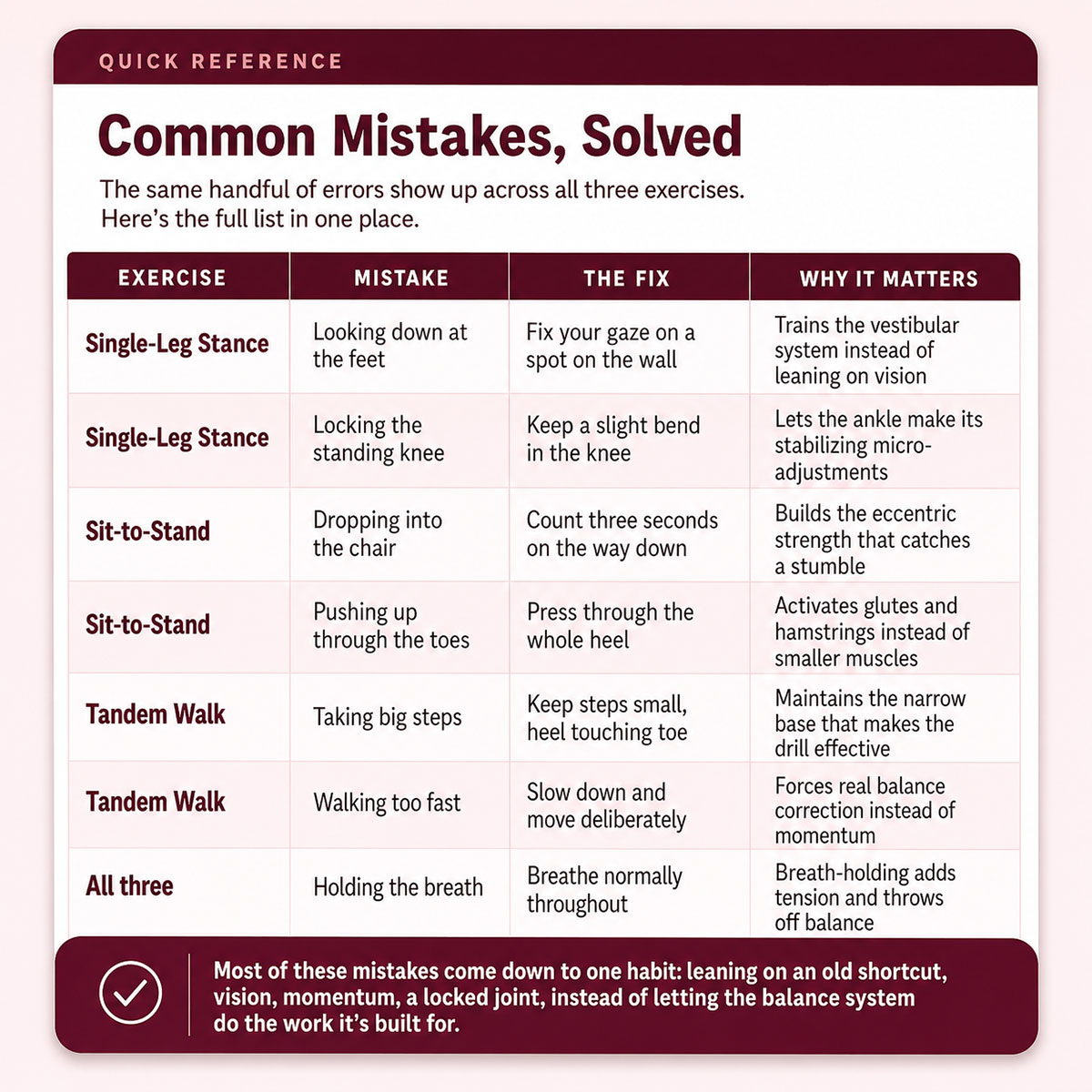
Common Mistakes, Solved
The same handful of errors show up across all three exercises. Rather than repeat them exercise by exercise, here’s the full list at a glance.
Two More Moves Worth Adding
The three exercises above cover static, dynamic, and functional balance on their own. Two more are worth folding in once the core routine feels manageable, mainly because they’re easy to do anywhere and reinforce what the main three are already training.
Heel-to-Toe Walk
- Stand at one end of an imaginary line, one foot in front of the other.
- Hold the arms out to the sides for balance.
- Walk the line for 10 to 15 steps, placing each heel directly against the opposite toes.
- Turn and repeat.
Calf Raises
- Stand with feet hip-width apart near a wall or counter for support if needed.
- Rise slowly onto the toes and hold for three seconds at the top.
- Lower with control over a slow three-count.
- Complete 10 to 15 reps for two sets.
Both moves take under two minutes and slot naturally into the warm-up or cool-down of the main routine.
Your Safe Start Checklist
These exercises suit generally healthy adults working on balance. They’re not a substitute for physical therapy after multiple falls, a neurological diagnosis, or recent surgery. A physical therapist should assess those situations individually.
Setup matters more than equipment. A corner with two walls nearby means there’s always something to catch a stumble. Clear about six feet of floor space, wear shoes with real grip or go barefoot, and keep good lighting, since some later progressions happen with eyes closed.
Nothing here requires a gym. A folded towel replaces a foam pad, a couch cushion doubles as an unstable surface, and a kitchen timer tracks hold times as well as any phone app.
Some symptoms warrant a doctor before a workout, not after. True spinning dizziness, as opposed to general unsteadiness, points toward an inner ear issue that needs evaluation. A sudden change in balance, as opposed to a gradual decline, can signal a stroke, a medication side effect, or an infection.
Numb feet suggest reduced sensation from something like diabetes-related neuropathy. Any fall within the past three months warrants a professional assessment before starting a home program.
A 2006 review by Laurence Rubenstein, one of the more widely cited papers on fall epidemiology, makes the broader case: the most effective fall-prevention approaches combine targeted exercise with individual risk assessment rather than relying on either alone. That’s the model this program follows, even in a simplified, at-home form. The American Physical Therapy Association’s guide to falls explains when that kind of individual assessment is worth scheduling.
Special Considerations
Osteoporosis: safe for all three exercises. Avoid jerky movements and lean on chair support liberally, since the bone stress from balance training actually helps maintain density.
Arthritis: a higher chair may be needed for sit-to-stand. Warm up stiff joints first with gentle ankle circles and knee bends.
Neuropathy: rely on visual and chair support since foot sensation is reduced, and work with a physical therapist on modifications.
Vertigo: get medical clearance first, start eyes-open only, and progress slowly.
Recent surgery: wait for doctor clearance and start at Level 1 regardless of prior fitness.
Heart conditions: these exercises are low-intensity, but check with a cardiologist first.
What a Sample Week Looks Like
Monday, Wednesday, and Friday carry the full 15-minute routine: a short warm-up, then all three exercises at the current level, with 30 seconds of rest between them. Tuesday and Thursday are full rest, not light exercise, since the nervous system does its consolidating during downtime rather than during another workout. Weekends can hold a walk or some stretching, nothing that taxes the legs enough to interfere with Monday.
Forty-eight hours between sessions turns out to be close to the sweet spot for this kind of adaptation, more a pattern the research keeps landing on than a rule that punishes deviation from it.
What to Expect, Month by Month
Month one brings mostly awareness: a clearer sense of where the wobble lives, hold times stretching by five to ten seconds, and less reliance on support.
Month two usually shows up as steadier daily movement, less hand-on-counter walking through the kitchen, and enough confidence to push into Level 2 or 3 progressions.
By month three, most people are noticeably more comfortable in the advanced levels, which lines up with research showing that programs running 12 weeks or longer produce the largest gains.
Balance Doesn’t Work Alone
Balance connects to more of the body than it gets credit for.
Bone health and balance reinforce each other. Weight-bearing balance work stresses bone the same way walking or hiking does, and that stress signals the body to maintain density rather than lose it. An old ankle sprain or knee injury leaves proprioception behind even after pain resolves, which is part of why these exercises show up in rehab programs long after the original injury has healed.
Certain medications complicate the picture too. Blood pressure drugs can cause lightheadedness on standing, and sedatives blunt coordination, so anyone on either should loop their doctor in before ramping up training intensity.
Vision plays a role that’s easy to overlook. Annual eye exams and an up-to-date prescription support balance as directly as any exercise does.
Footwear matters more than most people assume, too. Thick, cushioned soles blunt the sensory feedback the feet are supposed to be sending, which is part of why many physical therapists prefer barefoot training indoors when it’s safe to do so.
Consistency Wins Over Intensity
The instinct is to wait for a fall before taking balance seriously, the same way most people wait for a cavity before flossing. Physical therapists see the flaw in that logic every day. Balance decline is quiet right up until it isn’t, and by the time it announces itself on a curb or a bathmat, the easier window for fixing it has usually closed.
Three exercises, done consistently, don’t just prevent a future fall. They restore something that erodes slowly enough to go unnoticed: the confidence to reach for the top shelf, step off a curb, or walk on uneven ground without running a silent risk calculation first. That’s the part worth training for, long before there’s any reason to.
FAQs
What if I can’t lift my foot at all for the single-leg stance?
Start with a weight shift instead. Keep both feet down and shift 80% of your weight onto one leg for 10 seconds, feeling the pressure build in that leg. After a week of that, try lifting the foot an inch off the ground.
Can poor balance be restored?
In most cases, yes, and often faster than people expect, since the nervous system responds to new demands within weeks rather than months. The exception is balance loss tied to an underlying neurological or inner ear condition, where a physical therapist needs to identify the specific cause before a home program can help.
How do I know if I’m progressing too fast?
Complete three sets comfortably at the current level for at least five sessions before moving up. Feeling unstable or scared at any point is the signal to drop back one level rather than push through.
My knees hurt during sit-to-stand. What should I do?
Raise the seat height with stacked cushions to reduce knee bend, and try a slightly wider stance to change the angle at the knee joint.
How can I regain my balance in old age?
The same way it was built in the first place: through repeated, specific challenge. Age doesn’t remove the nervous system’s ability to adapt. It means the starting point is often lower, and the early progress can feel slower before it accelerates.
I feel dizzy when I close my eyes. Is that normal?
Mild unsteadiness is expected when visual input is removed. True spinning or nausea is not, and calls for a doctor’s evaluation rather than pushing through.
Can I do these exercises every day?
Three times a week is the research-backed sweet spot. More frequent training doesn’t speed results and tends to add fatigue instead.
How long until I see results?
Most people notice improvement within three to four weeks: steadier holds, less need for support, and more confidence in daily movement.
What if I miss a week of training?
Progress fades slowly, not all at once. Jump back in a level easier than where you left off and expect to catch up within a session or two.
Should I do these exercises if I’ve never fallen?
Yes. Prevention is easier than recovery, and these exercises maintain balance rather than waiting for a reason to rebuild it.